This article examines the effect of candidates’ local characteristics on their results in legislative elections. Previous research (Smith et al. Reference Smith, Pekkanen and Krauss2012; Tavits Reference Tavits2010) has shown that local-level political experience is a trait which has a significant effect on the number of preferential votes. This contribution adds to this research by focusing on the combined effect of local political office and the size of the candidate’s place of residence. We argue that the local office effect is dependent on the size of the municipality: the larger the municipality, the stronger the effect of local office on the number of preferential votes at the aggregate level. By analysing the impact of these two local background variables, we attempt to gain a better understanding of which candidates can build a personal reputation on the basis of their local ties, and to what extent this personal reputation secures their (re)election.
Our research builds on the growing literature about the local ties of a candidate as a crucial personal vote-earning attribute (PVEA). Earlier research has shown that having local ties increases a politician’s chances of being selected as a candidate (Gallagher Reference Gallagher1988). Other studies have focused on the effects of these attributes on legislative behaviour (Crisp et al. Reference Crisp, Escobar-Lemmon, Jones, Jones and Taylor-Robinson2004; Marangoni and Tronconi Reference Marangoni and Tronconi2011; Tavits Reference Tavits2009). They have shown that candidates and legislators with local personal vote-earning attributes are more likely to display constituency-oriented behaviour. But, most crucially, there is also convincing evidence that candidates can earn votes by emphasizing their local roots and their local political experience during the campaign. Candidates with local personal vote-earning attributes appear to obtain significantly more votes than candidates that do not have them. Moreover, holding local office is found to be a crucial attribute in that respect (Blais et al. Reference Blais, Gidengil, Dobrzynska, Nevitte and Nadeau2003; Smith et al. Reference Smith, Pekkanen and Krauss2012; Tavits Reference Tavits2010).
The hypothesis that the impact of local office on the electoral result depends on the size of the municipality will be tested with data on five consecutive federal and regional elections in Belgium. These elections are useful cases as they are held under a semi-open proportional or flexible list system (Marsh Reference Marsh1985; Shugart Reference Shugart2005). Recently, electoral reforms adapted both district magnitude and the relative weight of the party list vote, making the Belgian system more candidate centred. These two developments led to the increased importance of the personal versus party reputation: upgrading the impact of preferential votes created a stronger incentive for candidates to cultivate personal votes. In turn, this might lead Belgian parties to nominate more candidates with personal vote-earning attributes.
We first outline the main theoretical argument on the basis of the existing literature on the personal vote and develop a number of hypotheses. Subsequently, we discuss the recent reforms in the Belgian electoral system and their consequences. The next section elaborates on the data set of personal characteristics of Belgian/Flemish election candidates, the variable operationalization and the method used. In the fifth section, we discuss the results of the multilevel analyses. Finally, the conclusion puts the implications of this study in theoretical perspective.
Theoretical Arguments and Hypotheses
As originally argued by Carey and Shugart (Reference Carey and Shugart1995), the importance of the personal vote depends heavily on the electoral system type and how votes are cast. More specifically, ballot and vote type, vote pooling and district magnitude determine whether the electoral system is more party or candidate centred. In party-centred electoral systems, politicians are inclined to display the party label during campaigns and cultivate party votes. In candidate-centred systems, however, it is more important for candidates to cultivate personal votes and to build personal reputations. Some authors claim that in the latter category of electoral systems the political party is being replaced by the individual candidate as the primary criterion of choice (van Holsteyn and Andeweg Reference van Holsteyn and Andeweg2010). Candidates will increasingly display personal vote-seeking behaviour to cultivate personal votes. This implies that parties will have more difficulties in maintaining internal cohesion, and that voters are increasingly influenced more by candidate-based attributes than party-based attributes (Thijssen Reference Thijssen2013).
One strand of research on the personal vote has focused on how candidates or legislators cultivate personal votes, and how they build personal reputations that increase their chances of re-election. Legislators could, for example, engage in constituency service or pork barrel politics to please their constituents (Lancaster and Patterson Reference Lancaster and Patterson1990; Mayhew Reference Mayhew1974). In addition, some authors claim that specific personal characteristics of legislators allow them to earn personal votes, reducing the need to cultivate personal votes by means of constituency service (Martin Reference Martin2010; Shugart et al. Reference Shugart, Valdini and Suominen2005). The literature provides several examples of these so-called personal vote-earning attributes. Voters use these attributes as an information shortcut in their voting decisions, resulting in significantly more personal votes for this type of candidates.
First, the gender, class, race and religion of candidates possibly attracts personal votes from the candidates’ respective subgroups in society. Ethnic voters might, for example, feel that their concerns will be addressed by the party that includes candidates from their own ethnic background on their list. As a result, the inclusion of candidates from all social groups is an easy way for party selectorates to broaden the appeal of their list to a larger group of voters. However, in some electoral systems party selectorates might feel that candidate diversity on lists is undesirable (Valdini Reference Valdini2012). Especially in single member district systems, selectorates fear that candidates with other ethnic backgrounds or with a very specific religious profile will harm their electoral fortune.
Secondly, another category of candidate characteristics are universally interesting and appealing, regardless of the electoral system, such as previous electoral and political experience, and local roots. The incumbency advantage, for example, has been extensively documented in the literature (Carson et al. Reference Carson, Engstrom and Roberts2007; Cox and Katz Reference Cox and Katz1996; Gelman and King Reference Gelman and King1990). Incumbents have already proven their electoral appeal in the previous election. Their office also provided them with ample media attention and visibility, as well as an organizational capacity which can be relied on during the campaign. The fact that incumbent candidates have some previous experience in what they are running for might especially shape voters’ ballot decisions and attract additional personal votes. In addition, the possession of local roots in the electoral district is also a universally appealing candidate trait. Candidates with these characteristics, often referred to as local personal vote-earning attributes, can make a more convincing claim that they are well aware of local constituency needs. As a consequence, one expects candidates with local personal vote-earning attributes to be electorally more successful than competitors without local roots. Tavits (Reference Tavits2010) provides the most thorough and systematic empirical test of this assumption on the basis of data on national election candidates from Estonia.
In that study, local political experience and being a native of the district are used as indicators of local ties. The first measure appears to be an adequate predictor of individual candidate performance. There are several reasons why local office-holders would have significantly more electoral appeal. First, holding local office leads to a level of name recognition among the electorate. Second, local office-holders might have done some casework for (influential) members of the community, thereby proving their commitment to the local needs and strengthening their local networks. And third, as previously mentioned, local councillors, aldermen and mayors are generally more convincing in their claims to know what the local community wants.
The political experience at the local level has thus been recognized as a reliable indicator of local ties. Holding political office in the municipality has already been shown to constitute a useful measure of local ties and appears to be an electorally rewarding personal attribute for candidates. Hence the first hypothesis:
Hypothesis 1: Candidates who hold a political office at the local level are likely to be more successful in terms of preferential votes than candidates who do not.
According to previous research, holding local office is an important asset in parliamentary elections. Moreover, this effect increases with the prominence of the office. It is particularly the executive functions in the municipality which provide an electoral bonus for candidates in national elections.
The second measure used in the analysis of Tavits (Reference Tavits2010), however, lacks explanatory power. Being a district native failed to have any substantial effect on the individual candidate results. A second relevant study also uses local birth as one of three components in their personal vote-earning attribute index and comes to a similar conclusion when testing the effect of the local personal vote-earning attribute on candidate success: locally born candidates are not more likely to get elected than candidates lacking such ties (Smith et al. Reference Smith, Pekkanen and Krauss2012).
There are several reasons why district nativity or local birthplace might not be a good predictor of candidate success. Perhaps that a candidate was born in a particular district or municipality is not important to voters at all. It might only be a weak proof of local ties, and is far less salient than being a local politician. As Tavits (Reference Tavits2010: 226) correctly states: ‘Birthplace may not convey any meaningful information about a candidate who has lived most of their adult life elsewhere.’ Indeed, even the parachutists – that is, candidates from outside the district nominated and elected in their new constituency (Pedersen et al. Reference Pedersen, Kjaer and Eliassen2007) – might be able to develop local ties in their new district, making their place of birth totally irrelevant for their new voters. Moreover, the birthplace of candidates is not always very well known to the electorate.
In the present research, we focus on municipality size instead of birthplace. We hypothesize that the municipality size is an important variable which moderates the effect of local roots on the individual result of election candidates at the aggregate level.Footnote 1 Candidates can capitalize on their knowledge of the local needs and sensibilities, and on the local political network they have developed in the municipality. This will increase their vote in the municipality. But it is only when the municipality is sufficiently large relative to the constituency as a whole that this effect will also translate into a significantly better electoral result at the constituency level. In other words, candidates living in relatively large municipalities will have an advantage over candidates from smaller municipalities. This leads to the following hypothesis:
Hypothesis 2: The larger the population share of the candidate’s municipality in the electoral district, the higher the relative number of preferential votes for that candidate.
Additionally, we argue that municipality size will interact positively with the political office variable: the larger the municipality, the larger the effect on the number of preferential votes at the municipality level. This is so for two reasons. First, holding local political office in a large city leads to a comparatively larger local network than in a small municipality, both in terms of grassroots party volunteers and constituents. Activating this network in parliamentary elections would then result in a higher level of electoral success compared with local office-holders in small municipalities. Second, the electoral appeal of holding a local office is larger for election candidates in large municipalities, simply because they appeal to a larger group of constituents than their colleagues in small municipalities. There are substantially more inhabitants who feel that they share their local background with the candidate and perceive them as truly committed to the needs of the local community.
We acknowledge that, on the basis of the political geography literature, one might arrive at the opposite hypothesis. According to this literature, the social distance between constituents and local representatives is substantially larger in cities than in the less densely populated areas: smaller municipalities provide the opportunity for greater levels of contact, peer networks and knowledge of the representatives (Lewis-Beck and Rice Reference Lewis-Beck and Rice1983). Also, local attachment in urbanized areas is often comparatively weaker (Sampson Reference Sampson1988). According to this reasoning, the effect of local office will decrease if the candidate lives in a larger municipality. However, we believe that the aforementioned positive effect of living in a larger municipality will outweigh these possible negative effects. This implies that local office-holders in large cities have a structural advantage, and that the size of their place of residence functions as a personal vote multiplier, reinforcing the positive effect of holding local political office.
In other words, however popular the mayor of a village may be, if the population of that village is small, the electoral effect in terms of individual preferential votes at the aggregate constituency level will be relatively smaller than the effect for local office-holders in large municipalities. This leads to a third hypothesis:
Hypothesis 3: Candidates who are local political office-holders in large municipalities are likely to be more successful than similar candidates in small municipalities.
The Electoral System of Belgium
The Belgian electoral system is often characterized as a semi-open or flexible-list proportional representation system (Marsh Reference Marsh1985; Shugart Reference Shugart2005). In such a system, voters are able to endorse a party list as a whole or to cast one or more preferential votes for specific candidates. In theory, both the list order and the number of preferential votes play an important role in intraparty seat allocation. In practice, however, the threshold of preferential votes to overcome the list order is reached very infrequently, which led scholars to characterize flexible-list systems as closed-list systems in disguise (De Winter Reference De Winter2005; Crisp et al. Reference Crisp, Olivella, Malecki and Sher2013). In recent years, the Belgian system has undergone a number of important electoral reforms. In the remainder of this section, we briefly discuss these reforms and their impact on the personal vote-seeking behaviour of party candidates.
First, the relative weight of the list vote in determining which candidates are elected was changed. The impact of the preferential votes on the actual allocation of seats used to be very marginal. This was so because the votes at the head of the list, the so-called list votes, were first transferred to the candidates in the order of their position on the list. As a consequence, the candidates at the top of the list were almost guaranteed their seat and the intra-list competition between candidates was to a certain extent neutralized. Thus, the system effectively functioned as a closed-list system, the allocation of seats to candidates being determined in large part by pre-electoral intra-party bargaining. In 2000, the electoral law was changed so that the transferral of list votes was reduced by half. This implies that the number of candidates that can be elected on the basis of list votes is reduced and intra-list competition between candidates has become more important (Wauters and Weekers Reference Wauters and Weekers2008). This resulted in a larger share of candidates leap-frogging past higher-ranked co-partisans (Wauters et al. Reference Wauters, Weekers and Pilet2004).
Second, the mean district magnitude in Belgium has increased significantly over the last two decades. The two district reforms of 1993 and 2002 also led to more intra-list competition between candidates and thus encourage candidates to maximize their personal score. This second district reform was relatively controversial and has been debated extensively in the Belgian political arena. Opponents feared that the enlargement of electoral districts would lead to an increased nationalization of election campaigns and scores, rendering the local ties of candidates unimportant (Pilet Reference Pilet2007). In addition, it was argued that it would become increasingly difficult for rural candidates to gain campaign visibility, or even to be nominated on candidate lists (Maddens et al. Reference Maddens, Put and Smulders2014).
Both the increase in district magnitude and the decreased relative weight of list votes resulted in a more transparent system, in which it is easier for the voter to understand how seats are allocated to parties and candidates. At the same time, these reforms strengthened the tendency towards more candidate-centred campaigns, with a strong focus on the competition between individual candidates, both between and within lists (De Winter Reference De Winter2005). This focus on candidates is reflected in the voting behaviour. The percentage of voters casting a preferential vote increased substantially during the previous decade. André et al. (Reference André, Wauters and Pilet2012) calculated that more than 60 per cent of Belgian voters cast a preferential vote in the federal elections of 2003, with a slight decline at the subsequent federal elections. Moreover, they find comparable percentages for the 2009 Flemish and Walloon elections.
The fact that local ties are important in the Belgian system is also reflected by the relatively high share of candidates holding local office who have been selected by the Flemish parties for the federal and regional elections since 2003. Taken together, 50.4 per cent of all the candidates are incumbent local office-holders. Most of these candidates (65.9 per cent) are members of the local council. Furthermore, 34.1 per cent are members of the executive, of which 23 per cent are aldermen (a member of the executive body) and 11.1 per cent are mayors (the head of the executive body). Previous research has shown that these local office-holders, particularly the mayors, are also more likely to be selected as realistic candidates – that is, a candidate who has a realistic chance of obtaining a seat (Put and Maddens Reference Put and Maddens2013).
Data and Method
The data cover the elections for the federal House of Representatives and the Flemish Parliament during the period 2003–10. The analysis is limited to the Flemish parties that already had at least one seat in one of the Belgian parliaments during the legislative term preceding the election under investigation.Footnote 2 This results in a vast data set of 5,540 election candidatesFootnote 3 on 179 different party lists.
There are substantial reasons why we do not expect to see differences between the elections to the House of Representatives and the Flemish Parliament. In the Flemish part of the country, since 2003 the elections both take place in provincial constituencies. Moreover, Belgium has the peculiar feature of having two completely separate regional party systems in Flanders and Wallonia, which implies that the parties competing with each other on the federal and regional level are exactly the same (Verleden Reference Verleden2009). As already mentioned, the number of local office-holders among the candidates for both assemblies is also comparable. In addition, the fact that there is a relatively high degree of level-hopping in the Belgian political arena proves that politicians themselves rate the federal and regional level as relatively equal (Vanlangenakker et al. Reference Vanlangenakker, Maddens and Put2013).
Alternatively, a counterargument might be that local policy issues are more salient in regional elections, as the regions have the legislative powers with regard to local matters. More specifically, candidates for the regional assembly might stress local issues more strongly than their counterparts at the federal level, resulting in the local personal vote-earning attribute having a stronger impact in regional elections. We add a dummy variable to the model indicating whether the candidate stands in the federal or the regional election, and test whether there is an interaction effect with local office and municipality size.
We will apply a multilevel analysis when testing the three hypotheses. First, these election data have a nested structure. In the Belgian flexible-list system, each individual election candidate is placed on a party list among other candidates. These lists all have their own characteristics and constitute an additional explanatory level for the individual number of preferential votes. Second, we expect some of the aggregate characteristics of these party lists to contribute to the electoral success of individual candidates. More specifically, the percentage of votes for the list in the constituency will automatically have a positive effect on the number of preferential votes of every candidate on that particular list. As a result, it is appropriate to apply a multilevel analysis. Classic regression models would not take the possible correlations within party lists into account, resulting in inaccurately estimated parameters. Multilevel analysis allows the intra-class correlation and the variance between party lists to be taken into account.
The dependent variable is the percentage of preferential votes for the candidate, calculated on the basis of the total number of valid votes in the constituency.Footnote 4 As this variable is highly skewed and values are all positive, it is advisable to apply a logarithmic transformation.Footnote 5 This transformation overemphasizes differences between candidates in the low range of preferential votes and underemphasizes differences among candidates in the high range, which we see as an additional argument rather than a problem: we wish to explain significant differences in numbers of preferential votes among a large group of candidates, by testing the effect of a number of political and socioeconomic candidate traits. For candidates in the high range, there are often idiosyncratic factors at work, which might explain their unusually high numbers of preferential votes, but are less interesting in explaining the variation in preferential votes for a large number of election candidates.Footnote 6
Of course, transforming the dependent variable often makes it more difficult to interpret the meaning of the beta coefficients of regression models. In addition, our data set contains a number of variables that measure on completely different scales. To make the estimated beta coefficients of the independent variables at least comparable in terms of scale and size of the effects, we standardized the continuous variables included in the analysis.Footnote 7 Categorical variables are not standardized as there is no meaningful interpretation for their standardized coefficients.
In sum, we disentangle three groups of independent variables. First, it is important to control for some mechanical effects. At the individual level, the electoral result is in large part determined by the position on the list. It has been shown that candidates in critical positions on the ballot form automatically draw more votes, even when other factors such as incumbency are controlled for (Geys and Heyndels Reference Geys and Heyndels2003). There are several explanations for this phenomenon, such as the fact that voters are inclined to start evaluating candidates from the top of the ballot and are decreasingly capable, willing or interested to consider options as they move down the ballot (Lutz Reference Lutz2010; Taebel Reference Taebel1975). Furthermore, undecided voters tend to give preferential votes to candidates who appear at the top of the ballot list (Miller and Krosnick Reference Miller and Krosnick1998). High positions on the list also imply higher campaign spending caps, which give the candidates more leeway to wage an extensive campaign. The main critical positions are those at the top and the bottom of the list. We include the first five positions, the penultimate and the last position on the list as dummies in our analysis, with the other positions as a reference category.
Second, at the list level, the party strength (the number of votes for the list as a percentage of the total number of valid votes in the constituency) is a crucial variable that has an automatic effect on the electoral result at the individual level: the more votes the list obtains in the constituency, the larger the potential number of preferential votes available for the candidates on the list. The second list-level variable is the election type, measured as a binary variable indicating whether the candidate list is for the federal or regional elections. The interaction of this variable with local office and municipality size will indicate whether there are any substantial differences between the effects of the local personal vote-earning attribute in regional and federal elections.
The third group of independent variables are the candidate characteristics. We collected information about the age, occupational status and sex of candidates. Six categories of occupational status are distinguished: (1) candidates without a job; (2) self-employed candidates; (3) workers; (4) employees; (5) civil servants; and (6) party professionals or members of the personal staff of a minister. In addition to a binary variable expressing the sex of the candidate, we add a dummy variable to indicate the first female candidate on the list. Previous research has demonstrated that ‘gender voters’ are highly selective and tend to vote for those women candidates who occupy the best ballot position (Thijssen Reference Thijssen2013).Footnote 8
Candidates can also increase their votes by waging an extensive electoral campaign. A number of authors have examined the effect of several campaigning variables on the amount of preferential votes. First, media exposure and electoral success are often considered as going hand in hand (van Aelst et al. Reference van Aelst, Maddens, Noppe and Fiers2008). Previous research has indeed confirmed that media attention contributes to the individual success of candidates (Maddens et al. Reference Maddens, Wauters, Noppe and Fiers2006). Second, there has been a recent surge in attention for the political impact of social media campaigns (Spierings and Jacobs Reference Spierings and Jacobs2013). Third, the amplitude of a candidate’s election campaign can also be measured by his/her level of campaign spending. We collected data on the personal investment of each of the 5,540 candidates in our data set and added it as a control variable to the multivariate analysis. It can be assumed that the relationship between expenses and electoral outcome is non-linear, in the sense that the marginal returns of spending will gradually decrease with the amount spent. To allow for this possibility the normal practice in campaign expense research is to also include the squared expenses in the regression model. The squared spending term is expected to have a negative coefficient (for example, Palda Reference Palda1994; Samuels Reference Samuels2001).
We also registered whether the candidates have previously been ministers or MPs at any given point in their career. Self-evidently, former ministers and MPs are highly attractive candidates and their level of political experience will result in a substantially higher number of preferential votes. By controlling for the former offices of electoral candidates, we exclude the possibility that the apparent positive effect of their local office is actually caused by their previous experience at the regional or national level. To the extent that local office-holders in large municipalities used to be prominent figures at a higher political level, their electoral success might not be due to their local personal vote-earning attribute, but rather to their national reputation built up during an earlier stage of the political career. These former-office variables are expected to have high explanatory power in our multilevel models. A former MP/minister is defined as a candidate who has already been MP or minister before the election, at either the regional, federal or European level. To avoid multicollinearity between these two binary independent variables, we include them as mutually exclusive variables: a candidate with previous experience as both a minister and MP will only be registered as a former minister.
More important for this study, we take into account local-level incumbency, in particular whether a candidate currently holds office as either mayor, alderman or member of the local council. As explained above, we will also investigate whether the effect of holding local political office interacts with municipality size – that is, the population size of the candidate’s place of residence.
Multilevel Analysis
We test two multilevel regression models to address the three hypotheses formulated earlier in this article. The first model includes the mechanical effects that function as control variables, and the candidate characteristics, which include local political office and relative municipality size. The results of this first analysis indicate whether Hypothesis 1 and Hypothesis 2 hold true on the basis of our data on the Belgian case. The second model adds the interaction effects between these two local personal vote-earning attributes, which allows us to test Hypothesis 3.
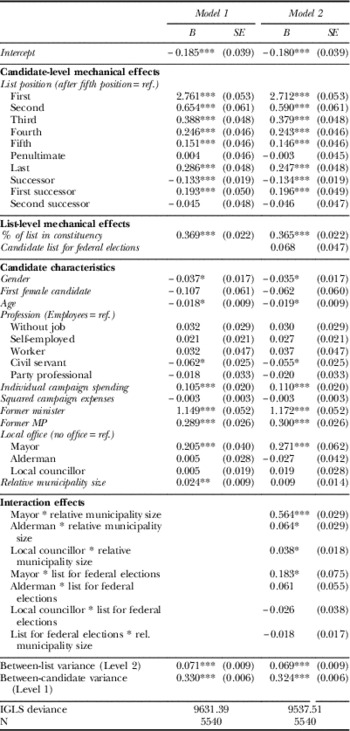
Table 1 reports the results of these two multilevel models. The size and sign of these beta coefficients indicate the change in the dependent variable (standardized logged preferential votes of candidates). With regard to Model 1, it can be observed that both the candidate-level and list-level mechanical effects have the expected strong impact on the relative number of preferential votes for individual candidates. Concerning list position, the size of the coefficients decreases neatly, which confirms that the visible positions at the top of the list are electorally far more attractive. In addition, the results show that the last candidates in the list (known as the ‘list pusher’ position, a position that is highly visible and relatively popular in Belgian elections) enjoy an electoral advantage (+0.29) compared with the less visible positions in the middle of the list. In general, successor candidatesFootnote 9 obtain significantly fewer preferential votes compared with the reference category (−0.13). At the list level, the electoral strength obviously has a significant effect on the percentage of preferential votes for individual candidates (+0.37).
Beta Coefficients and Standard Errors of Two Random Intercept Fixed Slope Models with Log(% preferential votes) as Dependent Variable

Note: *p<0.05; **p<0.01; ***p<0.001.
No fewer than four individual-level social background variables included in the model have a significant effect. Controlling for list position and political office variables, there seems to be a small difference in the number of preferential votes for men and women. The results of Model 1 point in the direction of a disadvantage for male candidates compared with their female counterparts. It is often the case that women candidates are disadvantaged by some other factors. For instance, previous research has shown that women generally occupy a lower position on the list, are less often the incumbent or spend less than men. Once such disadvantages are controlled for, the negative effect for women disappears, or is sometimes even reversed (Wauters et al. Reference Wauters, Weekers and Maddens2010). Being the first female candidate on the list does not yield an electoral bonus, according to our data. Age, operationalized as a continuous variable, has a significant but negligibly small effect on the number of preferential votes, in the sense that older candidates will on average receive fewer votes.Footnote 10 Profession also has an effect in the sense that candidates working as civil servants have a small electoral disadvantage (−0.06) compared with the reference category of employees. Finally, the individual campaign spending variable proves that personal investments in campaigning significantly increase a candidate’s preferential votes (+0.11). The squared expenses variable has the expected negative sign, but it does not have a significant effect.
Model 1 also includes the size of the candidate’s municipality, measured as the population share of the municipality in the constituency. The results indicate that this attribute in itself increases the candidate’s preferential votes, albeit rather modestly (+0.02). Model 1 suggests that the electoral success of individual party candidates is positively influenced by the relative size of their municipality in the constituency, which is in line with the second hypothesis.
The first hypothesis, however, is only partially confirmed. Only the highest local office significantly increases the relative number of preferential votes for individual candidates. The large effect of being mayor (+0.21) contrasts with the other two types of local office, alderman and local councillor. Apparently, these local political functions do not generate any additional personal votes. It seems that the mayors capitalize on their prior local experience and eclipse the other types of local office. Nevertheless, these effects of local ties are dwarfed by the effect of being a former minister (+1.15). But the electoral advantage of being a former MP (+0.29) is more or less comparable to the effect of being a mayor. The final rows in the table report the level 1 (between candidates) and level 2 (between lists) variance. At both levels, there is still some significant variance to be explained, especially at the candidate level. The IGLS deviance is a measure that allows us to compare the goodness of fit of the multilevel model. The lower the score, the better the fit.
In Model 2, we add the interaction terms for each of the local offices and relative municipality size. If Hypothesis 3 holds true, all three interactions should have a significant and positive effect on the dependent variable. This appears to be the case, but the level of significance varies strongly over the type of local office. For mayors, there is a large interaction effect (+0.56) which is significant at the level of α=0.001. Concerning aldermen and local councillors, this effect is considerably smaller and significant at the level of α=0.05. Adding the interaction terms has strengthened the main effect of being a mayor. At the same time, this made the significant main effect of municipality size, which was present in Model 1, disappear. Additionally, we added the interaction terms for the local offices and election type. Only the interaction term with mayors is significant, but it has a positive sign. Earlier, we argued that the local personal vote-earning attribute might have a stronger effect in regional elections as the regions are competent for local matters. The data do not support this argument: on the contrary, mayors seem to receive an even stronger bonus at the federal level. Finally, the interaction term of municipality size and election type is also not significant.
In sum, these results suggest that the local office of mayor in itself generates a large electoral advantage compared with election candidates without any local office, or other types of local office-holders. In addition, the electoral asset of being a mayor increases significantly with municipality size. The larger the municipality of the mayor, the stronger his/her advantage in terms of preferential votes. Second, the local office of alderman and local councillor is not rewarding in itself. In other words, Hypothesis 1 only holds for the office of mayor. This does not mean that holding a less important office is not electorally rewarding, but this effect is limited to the office-holders from the larger municipalities, as indicated by the significant interaction effect. For the office of mayor, both the main effect and the interaction with municipality size are significant. Hence, Hypothesis 3 is confirmed. Once the interactions between office and municipality size are included in the model, the main effect of municipality size disappears. Thus, Hypothesis 2 has to be rejected. Municipality size only affects the number of preferential votes of local office-holders through the interaction terms with the type of local office. The argument that large city candidates appeal to a larger share of voters in the district on the basis of a shared local background does not hold true according to our data. This logic only works for local office-holders, whose electoral advantage appears strongly dependent on the size of their municipality.
Conclusion
This study has examined the impact of local ties on electoral success in the case of the Belgian House elections and Flemish regional elections. We argued that local birthplace, which is frequently used in existing research, is not a suitable indicator of local ties. Instead, we operationalized the local ties of a candidate on the basis of the political functions he/she occupies in the municipality, moderated by the size of their respective municipalities.
Our multilevel analyses lead to three findings. First, the idea that holding political office at the local level is an important personal vote-earning attribute for party candidates only counts for mayors in our analysis. To our knowledge, previous studies did not make the distinction between various types of local office. However, our research shows that the effect depends on the nature of the local office, and that it is thus crucial to distinguish between, for instance, mayors and local councillors. Second, while the relative size of a candidate’s place of residence in the electoral district originally also determined the number of preferential votes, this effect disappeared when we added the interaction terms with local offices. The advantage of living in a large municipality is only substantial for election candidates when they hold a local office in their place of residence. If this is the case, these election candidates seem to appeal to a larger group of voters in the district. This brings us to the third and final finding: the effects of holding political office at the local level and municipality size interact. The electoral advantage of being a mayor, alderman or local councillor increases with the relative size of the municipality in the district.
While Belgium is, of course, a case with notoriously complex territorial and electoral dynamics, we believe that the results of these analyses can, to a certain extent, be generalized to other flexible-list systems, and even other types of list proportional representation systems with the possibility of casting preferential votes. The finding that local political experience leads to significantly more preferential votes has previously been confirmed in a latent list system such as Estonia, and the parallel system of Japan. As the data on the Belgian flexible list system point in the same direction with regard to mayors, we might conclude that local political experience is a candidate trait crucial to attract personal votes in any system where voters are able to cast preferential votes. And even if it is the case in most flexible-list systems that the number of votes cast for individual candidates almost never attains the threshold required to obtain a seat, candidates do seem to earn increasingly more individual-level preferential votes, because parties reward vote-earning candidates with better list positions in the future (Crisp et al. Reference Crisp, Olivella, Malecki and Sher2013). Earning personal votes is important for one’s political career, irrespective of the extent to which the odds of obtaining a seat are dependent on the number of preferential votes.
The interaction with municipality size indicates that the group of voters which can be persuaded by the candidate having prior local political experience is to a certain extent geographically bounded. On the basis of these results, we cannot say whether these boundaries coincide with the municipality boundaries. A more detailed analysis, including the individual candidate results per municipality or even neighbourhood within the constituency boundaries, could provide us with more insight into the geographical boundedness of local office-holders’ electoral appeal. Unfortunately, these data are not available for Belgian elections.
Finally, it would be interesting to investigate whether the established effects of local ties in previous studies are also dependent on the size of candidates’ localities. With regard to local political experience, this future research will also have to take into account that, according to our findings, it is crucial to distinguish between the various types of political office at the local level.
Acknowledgements
A previous version of this article was presented at the 12th Dutch–Belgian Political Science Conference in Ghent. The authors would like to thank all participants for their insights and comments. Furthermore, we thank the anonymous reviewers of Government and Opposition for their suggestions. Gert-Jan Put would also like to thank the Research Foundation Flanders for their generous support.