Implications
Cottonseed is a common protein and energy supplement in the ration of lactating cows and buffaloes in India. Bollgard II® cottonseed has been genetically engineered to contain two insecticidal proteins that protect cotton from specific pests. The objective of the study was to investigate the effects of Bollgard II cottonseed and control cottonseed on productivity of crossbred lactating cows. The study was carried out on account of growing of the BGII cotton by the farmers of India. The feeding Bollgard II cottonseed as a source of protein and energy was as safe and nutritious as the control. The authors have no conflict of opinion about the use of BGII cottonseed.
Introduction
Cottonseed is an important supplement in the ration of ruminants in India, particularly for lactating cows and buffaloes. Cottonseed, the byproduct of cotton, provides energy and protein-rich material in the ration of these animals. India is one of the leading cotton producers in the world, but it only produces 14% of world cotton from 25% of the cotton area of the world. The lower productivity is attributed to the heavy dependence on monsoon, inadequate pest and nutrient management, and seed quality.
In the last decade, through the use of biotechnology, cotton has been genetically enhanced with insect-protected and herbicide-tolerant traits. Specific DNA sequences containing either cry1Ac gene (Bollgard® cotton; Monsanto LC, St. Louis, MO, USA) or both cry1Ac and cry2Ab genes (Bollgard II® cotton, BGII) to protect against specific lepidopteran insects have been introduced into cotton. Insect protection is conferred to the plant by the expression of Cry1Ac and Cry2Ab proteins derived from the naturally occurring soil organism Bacillus thuringiensis (Bt). Bt proteins have a history (over 40 years) of safe use in animal feeding ration (Betz et al., Reference Betz, Hammond and Fuchs2000). Bt cotton, which is grown on 46% of the 15.5 million ha of land in 10 countries worldwide (James, Reference James2008), has been widely accepted. Since the introduction of Bt cotton in India in 2002, the adoption of its use has increased to 82% or 7.6 million ha (James, Reference James2008). Bollgard and Bollgard II were introduced in India in 2002 and 2006, respectively (James, Reference James2008). Bollgard II has two different Bt proteins, each having a different mode of action and thus affecting a broader spectrum of insects while reducing the probability for the development of insect resistance (Bates et al., Reference Bates, Zhao, Roush and Shelton2005). In India, the safety of Bt cottonseed having Cry1Ab was evaluated earlier in cattle (Singhal et al., Reference Singhal, Kumar, Tyagi and Rajput2006). Feeding of Bt cottonseed (Cry1Ab protein) has been shown to be safe in lactating dairy cows (Castillo et al., Reference Castillo, Gallardo, Maciel, Giordano, Conti, Gaggiotti, Quaino and Hartnell2004; Singhal et al., Reference Singhal, Kumar, Tyagi and Rajput2006). Performance and health of lactating dairy cows in Argentina fed BGII cottonseed were found to be not different from cows fed conventional non-genetically modified (GM) cottonseed (Castillo et al., Reference Castillo, Gallardo, Maciel, Giordano, Conti, Gaggiotti, Quaino and Hartnell2004). The objectives of this research were to evaluate the effects of BGII cottonseed on dry matter intake (DMI), milk yield and milk composition and to measure Cry1Ab and Cry2Ac proteins in milk and blood of Indian crossbred cows fed BGII and a conventional cottonseed.
Material and methods
Selection and management of cows
The Institutional Bio-Safety Committee at National Dairy Research Institute, Karnal, India, approved all procedures involving animals in this study. Twenty crossbred Karan swiss cows (Sahiwal × Brown Swiss) of similar milk yield and stage of lactation were moved to a well-ventilated, open-sided, asbestos-roofed tie-stall shed with brick floor and a mist cooling system at the livestock farm of National Dairy Research Institute, Karnal, India, located at 29°42″20s N and 76°58″52.5 s E at an altitude of 267.31 m m.s.l. Cows came from the main dairy herd that was maintained under a loose housing system and fed a cottonseed-free concentrate mixture with maize forage (green maize plant before ear formation). All cows were housed in the same row to avoid the potential temperature effects due to the movement of the sun over the shed. The experiment was conducted in summer months (May and June) and the temperature during the daytime varied from 40°C to 47°C (1450 hr) to 22°C to 38°C (1000 hr). Therefore, the mist cooling system was used during the daytime from 1000 to 1700 h daily. The general health of cows was checked daily by a veterinarian. BW of each cow was recorded before feeding and watering in the morning (0900 hr) before the start and at the end of experimental feeding.
Adaptation period and feeding of diets
During the 2-week adaptation period, cows were fed individually and the herd concentrate mixture was replaced gradually at 25%/day with a mixture containing 40% crushed cottonseed (non-GM, CON), 20% maize, 15% groundnut cake, 22% wheat bran, 1% salt and 2% mineral mixture on a dry matter (DM) basis. The mineral mixture contained calcium (20%), phosphorus (12%), magnesium (5%), sulfur (2%), iron (0.4%), iodine (0.026%), copper (0.1%), manganese (0.12%), cobalt (0.012%) and zinc (0.8%) as per recommendation of Bureau of Indian Standards (BIS, 1975). Freshly chopped (2 to 3 cm) maize forage was fed ad libitum to each cow. The diets were formulated to meet or exceed energy, protein and minerals requirement of each cow (National Research Council, NRC, 2001). The amount of concentrate mixture fed was based on the nutritional requirements, and it was maintained throughout the experiment as recommended. The cows were assigned to the two treatments so that each treatment group was similar in parity (CON : BGII, 2.2 v. 1.8), stage of lactation (CON, 68 DIM; BGII, 68.2 DIM) and milk yield (CON, 16.7 kg/cow per day; BGII, 16.9 kg/cow per day). After the adaptation period, cows on the CON treatment continued on the same ration, whereas cows on the BGII treatment were switched from the CON concentrate to a concentrate mixture containing the crushed BGII cottonseed during experimental period of 28 days. The BGII cottonseed and the CON cottonseed were received from MAHYCO Seeds Ltd (Mumbai, India) as crushed cottonseed. The cows were milked three times a day (0500, 1200 and 1800 h) as per the routine practices and received 1/3rd of total allowance of concentrate mixture before each milking. Green corn forage was harvested and chopped daily and provided ad libitum at 1000 and 1500 h. Leftover concentrate mixture, if any, and green forage of individual cow was weighed the next morning. DM content of concentrate mixture, fresh forage, as well as weigh backs, was determined daily to calculate the total DMI by individual cow. Fresh and clean tap water was provided free of choice to each cow three times a day. Rectal temperature of animals was recorded by a clinical digital thermometer. Milk yield was recorded at each milking during the experiment.
Collection and analysis of samples
Milk samples (100 ml) from each cow were collected on days 0 (immediately after adaptation period), 3, 7, 14, 21 and 28 of experimental feeding. Milk samples of each cow were pooled in proportion of yield at each milking on the same day and used for analysis. An aliquot of pooled milk samples from each cow (10 ml) was stored at −20°C until analysis for Cry1Ab and Cry2Ac proteins. Milk collected at each milking from the cows fed BGII cottonseed was discarded so as to avoid its entry in the food supply. A blood sample from each cow (5 ml) was collected on the last day of the study in a heparinized tube from the jugular vein. Plasma was separated by centrifugation for 15 min at 1500 × g in a refrigerated centrifuge and stored frozen at −20°C.
Representative samples of crushed cottonseeds, their respective concentrate mixtures and the pooled corn forage were analyzed for DM, organic matter, ether extract, CP (Association of Official Analytical Chemists, AOAC, 1990), ADF, NDF and lignin (Goering and Van Soest, Reference Goering and Van Soest1967). Corn forage and feed refusals were collected daily and pooled over the 28-day period and analyzed for the aforementioned parameters. Cottonseeds (CON and BGII), milk (stored at −20°C) and blood samples were analyzed for Cry1Ac and Cry2Ab using ELISA kit (Desi Gen QL96ELISA plate kit supplied by Maharashtra Hybrid Seed Co Ltd., MAHYCO, Mumbai, India). The supplied ELISA kit used 96-well plates pre-coated with anti-Cry1Ac or anti-Cry2Ab antibodies. Anti-Cry1Ac or anti-Cry2Ab peroxidase conjugate (100 μl) was added to each well in the antibody-coated 96-well plates. Milk (100 μl) or plasma (100 μl) or seed extract (100 μl) or standard protein (anti-Cry1Ac or anti-Cry2Ab; 100 μl) were added in wells. Cry1Ac was added at 0.625, 1.25, 2.5, 5.0, 10.0 and 20.0 ng/ml. Cry2Ab was added at 2.5, 5.0, 10.0, 20.0, 40.0 and 80.0 ng/ml concentrations. Extraction of crushed cottonseed or concentrate mixture was done by treating with sample extraction buffer (supplied with kit) and using the supernatant. Extracts were added to wells. Blank samples contained 100 μl of extraction buffer. ELISA plate containing samples was incubated at room temperature (25°C to 28°C) for 45 min. ELISA plate was washed four times with wash buffer. A volume of 100 μl freshly prepared substrate solution was added. The plate was kept in the dark for 15 min. Reaction was stopped by 100 μl stop solution. Absorbance was recorded in Toyo ELISA plate reader using 450 nm filters. Values of Bt proteins were obtained using Sigma Plot software version 8.02. Gossypol content in cottonseed was measured as per Smith (Reference Smith1968). Pooled milk samples were analyzed for fat (Indian Standard Institution, ISI, 1958), protein (AOAC, 1990), total solids, solids-not-fat using standard procedures immediately after collection. Somatic cell counts (SCC) in fresh milk samples were measured (Singh and Ludri, Reference Singh and Ludri2001).
Statistical analysis
Statistical analyses of DMI, DMI/BW%, BW, milk yield, 4% fat-corrected milk (FCM), body temperature and milk composition were carried out using SAS® version 9.1.3 (SAS, 1985). Analysis of covariance was performed through a model selection process. The first step of model selection process was to test for slopes equal to zero. When the variables did not have a significant covariate, then the comparisons were made without the covariate, using model (1):

where yij is the observed response for the jth observation of the ith treatment, μ the overall mean, ti the effect of the ith treatment and εij the random error.
For the variables that had a significant effect, a test was performed to determine whether the slopes for the treatment were significantly different. If the slopes were significantly different, then model (2) with different slopes for each treatment was used and comparisons of the treatments were made at several different values of the covariate (SAS version 9.1.3):

where yij is the observed response for the jth observation of the ith treatment, μ the overall mean, ti the effect of the ith treatment, βi the slope of the regression line for the ith treatment, xij the value of the covariate for the jth observation of the ith treatment and εij the random error.
If the slopes were not significantly different, then model (3) with equal slopes for all treatments was used and comparisons of the treatments were made at a single value of the covariate (SAS version 9.1.3):

where yij is the observed response for the jth observation of the ith treatment, μ the overall mean, ti the effect of the ith treatment, β the slope of the regression lines for the treatments, xij the value of the covariate for the jth observation of the ith treatment and εij the random error.
Treatment means were reported as least square means with the associated standard error. Observations that were at least two standard deviations outside the treatment mean were investigated. Observations that were deemed to be outliers were eliminated from the analysis. Differences were considered to be significant at P < 0.05.
Results
Chemical composition of the feed
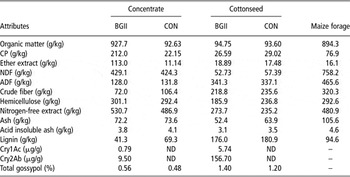
Chemical composition of lint- and fuzz-free cottonseeds, concentrate mixtures and maize forage are presented in Table 1. BGII cottonseeds had lower CP and higher cell wall fractions and ether extract than those of CON cottonseeds; however, gossypol content was similar in both types of cottonseeds. The variation in the chemical composition of both types of cottonseeds was not reflected in the respective composition of concentrate mixtures. The chemical composition of both concentrate mixtures was quite close to the specifications of type II concentrate mixtures given by BIS (1975); however, ether extract content was higher than the recommended value as a result of high level of oil-rich cottonseed (40%) in the concentrate mixtures. The concentrations of Cry1Ac and Cry2Ab proteins in BGII cottonseed were 5.74 and 156.7 μg/g on DM basis, respectively, while these proteins were not detected in the CON cottonseeds. The concentrations of Cry1Ac and Cry2Ab proteins in the BGII concentrate mixture were 0.79 and 9.50 μg/g on DM basis. Theoretically, the level of these proteins in the experimental concentrate mixture should have been 2.29 and 62.67 μg/g, respectively.
Nutrient composition and concentrations of cry proteins and gossypol in cottonseed, concentrate mixture and maize forage (% dry matter basis)

BW, feed intake and milk production
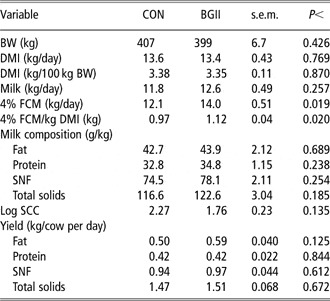
Mean BW of cows in CON and BGII groups did not vary significantly between the groups. Total DMI and DMI as a percentage of BW between the groups also did not vary significantly (Table 2). Concentrate to roughage ratios for the respective treatments were numerically similar (1.18:1 v. 1.19:1). Concentrate and cottonseed consumption (DM basis) were 6.24 kg concentrate/cow per day and 2.9 kg cottonseed/cow per day for the CON and 6.12 kg concentrate/cow per day and 2.9 kg cottonseed/cow per day for the BGII group. These values indicated that irrespective of its type the cottonseed intake was about 20% of total ration.
Effect of cottonseed with (BGII) and without (CON) the expression of the Cry1Ac and Cry2Ab proteins on feed intake, BW, milk yield and milk composition of dairy cows (least square means)

DMI = dry matter intake; FCM = fat-corrected milk; SNF = solid not fat; SCC = somatic cell counts.
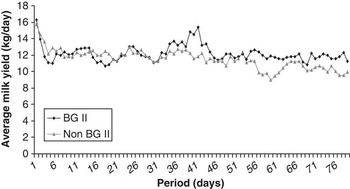
Daily milk yields and 4% FCM yields for cows fed the CON and BGII treatments varied non-significantly between the groups (Table 2). The 4% FCM yield/kg DMI for the BGII treatment group increased significantly over the CON group by about 15%. There was no statistical difference between the milk yield or milk fat composition, although BGII had numerically higher milk fat percentage (Table 2; Figure 1).
Average milk yield of BGII and non-BGII groups. 1 to 15 days, adaptation period (25 May to 9 June 2005); 16 to 46, experimental period (10 June to 9 July 2005); 47 to 78, post-experimental period (10 July to 10 August 2005).

There was no significant effect of the experimental diets on milk composition and SCC at different sampling intervals. Cry1Ac and Cry2Ab proteins were not detected in milk or blood plasma for any sampling day. Cows fed with BGII cottonseed-based diet did not exhibit any abnormal behavior or health disorders during the experimental period.
Discussion
BGII cottonseeds had higher CP and ether extract content than CON cottonseed, and the values were within the range as reported for cottonseed by Sen and Ray (Reference Sen and Ray1977). The difference in the fiber fractions between these two types of cottonseed was possibly due to the difference in proportions of their hull content. Gossypol contents of cottonseeds were numerically similar and within the range reported in Bt and non-GM cottonseeds (Senthil and Singhal, Reference Senthil and Singhal2004) in other varieties of cottonseed (Mujahid et al., Reference Mujahid, Abdullah, Barque and Gilani2000) and for dehulled cottonseed containing Cry1Ac protein (1.52%) and control cottonseed (1.23%) as reported by Senthil and Singhal (Reference Senthil and Singhal2004). The lower value of Cry1Ac and Cry2Ab proteins in the BGII concentrate mixture was attributed to interference from other constituents in the concentrate mixture, which might have affected the detection during the analysis. As cottonseed constituted 20% of the total DM intake in both groups, it can be inferred that cows were exposed to the level of Cry proteins feasible under practical feeding conditions. Therefore, it can be inferred that feeding BGII cottonseed to the feasible level kept the intake of Cry1Ac and Cry2Ab proteins low. Nutrient content of maize forage was similar to values reported by Sen and Ray (Reference Sen and Ray1977). The DMI in this study was similar to a previous study in which crossbred lactating cows consumed a Bt (Cry1Ac) cottonseed-based ration (Singhal et al., Reference Singhal, Kumar, Tyagi and Rajput2006) and also in an experiment in which cows consumed cottonseed containing both Cry1Ac and Cry2Ab (Castillo et al., Reference Castillo, Gallardo, Maciel, Giordano, Conti, Gaggiotti, Quaino and Hartnell2004).
The higher NDF intake as the percentage of total DM intake in both groups than the level (37%) recommended by NRC (2001), as well as Mertens (Reference Mertens1985) for cows yielding 16 to 24 kg FCM daily, could be attributed to the tropical conditions, which increases the cell wall fractions in feeds and fodder. Singhal et al. (Reference Singhal, Kumar, Tyagi and Rajput2006) reported no difference (P > 0.05) in DMI, milk yield, milk composition and 4% FCM between cows receiving cottonseed containing Cry1Ac protein and conventional cottonseed. It can be inferred that neither milk yield nor fat%, which contribute to the calculation of FCM, were affected by the incorporation of BGII cottonseed in the ration of dairy cows. Similar results were reported by Castillo et al. (Reference Castillo, Gallardo, Maciel, Giordano, Conti, Gaggiotti, Quaino and Hartnell2004) in lactating Argentinian Holstein cows fed BGII v. the control. The non-significant effect of the experimental diets on milk composition and SCC were also reported by Singhal et al. (Reference Singhal, Kumar, Tyagi and Rajput2006) for Cry1Ac and Castillo et al. (Reference Castillo, Gallardo, Maciel, Giordano, Conti, Gaggiotti, Quaino and Hartnell2004) for Cry1AC and Cry2Ab. The values of SCC were within the normal range as reported by Nazem et al. (Reference Nazem, Zab, Tahlaury and Mohmoud1998), and when analyzed as log SCC were not affected by the type of cottonseed or sampling interval.
Non-detection of Cry1Ac and Cry2Ab proteins in milk and in blood plasma suggest that these proteins were digested in the digestive tract and/or were not absorbed intact across the intestinal mucosa. Singhal et al. (Reference Singhal, Kumar, Tyagi and Rajput2006) did not detect Cry1Ac or Cry1C proteins in milk or blood plasma using an ELISA method with a sensitivity to detect 0.002 ppm in milk and 0.004 ppm in blood plasma. Similar observations were made by Mohanta et al. (Reference Mohanta, Singhal, Tyagi, Rajput and Prashad2009) following the feeding of similar concentrate mixture containing cottonseed (Cry1C) to the lactating cows in India. Castillo et al. (Reference Castillo, Gallardo, Maciel, Giordano, Conti, Gaggiotti, Quaino and Hartnell2004) were unable to detect the Cry1Ac transgene in milk using PCR coupled with Southern blot analysis to achieve a level of sensitivity approaching the theoretical limits of detection for PCR.
Conclusions
Lactating crossbred dairy cattle fed cottonseed derived from cotton expressing the insect-protection proteins Cry1Ac and Cry2Ab did not differ in DMI, milk yield, milk composition and BW compared with cows fed with conventional cottonseed. The 4% FCM and 4% FCM/kg DMI were increased in cows fed the insect-protected cottonseed. Therefore, cottonseed containing Cry1Ac and Cry2Ab proteins are as safe and nutritious as its conventional counterpart when fed to lactating dairy cows as 0.2% of total DM consumed over a 28-day period.
Acknowledgements
The authors are thankful to the Director National Dairy Research Institute, Karnal for providing the facilities to conduct the experiment. The necessary funding to conduct and support the experiment was provided by M/s Maharashtra Hybrid Seed Company Ltd (Mahyco), Mumbai, India and is duly acknowledged.