Lobesiodes euphorbiana (Freyer) (Lepidoptera: Torticideae) (formerly genus Lobesia), the spurge leaf tying moth (Winston et al. Reference Winston, Randall, De Clerck-Floate, McClay, Andreas and Schwarzlander2017), is native to Europe but was intentionally introduced into Canada as a classical biological control agent against Euphorbia virgata Waldstein and Kitaibel (Euphorbiaceae) (leafy spurge, formerly E. esula Linnaeus; Berry et al. Reference Berry, Riina, Peirson, Yang, Steinmann and Geltman2021). The larvae spin a silk webbing that ties leaves together, hence the common name, and feed on flower and vegetative buds and shoot tips within these characteristic leaf ties. These leaf-rolling and feeding behaviours inhibit stem growth and can result in plant death following repeated heavy attacks, but more importantly, they may reduce flowering and seed production (British Columbia Forests, Lands and Natural Resource Operations 2017; iBiocontrol Reference Winston, Schwarzlander, Hinz, Day, Cock and Julien2025). Larvae develop through four to five instars, depending on resource availability, eventually spinning a thick web within the leaf tie, where they pupate until emerging as adult moths with brown, tan, and burnt-orange colouring (Fig. 1). A second generation may follow in the same season, but larvae have a high temperature threshold for development, and shortening day lengths leads to diapause (Harris and Soroka Reference Harris and Soroka1982). Pupae overwinter within the leaf ties in the leaf litter. This overwintered cohort emerges in the spring as adults. See Harris and Soroka (1982), Winston et al. (Reference Winston, Randall, De Clerck-Floate, McClay, Andreas and Schwarzlander2017), and iBiocontrol (Reference Winston, Schwarzlander, Hinz, Day, Cock and Julien2025) for more detailed descriptions of L. euphorbiana life stages and cycle.
Photographs of a leaf tie and the larva, pupa, and adult of the spurge leaf tying moth collected from Richland County, Montana, United States of America

Lobesiodes euphorbiana was permitted for release only in Canada on leafy spurge, E. virgata, and cypress spurge, Euphorbia cyparissias Linnaeus (Bourchier et al. Reference Bourchier, Erb, McClay, Gassmann, Mason and Huber2002; iBiocontrol Reference Winston, Schwarzlander, Hinz, Day, Cock and Julien2025). Introductions onto E. cyparissias were not successful, and L. euphorbiana is not considered established on that species in Canada (iBiocontrol Reference Winston, Schwarzlander, Hinz, Day, Cock and Julien2025). Initial releases on E. virgata occurred in Saskatchewan and Manitoba in the early 1980s, with subsequent introductions and redistribution in all provinces except Quebec through the 1990s (Bourchier et al. Reference Bourchier, Erb, McClay, Gassmann, Mason and Huber2002). This agent was rejected for release in the United States of America in 1993 by the United States Department of Agriculture, Animal and Plant Health Inspection Service, based on recommendations from the Technical Advisory Group for Biological Control Agents of Weeds (2023, Petition 92-06), likely due to the risk of nontarget attacks on native spurges (Pemberton Reference Pemberton and Delfosse1984). Currently, this moth is not considered present or established in the United States of America (Winston et al. Reference Winston, Randall, De Clerck-Floate, McClay, Andreas and Schwarzlander2017; iBiocontrol Reference Winston, Schwarzlander, Hinz, Day, Cock and Julien2025). However, distinctive leaf ties characteristic of L. euphorbiana were detected on E. virgata plants in Richland County, Montana, United States of America, in August 2024. Local surveys, rearing of pupae, and DNA barcoding have confirmed that L. euphorbiana is present at multiple sites in Montana. We therefore report the first observation of L. euphorbiana as established in the United States of America.
To confirm L. euphorbiana presence and to conduct a pilot assessment of its commonality in the region, we collected E. virgata stems with leaf ties from five sites in Richland County along the Yellowstone River and from one site in Missoula County in western Montana between 10 August and 12 September 2024. Leaf ties were also observed and photographed in Ransom County, North Dakota, United States of America, but were not collected.
Stems with leaf ties were cut at ground level and brought back to the laboratory. Collected leaf ties were carefully opened until a larva or pupa was visible but kept mostly closed to reduce disturbance. Pupae found in the initial collections were extracted and placed individually into Eppendorf tubes and kept until adults emerged and could be identified. Leafy spurge stems with leaf ties containing larvae were placed as a bouquet into an Erlenmeyer flask filled with reverse osmosis water. These flasks were capped with Parafilm to provide support for the stems. Flasks containing the plant material and larvae from each individual site were placed together into one BugDorm™ cage (24.5 cm × 24.5 cm × 63.0 cm; BugDorm, Taichung, Taiwan), with separate cages for each site. Cage bottoms were lined with paper towels moistened daily to maintain humidity. Cages were placed in areas with direct sunlight, maintained in the laboratory under ambient light conditions at room temperature (21 °C) and checked daily for emerged adults.
The taxonomic identity of larvae and emerged adults was compared with descriptions and photos from Winston et al. (Reference Winston, Randall, De Clerck-Floate, McClay, Andreas and Schwarzlander2017) and verified by T. Gilligan (Colorado State University, Fort Collins, Colorado, United States of America). We also sequenced an adult specimen using standard DNA barcoding techniques (Hebert et al. Reference Hebert, Cywinska, Ball and deWaard2003) and compared the results to specimens of Lobesiodes euphorbiana in the Barcode of Life Data Systems (BOLD) sequence database (Ratnasingham and Herbert Reference Ratnasingham and Hebert2007). The sequence was 100% identical to sequences of L. euphorbiana collected in Austria, confirming the identity of the Montana specimens as this species. The DNA sequence was submitted to GenBank under accession number PV601185.
Hundreds of leaf ties were observed at each of our five sites along the Yellowstone River in Richland County, and we haphazardly collected numerous leaf ties with the goal of confirming the moth’s identity. From our collected plants with leaf ties, we were able to find 84 larvae or pupae. From these, we successfully reared 33 adult moths. Specimens of all life stages of L. euphorbiana are stored at the United States Department of Agriculture, Agricultural Research Service, Pest Management Research Unit in Sidney, Montana, and adult specimens were also deposited at the C.P. Gillette Museum of Arthropod Diversity (Fort Collins, Colorado).
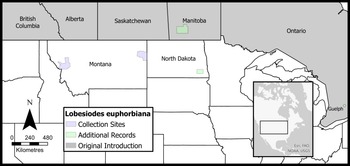
Original introductions of L. euphorbiana (sourced in Italy, collected from Euphorbia lucida and E. seguierana) occurred in the Prairie Provinces of Canada (Manitoba, Saskatchewan, and Alberta), with later redistributions into British Columbia and Ontario, Canada (Gassmann and Schroeder Reference Gassmann and Schroeder1995; McClay et al. Reference McClay, Cole, Harris and Richardson1995; Bourchier et al. Reference Bourchier, Erb, McClay, Gassmann, Mason and Huber2002; iBiocontrol Reference Winston, Schwarzlander, Hinz, Day, Cock and Julien2025). These areas, along with the bordering northern Great Plains and intermountain western states in the United States of America, contain the highest densities of E. virgata infestations (West and Gaskin Reference West, Gaskin, Van Driesche, Winston, Perring and Lopez2022). Although active redistribution in Canada has seemingly been sparse, it is not a stretch to suggest L. euphorbiana populations are widespread enough to launch natural dispersal into other areas and may already have a much larger range than we are documenting here. For instance, Cock et al. (Reference Cock, Mason, Haye and Cappuccino2021) field collected L. euphorbiana in Guelph, Ontario, for use in host-specificity testing for a candidate insect biocontrol agent. In Saskatchewan and British Columbia, two provinces that border Montana, the moth had reached densities high enough for redistribution by 2000 (Bourchier et al. Reference Bourchier, Erb, McClay, Gassmann, Mason and Huber2002). North Dakota, where we have photographic evidence of leaf ties, borders Manitoba, which had the highest number of releases listed in Bourchier et al. (Reference Bourchier, Erb, McClay, Gassmann, Mason and Huber2002). Other recent observations were reported near Brandon and Shilo, Manitoba, via iNaturalist (https://www.inaturalist.org; hipstermama 2019, 2021, 2022, 2023a, 2023b, 2023c, 2023d, 2024a, 2024b, 2024c, 2025a, 2025b; camlough 2023a, 2023b, 2023c) and GBIF.org (2025). Our collected Montana specimens from Richland and Missoula Counties, which are separated by approximately 900 km, and the North Dakota photographs that push the longitudinal separation distance to approximately 1500 km suggest broad distribution of the moth in the northern United States of America (Fig. 2).
Map detailing the locations of collected leaf ties (purple) and of photographs of leaf ties, iNaturalist observations, and GBIF.org observations (green), as well as the approximate location where Cock et al. (Reference Cock, Mason, Haye and Cappuccino2021) field collected Lobesiodes euphorbiana. Canadian provinces are shaded grey to indicate the provinces in which intentional biological control releases of the moth occurred.

Our finding of L. euphorbiana across a large geographic area in which it was previously undocumented suggests that additional follow-up monitoring of released biocontrol agents is warranted, especially because L. euphorbiana is known to use different spurge species in its native range and because potential nontarget hosts are possible (i.e., Harris and Soroka Reference Harris and Soroka1982; Pemberton Reference Pemberton and Delfosse1984; Gassmann and Schroeder Reference Gassmann and Schroeder1995). It is well established that climate warming has enabled many insect species, particularly lepidopterans, to expand their distributions or migrations through warmer nights and greater flight distances (e.g., Campbell et al. Reference Campbell, Fulcher, Grewell and Young2023). Lobesiodes euphorbiana requires high temperatures to complete its development (Harris and Soroka Reference Harris and Soroka1982). Therefore, warming temperatures and extended northern growing seasons could increase moth population abundances across both established Canadian sites and new locations in the United States of America, further increasing the species’ distribution. We know little about L. euphorbiana abundance in Canada, and future work should focus on elucidating the moth’s full range in both countries through a more systematic survey approach, as well as on determining the insect’s realised efficacy as a biological control agent on leafy spurge.
Acknowledgements
The authors thank Beth Redlin for assistance with graphics and Cody Meservy and Laura Senior for assistance with photographing insects.
Competing interests
The authors declare that they have no competing interests.