Introduction
The white grub beetle, Dasylepida ishigakiensis Niijima et Kinoshita (Coleoptera: Scarabaeidae), is one of the most destructive pests plaguing the sugarcane crop Saccharum officinarum in the Miyako Islands (Sadoyama et al., Reference Sadoyama, Oroku and Nakamori2001). Sugarcane roots and underground stems are voraciously eaten by third instar larvae and the plants often die just prior to harvest. This beetle has a two-year life cycle (Oyafuso et al., Reference Oyafuso, Arakaki, Sadoyama, Kishita, Kawamura, Ishimine, Kinjo and Hirai2002). After an approximately one-year feeding period, they migrate to a deeper soil layer in March and April and aestivate (Kijima & Tarora, Reference Kijima and Tarora2010). They pupate in October and then emerge as adults in November. The adults remain in the soil for an additional two months. During the coldest months of February and March, they appear above the ground for mating in the evening at temperatures above 18°C at 18:00 (Oyafuso et al., Reference Oyafuso, Arakaki, Sadoyama, Kishita, Kawamura, Ishimine, Kinjo and Hirai2002; Arakaki et al., Reference Arakaki, Sadoyama, Kishita, Nagayama, Oyafuso, Ishimine, Ota, Akino, Fukaya, Hirai, Yamamura and Wakamura2004). The mating flight lasts for only a half hour and mated adults return to the soil shortly after mating or before dawn (Harano et al., Reference Harano, Tanaka, Yasui, Wakamura, Nagayama, Hokama and Arakaki2010). Therefore, they spend most of their lives underground.
The extent of the damage caused by D. ishigakiensis to the sugarcane production in the Miyako Islands amounts to approximately 1.5 million US dollars annually (Kijima & Tarora, Reference Kijima and Tarora2010). The application of pesticides may not be effective against soil insects. An alternative approach that involves spraying sugarcane fields during the mating season may be necessary. However, the appearance of adults from the soil is influenced by various intrinsic and extrinsic factors and not always predictable (Oyafuso et al., Reference Oyafuso, Arakaki, Sadoyama, Kishita, Kawamura, Ishimine, Kinjo and Hirai2002; Tanaka et al., Reference Tanaka, Yukuhiro, Yasui, Fukaya, Akino and Wakamura2008; Tokuda et al., Reference Tokuda, Tanaka, Maeno, Harano, Wakamura, Yasui, Arakaki, Akino and Fukaya2010). Therefore, using sex pheromone to interfere with mating activity may be a better method for abating this pest insect. During a short period of flight activity for mating, males are attracted to the female sex pheromone, and the chemical structure of this pheromone was recently identified (Wakamura et al., Reference Wakamura, Yasui, Akino, Yasuda, Fukaya, Tanaka, Maeda, Arakaki, Nagayama, Sadoyama, Kishita, Oyafuso, Hokama, Kobayashi, Tarora, Uesato, Miyagi and Osuga2009a). The major sex pheromone component of D. ishigakiensis is (R)-2-butanol (R2B). (S)-2-Butanol (S2B) and 2-propanol are also released by females and evoke an electroantennogram (EAG) response in the male antenna. However, these compounds do not attract males in either the laboratory or the field (Wakamura et al., Reference Wakamura, Yasui, Akino, Yasuda, Fukaya, Tanaka, Maeda, Arakaki, Nagayama, Sadoyama, Kishita, Oyafuso, Hokama, Kobayashi, Tarora, Uesato, Miyagi and Osuga2009a, Reference Wakamura, Yasui, Mochizuki, Fukumoto, Arakaki, Nagayama, Uesato, Miyagi, Oroku, Tanaka, Tokuda, Fukaya, Akino, Hirai and Shigab). Males orientated towards lures impregnated with a racemic mixture of 2-butanol (rac-2B) as well as those with R2B in a flight tunnel assay, but males have not been captured with rac-2B traps in the field (Wakamura et al., Reference Wakamura, Yasui, Akino, Yasuda, Fukaya, Tanaka, Maeda, Arakaki, Nagayama, Sadoyama, Kishita, Oyafuso, Hokama, Kobayashi, Tarora, Uesato, Miyagi and Osuga2009a, Reference Wakamura, Yasui, Mochizuki, Fukumoto, Arakaki, Nagayama, Uesato, Miyagi, Oroku, Tanaka, Tokuda, Fukaya, Akino, Hirai and Shigab).
Polyethylene tube formulation has been widely used for releasing synthetic sex pheromone at a constant rate over a long period of time to disrupt communication among many lepidopteran pest species (e.g. Sarfraz et al., Reference Sarfraz, Evenden, Keddie and Dosdall2006; de Lame et al., Reference de Lame, Miller, Atterholt and Gut2007; Witzgall et al., Reference Witzgall, Kirsch and Cork2010 and references cited therein). This method has also been tested for this coleopteran insect, D. ishigakiensis. Polyethylene tube formulation reserving R2B liquid in the hollow space continues to release R2B through the outer surface of the tube over a three-month period, which covers the entire flight season of D. ishigakiensis (Wakamura et al., Reference Wakamura, Yasui, Mochizuki, Fukumoto, Arakaki, Nagayama, Uesato, Miyagi, Oroku, Tanaka, Tokuda, Fukaya, Akino, Hirai and Shiga2009b).
One serious problem associated with using R2B to control D. ishigakiensis is its high cost. Conversely, rac-2B is much less expensive and is thus more practical than R2B for this purpose. In this study, we aimed to compare the effectiveness of aerial permeation with R2B and rac-2B as communication-disrupting agents in a flight tunnel and in sugarcane fields and to evaluate the feasibility of field use of the less expensive compound rac-2B. On the basis of the results presented here, we propose a method to estimate the incidence of mating disruption and discuss the possibility of successfully disrupting mating by the female sex pheromone in this beetle. The goal of our project is to develop a feasible method to control this beetle by disrupting its sexual communication using its sex pheromone.
Materials and methods
Insects
Third instar D. ishigakiensis larvae were collected from the soil in sugarcane fields on Miyako Island in February 2009. They were individually kept in plastic caps (inner diameter, ca. 5.7 cm; height, 3.5 cm), each containing humus and fertile soil as substrate and a piece of sugarcane stem (diameter, ca. 1.5 cm; length, 2 cm) as food. They were kept at 24°C and at a 12L:12D photoperiod (light period: 7:00–19:00 h). Sugarcane pieces were changed every three weeks until the larvae stopped feeding. The larvae pupated 6–8 months later, and pupae became adults approximately four weeks later. Female adults were initially kept at 17°C for 45 days and were then transferred to 22°C at a 12L:12D (light period: 0:00–12:00 h) photoperiod. The treated adults terminated diapause and became sexually mature (Tanaka et al., Reference Tanaka, Yukuhiro, Yasui, Fukaya, Akino and Wakamura2008). In experiment 1, males kept at 17°C for 57–62 days were used. In experiment 2, the males used were collected with sex-pheromone traps in sugarcane fields on Miyako Island on 11 February 2010 and were brought to the NIAS laboratory. They were individually kept with moist absorbent wiper (JK wiper®, Nippon Paper Crecia Co., Ltd, Tokyo, Japan) in plastic cups at 22°C until used.
Chemicals
(R)-2-Butanol (R2B) (>99% purity) was purchased from Wako Pure Chemical Industries, Ltd (Osaka, Japan) and (S)-2-butanol (S2B) (>98%) and 2-butanol (racemic mixture, rac-2B) (>99%) were purchased from Tokyo Kasei Kogyo Co., Ltd (Tokyo, Japan). R2B and S2B each exhibited a single peak with different retention times by a gas chromatography (GC) analysis on a chiral column (for detail see Wakamura et al., Reference Wakamura, Yasui, Akino, Yasuda, Fukaya, Tanaka, Maeda, Arakaki, Nagayama, Sadoyama, Kishita, Oyafuso, Hokama, Kobayashi, Tarora, Uesato, Miyagi and Osuga2009a). Rac-2B also exhibited a single peak by a GC analysis on an achiral column. The lures and dispensers used in the field were prepared and supplied by the ShinEtsu Chemical Co. (Tokyo, Japan), and the purities of the chemicals were at the same level as the laboratory chemicals.
Polyethylene tube lures and dispensers
The tested compounds were sealed in two types of tubes. Type-A tubes were made of high density polyethylene (HDPE), and the inner and outer diameters were 0.84 mm and 1.54 mm, respectively. Type-B tubes were made of HDPE mixed with ethylene vinyl acetate copolymer, and the inner and outer diameters were 1.30 mm and 2.34 mm, respectively. One-centimetre-long type-A and -B tubes were filled with 4.5 mg and 12 mg of 2-butanol, were estimated to release approximately 3.5 ng of rac-2B per min (5 μg per day) and 60 ng per min (90 μg per day), respectively, at ca. 23°C in the laboratory, according to the method of Yasui et al. (Reference Yasui, Wakamura, Tanaka, Harano, Mochizuki, Nagayama, Hokama and Arakaki2010) and will be abbreviated as A1 and B1, respectively (fig. 1a).
A photograph illustrates polyethylene tube lures and dispensers. (a) A1-type (1 cm) and B1-type (1 cm) tube lures, and (b) tube-type (20 cm) and rope-type (25 m) dispensers.

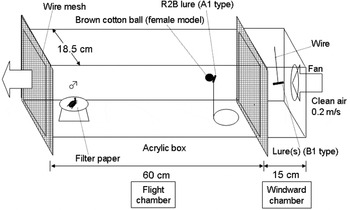
In the flight tunnel assay, an A1 tube was used to release R2B near a female model that will be described later. R2B, S2B and rac-2B sealed in B1 tubes were used for dispensing the chemicals into the windward chamber of the flight tunnel (fig. 2).
A diagram illustrating the flight tunnel assay. An A1 lure was used to release R2B near a female model. R2B, S2B and rac-2B sealed in B1 lures were used for dispensing the chemicals at the windward end of the flight tunnel.

In communication disruption experiments in the field, the synthetic compounds sealed either in type-B tubes or rope-type dispensers were used (fig. 1b). Each tube-type dispenser was 20-cm long, containing approximately 240 mg of the compound, whereas each rope-type was 25 m long and was sealed with a 6-mm-wide strap every 20 cm to prevent leakage.
Female models in the flight tunnel experiments
A female model was made by wrapping a wad of absorbent cotton with a piece of brown cloth made of polyester and tying it with plastic-coated wire to form a ball, approximately 1.2 cm in diameter. An A1-type R2B lure was tied with thin wire to the model, providing both visual and olfactory signals (see fig. 2).
Flight tunnel
Two experiments were conducted using a flight tunnel developed by Yasuda (Reference Yasuda1996) to evaluate male behaviour towards a female model (fig. 2) by following the basic protocol described in previous reports (Fukaya et al., Reference Fukaya, Yasui, Akino, Yasuda, Tanaka, Wakamura, Maeda, Hirai, Yasuda, Nagayama and Arakaki2009; Wakamura et al., Reference Wakamura, Yasui, Akino, Yasuda, Fukaya, Tanaka, Maeda, Arakaki, Nagayama, Sadoyama, Kishita, Oyafuso, Hokama, Kobayashi, Tarora, Uesato, Miyagi and Osuga2009a). The flight tunnel was made of transparent acrylic plates with inside dimensions of 60-cm length, 18.5-cm width and 18.5-cm height. The flight chamber was separated from the windward chamber by a fine wire screen with an additional wire screen at the other end. Air was supplied by an electric fan at approximately 20 cm s−1, and outlet air was exhausted to the outside. The main tunnel floor was covered with a sheet of white paper.
A female model tied with a thin wire stand was placed at the centre of the tunnel 10 cm apart from the windward end of the flight tunnel (fig. 2). B1-type lure(s) filled with R2B, S2B or rac-2B was hung from the ceiling with thin wire in the center of the windward chamber. Air was sent from the outside of the windward chamber by a fan to generate air flow containing test chemicals through the tunnel chamber.
One male was placed on a paper disk (9 cm in diameter; filter paper: no. 2, Toyo Roshi Kaisha, Tokyo, Japan) that was placed on a plastic container (5 cm in height) at the leeward end of the flight tunnel. The male was covered with a transparent plastic cup (6 cm diameter×4 cm height), which was opened to expose him to the test chemical when the observations started. The flight tunnel floor was illuminated by an incandescent light bulb (40W bulb, Toshiba Co., Tokyo, Japan) at approximately 175 lx for the initial voltage at 130 V, which was decreased to 100 V for 3 min, decreased to 80 V, and then further reduced by 10 V stepwise every 3 min until 30 V, resulting in a gradual reduction of light intensity from 175 lx to 0.9 lx (Fukaya et al., Reference Fukaya, Yasui, Akino, Yasuda, Tanaka, Wakamura, Maeda, Hirai, Yasuda, Nagayama and Arakaki2009), measured by an illuminometer (TL-1, Minolta Camera Co., Ltd, Tokyo, Japan). This rate of change in light intensity was roughly comparable to the values when mating behaviour was observed in sugarcane fields (Arakaki et al., Reference Arakaki, Sadoyama, Kishita, Nagayama, Oyafuso, Ishimine, Ota, Akino, Fukaya, Hirai, Yamamura and Wakamura2004). Each test male was observed (i) if he took off for flight or not, (ii) if he hovered within 5 cm of the female model for more than 2 sec in the leeside of the model (orientation), and (iii) if he landed on the model with his elytra closed. The experiments were conducted between 9:30 h and 12:00 h in the laboratory at approximately 22°C.
Monitoring traps
A funnel trap with crossed vanes (15 cm diameter×39 cm height, Trécé Inc., Salinas, CA, USA) was anchored with wire to a stick (ca. 1 cm diameter×60 cm height) in the ground. A B1-tube lure containing R2B was attached to the trap with plastic-coated wire.
Mating disruption in the field
Field tests were conducted in sugarcane fields on Miyako Island during a period from 4 to 11 February 2010. Eleven sugarcane fields of 800 m2 (25×32 m) were used to test different treatments, including controls, and each treatment was tested in more than two sugarcane fields. Six rac-2B or three R2B-tube-type dispensers (20 cm) were bound on a stick (ca. 1 cm diameter×50 cm) with plastic-coated wire. Two hundred sticks tied with R2B dispensers (600 tube dispensers total) were anchored to the ground in 600-R2B-tube treatment plots, wherein they were equally spaced with the dispensers positioned at approximately 30 cm above the ground. Likewise, 200 or 400 sticks tied with rac-2B dispensers were placed in other fields (1200 or 2400 rac-2B-tube treatment plots). Ten or 20 rope-type dispensers containing rac-2B (equivalent to 1250 or 2500 tube-type dispensers, respectively) were set on sugarcane leaves, leaf sheaths or stems at approximately 30 cm above the ground in the test plots.
To evaluate the effects of these dispensers on D. ishigakiensis mating behaviour, four monitoring traps were set in each experimental plot and checked the following morning. To determine the proportion of male catches by chance, four empty traps (without lures) were also set in each treatment plot, thus allowing us to calculate the net catches by lures in each plot. Relative net catches to those in untreated control plots were calculated each day by dividing the net number of males caught with monitoring traps in a treated plot by the net number of males caught with monitoring traps in control plots.
To calculate the mating rate of D. ishigakiensis females for each experimental plot, all adults found on sugarcane leaves in each experimental plot were captured by hand by two persons from 19:00 to 19:30 h or by one person from 19:00 to 20:00 h. During those periods, all adults that appeared from the soil for mating at around 18:30 h ceased flying and rested or were in copula on plants (Harano et al., Reference Harano, Tanaka, Yasui, Wakamura, Nagayama, Hokama and Arakaki2010). Captured single individuals or mating pairs were separately stored in small polyethylene bags. After transfer to the laboratory, they were sexed based on morphological differences in the antennae (Tanaka et al., Reference Tanaka, Yukuhiro and Wakamura2006). Data were omitted when the number of all females (mated and single females) caught in a plot per day was less than ten. The mating rate was determined by dividing the number of mating pairs by the number of all females (mated and single females) caught in each plot. Some of the captured single females were dissected to examine the spermatheca for the presence or absence of sperm under a stereoscopic microscope. All dissected females were virgins (n=20).
Weather data during the field tests were obtained from the website of the Japan Meteorological Agency. Throughout the experiment period, air temperature at 18:00 h was higher than 18°C, the lower threshold for adult appearing from the soil for mating (Arakaki et al., Reference Arakaki, Sadoyama, Kishita, Nagayama, Oyafuso, Ishimine, Ota, Akino, Fukaya, Hirai, Yamamura and Wakamura2004). The weather at 18:00 h was either fine or cloudy, and the wind velocity was between 2.5 and 6.3 m s−1.
Statistical analyses
To compare rate values obtained in the laboratory assay, when the n×2 chi-square test was significant (P<0.05), the paired chi-square test or Fisher's exact probabilities were subsequently calculated and significance was judged using Bonferroni's corrected P value (Sokal & Rohlf, Reference Sokal and Rohlf1995). In figs 3 and 4, values accompanied by the same letter within the same category are not significantly different at the P=0.05 level. To compare mating rates of collected females and the relative trap catch of males in the fields, data (X) were transformed to arcsinX 1/2 and logX, respectively, and submitted to a one-way layout analysis of variance and subsequently to Tukey's ranking when the ANOVA results were significant. The values shown in the graphs in fig. 5 are the back-transformed means, and the bars indicate the SE. The means designated by the same letter are not significantly different at P=0.05.
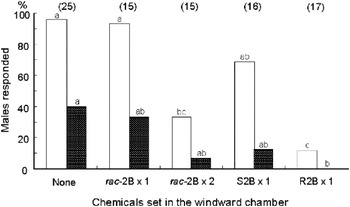
Effects of chiral or racemic 2-butanol on male behaviour in response to a R2B-releasing female model in the flight tunnel. Each chemical sealed in a B1-type lure was permeated in the windward chamber. The values presented are (no. of males responding) per (no. of males taking off), and the values assigned with the same letter are not significantly different in the same behavioural category at P=0.05 level (see text for detail). The numbers in parentheses are the number of males examined (=no. of males taking off). rac-2B, racemic 2-butanol; S2B, (S)- 2-butanol; R2B, (R)-2-butanol in a B1-type lure (□, orientation;  , landing).

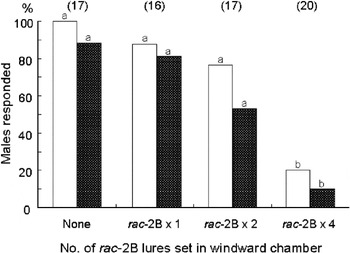
Effects of different concentrations of the racemic mixture of 2-butanol on male behaviour in response to a R2B-releasing female model in the flight tunnel. The values presented are (no. of males responding) per (no. of males taking off), and the values assigned with the same letter are not significantly different in the same behavioural category at P=0.05 level (see text for detail). The numbers in parentheses are the number of males taking off. rac-2B, racemic mixture of 2-butanol in B1-type lure. (□, orientation; , landing).

Effects of pheromone components, dispenser types and concentrations on the mating rates of D. ishigakiensis females and relative percentages of male trap catches in the sugarcane fields on Miyako Island in February 2010. (a) Mating rate of females. (no. of mating female) per (total no. of females)×100. (b) Relative trap catch of males. (no. of males caught with monitoring traps in treated plots) per (no. of males caught with monitoring traps in control plots)×100. Histograms and vertical bars indicate the back-transformed means and SE, and the means designated by the same letter are not significantly different at P=0.05. The numbers in parentheses indicate the total number of plots replications. T, tube-type dispenser; R, rope-type dispenser.

Results
Effects of R2B, S2B and rac-2B release on male mate locating behaviour in a flight tunnel
In experiment 1, D. ishigakiensis male behaviour towards a female model releasing R2B from the attached A1-type lure was observed in a flight tunnel. Most of the males that took off for flight orientated to the female model (96%) and 40% of them landed on it (untreated controls; fig. 3). When additional R2B was released from the back of the model from a B1-type lure, only 12% of males orientated to the model, and none of them landed on it. Release of S2B was less effective in reducing the frequencies of male orientation (69%) and landing (12%). Male behaviour was minimally influenced by the release of rac-2B from one lure in the windward chamber, and a significant difference was not found in the frequencies of orientation and landing when compared with untreated controls (fig. 3). However, when two rac-2B lures were used, male behaviour was significantly affected, causing fewer males to exhibit orientation (33%) and landing (7%).
Experiment 2 tested the effects of different concentrations of rac-2B on D. ishigakiensis male mate-locating behaviour. The frequency of both orientation and landing success on the model by males decreased in a dose-dependent fashion (fig. 4; r=−0.971; n=4; P<0.05 for landing success). The highest concentration of rac-2B released from four lures suppressed both orientation and landing on the female model in approximately 80% of males when compared with the male's performance without rac-2B (fig. 4).
Mating disruption in sugarcane fields
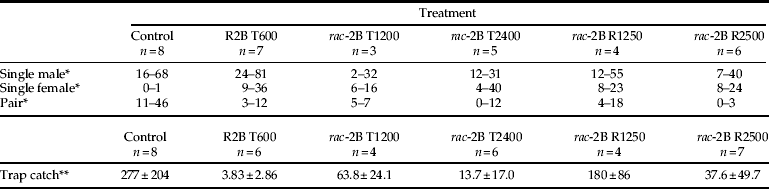
The field data of number of adults captured by hand and male net trap catches in the treated and untreated control plots were shown in table 1. Almost all of females collected from untreated control plots were found mating with males (mean mating rate=99.6%; fig. 5a). In all plots, single males were frequently encountered (table 1). In plots treated with R2B-tube dispensers (600 tubes per 800 m2), only 28% of the females were mating. An application of R2B-tube dispensers reduced the number of males caught by R2B-baited traps to 1.0% of the corresponding value in the untreated plots (fig. 5b). Conversely, in plots treated with rac-2B-tube dispensers (1200 tubes per 800 m2) the proportion of mating females significantly decreased relative to the untreated plots, and only 38% of females were observed mating (fig. 5a). No further significant decrease was observed in the frequency of mating females (16%), when the number of rac-2B-tube dispensers increased from 1200 to 2400 per plot. The number of males caught by R2B-baited traps in plots treated with 1200 rac-2B-tube dispensers decreased to 15% of the value in the untreated plots (fig. 5b). A more pronounced reduction was observed in the number of males caught by the traps in plots treated with 2400 rac-2B-tube dispensers (1.2% of the value in the untreated plots).
Field data of number of adults captured and male trap catches on the treated and untreated control plots, Miyako Island in 2010.
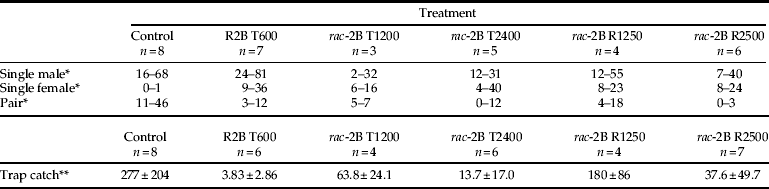
* range of number of captured individuals per plot per day; ** average±SE of male trap catch per plot per day.
Similar effects on mating success and trap catches were observed when rope-type dispensers were applied. In this case, however, a stronger effect was observed with increased dispenser numbers (fig. 5b). The female mating success in plots treated with 1250 rope-type dispensers was 37%. The number of males caught by R2B-baited traps in the plots treated with 1250 rope-type dispensers was 38% of the number captured from untreated plots (fig. 5b). The female mating success in the plots treated 2500 rope-type ones was 5.9%. The number of males caught by R2B-baited traps from the plots treated with 2500 rope-type dispensers was 3.9% of what was observed in untreated plots.
Discussion
The present study was conducted to examine the effects of R2B, S2B and rac-2B, on the mating success of D. ishigakiensis males both in the laboratory and in the field. We first investigated the effect of the major female pheromone component R2B on male behaviour. In the flight tunnel experiments, almost all males orientated towards a R2B-releasing female model and some of them landed on the model. When extra R2B was introduced by air current from the back of the female model, the frequency of male orientation and landing on the female model was significantly reduced (fig. 3). Another female pheromone component, S2B, failed to reduce the frequencies of male orientation and landing on a R2B-releasing female model. Conversely, rac-2B reduced the frequency of male orientation and landing on the female model when the number of lures containing rac-2B was increased (figs 3 and 4). Therefore, the effects of rac-2B on male behaviour may be a result of the amount of R2B in rac-2B.
We tested the above compounds on the mating success of D. ishigakiensis in the field. R2B released from polyethylene dispensers in sugarcane plots greatly reduced not only the proportion of females mating with males but also the number of males caught by R2B-baited traps, indicating that male mate-searching behaviour was strongly affected by the released R2B (fig. 5). Similar inhibitory effects on male behaviour were observed when tube- or rope-type dispensers releasing rac-2B at high concentrations were placed in the field. In these plots, considerable single males were captured by hand as well as single females (table 1). These results suggest that D. ishigakiensis may be controlled through disruption of the sexual communication by releasing either synthetic R2B or rac-2B. The use of the inexpensive rac-2B as a disruption chemical will solve the problem of the high cost of synthetic pheromone. Optimizing pheromone deployment for effective mating disruption is vital (Rodriguez-Saona et al., Reference Rodriguez-Saona, Polk and Barry2009), for which more extensive experiments are needed.
One of the most important results in this study is a direct evaluation of mating rates of females in wild populations. The effects of chemicals were evaluated by collecting single and mating females from the treated plots. Only a few studies have adopted such a direct evaluating method (Wakamura & Takai, Reference Wakamura and Takai1995; Arakaki et al., Reference Arakaki, Nagayama, Kobayashi, Hokama, Sadoyama, Mogi, Kishita, Adaniya, Ueda, Higa, Shinzato, Kawamitsu, Nakama, Wakamura and Yamamura2008). This method would be useful for developing effective mating disruption dispensers for D. ishigakiensis. We also used relative trap catches to evaluate the efficacy of test chemicals. Unlike the above method catching single and mating females, this method captured males that were attracted to the female sex pheromone by traps. Both methods suggest that rac-2B treatments significantly reduce female mating success and male orientation towards the female sex pheromone. Moreover, such effects are more pronounced at higher concentrations of rac-2B released from the dispensers.
Both laboratory and field experiments demonstrated that D. ishigakiensis male behaviour was greatly affected by the artificial release of the female sex pheromone. This result may indicate that the flight tunnel assay is useful for evaluating the efficacy of the chemicals as mating-disruption agents and to estimate their approximate amounts required for mating disruption. However, in the flight tunnel assay, additional R2B, released from the back of the female model with R2B, completely inhibited males from landing on the female models, whereas the proportion of mating females in the R2B-treated plots reached 28% (fig. 5a). This result indicates that certain males were able to locate their mates in the R2B-treated plots. Males may have used visual cues to locate the female once they reached her vicinity. Intact wild females likely provide conspecific males with better visual cues than do brown cotton balls.
The development of a manageable form of dispensers is important for practical use. The rope-type dispensers used in this study are easier to handle than tube-type ones. We observed that rope-type dispensers disrupted mating in D. ishigakiensis as effectively as tube-type dispensers when sufficient doses were applied (fig. 5). Because the dispensers used in this report were constructed of the same material and diameter as those of polyethylene tube-lures used by Wakamura et al. (Reference Wakamura, Yasui, Mochizuki, Fukumoto, Arakaki, Nagayama, Uesato, Miyagi, Oroku, Tanaka, Tokuda, Fukaya, Akino, Hirai and Shiga2009b), they would continue to emit the pheromone for at least three months, covering the entire mating season of this species. We consider that the rope-type dispensers exhibit a high potential for disrupting mating in this species in the field. Recently, sprayable formulations were developed and used on coleopteran insects to disrupt mating, e.g. pellet- or granule-type ones (Behle et al., Reference Behle, Cossé, Dunlap, Fisher and Koppenhöfer2008; Koppenhöfer et al., Reference Koppenhöfer, Behle, Dunlap, Fisher, Laird and Vittum2008). They might be easier to handle and more labour-efficient than tube- or rope-type dispensers. However, if these sprayable formulations on the soil are flooded by rain water, water-soluble 2-butanol in the formulations may be transferred to the water. Arakaki et al. (Reference Arakaki, Nagayama, Kobayashi, Hokama, Sadoyama, Mogi, Kishita, Adaniya, Ueda, Higa, Shinzato, Kawamitsu, Nakama, Wakamura and Yamamura2008) performed mating-disruption experiments on Melanotus okinawaensis (Coleoptera: Elateridae) with polyethylene tube-dispensers impregnated with synthetic sex pheromone of this beetle on Minami-Daito Island, Japan and provided the first example of successful control by mating disruption in the Coleoptera. With regard to stable emission of 2-butanol, we believe that rope-type polyethylene dispensers used in this study offer the most promising formulation for D. ishigakiensis.
Acknowledgements
We would like to thank Ikuko Hashimoto of NIAS for rearing the insects and assistance with the flight tunnel experiments. We also would like to thank Itaru Shimoji of Miyakojima Branch of OPARC, Hiroaki Sunagawa of JA Okinawa Miyako Branch, Yasushi Taira of Miyakojima City Office, Zenta Arakaki and Yayoi Kohatsu of OPARC, Ayako Yamaguchi of Okinawa Prefectural Plant Protection Center, Miyako Branch Office, and Yoshio Hirai and Junko Ikeda for assistance with the field experiments.