Introduction
Mental disorders such as depression, schizophrenia, and obsessive compulsive disorder (OCD) share a common neuropathology with evidence from symptomatology (Barch & Sheffield, Reference Barch and Sheffield2014), genetic architecture (Sonuga-Barke, Reference Sonuga-Barke2013), environmental risk (Anttila, Bulik-Sullivan, & Finucane, Reference Anttila, Bulik-Sullivan and Finucane2018), and neuroimaging findings (Patel et al., Reference Patel, Parker, Shin, Howard, French, Thomopoulos and Paus2021). Through modern neuroimaging methods, researchers have gradually established the hypothesis that the common etiology of mental disorders is the damage to balanced large-scale interconnected brain networks during development (Fornito, Zalesky, & Breakspear, Reference Fornito, Zalesky and Breakspear2015). This hypothesis has been verified by a series of neuroimaging studies that elaborate on shared and distinct patterns of aberrance brain networks across mental disorders (Ge, Sassi, Yatham, & Frangou, Reference Ge, Sassi, Yatham and Frangou2022; Itahashi et al., Reference Itahashi, Fujino, Hashimoto, Tachibana, Sato, Ohta and Aoki2020; Koshiyama et al., Reference Koshiyama, Fukunaga, Okada, Morita, Nemoto, Usui and Narita2020; Li et al., Reference Li, Dong, Womer, Han, Yin, Jiang and Wang2021; Nakamura et al., Reference Nakamura, Okada, Koshiyama, Kamiya, Abe, Kunimatsu and Koike2020; Xia et al., Reference Xia, Womer, Chang, Zhu, Zhou, Edmiston and Wang2019). However, the shared and distinct patterns of brain network abnormalities across mental disorders remain largely unclear, owing to high interindividual heterogeneity.
Mental disorders, including depression, schizophrenia, and OCD, are notably heterogeneous disorders as indicated by their complex genetic architectures, manifold symptom manifestations, and treatment responses (Boedhoe et al., Reference Boedhoe, Schmaal, Abe, Alonso, Ameis, Anticevic and van den Heuvel2018; Bondar, Caye, Chekroud, & Kieling, Reference Bondar, Caye, Chekroud and Kieling2020; Drysdale, Grosenick, & Downar, Reference Drysdale, Grosenick and Downar2017; Krishnan & Nestler, Reference Krishnan and Nestler2008; Rodriguez-Murillo, Gogos, & Karayiorgou, Reference Rodriguez-Murillo, Gogos and Karayiorgou2012). Heterogeneity, which is one of the leading causes of conflicting findings, hampers the identification of reliable neuroimaging markers for clinical decision making (Boedhoe et al., Reference Boedhoe, Schmaal, Abe, Alonso, Ameis, Anticevic and van den Heuvel2018; Saxena & Rauch, Reference Saxena and Rauch2000). Patients with mental disorders exhibit high inter-individual variation in neuroimaging representations. For example, patients with different illness durations exhibit stage-specific hippocampal atrophy during depression (Han et al., Reference Han, Zheng, Li, Liu, Wang, Jiang and Cheng2021). Distinct subtypes of mental disorders usually show distinct or even completely opposing patterns of brain aberrance (Chand et al., Reference Chand, Dwyer, Erus, Sotiras, Varol, Srinivasan and Davatzikos2020). Studies have consistently found that mental disorders show higher inter-individual variation in distributed brain regions than do the normal population (Alnæs et al., Reference Alnæs, Kaufmann, van der Meer, Córdova-Palomera, Rokicki, Moberget and Westlye2019; Sun et al., Reference Sun, Liu, Ma, Duan, Wang, Xu and Xia2021). Nevertheless, most neuroimaging studies still adopt traditional case–control designs aimed at detecting group effects while ignoring inter-individual heterogeneity; thus, their conclusions are not representative of the general patient population (Lv, Di Biase, Cash, & Cocchi, Reference Lv, Di Biase, Cash and Cocchi2020; Wolfers et al., Reference Wolfers, Doan, Kaufmann, Alnæs, Moberget, Agartz and Marquand2018). Heterogeneity hinders the derivation of reproducible image markers indicative of precision in diagnosis and treatment (Chand et al., Reference Chand, Dwyer, Erus, Sotiras, Varol, Srinivasan and Davatzikos2020). As such, high heterogeneity hinders the identification of shared and distinct patterns of brain network abnormalities across mental disorders.
Increasing evidence shows the high heterogeneity of mental disorders, and a number of methods have been proposed to address this (Lv et al., Reference Lv, Di Biase, Cash and Cocchi2020; Voineskos, Jacobs, & Ameis, Reference Voineskos, Jacobs and Ameis2020; Wolfers et al., Reference Wolfers, Doan, Kaufmann, Alnæs, Moberget, Agartz and Marquand2018). These pioneering studies deepen our understanding of heterogeneity and pave the way for facilitating personalized clinical care for mental disorders. Liu et al., proposed an individualized differential structural covariance network (IDSCN) analysis method that enabled identification of differential structural covariance at the subject level (Liu et al., Reference Liu, Palaniyappan, Wu, Zhang, Du, Zhao and Lin2021). Moreover, using this method, they found that although patients with schizophrenia present high inter-individual heterogeneity of altered edges, patients shared a common feature of altered edges in the fronto-temporo-parietal network. These findings elaborate on individualized and shared structural covariance aberrances in schizophrenia (Liu et al., Reference Liu, Palaniyappan, Wu, Zhang, Du, Zhao and Lin2021). Structural covariance describes the co-variation in morphology between brain regions hypothesized to reflect synchronized maturation (Alexander-Bloch, Giedd, & Bullmore, Reference Alexander-Bloch, Giedd and Bullmore2013; Yun, Jang, Kim, Jung, & Kwon, Reference Yun, Jang, Kim, Jung and Kwon2015). Compared to functional connectivity, structural covariance represents more stable brain connectivity features (Evans, Reference Evans2013). The architecture of the structural covariance network is highly heritable and likely reflects anatomical/functional connectivity (Lerch et al., Reference Lerch, Worsley, Shaw, Greenstein, Lenroot, Giedd and Evans2006). Factors such as brain-derived neurotrophic factor (Lamb et al., Reference Lamb, McKay, Thompson, Hamm, Waldie and Kirk2015; Pezawas et al., Reference Pezawas, Verchinski, Mattay, Callicott, Kolachana, Straub and Weinberger2004), activity-dependent structural plasticity (Draganski et al., Reference Draganski, Gaser, Busch, Schuierer, Bogdahn and May2004), development/normal aging, and mental disorders can rearrange the architecture of the structural covariance network (Alexander-Bloch et al., Reference Alexander-Bloch, Giedd and Bullmore2013; Mitelman, Buchsbaum, Brickman, & Shihabuddin, Reference Mitelman, Buchsbaum, Brickman and Shihabuddin2005; Yun & Kim, Reference Yun and Kim2021; Yun et al., Reference Yun, Boedhoe, Vriend, Jahanshad, Abe, Ameis and Kwon2020). Structural covariance is a powerful tool for investigating mental disorders whose common neuropathology is related to disturbed neurodevelopmental trajectories (Kaiser, Andrews-Hanna, Wager, & Pizzagalli, Reference Kaiser, Andrews-Hanna, Wager and Pizzagalli2015; Lima-Ojeda, Rupprecht, & Baghai, Reference Lima-Ojeda, Rupprecht and Baghai2018; Moberget et al., Reference Moberget, Doan, Alnæs, Kaufmann, Córdova-Palomera, Lagerberg and Westlye2018; Yun et al., Reference Yun, Boedhoe, Vriend, Jahanshad, Abe, Ameis and Kwon2020).
This study aimed to identify shared and distinct patterns of altered structural covariance across mental disorders using IDSCN. Toward this goal, the IDSCN was adopted for the identification of commonly shared structural covariance differences for each disorder. T1-weighted anatomical images of 513 participants were acquired. The remainder of this paper was organized as follows. First, subject-level structural covariance aberrance was calculated for each patient with mental disorders. Second, the heterogeneity of the structural covariance aberrance was quantified, and the distribution of difference variability was delineated for each mental disorder. Finally, the common and disease-specific patterns of structural covariance aberrance across mental disorders were investigated.
Materials and methods
Study design and sample
The study was approved by the Research Ethics Committee of the First Affiliated Hospital of Zhengzhou University and was conducted according to the tenets of the Declaration of Helsinki. All participants were fully informed of the study scope and provided written informed consent.
In total, 383 patients with depression (n = 105), OCD (n = 98), and schizophrenia (n = 180) were recruited from the outpatient services of the Department of Psychiatry, the First Affiliated Hospital of Zhengzhou University, Zhengzhou, China. The exclusion criteria were as follows: (1) comorbidity with other mental (psychotic) disorders; (2) with nervous system diseases such as brain tumors, epilepsy, and brain trauma; and (3) depression with no history of manic symptoms. All patients had their first episode and were treatment naïve. The diagnosis of the mental disorder was performed by a chief physician and a well-trained psychiatrist according to the Diagnostic and Statistical Manual of Mental Disorders, Fourth Edition criteria. All patients were Han Chinese and right-handed. Symptom severity was evaluated using the Yale–Brown Obsessive Compulsive Scale (Y-BOCS) (Goodman et al., Reference Goodman, Price, Rasmussen, Mazure, Fleischmann, Hill and Charney1989). Psychotic symptoms in patients with schizophrenia were evaluated using the Positive and Negative Symptom Scale (PANSS) (Kay, Fiszbein, & Opler, Reference Kay, Fiszbein and Opler1987). Meanwhile, the clinical state of patients with depression was evaluated using the 17-item Hamilton Depression Scale (HAMD) (Hamilton, Reference Hamilton1960).
As healthy controls (HCs), 130 age- and sex-matched individuals were recruited from the community using poster advertisements. The selection criteria were as follows: no history of serious medical or neuropsychiatric illness and no family history of major psychiatric or neurological illness in their first-degree relatives.
Data acquisition
T1-weighted anatomical images were acquired using a 3-Tsela GE Discovery MR750 scanner (General Electric, Fairfield, Connecticut, USA). The parameters were as follows: repetition time, 8164 ms; echo time = 3.18 ms, inversion time, 900 ms; flip angle, 7 degrees; resolution matrix, 256 × 256; slices, 188; thickness = 1.0 mm; and voxel size, 1 × 1 × 1 mm3.
Voxel-based morphometric analysis
Voxel-wise gray matter volume (GMV) for each subject was obtained using voxel-based morphometry in the CAT 12 toolbox (http://dbm.neuro.uni-jena.de/cat12/). The standard pipeline of CAT 12 was adopted. The details are described in (Ashburner, Reference Ashburner2009). The main steps included bias-field correction, segmentation of the brain into gray and white matter and cerebrospinal fluid, adjustment for partial volume effects, normalization into Montreal Neurological Institute space, resampling to 1.5 mm × 1.5 mm × 1.5 mm, and nonlinear modulation (Ashburner, Reference Ashburner2009). Finally, the gray matter maps were smoothed using a 6-mm full width at half maximum Gaussian kernel.
Overall approach
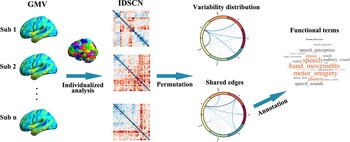
A flowchart of the analysis is shown in Fig. 1. For each disorder, GMV was used to construct an IDSCN. We then obtained the distribution of the difference variability and shared altered edges using permutation testing. Finally, functional annotation was performed to further associate functional and cognitive terms with the altered edges (Fig. 1). Further details are provided in the corresponding sections.
The analysis flowchart. For each mental disorder, we first obtained individualized differential structural covariance network (IDSCN) from the gray matter volume (GMV). In general, for one patient k, the reference of structural covariance network (rSCN) was constructed in healthy controls and patient k and HCs were merged as a ‘new’ perturbed group and a perturbed SCN (pSCN) was built. Finally, the Z scores of differences between the pSCN and rSCN were defined as individualized SCN differences. Then, we obtained the distribution of difference variability and shared altered edges using permutation testing. Finally, to further associate functional/cognitive terms with altered edges, functional annotation was performed to determine related function/cognitive terms.

Obtaining subject-level structural covariance aberrance using the individual differential structural covariance network analysis
The subject-level structural covariance aberrance for each mental disorder patient was calculated using the IDSCN (Liu et al., Reference Liu, Palaniyappan, Wu, Zhang, Du, Zhao and Lin2021). The method was previously described in detail by Liu et al. (Liu et al. Reference Liu, Palaniyappan, Wu, Zhang, Du, Zhao and Lin2021). First, the reference SCN (rSCN) was constructed with matched HCs by calculating the partial correlation among regional GMVs for each pair of brain regions, with age, sex, and total intracranial volume (TIV) treated as covariates. Second, one patient k and HCs were merged as a ‘new’ perturbed group, and a perturbed SCN (pSCN) was built as described in the previous step. Third, the difference (ΔSCN) between pSCN and rSCN was calculated as ΔSCN = pSCN – rSCN. ΔSCN followed a new type of symmetrical distribution, whose tail was similar to that of the normal distribution (Liu, Wang, Ji, Aihara, & Chen, Reference Liu, Wang, Ji, Aihara and Chen2016). Finally, IDSCN was defined as the Z-score of ΔSCN:

Thus, we obtained the IDSCN for patient k, where each edge was the Z-score from the Z-test representing the disturbance introduced by the addition of patient k. A positive Z-score represented a higher strength against the reference HCs and vice versa. Edges that were significantly different from the reference SCN in the patient group were identified according to the Z-score, where p < 0.05, Bonferroni corrected for 268 × 267 ÷ 2 = 35 778 edges.
Distribution of difference variability for each mental disorder
Although the patients demonstrated notable inter-individual variation, the variation was regularly or desultorily distributed and remained unclear. Thus, we investigated the distribution of inter-individual variations in the individualized differential edges for each disorder. A difference in variability value (standard deviation of Z-scores across patients) was used to assess the degree of dispersion for an individualized differential edge among patients with the same disorder. For each disorder, the difference in the variability value was calculated for each edge. The within- and between-network variability values were the average difference variability values of the constituent edges. Networks were defined based on a previous study, in which 268 brain regions were divided into 7 networks (Finn et al., Reference Finn, Shen, Scheinost, Rosenberg, Huang, Chun and Constable2015) (online Supplementary Fig. S5). The significance of the within-/between-network difference variability value was determined with 1000 times permutation testing that generated a random network through the Markov chain algorithm. The false positive was controlled using Bonferroni (p < 0.05) (Maslov & Sneppen, Reference Maslov and Sneppen2002).
Distribution of altered edges for each mental disorder
The common and disease-specific network-level distributions of altered edges were the investigated. For each disorder, the distribution of the shared altered edges was obtained through the following steps. First, significantly increased (or decreased) edges (p < 0.05, Bonferroni corrected) according to the Z-scores for each patient were identified. Second, for each altered edge, the number of affected patients was counted. The top 100 increased (or decreased) edges were identified according to the number of affected patients. Third, the top n edges were divided into within-and between-network communities. Finally, the significance of each community was determined using 1000 permutation tests by generating a random network through the Markov chain algorithm (Maslov & Sneppen, Reference Maslov and Sneppen2002). The results were corrected for multiple comparisons using the false discovery rate (FDR) (p < 0.05). Considering the tremendous heterogeneity of each disorder (see below), a tolerant correction method was adopted.
To investigate the relationship between the subject-level and group-level differential structural covariance networks, a group-level differential structural covariance network was also obtained for each disorder and compared with that for HCs using a two-sample t test. The significance of each edge was determined using a permutation test (1000 permutations). Consequently, significant group-level altered edges were identified (p < 0.05, Bonferroni corrected for 35 778 edges).
Reproducibility analysis
When obtaining the network-level distribution of the differential edges for each disorder, we chose the top 100 edges according to the number of affected patients. The reproducibility of these results was investigated by obtaining the distributions of the differential edges with different parameter selections (top n = 80/120 edges). The main results were reproduced using a different brain atlas [200 brain atlas (Craddock, James, Holtzheimer, Hu, & Mayberg, Reference Craddock, James, Holtzheimer, Hu and Mayberg2012)].
Association between IDSCN and clinical variables
Pearson's correlation analysis between regional aberrance value and symptom scores (HAMD, Y-BOCS or PANSS) was performed, with the regional aberrance value calculated by averaging Z-score of edges attached to it.
Functional annotation analysis for altered structural covariance edges in each mental disorder
To further associate functional/cognitive terms with the distribution of altered edges, functional annotation was performed to determine the related function/cognitive terms for each mental disorder. Functional annotation analysis was based on probabilistic (activation) mapping, supporting quantitative inferences about the association between cognitive processes and brain activity (Neurosynth, https://neurosynth.org/) (Yarkoni, Poldrack, Nichols, Van Essen, & Wager, Reference Yarkoni, Poldrack, Nichols, Van Essen and Wager2011). More than 4000 search terms with activation maps were provided by Nerurosynth. Among these, 217 terms had clear biological significance. The selection criteria were previously described by Cheng et al. (Cheng et al. Reference Cheng, Rolls, Zhang, Sheng, Ma, Wan and Feng2017). After this step, the distribution of the altered edges in each mental disorder was associated with the number of functional/cognitive terms. Functional annotation for these 217 terms was performed, and significance was determined using permutation testing (Liu et al., Reference Liu, Rolls, Liu, Zhang, Yang, Du and Feng2019). In this step, we obtained (both increased and decreased edges) the merged network-level distribution of significantly shared altered edges and performed functional annotation for each disorder. This procedure was performed using the BAT toolbox (BAT, http://123.56.224.61/softwares) (Liu et al., Reference Liu, Rolls, Liu, Zhang, Yang, Du and Feng2019). Functional/cognitive terms with p values <0.05 (permutation testing) were included.
Results
Clinicodemographic characteristics
The four groups showed no significant difference with respect to age and sex. The clinical demographics of all participants are shown in Table 1.
Demographic and clinical characteristics

OCD, obsessive compulsive disorder; Sch, schizophrenia; HC, healthy control; HAMD, Hamilton rating scale for depression; Y-BOCS, Yale–Brown obsessive compulsive scale; PNASS, positive and negative syndrome scale
a χ2 test.
b One-way ANOVA.
Heterogeneity of IDSCNs in patients with mental disorder
Patients with mental disorders exhibited significant heterogeneity with respect to altered edges (p < 0.05, Bonferroni-corrected). The number of altered edges also showed significant individual variability. Specifically, patients with depression had, on average, 235.48 altered edges (±1.36 × 10³); however, at the individual level, the number of altered edges implicated ranged from 0 to 12 839 (0–35.89% of the total 35 778 edges), reflecting significant within-disorder heterogeneity. Patients with OCD had, on average, 191.47 altered edges (1.03 × 10³); at the individual level, the number of altered edges ranged from 0 to 9582 (0–26.79% of the total 35 778 edges). Patients with schizophrenia had, on average, 72.01 altered edges (0.33 × 10³); at the individual level, the number of altered edges implicated ranged from 0 to 3825 (0–10.69% of the total 35 778 edges). Additional details are provided in online Supplementary Table S1 and Fig. S1.
Distribution of difference variability for each disorder
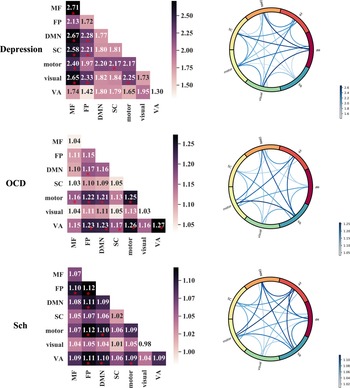
The results showed significant distribution of variability (permutation p < 0.05, Bonferroni-corrected) for each disorder. The three mental disorders shared high variability in edges attached to the frontal network and subcortical-cerebellum network and exhibited disease-specific variability distributions. Specifically, schizophrenia featured high inter-individual variation in edges attached to the frontoparietal network; depression, edges attached to the medial frontal network and frontoparietal network; and OCD, edges attached to the motor and visual networks. The results are shown in Fig. 2.
Distribution of difference variability for each disorder. The heat maps represented network-level difference variability for each disorder. The network-level (within- and between-network) difference variability was defined as the average difference variability values (standard deviation of Z-scores across patients) of constituent edges. The red star meant the permutation test p value <0.05 (FWE corrected). The chord diagrams represented how difference variability (the corresponding heat maps in the left) distributed.
Note: MF, medial frontal network; FP, frontopartial network; DMN, default model network; SC, subcortical-cerebellum network; VA, visual association network.

Distributions of altered edges for each mental disorder
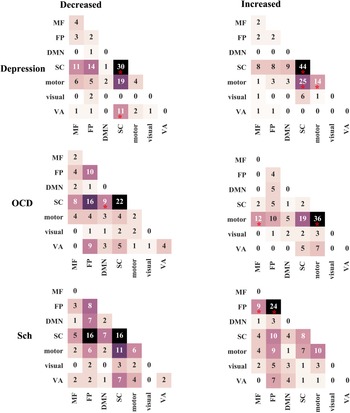
Despite notable inter-individual differences for each edge, patients with the same disorder demonstrated a significant overlap of altered edges at the network level. Specifically, patients with depression shared significantly decreased edges within the subcortical-cerebellum network (n = 30 for the top 100 edges) and decreased edges between the subcortical-cerebellum network and visual association (n = 11 for the top 100 edges). In addition, patients with depression shared significantly increased edges within the subcortical-cerebellum network (n = 44 for the top 100 edges)/motor network (n = 30 for the top 100 edges) and increased edges between the subcortical-cerebellum network and motor network (n = 14 for the top 100 edges). Patients with OCD shared increased edges within the motor network (n = 36 for top 100 edges) and edges between the motor network (n = 36 for top 100 edges) and medial frontal network (n = 12 for top 100 edges) and decreased edges between the frontoparietal network and visual association (n = 9 for top 100 edges). Meanwhile, patients with schizophrenia only shared significantly increased edges within the frontoparietal network (n = 24 for top 100 edges) and edges between the frontoparietal network and the medial frontal network (n = 9 for top 100 edges)/visual association network (n = 7 for top 100 edges). The results are summarized in Fig. 3.
Distribution of most shared altered edges for each disorder. For each disorder, the numbers in heat maps described how top 100 altered (increased or decreased) edges according to the number of affected patients distributed in networks. The red star meant the permutation test p value <0.05 (FDR corrected).
Note: MF, medial frontal network; FP, frontopartial network; DMN, default model network; SC, subcortical-cerebellum network; VA, visual association network.

There were no significantly altered edges at the group level (p < 0.05, Bonferroni corrected for 35 778 edges) in all disorders.
Clinical relevance of IDSCN
In depression, the regional aberrance values of the anterior cingulate cortex were negatively correlated with anxiety/somatization factor scores (r = −0.352, FDR corrected p < 0.001). In OCD, the regional aberrance values of the precuneus were correlated with both obsession (r = 0.243, FDR corrected p = 0.016) and compulsion scores (r = 0.246, FDR corrected p = 0.015). The regional aberrance values of the thalamus (r = −0.250, FDR corrected p = 0.013) were associated with obsession scores. The regional aberrance values of the middle temporal gyrus were associated with compulsion scores (r = 0.243, FDR-corrected p = 0.016). In schizophrenia, the regional aberrance values of the left hippocampus correlated with the general PANSS score (r = 0.210, FDR corrected p = 0.030) (online Supplementary Fig. S2).
Reproducibility results
The distribution of the top 80/120 shared edges exhibited good consistency with the results. More details are provided in online Supplementary Figs S3 and S4. When the main results were reproduced using a different brain atlas, the results exhibited good consistency with those reported previously (online Supplementary Figs S6 and S7), confirming the robustness of our results.
Functional annotation analysis results
Results of functional annotation analysis
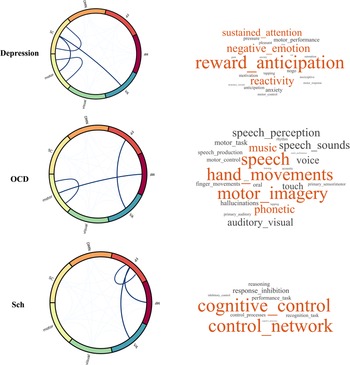
Functional annotation to associate shared altered edges with functional/cognitive terms for each mental disorder showed that differential edges in each disorder were functionally enriched in several functional and cognitive terms. In depression, altered edges were mainly related to functional/cognitive processes, including reward anticipation, negative emotion, sustained attention, and so on. In OCD, altered edges were associated with motor and speech functions. In schizophrenia, altered edges were functionally enriched in the control/inhibition and cognitive processes. More details can be found in Fig. 4. The chord diagrams on the left represent the merged network-level distributions of significantly shared edges. For example, patients with depression shared significantly decreased edges belonging to the subcortical-cerebellum network (SC-SC) and edges linking the subcortical-cerebellum and visual association networks (SC-VA). In addition, they also significantly increased the number of edges within the cerebellum-cortical network (SC-SC)/motor network (motor-motor) and edges linking the cerebellum-cortical network and motor network (SC-motor). All these links are marked with red stars in Fig. 3. The final merged network-level distribution of significantly shared edges was similar to the chord diagram for depression (including edges belonging to SC-SC, SC-motor- motor-motor, and SC-VA) (Fig. 4).
Functional annotation analysis results. The left chord diagrams represented the merged network-level distribution of significantly shared edges. For example, patients with depression significantly shared decreased edges belonging to the subcortical-cerebellum network (SC-SC) and edges linking the subcortical-cerebellum network and visual network (SC-VA). In addition, they also significantly increased edges within the cerebellum-cortical network (SC-SC)/motor network (motor-motor) and edges linking the cerebellum-cortical network and motor network (SC-motor). All these links were marked with red star in Fig. 3. Thus, the final merged network-level distribution of significantly shared edges was just like chord diagram for depression (including edges belonging to SC-SC, SC-motor- motor-motor and SC-VA). The right word cloud represented the associated functional/cognitive terms where the size of word was proportional to 1/permutation p.
Note: MF, medial frontal network; FP, frontopartial network; DMN, default model network; SC, subcortical-cerebellum network; VA, visual association network.

Discussion
This study used IDSCN to calculate differences in subject-level structural covariance among patients with mental disorders. Then, for each disorder, we elaborated on the distribution of the difference variability and network-level distribution of the most shared altered edges. The three main findings were as follows. First, patients with mental disorders exhibited notable heterogeneity with respect to differential edges that were otherwise obscured by group-level analysis. Second, mental disorders shared high difference variation in edges attached to the frontal network and subcortical-cerebellum network while demonstrating disease-specific distributions of difference variability. Third, despite the notable heterogeneity at each edge, patients with the same disorder shared communities of altered edges at the network level. Specifically, patients with depression shared differential edges attached to the subcortical-cerebellar network. Patients with OCD shared edges linking the subcortical-cerebellum and motor networks, and patients with schizophrenia shared edges related to the frontal network.
The three mental disorders exhibited tremendous heterogeneity with respect to differential structural covariance edges. To our best knowledge, this study was the first to investigate differences in individualized structural covariance in the three common mental disorders based on their relation to altered trajectories of brain development in distributed brain regions and inter-regional connections (Kaiser et al., Reference Kaiser, Andrews-Hanna, Wager and Pizzagalli2015; Lima-Ojeda et al., Reference Lima-Ojeda, Rupprecht and Baghai2018; Yun et al., Reference Yun, Boedhoe, Vriend, Jahanshad, Abe, Ameis and Kwon2020). Consistent with previous findings, our results showed that the three mental disorders exhibited tremendous inter-individual variation with respect to subject-level altered edges. Previously, sources of heterogeneity in neuroimaging studies have been attributed to multifactorial factors such as medicine status, comorbidity, and differences in acquisition protocols (Schmaal et al., Reference Schmaal, Veltman, van Erp, Sämann, Frodl, Jahanshad and Tiemeier2016). The current study showed that although these factors were well-controlled, patients with mental disorders still exhibited tremendous inter-individual heterogeneity. These results suggested that the high heterogeneity in disturbed coordinated neurodevelopmental trajectories was inherent to mental disorders.
Furthermore, we identified the shared and distinct distributions of variability in mental disorders. The three disorders shared high variation in distributed brain networks, including the medial frontal network, frontoparietal network, and default model network. Most of the involved brain regions are located in the association cortex, which matures throughout adolescence and young adulthood (Toga, Thompson, & Sowell, Reference Toga, Thompson and Sowell2006). Disturbed neurodevelopment trajectories of these brain regions during this critical period was hypothesized to be the common neuropathology of mental disorders (Kaiser et al., Reference Kaiser, Andrews-Hanna, Wager and Pizzagalli2015; Lima-Ojeda et al., Reference Lima-Ojeda, Rupprecht and Baghai2018; Moberget et al., Reference Moberget, Doan, Alnæs, Kaufmann, Córdova-Palomera, Lagerberg and Westlye2018; Sotiras et al., Reference Sotiras, Toledo, Gur, Gur, Satterthwaite and Davatzikos2017; Yun et al., Reference Yun, Boedhoe, Vriend, Jahanshad, Abe, Ameis and Kwon2020). However, despite the similarity, the three mental disorders also exhibited disease-specific patterns of variability, possibly accounting for conflicting neuroimaging findings. For example, schizophrenia was characterized by high inter-individual variation of edges attached to the frontoparietal network, which was implicated in top-down regulation of attention and emotion (Zhou et al., Reference Zhou, Liang, Jiang, Tian, Liu, Liu and Kuang2007). Higher functional and structural variability of this network had been reported in schizophrenia (Brugger & Howes, Reference Brugger and Howes2017; Sun et al., Reference Sun, Liu, Ma, Duan, Wang, Xu and Xia2021) and clinically high-risk individuals (Antoniades et al., Reference Antoniades, Haas, Modabbernia, Bykowsky, Frangou, Borgwardt and Schmidt2021). As for depression, edges attached to the medial frontal and frontoparietal networks exhibited significantly high variability. Brain regions in these networks also demonstrated conflicting structural changes, especially in the hippocampus and medial frontal gyrus (Eker & Gonul, Reference Eker and Gonul2010; Malykhin, Carter, Seres, & Coupland, Reference Malykhin, Carter, Seres and Coupland2010; Schmaal et al., Reference Schmaal, Hibar, Sämann, Hall, Baune, Jahanshad and Tiemeier2017). As for OCD, neuroimaging studies had shown conflicting findings of reduced, increased, and unchanged gray matter volumes (Lázaro et al., Reference Lázaro, Castro-Fornieles, Cullell, Andrés, Falcón, Calvo and Bargalló2011; Okasha et al., Reference Okasha, Rafaat, Mahallawy, El Nahas, El Dawla, Sayed and El Kholi2000). The high heterogeneity offered a potential explanation for the high heterogeneity of clinical symptoms and compelling findings of neuroimaging studies of mental disorders (Giraldo-Chica, Rogers, Damon, Landman, & Woodward, Reference Giraldo-Chica, Rogers, Damon, Landman and Woodward2018; Han, Xu, Guo, Fang, & Wei, Reference Han, Xu, Guo, Fang and Wei2022; Tu, Lee, Chen, Li, & Su, Reference Tu, Lee, Chen, Li and Su2013). Heterogeneity was hypothesized to originate from multifaceted factors, such as gene-environment interaction, clinical heterogeneity, and factors secondary to illness (Alnæs et al., Reference Alnæs, Kaufmann, van der Meer, Córdova-Palomera, Rokicki, Moberget and Westlye2019). Collectively, these results suggested potential implications of differences in the understanding of neural substrates of mental disorders.
Despite notable inter-individual heterogeneity, patients with the same disorder shared disease-specific communities with altered edges. At the edge level, the inter-individual variation was extremely large that only a handful of patients shared one altered edge. However, patients with the same disorder showed significantly shared differential edges at the network level. Patients with depression share differential edges attached to the network in charge of emotion regulation and stimulus evaluation in the human brain (Phillips, Drevets, Rauch, & Lane, Reference Phillips, Drevets, Rauch and Lane2003; Phillips, Ladouceur, & Drevets, Reference Phillips, Ladouceur and Drevets2008). The imbalanced interaction between them is responsible for the negative cognitive bias and stress-system dysfunction in depression (Albert & Newhouse, Reference Albert and Newhouse2019) and plays an essential role in the pathology of depression (Gong et al., Reference Gong, Wang, Qiu, Chen, Luo, Wang and Wang2020). Regarding schizophrenia, our results suggest that most patients shared a common feature of altered edges among frontal brain networks. As a key characteristic of schizophrenia, cognitive impairment can better predict long-term functional outcomes than severity of psychotic symptoms (Minzenberg & Carter, Reference Minzenberg and Carter2012). Moreover, cognitive dysfunction in schizophrenia typically precedes the onset of psychotic symptoms (Fusar-Poli et al., Reference Fusar-Poli, Deste, Smieskova, Barlati, Yung, Howes and Borgwardt2012) and is seen in unaffected first-degree relatives of patients with schizophrenia. This potentially reflects an early phenotype of brain changes associated with an elevated risk of schizophrenia (Snitz, Macdonald, & Carter, Reference Snitz, Macdonald and Carter2006; Unschuld et al., Reference Unschuld, Buchholz, Varvaris, van Zijl, Ross, Pekar and Schretlen2014). Although patients with schizophrenia experience deficits in various cognitive skills, their attention and working memory are particularly affected (Unschuld et al., Reference Unschuld, Buchholz, Varvaris, van Zijl, Ross, Pekar and Schretlen2014). In schizophrenia, shared increased edges attached to the frontal network might be due to the disturbed hierarchical organization of the prefrontal cortex (Pomarol-Clotet et al., Reference Pomarol-Clotet, Canales-Rodríguez, Salvador, Sarró, Gomar, Vila and McKenna2010) as a compensatory mechanism for the related dysregulation of inhibitory brain circuits (Marín, Reference Marín2012). In OCD, the shared differential edges might be related to deficits in visual processing (Gonçalves, Marques, Lori, Sampaio, & Branco, Reference Gonçalves, Marques, Lori, Sampaio and Branco2010) and motor response inhibition in patients and their first-degree relatives (Chamberlain, Fineberg, Blackwell, Robbins, & Sahakian, Reference Chamberlain, Fineberg, Blackwell, Robbins and Sahakian2006; de Wit et al., Reference de Wit, de Vries, van der Werf, Cath, Heslenfeld, Veltman and van den Heuvel2012; Menzies et al., Reference Menzies, Achard, Chamberlain, Fineberg, Chen, del Campo and Bullmore2007; Tomiyama et al., Reference Tomiyama, Murayama, Nemoto, Tomita, Hasuzawa, Mizobe and Nakao2022).
In general, while traditional case–control studies identified group-level differences, our results provide unique insights into the neural substrates of mental disorders at the individual level. First, the IDSCN uncovered individualized differences that would otherwise have been missed by group-level statistical designs. Patients with mental disorders exhibit well-accepted inter-individual heterogeneity, which often leads to discordant and even totally opposing differential patterns of neuroimaging characteristics (Chand et al., Reference Chand, Dwyer, Erus, Sotiras, Varol, Srinivasan and Davatzikos2020; Han et al., Reference Han, Xu, Guo, Fang and Wei2022; Liu et al., Reference Liu, Palaniyappan, Wu, Zhang, Du, Zhao and Lin2021). Our results revealed noticeable inter-individual heterogeneity and identified opposing patterns of differential edges (especially for depression, where both increased and decreased edges were found in the subcortical-cerebellum network). These results explain, in part, the conflicting structural aberrances observed in mental disorders. Second, our results suggest that structural covariance aberrance could be highly heterogeneous and preserved across patients with mental disorders. These results challenge the empirical notion that brain regions showing lower variability across patients are the core systems involved in the biological processes underlying mental disorders (Brugger & Howes, Reference Brugger and Howes2017). The current study results suggest that this notion is not true in the context of subject-level aberrance (e.g. structural covariance could be increased in some patients and decreased in others simultaneously). The results indicate that investigating individualized aberrance will provides new insights into the pathology of mental disorders.
This study has some limitations that must be acknowledged. First, our results were obtained in a single dataset; the results need to be confirmed in more than one dataset and other comparable methods (e.g. normative modeling). Second, clinical data for the patients with mental disorders were insufficient, and thus, the association between individualized structural aberrance and clinical phenomena (e.g. obsessive dimensions for OCD) could not be analyzed in depth. Future studies should collect longitudinal data to investigate the mechanisms by which individualized altered edges change as the disease progresses and the effects of treatment on individualized aberrance. Third, factors such as body mass index and alcohol/cigarette use were not recorded in this study. Future studies should investigate their effects on individualized differential structural covariance. Fourth, all patients were aged <36 years. Investigating individualized aberrance in a broader age range or even across the lifespan would help depict individual developmental trajectories. Finally, as the educational level of schizophrenia patients was unknown, we could not systematically evaluate its effect on our results. For depression and OCD, we did not observe any significant correlation between the average strength of structural covariance showing differences compared with HCs and educational level.
Conclusion
To resolve the heterogeneity in mental disorders, this study performed an individualized differential structural covariance analysis to obtain subject-level structural covariance aberrance. The heterogeneity and patterns of altered structural covariance in depression, OCD, and schizophrenia were systematically analyzed. These mental disorders demonstrated notable inter-individual heterogeneity in subject-level structural aberrance. In addition, common and disease-specific variability distributions were observed across the three disorders. However, despite this variability, patients with the same disorders shared disease-specific communities with altered edges. The results suggested that structural covariance aberrance can be both highly heterogeneous and preserved across patients with mental disorders. These results provide insights into heterogeneity in mental disorders and facilitate individualized diagnosis and intervention.
Supplementary material
The supplementary material for this article can be found at https://doi.org/10.1017/S0033291723000302.
Financial support
This research study was supported by the Natural Science Foundation of China (81601467, 81871327, 62106229) and Medical science and technology research project of Henan province (201701011, SBGJ202102103, SBGJ202101013) and China Postdoctoral Science Foundation (2022M712890).
Conflict of interest
All authors declared no conflict of interest and approve to submit this manuscript.