Introduction
The humanitarian “rules of war,” delineated by the Geneva Conventions and the Rome Statute of the International Criminal Court, enforce protections for health facilities and health care workers during armed conflicts. Reference Gostin and Rubenstein1 These safeguards have been breached on multiple occasions during several recent armed conflicts. The full-scale Russian invasion of Ukraine, which was launched on February 24, 2022, is no exception to this worrisome trend. Reference Barten, Tin, Granholm, Rusnak, van Osch and Ciottone2 As of October 2024, the Surveillance Systems for Attacks on Health Care (SSA) of the World Health Organization (WHO; Geneva, Switzerland) contained 2,047 attacks on health care in Ukraine since the Russian invasion began. Attacks on health care should be regarded as potential war crimes. 3 Regrettably, accountability for violence against health care is challenged by inherent structural constraints within the United Nations Security Council (New York USA) and the absence of enforcement mechanisms that can be used by international prosecutorial authorities. Reference Hakki, Stover and Haar4 Furthermore, war crime prosecutions of suspected deliberate attacks on health care facilities require proof that they were the intended target, which is extremely challenging. Reference Gostin and Rubenstein1,Reference Heisler, Kovtonyuk and De Vos5 As a result, attacks on health facilities and medical staff in conflict zones often end with impunity – a grim reality that should be reversed. Reference Gostin and Rubenstein1 If health care facilities are attacked more than once, this may increase the likelihood of intent. The Ukrainian Healthcare Center (UHC; Kyiv, Ukraine) began collecting, verifying, and documenting attacks on health care infrastructure since the full-scale Russian invasion of Ukraine began. In this study, the aim was to assess repetitive attacks on Ukrainian health care facilities from February 24, 2022 through October 24, 2023.
Methods
The UHC is based in Kyiv, Ukraine. Before the full-scale Russian invasion of Ukraine, UHC mainly offered consultancy, analytics, and educational services. 6 The documentation of health care attacks was commenced by UHC in February 2022 when Russia launched its full-scale invasion of Ukraine. For the aim of this study, health care attacks that occurred from February 24, 2022 through October 24, 2023 were assessed. The UHC database was used in a previous study which assessed attacks on Ukrainian health care facilities during the first 12 months of the full-scale Russian invasion of Ukraine. Reference Barten, Tin, Granholm, Rusnak, van Osch and Ciottone2 In contrary, this present study entails a 20-month cohort and is particularly focused on repetitive attacks.
Data Collection
The methodology UHC used to document each health care attack has been comprehensively reported elsewhere. Reference Barten, Tin, Granholm, Rusnak, van Osch and Ciottone2 Briefly, the Berkeley Protocol on Digital Open Source Investigations (Human Rights Center at the University of California, Berkeley, School of Law; Berkeley, California USA) was applied to document attacks on Ukrainian health care facilities through open sources, including news media, social media platforms (Facebook [Meta Platforms; Menlo, California USA], Twitter [Twitter Inc.; San Francisco, California USA], Instagram [Meta Platforms], Telegram [Dubai, United Arab Emirates], and YouTube [Google Corp.; San Bruno, California USA]), designated government websites, eyewitness reports, and on-site, in-person visits. The Berkeley protocol adheres to international guidelines for online assessment of alleged violations of international criminal, human rights, and humanitarian law, with the involvement of United Nations representatives in the verification procedure. 7 To improve comprehensiveness, supplementary cross-checking was performed with existing databases that collect information on health care attacks, including those preserved by Médecins Sans Frontières (MSF; Geneva, Switzerland), Insecurity Insight (Geneva, Switzerland), and the Ministry of Health of Ukraine (MoH; Kyiv, Ukraine). Variables that were collected included: facility type and name, geographical coordinates, pictorial evidence, eyewitness testimonies (both audio and chats, including email conversations and messaging logs from social media networks like WhatsApp [Meta Platforms] and Viber [Rakuten; Tokyo, Japan]), photos or audio recordings from on-site visits, satellite image analysis, and the reported amount of health care staff that were injured and killed.
A health care facility was defined as a principal health system institution employed by nurses and/or physicians. Military (non-civilian) health care facilities, midwife points or rural feldshers (principal health care access in remote Ukrainian regions, where basic health care services are delivered by intermediate health practitioners with interchangeable education and clinical responsibilities as those of nurse practitioners: “feldshers”), recreational facilities, and pharmacies were excluded from this analysis. Any method of physical violence or obstruction that affects the accessibility and delivery of health care was defined as a health care facility attack. A facility was deemed damaged if it was still (partly) functional after one or more attacks, and a facility was regarded as being destroyed if it was completely non-functional as a result. Weapon and attack types were characterized according to the Explosive Weapons Monitor. 8
For inclusion in this study, attacks on health care had to be documented by multiple sources within one or more of the following “source categories,” or confirmed by at least one “definite” source (ie, satellite imagery). Corroborating evidence was classified into four source categories: (1) news media reports about the attack – which includes social media posts; (2) graphic evidence – photo(s) or video(s) of damage to health care facilities; (3) eyewitness testimonies, including messaging logs from social media such as WhatsApp and Viber, or information collected via phone calls; and (4) satellite imagery – damage or destruction of the facility evidenced by satellite imagery analysis.
Data Analysis
Data were collected into a Google spreadsheet (Google Inc.; Mountain View, California USA) and were subsequently categorized and analyzed based on collected variables, including date of the attack, geographic location, facility type, weapons used, injury and death rates of civilians and health care staff, and whether the facilities were damaged or destroyed as a result of the attack(s). Only baseline characteristics were provided for health care facilities that were targeted once. Health care facilities that sustained repetitive attacks were the subject of further study and analyzed descriptively.
Ethical approval of this study was waived by the medical-ethical review board of Maastricht University Medical Center (Maastricht, The Netherlands; 2022-3518).
Results
During the first 20 months of the full-scale Russian invasion of Ukraine, there were 397 attacks on 281 Ukrainian health care facilities, damaging 237 facilities and destroying another 44. Fifty-three facilities (18.9%) were attacked more than once (total: 163 attacks; mean 3.1; median 2; range 2-10 attacks), and 27.7% of all health care attacks (110/397) concerned repeat attacks. The majority of repetitive strikes took place during the first three months of the war, which is in line with the overall temporal trend of health care attacks since the full-scale invasion of Ukraine was launched.
Types of health care facilities that were repeatedly attacked are shown in Table 1. General hospitals experienced the highest incidence of repeated attacks, constituting nearly one-half of all facilities subjected to multiple assaults. Maternity and children’s hospitals, as well as Emergency Medical Service facilities, were also frequently targeted more than once.
Baseline Characteristics of Health Care Facilities that were Repeatedly Attacked

Note: Emergency Medical Services facilities includes Emergency Aid and Disaster Medicine Centers, Emergency Medical Services stations, and Emergency Medical substations.
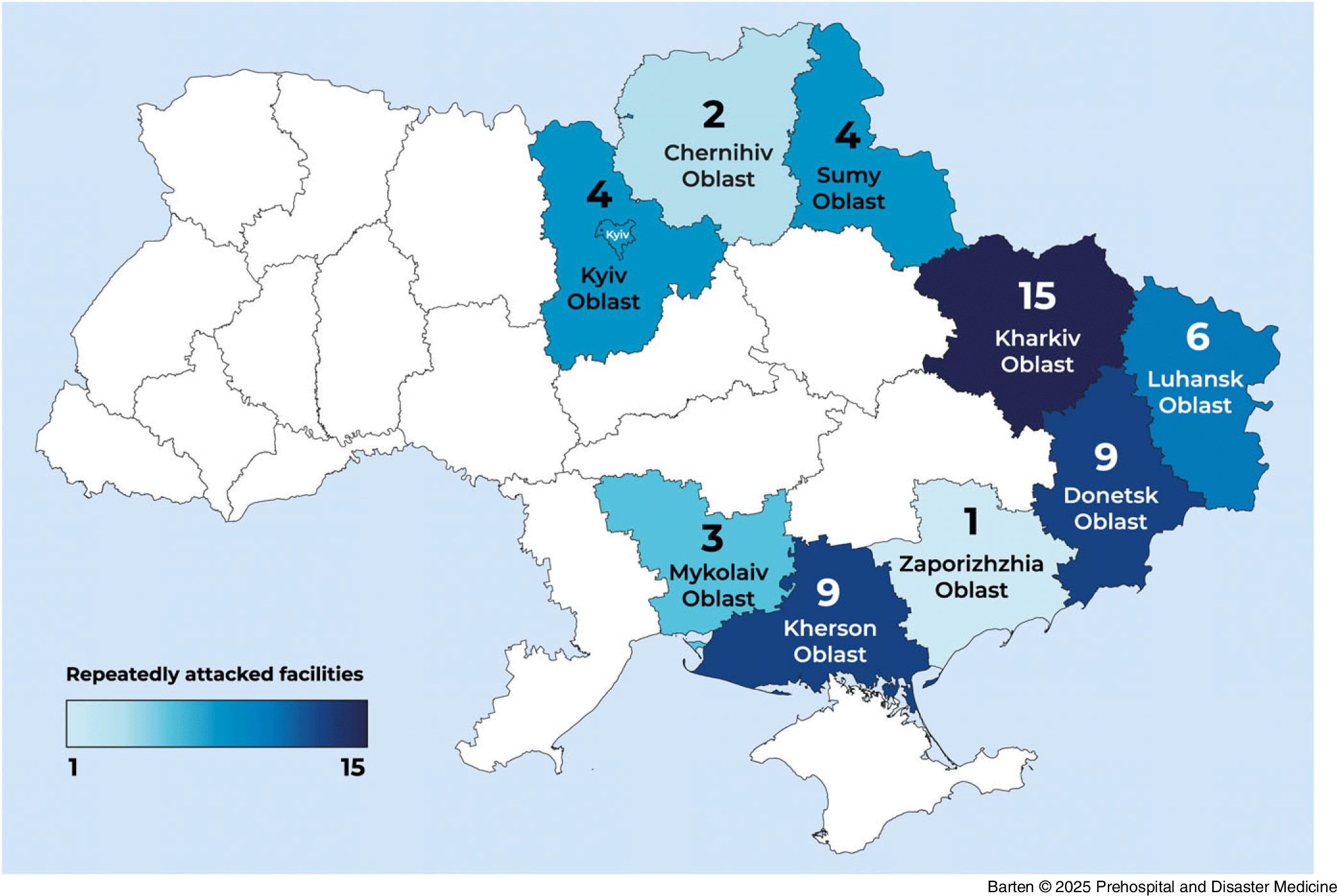
The median time between attacks was 18 days (range: 0-289 days), as shown in a scatter plot diagram (Figure 1). The total number of casualties in the facilities that were repeatedly attacked included 57 injured persons and 22 fatalities. The majority of attacks took place in the Southern and Eastern Ukrainian oblasts, as show in Figure 2. Heavy weaponry was employed in almost all of the attacks.
Scatter Plot Diagram of Repetitive Attacks.

Map of Health Care Facilities Repeatedly Attacked in Ukraine Oblasts.

Discussion
In any armed conflict, it is a joint responsibility of all involved parties to guarantee and uphold the protection of health care workers and health facilities. Unfortunately, attacks on health care are increasingly common in armed conflicts and hybrid wars. In efforts to end impunity, improved surveillance and reporting of health care attacks remain critical. Reference Meier, Rice and Bandara9 In this study, it was observed that one-in-five targeted health care facilities in Ukraine experienced repetitive attacks. Furthermore, almost one-third of all health care attacks involved recurrent attacks. This observed pattern raises the possibility that health care facilities in Ukraine are being intentionally targeted.
Unintentional collateral damage is expected to occur more frequently with larger hospitals as compared to smaller facilities, simply because a larger surface is more likely to be coincidentally hit than a smaller surface. However, a study on health care damage in Mariupol concluded that facility size was not associated with damage. The authors therefore suggested that health care facilities in this Ukrainian city were intentionally targeted. Reference Poole, Andersen and Raymond10 It may happen that single attacks on military objectives cause incidental damage to civilians or civilian objects, although they may raise doubts as to their lawfulness. However, in case of repeat attacks, with all or most of them falling within the gray area between legality and unlawfulness, it could be concluded that the cumulative effect of such attacks implies that some of the impacts must be considered intentional. Reference Hakki, Stover and Haar4 In line with this reasoning, repetitive health care attacks may be associated with a larger-scale policy of intentional attacks on health care. The same logic applies to “double-tap” attacks targeting rescue workers and indiscriminate or even deliberate attacks on energy facilities, nuclear power plants, or food and water supplies, which have indirect but potentially severe effects on health care provision. Reference Granholm, Tin and Ciottone11 Furthermore, erroneous strikes on health care facilities are becoming less likely with the increasing capabilities and accuracy of missiles and unmanned aerial vehicles. Reference Tin, Kallenborn, Hart, Hertelendy and Ciottone12
Limitations
With regards to this study, there are several limitations to report. As the UHC database relies on verified evidence only, the numbers observed in this research represent a cautious estimate of attacks on health care during the study period. Furthermore, the UHC database is prone to selective reporting, similar to other data collection incentives. The inclusion or exclusion of certain incidents may be caused by restricted access, inadequate data, unavailable internet connections, and other constraints. Notably, events that occurred in areas directly or previously occupied by Russia were irregularly or even rarely reported, which may have led to an incomplete portrayal of the extent of violence in these particular territories.
During on-site visits, efforts were made to gather comprehensive evidence about the incidents. Most of these visits transpired at least one month after the territories were liberated, which could have impacted damage estimations and the quantity of evidence collected.
While the UHC database only documents attacks on fixed (core) health care facilities, attacks on other vital components of the health system, such as pharmacies, ambulances, and medical warehouses or logistics, are also included by some other databases. This somewhat “skewed” focus has resulted in a lower count of attacks during similar timeframes as compared to other health care attack databases, such as the WHO and MoH databases. Nonetheless, the focus of this database on attacks on fixed health care facilities was intentionally chosen in order to create a better understanding of safety issues for hospitals and primary care clinics in conflict settings. Furthermore, the documentation of attacks on non-fixed health system components, such as Emergency Medical Services and medical transports, is generally more time-sensitive with regards to evidence collection. Next, proof of damage in the form of satellite imagery is rarely available. Verification of attacks on these non-fixed health care facilities is therefore more complicated and probably more prone to missed events. Finally, only civilian health care infrastructure was included in the database, which means that military medical facilities were excluded. Although such military facilities play an important role in health care during armed conflicts, Reference Kazmirchuk, Yarmoliuk and Lurin13 information about attacks on military hospitals remains largely undisclosed.
Notwithstanding the aforementioned limitations, the UHC database that was used for the present study is likely the most detailed dataset of attacks on fixed health care facilities during the Russia-Ukraine War. Summary estimates of health care damage and destruction are typically readily available for several armed conflicts. However, these estimations are generally short of a meticulously described methodology, well-defined period of time, and detailed (and verified) location data. Therefore, estimate disparities may vary widely. Reference Haar, Read and Fast14
Conclusion
From February 24, 2022 through October 24, 2023, one-in-five targeted health care facilities in Ukraine experienced repetitive attacks. Furthermore, one-in-four health care attacks concerned recurrent attacks. This observed pattern raises the possibility that health care facilities in Ukraine are being intentionally targeted.
Author Contributions
DB was responsible for the conceptualization of the study. DR, DT, and FvO provided advice on the study design. DB and DR managed the data and performed data analyses. DB drafted the manuscript. DR, DT, FvO, GC, and FG provided feedback and contributed substantially to the final version of this manuscript. All authors read and approved this manuscript.
Conflicts of interest/funding
The authors attest the original nature of the material and not to have any financial or other relationships that could be construed as a conflict of interest. The authors received no funding for this work.