Most individuals start to drink sometime during adolescence. In the United States, for example, the initiation of alcohol use typically occurs in midadolescence and escalates rapidly thereafter (Faden, Reference Faden2006). Based on data from the Monitoring the Future study (O'Malley, Johnston, & Bachman, Reference O'Malley, Johnston and Bachman1998), the rate of any instance use of alcohol increases from approximately 50% among 8th graders to 72% in 10th graders and 82% in 12th graders. Although alcohol use in adolescence may in some cases be considered a “normal” feature of youthful experimentation (cf. Shedler & Block, Reference Shedler and Block1990), there is growing evidence that it is far from benign. We know, for example, that early use of alcohol is a strong predictor of risk of alcoholism (Grant & Dawson, Reference Grant and Dawson1997) as well as other substance abuse, mental health, and social problems in adulthood (McGue, Iacono, & Krueger, Reference McGue, Iacono and Krueger2006; McGue, Iacono, Legrand, & Elkins, Reference McGue, Iacono, Legrand and Elkins2001). We also know that adolescent alcohol use is typically seen in conjunction with the use and abuse of other drugs (Brener & Collins, Reference Brener and Collins1998; Jessor, Reference Jessor1991; Jessor & Jessor, Reference Jessor and Jessor1977) along with the generalized expression of other indices of disinhibited behavior (Iacono, Carlson, Taylor, Elkins, & McGue, Reference Iacono, Carlson, Taylor, Elkins and McGue1999; Krueger, Markon, Patrick, & Iacono, Reference Krueger, Markon, Patrick and Iacono2005; Sher & Trull, Reference Sher and Trull1994). There is a need to understand the origins of adolescent drinking behavior as well as the mechanisms that underlie the association of adolescent drinking with other substance use and behavioral pathologies. Models of gene–environment interplay may be especially helpful in this regard (Rutter, Pickles, Murray, & Eaves, Reference Rutter, Pickles, Murray and Eaves2001; Rutter & Silberg, Reference Rutter and Silberg2002).
Mendelian Randomization: Exploring the Association of Adolescent Drinking With Other Indices of Disinhibited Behavior
Adolescent disinhibited behavior is evident in the use and misuse of nicotine, alcohol, and illicit substances, as well as in manifestations of antisociality such as antisocial behavior and delinquency. At present, evidence related to the etiology of the association among the multiple indicators of adolescent disinhibited behavior is not comprehensive enough to support any single explanation exclusively. A variety of theoretical perspectives propose to account for the construct of disinhibition, with varying degrees of overlap between them (Nigg, Reference Nigg2000). One possibility is that a heritable dimension of vulnerability exists underlying risk for engaging in diverse aspects of disinhibited behavior (Krueger et al., Reference Krueger, Hicks, Patrick, Carlson, Iacono and McGue2002; Young, Stallings, Corley, Krauter, & Hewitt, Reference Young, Stallings, Corley, Krauter and Hewitt2000). Alternatively, the gateway hypothesis provides a framework to account for the associations among multiple indicators of adolescent disinhibited behavior by positing that earlier use of substances such as marijuana, alcohol, and cigarettes, acts as a causal factor in later development of a broad spectrum of maladaptive behaviors, especially the use of “harder” drugs (e.g., cocaine, heroin; Kandel, Yamaguchi, & Chen, Reference Kandel, Yamaguchi and Chen1992) and socially disinhibited or maladjusted behavior (Hays & Ellickson, Reference Hays and Ellickson1996; Kandel et al., Reference Kandel, Johnson, Bird, Weissman, Goodman and Lahey1999). The substance most often studied as a possible gateway drug is marijuana (Kandel, Yamaguchi, & Klein, Reference Kandel, Yamaguchi and Klein2006), but both cigarettes and alcohol are also among the substances considered as potential causal precursors to later substance use (Kandel & Yamaguchi, Reference Kandel and Yamaguchi1993; Kandel, Yamaguchi, & Chen, Reference Kandel, Yamaguchi and Chen1992) or other disinhibitory behavioral problems (Bachman & Peralta, Reference Bachman and Peralta2002). The gateway hypothesis well describes the sequence of the progression of substance use and behavior across time; it is unusual for an individual to use “hard” drugs (e.g., cocaine) without having first used one or more putative gateway substances (Yamaguchi & Kandel, Reference Yamaguchi and Kandel1984). Yet, it is more difficult to gauge the soundness of the causal progression postulated by the gateway hypothesis. Studies advocating the existence of a gateway effect based on sequential stages of drug involvement, in which use of licit substances like cigarettes and alcohol is the first (Kandel & Yamaguchi, Reference Kandel and Yamaguchi1993), have been criticized for their failure to establish convincing evidence that these substances actually cause progression to further substance use (Golub & Johnson, Reference Golub and Johnson1998; Peele & Brodsky, Reference Peele and Brodsky1997).
To conclude that the use of alcohol actually has a hand in causing future outcomes using nonexperimental data only would require control for all potentially confounding factors, an extremely difficult proposition. Any number of factors, either environmental or heritable, could explain away the observed associations. Further, even if confounds are adequately controlled, it is possible that the sequence of initiation may not tell the whole story of causal direction. Alternatively, the causal effect of adolescent drinking could be assessed experimentally, although the challenges associated with undertaking a large-scale intervention trial makes this a difficult option for testing the gateway hypothesis.
Mendelian randomization is a potentially useful epidemiological tool for testing causal hypotheses that takes advantage of the random independent assortment of alleles during meiosis. In cases where both the pathway from genotype to phenotype is relatively well understood and the gene in question has functionally varying alleles, allele status can be used as a naturally randomized proxy for the behavioral differences that emerge from it. That is, groups defined by allelic variants of a polymorphism known to affect variation (“exposure”) in some intermediate phenotype (such as drinking behavior) can be used to study the effect of variation in that phenotype on some other phenotype (“disease”) putatively related to the first. This is useful for eliminating confounding factors or helping to establish causal direction between an environmental exposure and a phenotypic outcome (Davey Smith & Ebrahim, Reference Davey Smith and Ebrahim2005).
The existence of known specific genetic influences on alcohol metabolism provides the bases for a Mendelian randomization test of the gateway hypothesis. Acetaldehyde is the primary product of the first stage of alcohol metabolism; it is much more toxic than the alcohol from which it is derived (Brien & Loomis, Reference Brien and Loomis1983). The aldehyde dehydrogenase (ALDH) family of enzymes, ALDH2 in particular, contains the most important agents for the metabolism of acetaldehyde to less toxic acetate. A variant form of the ALDH2 allele exists, ALDH2*2, which imparts greatly reduced ALDH2 enzyme activity. The dominant mutant ALDH2*2 variant of the gene is practically unknown in populations other than those of East Asians, in which as much as 50% of the population carries at least one copy of the variant (Goedde et al., Reference Goedde, Agarwal, Fritze, Meier-Tackmann, Singh and Beckmann1992). Individuals heterozygous for ALDH2*2 have less than 10% of the ALDH function of those homozygous for the wild allele (Wang, Nakajima, Kawamoto, & Honma, Reference Wang, Nakajima, Kawamoto and Honma2002), and homozygous carriers of ALDH2*2 have extremely low to totally absent oxidization of acetaldehyde by the ALDH enzyme.
ALDH2 enzyme deficiency results in the accumulation of acetaldehyde in the blood and organs of affected individuals after drinking, which produces a variety of dysphoric symptoms such as facial flushing, increased heart rate, and nausea (Lee et al., Reference Lee, Lee, Jung, Yi, Jung and Yoon2001) so as to provoke an aversive response to alcohol. The dysphoria that accompanies drinking in ALDH2*2 carriers provides a protection against the development of alcoholism. Among East Asians, ALDH2*2 is far less common in alcoholics than nonalcoholics (Higuchi et al., Reference Higuchi, Matsushita, Masaki, Yokoyama, Kimura and Suzuki2004), and individuals with an ALDH2*2 allele drink less often and consume smaller quantities of alcohol when they do drink (Takeshita, Morimoto, Mao, Hashimoto, & Furuyama, Reference Takeshita, Morimoto, Mao, Hashimoto and Furuyama1994). Although the risk for development of alcohol related psychopathology is experienced universally to varying degrees, no other known single polymorphism effects such substantial protection against the potentially adverse psychological impact of alcohol use.
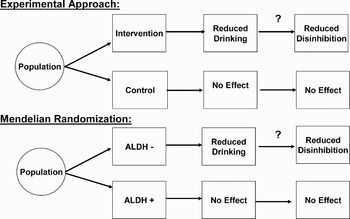
Using Mendelian randomization, we can make use of any naturally occurring differences in drinking behavior between people who carry the deficient ALDH2 allele and those who do not to test the gateway hypothesis (Figure 1). The ALDH2 deficient allele has been repeatedly observed, using a variety of different measures of alcohol use, to result in diminished use relative to the wild-type allele, and the mechanism by which ALDH2 deficiency is presumed to produce this effect (the buildup of unmetabolized acetaldehyde) is relatively well understood. The ALDH2 gene is also expressed only in liver, so it is highly unlikely that it has a direct influence on nondrinking behavioral phenotypes. Therefore, it should be possible to use ALDH2 allele status to examine outcomes that are hypothesized to be caused by alcohol use, abuse, or dependence (such as the use of other substances and the development of other disinhibitory behaviors), thereby sidestepping the myriad environmental confounds, questions of causal direction, and other biases that plague observational studies. In this way ALDH2 allele status can be perceived as directly analogous to assignment to randomized controlled treatment groups in an experimental study: if the gateway theory is correct, we expect that individuals who are ALDH deficient would not only drink less often, but they would also use other substances less and show less disinhibited behavior relative to individuals who did not inherit ALDH deficiency.
Mendelian randomization as an alternative to a true experiment for testing the gateway hypothesis. An experiment involves randomizing adolescents to intervention and control groups, documenting that the intervention had the expected effect on adolescent drinking, and then determining whether the intervention group experienced correlated reductions on other indicators of adolescent disinhibition. In Mendelian randomization, random assignment occurs at meiosis when some individuals inherit a deficient form of the aldehyde dehydrogenase 2 (ALDH2) enzyme and others do not. Those who are ALDH2 deficient are expected to drink less; a test of the gateway hypothesis is then made by determining whether they also show reductions in other indicators of adolescent disinhibition.

Gene–Environment Models of Adolescent Alcohol Use and Abuse
Both genetic and environmental factors clearly influence differences in adolescent drinking behavior (Heath & Martin, Reference Heath and Martin1988; Hopfer et al., Reference Hopfer, Timberlake, Haberstick, Lessem, Ehringer and Smolen2005). ALDH2 deficiency may also provide a model system for exploring models of gene–environment interplay. The protection against drinking behavior granted by ALDH2 deficiency is by no means absolute. Some individuals with ALDH2 deficiency become alcoholic (Higuchi, Matsushita, Muramatsu, Takagi, & Hayashida, Reference Higuchi, Matsushita, Muramatsu, Takagi and Hayashida1995), and many others drink heavily (Matsuo et al., Reference Matsuo, Hamajima, Shinoda, Hatooka, Inoue and Takezaki2001). Although it is possible that variation in other genetic systems moderate the impact of ALDH2 deficiency on drinking behavior, there is evidence that the protection afforded by ALDH2 is dampened by environmental changes. For example, the percentage of Japanese alcoholics with ALDH2 deficiency grew nearly sixfold (from 2.5 to 13%) from 1979 to 1992, a period when sociocultural shifts increased both per capita consumption and alcohol dependence in Japan (Higuchi et al., Reference Higuchi, Matsushita, Imazeki, Kinoshita, Takagi and Kono1994). That ALDH deficiency nonetheless persists among Japanese populations in sustaining some measure of protection in the face of such substance-specific adverse conditions (Luczak, Glatt, & Wall, Reference Luczak, Glatt and Wall2006) bolsters the impression that ALDH2 is an important puzzle piece in the investigation into the genetic correlates of resilience to psychopathology (Curtis & Cicchetti, Reference Curtis and Cicchetti2003).
It is probable that processes similar to those operating at the macrocultural level to modulate the effect of ALDH2 deficiency on drinking behavior also operate at the microcultural level. Specifically, if processes that model or encourage drinking at the society-wide level can attenuate the protective effect of ALDH2 deficiency, then it is reasonable to hypothesize that similar processes at the level of the family might moderate the protective effects of inherited ALDH2 deficiency. Families differ markedly in the degree to which they model drinking behavior versus sobriety, and we might expect that an adolescent who inherits ALDH2 deficiency may be more likely to drink despite the aversive effects of alcohol if reared in a family of heavy drinkers rather than in a family of teetotalers (Barnes, Reference Barnes, Collins, Leonard and Searles1990).
The Present Study
The present study utilized a unique sample of adopted adolescents to explore the behavioral correlates of ALDH2 deficiency. The sample consists of adolescents who had been born in Asia and placed as infants in the United States and reared by Caucasian adoptive parents. This allowed us to explore not only how ALDH2 deficiency affects drinking behavior in a non-Asian culture, but also how this expression is affected by factors in the rearing environment unconfounded by correlated genetic effects. The specific hypotheses/research questions we address are the following:
1. Is ALDH2 deficiency associated with reduced drinking among Asian American adolescents?
2. Is ALDH2 deficiency associated with reduced use of other substances and disinhibited behavior as predicted by the gateway model?
3. What factors in the family environment diminish the protective effects of ALDH2 deficiency?
Method
Sample
The sample used in the present investigation is taken from the ongoing Sibling Interaction and Behavior Study (SIBS; McGue et al., Reference McGue, Keyes, Sharma, Elkins, Legrand and Johnson2007). SIBS is a longitudinal investigation of 408 adoptive and 209 nonadoptive families, each consisting of a pair of adolescent siblings and their rearing parents. Adoptive SIBS families were identified through the records of three large adoption agencies in Minnesota; nonadoptive families were identified through Minnesota state birth records. Approximately 60% of eligible families agreed to complete a 5-hr in-person assessment at our labs at the University of Minnesota. Based on a demographic interview administered to eligible but nonparticipating families, we found that participating adoptive and nonadoptive families differed minimally from their nonparticipating counterparts on demographic factors and parent reports of offspring behavioral disorders. After being familiarized with SIBS, parents and adult participants in SIBS gave their informed written consent, and child participants gave written assent to participate in the study. A complete description of the SIBS recruitment procedure including an analysis of nonparticipants is given in McGue et al. (Reference McGue, Keyes, Sharma, Elkins, Legrand and Johnson2007).
The sample used in the present study is restricted to East Asian participants in SIBS because the functional variant in the ALDH2 gene exists only in this population. All of the East Asian participants had been born in Korea and had been placed in adoptive homes in the United States in infancy. None of the adopting parents in this sample were of East Asian descent. DNA samples are obtained on SIBS participants at their first follow-up assessment, which was scheduled approximately 3.5 years after the intake assessment. Because the follow-up assessment is ongoing, this preliminary report is based on the 180 adopted East Asian adolescents who had completed the follow-up assessment and had data available for this report.
Procedure
Outcome measures were obtained at the first follow-up assessment that, like the intake assessment, was an in-person 5-hr assessment that took place at our labs at the University of Minnesota. The assessment included the completion of self-report questionnaires and a comprehensive clinical interview by trained staff with either a BA or MA in psychology or a related field. All interviews were audiotaped, and a consensus team of at least two individuals with advanced clinical training reviewed evidence for each positive symptom. Travel costs were paid and family members received a small honorarium in return for their participation.
Measures
Alcohol-related outcomes
Categorical alcohol-related outcomes included (a) any instance of use of alcohol without parental permission, (b) past year use of alcohol without parental permission, (c) lifetime diagnosis of alcohol abuse according to DSM-IV criteria, and (d) lifetime diagnosis of alcohol dependence according to DSM-IV. Symptoms of alcohol abuse and dependence were obtained using the expanded substance abuse module, developed by Robins, Baber, and Cottler (Reference Robins, Baber and Cottler1987) as a supplement to the World Health Organization's Composite International Diagnostic Interview (Robins et al., Reference Robins, Baber and Cottler1987) updated by our staff to cover DSM-IV criteria. After consensus review, computer algorithms that applied the DSM-IV criteria were used to assign alcohol abuse and dependence diagnoses. Quantitative measures of alcohol use included (a) a three-item index of past year drinking (α = .89, sample item = “In the past 12 months when you drank alcohol how many drinks did you usually have?”), (b) a three-item index of past year drunkenness (α = .86; sample item = “How many times in the past 12 months have you been drunk?”), and (c) number of DSM-IV alcohol dependence symptoms. Because all three quantitative indexes were positively skewed, each was log transformed prior to statistical analysis.
Other substance use and indicators of disinhibitory behavior
Categorical indicators of other substance use and disinhibitory psychopathology and behavior included (a) ever having used tobacco and any use of tobacco within the past year, (b) ever having used marijuana and any use of marijuana within the past year, (c) ever having used any other illicit drug (i.e., any of amphetamines, barbiturates, cocaine, hallucinogens, inhalants, opioids, and PCP) and having used any other illicit drug within the past year, (d) lifetime DSM-IV diagnosis of nicotine dependence, (e) lifetime DSM-IV diagnosis of illicit drug abuse or dependence, and (f) lifetime DSM-IV diagnostic evidence of adult (or adolescent) antisocial behavior (AAB, defined as the presence of three or more of the symptoms of antisocial personality disorder onsetting since age 15). Symptoms of nicotine dependence and drug abuse and dependence were assessed as part of the expanded substance abuse model. The diagnosis of drug abuse or dependence was considered positive if an individual met DSM-IV criteria for abuse or dependence on any of the following eight substances: cannabis, amphetamines, sedatives, cocaine, hallucinogens, inhalants, opioids, and PCP. AAB was assessed using a version of the Structured Clinical Interview for DSM-III-R Personality Disorders updated to cover DSM-IV criteria.
Quantitative indicators of disinhibitory behavior and psychopathology included (a) the 36-item Delinquent Behavior Inventory (Gibson, Reference Gibson1967), which covers a range of minor (e.g., skipping school) to major (e.g., using a weapon in a fight) delinquent behaviors and has a high internal consistency reliability (α = .96); (b) a nine-item self-report of exposure to bad peer models (α = .89; sample item = “My friends break the rules”); (c) number of DSM-IV symptoms of illicit drug abuse and dependence; and (d) number of DSM-IV AAB symptoms. Because they were positively skewed, the symptom count and the delinquency measures were log transformed prior to statistical analysis.
Genetic analysis
Samples of either peripheral blood (n = 92) or buccal swabs (n = 88) were taken from participants during the assessment session. DNA was extracted from buccal swabs using the Epicentre BuccalAmp DNA extraction kit (Epicentre Biotechnologies, Madison, WI). For genotyping, all DNA samples were diluted to a uniform concentration of 20 ng/μl with water. Custom primers at 40× concentration with 5′-fluoresceinated probe sequences for each of the allele variants were obtained from the Applied Biosystems (Foster City, CA) Assays-by-Design service. The forward ALDH2 SNP (rs671) primer was 5′CGGGAGTTGGGCGAGTAC3′, and the reverse primer was 5′AGGTCCCACACTCACAGTTTTC3′. The probe reporter sequence was 5′CAGGCATACACT(A/G)AAGT3′ with VIC/FAM (Applied Biosystems) as the 5′-fluorescent labels for the respective allele variants.
Each genotyping reaction comprised 12.5 µl of TaqMan universal PCR master mix (Applied Biosystems), 0.625 µl of primer/probe mix, either 1 µl of DNA for a sample from peripheral blood or 2 µl of DNA for a sample from a buccal swab, and water up to a total volume of 25 µl. The thermal cycler polymerase chain reaction (PCR) program was as recommended by the manufacturer: an initial step of 10 min at 95°C followed by a 15-s denaturing at 92°C and a 1-min annealing and extension at 60°C. These latter two steps were cycled through 40 times.
Discrimination between alleles was achieved using an Applied Biosystems PRISM sequence detection 7500 Real-Time PCR System, which uses optical reading of fluorescent markers after a 1-min period of activation at 60°C to determine amount of probe sequence product.
Results
Descriptive data
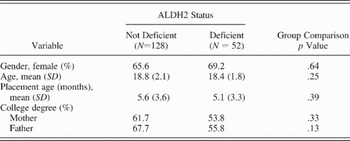
Among the 180 East Asian SIBS participants genotyped for ALDH2, 128 (71.1%) were ALDH2*1/ALDH2*1 homozygotes, 8 (4.4%) were ALDH2*2/ALDH2*2 homozygotes, and 44 (24.4%) were ALDH2*1/ALDH2*2 heterozygotes. The genotype frequencies did not differ significantly from Hardy–Weinberg equilibrium, χ2 (1 df) = 2.62, p > .05, (Thomas, Reference Thomas2004). Because the literature is consistent in showing that a single copy of the ALDH2*2 allele is sufficient to experience a protective effect against abusive drinking, the ALDH2*2/ALDH2*2 homozygotes and ALDH2*1/ALDH2*2 heterozygotes were merged to form an ALDH2 deficient group (N = 52), which we compared to the ALDH2 nondeficient group composed of the ALDH2*1/ALDH2*1 homozygotes.
Table 1 gives a descriptive breakdown of the two groups. The ALDH deficient and nondeficient samples did not differ significantly in age at follow-up, gender, age at placement, rearing mother's education and rearing father's education. On average, the sample is 18 years old and approximately two-thirds of the participants are female. The overall excess of females relative to males reflects the gender imbalance of adopted infants from East Asia and not a sampling bias. Consistent with the demographics of adoption, adoptive parents have higher rates of college education than the general Minnesota population (McGue et al., Reference McGue, Keyes, Sharma, Elkins, Legrand and Johnson2007).
Characteristics of participants by ALDH2 status

Note: The aldehyde dehydrogenase 2 (ALDH2) deficient group includes those with either one (i.e., heterozygotes) or two (i.e., homozygotes) copies of the ALDH2*2 allele. Group comparisons were based on a t statistic for quantitative outcomes and a chi-square statistic for categorical outcomes.
Association of ALDH2 status with drinking outcomes
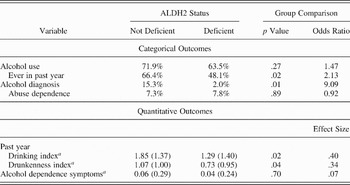
The association of ALDH2 status with the various categorical and quantitative drinking outcomes is summarized in Table 2. Hierarchical methods of analysis were used to account for the correlated nature of the sibling data. For categorical outcomes, odds ratios (ORs) are computed so that ORs > 1.0 reflect lower rates of the outcome in ALDH deficient individuals. For quantitative outcomes, standardized effect sizes were computed so that effect sizes > 0 reflect a lower mean in the ALDH deficient sample. Because individuals are not likely to know their ALDH2 status prior to their first trying alcohol, we did not expect, nor did we find, an association between ALDH2 status and ever having used alcohol. However, ALDH2 status was significantly associated in the expected direction with past year use of alcohol, a lifetime diagnosis of alcohol abuse, the past year drinking index, and the past year drunkenness index. Effect sizes associated with each of these differences were generally in the moderate range. Contrary to expectation, ALDH2 status was not associated with either a diagnosis of alcohol dependence or the number of alcohol dependence symptoms.
Alcohol use outcomes as a function of ALDH2 status
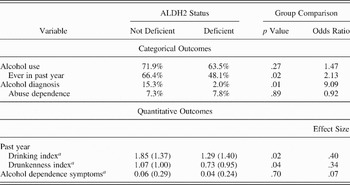
Note: The aldehyde dehydrogenase 2 (ALDH2) deficient group includes those both heterozygous and homozygous for the ALDH2*2 allele. Group comparisons were based on a t statistic for quantitative outcomes and a chi-square statistic for categorical outcomes. Effect size estimates are odds ratios for categorical outcomes (>1 indicate a protective effect of the ALDH2*2 allele) and standardized mean differences for quantitative outcomes (positive effect sizes reflect a protective effect of the ALDH2*2 allele).
aThe quantitative index was log transformed. Values are means (standard deviations).
Relationship of drinking outcomes with other substance use and abuse and measures of disinhibited behavior
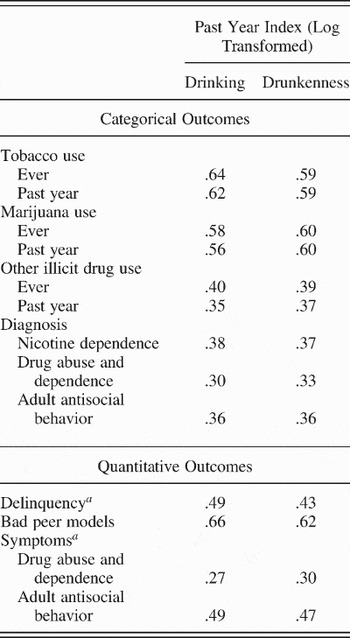
Table 3 gives the correlations between the past year drinking and drunkenness indexes and measures of substance use and misuse and indicators of disinhibitory behavior. These correlations were computed in the nondeficient ALDH2 sample. The correlations reported in the table are all statistically significant and are moderate to large in magnitude (range = .27–.62). Consistent with expectation, in the nondeficient ALDH2 sample, drinking, and drunkenness in the past year is consistently associated with other substance use and abuse, antisocial behavior in adolescence and adulthood, and exposure to negative peer models.
Correlation of nonalcohol outcomes and past year drinking and drunkenness indexes in non-ALDH deficient sample

Note: All correlations are significant at p < .01. Correlations are point biserial for categorical outcomes and product moment for quantitative outcomes. ALDH, aldehyde dehydrogenase.
aThe quantitative index was log transformed.
Association of ALDH2 status with other substance use and abuse and measures of disinhibited behavior
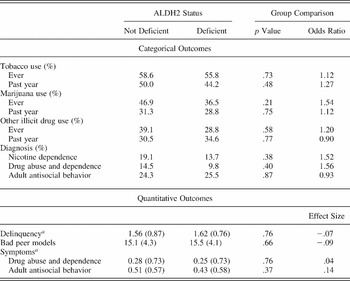
The association of ALDH2 status with the various categorical and quantitative indicators of other substance use and abuse and disinhibitory psychopathology is summarized in Table 4 in terms of the significance of group differences and estimate of effect size (ORs for categorical outcomes and standardized mean differences for quantitative outcomes). None of the group differences was statistically significant, and the ORs and effect size estimates were generally small, suggesting that failure to find significant effects is not likely to be due entirely to lack of statistical power.
Nonalcohol outcomes as a function of ALDH status

Note: The aldehyde dehydrogenase 2 (ALDH2) deficient group includes those both heterozygous and homozygous for the ALDH2*2 allele. Group comparisons were based on a t statistic for quantitative outcomes and a chi-square statistic for categorical outcomes. Effect size estimates are odds ratios for categorical outcomes (>1 indicates a protective effect of the ALDH2*2 allele) and standardized mean differences for quantitative outcomes (positive effect sizes reflect a protective effect of the ALDH2*2 allele).
aQuantitative indices were log transformed. Values are means (standard deviations).
Relationship of drinking outcomes with substance-related measures of family environment among ALDH deficient participants
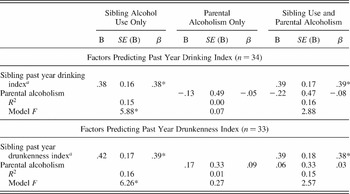
Although our analyses document a protective effect of ALDH2 on drinking behavior, there are individuals who are ALDH2 deficient who drink, some heavily. To identify factors in the adopted adolescents' family environments that diminish the protective effect of ALDH deficiency, we investigated whether adoptive parent history of alcoholism and sibling alcohol use predicted the drinking behavior of target adolescents who were ALDH2 deficient. These analyses were restricted to target adolescents who were ALDH2 deficient and had ever used alcohol (N = 34), because our aim was to identify which environmental factors predict continued drinking despite metabolic protection. Analyses were based on linear regression, using as the dependent variables the two drinking indexes for the target adolescent. The independent variables were parental alcoholism, coded as 1 if either adopted parent had met lifetime DSM-IV criteria for alcohol dependence, and 0 otherwise; and sibling drinking behavior, coded using the same index as was being predicted in the target adolescent.
The results of the regression analyses are summarized in Table 5. For each outcome, results are reported for three different regression models defined by the independent variables included in the analysis: sibling alcohol use only, parental alcoholism only, and both sibling alcohol use and parental alcoholism. In both cases, sibling alcohol use alone was significantly and moderately associated with target adolescent alcohol use, accounting for about 16% of the variance. In neither case, however, was parental alcoholism significantly associated with target adolescent alcohol use. In the analysis that included both sibling and parental influences, only sibling drinking was statistically significant and the inclusion of parental alcoholism added little to the prediction of adolescent drinking behavior beyond that accounted for by sibling use alone.
Regression of alcohol use outcomes upon substance-related measures of family environment among aldehyde dehydrogenase deficient individuals who had ever had a drink

Note: Linear regression was performed for the drinking and drunkenness indices.
aThe quantitative index was log transformed.
* p < .05.
Discussion
This study utilized data on ALDH deficiency in a unique sample of adopted Asian American adolescents to address three questions about the nature and consequences of adolescent drinking:
1. Does ALDH deficiency protect against drinking in a US adolescent sample?
2. Is ALDH deficiency associated with lower rates of other substance use and disinhibited behavior as predicted by the gateway model?
3. What familial environmental factors diminish the protective effect of ALDH deficiency on adolescent drinking behavior?
We discuss the significance of our findings relevant to each of these questions in turn.
The protective effect of ALDH deficiency in Asian American adopted adolescents
Although ALDH deficiency has been shown repeatedly and consistently to be associated with reduced rates of heavy drinking and risk of alcoholism (Luczak et al., Reference Luczak, Glatt and Wall2006), there are several notable limitations to the existing literature relating genetic variation in ALDH2 to drinking behavior. First, most research has been undertaken in East Asian cultures where a relatively high proportion of the population can be expected to be ALDH deficient. Second, in all likelihood, previous research on ALDH2 has been based on samples of nonadopted individuals. Because a single copy of the ALDH2*2 allele is sufficient to provide metabolic protection, this means that participants in previous research on ALDH2 had in all likelihood been reared in homes where there was at least one model of ALDH2*2 associated sobriety. Members of our adopted sample, however, were being reared by non-Asian parents and so would not have been exposed to models of individuals with ALDH deficiency in their rearing homes. Third and finally, previous research on ALDH deficiency has been based primarily on adult samples. Adolescence is a period where there can be strong peer pressure to use alcohol and other substances (Urberg, Degirmencioglu, & Pilgrim, Reference Urberg, Degirmencioglu and Pilgrim1997). Consequently, the finding that the protective effect of ALDH deficiency has diminished as Japanese society has become more accepting of drinking (Higuchi et al., Reference Higuchi, Matsushita, Imazeki, Kinoshita, Takagi and Kono1994), suggests that ALDH deficiency may not have the same effect on adolescent drinking behavior as it does on adult drinking behavior.
There is no reason for adolescents to know their ALDH2 status before they have ever tried alcohol, especially if they are adopted and being reared in a US state where East Asians are a minority. Consequently, we did not expect nor observe an effect of ALDH deficiency on any instance of use of alcohol. Any protective effects of ALDH deficiency are likely to be the result of a reduced desire to drink over time because of the experience of alcohol toxicity. Our finding that ALDH deficiency was associated with diminished drinking behavior in our sample of adopted adolescents is consistent with this hypothesis. Specifically, we found that ALDH2 status was significantly associated with any instance of use of alcohol in the past year, a diagnosis of alcohol abuse, and the past year drunkenness and drinking indexes. In all cases, the effect size associated with ALDH deficiency was moderate in magnitude. Somewhat anomalous, however, is our failure to find an association of ALDH2 with a diagnosis or symptoms of alcohol dependence. This failure may owe to the relatively low prevalence of alcohol dependence in our adolescent sample. Alternatively, it may reflect a diminished effect of ALDH deficiency among a subset of very high-risk drinkers (i.e., the minority of adolescents who drink enough to develop dependence symptoms). As our sample expands and is followed longitudinally we will be in a better position to address these possibilities.
Mendelian randomization and a test of the gateway model
The fundamental condition for the useful application of Mendelian randomization is that the polymorphism upon which groups are defined must cause an appreciable difference in intermediate phenotype between individuals (Brennan, Reference Brennan2004). As summarized in the previous section, this condition is clearly met in our sample. We further found that alcohol use among adolescents who were not ALDH deficient was moderately to strongly associated with other measures of substance use and disinhibitory psychopathology. The Mendelian randomization paradigm allowed us to determine whether these associations were consistent with a causal effect of drinking behavior. We found that the ALDH2 polymorphism was not significantly associated with any measures of other substance use or disinhibited behavior. In particular, we examined 13 different manifestations of nonalcohol substance misuse and antisociality, and in no case did the ALDH deficient participants show a significant reduction in these disinhibitory characteristics. Because the gateway hypothesis would predict differences in alcohol use to lead causally to differences in the use of other substances or disinhibitory behaviors, the findings of the present study do not support the gateway hypothesis. Although not interpreted by the original investigators in these terms, other studies of the ALDH2 polymorphism do not support the hypothesis that early substance use results in the escalation of the expression of disinhibited behavior. Luczak et al. (Reference Luczak, Wall, Cook, Shea and Carr2004) reported that ALDH2 status was unrelated to risk of conduct disorder in a sample of US college students of East Asian background, whereas in another sample of Asian American college students, Wall, Shea, Chan, and Carr (Reference Wall, Shea, Chan and Carr2001) reported that ALDH2 deficiency was unrelated to the use of both marijuana and other drugs. The one contrary finding is for tobacco use, which Wall et al. (Reference Wall, Shea, Chan and Carr2001) found was significantly diminished among those with ALDH2 deficiency.
Failure of the gateway hypothesis to account for the comorbidity among disinhibitory behaviors and disorders as a result of a causal sequence of behavioral progression leads to a search for alternative models. Mounting evidence from behavior genetic studies indicates that a sizable proportion of this comorbidity might be explainable by a shared liability, working in common upon all externalizing disorders. Recognizing first that psychiatric and substance use disorders are frequently observed to aggregate within families (Kendler, Davis, & Kessler, Reference Kendler, Davis and Kessler1997), a number of twin studies have found not only that individual manifestations of behavioral disinhibition have sizable specific genetic etiological correlates, but also that the comorbidity between externalizing disorders may be best modeled as being substantially dependent upon a single latent factor, and that this factor is largely heritable in nature (Hicks, Krueger, Iacono, McGue, & Patrick, Reference Hicks, Krueger, Iacono, McGue and Patrick2004; Krueger et al., Reference Krueger, Hicks, Patrick, Carlson, Iacono and McGue2002; Slutske et al., Reference Slutske, Heath, Madden, Bucholz, Statham and Martin2002). Young et al. (Reference Young, Stallings, Corley, Krauter and Hewitt2000), for example, found individual measures of behavioral disinhibition to be subject to relatively small amounts of specific genetic effects, whereas a factor indexing disinhibitory comorbidity explained substantial portions of the variance in attention-deficit/hyperactivity disorder (27%), substance experimentation (36%), and conduct disorder (42%), among others. This comorbidity factor was also shown to be largely a product of genetic influences, with an estimated 84% of the variance in the latent behavioral disinhibition phenotype attributable to heritability. These studies are bolstered by neurophysiological data suggesting that reduced P300 amplitude in an event-related potential on a visual oddball task, among other anomalies, may be associated with behaviors in the externalizing spectrum, even if event-related potential measurements are taken several years before the accompanying externalizing behaviors become apparent (Iacono, Malone, & McGue, Reference Iacono, Malone and McGue2003). Direct molecular evidence is also beginning to come to light; notably, Stallings et al. (Reference Stallings, Corley, Dennehy, Hewitt, Krauter and Lessem2005) mapped quantitative trait loci, finding regions in chromosomes 3 and 9 to which both vulnerability to substance use and antisocial behavior were linked, suggesting a genetic etiology common to both behaviors.
Although our data thus provide little support for the gateway hypothesis, several features of our study warrant caution in interpreting our results. Although there were no significant differences in the use of substances other than alcohol between ALDH2 deficient and nondeficient youth, in most cases substance use was marginally lower in ALDH2 deficient youth. It may be that we do not have sufficient power to detect the more subtle effects of ALDH2 deficiency on outcomes in the use of substances other than alcohol. It is interesting in this regard to contrast our findings on nonalcohol substance use with those for indicators of disinhibitory behavior. In the latter case, group differences were not only nonsignificant, they were uniformly small, with three of the four indicators of antisociality showing effects that were opposite in direction to what would be expected from the gateway hypothesis. Our data thus do not support the proposition that adolescent alcohol use contributes to the escalation of adolescent disinhibited behavior. Another feature of our study that justifies caution in interpreting our results concerns the failure to observe group differences in alcohol dependence diagnosis or symptom counts between the ALDH2 deficient and nondeficient group. Failure to find differences in alcohol dependence may be associated with reduced effects on correlated measures of the use of substances other than alcohol, and disinhibition. Follow-up of this sample will help to resolve this possibility. A final limitation of our use of Mendelian randomization is that mere exposure to alcohol may be sufficient to trigger the gateway process and, as expected, we did not find an association of ALDH2 with any instance of use of alcohol. Previous studies indicate that early use of alcohol in adolescence is associated with elevated rates of other substance abuse (McGue et al., Reference McGue, Iacono, Legrand and Elkins2001) and substance use and antisocial disorders (McGue & Iacono, Reference McGue and Iacono2005). The cumulative evidence, however, is that these associations reflect the effects of a shared latent etiology for the development of disinhibitory behavior (McGue, Keyes, et al., Reference McGue, Iacono and Krueger2006). In any case, our results suggest that the effects of targeted interventions to prevent adolescent drinking once it has started even if successful might not extend beyond adolescent drinking behavior.
ALDH deficiency and models of gene–environment interplay
Although the present study largely replicates past findings suggesting that the ALDH deficient allele of ALDH2 affords protection against drinking and alcohol-related psychopathology, this protection is far from complete. In our sample nearly half of ALDH deficient participants had used alcohol in the year preceding assessment. Because previous research had indicated that cultural factors (albeit at a society-wide level) could diminish the impact of ALDH deficiency on drinking behavior, we looked to the familial environment to help explain the persistence of alcohol use among ALDH deficient participants. It was significant that our use of a sample of adopted individuals allowed us to investigate the environmental consequences of living in a home with someone modeling drinking behavior that was unconfounded by the existence of common genetic effects.
Our analyses suggest that sibling, but not parent, drinking behavior is an important factor in the prediction of adolescent drinking behavior over the year preceding follow-up assessment of our sample of ALDH deficient participants who had ever had a drink. The lack of any evidence for a relationship between parental alcoholism and drinking among ALDH deficient individuals is consistent with other research suggesting that parent–offspring resemblance for drinking behavior is primarily genetically and not environmentally mediated (Cloninger, Bohman, & Sigvardsson, Reference Cloninger, Bohman and Sigvardsson1981; Goodwin, Schulsinger, Hermansen, Guze, & Winokur, Reference Goodwin, Schulsinger, Hermansen, Guze and Winokur1973; McGue, Sharma, & Benson, Reference McGue, Sharma and Benson1996a). Our finding that sibling drinking behavior was consistently and moderately associated with adolescent drinking behavior implicates siblings as a potent but arguably underappreciated source of familial environmental effect on adolescent behavior (McGue, Sharma, & Benson, Reference McGue, Sharma and Benson1996b; Slomkowski, Rende, Conger, Simons, & Conger, Reference Slomkowski, Rende, Conger, Simons and Conger2001; Slomkowski, Rende, Novak, Lloyd-Richardson, & Niaura, Reference Slomkowski, Rende, Novak, Lloyd-Richardson and Niaura2005).
Conclusion
In a sample of adopted East Asian adolescents, both quantity–frequency of drinking and tendency to get drunk were associated with ALDH2 status such that participants with the deficient form of the ALDH enzyme (those with the ALDH2*2 allele) exhibited less drinking behavior. However, even in the presence of this, the single strongest known genetic protective factor against drinking behavior, family environment mattered. Adopted ALDH deficient individuals were still capable of being influenced, for example, by the alcohol use of their siblings, in such a way that their own alcohol use was elevated compared to ALDH deficient individuals with lower levels of exposure to such environmental influences. Nonetheless, we are able to provide evidence for the valid use of ALDH2 as a naturally randomized proxy for alcohol consumption; yet, unlike alcohol use, measures of disinhibited behavior and other substance use did not differ by ALDH2 allele variants. These data thus do not support the proposition that adolescent drinking is a gateway to other substance use and disinhibited behavior, and suggest that interventions that specifically target adolescent drinking (e.g., by tighter regulation of alcohol vendors) may have limited impact on other aspects of adolescent problem behavior. The fact that we observed an association between alcohol use and other measures of substance use and behavioral disinhibition among the non-ALDH2 deficient participants in the present sample but did not find any evidence of a causal connection between the behaviors lends credence to the perspective that much of the comorbidity between disinhibitory behaviors may instead be because of a latent common etiological factor.