. Finally, we describe a new prelocally tabular extension of
 .

1 Introduction
It is well-known that the operation of product of modal logics does not preserve the finite model property of the factors (see, e.g., [Reference Gabelaia, Kurucz, Wolter and Zakharyaschev15, Reference Reynolds and Zakharyaschev25], or the monography [Reference Gabbay, Kurucz, Wolter and Zakharyaschev11]). In this article we describe new families of modal products which have the finite model property and, in fact, satisfy a stronger property of local tabularity.
A logic L is locally tabular, if there are only finitely many formulas non-equivalent in L in each finite set of variables. In particular, every locally tabular logic has the finite model property. It is well known that for unimodal logics above  , local tabularity is equivalent to finite height [Reference Maksimova20, Reference Segerberg26]. In the non-transitive unimodal, and in the polymodal case, no axiomatic criterion of local tabularity is known.
It follows from [Reference Gabbay, Shapirovsky and Shehtman12] that the product of a locally tabular logic with a tabular one is locally tabular. However, these cases are not exhaustive: other families of locally tabular modal products were identified in [Reference Shehtman36] (see also [Reference Shehtman and Odintsov35]). For close systems, intuitionistic modal logics and expanding products, locally tabular families were identified in, for example, [Reference Bezhanishvili1–Reference Bezhanishvili and Grigolia3] and more recently in [Reference Bezhanishvili and Meadors4].
In the product
 $L_1\times L_2$
of two Kripke complete consistent logics, local tabularity of
 $L_1$
and
 $L_2$
is necessary for local tabularity of
 $L_1\times L_2$
. However, it is not sufficient: the product of two locally tabular logics may not be locally tabular. The simplest example is the logic
 [Reference Henkin, Monk and Tarski18]. We provide extra semantic (Theorem 4.21) and axiomatic (Corollary 4.22) conditions which give criteria of local tabularity of the product of two locally tabular logics: bounded cluster property of one of the factors; a condition we call product reducible path property; finiteness of the one-variable fragment of the product.
In Section 5, we apply the criteria to identify new families of locally tabular products. In particular, we generalize some results from [Reference Shehtman and Odintsov35, Reference Shehtman36].
In Section 6, we discuss the product finite model property in the locally tabular case. A modal logic L has the product fmp, if L is the logic of a class of finite product frames. The product fmp is stronger than the fmp: for example,  has the fmp [Reference Gabbay and Shehtman13], but lacks the product fmp [Reference Gabbay, Kurucz, Wolter and Zakharyaschev11]. It is perhaps surprising that the local tabularity of a product logic does not imply the product fmp even in the case of height 3, as we discovered in Theorem 6.5.
In Section 7, we discuss local tabularity and prelocal tabularity in extensions of  . It is known that
 is prelocally tabular [Reference Bezhanishvili5]. The logic
 is known to be one of the five pretabular logics above
 [Reference Esakia and Meskhi10, Reference Maksimova21]. We observe that for another pretabular logic
 , the logic of the ordered sum of a countable cluster and a singleton, the product
 is not prelocally tabular. Then we consider a weaker than
 logic
 , the extension of
 with the axiom of height 2, and give an axiomatic criterion of local tabularity for all normal extensions of
 . Finally, we construct a frame of height two, which we call two-dimensional tack, and show that its logic is another example of a prelocally tabular logic above
 .
2 Preliminaries
For basic notions in modal logic, see, e.g., [Reference Chagrov and Zakharyaschev9] or [Reference Blackburn, de Rijke and Venema6].
2.1 Modal syntax and semantics
Let
 $\mathrm {A}$
be a finite set, an alphabet of modalities. Modal formulas over
 $\mathrm {A}$
,
 in symbols, are constructed from a countable set of variables
 using Boolean connectives
 $\bot ,\rightarrow $
and unary connectives
 $\lozenge \in \mathrm {A}$
. Other logical connectives are defined as abbreviations in the standard way, in particular
 $\Box \varphi $
denotes
 $\neg \lozenge \neg \varphi $
.
We define the following abbreviations:
 $\lozenge ^0 \varphi =\varphi $
,
 $\lozenge ^{i+1}\varphi =\lozenge ^i\lozenge \varphi $
,
 $\lozenge ^{\leq m} \varphi = \bigvee _{i\leq m} \lozenge ^i \varphi $
. We write
 $\lozenge _{\mathrm {A}}\varphi $
for
 $\bigvee _{\lozenge \in \mathrm {A}}\lozenge \varphi $
. Abbreviations such as
 $\lozenge _{\mathrm {A}}^i,\,\lozenge _{\mathrm {A}}^{\leq m}$
are defined likewise.
By an
 $\mathrm {A}$
-logic we mean a normal modal logic whose alphabet of modalities is
 $\mathrm {A}$
(see, e.g., [Reference Blackburn, de Rijke and Venema6]). The terms unimodal and bimodal refer to the cases
 $\mathrm {A}=\{\lozenge \}$
and
 $\mathrm {A} = \{\lozenge _1,\lozenge _2\}$
, respectively.
An
 $\mathrm {A}$
-frame is a pair
 $F = (X,\,(R_\lozenge )_{\lozenge \in \mathrm {A}})$
, where X is a non-empty set and
 $R_\lozenge \subseteq X\times X$
for any
 $\lozenge \in \mathrm {A}$
. We write
 $\mathop {\mathrm {dom}} F$
for X. By the cardinality
 $|F|$
of F we mean the cardinality of X. We put
 $R_F = \bigcup _{\lozenge \in \mathrm {A}} R_\lozenge .$
For
 $a\in X$
,
 $Y\subseteq X$
, we put
 $R_\lozenge (a)=\{b\mid aR_\lozenge b\}$
,
 $R_\lozenge [Y]=\bigcup _{a\in Y} R_\lozenge (a)$
.
A model on F is a pair
 $(F,\,\theta )$
, where
 , and
 $\mathcal {P}(X)$
is the powerset of X;
 $\theta $
is called a valuation in F. The truth-relation
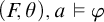 $(F,\theta ),a\vDash \varphi $
is defined in the standard way; in particular,
 $(F,\,\theta ),\,a\models \lozenge \varphi $
means that
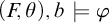 $(F,\theta ),b\models \varphi $
for some
 $b\in R_\lozenge (a)$
. We put
 $$ \begin{align*}\bar{\theta}(\varphi)=\{a\mid (F,\theta),a\vDash\varphi\}.\end{align*} $$
A formula  is valid in an
 $\mathrm {A}$
-frame F, in symbols
 $F\vDash \varphi $
, if
 $X=\bar {\theta }(\varphi )$
for every model
 $(F,\theta )$
on F. For a set of formulas
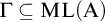 , by
 $F\vDash \Gamma $
we mean that
 $F\vDash \varphi $
for all
 $\varphi \in \Gamma $
; in this case F is said to be a
 $\Gamma $
-frame. For a class
 $\mathcal {F}$
of
 $\mathrm {A}$
-frames,
 $\mathcal {F}\vDash \Gamma $
means that
 $F\vDash \Gamma $
for all
 $F\in \mathcal {F}$
.
The set of
 $\mathrm {A}$
-formulas that are valid in F is denoted by
 $\mathop {\mathrm {Log}} F$
. For a class
 $\mathcal {F}$
of
 $\mathrm {A}$
-frames,
 $\mathop {\mathrm {Log}} \mathcal {F}$
is the set of all formulas over
 $\mathrm {A}$
that are valid in each
 $F\in \mathcal {F}$
; this set is a logic [Reference Chagrov and Zakharyaschev9, Section 4.2] and is called the logic of
 $\mathcal {F}$
. Such logics are said to be Kripke complete.
Let us recall that  is the smallest unimodal logic that contains
 $\lozenge \lozenge p \to \lozenge p$
,
 extends
 with
 $p\rightarrow \lozenge p$
, and
 extends
 with
 $p\rightarrow \Box \lozenge p$
. These logics are Kripke complete;
 $\lozenge \lozenge p \to \lozenge p$
expresses the transitivity,
 $p\rightarrow \lozenge p$
reflexivity, and
 $p\rightarrow \Box \lozenge p$
the symmetry of a binary relation (see, e.g., [Reference Blackburn, de Rijke and Venema6, Section 4.3] or [Reference Chagrov and Zakharyaschev9, Section 5.2]).
The notions of generated subframe and p-morphism (or bounded morphism) are defined in the standard way (see, e.g., [Reference Blackburn, de Rijke and Venema6, Section 3.3]). In particular, for frames
 $F = (X,\,(R_\lozenge )_{\lozenge \in \mathrm {A}})$
and
 $G = (Y,\,(S_\lozenge )_{\lozenge \in \mathrm {A}})$
,
 $f:\:X\to Y$
is a p-morphism from F to G, if
-
1. f is a homomorphism: for any
 $a,\,b\in X$
and
$\lozenge \in \mathrm {A},\, a R_\lozenge b$
implies
$f(a) S_\lozenge f(b)$
, and
-
2. f satisfies the back condition: for any
$a\in X,\,u\in Y$
, and
$\lozenge \in \mathrm {A},\, f(a) S_\lozenge u$
implies that there exists
$b\in X$
such that
$a R_\lozenge b$
and
$f(b) = u.$







If f is surjective, we write
 $f:\:F\twoheadrightarrow G.$
If there exists a p-morphism from F onto
 $G,$
we write
 $F \twoheadrightarrow G;$
in this case,
 $\mathop {\mathrm {Log}}{F} \subseteq \mathop {\mathrm {Log}}{G}$
[Reference Blackburn, de Rijke and Venema6, Section 3.3].
For a frame
 $F = (X,\,(R_\lozenge )_{\lozenge \in A})$
and an equivalence
 $\approx $
on X, the quotient frame
 ${F}{/}{\approx }$
is the frame
 $({X}{/}{\approx },\,(R^\approx _\lozenge )_{\lozenge \in \mathrm {A}})$
, where for
 $[a],[b]\in {X}{/}{\approx }$
and
 $\lozenge \in \mathrm {A}$
,
 $$\begin{align*}[a] R^\approx_\lozenge [b] \text{ iff } \exists a'\in[a]\ \exists b'\in [b]\ \left(a' R_{\lozenge} b' \right). \end{align*}$$
2.2 Products
Let
 $\mathrm {A}$
and
 $\mathrm {B}$
be two disjoint finite sets. For an
 $\mathrm {A}$
-frame
 $F=\left (X,\,(R_\lozenge )_{\lozenge \in \mathrm {A}}\right )$
and
 $\mathrm {B}$
-frame
 $G = \left (Y,\,(R_\lozenge )_{\lozenge \in \mathrm {B}}\right )$
, the product frame
 $ F\times G$
is the frame
 $(X\times Y,\,(R^h_\lozenge )_{\lozenge \in \mathrm {A}}, (R^v_\lozenge )_{\lozenge \in \mathrm {B}})$
, where
 $$ \begin{align*} R^h_\lozenge&=\{((a,\,b),\,(a',\,b))\mid a,\,a'\in X \text{ and } b\in Y \text{ and } a R_\lozenge a'\} &\text{ for }\lozenge\in \mathrm{A};\\ R^v_\lozenge &= \{((a,\,b),\,(a,\,b'))\mid a\in X \text{ and } b,\,b'\in Y \text{ and } b R_\lozenge b'\} &\text{ for }\lozenge\in \mathrm{B}. \end{align*} $$
We say that relations
 $R^h_\lozenge $
are horizontal, and
 $R^v_\lozenge $
are vertical. For a class
 $\mathcal {F}$
of
 $\mathrm {A}$
-frames and a class
 $\mathcal {G}$
of
 $\mathrm {B}$
-frames, we put
 $ \mathcal {F} \times \mathcal {G} = \{F\times G \mid F\in \mathcal {F},\,G\in \mathcal {G}\}. $
For logics
 $L_1,L_2$
, the product logic
 $L_1\times L_2$
is defined as
 $$\begin{align*}L_1\times L_2 = \mathop{\mathrm{Log}}\{F\times G \mid F\models L_1,\,G\models L_2\}. \end{align*}$$
If
 $L_1$
and
 $L_2$
are unimodal logics, we rename their modalities and follow the convention that the alphabet of
 $L_1\times L_2$
is
 $\{\lozenge _1,\lozenge _2\}$
. We write
 $L^2$
for
 $L\times L$
.
It is important to note that
 $\mathop {\mathrm {Log}} \mathcal {F} = \mathop {\mathrm {Log}} \mathcal {F}'$
and
 $\mathop {\mathrm {Log}} \mathcal {G} = \mathop {\mathrm {Log}} \mathcal {G}'$
do not imply that
 $\mathop {\mathrm {Log}} (\mathcal {F}\times \mathcal {G}) = \mathop {\mathrm {Log}} (\mathcal {F}'\times \mathcal {G}')$
. Moreover,
 $\mathop {\mathrm {Log}}\mathcal {F}\times \mathop {\mathrm {Log}} \mathcal {G}$
and
 $\mathop {\mathrm {Log}}(\mathcal {F}\times \mathcal {G})$
can be distinct. The reader may find examples of such logics in [Reference Gabbay, Kurucz, Wolter and Zakharyaschev11, Theorem 7.11].
2.3 Local tabularity and local finiteness
Let L be a logic over
 $\mathrm {A}$
. Formulas
 $\varphi $
and
 $\psi $
are said to be L-equivalent, if
 $\varphi \leftrightarrow \psi \in L$
. For a finite k, L is said to be k-finite, if there are only finitely many L-equivalence classes in the set of formulas over
 $\mathrm {A}$
in variables
 $p_i,\,i < k$
. Equivalently, L is k-finite, if the k-generated Lindenbaum (or free) algebra of L is finite. L is said to be locally tabular, if it is k-finite for all finite k.
In algebraic terms, local tabularity of a logic means that its countably generated Lindenbaum algebra is locally finite, which, in turn, means that the variety of its algebras is locally finite (see, e.g., [Reference Burris and Sankappanavar8, Chapter 2], [Reference Chagrov and Zakharyaschev9, Chapter 7] for corresponding notions).
The following fact is immediate.
Proposition 2.1. Let L be locally tabular. Then:
-
1. L has the finite model property, that is, L is the logic of a class of finite frames. In particular, L is Kripke complete.
-
2. Every extension of L (over the same modal alphabet) is locally tabular.
A class
 $\mathcal {C}$
of algebras of a finite signature is said to be uniformly locally finite, if there exists a function
 $f:\omega \to \omega $
such that the cardinality of a subalgebra of any
 $B\in \mathcal {C}$
generated by
 $k<\omega $
elements does not exceed
 $f(k)$
.
Theorem 2.2 [Reference Mal’cev23, Section 14, Theorem 3].
Local finiteness of the variety generated by a class
 $\mathcal {C}$
is equivalent to uniform local finiteness of
 $\mathcal {C}$
. Moreover, for each finite k, we have: the k-generated free algebra of
 $\mathcal {C}$
is finite iff for a fixed finite n, every k-generated subalgebra of any algebra
 $B\in \mathcal {C}$
has at most n elements.
2.4 Remark on infinite alphabets
As we mentioned, in this article we only consider finite modal alphabets. The current small remark is an exception.
If
 $\mathrm {B}$
is an infinite set of modalities, and a logic L over
 $\mathrm {B}$
is locally tabular (in fact, one-finite), then all but finitely many elements of
 $\mathrm {B}$
are just a “syntactic sugar.” Namely, let N be the number of L-equivalence classes of one-variable formulas over
 $\mathrm {B}$
. Choose their representatives
 $\{\psi _i(p)\}_{i<N}$
and let
 $\mathrm {A}$
be the set of all modalities occurring in them. Now consider the formulas
 $\{ \lozenge p\mid \lozenge \in \mathrm {B}\}$
. For each of them, for some
 $i<N$
, the logic L contains
 $\lozenge p \leftrightarrow \psi _i(p)$
. Hence, every formula over
 $\mathrm {B}$
is L-equivalent to a formula over the finite
 $\mathrm {A}$
.
2.5 Pretransitivity and finite height
For a binary relation R on X and a number
 $m < \omega $
, put
 $R^{\leq m}= \bigcup _{i \leq m} R^i$
, where
 $R^{i+1}=R\circ R^i$
,
 $\circ $
is the composition of relations, and
 $R^0$
is the diagonal relation
 $\{(x,x)\mid x\in X\}$
. The transitive reflexive closure
 $\bigcup _{i < \omega } R^i$
of R is denoted by
 $R^*$
.
A frame F is said to be m-transitive, if
 $R_F^{\leq m}=R_F^*$
.Footnote
1
F is pretransitive, if it is m-transitive for some finite m. The following fact is standard.
Proposition 2.3 (Jankov–Fine theorem for pretransitive frames).
If
 $\mathop {\mathrm {Log}} G\subseteq \mathop {\mathrm {Log}} F$
, G is pretransitive, and F is finite and rooted, then there exists a point-generated subframe H of G such that
 $H\twoheadrightarrow F$
.
For any
 $\mathrm {A}$
-frame F, we have the following equivalence [Reference Kracht19, Section 3.4]:
 $$ \begin{align} R_F\ \text{is} \ m\text{-transitive iff} \ F\vDash \lozenge_{\mathrm{A}}^{m+1} p \rightarrow \lozenge_{\mathrm{A}}^{\leq m} p. \end{align} $$
A logic L is said to be m-transitive, if L contains
 $\lozenge _{\mathrm {A}}^{m+1} p \rightarrow \lozenge _{\mathrm {A}}^{\leq m} p$
, and pretransitive, if it is m-transitive for some
 $m\geq 0$
. Let
 $\mathrm {tra}{(L)}$
be the least m such that L is m-transitive; m is called the pretransitivity index of L.
For a frame F, let
 $F^*$
be the preorder
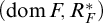 $(\mathop {\mathrm {dom}}{F},R_F^*)$
. For a class
 $\mathcal {F}$
of frames,
 $\mathcal {F}^*=\{F^*\mid F\in F\}$
.
The following fact is straightforward: for an m-transitive frame
 $F=(X,(R_\lozenge )_{\lozenge \in \mathrm {A}})$
, and any unimodal formula
 $\varphi $
, we have
 $$ \begin{align} F\vDash { [\varphi ]}^{m} \text{ iff } F^*\vDash \varphi, \end{align} $$
where
 ${ [\varphi ]}^{m}$
is the translation that is compatible with Boolean connectives (i.e.,
 ${ [\bot ]}^{m}=\bot $
,
 ${ [p ]}^{m}=p$
for variables,
 ${ [\psi _1\rightarrow \psi _2 ]}^{m}={ [\psi _1 ]}^{m}\rightarrow { [\psi _2 ]}^{m}$
) given by
 ${ [\lozenge \psi ]}^{m}= \lozenge _{\mathrm {A}}^{\leq m} { [\psi ]}^{m}$
.
For a frame
 $F = (X,\,(R_\lozenge )_{\lozenge \in \mathrm {A}}),$
let
 $\sim _F$
be the equivalence
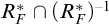 $R_F^*\cap (R_F^*)^{-1}$
on X, and
 $\mathop {\mathrm {Sk}} F={F^*}{/}{\sim _F}$
. The quotient frame
 $\mathop {\mathrm {Sk}} F$
is a poset; it is called the skeleton of F. Equivalence classes modulo
 $\sim _F$
are called clusters in F.
The height of a poset
 $(X,\leq )$
is defined as
 $$ \begin{align*}\sup\{|\Sigma|\mid \Sigma\ \text{is a finite chain in}\ (X,\leq)\}.\end{align*} $$
The height of a frame F, in symbols
 $h(F)$
, is the height of its skeleton.
Consider unimodal formulas
 $$\begin{align*}B_0 = \bot,\quad B_{i+1} = p_{i+1}\rightarrow \Box \left (\lozenge p_{i+1} \lor B_i\right). \end{align*}$$
For a unimodal frame
 $G=(X,R)$
with a transitive R, we have [Reference Segerberg26]
 $$ \begin{align*}G\vDash B_h \text{ iff } h(G)\leq h.\end{align*} $$
Consequently, if F is an m-transitive
 $\mathrm {A}$
-frame, then
 $F\models { [B_h ]}^{m}$
iff
 $h(F)\le h$
. Formulas
 $B_h$
and their polymodal pretransitive generalizations
 ${ [B_h ]}^{m}$
are called formulas of finite height. For an m-transitive logic L, we define the height of L, denoted by
 $h(L),$
as the smallest
 $h < \omega $
such that
 $L \vdash [B_h]^m$
; if there is no such h, we put
 $h(L)=\omega $
. Observe that for any m such that L is m-transitive this condition defines the same
 $h(L)$
.
Theorem 2.4 [Reference Shapirovsky and Shehtman33].
Let L be an
 $\mathrm {A}$
-logic. If L is 1-finite, then for some
 $h,m<\omega $
, L contains
 $\lozenge _{\mathrm {A}}^{m+1} p \rightarrow \lozenge _{\mathrm {A}}^{\leq m} p$
and
 ${ [B_h ]}^{m}.$
In [Reference Shapirovsky and Shehtman33], this fact was stated for the unimodal case; its polymodal generalization is straightforward, details can be found in [Reference Shapirovsky32].
2.6 Local tabularity and tuned partitions
A partition
 $\mathcal {V}$
of a set X is a family of non-empty pairwise disjoint sets such that
 $X=\bigcup \mathcal {V}$
. For
 $x\in X$
,
 $[x]_{\mathcal {V}}$
denotes
 $V\in \mathcal {V}$
that contains x. A partition of X induced by
 $h :X\to Y$
is the set of non-empty sets
 $h^{-1}(y)$
,
 $y\in Y$
. A partition
 $\mathcal {U}$
refines
 $\mathcal {V}$
, if each element of
 $\mathcal {V}$
is the union of some elements of
 $\mathcal {U}$
.
Definition 2.5. Let R be a binary relation on X. A partition
 $\mathcal {U}$
of X is said to be R-tuned, if for every
 $U,V\in \mathcal {U}$
,
 $$ \begin{align} \exists a\in U \exists b\in V \, (aR b) \,\text{ implies }\, \forall a\in U \exists b\in V \, (aR b). \end{align} $$
Let
 $F=(X,(R_\lozenge )_{\lozenge \in \mathrm {A}})$
be an
 $\mathrm {A}$
-frame. A partition
 $\mathcal {U}$
of X is said to be tuned in F, if it is
 $R_\lozenge $
-tuned for every
 $\lozenge \in \mathrm {A}$
. In other terms, the condition (3) means that the map
 $x\mapsto [x]_{\mathcal {U}}$
is a p-morphism
 $F\twoheadrightarrow {F}{/}{\sim }$
, where
 $\mathcal {U}={X}{/}{\sim }$
, see, e.g., [Reference Blok7, Proposition 3.2] for details.Footnote
2
A class
 $\mathcal {F}$
of
 $\mathrm {A}$
-frames is said to be f-tunable for a function
 $f:\omega \to \omega $
, if for every
 $F\in \mathcal {F}$
, for every finite partition
 $\mathcal {V}$
of F there exists a refinement
 $\mathcal {U}$
of
 $\mathcal {V}$
such that
 $|\mathcal {U}|\leq f(|\mathcal {V}|)$
and
 $\mathcal {U}$
is tuned in F. A class
 $\mathcal {F}$
is uniformly tunable, if it is f-tunable for some
 $f:\omega \to \omega $
.
The following theorem is a Kripke-style version of Mal’cev’s criterion (Theorem 2.2).
Theorem 2.6 [Reference Shapirovsky and Shehtman33].
-
1. The logic of a class
$\mathcal {F}$
of
$\mathrm {A}$
-frames is locally tabular iff
$\mathcal {F}$
is uniformly tunable. -
2. Every locally tabular logic is the logic of a uniformly tunable class.


This characterization makes many properties of locally tabular logics visible.
Example 2.7 [Reference Shapirovsky29].
Let L be a locally tabular logic, and let  be the expansion of L with the universal modality [Reference Goranko and Passy16]. Then
 is locally tabular. Indeed, adding the universal modality to a pretransitive logic preserves Kripke-completeness [Reference Hemaspaandra17]. Hence,
 is characterized by its point-generated frames, which are L-frames with additional universal relation
 $X\times X$
. Clearly, any partition is tuned with respect to
 $X\times X$
, and so this class inherits the uniform tunability from L-frames.
For a frame
 $F = (X,\,(R_\lozenge )_{\lozenge \in \mathrm {A}})$
and
 $Y \subseteq X$
, put
 $F{\upharpoonright } Y = (Y,\,(R_\lozenge {\upharpoonright } Y)_{\lozenge \in \mathrm {A}})$
, where
 $R_\lozenge {\upharpoonright } Y= R_\lozenge \cap (Y\times Y)$
. For a class
 $\mathcal {F}$
of frames, put
 $$ \begin{align*}\mathop{\mathrm{Sub}}{\mathcal{F}}=\{F{\upharpoonright} Y\mid F\in \mathcal{F} \text{ and } \varnothing\neq Y\subseteq \mathop{\mathrm{dom}}{F}\}.\end{align*} $$
Proposition 2.8 [Reference Shapirovsky32].
If
 $\mathop {\mathrm {Log}}\mathcal {F}$
is k-finite for some positive
 $k<\omega $
, then the logic of
 $\mathop {\mathrm {Sub}}{\mathcal {F}}$
is
 ${(k{-}1)}$
-finite.
A frame F is a cluster, if
 $a R_F^* b$
for all
 $a,b$
in F. For a class
 $\mathcal {F}$
of frames,
 $Cl{(\mathcal {F})}$
is the class of cluster frames which are restrictions on clusters (as sets) occurring in frames in
 $\mathcal {F}$
:
 $$ \begin{align*}Cl{(\mathcal{F})}=\{F{\upharpoonright} C\mid C \text{ is a cluster in } F\in\mathcal{F}\}. \end{align*} $$
A class
 $\mathcal {F}$
is of uniformly finite height, if for some finite h, for every
 $F\in \mathcal {F}$
, we have
 $h(F)\leq h$
.
The following characterization is one of the main technical tools for our study.
Theorem 2.9 [Reference Shapirovsky and Shehtman33].
A logic
 $\mathop {\mathrm {Log}} \mathcal {F}$
is locally tabular iff
 $\mathcal {F}$
is of uniformly finite height and
 $\mathop {\mathrm {Log}}Cl{(\mathcal {F})}$
is locally tabular.
Remark. In [Reference Shapirovsky and Shehtman33], Theorems 2.6 and 2.9 were stated for the unimodal case. Their polymodal generalizations are straightforward. For Theorem 2.6, details are given in [Reference Shapirovsky32]. The polymodal version of Theorem 2.9 was not considered before; for the sake of rigor, we prove it in the Appendix.
3 Important properties of frames
As we discussed, the finite height and pretransitivity are necessary for local tabularity. In this section we discuss additional properties of Kripke frames related to local tabularity.
3.1 Reducible path property
For
 $m<\omega $
, consider the following first-order property
 $\mathrm {RP}_m$
:
 $$ \begin{align*} \forall x_0,\ldots, x_{m+1} \; (x_0Rx_1R\ldots R x_{m+1}\rightarrow \bigvee\limits_{i<j\leq m+1} x_i = x_j \vee \bigvee\limits_{i< j\leq m} x_i R x_{j+1}). \end{align*} $$
We say that a class of
 $\mathcal {F}$
of frames has the reducible path property (for short, rpp), if for some fixed m, for every
 $F\in \mathcal {F}$
,
 $\mathrm {RP}_m$
holds in
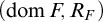 $(\mathop {\mathrm {dom}} F,R_F)$
. Notice that
 $\mathrm {RP}_m$
is stronger than m-transitivity. This property is another necessary condition for local tabularity.
Theorem 3.1 [Reference Shapirovsky and Shehtman33, Theorem 7.3].
If a class of unimodal frames is uniformly tunable (equivalently, has a locally tabular logic), then it has the rpp.
Let
 $\mathrm {rp}_m(\lozenge )$
be the modal formula
 $$ \begin{align*}p_0\wedge \lozenge(p_1\wedge \lozenge(p_2\wedge \dots \wedge \lozenge p_{m+1})\dots)\rightarrow \bigvee\limits_{i<j\leq m+1} \lozenge^i (p_i \wedge p_j) \vee \bigvee\limits_{i< j\leq m} \lozenge^i(p_i \wedge \lozenge p_{j+1}). \end{align*} $$
Proposition 3.2. A unimodal frame F validates
 $\mathrm {rp}_m(\lozenge )$
iff F satisfies
 $\mathrm {RP}_m$
.
Proof. Straightforward.
Since every locally tabular logic L is the logic of a uniformly tunable class, L contains
 $\mathrm {rp}_m(\lozenge _{\mathrm {A}})$
for some m.
Whether the reducible path property is sufficient for local tabularity in a class of clusters was left as an open question in [Reference Shapirovsky and Shehtman33, Problem 8.1]. Below we give a very simple example that shows that it is not sufficient; at the same time, in the next section we show that a variant of the reducible path property is sufficient for local tabularity of products.
Proposition 3.3 (Negative solution to Problem 8.1 in [Reference Shapirovsky and Shehtman33]).
There is a unimodal cluster C such that
 $\mathrm {RP}_2$
holds in C, while its logic is not locally tabular.
Proof. Let
 $C=(\omega ,R)$
, where
 $m R n \text { iff } m\neq n+1$
. Clearly, C is a cluster:
 $m R^2 n$
for all
 $m,n$
. Consider a path
 $m_0 R m_1 R m_2 R m_3$
in
 $C.$
If
 $m_0,\,\ldots ,\,m_3$
are distinct, then
 $m_0 \neq m_2 + 1$
or
 $m_0 \ne m_3 +1$
, so
 $m_0 R m_2$
or
 $m_0 R m_3.$
In either case, the path
 $m_0 R \ldots R m_3$
can be reduced. Therefore, C satisfies
 $\mathrm {RP}_2.$
Consider a valuation
 $\theta $
on
 $\omega $
with
 $\theta (p) = \{0\}.$
Let
 $\varphi _0 = p$
,
 $\varphi _{n+1} = \lnot \lozenge \varphi _n$
. A simple induction on n shows that
 $(C,\,\theta ),\,n\models \varphi _m$
iff
 $n=m.$
So the logic of C is not locally tabular (in fact, not 1-finite).
3.2 Bounded cluster property
Recall that
 $Cl{(\mathcal {F})}$
denotes the class of clusters occurring in frames of a class
 $\mathcal {F}$
. We say that
 $\mathcal {F}$
has the bounded cluster property, if for some
 $n<\omega $
,
 $$ \begin{align} |C| \le n \text{ for all }C\in Cl{(\mathcal{F})}. \end{align} $$
The bounded cluster property in a class of frames is neither necessary nor sufficient for the local tabularity of its logic, even in the unimodal case. As examples, consider the class of all equivalence relations and the class of all posets.
The condition (4) is not modally definable in general. Indeed, by the bulldozer theorem (see [Reference Chagrov and Zakharyaschev9, Theorem 3.20]), the countable cluster
 $(\omega ,\omega \times \omega )$
is a p-morphic image of some strictly partially ordered frame, which satisfies (4) for
 $n = 1$
. However, as we show below, it is definable in classes of m-transitive frames of finite height, and in particular, in the class of frames of any locally tabular logic.
Let
 $F=(X,R)$
be a preorder whose skeleton is converse well-founded. Observe that F has no clusters of size greater than n iff
 $F{\upharpoonright } Y\twoheadrightarrow \boldsymbol {n+1}$
for no
 $Y\subseteq \mathop {\mathrm {dom}} F$
. It follows from [Reference Chagrov and Zakharyaschev9, Theorem 9.39(ii)] that in the class of converse well-founded preorders, (4) is definable by a modal formula
 $\mathrm {bc}_n$
.
The formulas
 $\mathrm {bc}_n$
can be defined explicitly in the following way.Footnote
3
Namely, let
 $\mathrm {bc}_n$
be
 $$\begin{align*}\lnot ( \chi_0 \land \Box (\chi_0 \to \lozenge \varphi_n)), \end{align*}$$
where
 $\chi _k$
is
 $p_k \land \bigwedge _{i < k} \lnot p_i$
,
 $\varphi _0$
is
 $\chi _0$
, and
 $\varphi _{k+1}$
is
 $\chi _{k+1} \land \lozenge \varphi _k$
.
For example,
 $\mathrm {bc}_3$
is
 $$\begin{align*}\lnot ( \chi_0 \land \Box (\chi_0 \to \lozenge (\chi_3 \land \lozenge(\chi_2 \land \lozenge(\chi_1\land \lozenge \chi_0))))). \end{align*}$$
Proposition 3.4. Let
 $\mathcal {F}$
be a class of preorders. The formula
 $\mathrm {bc}_n$
is valid in
 $\mathcal {F}$
iff
 $\mathop {\mathrm {Sk}} F$
is converse well-founded for any
 $F\in \mathcal {F}$
and
 $\mathcal {F}$
satisfies (4).
Proof. ‘Only if’. Assume that some cluster in a preorder
 $F = (X,R)$
has at least
 $n+1$
elements. Then there are
 $n+1$
distinct points
 $a_0,\,\ldots ,\,a_n$
with
 $a_0 R a_n R a_{n-1} R\ldots R a_1 R a_0$
. Now it is straightforward that
 $\lnot \mathrm {bc}_n$
is satisfiable at
 $a_0$
: put
 $\theta (p_k) = \{a_k\}$
for
 $k \le n.$
Similarly, if
 $\mathop {\mathrm {Sk}} F$
of a preorder F is not converse well-founded, then X contains countably many distinct points
 $a_i$
with
 $a_i R a_{i+1}$
for all
 $i < \omega .$
By letting
 $\theta (p_k) = \{a_{(n+1)i - k} \mid i < \omega , \, (n+1)i \ge k\},$
we force
 $\mathrm {bc}_n$
to fail at
 $a_0.$
‘If’. Let
 $\theta $
be a valuation in a preorder
 $F = (X,R)$
such that
 $(F,\theta )$
falsifies
 $\mathrm {bc}_n$
. If
 $\mathop {\mathrm {Sk}} F$
is not converse well-founded, then the proof is complete. Otherwise, let C be a maximal cluster containing a point where
 $\mathrm {bc}_n$
is false. For some
 $a\in C$
, we have
 $(F,\theta ),a\models \chi _0 \land \Box (\chi _0 \to \lozenge \varphi _n)$
. So there is a path
 $a R a_n R \ldots R a_1 R a_0$
such that
 $(F,\theta ),a_0\vDash \chi _0$
and
 $a_0, \ldots a_n$
are pairwise distinct. Since
 $aR a_0$
, we have
 $(F,\theta ),a_0\vDash \Box (\chi _0 \to \lozenge \varphi _n)$
, and so
 $(F,\theta ),a_0\vDash \neg \mathrm {bc}_n$
. It follows that
 $a_0\in C$
, and so
 $a_i\in C$
for all
 $i\leq n$
. Thus,
 $|C|\geq n+1$
.
This proposition allows to characterize the bounded cluster property for the case of finite height (over an arbitrary finite alphabet) as follows.
Proposition 3.5. Let
 $\mathrm {A}$
be a finite alphabet, and let
 $\mathcal {F}$
be a class of m-transitive
 $\mathrm {A}$
-frames of finite height. Then
 $\mathcal {F} \models { [\mathrm {bc}_n ]}^{m}$
iff
 $\mathcal {F}$
satisfies (4).
Proof. By (2), we have that
 $F\models { [\mathrm {bc}_n ]}^{m}$
iff
 $F^* \models \mathrm {bc}_n$
for any
 $F\in \mathcal {F}$
. The preorder
 $F^*$
has the same clusters as F, and its skeleton has a finite height. Now the statement follows from Proposition 3.4.
We call
 ${ [\mathrm {bc}_n ]}^{m}$
the bounded cluster formulas.
3.3 Path-bounded frames
Now we consider the combination of local tabularity and the bounded cluster property. This situation can be visualized via several equivalent conditions.Footnote 4
A logic is called tabular, if it is the logic of a single finite frame. It is trivial that tabularity implies local tabularity.
We call a class of frames
 $\mathcal {F}$
path-bounded, if for some
 $n < \omega $
, any path (i.e., a subset
 $\{a_0, \ldots , a_l\} \subseteq \mathop {\mathrm {dom}} F$
satisfying
 $a_0 R_F \ldots R_F a_l$
) in any frame
 $F\in \mathcal {F}$
contains at most n distinct points. The logic of a path-bounded class of frames is said to be strongly locally tabular. The latter definition is justified by the following proposition.
Proposition 3.6. Let L be a Kripke complete
 $\mathrm {A}$
-logic, and let
 $\mathcal {C}$
be the class of all clusters occurring in the frames of L. TFAE:
-
1. L is strongly locally tabular.
-
2. L is a pretransitive logic of finite height containing a bounded cluster formula.
-
3. The class of all frames of L is path-bounded.
-
4. L is a locally tabular logic containing a bounded cluster formula.
-
5. L is a pretransitive logic of finite height and
$\mathop {\mathrm {Log}} \mathcal {C}$
is tabular. -
6. L is locally tabular and
$\mathop {\mathrm {Log}} \mathcal {C}$
is tabular.


Proof. First, we show equivalence of (1)–(3).
To show that (1) implies (2), assume that
 $L=\mathop {\mathrm {Log}}(\mathcal {F})$
and any path in any frame in
 $\mathcal {F}$
contains at most n distinct points. It follows that L is pretransitive. For any frame
 $F\in \mathcal {F}$
, n is an upper bound on the size of paths in
 $\mathop {\mathrm {Sk}} F$
; it follows that
 $h(F)\leq n$
. For any cluster C that occurs in a frame from
 $\mathcal {F}$
, there exists a path that connects all points of C (possibly, with repetitions). Thus every cluster in
 $\mathcal {F}$
contains at most n points. By Proposition 3.5,
 $\mathcal {F}$
validates a bounded cluster formula.
That (2) implies (3) follows from Proposition 3.5 and a simple observation that every path in a frame of height h is contained in at most h clusters.
Now we prove the remaining equivalences.
We have that (2) implies (4) in light of Theorem 2.9 and Proposition 3.5. Theorem 2.4 and Proposition 3.5 show that (4) implies (5). By Theorem 2.9, (5) implies (6).
Assume (6) and show (2). By Theorem 2.4, L is a pretransitive logic of finite height. Since
 $\mathop {\mathrm {Log}}\mathcal {C}$
is tabular, Proposition 3.5 yields that it contains a bounded cluster formula. By the same proposition,
 $\mathcal {C}$
has the bounded cluster property, and so does
 $\mathcal {F}$
. Using Proposition 3.5 once again, we conclude that a bounded cluster formula is valid in
 $\mathcal {F}$
.
4 Criteria
Throughout this section,
 $\mathrm {A}$
and
 $\mathrm {B}$
are finite disjoint alphabets,
 $L_1$
is an
 $\mathrm {A}$
-logic,
 $L_2$
is a
 $\mathrm {B}$
-logic, and
 $\mathcal {F}$
and
 $\mathcal {G}$
are classes of
 $\mathrm {A}$
- and
 $\mathrm {B}$
-frames, respectively.
4.1 Products of locally tabular logics
In the product
 $L_1\times L_2$
of two Kripke complete consistent logics, local tabularity of the factors is a necessary condition for local tabularity of
 $L_1\times L_2$
: the product is conservative over the factors in this case. However, it is not sufficient: it is known that the product of two locally tabular logics can be not locally tabular. The simplest example is the logic
 : that
 is locally tabular is well known (e.g., one can observe that in the class of point-generated frames of this Kripke complete logic every partition is tuned); at the same time
 is not locally tabular [Reference Henkin, Monk and Tarski18, Theorem 2.1.11]. We provide extra conditions which give criteria of local tabularity of the product of locally tabular logics.
The following classical fact about  is important for our goals. For a set X, let
 ${\boldsymbol X}$
be the frame
 $(X,X\times X)$
. For sets
 $X,\,Y$
, the product frame
 $\boldsymbol X \times \boldsymbol Y$
is called a rectangle.
Theorem 4.1 [Reference Segerberg28].
If
 $\mathcal {X}$
and
 $\mathcal {Y}$
are families of non-empty sets and
 $\sup \{|X| \mid X\in \mathcal {X}\}$
and
 $\sup \{|Y| \mid Y\in \mathcal {Y}\}$
are infinite, then
 $\mathop {\mathrm {Log}}\{\boldsymbol X \times \boldsymbol Y\mid X\in \mathcal {X} \text { and } Y\in \mathcal {Y}\}$
is
 .
Remark 4.2. The system considered in [Reference Segerberg28] is a conservative extension of  . See [Reference Gabbay, Kurucz, Wolter and Zakharyaschev11, p. 243] for other references.
4.2 Products of pretransitive logics
Proposition 4.3. Let
 $R_h$
and
 $R_v$
be the unions of all horizontal and all vertical relations of
 $F\times G$
, respectively, for some frames F and G. Then
 $R_{F\times G}^* = R_h^* \circ R_v^*=R_v^* \circ R_h^*$
.
Proof. If R is a vertical and S is a horizontal relation in
 $F\times G$
, then they commute:
 $R\circ S=S\circ R$
. By a routine argument,
 $R_v^i$
and
 $R_h^j$
commute for all
 $i,j < \omega $
. It follows that
 $R_h^* \circ R_v^*=R_v^* \circ R_h^*$
.
Since
 $R_h^*$
and
 $R_v^*$
are contained in the transitive relation
 $R_{F\times G}^*$
, we have
 $R_h^* \circ R_v^*\subseteq R_{F\times G}^*$
. By induction on m, one can easily check that
 $R_{F\times G}^{\leq m} \subseteq R_h^* \circ R_v^*$
for all m. Hence,
 $R_{F\times G}^* \subseteq R_h^* \circ R_v^*$
.
Proposition 4.4.
-
1. If F is m-transitive and G is n-transitive, then
$F\times G$
is
$(m+n)$
-transitive. -
2. The product of two pretransitive logics is pretransitive.


Proof. The second statement is immediate from the first. To check the first statement, let
 $R_h$
and
 $R_v$
be the unions of all horizontal and all vertical relations of
 $F\times G$
, respectively. Since F is m-transitive,
 $R_h$
is m-transitive; similarly,
 $R_v$
is n-transitive. By Proposition 4.3, we have
 $R^*_{F\times G}=R_h^* \circ R_v^*=R_h^{\leq m} \circ R_v^{\leq n}\subseteq R^{\leq m}_{F\times G}\circ R^{\leq n}_{F\times G} = R^{\leq m+n}_{F\times G}$
.
Example 4.5.
 ,
 ,
 are 2-transitive logics.
Proposition 4.6. Assume
 $h(F)=h_1$
and
 $h(G)=h_2$
for some finite
 $h_1, h_2$
. Then
 $h(F\times G)=h_1+h_2-1$
.
Proof. Consider a chain
 $[a_1] < [a_2] < \cdots < [a_{h_1}]$
in
 $\mathop {\mathrm {Sk}} F$
and a chain
 $[b_1]< [b_2] < \cdots < [b_{h_2}]$
in
 $\mathop {\mathrm {Sk}} G.$
Then there is a chain of
 $h_1 + h_2 - 1$
elements in
 $\mathop {\mathrm {Sk}} (F\times G)$
:
 $$\begin{align*}[(a_1,\,b_1)] < [(a_2,\,b_1)] < \cdots < [(a_{h_1},\,b_1)] < [(a_{h_1},\,b_2)] < \cdots < [(a_{h_1},\,b_{h_2})]. \end{align*}$$
Hence,
 $h(F\times G) \geq h_1 + h_2 -1$
.
For the converse direction, we prove by induction that for any chain
 $[(a_1,b_1)] < \cdots < [(a_l,b_l)]$
in
 $\mathop {\mathrm {Sk}}(F\times G)$
there exists a chain
 $[c_1] < \cdots < [c_m]$
in
 $\mathop {\mathrm {Sk}} F$
and a chain
 $[d_1] < \cdots < [d_n]$
in
 $\mathop {\mathrm {Sk}} G$
such that
 $a_1 = c_1,\,a_l = c_m,\,b_1 = d_1,\,b_l = d_n, $
and
 $m + n \ge l + 1.$
The base case is trivial. For the induction step, consider a chain
 $[(a_1,b_1)] < \cdots < [(a_{l+1},b_{l+1})]$
in
 $\mathop {\mathrm {Sk}}(F\times G)$
. The induction hypothesis holds for
 $\{[(a_i,b_i)]\}_{1 \le i \le l}$
, so let
 $\{c_i\}_{1 \le i \le m}$
and
 $\{d_i\}_{1 \le i \le n}$
be the corresponding chains in
 $\mathop {\mathrm {Sk}} F$
and
 $\mathop {\mathrm {Sk}} G$
, respectively. Then
 $[a_{l+1}] \ge [c_m]$
in
 $\mathop {\mathrm {Sk}} F$
and
 $[b_{l+1}] \ge [d_n]$
in
 $\mathop {\mathrm {Sk}} G$
. Moreover, at least one of these inequalities is strict, since otherwise
 $[(a_{l+1},b_{l+1})] = [(c_m,d_n)] = [(a_l,b_l)]$
. It follows that
 $[c_1],\,\dots ,\,[c_m],\,[a_{l+1}]$
is a strict chain in
 $\mathop {\mathrm {Sk}} F$
or
 $[d_1],\,\dots ,\,[d_n],\,[b_{l+1}]$
is a strict chain in
 $\mathop {\mathrm {Sk}} G$
, and the induction statement follows. Since
 $m\leq h_1$
and
 $n \leq h_2$
, we obtain
 $l\leq h_1+h_2 - 1$
.
Example 4.7.
 is a logic of height 1.
For a formula
 $\varphi $
in the alphabet
 $\{\lozenge _1,\lozenge _2\}$
, we define the translation
 as follows. Let
 ${ [\varphi ]}^{m,n}$
be compatible with Boolean connectives, and let
 ${ [\lozenge _1 \psi ]}^{m,n}= \lozenge _{\mathrm {A}}^{\leq m} { [\psi ]}^{m,n}$
,
 ${ [\lozenge _2 \psi ]}^{m,n}= \lozenge _{\mathrm {B}}^{\leq n} { [\psi ]}^{m,n}$
. The following is straightforward.
Proposition 4.8. If F is an m-transitive
 $\mathrm {A}$
-frame and G is an n-transitive
 $\mathrm {B}$
-frame, then
 $F\times G\vDash { [\varphi ]}^{m,n}$
iff
 $F^*\times G^*\vDash \varphi $
.
Proposition 4.9. Let
 $\mathcal {F}$
and
 $\mathcal {G}$
be classes of m- and n-transitive clusters, respectively. If
 $\sup \{|F| \mid F\in \mathcal {F}\}$
and
 $\sup \{|G | \mid G\in \mathcal {G}\}$
are infinite, then

4.3 Bounded cluster property
Recall that for a class
 $\mathcal {F}$
,
 $Cl{(\mathcal {F})}$
denotes the class of clusters occurring in frames in
 $\mathcal {F}$
, and that
 $\mathcal {F}$
has the bounded cluster property, if for some
 $n<\omega $
,
 $|C| \le n$
for all
 $C\in Cl{(\mathcal {F})}$
.
Proposition 4.10. Assume that a frame F is f-tunable, and a frame G is finite. Then
 $F\times G$
is g-tunable for
 $g(n)=f\left (n^{|G|}\right )|G|$
.
Proof. Let
 $\mathcal {V}$
be a finite partition of
 $F\times G$
,
 $n=|\mathcal {V}|$
.
Define
 $\alpha :\:\mathop {\mathrm {dom}} F \to \mathcal {V}^{\mathop {\mathrm {dom}} G}$
by
 $$\begin{align*}\alpha(a) = ([(a,\,b)]_{\mathcal{V}})_{b\in\mathop{\mathrm{dom}} G},\quad a\in \mathop{\mathrm{dom}} F. \end{align*}$$
Then
 $\alpha $
induces a partition of F of cardinality at most
 $n^{|G|}.$
Since F is f-tunable, there is a refinement
 $\mathcal {U}$
of this partition such that
 $|\mathcal {U}|\le f\left (n^{|G|}\right )$
and
 $\mathcal {U}$
is tuned in F.
For
 $(a,b)$
in
 $F\times G$
, put
 $\beta (a,b) = ([a]_{\mathcal {U}},\,b)$
. Then
 $\beta $
induces a refinement
 $\mathcal {S}$
of
 $\mathcal {V}$
of cardinality at most
 $f\left (n^{|G|}\right )| G|.$
We show that
 $\mathcal {S}$
is tuned in
 $F\times G$
.
Let
 $R_\lozenge $
be a relation of
 $F,$
and suppose
 $(a_1,b) R_\lozenge ^h (a_2,b)$
in
 $F\times G$
. Then
 $a_1 R_\lozenge a_2.$
Let
 $(a_1',b')\in [(a_1,b)]_{\mathcal {S}}.$
Then
 $b'=b$
and
 $[a_1']_{\mathcal {U}} = [a_1]_{\mathcal {U}}$
. We have
 $a_1' R_\lozenge a_2'$
for some
 $a_2'\in [a_2]_{\mathcal {U}}$
, since
 $\mathcal {U}$
is tuned in F. Then
 $(a_1',b') R_\lozenge ^h (a_2',b)$
and
 $(a_2',b)\in [(a_2,b)]_{\mathcal {S}}$
.
Now let
 $(a,b_1) R_\lozenge ^v (a,b_2)$
, where
 $R_\lozenge $
is a relation of
 $G.$
Let
 $(a',b_1') \in [(a,b_1)]_{\mathcal {S}}.$
Then
 $b_1' = b_1 $
, so
 $b_1' R_\lozenge b_2.$
Moreover,
 $[a']_{\mathcal {U}}$
=
 $[a]_{\mathcal {U}}$
, so
 $\beta (a',b_2) = \beta (a,b_2)$
. Hence, we have
 $(a',b_1') R_\lozenge ^v (a',b_2)$
and
 $(a',b_2)\in [(a,b_2)]_{\mathcal {S}}$
.
Corollary 4.11. If
 $L_1$
is locally tabular and
 $L_2$
is tabular, then
 $L_1\times L_2$
is locally tabular.
Proof. Follows from [Reference Gabbay, Shapirovsky and Shehtman12, Corollary 5.8] and Proposition 4.10.
Theorem 4.12. Let
 $\mathcal {F}$
and
 $\mathcal {G}$
be non-empty classes of
 $\mathrm {A}$
- and
 $\mathrm {B}$
-frames, respectively. The logic
 $\mathop {\mathrm {Log}}(\mathcal {F}\times \mathcal {G})$
is locally tabular iff the logics
 $\mathop {\mathrm {Log}}\mathcal {F}$
and
 $\mathop {\mathrm {Log}}\mathcal {G}$
are locally tabular, and at least one of the classes
 $\mathcal {F}$
,
 $\mathcal {G}$
has the bounded cluster property.
Proof. Assume that
 $L=\mathop {\mathrm {Log}}(\mathcal {F}\times \mathcal {G})$
is locally tabular. Then
 $L_1=\mathop {\mathrm {Log}}\mathcal {F}$
and
 $L_2=\mathop {\mathrm {Log}} \mathcal {G} $
are locally tabular, since L is a conservative extension of each of them. By Theorem 2.4,
 $L_1$
and
 $L_2$
are pretransitive. Let
 $\mathcal {C}_1=Cl{(\mathcal {F})}$
,
 $\mathcal {C}_2=Cl{(\mathcal {G})}$
, and
 $\mathcal {C}=Cl{(\mathcal {F} \times \mathcal {G})}$
. It follows from Proposition 4.3 that
 $\mathcal {C}_1\times \mathcal {C}_2=\mathcal {C}$
. By Theorem 2.9, the logic of
 $\mathcal {C}$
is locally tabular. On the other hand,
 is not locally tabular. By Proposition 4.9, for some finite n we have
 $|C|<n$
for all C in
 $\mathcal {C}_1$
or for all C in
 $\mathcal {C}_2$
.
The other direction follows from the fact that locally tabular logics have finite height (Theorem 2.4), which is preserved under the product (Proposition 4.6). By Theorem 2.9, it is enough to show that clusters occurring in the underlying products form a uniformly tunable class. The required partitions exist according to the bounded cluster property, in view of Proposition 4.10.
4.4 Product reducible path property
Proposition 4.13. Assume that
 $\mathcal {F}^*\times \mathcal {G}^*$
has the rpp. Then
 $\mathcal {F}$
or
 $\mathcal {G}$
has the bounded cluster property.
Proof. For the sake of contradiction, assume that for all
 $l<\omega $
there are
 $F\in \mathcal {F}$
and
 $G\in \mathcal {G}$
, a cluster C in F and a cluster D in G such that
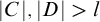 $|C|,|D|>l$
. Let
 $H=F^*\times G^*$
. Pick distinct
 $x_0,\ldots , x_l\in C$
and distinct
 $y_0,\ldots ,y_l\in D$
and consider
 $a_0,\ldots , a_{2l}$
in H, where
 $a_{2i}=(x_i,y_i)$
, and
 $a_{2i+1}=(x_i,y_{i+1})$
. Then the zigzag path
 $$ \begin{align*}a_0R_H a_1 R_H a_2 R_H \ldots R_H a_{2l} \end{align*} $$
falsifies
 $\mathrm {RP}_{2l-1}$
in H. It follows that
 $\mathrm {RP}_m$
holds in
 $\mathcal {F}^*\times \mathcal {G}^*$
for no m, and so
 $\mathcal {F}^*\times \mathcal {G}^*$
lacks the rpp.
From Theorem 4.12 and Proposition 4.13, we obtain the following corollary.
Corollary 4.14. If the logics
 $\mathop {\mathrm {Log}}\mathcal {F}$
and
 $\mathop {\mathrm {Log}}\mathcal {G}$
are locally tabular, and
 $\mathcal {F}^*\times \mathcal {G}^*$
has the rpp, then
 $\mathop {\mathrm {Log}}(\mathcal {F}\times \mathcal {G})$
is locally tabular.
Let
 $\mathrm {rp}_m(k,n)$
denote the formula
 $\mathrm {rp}_m(\bar {\lozenge })$
, where
 $\bar {\lozenge }\varphi $
abbreviates
 $\lozenge _{\mathrm {A}}^{\leq k}\varphi \vee \lozenge _{\mathrm {B}}^{\leq n}\varphi $
. These formulas are called product rpp formulas.
It follows from Theorem 3.1 that these formulas are necessary for local tabularity. Indeed, consider a locally tabular logic L over
 $\mathrm {A}\cup \mathrm {B}$
. For a formula
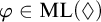 , let
 $t(\varphi )$
be the translation of
 $\varphi $
that is compatible with Boolean connectives and satisfies
 $t(\lozenge \varphi ) = \lozenge ^{\leq k}_{\mathrm {A}} t(\varphi ) \lor \lozenge _{\mathrm {B}}^{\leq n} t(\varphi ).$
Let
 Then
 $L_0$
is a normal unimodal logic, and it is locally tabular since L is. So
 $L_0$
contains
 $\mathrm {rp}_m(\lozenge )$
for some m. Hence, L contains
 $\mathrm {rp}_m(k,n) = t(\mathrm {rp}_m(\lozenge )).$
So we have the following proposition.
Proposition 4.15. If a logic L over
 $\mathrm {A}\cup \mathrm {B}$
is locally tabular, then for each
 $k,n$
there is m such that L contains the product rpp formula
 $\mathrm {rp}_m(k,n)$
.
Proposition 4.16. For a frame
 $F=(X,(R_\lozenge )_{\lozenge \in \mathrm {A}\cup \mathrm {B}})$
, we have
 $F \vDash \mathrm {rp}_m(k,n)$
iff
 $(X,(\bigcup _{\lozenge \in \mathrm {A}} R_\lozenge )^{\leq k}\cup (\bigcup _{\lozenge \in \mathrm {B}} R_\lozenge )^{\leq n})$
satisfies
 $\mathrm {RP}_m$
.
Proof. Follows from Proposition 3.2.
Note that if
 $\mathrm {A} = \{\lozenge _1,\,\lozenge _2\}$
,
 $F = (X, R_1, R_2)$
, and both
 $R_1$
and
 $R_2$
are preorders, then the following are equivalent:
-
1.
$F \models \mathrm {rp}_m(1,1)$
; -
2.
$(X, R_1\cup R_2)$
satisfies
$\mathrm {RP}_m$
; -
3.
$(X, R_F)$
satisfies
$\mathrm {RP}_m$
; -
4.
$F \models \mathrm {rp}_m(\lozenge _{\mathrm {A}}).$


Hence, in the case of two preorders, rpp and product rpp are equivalent. This equivalence does not hold in general.
Example 4.17. Let
 $F=(\omega \times \omega , R)$
, where
 $(a,b) R (c,d)$
iff
 $a=c$
or
 $b=d$
, and let G be a reflexive singleton. It is straightforward that F is 2-transitive, but does not have the reducible path property. Hence, the product
 $F\times G$
does not have the reducible path property as well. On the other hand,
 $\mathrm {rp}_1(2,1)$
is valid in
 $F\times G$
.
Proposition 4.18. Formulas
 $\mathrm {rp}_m(k,n)$
are canonical.
Proof. These formulas are Sahlqvist.
Proposition 4.19. Let
 $\mathcal {F}$
be a class of k-transitive
 $\mathrm {A}$
-frames, and let
 $\mathcal {G}$
be a class of n-transitive
 $\mathrm {B}$
-frames. If
 $\mathop {\mathrm {Log}}(\mathcal {F}\times \mathcal {G})$
is locally tabular, then
 $\mathcal {F}^*\times \mathcal {G}^*$
has the rpp, and
 $\mathcal {F}\times \mathcal {G}\vDash \mathrm {rp}_m(k,n)$
for some m.
Proof. That
 $\mathcal {F}\times \mathcal {G}\vDash \mathrm {rp}_m(k,n)$
for some m follows from Proposition 4.15.
Consider
 $F\in \mathcal {F}$
and
 $G\in \mathcal {G}$
, and let
 $F^*\times G^*$
be
 $(X\times Y, R_1,R_2)$
. By Proposition 4.16,
 $(X\times Y, R_1\cup R_2)$
satisfies
 $\mathrm {RP}_m$
. Hence,
 $\mathrm {RP}_m$
holds in
 $\mathcal {F}^*\times \mathcal {G}^*$
.
4.5
$1$
-finiteness

It is known that above  , 1-finiteness is sufficient for local tabularity [Reference Maksimova22]. In general, there are 1-finite logics that are not locally tabular [Reference Shapirovsky31, Reference Shapirovsky32]. We show that for products of locally tabular logics,
 $1$
-finiteness guarantees local tabularity.
Theorem 4.20. Let
 $\mathcal {F},\,\mathcal {G}$
be non-empty classes of frames. If the logics
 $\mathop {\mathrm {Log}}\mathcal {F}$
and
 $\mathop {\mathrm {Log}}\mathcal {G}$
are locally tabular, and
 $\mathop {\mathrm {Log}}(\mathcal {F}\times \mathcal {G})$
is
 $1$
-finite, then
 $\mathop {\mathrm {Log}}(\mathcal {F}\times \mathcal {G})$
is locally tabular.
Proof. Assume that
 $\mathop {\mathrm {Log}}\mathcal {F}$
and
 $\mathop {\mathrm {Log}}\mathcal {G}$
are locally tabular. Let
 $\mathcal {C}_1=Cl{(\mathcal {F})}$
,
 $\mathcal {C}_2=Cl{(\mathcal {G})}$
, and let
 $\mathcal {I}$
be the class of rectangles
 $\boldsymbol X_1 \times \boldsymbol X_2$
such that
 $X_j$
is the domain of
 $C_j\in \mathcal {C}_j$
,
 $j=1,2$
.
For the sake of contradiction, assume that
 $\mathop {\mathrm {Log}}(\mathcal {F}\times \mathcal {G})$
is not locally tabular. Then
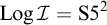 according to Theorems 4.1 and 4.12. It is known that
 is not 1-finite [Reference Henkin, Monk and Tarski18, Theorem 2.1.11(i)]. Hence, for each l, there is a model
 $M=(I,\theta )$
on
 $I\in \mathcal {I}$
and formulas
 $\psi _1, \ldots , \psi _l$
in the single variable p such that all sets
 $\bar {\theta }(\psi _i)$
are pairwise distinct (Mal’cev’s criterion, Theorem 2.2). Consider the frames F in
 $\mathcal {F}$
and G in
 $\mathcal {G}$
with clusters
 $C_1$
in F and
 $C_2$
in G that form the rectangle I. Let H be the subframe of
 $F\times G$
generated by a point in
 $C_1\times C_2$
. Consider a model
 $M'=(H,\theta ')$
with
 $\theta '(p)=\theta (p)$
.
Assume that
 $l>2$
. Then
 $\theta (p)\neq \varnothing $
: otherwise, every formula in the single variable p is equivalent to either
 $\bot $
or
 $\top $
on M. By Theorem 2.4, for some
 $m,n$
, every frame in
 $\mathcal {F}$
is m-transitive and every frame in
 $\mathcal {G}$
is n-transitive. Let
 $\bar {\lozenge } p$
abbreviate
 $\lozenge _{\mathrm {A}}^{\leq m} \lozenge _{\mathrm {B}}^{\leq n} p$
. By Proposition 4.3, we have
 $$ \begin{align*}M',a\vDash \bar{\lozenge} p \ \text{iff} \ a \ \text{belongs to } C_1\times C_2. \end{align*} $$
For bimodal formulas
 $\varphi $
in the single variable p, we define
 $t(\bot )=\bot $
,
 $t(p)=p$
,
 $t(\psi _1\rightarrow \psi _2)=\bar {\lozenge } p\wedge ( t(\psi _1)\rightarrow t(\psi _2))$
, and
 $t(\lozenge _1 \psi )=\bar {\lozenge } p \wedge \lozenge _{\mathrm {A}}^{\leq m} t(\psi )$
,
 $t(\lozenge _2 \psi )=\bar {\lozenge } p\wedge \lozenge _{\mathrm {B}}^{\leq n} t(\psi )$
. Then we have
 $$ \begin{align*} M',a\vDash t(\varphi) \ \text{iff} \ (a \ \text{is} \ \text{in} \ M \text{and} \ M,a\vDash \varphi). \end{align*} $$
So formulas
 $t(\psi _1), \ldots , t(\psi _l)$
are pairwise non-equivalent in
 $M'$
. It follows that
 $\mathop {\mathrm {Log}}(\mathcal {F}\times \mathcal {G})$
is not 1-finite.
4.6 Main results
We combine our earlier results in the form of the following two criteria.
Theorem 4.21. Let
 $\mathcal {F}$
and
 $\mathcal {G}$
be non-empty. TFAE:
-
1.
$\mathop {\mathrm {Log}}(\mathcal {F}\times \mathcal {G})$
is locally tabular. -
2.
$\mathop {\mathrm {Log}}\mathcal {F}$
and
$\mathop {\mathrm {Log}}\mathcal {G}$
are locally tabular and at least one of the classes
$\mathcal {F}$
,
$\mathcal {G}$
has the bounded cluster property. -
3.
$\mathop {\mathrm {Log}}\mathcal {F}$
and
$\mathop {\mathrm {Log}}\mathcal {G}$
are locally tabular and at least one of the classes
$\mathcal {F}$
,
$\mathcal {G}$
is path-bounded. -
4.
$\mathop {\mathrm {Log}}\mathcal {F}$
and
$\mathop {\mathrm {Log}}\mathcal {G}$
are locally tabular and
$\mathcal {F}^*\times \mathcal {G}^*$
has the reducible path property. -
5.
$\mathop {\mathrm {Log}}\mathcal {F}$
and
$\mathop {\mathrm {Log}}\mathcal {G}$
are locally tabular and
$\mathop {\mathrm {Log}}(\mathcal {F}\times \mathcal {G})$
is 1-finite.


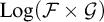
Proof. Theorem 4.12 shows the equivalence between (1) and (2). The equivalence of (2) and (3) follows from Proposition 3.6. By Proposition 4.19, (1) implies (4). By Proposition 4.13, (4) implies (2).
Recall that for a pretransitive logic L, its pretransitivity index
 $\mathrm {tra}{(L)}$
is the least k such that L is k-transitive. By Theorem 2.4,
 $\mathrm {tra}{(L)}$
is defined for every locally tabular logic.
Corollary 4.22. Let
 $L_1, L_2$
be Kripke complete consistent logics. TFAE:
-
1.
$L_1\times L_2$
is locally tabular. -
2.
$L_1$
and
$L_2$
are locally tabular and at least one of them contains a bounded cluster formula
${ [\mathrm {bc}_n ]}^{k}$
, where k is the pretransitivity index of this logic. -
3.
$L_1$
and
$L_2$
are locally tabular and at least one of them is strongly locally tabular. -
4.
$L_1$
and
$L_2$
are locally tabular and
$L_1\times L_2$
contains a product rpp formula
$\mathrm {rp}_m(k_1,k_2)$
, where
$k_i=\mathrm {tra}{(L_i)}$
.


5 Examples
It is well known that for unimodal logics above  , local tabularity is equivalent to finite height [Reference Maksimova20, Reference Segerberg26]. This criterion was extended to weaker systems in [Reference Shapirovsky and Shehtman33]: it holds for logics containing
 $\lozenge ^{k+1} p\rightarrow \lozenge p\vee p$
with
 $k>0$
.
Corollary 5.1. Let
 $L_1, L_2$
be Kripke complete consistent unimodal logics, and for some
 $k,n>0$
,
 $L_1$
contains
 $\lozenge ^{k+1} p\rightarrow \lozenge p\vee p$
and
 $L_2$
contains
 $\lozenge ^{n+1} p\rightarrow \lozenge p\vee p$
. In this case,
 $L_1\times L_2$
is locally tabular iff
 $L_1$
and
 $L_2$
contain formulas of finite height and for some m,
 $L_1\times L_2$
contains the product rpp formula
 $\mathrm {rp}_m(k,n)$
.
For a transitive logic L, let
 $L[h]$
be its extension with the axiom
 $B_h$
of finite height.
Let  and
 be the logics of converse well-founded partial orders, strict and non-strict, respectively. Clearly, these classes have the bounded cluster property: their clusters are singletons.
Corollary 5.2. For any locally tabular L, and any finite h, the logics  ,
 are locally tabular. Consequently,
 $L'\times L$
is locally tabular for any extension
 $L'$
of
 or
 .
It is known that if an
 $\mathrm {A}$
-logic L contains a formula
 $\Box _{\mathrm {A}}^m\bot $
for some m, then this logic is locally tabular (see [Reference Gabbay and Shehtman13, Theorem 9.4 and Lemma 9.2]). It follows from [Reference Shehtman36, Lemma 6.15] (see also [Reference Shehtman and Odintsov35, Corollary 12.6.13]) that
 $L\times L$
is locally tabular. We notice that the bounded cluster property holds for L-frames: in this case, clusters are singletons. Hence, we have the following generalization of the above result.
Corollary 5.3. If
 $L_1$
contains a formula
 $\Box _{\mathrm {A}}^m\bot $
and
 $L_2$
is locally tabular, then
 $L_1\times L_2$
is locally tabular.
6 Product finite model property
A modal logic L has the product fmp, if L is the logic of a class of finite product frames. The product fmp is stronger than the fmp: for example,  has the fmp [Reference Gabbay and Shehtman13, Theorem 12.12], but lacks the product fmp [Reference Gabbay, Kurucz, Wolter and Zakharyaschev11, Theorem 5.32]. Examples of logics with this property are also known: they include
 (where
 stands for the smallest unimodal logic) [Reference Gabbay and Shehtman14, Theorem 8.12] and
 (see [Reference Gabbay, Kurucz, Wolter and Zakharyaschev11, Theorem 6.56]), the logic
 [Reference Segerberg28], or its extensions [Reference Bezhanishvili5].
The product of a logic possessing the fmp with a tabular logic has the product fmp ([Reference Gabbay, Shapirovsky and Shehtman12], see Proposition 6.6 below). In this section, we show that the weaker property of local tabularity is not sufficient for the product fmp.
6.1 Product fmp fails for a locally tabular product logic
We define the saw frame
 $F_S = (W,S,S_l,S_r)$
for the alphabet
 $\mathrm {A} = \{\lozenge ,\,\lozenge _l,\,\lozenge _r\}$
as follows:
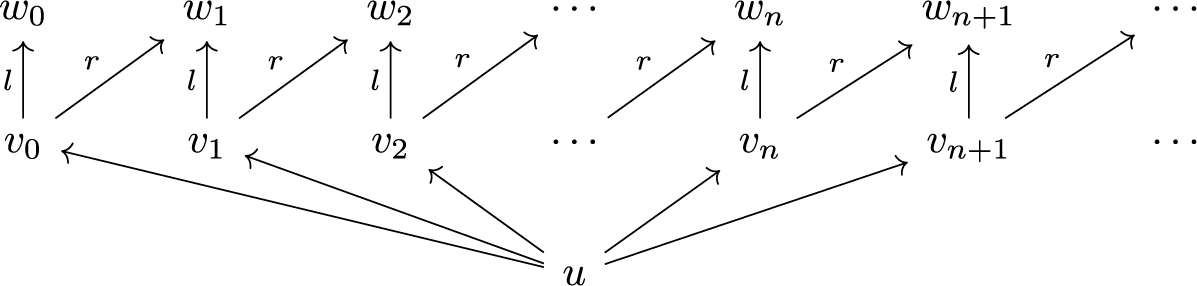
 $$ \begin{gather*} W = \{u\} \sqcup \{v_i\}_{i < \omega} \sqcup \{w_i\}_{i < \omega}; \\ S = \{u\} \times \{v_i\}_{i < \omega}; \\ S_l = \{(v_i,w_i)\}_{i < \omega}; \\ S_r = \{(v_i,w_{i+1})\}_{i < \omega}. \end{gather*} $$
The saw frame is shown in Figure 1.
The saw frame
 $F_S$
.

Let  The next proposition follows from simple semantic observations.
Proposition 6.1. The following formulas are theorems of  :
 $$ \begin{align} &\Box_{\mathrm{A}}^3 \bot; \end{align} $$
 $$ \begin{align} \lozenge \lozenge_r &p \to \lozenge \lozenge_l p. \end{align} $$
Proposition 6.2.
 is locally tabular.
We define the formula  as
 $\varphi = \varphi _1 \land \varphi _2 \land \varphi _3,$
where

Proposition 6.3. The formula
 $\varphi $
is consistent with

Proof. It suffices to show that
 $\varphi $
is satisfiable in
 $F_S\times \boldsymbol \omega .$
Let
 $\theta $
be a valuation in
 $F_S\times \boldsymbol \omega $
given by
 $\theta (p) = \{(w_i,j) \mid i < \omega ,\,j < i\}$
. Then a direct evaluation shows that
 $F_S\times \boldsymbol \omega ,\theta ,(u,0) \models \varphi .$
Proposition 6.4. If
 $\varphi $
is satisfiable in a
 -frame
 $F\times G$
, then
 $F\times G$
is infinite.
Proof. Let  be valid in a rooted frame
 $F = (X,R,R_l,R_r)$
with a root r and let
 $G = (Y,Y\times Y).$
Assuming that
 $\varphi $
is true at
 $F\times G,\theta ,(r,s)$
for some valuation
 $\theta $
and a point
 $s \in Y,$
we will show that X is infinite.
Let us show by induction that there exist sequences
 $\{m_i\}_{i < \omega },\,\{a_i\}_{i < \omega } \subseteq X$
and
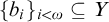 $\{b_i\}_{i < \omega }\subseteq Y$
such that the following are true for all
 $i < \omega $
:
 $$ \begin{align} &r R m_i R_l a_i; \end{align} $$
 $$ \begin{align} \text{for any } k < j \le i,\ &(a_k,b_k) \not\models p \text{ and }(a_j,b_k)\models p. \end{align} $$
By the assumption
 $\varphi _1$
is true at
 $(r,s),$
so
 $(r,s) R^h (m_0,s) R^h_l (a_0,s)$
for some
 $m_0,\,a_0 \in X.$
Then in the base case (7) holds, and (8) holds vacuously.
For the induction step, we assume that
 $\{m_j\}_{j \le i},\,\{a_j\}_{j \le i},$
and
 $\{b_j\}_{j < i}$
satisfying (7) and (8) are already constructed. Let us define
 $b_i$
,
 $m_{i+1},$
and
 $a_{i+1}$
. Since
 $\varphi _2$
is true at
 $(r,s)$
and
 $(r,s) R^h (m_i,s)$
, there exists
 $b_i \in Y$
such that p is false in
 $R_l^h(m_i,b_i)$
and true at some point
 $(a_{i+1},b_i)\in R^h_r(m_i,b_i).$
Then
 $m_i R_r a_{i+1}$
and therefore
 $a_{i+1} \in R\circ R_r(r)$
. The frame condition of (6) holds in F by Proposition 6.1, which means that
 $R \circ R_r \subseteq R \circ R_l$
. Then there exists
 $m_{i+1}$
such that
 $r R m_{i+1} R_l a_{i+1}$
, so (7) holds for
 $i + 1$
.
To complete the induction, it remains to prove (8) for
 $k < j \le i + 1.$
The induction hypothesis implies this condition for
 $k < j \le i$
, so we only need to show it for
 $j = i + 1$
and
 $k < j$
. The point
 $b_i$
was defined in such a way that p is true at
 $(a_{i+1}, b_i)$
. For all
 $k < i$
, p is also true at
 $(a_i, b_k)$
by the induction hypothesis, so
 $\varphi _3$
forces that
 $(a_{i+1}, b_k)$
satisfies p since
 $(m_i, b_k) R_l^h (a_i, b_k)$
and
 $(m_i,b_k) R_r^h (a_{i+1}, b_k)$
. Finally, recall that p is false in
 $R^h_l(m_i,b_i)$
. Since
 $m_i R_l a_i$
by the induction hypothesis, p is false at
 $(a_i,b_i)$
. Thus we proved the step.
Now (8) implies that
 $\{a_i\}_{i < \omega }$
is infinite. Indeed, for any
 $k < i < \omega $
we have
 $(a_k,b_k)\not \models p$
and
 $(a_i,b_k) \models p$
by (8), so
 $a_i \ne a_k$
. Thus
 $a_i$
are pairwise distinct for
 $i < \omega $
. It follows that X is infinite.
Theorem 6.5. The local tabularity of a product logic does not imply the product fmp.
6.2 Product fmp and products of small height
As follows from Theorem 2.4 and Corollary 4.22, it is necessary for any locally tabular product of two logics that both have a finite height and one of them contains a bounded cluster formula. We will discuss how the product fmp depends on the height of
 $L_1$
and
 $L_2.$
For this section, we will assume that
 $L_1$
and
 $L_2$
are locally tabular, and that
 $L_1 \vdash [\mathrm {bc}_n]^{\mathrm {tra}{(L_1)}}$
for some
 $n < \omega $
.
By Theorem 6.5, the product fmp can fail even when
 $h(L_2) = 1$
. Thus we will focus on the height of
 $L_1.$
If
 $L_1$
has unit height, then the product fmp follows from the following result.
Proposition 6.6 [Reference Gabbay, Shapirovsky and Shehtman12, Corollary 5.9].
If L is a tabular logic and
 $L'$
has the fmp, then
 $L\times L'$
has the product fmp.
The logic
 $L_1$
is complete with respect to the class of its finite rooted frames by Proposition 2.1. Every such frame has unit height, so it consists of one cluster, which has size at most n by the frame condition of
 $[\mathrm {bc}_n]^{\mathrm {tra}{(L_1)}}$
. Then
 $L_1$
is tabular, so the product fmp for
 $L_1\times L_2$
follows by Proposition 6.6.
Corollary 6.7. If
 $L_1$
and
 $L_2$
are locally tabular logics,
 $L_1$
contains a bounded cluster formula, and
 $h(L_1) = 1,$
then
 $L_1 \times L_2$
has the product fmp.
Proposition 6.4 shows that the product fmp can fail when
 $h(L_1)=3.$
The tabularity of
 $L_1$
or
 $L_2$
is a sufficient condition for the product fmp in this case, as well as for greater
 $h(L_1)$
. Describing weaker sufficient conditions is an open problem.
Finally, the case when
 $L_1$
has height
 $2$
is the most intriguing. Neither a proof, nor a counterexample for the product fmp of such logics is known yet.
7 Logics above

In this section, we discuss local tabularity and prelocal tabularity in extensions of  .
7.1 Preliminaries: Commutators of logics
Let
 $L_1$
be an
 $\mathrm {A}$
-logic and
 $L_2$
be a
 $\mathrm {B}$
-logic. The fusion
 $L_1*L_2$
is the smallest
 $(\mathrm {A}\cup \mathrm {B})$
-logic that contains
 $L_1 \cup L_2.$
The commutator
 $\left [L_1,L_2\right ]$
is the smallest logic that contains
 $L_1*L_2$
and the formulas
 $ \lozenge _a \lozenge _b p \leftrightarrow \lozenge _b \lozenge _a p,\, \lozenge _a \Box _b p \to \Box _b \lozenge _a p $
for all
 $\lozenge _a\in \mathrm {A}$
and
 $\lozenge _b\in \mathrm {B}.$
In an
 $(\mathrm {A}\cup \mathrm {B})$
-frame, these formulas express commutativity
 $R_a\circ R_b = R_b \circ R_a$
and the Church–Rosser property
 $$ \begin{align*} \forall x\,\forall y\,\forall z\,(x R_a y\,\&\,x R_b z \to \exists u\,(y R_b u\,\&\,z R_a u)). \end{align*} $$
For any
 $L_1$
and
 $L_2,$
the product logic
 $L_1\times L_2$
is a normal extension of
 $\left [L_1,L_2\right ]$
[Reference Gabbay, Kurucz, Wolter and Zakharyaschev11, Section 5.1].
Proposition 7.1 [Reference Gabbay and Shehtman13, Theorem 7.12].
 .
7.2 The product rpp criterion
Recall that a logic is tabular, if it is characterized by a single finite frame. A non-tabular logic is pretabular, if all of its proper extensions are tabular. There are exactly five pretabular logics above  (see [Reference Esakia and Meskhi10, Reference Maksimova21] or [Reference Chagrov and Zakharyaschev9, Section 12.3]). One of them is the logic
 . Another is the logic
 defined below.
An important fact about  was established in [Reference Bezhanishvili5]: this logic is prelocally tabular, that is, the following theorem holds.
Theorem 7.2 [Reference Bezhanishvili5].
All proper extensions of  are locally tabular.
In this section we observe that for another pretabular logic  , despite its similarities with
 , the product
 is not prelocally tabular. Then we give an axiomatic criterion of local tabularity for a family of logics, which in particular contains
 and its extensions.
The (one-dimensional) tack frame  is the ordered sum
 $(\omega +1,R)$
of a countable cluster and a singleton, that is,
 $\alpha R \beta $
iff
 $\alpha <\omega $
or
 $\beta =\omega $
. Let
 be the logic of its frame.
Proposition 7.3.
 is not prelocally tabular.
Proof. Let  . The formula
 $\varphi =\lozenge _2\lozenge _1\Box _1 p\rightarrow \Box _1\lozenge _1 p$
is not valid in H: consider a model
 $M=(H,\theta )$
with
 $\theta (p)=\{(\omega ,1)\}$
; then
 $\varphi $
is falsified in M at
 $(0,0)$
.
Consider the equivalence
 $\equiv $
on
 $\mathop {\mathrm {dom}} H$
that extends the diagonal by the set of pairs of form
 $((\omega ,m),(\omega ,n))$
. It is easy to check that
 $H \twoheadrightarrow {H}{/}{\equiv }$
, hence the logic L of the latter frame extends
 . It is also straightforward that
 $\varphi $
is valid in
 ${H}{/}{\equiv }$
, so L is a proper extension of
 . Finally, we observe that L is not locally tabular:
 ${H}{/}{\equiv }$
contains
 $\boldsymbol \omega \times \boldsymbol \omega $
as a subframe, and the logic
 of this subframe is not locally tabular.
The description of locally tabular extensions of  (and, in fact, of a weaker logic) can be obtained via the product rpp formulas. We say that the product rpp criterion holds for a logic L above
 , if for any normal extension
 $L'$
of L, we have:
 $$ \begin{align*} L' \text{ contains a product rpp formula } \mathrm {rp}_m(1,1) \text{ iff } L' \text{ is locally tabular}. \end{align*} $$
Recall that
 $L[h]$
denotes the extension of L with the axiom
 $B_h$
of finite height.
The unimodal logic  is the extension of
 with the axiom
 $\Box \lozenge p\rightarrow \lozenge \Box p$
. In transitive frames,
 $\Box \lozenge p\rightarrow \lozenge \Box p$
defines the first-order property
 $$ \begin{align} \forall x\,\exists y\,\left(xRy \land \forall z \left(yRz \to z = y\right)\right), \end{align} $$
see, e.g., [Reference Blackburn, de Rijke and Venema6, Section 3.7].
Hence, in our notation, the unimodal logic  is the extension of
 with the axioms
 $\Box \lozenge p\rightarrow \lozenge \Box p$
and
 $B_2$
. In particular, the tack frame T has this property; since it is transitive and has height
 .
We are going to show that the product rpp criterion holds for  .
We say that a bimodal frame
 $(X,R,\approx )$
is simple, if
 $\approx $
is
 $X\times X$
.
Lemma 7.4. Let
 $\mathcal {F}$
be the class of all
 -frames,
 $C\in Cl{(\mathcal {F})}$
. Then C is a point-generated
 -frame, or a simple frame.
Proof. Let
 $C=(X,R,\approx )$
. The frame
 $(X,R)$
is a preorder and
 $\approx $
is an equivalence on X, and we have
 $R\, \circ \approx \; = \; X\times X$
. Assume that C is not simple. We claim that in this case R is symmetric, and hence an equivalence relation. Assume
 $xRy$
. There is
 $z\in X$
such that
 $y\not \approx z$
. We have
 $yRz'\approx z$
for some
 $z'$
. Then
 $y\neq z'$
. It follows that y is not maximal in
 $(X,R)$
since by (9) the maximality would imply
 $R(y) = \{y\}.$
Hence
 $yRx$
.
Theorem 7.5. The product rpp criterion holds for  Namely, for any extension L of
 , we have: L is locally tabular iff for some m, L contains the product rpp formula
 $\mathrm {rp}_m(1,1)$
.
Proof. The ‘only if’ direction follows from Proposition 4.15.
‘If’. Let
 $F_L$
be the canonical frame of L,
 $\mathcal {C}$
the set of cluster frames in F,
 $\mathcal {C}_0$
the set of simple frames in
 $\mathcal {C}$
, and
 $\mathcal {C}_1$
the set of other frames in
 $\mathcal {C}$
.
Since the logic  is locally tabular, the class of its frames is uniformly tunable, and so is
 $\mathcal {C}_0$
.
By Proposition 4.18,
 $F_L\vDash \mathrm {rp}_m(1,1)$
. Due to the first-order characterization of
 $\mathrm {rp}_m(1,1)$
given in Proposition 4.16,
 $\mathrm {rp}_m(1,1)$
is valid in each subframe
 $C\in \mathcal {C}_1$
of
 $F_L$
. Hence, we have
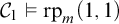 $\mathcal {C}_1\vDash \mathrm {rp}_m(1,1)$
. By Lemma 7.4, the logic
 $L_1$
of
 $\mathcal {C}_1$
is an extension of
 ; since
 $\mathrm {rp}_m(1,1)$
is not in
 , this extension is proper. By Theorem 7.2,
 $L_1$
is locally tabular, and so
 $\mathcal {C}_1$
is uniformly tunable.
It follows that
 $\mathcal {C}=\mathcal {C}_0\cup \mathcal {C}_1$
is uniformly tunable.Footnote
5
The formulas
 $B_h$
are known to be canonical [Reference Segerberg26, Theorem 6.4], so
 $h(F_L)\leq 2$
. By Theorem 2.9, the logic of
 $F_L$
is locally tabular. Since
 $\mathop {\mathrm {Log}} F_L\subseteq L$
, L is locally tabular as well.
7.3 Two-dimensional tack
A prelocally tabular logic  has height
 $1$
. In this section, we give another example of a prelocally tabular logic above
 , which has height
 $2$
.
We define the semi-ordered sum
 $F \oplus G$
of disjoint bimodal frames
 $F = (X,R_1,R_2)$
and
 $G = (Y,S_1,S_2)$
as
 $(X\cup Y, R_1 \cup S_1 \cup (X \times Y), R_2 \cup S_2).$
Let
 $\circ $
denote the reflexive, with respect to both relations, singleton
 $(\{0\},R,S)$
with
 $R = S = \{(0,0)\}.$
Let  . The two-dimensional tack is the frame
 . Let
 We show that
 is canonical, has the finite model property, and is prelocally tabular.
Firstly, we identify some axioms of  , study its abstract frames, and then give a complete axiomatization.
Notice that the composition of relations
 $R=R_1\circ R_2$
in
 is a preorder. Let
 $\lozenge $
denote the compound modality
 $\lozenge _1\lozenge _2$
.
Observe that the skeleton of  is a two-element chain. Hence,
 contains the axiom of height two for the compound modality
 $\lozenge $
. Moreover, the height of the first relation in
 is 2, so the fragment of
 in the first modality contains
 . Clearly, its fragment in the second modality is
 .
Moreover, our observation about the skeleton being the two-element chain implies the following modally definable properties. Clearly, the composition
 $R_1\circ R_2$
in
 satisfies the Church–Rosser property, and hence, the formula
 $\lozenge \Box p\rightarrow \Box \lozenge p$
, which is an abbreviation for
 $$ \begin{align} \lozenge_1\lozenge_2 \Box_1\Box_2 p\rightarrow\Box_1\Box_2 \lozenge_1\lozenge_2 p, \end{align} $$
is a valid principle of  . In the combination with height 2, it follows that in every rooted
 -frame, there is a top cluster (i.e., the greatest in the skeleton). Next, observe that R satisfies the condition (9). It follows that the formula
 $\Box \lozenge p\rightarrow \lozenge \Box p$
, which is an abbreviation for
 $$ \begin{align} \Box_1\Box_2\lozenge_1\lozenge_2 p\rightarrow\lozenge_1\lozenge_2\Box_1\Box_2 p, \end{align} $$
belongs to the logic  . In particular, it follows that in every rooted
 -frame, the top cluster is a singleton.
Our next step aims to express the symmetry property in the bottom cluster of an arbitrary rooted  -frame (notice that in clusters of
 -frames, the symmetry of the first relation is not guaranteed). Consider the following relativized version of the symmetry axiom:
 $$ \begin{align} \lozenge_1\Box_1 q \wedge \neg q\wedge p\rightarrow \Box_1 (\neg q\rightarrow \lozenge_1 p). \end{align} $$
Readily, this formula is valid in  . Let F be a point-generated
 -frame of height 2. We claim that its rooted cluster C, considered as a frame-restriction, validates
 . Given the axiomatization of
 from Proposition 7.1, it suffices to show the symmetry of
 $R_1$
. Indeed, assume that
 $x,y\in C$
are connected by the first relation
 $R_1$
. Then consider a valuation
 $\theta $
in F with
 $\theta (q)$
being the top cluster, and
 $\theta (p)=\{x\}$
. The validity of (12) implies that
 $yR_1 x$
, which proves the claim.
Let L be the extension of the commutator  with the axioms (10)–(12). Putting our observations together, we obtain the following lemma.
Lemma 7.6. Let F be a rooted L-frame. Then F is isomorphic to
 $C\oplus \circ $
for an
 -frame C, or to
 $\circ $
.
Our next goal is to prove completeness.
Lemma 7.7. Assume that  for classes
 $\mathcal {C}$
,
 $\mathcal {D}$
of rooted frames. Then
 $\mathop {\mathrm {Log}}\{{{C}\,\oplus \, \circ }\mid C\in \mathcal {C} \} =\mathop {\mathrm {Log}}\{{{D}\,\oplus \, \circ }\mid D\in \mathcal {D} \}$
.
Proof. The semi-ordered sum
 ${{F}\,\oplus \, \circ }$
is the sum of F and the singleton
 $\circ $
over the indexing frame
 $(2,\leq ,\varnothing )$
in the sense of [Reference Shapirovsky30, Definition 3.1]. Two classes are interchangeable, if they have the same logic in the language enriched with the universal modality. It follows from [Reference Shapirovsky30, Section 4] that replacing interchangeable classes of summands does not change the logic of the sums. Classes
 $\mathcal {C}$
and
 $\mathcal {D}$
are interchangeable, since the universal modality is expressible as
 $\lozenge _1\lozenge _2$
in rooted
 -frames. Hence
 $\mathop {\mathrm {Log}}\{{{C}\,\oplus \, \circ }\mid C\in \mathcal {C} \} =\mathop {\mathrm {Log}}\{{{D}\,\oplus \, \circ }\mid D\in \mathcal {D} \}$
.
It follows from Lemma 7.7 that  has an analog of the product fmp:
Corollary 7.8.
 is the logic of
 .
 is the extension of the commutator
 with the axioms (
 is canonical.
Proof. Let L be the mentioned axiomatic extension of  .
Firstly, we show that L is canonical. The axioms of  are known to be canonical, in particular, canonicity of the finite height formula is given in [Reference Segerberg26, Theorem 6.4]. It is immediate that (12) is equivalent to the Sahlqvist formula
 $$ \begin{align*}\lozenge_1\Box_1 q \wedge p\rightarrow \Box_1( q \vee \lozenge_1 p)\vee q, \end{align*} $$
and so is canonical. The formula
 $\lozenge \Box p \rightarrow \Box \lozenge p$
is also Sahlqvist.
The formula
 $\Box \lozenge p \rightarrow \lozenge \Box p$
is not a Sahlqvist formula. However, it is well-known that it is canonical in the transitive case, which, in our setting, pertains to the composition
 $R_1\circ R_2$
. Hence, we have a singleton cluster above every point in the canonical frame of L.
It follows that L is canonical.
Let us show that  . Since L is canonical, it is Kripke complete, and so, in view of Lemma 7.6, L is included in the logic of the class

It is straightforward that
 $\mathcal {F}\vDash L$
, so
 $L=\mathop {\mathrm {Log}}(\mathcal {F})$
. From Lemma 7.7, the logic of
 $\mathcal {F}$
is
 .
Lemma 7.10.
 is not locally tabular.
Proof. The frame  contains
 $\boldsymbol \omega \times \boldsymbol \omega $
as a subframe. Now the statement follows from Proposition 2.8.
Lemma 7.11. Let
 $\mathcal {F}$
be a class of bimodal frames such that
 $\mathop {\mathrm {Log}}\mathcal {F}$
is a proper extension of
 . Then
 $\mathop {\mathrm {Log}}\mathcal {F}$
is locally tabular.
Proof. Let
 $\mathcal {G}$
be the class of point-generated subframes of frames in
 $\mathcal {F}$
. By Lemma 7.6, every frame in
 $\mathcal {G}$
is isomorphic to
 $C\oplus \circ $
for an
 -cluster C. Let
 $\mathcal {C}$
be the class of all such clusters. Since
 $\mathop {\mathrm {Log}}\mathcal {F}=\mathop {\mathrm {Log}}\mathcal {G}$
is a proper extension of
 , then, in view of Lemma 7.7,
 $\mathop {\mathrm {Log}}(\mathcal {C})$
is a proper extension of
 . By Theorem 7.2, the logic L of this class is locally tabular. So
 $\mathcal {C}$
is a uniformly tunable class. Clearly, the top clusters in
 -frames also form a uniformly tunable class, since they are singletons. Now the statement follows from Theorem 2.9.
Theorem 7.12.
 is prelocally tabular.
Proof. Let L be an extension of  . Let
 $F_k$
denote the k-generated canonical frame of L. For a set
 $\Psi $
of formulas, let
 $\Psi {\upharpoonright }{k}$
denote the set of all k-formulas in
 $\Psi $
.
Consider two cases.
First, assume that for each finite k, each point-generated subframe in
 $F_k$
is finite. It is straightforward that in this case
 $\mathop {\mathrm {Log}}(F_k){\upharpoonright }{k}=L{\upharpoonright }{k}$
. In particular, it follows that
 $L=\bigcap _{k<\omega }\mathop {\mathrm {Log}}(F_k)$
, and so L is Kripke complete. By Lemma 7.11, if L is a proper extension of
 , it is locally tabular.
Now assume that for some finite k, there is an infinite point-generated subframe in
 $F_k$
. We show that in this case
 .
Let us list some properties of
 $F_k$
. Since
 is canonical (Theorem 7.9), and L contains
 ,
 $F_k$
is a
 -frame. The top clusters in
 $F_k$
are singletons. Let
 $\mathcal {C}$
be the family of non-top clusters in
 $F_k$
. In view of Lemma 7.6,
 $\mathcal {C}$
consists of
 -frames. We also have:
 $$ \begin{align} \text{For} \ C\in \mathcal{C}, \text{ there is a unique cluster} \ D \ \text{above} \ C, \text{ and} \ D\ \text{is a singleton.} \end{align} $$
It follows that there is an infinite cluster C in
 $\mathcal {C}$
. Let D be the cluster above C. Put
 $X=C\cup D$
. By (13), the restriction
 $F_k{\upharpoonright } X$
is a generated subframe of
 $F_k$
.
Consider the extension  of
 with the axiom of height 1, which makes the composite relation
 $R_1\circ R_2$
an equivalence. Clearly,
 is locally tabular (even tabular, since this is the logic of the singleton
 $\circ $
). It follows that the set T of points in top clusters in
 $F_k$
is definable [Reference Shapirovsky31, Theorem 5.1]: there exists a formula
 $\psi _T$
such that
 $$ \begin{align} \psi_T\in x \text{ iff } x\in T. \end{align} $$
Hence, for every x in X,
 $$ \begin{align} x\in C \text{ iff } \psi_T\notin x. \end{align} $$
Let
 $\Psi $
be the set of all bimodal formulas in k variables. For a formula
 $\psi \in \Psi $
, let
 $\theta (\psi )=\{x \in X \mid \psi \in x\}$
and
 $\eta (\psi )=\{x \in C \mid \psi \in x\}$
.
Let A denote the powerset modal algebra of the cluster-frame
 $F_k{\upharpoonright } C$
, and let B be its subalgebra generated by the sets
 $\eta (p_i)$
,
 $i<k$
.
By a straightforward induction on the structure of formulas, we have:
 $$ \begin{align} \text{For every} \ b\in B, \text{there is} \ \psi\in\Psi \ \text{such that} \ b=\eta(\psi). \end{align} $$
Since C is infinite, B is infinite as well: any two distinct points in C are separable by some formula. Hence, B is a finitely generated infinite  -algebra. The logic of B is not locally tabular, thus it is
 by Theorem 7.2.
Let G be the general frame on
 $F_k{\upharpoonright } C$
, whose admissible subsets are elements of B. Since its logic is
 (the logic of B), for each finite m there is a p-morphism
 $f_m: F_k{\upharpoonright } C \twoheadrightarrow \boldsymbol m \times \boldsymbol m$
such that preimages of subsets of
 $\boldsymbol m \times \boldsymbol m$
are in B: it follows from the standard technique using Jankov–Fine formulas
 $\chi _m$
of the squares
 $\boldsymbol m \times \boldsymbol m$
. Namely, since the logic of G is
 , every
 $\chi _n$
is satisfiable in G, encoding a p-morphism from a point-generated subframe of G onto
 $\boldsymbol m \times \boldsymbol m$
. It remains to notice that every point-generated subframe of G is G.
Let  be the extension of
 $f_m$
that maps the top to the top. Clearly,
 $g_m$
is a p-morphism (of Kripke frames). For any subset V of
 $\boldsymbol m \times \boldsymbol m$
, its preimage
 $g_m^{-1}(V)$
is defined in
 $F_k{\upharpoonright } X$
by
 $\psi \land \lnot \psi _T$
, where
 $\psi $
defines
 $g_m^{-1}(V)$
in G according to (16), and the preimage of the top singleton is defined by
 $\psi _T$
. Therefore
 validates the logic of the general frame
 $(F_k{\upharpoonright } X,U)$
, where
 ${U = \{\theta (\psi )\mid \psi \in \Psi \}}$
. Then, since
 $(F_k{\upharpoonright } X,U)$
is a generated subframe of the k-canonical general frame of L, we have
 Since m was arbitrary,
 , where the intersection equals
 by Corollary 7.8. Consequently,
 .
8 Conclusion
8.1 Summary of the results
-
1. The main result of this article is the criteria obtained in Section 4.
-
2. In Section 5, the criteria are applied to describe new families of locally tabular products. In particular, we generalized results from [Reference Shehtman and Odintsov35, Reference Shehtman36].
-
3. In Section 6, we discussed the product finite model property. In particular, we showed that the local tabularity of a product logic does not imply the product fmp, even in the case of height 3.
-
4. We showed in Theorem 7.5 that the product rpp formula gives an axiomatic criterion of local tabularity for all extensions of
. -
5. Finally, we described a prelocally tabular extension of
of height 2.
 .
 of height 2.
8.2 Open problems
8.2.1 Criterion for extensions of products.
According to Theorem 4.21, local tabularity of the factors and a product rpp formula are equivalent to the local tabularity of the product. In particular, in the case of transitive logics of finite height, local tabularity of the product is equivalent to the product rpp due to Corollary 5.1. These facts do not give a criterion for normal extensions of a product. Unlike them, Theorem 7.5 gives an axiomatic criterion for all extensions of  . We conjecture that Theorem 7.5 can be generalized for a wider class of logics.Footnote
6
8.2.2 Prelocal tabularity in products.
It is a well-known open problem whether every non-locally tabular unimodal logic is contained in a prelocally tabular logic [Reference Chagrov and Zakharyaschev9, Problem 12.1]. For the case of logics above  , this question is also open. We announce that this is true for logics above
 with
 $h,\,l < \omega $
[Reference Shapirovsky and Sliusarev34].
8.2.3 Local tabularity in the symmetric case.
One of the central tools for our results was the criterion given in Theorem 2.9 [Reference Shapirovsky and Shehtman33], which, informally, says that under the necessary condition of finite height, local tabularity only depends on clusters. While this criterion has many applications, there is an obvious limitation for this approach. Namely, even in the unimodal case, if the relation is symmetric, then every point-generated frame consists of one cluster, and no additional structure is given by the skeleton construction. Hence, it is of definite interest to study local tabularity of symmetric relations. Under the necessary condition of pretransitivity, this means that we are interested in graphs of finite diameters. No axiomatic criterion is known for this case, and it is not guaranteed that an explicit axiomatic characterization of local tabularity is possible in this case.
Acknowledgments
We are grateful to Guram Bezhanishvili and Valentin Shehtman for valuable discussions. We are grateful to the referee for deep and very helpful comments.
Funding
The work of I. Shapirovsky was supported by NSF Grant DMS-2231414.
9 Appendix
9.1 Proof of Theorem 2.9
Lemma 9.1. Let
 $\mathrm {A}$
be finite
 $and \ F$
be an
 $\mathrm {A}$
-frame such that:
-
(a)
$\mathop {\mathrm {dom}} F = X_1\cup X_2$
for disjoint
$X_1$
and
$X_2$
, -
(b)
$F{\upharpoonright } X_1$
is a generated subframe of
$F,$
and -
(c)
$F{\upharpoonright } X_i$
is
$f_i$
-tunable for some monotone
$f_i:\:\omega \to \omega ,\, i = 1, 2.$


Then F is g-tunable for
 $$\begin{align*}g(n) = f_1(n) + f_2\left(n\cdot2^{f_1(n)\cdot |\mathrm{A}|} \right). \end{align*}$$
Proof. Let
 $\mathcal {V}$
be a partition of
 $\mathop {\mathrm {dom}} F,\,|\mathcal {V}| = n < \omega .$
Then
 $\mathcal {V}$
induces partitions
 $\mathcal {V}_1,\,\mathcal {V}_2$
of
 $X_1$
and
 $X_2,$
respectively. There exists a refinement
 $\mathcal {U}_1$
of
 $\mathcal {V}_1$
such that
 $\mathcal {U}_1$
is tuned in
 $F_1 = F {\upharpoonright } X_1$
and
 $$ \begin{align} |\mathcal{U}_1| \le f_1(|\mathcal{V}_1|) \le f_1(n). \end{align} $$
For
 $\lozenge \in \mathrm {A}$
, define
 $\alpha _\lozenge :\:X_2 \to 2^{\mathcal {U}_1}$
by letting
 $$\begin{align*}\alpha_\lozenge(x) = \{U\in \mathcal{U}_1 \mid x\in R_\lozenge^{-1}[U]\}. \end{align*}$$
Let
 $\sim _\lozenge $
be the equivalence induced by
 $\alpha _\lozenge $
; it has at most
 $2^{|\mathcal {U}_1|}$
classes. Hence, the equivalence
 $\sim \; = \;\bigcap \{ \sim _\lozenge \mid \lozenge \in \mathrm {A}\}$
has at most
 $2^{f_1(n)\cdot |\mathrm {A}|}$
classes. Let
 $\equiv $
be the equivalence on
 $X_2$
whose quotient is
 $\mathcal {V}_2$
. Put
 $\mathcal {S}={X_2}{/}{(\sim \cap \equiv )}$
. We have
 $$ \begin{align} |\mathcal{S}| \le |\mathcal{V}_2| \cdot 2^{|\mathcal{U}_1|\cdot |\mathrm{A}|} \le n \cdot 2^{f_1(n)\cdot |\mathrm{A}|}, \end{align} $$
where the latter inequality holds by (17). Hence, there exists a refinement
 $\mathcal {T}$
of
 $\mathcal {S}$
of size at most
 $f_2 (n\cdot 2^{f_1(n)\cdot |\mathrm {A}|} )$
, which is tuned in
 $F_2 = F {\upharpoonright } X_2$
.
Consider the partition
 $\mathcal {U}=\mathcal {U}_1 \cup \mathcal {T}$
of F. Clearly, it refines
 $\mathcal {V}$
, and it has at most
 $g(n)$
elements in view of (17) and (18). So it remains to check that
 $\mathcal {U}$
is tuned in F.
Let
 $xR_{\lozenge } y$
for some
 $x,\,y\in \mathop {\mathrm {dom}} F$
and
 $\lozenge \in \mathrm {A}$
, and let
 $x'\in [x]_{\mathcal {U}}.$
We will show that
 $x' R_\lozenge y'$
for some
 $y'\in [y]_{\mathcal {U}}$
.
Assume that
 $x\in X_1$
. Then
 $y\in X_1$
, since
 $F_1$
is a generated subframe of F. In this case, x and
 $x'$
belong to the same element of
 $\mathcal {U}_1.$
Since
 $\mathcal {U}_1$
is tuned in
 $F_1$
,
 $x' R_{\lozenge } y'$
for some
 $y'\in [y]_{\mathcal {U}_1}=[y]_{\mathcal {U}}$
, as desired.
Now assume
 $x\in X_2$
. Then
 $x'\in [x]_{\mathcal {T}}$
, so
 $\alpha _\lozenge (x) = \alpha _\lozenge (x').$
If
 $y\in X_1$
, then
 $[y]_{\mathcal {U}_1}\in \alpha _\lozenge (x) = \alpha _\lozenge (x')$
, so
 $x' R_\lozenge y'$
for some
 $y'\in [y]_{\mathcal {U}_1}=[y]_{\mathcal {U}}$
, as desired. If
 $y\in X_2$
, then
 $x' R_{\lozenge } y'$
for some
 $y'\in [y]_{\mathcal {T}}=[y]_{\mathcal {U}}$
, since
 $\mathcal {T}$
is tuned in
 $F_2$
.
Proof of Theorem 2.9. ‘Only if’. Finite height follows from Theorem 2.4. The logic of subframes of frames in
 $\mathcal {F}$
is contained in the logic of the clusters
 $Cl{(\mathcal {F})}$
and is locally tabular by Proposition 2.8. Hence, the logic of
 $Cl{(\mathcal {F})}$
is locally tabular.
‘If’. For
 $1\leq h<\omega $
, let
 $\mathcal {F}_h$
be the class of frames F such that
 $h(F)\leq h$
and each cluster in F belongs to
 $Cl{(\mathcal {F})}$
. By induction on h we show that
 $\mathcal {F}_h$
is
 $g_h$
-tunable for some monotone
 $g_h:\omega \to \omega $
. Let
 $h=1$
. The class
 $\mathcal {F}_1$
consists of disjoint sums of frames in
 $Cl{(\mathcal {F})}$
, so
 $\mathop {\mathrm {Log}}Cl{(\mathcal {F})}=\mathop {\mathrm {Log}}\mathcal {F}_1$
. Since
 $\mathop {\mathrm {Log}}\mathcal {F}_1$
is locally tabular, the class
 $\mathcal {F}_1$
is f-tunable for some f by Theorem 2.6. Put
 $g_1(n)=\max \{f(i)\mid i\leq n\}$
; clearly,
 $\mathcal {F}_1$
is
 $g_1$
-tunable. Assume
 $h>1$
. By the induction hypothesis,
 $\mathcal {F}_{h-1}$
is
 $g_{h-1}$
-tunable for some monotone
 $g_{h-1}$
. Put
 $g_h(n) = g_1(n) + g_{h-1}(n\cdot 2^{g_1(n)\cdot |\mathrm {A}|} ).$
Consider
 $F\in \mathcal {F}_{h}$
. Let
 $F_1$
be the restriction of F to its top clusters,
 $X_1=\mathop {\mathrm {dom}} F_1$
,
 $X_2=(\mathop {\mathrm {dom}} F){\setminus }X_1$
. If
 $X_2 =\varnothing $
, then
 $F\in \mathcal {F}_1$
, and so is
 $g_1$
-tunable; hence, F is
 $g_h$
-tunable. If
 $X_2 \neq \varnothing $
, then F is
 $g_h$
-tunable by Lemma 9.1.
Let h be the height of
 $\mathcal {F}$
. Since
 $\mathcal {F}\subseteq \mathcal {F}_h$
,
 $\mathcal {F}$
is uniformly tunable, and hence its logic is locally tabular by Theorem 2.6.


 containing the modal Casari formula

 , including all logics
 .