I. INTRODUCTION
The chemical synthesis of fused aromatic diketopyrrolopyrrole (DPP) core pigments was reported by Ciba Specialty chemicals a few decades back. Reference Iqbal, Jost, Kirchmayr, Pfenninger, Rochat and Wallquist1 DPP is an aromatic conjugated planar moiety with lactam nitrogen and two electron-withdrawing carbonyl groups, which makes DPP a promising solution-processable block for synthesizing many varieties of donor–acceptor (D–A)-based polymers. Reference Li, Singh and Sonar2 Recently, DPP-based semiconducting polymers have become a popular choice of material for organic thin film transistors and organic photovoltaic devices. Reference Yi, Wang and Liu3,Reference Li, Sonar, Murphy and Hong4 Worldwide, many groups are exploring structure–property relationships of such materials. Reference Kanimozhi, Balraju, Sharma and Patil5 These DPP-based organic semiconductors not only exhibit exceptional thermal and mechanical robustness but also superior photochemical stability. Such features are required for fabricating stable organic electronic devices. Small molecules of DPP have been widely used for organic photovoltaic applications because of their excellent light absorbing and charge transporting ability. Reference Qu and Tian6 Many reports can also be found about DPP-based materials for other opto-electronic devices including organic light emitting diodes, Reference Fenwick, Fusco, Baig, Di Stasio, Steckler, Henriksson, Fléchon, Andersson and Cacialli7 chemical sensors, Reference Wolfbeis8,Reference Qu, Hua and Tian9 and memory devices. Reference Zhou, Han, Sonar and Roy10 Though DPP polymers can be made in bulk using various organometallic coupling reactions, DPP polymers can also be synthesized via an electrochemical approach in the form of a thin film on any conducting substrate by oxidizing conjugated monomers by applying an appropriate electrochemical potential. Using chemical polymerization methods, a bulk quantity of polymer can be obtained with high molecular weight, but this polymerization method often involves some cumbersome synthesis and the use of expensive catalysts such as palladium and nickel with precautionary synthetic conditions. The presence of the catalysts in the polymer after purification may adversely affect its performances in electronic devices. In comparison, electropolymerization is a simple way of preparing oligomer/polymer films directly on a conductive substrate which does not require an expensive catalyst. Another important feature of electropolymerization is that film growth can be done directly on the working electrode, and the polymer thickness can be controlled by various parameters like number of potential sweeps, scan rate, and monomer concentration. The only drawback of electropolymerization is that the polymer material cannot be synthesized in a bulk quantity and it might be restricted to choices of monomers that are suitable for oxidative polymerization. In the literature much attention has been paid to chemical polymerization methods; however, very few publications can be found on the synthesis of DPP-based polymers via electrochemical polymerization. Reference Zhu11,Reference Zhu, Zhang and Tieke12 There are several reports on the electropolymerization of other monomers, but there are very few reports on this new and promising class of DPP based monomers. Reference Adamcová and Dempírová13 During electropolymerization, the growth of a polymer film on a conducting substrate is a rapid process and polymer thicknesses of up to a few nanometers can be achieved which is convenient for most electrochemical and spectroelectrochemical studies and fabrication of electronic devices. Reference Liu, Luo, Shi, Yang, Chi and Ma14–Reference You, Li, Wang, Nie, Wang and Li18
The DPP core can be substituted with electron-donating heterocyclic moieties such as thiophene, furan, thienothiophene, selenophene; these groups act as electropolymerization initiation moieties. Such donor groups determine the oxidation onset potential of the monomer during electropolymerization. Furthermore, the electron donating strength influences the effective conjugation length and enhancement of planarity, and therefore can be used to decrease the band-gap of organic semiconductors. Reference Dhar, Venkatramaiah, Anitha and Patil19 The most widely used DPP derivatives are thiophene flanked DPP due to their easy synthesis, high performance, and better donor–acceptor interactions. Among these derivatives, DPP with furan molecules have emerged as versatile semiconducting materials with numerous applications in various polymer optoelectronic devices. Reference Liu, Luo, Shi, Yang, Chi and Ma14–Reference You, Li, Wang, Nie, Wang and Li18
Sonar et al. who have shown that furan-substituted DPP copolymers also exhibit comparable performance to thiophene-flanked DPP copolymers have produced some of the prominent work on furan-flanked DPP. Furan-flanked DPP copolymer has been used in organic thin film transistor devices and a high hole mobility of 3.56 cm2/V s has been achieved. Reference Sonar, Chang, Shi, Gann, Li, Wu and McNeill20 In addition, Li et al. have also reported several new polymers based on furan-flanked DPP. Reference Li, Sonar, Singh, Ooi, Lek and Loh21 Several other recent reports Reference Bijleveld, Karsten, Mathijssen, Wienk, de Leeuw and Janssen22–Reference Sonar, Zhuo, Zhao, Lim, Chen, Rondinone, Singh, Chua, Ho and Dodabalapur25 clearly demonstrated that the replacement of thiophene by furan can produce promising low-band gap donor–acceptor copolymers. This progress clearly indicates that the furan-flanked DPP is also a promising building block for making a wide range of semiconductors and various electronic devices including organic field effect transistors.
Concerning the electropolymerization of DPP-based monomers, the thiophene-flanked DPP core has been widely used in most of the initial studies in this area. Reference Zhu, Zhang and Tieke12,Reference Welterlich, Neudörfl and Tieke26 The most common electron donor groups attached to the thiophene-flanked DPP moiety studied for electropolymerization are EDOT, thiophene, and selenophene. Reference Huang, Jia, Li, Lu, Zhang, He, Jiang, Tang, Tan and Zhan27 In 2009, Zhu et al. reported that EDOT-DPP-EDOT films exhibit a low oxidation potential of 0.67 V (v/s Ferrocene) which gives a stable, well-adhered polymer thin film on an ITO electrode. Reference Zhu, Zhang and Tieke12 In the same year, Zhang et al. also demonstrated the incorporation of heterocyclic and heteroaromatic moieties into the conjugated polymer chain. This is a useful strategy to alter optical properties such as absorption and emission maxima and electronic properties such as band gap and oxidation potential of the polymer chains. Reference Zhang, Tieke, Forgie and Skabara28 Welterlich et al. synthesized new π-conjugated polymers containing 1,3,4,6-tetraarylpyrrolo[3,2-b]pyrrole-2,5-dione (iso-DPP) units in the main chain, via an electrochemical polymerization of iso-DPP based monomers, Reference Welterlich, Neudörfl and Tieke26 where they showed that these polymers might be useful as active materials for organic electronic devices. It has been shown that the electropositive heterocyclic moieties are useful for constructing various electronic devices. The π–π intermolecular interactions, solid-state packing and optical properties of such electropolymerized DPP-containing thin films are dependent on the nature of these substituents. Sheberla et al. reported synthesis of polyfurans by electropolymerization of oligofurans and demonstrated that these furans are much more rigid than polythiophenes. It has been also documented that alkyl substitutions on the furan do not disturb backbone planarity and conjugation. Reference Sheberla, Patra, Wijsboom, Sharma, Sheynin, Haj-Yahia, Barak, Gidron and Bendikov29 The obtained properties of poly(oligofuran) films are superior to the properties of electrochemically prepared poly (oligothiophene)s under similar conditions. In their reports, they mention that polyfuran films prepared electrochemically are smoother when compared to other films and exhibit better stability while also being spectrochemically active.
To the best of our knowledge, there is no report on the electropolymerization of the furan-flanked DPP-based monomer system. In this paper, for the first time we have used furan-flanked DPP monomer BO-DPPF for an electropolymerization study to compare it with its thiophene analogue BO-DPPT by keeping the same butyloctyl (BO) side alkyl chain. We systematically investigated the effects of furan and thiophene heterocyclic moieties attached to the DPP core and their effect on the electropolymerization behavior. Even though these furan- and thiophen-flanked monomers are electron deficient moieties, we attempted to investigate these monomers to gain basic knowledge about electropolymerization of electron deficient DPP and to correlate the effect of heterocyclic groups (furan versus thiophene) on electrochemical behavior. Apart from electrochemical studies of monomers and their polymers, we have also systematically investigated the comparative optical and thermal properties as well as solid state ordering of BO-DPPF and BO-DPPT monomers in detail. Electrochemical and optical properties are rationalized with the help of electronic structure calculations.
II. EXPERIMENTAL PART
A. Materials and methodology
2,5-Bis(2-butyloctyl)-3,6-di(furan-2-yl)pyrrolo[3,4-c]pyrrole-1,4(2H,5H)-dione (BO-DPPF) and 2,5-bis(2-butyloctyl)-3,6-di(furan-2-yl)pyrrolo[3,4-c]pyrrole-1,4(2,5H)-dione (BO-DPPT) monomers were designed and prepared according to a previously reported procedure. Reference Li, Sonar, Singh, Soh, Van Meurs and Tan30 All other chemicals used for the electropolymerization study of DPP derivatives were of analytical grade. The diamond-polished glassy carbon (GC) working disc electrodes having a geometric area of 0.785 cm2 were purchased from HTW, Germany. A platinum wire (purity 99.99%) is used as the counter electrode and an Ag (purity 99.99%) wire as the pseudo-reference electrode were purchased from A & E Metals, Australia. The solvent dichloromethane (DCM), supporting electrolyte tetrabutylammonium hexafluorophosphate (TBAPF6), internal standard ferrocene were obtained from Sigma Aldrich, Australia. Micro Polish Alumina 0.3 µm was purchased from Buehler, USA to polish the GC surface, whereas pads (Micro cloth®) and polishing slurries were purchased from Buehler, Germany. The electrolyte was purged using argon for 20 min before starting electrochemical experiments. The entire electrochemical experiments were conducted in anhydrous DCM solution containing 0.1 M TBAPF6 as supporting electrolyte and monomer concentration of 0.1 mg/mL.
B. Instrumentation and characterization
UV–Vis absorption spectra were recorded using a Cary 50 probe UV–Vis spectrometer (Conquer Scientific, San Diego, California) whereas photoluminescence spectra were measured using an Argus Cary eclipse fluorescence spectrometer (Varian Optical Spectroscopy Instruments, Mulgrave, Australia). Thermal characterizations were carried out using chimaera Q 100-DSC 2005 Differential Scanning Calorimetry (DSC; Lab-X, Midland, Canada) whereas thermogravimetric analysis (TGA) was conducted with a Peagasus Q 500 (PANalytical, New Castle, Delware). X-Ray diffraction patterns were collected using a PANalytical X’Pert Pro diffractometer (Co Kα1) operating at 40 kV and 40 mA. Data were collected in Bragg–Brentano geometry using a parabolic mirror and 0.09° parallel plate collimator, with samples front-pressed into low background quartz sample holders. These holders were used because some of the samples were paste-like and would not pack appropriately into a capillary. Patterns were collected for 1.5 h at a step size of 0.02° over the 3–60° 2θ range using 0.04 rad soller slits, 10 mm mask, and 0.5° divergence slit. Theoretical modeling was carried out using Density Functional Theory Reference Kohn and Sham31,Reference Hohenberg and Kohn32 and the Gaussian 09 code. Reference Frisch, Trucks, Schlegel, Scuseria, Robb, Cheeseman, Scalmani, Barone, Mennucci and Petersson33 The B3LYP functional Reference Becke34 and the LANL2DZ basis set were used. Reference Dunning and Hay35,Reference Check, Faust, Bailey, Wright, Gilbert and Sunderlin36 A polarized continuum model Reference Mennucci37 of the chloroform solvent was used. Optical properties emission and absorption were computed with time-dependent DFT (TD-DFT) considering six lowest excited states. Reference Casida38
All electrochemical experiments were carried out using an Autolab PGSTAT204 potentiostat (Metrohm Australia, Boronia Park, Australia) with a custom-made three-electrode cell setup in which the GC disc acts as the working electrode (Fig. S4 for electrochemical setup). The GC electrode was cleaned using Micro Polish Alumina (0.3 µm). Electrochemical experiments undertaken for both monomers were conducted in DCM containing 0.1 M TBAPF6 as a supporting electrolyte and the monomer at a concentration of 0.1 mg/mL using a potential cycling protocol between −2.0 and 2.0 V for BO-DPPF and BO-DPPT for 50 repetitive cycles at a scan rate of 0.1 V/s.
III. RESULTS AND DISCUSSION
A. Synthesis of the monomers
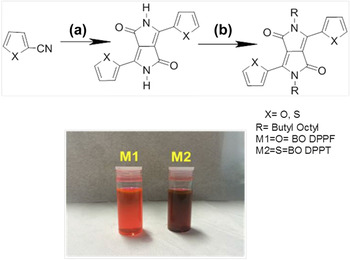
The thiophene-flanked DPP core was synthesized using 2-thiophenecarbonitrile, di-n-butyl succinate ester with an excess of potassium t-butoxide as a strong base in 2-methyl-2-butanol high boiling point solvent medium, according to a previously reported procedure (Scheme 1). Reference Bronstein, Chen, Ashraf, Zhang, Du, Durrant, Shakya Tuladhar, Song, Watkins and Geerts39,Reference Zou, Gendron, Neagu-Plesu and Leclerc40 Similarly, the furan-flanked DPP compound was synthesized by reacting 2-furylnitrile with diisopropyl succinate in the presence of sodium tert-amyl alcohol and iron chloride at 110 °C Reference Grzybowski and Gryko41 in a 61% yield. To make soluble precursors for these two monomers, the DPP cores were alkylated using branched butyl-octyl bromide in anhydrous dimethylformamide (DMF) in the presence of potassium carbonate (K2CO3) as the base (Scheme 1). The crude monomers, 2,5-bis(2-butyloctyl)-3,6-di(furan-2-yl)pyrrolo[3,4-c]pyrrole-1,4(2H,5H)-dione (BO-DPPF) and 2,5-bis(2-butyloctyl)-3,6-di(thiophen-2-yl)pyrrolo[3,4-c]pyrrole-1,4(2H,5H)-dione (BO-DPPT) were later purified by column chromatography using chloroform as the solvent, resulting in a dark red-orange crystalline solid. The monomer’s purity was confirmed by NMR spectroscopy (see Fig. S1 and S2 for proton and C13 NMR spectroscopy), and these monomers were later used for thermal, optical, solid state ordering, and electrochemical studies using various characterization techniques.
Synthesis of DPP monomer derivatives BO-DPPF (M1) and BO-DPPT (M2); (a) di isopropylsuccinate/t-C5H11OK/2-methyl-2-butanol/120 °C; (b) butyl octyl bromide/K2CO3/DMF/130 °C.

B. Thermal characterization of the monomers
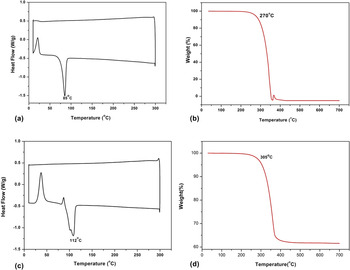
BO-DPPF and BO-DPPT monomers were characterized by DSC, which is used to study the thermal transition of the sample, and the reference is measured as a function of temperature. TGA was also performed where repetitive heating–cooling cycles were used. Both DSC and TGA thermograms are shown in Fig. 1. DSC analysis was performed at a heating rate of 10 °C/min. Both the DPP derivatives show semicrystalline behavior (isotropic transitions) with a melting temperature (T m) varying from 80 °C to 115 °C in the DSC thermogram. The melting temperature of BO-DPPF and BO-DPPT was measured as 85 °C and 112 °C, respectively. BO-DPPF exhibits a sharper melting point compared to BO-DPPT, which is a significant indication of possible higher crystallinity of this monomer. To find out the weight loss, TGA was performed for BO-DPPF and BO-DPPT monomers by heating the sample from room temperature to 700 °C, and a 5% weight loss was observed for BO-DPPF and BO-DPPT at 270 °C and 305 °C, respectively. The furan-flanked DPP monomer (BO-DPPF) shows a lower decomposition temperature than that of the thiophene-flanked DPP (BO-DPPT). These results are in accordance with the DSC data. From both the DSC and TGA data, it is clear that both compounds are thermally stable up to more than 250 °C. The thermal data of these monomers are summarized in Table I.
DSC and TGA analysis of monomers BO-DPPF (a and b) and BO-DPPT (c and d), respectively.

Optical and thermal data of the monomers BO-DPPT and BO-DPPF.

C. Optical characterization of the monomers
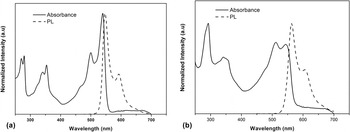
The optical characteristics of both monomers BO-DPPF and BO-DPPT were studied by absorption and fluorescence spectroscopy in DCM solutions as shown in Fig. 2. Two peaks were observed in the shorter wavelength ultraviolet region (250–400 nm), whereas one peak was observed in the higher wavelength visible (400–700 nm) region. The BO-DPPF monomer absorption profile exhibits the first peak at 279 nm which is attributed to the n–π* transition, whereas the second peak was noticed at 353 nm which is arising from the π–π* transition. The third and last peak observed at 538 nm (λmax) in the long wavelength region is associated with intramolecular charge transfer (ICT) between the furan donor and DPP lactam core acceptor. Similarly, in case of BO-DPPT, the first peak occurs at 292 nm (short wavelength region), second peak was measured at 330 nm, and the final peak (λmax) was recorded at 544 nm (long wavelength region). BO-DPPT exhibits a minor red shift of 6 nm and also exhibits different shoulder peaks compared to BO-DPPF, and this might be due to the stronger electron donating nature of thiophene, polarizability, and donor–acceptor interaction of the thiophene building block in DPPT than the furan moiety in DPPF. Reference Sonar, Ha, Seohee and Manzhos42 Grzybowski et al. also observed such optical transitions upon flanking various heterocyclic moieties to DPP. Reference Grzybowski and Gryko41 Furthermore, emission spectroscopy was carried out in DCM solution at a lower concentration of 1 × 10⁻⁵ M. BO-DPPF shows emission maxima at 547 nm whereas BO-DPPT exhibits a band at 562 nm. The shoulder peaks at 590 and 610 nm were also observed, and they might be arising from the vibronic transition. There is a red shift of 15 nm which is affiliated to the stronger electropositive and high polarizability nature of thiophene-flanked DPP when compared to that of furan-flanked DPP. The optical bandgaps of both the monomers (Fig. 2) were calculated from the absorption cutoff values of BO-DPPF (578 nm) and BO-DPPT (572 nm), respectively. The optical bandgap value is calculated using equation 1240/λonset, where λonset is the optical absorbance cutoff value. Reference Rabus43 The optical band gap values obtained were 2.14 and 2.16 eV for BO-DPPF and BO-DPPT, respectively. The optical band gap value of any conjugated materials varies with respect to the nature of conjugated backbone and the moieties added in the backbone. Additionally, the effects of such heteroatom substitution on optoelectronic properties of DPP-based materials have also been discussed by Lui et al. Reference Liu, Walker, Tamayo, Zhang and Nguyen44 The optical data of these two monomers are presented in Table I.
UV–visible absorption (black) and photoluminescence (red) spectra of monomers (a) BO-DPPF and (b) BO-DPPT in DCM.

D. X-ray diffraction analysis of the monomers
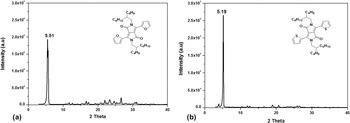
To study the effect of heterocyclic rings (thiophene and furan) attached to DPP and their effects on solid state ordering and crystallinity, we performed X-ray diffraction studies. The X-ray diffraction patterns for BO-DPPF and BP-DPPT are shown in Fig. 3. The powdered monomer shows strong X-ray diffraction peaks, which is a clear indication of some degree of crystallinity present in the solid state of this material. For the monomer BO-DPPF, the primary intense peak was measured at 2θ = 5.51° (d = 18.61 Å), whereas for BP-DPPT this occurred at 2θ = 5.19° (d = 19.73 Å). These two primary peaks indicate the interspacing distance of the materials. The furan-substituted monomer BO-DPPF has slightly smaller interspacing distances compared to the thiophene-substituted monomer BO-DPPT. Again, this difference is minimal because of their common solubilizing butyl-octyl side chain. The BO-DPPT compound shows higher intensity peaks compared to BO-DPPF, this might be due to better crystallinity of the former due to strong donor–acceptor interactions arising from the heterocyclic moieties flanked to DPP. Again, a slight electropositive disparity between thiophene and furan appears to be playing a role in solid-state ordering. Reference Sanford and Boyd45 It has been well documented that incorporation of a thiophene moiety in the DPP unit diminishes the interchange hindrance and enhances well-ordered lamellar structure, which is better for π–π stacking. Reference Cosnier and Karyakin46,Reference Ripaud, Demeter, Rousseau, Boucard-Cétol, Allain, Po, Leriche and Roncali47
X-ray diffraction (XRD) diagrams of monomers (a) BO-DPPF and (b) BO-DPPT, respectively.

E. Theoretical modeling of the monomers
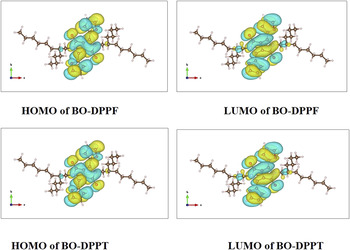
Furan- and thiophene-substituted DPP monomers BO-DPPF and BO-DPPT were also modeled ab initio. Such theoretical modeling provides various features such as planarity, dihedral angles, energy levels, and electron density isocontours. The absorption spectrum of BO-DPPF monomer was predicted by the model to give a maximum at 527 nm (see Fig. S3), which is close to the peak in the experimental absorption spectrum which gave a maximum value at 538 nm (refer to Tables I and II). The theoretical optical band gap of BO-DPPF gave a value of 2.35 eV, which is 0.2 eV higher than the experimental band gap measured at 2.14 eV (refer to Tables I and II). The modeled emission spectra for BO-DPPF predicted a photoluminescence maximum at 604 nm (see Fig. S3), which is higher than the experimental value measured at 547 nm. This is not surprising, as TD-DFT with the B3LYP functional is known to significantly underestimate the excitation energies of long-wavelength charge transfer transitions. Similarly, for the BO-DPPT monomer, the absorption spectra were computed to give a maximum at 546 nm (see Fig. S3), which is in close alignment with the experimental absorption spectra, which measured a maximum at 544 nm. The predicted emission spectra for BO-DPPT gave a maximum at 636 nm (see Fig. S3), compared to the experimental value measured at 562 nm. The optical band gap of BO-DPPT as predicted by the model is 2.27 eV, which was found to be in relatively close agreement with the experimentally determined band gap value of 2.16 eV. The theoretical and experimental data of BO-DPPF and BO-DPPT are therefore in agreement with respect to their absorption and optical band gap. This theoretical study shows that the effect of heterocyclic furan and thiophene attached to the DPP moiety imparts disparity in optical band gaps, and absorption-emission λmax values (see Fig. S3). Furthermore, the highest occupied molecular orbital (HOMO) and lowest unoccupied molecular orbital (LUMO) of BO-DPPF and BO-DPPT are shown in Table II and Fig. 4, respectively. The HOMO and LUMO frontier orbitals are delocalized over the entire core of the molecule. The theoretically calculated HOMO and LUMO energy values for BO-DPPF are −5.41 eV and −2.96 eV whereas for BO-DPPT they are −5.44 eV and −3.04 eV, respectively, which are given in Table III. The theoretical HOMO–LUMO energy band gap for BO-DPPF and BO-DPPT are calculated and they found around 2.45 eV and 2.40 eV respectively, which is also given in Table II. The theoretical band gap value of BO-DPPF is slightly higher than that of BO-DPPT.
Theoretical UV–Vis, PL, optical band gaps, HOMO, LUMO of BO-DPPT and BO-DPPF monomers.

The optimized geometries and electron density isocontours of HOMO and LUMO of BO-DPPF and BO-DPPT monomers.

Onset oxidation potential, onset reduction potential, and estimated (experimental) HOMO and LUMO energy levels of the polymers synthesized by electropolymerization using BO-DPPT and BO-DPPF monomers.

F. Electrochemical and electropolymerization study of the monomers
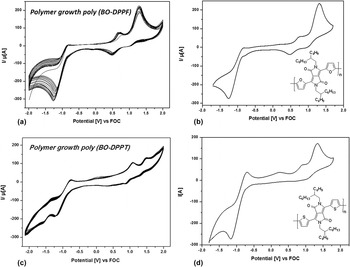
The electropolymerization of both the monomers, BO-DPPF and BO-DPPT, were independently investigated under potentiodynamic conditions i.e., the potential was repeatedly cycled between −2.0 and +2.0 V (versus ferrocene). The results of repetitive potential cycling of the BO-DPPF and BO-DPPT monomers in 0.1 M TBAPF6/DCM are shown in Figs. 5(a) and 5(c). Despite having the same alkyl chain (butyl-octyl), the two monomers exhibit different electropolymerization behavior due to the different oxidation behaviors of thiophene and furan heterocyclic moieties flanked to the DPP core. During the anodic scan, a radical cation is generated on the electron-donating moieties such as furan and thiophene, which subsequently initiates the electropolymerization reaction. The furan-based DPP exhibits a first peak at −0.84 V and two pronounced oxidation peaks at 0.68 and 1.28 V in the anodic scan. During the cathodic scan, three reduction peaks are observed at 1.02, 0.48, and −1.27 V (the latter is the corresponding reduction peak for the anodic peak at −0.84 V). In contrast, the BO-DPPT exhibits a first peak at −0.76 V and two oxidation peaks at 1.08 and 1.47 V in the anodic scan and three reduction peaks at 1.29, 0.89, and −1.21 V (the latter is the corresponding reduction peak for the anodic peak at −0.76) during cathodic scan. All the peaks and their values are given in Table III. The observed oxidation peaks for both the monomers might be due to the presence of the electron-donating heterocyclic groups (furan and thiophene) attached to electron deficient DPP core at both ends. Analyzing the CVs of both the monomers reveals that the current response of the furan-substituted DPP moiety is comparatively higher than that of the thiophene counterpart. Furthermore, the oxidation peak corresponding to the polymer initiation unit (furan) of BO-DPPF (0.68 V) is lower than the oxidation peak corresponding to the polymer initiation unit (thiophene) of BO-DPPT (1.08 V) which clearly indicates the more electropositive nature of furan compared to thiophene. Thus, the lower oxidation potential and higher electropolymerization current of BO-DPPF than BO-DPPT indicates that the former one will potentially lead to a better electropolymerized film on the electrode surface. Our observation is also well supported by the recent electropolymerization report on oligofurans and oligothiphenes. Reference Sheberla, Patra, Wijsboom, Sharma, Sheynin, Haj-Yahia, Barak, Gidron and Bendikov29
Repetitive cyclic voltammograms for the electropolymerization of monomers (a) BO-DPPF and (c) BO-DPPT on a GC electrode in dichlromethane containing 0.1 M TBAPF6 as supporting electrolyte. The monomer concentration used was 0.1 mg/mL. Cyclic voltammograms of the electropolymerized polymer thin film (b) poly(BO-DPPF) and (d) poly(BO-DPPT) deposited on glassy-carbon electrodes in 0.1 M TBAPF6/DCM. The scan rate used in all cases was 0.1 V/s.

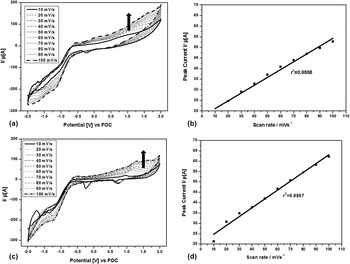
After preparing the oligomer/polymer film on the electrode surface, the electrochemical analysis of poly(BO-DPPF) and poly(BO-DPPT) films was undertaken by running a cyclic voltammogram between −2.0 and 2.0 V in only 0.1 M TBAPF6 in DCM. The cyclic voltammograms for both polymers are shown in Figs. 5(b) and 5(d). Before discussing the electrochemical characterization of the film, we need to dismiss the possibility of any physically absorbed molecules contributing to the observed faradaic current. Therefore, we conducted two different cross-verification experiments. In the first experiment, clean GC electrodes were soaked into both the BO-DPPF and BO-DPPT monomer solutions independently for an hour and the electrode was removed from the respective solution and then washed with a copious amount of DCM prior to cyclic voltammetry measurements. In that instance no voltammetric features were observable. In the second experiment, both BO-DPPF and BO-DPPT monomers were independently electropolymerized on a clean GC electrode. After electropolymerization, the polymer-modified electrodes were washed with copious of amount of DCM (four times) to remove any physically adsorbed monomer from the electrode surface. Both experiments were conducted to rule out the possibility of any monomer contribution to the CV response and to clearly confirm that the CVs obtained on the electropolymerized electrode are from the polymer, which is adhered to the GC substrate. Both the oligomer/polymer modified electrodes exhibited irreversible oxidation processes and a quasireversible reduction process similar to that of Figs. 5(b) and 5(d) confirming the presence of an electropolymerized film on the electrode surface. The poly(BO-DPPF) showed the first oxidation peak −0.84 V, the second oxidation peak at 0.74, and the third oxidation peak at potential of 1.30 V. The reduction peaks for poly(BO-DPPF) were observed at 0.96 V, 0.49 V, and −1.25 V, respectively. On the other hand, poly(BO-DPPT) showed four distinct oxidation peaks at −0.70, 0.22, 0.90, and 1.03 V with a broad reduction peak centered at 1.05 V followed by a distinct reduction peak at −1.17 V. It is believed that the peaks at higher potential may be from the core DPP moiety whereas the more intense peak at lower potential may be from the thiophene and furan moieties. The observed oxidation and reduction onset and peak potentials are in accordance with the earlier reported electropolymerized DPP thin films. Reference Chandran, Marszalek, Zajaczkowski, Madathil, Vijayaraghavan, Koh, Park, Ochsmann, Pisula and Lee48 The HOMO values for both the polymers were calculated using the HOMO = −E HOMO = e(E onset(ox) + 4.8) eV equation. The HOMO values for poly(BO-DPPF) and poly(BO-DPPT) are found to be −5.69 and −5.83 eV, respectively. LUMO values were also calculated (in a similar manner to that of the HOMO value determination) from the corresponding reduction onset potentials using E LUMO = e(E onset(red) + 4.8) eV. Reference Leonat, Sbarcea and Branzoi49 The LUMO values calculated for poly(BO-DPPF) and poly(BO-DPPT) (Figs. S5 and S6) were found to be −4.08 and −4.33 eV, respectively. The reduction peaks [Figs. 5(b) and 5(d)] and the lower LUMO values of both the monomers clearly indicates the electron withdrawing nature of the polymer. Due to the electron deficient nature of DPP, the obtained HOMO and LUMO values for the electropolymerized polymers are deeper from vacuum level and they are in a good agreement with DPP homopolymer synthesized via a chemical polymerization method. Reference Li, Sun, Sonar and Singh50,Reference Johansson, Mammo, Svensson, Andersson and Inganäs51 The electrochemical bandgaps of the polymers obtained from the HOMO–LUMO differences were found to be 1.61 and 1.50 eV for poly(BO-DPPF) and poly(BO-DPPT), respectively, which is provided in Table III. Even though the electropolymerized film adheres to the GC electrode, it was very thin which made it hard to perform other characterization methods and investigate its solid-state properties. We also attempted to electropolymerize films on ITO-coated glass to measure their optical and other properties but unfortunately, electropolymerization of thicker films was unsuccessful. Attempts to improve the process via employing slower sweep rates, a constant potential and increased monomer concentration in solution were also unsuccessful. The polymer film formed on the GC electrode was unfortunately found to be unstable and over time leached into the DCM solution. Reference Welterlich, Neudörfl and Tieke26 The generation of thicker films using more electron rich monomers incorporated with DPP is an ongoing endeavor. To further confirm that the observed redox behavior on the polymer-modified electrode are from an electropolymerized film, i.e., surface confined species, we carried out a scan rate study and found that the anodic peak current (I pa) varies linearly with scan rate (ν). The CVs of poly(BO-DPPF) and poly(BO-DPPT) on GC electrodes in 0.1 M TBAPF6 at different scan rates (ν) varying from 10 to 100 mV/s are shown in Figs. 6(a) and 6(c). A step by step increment with respect to the anodic and cathodic peak current was observed when the scan rate is increased from 10 to 100 mV/s. The graphs of I pa versus ν for both the polymers i.e., poly(BO-DPPF) and poly(BO-DPPT) are shown in Figs. 6(b) and 6(d). Both the plots show a linear relationship with a correlation coefficient (r 2) of 0.9868 and 0.9857, respectively, for poly(BO-DPPF) and poly(BO-DPPT). Thus, the obtained linear relationship between ν and I pa indicates that the observed redox reactions on the polymer-modified electrode are from a surface confined electropolymerized film.
Cyclic voltammograms of (a) BO-DPPF and (c) BO-DPPT deposited on glassy-carbon electrodes in 0.1 M TBAPF6/DCM solution. The scan rate used in all cases was 10–100 mV/s and Linear dependence of anodic oxidation peak current (i) on scan rate of (b) BO-DPPF and (d) BO-DPPT monomers on GC electrode under ir-reversible conditions in DCM/0.1 M TBAPF6.

IV. CONCLUSION
This work reports on the design, synthesis, and characterization of two different DPP-based monomers flanked with thiophene and furan heterocycles having a common BO side chain. The thermal, optical, theoretical characterization, solid-state ordering, and electrochemical behaviors clearly give an insight about how heterocyclic substitution to DPP core tunes various properties. We compared the electrochemical behavior of the monomers and it clearly shows that DPP with a furan exhibits a lower oxidation potential compared to DPP with a thiophene unit without distorting the planarity and conjugation of the DPP backbone. Electrochemical polymerization experiments using a GC-working electrode showed that the monomer polymerizes on the working electrode and forms a very thin layer of oligomer/polymer film, and this was further confirmed by electrochemical analysis of the polymers. However, the films obtained on a GC electrode are very thin and fragile precluding the use of other characterization techniques. The lower thickness or fragile polymer thin film nature is due to an electron-deficient nature of the monomer. The electropolymerized thin films gave different oxidation and reduction onset, peak potentials and the HOMO–LUMO values with respect to the different heterocycles. This work offers a new approach to polymerize electron-deficient monomers via an electrochemical route and provides knowledge on how the heterocyclic moiety effects on the overall properties. This study opens up new approaches to electropolymerizing novel conjugated promising building blocks to fabricate electrochromic, sensors, and storage devices.
Supplementary Material
To view supplementary material for this article, please visit https://doi.org/10.1557/jmr.2017.26.
ACKNOWLEDGMENTS
Supreetha is thankful to the CRC for Polymers and Central Analytical Research Facility (CARF), Institute of Future Environments, Queensland University of Technology (QUT) for providing equipment support. Supreetha is also thankful to Thu Trang Do for helping in NMR characterization. P.M.S is thankful to QUT for the financial support from QUT core funding (QUT/322120-0301/07). P.M.S also acknowledges the Australian Research Council (ARC) for the Future Fellowship (FT130101337). S.M. is supported by the Ministry of Education of Singapore.