


In the introduction to this book, its author, David Adger, explains that it arose from two separate papers in progress. This is still visible in the structure of the book, which is clearly made up of two different parts. The first part (Chapters 2–3) is completely theoretical, and concerns central issues such as labels, lexicon, and cartography. It is followed by an analytical part (Chapters 4–6), which is entirely empirically oriented and devoted to an in-depth analysis of the syntax of DP constructions in a number of languages, notably (Scottish) Gaelic. In this review I will describe the content of these two parts of the book, discuss the main arguments and finally address some minor concerns.
The first part of the book is about labeling, in particular about how syntactic structures come to be labeled. It is very dense but important, both in its pars destruens and in its pars construens.
All the approaches to labeling put forward in recent years start with a notion of lexical item as containing a label, and have the problem of how to predict its transmission (projection). This becomes particularly difficult once a minimal definition of Merge is introduced, which necessarily yields a symmetric object, and not the needed notion of endocentricity. Adger's detailed discussion focuses on the ‘specifier problem’ (13). While minimal search can easily be sufficient to determine the label when one and only one of the merged elements is a simple object (a lexical item, or call it a head), something more is needed when two phrases are merged and the structure is thus symmetrical. There have been proposals solving the problem, which Adger acknowledges, but he concludes they are all unsatisfactory. This is also an issue discussed in Chomsky (Reference Chomsky2013), where he argues that XP,YP objects are simply not labeled and that this is not problematic in so far as a label is introduced by the end of the derivation (thanks to a symmetry breaking movement operation). Of course Chomsky's approach presupposes that labels are not needed internally, for the syntactic computation itself, but only at the interface, for interpretation. Adger discusses this option and excludes it with strong arguments: a label-less syntax is problematic, in particular for accounting for movement phenomena; labels are needed, and they are needed in syntax.
The problem, Adger says, is not Merge, but it is the notion of head itself, or of endocentricity. His proposal is that labels do not come from lexical items, they actually do not even belong to the same module of grammar. Categories and functional labels belong to a separate list, and are universally ordered in a sequence called UEP (Universal Extended Projection), roughly equivalent for each category to the extended projections of Grimshaw Reference Grimshaw1991 as a concept, but also incorporating the findings of the cartographic line of research. In this view, the architecture of the clause, in particular the selectional relations between its nodes, is not the output of a derivation, but rather given as a primitive sequence, imposed on the output of simple merge by a simple transfer algorithm.
Lexical items are bare roots, bits of information with no categorial features, hence no label. They simply act as starters of any syntactic derivation, and this is all they do. Merge is indeed binary and symmetric, and yields no label. Even the ‘distinctness stipulation’ (19) is removed from its definition, so that self-merge of an element x with itself is possible. Structure building (Merge) and labeling are thus entirely separate.
The starting point of each Extended Projection is always a root. Since a root has no category, it has to self-merge in order to get one, which then starts a Rooted Extended Projection. Then the structure undergoes further structure-building operations. Each new structure is built from the previous one and is labeled on the basis of the labels of its immediate constituents and the relevant extended projection.
Adger discusses the issue of the potential violation by his system of so-called inclusiveness condition, namely the Minimalist condition imposing that no information is introduced in the course of the derivation. But this, he argues (28–29), is a condition banning the introduction of descriptive technology during the course of the derivation. Form this point of view, adding information via merging of functional heads or via transferring from the Universal Extended Projection is no different: the (Universal) Extended Projection plays a role that is equivalent to that of a functional lexicon.
On the other hand, this system entails that grammatical relations, such as complements and specifiers, are not defined by merge, which only creates symmetrical pairs. The only way to read off the structure the distinction between specifier and complement, which is indeed needed at the interfaces, is by reading the labels and confronting them with the Extended Projection. Thus, the notions of specifier and complement are thus interpretive notions associated with the representational output of Merge + Labeling. The notions of i-specifier and i-complement (where ‘i’ strands for ‘interpretive’) are defined in terms of labels and in relation to the relevant Extended Projections: if a given syntactic object has a label that belongs to the same extended projection as the label of the higher node but is lower in its hierarchy, then it is a complement. Otherwise, i.e. if its label does not belong to the same extended projection as the higher node, it is a specifier (39).
There are two important corollaries to this system. Both of them are directly relevant for the empirical part of the book, which provides empirical evidence for these claims. They are thus the bridge connecting the two parts and as such worth a detailed discussion.
The first is that a root cannot merge with an object distinct from that root. This is because roots on their own are not in the domain of the labeling algorithm, since only labeled structures are. It follows that arguments cannot be introduced as sisters to lexical roots and that the relation of argumenthood must be negotiated by some functional structure.
The second corollary is that roll-up/remnant movement is impossible. Let us see why with the diagram in (1), representing the possible output of a roll-up movement (and hence input to a remnant movement). Here all the nodes labeled X belong to the same extended projection and the number corresponds to their rank in the extended projection (43). Angled brackets indicate movement.
(1)


For X3 to be an i-complement of X5, X4 must not be in the same Rooted Extended Projection, but it is. Similarly, for X4 to be an i-complement of X5, X3 must not be in the same Rooted Extended Projection of X4, but it is. Thus, neither daughter of X5 can be an i-complement and neither can be an i-specifier: there is no successful assignment of grammatical relations to this structure, which is why it is ruled out.
The second part of the book is a very empirically oriented and fine-grained study of DP syntax. It shows that the traditional view of relational nominals, which presupposes a strong syntactic and semantic parallelism with transitive verbs, is necessarily wrong: cross-linguistically, the internal argument of relational nominals is systematically optional, while for verbs it is lexically determined. Adger discusses in great detail what is usually seen as evidence for relational nouns taking arguments, and concludes that none of it is solid enough.
This is where the first corollary of the first part comes into play: given that roots cannot be directly merged with their arguments, the fact that nouns do not directly select arguments is predicted.
The radical alternative Adger proposes is that relational nouns , such as picture or friend, simply do not exist as such. Nouns are just substance predicates, all of them (this is where the title, the syntax of substance, comes from, I guess). The ‘relation’ is introduced by a light root, which can be of different kinds (PART, REP, POSS, etc.), as reflected in many languages by the different prepositions that can be associated with different interpretations (possession, part, etc.). The final structure of a DP like the side of the table is illustrated in (2). Crucially, the N does not select the PP complement, but rather a functional category (notated by the Hebrew letter Qof, ק) which corresponds to one of the various roots just mentioned and relates its two arguments (78).
(2)
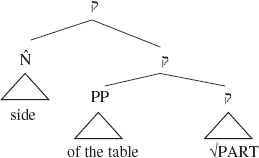
Chapter 5 goes deeper into this structure and shows that ˆN in (2) is not just N, but can also contain any adjectival modifier of the noun. The chapter is devoted to a generalization called PP peripherality, stated as follows.
(3) When (intersective) AP modifiers and PP complements both occur to one side of N inside a noun phrase, the PP is separated from the N by the AP. (93)
Chapter 5 discusses in detail the relations within the DP, with special focus on Gaelic. The above generalization is interpreted as a direct effect of the structure in (2) and the absence of any direct relation between the Noun and its alleged PP complement imposed by the theory.
However, the rich empirical evidence presented in Chapter 5 for the order and constituency of AP and PP is also compatible with a movement analysis, in terms of remnant movement. Suppose the PP is generated in a standard complement position, to the right of the N, and then raises to a higher specifier position, followed by movement of the remnant. Resulting from this is the correct word order.
The issue of excluding this possible derivation is taken up in Chapter 6. Binding facts are discussed, in particular with data from (Scottish) Gaelic. The facts go in the direction predicted by a base generation analysis along the lines illustrated in (2) and not, crucially, as predicted by a remnant movement derivation. This chapter is important, because it reconnects again this empirical part with the theoretical one. Recall that the other corollary of the system presented in the first part concerned roll-up/remnant movement, which was excluded on principled grounds: the empirical inadequacy of a remnant movement analysis of the DP–PP structure in Gaelic is thus interpreted as an empirical validation of the correctness of the theoretical approach.
Adger's book has the great merit of taking us to the center of one of the hottest debates in the recent theory of grammar, namely that of the relation between words and syntax, discussed in terms of labeling. The author takes a strong antilexicalist stand and pursues it with great coherence: structure building and labeling are completely dissociated, and lexical roots are inert from this point of view, except as units to be assembled. This makes this book highly recommended, and even a must, for anyone interested in the debate and its most advanced evolutions.
I have so far signaled only one concern I have about this book. I think that the division between the strictly theoretical part and the strictly empirical one is too rigid and not entirely felicitous. This is partly a presentation problem. But it also has a substantial aspect to it. Let us start with the latter.
In discussing only the syntax of DP structures in the empirical section of the book, Adger seems to be due to make the same mistake he criticizes sharply and correctly in Chapter 5. In that chapter he shows in great detail that the conclusions drawn for verbs cannot be extended to nouns because nouns and verbs are different. While the choice of a particular verb does affect the obligatoriness of its arguments, this is never completely true for nominals. This is why he opts for a mediated structure as the one schematized in (2) above for nouns. But while the idea that roots cannot merge with arguments is well suited for the noun, it is not shown in the book that it is as appropriate for the verb. Adger hints at the fact that an event structure could play a role in defining argumenthood in the verbal domain (76–77) but this is not enough. The domain in which it should be shown that arguments are not selected by lexical roots cannot be only noun complementation, which has always been murky and controversial, but should also concern the core of complementation, namely verbs, where, as Adger acknowledges, the fact of having an argument or not seems to be lexically constrained.
As for the formal aspect of my concern, the first part is very difficult to read. It is worth the effort, because it is challenging and fascinating in the way it reverses some deeply rooted beliefs, and this is always a good exercise, but the sharp dissociation from the empirical part makes these first chapters very abstract. Perhaps also the introduction of as many as six new acronyms in only two pages (21–22) is not the best way to help the reader make this effort. The intricacies of the system presented here and, again, the rigid separation of theory from data forces anticipations and other undue demands on the reader. Just to give an example, it is only at page 49 that it is clearly stated that a universal linearization for specifiers and complements is assumed, à la Kayne (Reference Kayne1994). But the problem of the ordering of constituents within the DP, which is a consequence of this stipulation, is mentioned on page 30. At that time, the reader does not know why the specifier should be linearized at the left of the phrase, and even the notion of specifier has not yet been defined (this happens some pages later (39).
Summarizing and concluding, this is an important and challenging book. Its theoretical proposals are something that anyone interested in the issues of lexicon, labeling, and complementation should read. Such a reader is likely to enjoy it, suffer from its intricacies (and its acronyms!) and look forward to a third part, where it is demonstrated that the divorce of argumenthood from sisterhood is applicable to the verbal domain.


