Introduction
Sugarcane is an important sugar and energy crop worldwide, supplying ~80% of global sugar and ~40% of global biofuel production (Food and Agricultural Organisation Statistics (FAOSTAT), 2010; Liang et al., Reference Liang, Yu, Zhen, Zhao, Deng and Jiang2020). Seeds are the ‘chips’ of agriculture, and the sugarcane seed industry is the key to ensuring the high-quality development of China's sugar industry. At present, most of the world's sugarcane breeding cultivars are derived from a few limited original species, and homogenization of the genetic base has made it difficult to make major breakthroughs in yield and resistance for more than half a century (Zhang et al., Reference Zhang, Wang, Lu, Wu, Liu, Zhao, Liu and Huang2020). According to 2014 data from the Food and Agriculture Organization (FAO), sugarcane yield improvement has lagged significantly behind rice, wheat, maize, soybean and sugar beet, increasing only slowly since 1960 (Fischer et al., Reference Fischer, Byerlee and Edmeades2014), and sugarcane genetic improvement has also suffered from slow growth (Jackson, Reference Jackson2005). It seems that the genetic improvement of sugarcane has encountered a bottleneck, and overcoming this requires consideration by sugarcane breeders (Liu et al., Reference Liu, Deng, Wu, Tao, Lu, Zhao and Zhang2021). Germplasm resources are the material basis of crop breeding, and every important breakthrough in sugarcane breeding in history was related to the discovery and effective hybrid utilization of excellent parental germplasm resources (Liu et al., Reference Liu, Bai, Yan, Jia, Luo and Zhang2015). Thus, exploiting superior germplasm in sugarcane is a direct and effective option to break the current bottleneck of sugarcane breeding.
Most modern sugarcane cultivars are derived from interspecific hybridization between S. officinarum (2n = 80, x = 10) and S. spontaneum (2n = 40–128) followed by backcrossing several times with S. officinarum (Hermann et al., Reference Hermann, Aitken, Jackson, George, Piperidis, Wei, Kilian and Detering2012). They are all high polyploids and aneuploids, with chromosome numbers between 100 and 130, of which 80–90% are from S. officinarum, 10–20% are from S. spontaneum and 5–17% are from interspecific recombination (D'Hont et al., Reference D'Hont, Grivet, Feldmann, Glaszmann, Rao and Berding1996; Piperidis et al., Reference Piperidis, Piperidis and D'Hont2010; Wang et al., Reference Wang, Xiao, Zhu, Liu, Alam, Chen and Lu2018). It is evident that S. officinarum and S. spontaneum are essential germplasm resources in existing sugarcane cultivars (Irvine, Reference Irvine1999), especially S. officinarum, which occupies a pivotal position in sugarcane breeding. S. officinarum also known as ‘noble’ species originated in eastern Indonesia-New Guinea (Bakker, Reference Bakker1999) and they possess high-quality industrial and agronomic traits including being tall, high sugar content and low fibre levels, hence they are the most important source of high-sugar and high-yield genes for modern sugarcane cultivars. China is one of the origin centres of sugarcane, and possesses a rich array of wild sugarcane resources, but no native S. officinarum has been found (Chen, Reference Chen2003). Therefore, introducing S. officinarum resources from abroad and utilizing them creatively have become an important part of the innovation-driven strategy of sugarcane science and technology in China.
Saccharum officinarum clones are mainly used in breeding as original and backcross parents for noble breeding, hence their authenticity directly affects the efficiency of sugarcane noble breeding. Introduced S. officinarum must be assessed for authenticity to ensure the accuracy of source parents for germplasm innovation. The traditional method for determining the authenticity of S. officinarum uses somatic chromosome number counting. Typical S. officinarum clones have chromosome number 2n = 80 and chromosome base x = 10 (Yu et al., Reference Yu, Wang, Li, Huang, Wang, Luo, Jing, Liu, Deng, Wu, Yang, Chen, Zhang and Xu2018), and their main representative variety types are Badila, Black Cheribon and Luohanzhe. However, there also exist atypical S. officinarum clones whose chromosome numbers are not 80. These clones are generally considered to be the progenies of S. officinarum and S. spontaneum (Chai et al., Reference Chai, Yu, Xie, Huang, Deng and Yang2019).
In recent years, molecular marker technology has been widely used for authenticity analysis of sugarcane germplasm resources. Tetra-primer amplification refractory mutation system PCR (Tetra-primer ARMS PCR) is a derivative technique based on standard PCR that can be specifically used to detect single-nucleotide polymorphisms (SNPs) (Ye et al., Reference Ye, Dhillon, Ke, Collins and Inm2001), and primer design for SNP mutations in known sequences of species, which amplify due to inter-species bases. These primers amplify different PCR products to distinguish between species due to differences in base binding competition between species (Yu et al., Reference Yu, Chi, Jia, Liu, Zhu and Gu2020).
In the present study, we used ARMS PCR primers designed previously (Yang et al., Reference Yang, Li, Huang, Huang, Liu, Wu, Wang, Deng, Chen and Zhang2018) based on specific SNP mutations in nuclear ribosomal DNA internal transcribed spacer (nrDNA-ITS) sequences between S. spontaneum and other germplasm materials to authenticate the 22 sugarcane germplasms introduced from Sri Lanka and now preserved in the China National Germplasm Repository of Sugarcane (NGRS). We combined the results with somatic chromosome number count data to clarify authenticity. The findings can be applied to create and genetically improve new, superior sugarcane parents.
Materials and methods
Plant materials
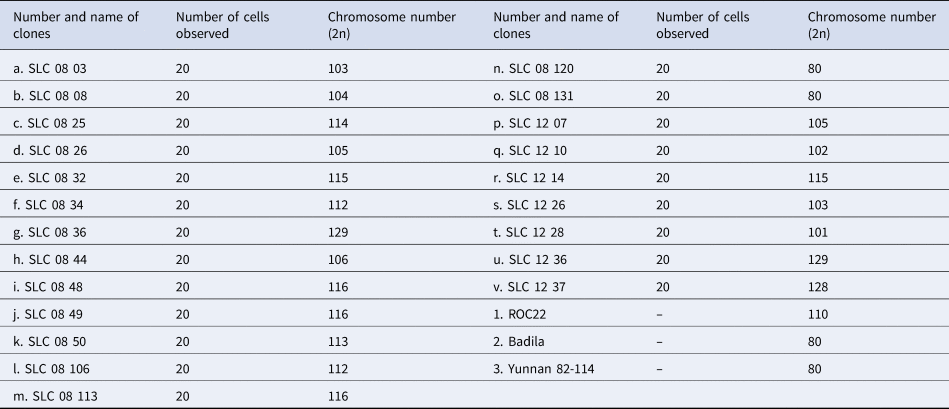
Twenty-two sugarcane clones introduced from Sri Lanka in July 2019 were tested, and S. officinarum (Badila), S. spontaneum (Yunnan 82-114) and cultivar (ROC22) served as control materials (Table 1). All the materials were provided by the NGRS, and planted in a field at Kaiyuan Observation Station, Sugarcane Research Institute, Yunnan Academy of Agricultural Sciences in January 2021.
List of test materials and statistical results for chromosome number counts

Experimental methods and reagents
Genomic DNA extraction
Young leaves of test materials were selected, brought back to the laboratory, veins were removed, cut and placed in a sterile 2 ml round-bottom centrifuge tube with magnetic beads, snap-frozen in liquid nitrogen, homogenized using a Gd 200 tissue grinder, then the genomic DNA was extracted with the EASY Pure Plant Genomic DNA Kit (TransGen Biotech, Beijing). The extracted genomic DNA was diluted to 50 ng/μl and stored at −20°C.
Four-primer ARMS PCR
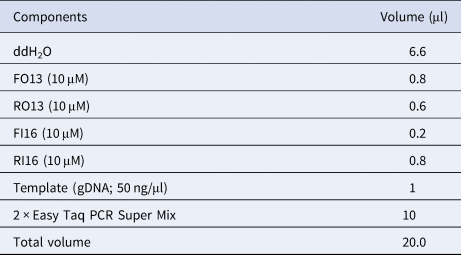
Using the above genomic DNA as a template, four primers FO13, RO13, FI16 and RI16 (FO13: GTTTTTGAACGCAAG TTGCGCCCGAGGC; RO13: AATTCGGGCGACGAAGCCACCCGATTCT; FI16: GCCGGCGCATCGGC CCTAAGGACCTAT; RI16: GAGCGGCTATGCGCTGCGGTGCTTCT) were synthesized by Sangon Biotech (Shanghai) and PCR was performed using 2 × Easy Taq PCR Super Mix (TransGen Biotech). The PCR system and procedure were slightly modified from Yang et al. (Reference Yang, Li, Huang, Huang, Liu, Wu, Wang, Deng, Chen and Zhang2018). The system is shown in Table 2. The reaction conditions were as follows: pre-denaturation at 95°C for 5 min, followed by six cycles of 95°C for 30 s, 78°C for 20 s for one cycle and descending by 1°C for each subsequent 20 s cycle, 72°C for 20 s; the reaction ended with 26 cycles of 95°C for 30 s, 71°C for 10 s, 72°C for 10 s and a final extension at 72°C for 5 min. When PCR amplification was completed, 5 μl of the PCR product was subjected to 2% agarose gel electrophoresis.
Tetra-primer ARMS PCR mixtures

Chromosome specimen preparation
Tissues from the stem tip meristem area of the above materials were collected from the field, brought to the laboratory, cut into small pieces of 0.3–0.5 cm3, soaked in pre-cooled sterilized water and pre-treated at 4°C for 5–24 h. Pre-treated materials were then fixed for 2–3 days at 4°C, washed with sterilized water, dissociated, placed on slides after dissociation, stained and pressed with modified phenol carbo magenta staining solution to disperse somatic chromosomes. Slides were prepared according to a published patent (Lin et al., Reference Lin, Lu, Cai, Zhou, Mao, Wu, Liu, Liu, Li, Zi, Li and Xu2020).
Chromosome number counting
The prepared slides of stem tip chromosomes were observed using a microscope (Olympus, BX43, Shanghai) at 40× magnification. Well-dispersed cells with a clear background and intact chromosomes were counted and photographed using Olympus Cell Sens Standard software. Mid-stage cells with clear chromosome morphological structure and good dispersion were selected, photographed and karyotyped with a Zeiss Metasystem automated karyotype analysis system, as described in the published patent (Lin et al., Reference Lin, Lu, Cai, Zhou, Mao, Wu, Liu, Liu, Li, Zi, Li and Xu2020). Since sugarcane chromosomes are small and numerous, the filming technique is difficult to master, and chromosome loss or overlap may occur during both enzymatic digestion and filming. Therefore, at least 20 cells were counted and the mode was calculated during the counting process to reduce statistical errors.
Results
Four-primer ARMS-PCR
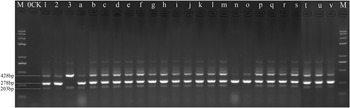
The results of ARMS-PCR with four primers showed that all the test clones had a common band of 428 bp, in addition to the common 428 bp band, the S. officinarum Badila (lane 2 of Fig. 1) and S. spontaneum Yunan 82-114 (Fig. 1, lane 3) amplified a unique band of 278 and 203 bp, respectively, while the variety ROC22 (Fig. 1, lane 1) had all the above three bands. Among the test materials, only two materials SLC 08 120 (Fig. 1, lane n) and SLC 08 131 (Fig. 1, lane o) had the same band type as Badila (Fig. 1, lane 2), with only the common band of 428 bp and the unique band of 278 bp of S. officinarum appeared, which was tentatively determined to be S. officinarum.
Agarose gel electropherogram of tetra-primer ARMS PCR products.
M, Trans 2 K plus II DNA markers; 0CK, ddH2O; 1, ROC22; 2, Badila; 3, Yunnan 82-114; a, SLC 08 03; b, SLC 08 08; c, SLC 08 25; d, SLC 08 26; e, SLC 08 32; f, SLC 08 34; g, SLC 08 36; h, SLC 08 44; i, SLC 08 48; j, SLC 08 49; k, SLC 08 50; l, SLC 08 106; m, SLC 08 113; n, SLC 08 120; o, SLC 08 131; p, SLC 12 07; q, SLC 12 10; r, SLC 12 14; s, SLC 12 26; t, SLC 12 28; u, SLC 12 36; v, SLC 12 37.

Chromosome number identification
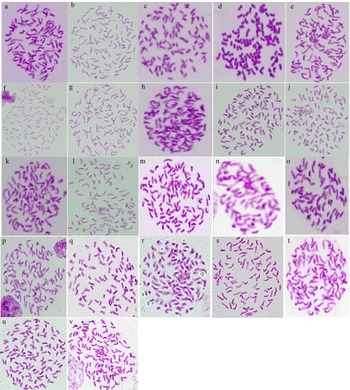
Twenty somatic cells with a clean background, intact morphology and good dispersion were selected from each of the 22 test materials for chromosome number counting, and the mode was calculated for each material (Fig. 2, Table 1). The chromosome numbers for n (SLC 08 120) and o (SLC 08 131) were 2n = 80, owning the characteristics of typical S. officinarum, while the chromosome numbers of the remaining 20 materials ranged from 101 to 129, and all were greater than 80 (Table 1), hence they were tentatively judged to be hybrids.
Chromosome number count results for 22 imported SLC-series clones.
a, SLC 08 03; b, SLC 08 08; c, SLC 08 25; d, SLC 08 26; e, SLC 08 32; f, SLC 08 34; g, SLC 08 36; h, SLC 08 44; i, SLC 08 48; j, SLC 08 49; k, SLC 08 50; l, SLC 08 106; m, SLC 08 113; n, SLC 08 120; o, SLC 08 131; p, SLC 12 07; q, SLC 12 10; r, SLC 12 14; s, SLC 12 26; t, SLC 12 28; u, SLC 12 36; v, SLC 12 37.

Combining the above two results, we can confirm that among the 22 tested materials, SLC 08 120 and SLC 08 131 are typical S. officinarum.
Discussion
Saccharum officinarum are the most important sources of high-sugar and high-yield genes for modern sugarcane cultivars, and occupy a pivotal position in sugarcane breeding (Bakker, Reference Bakker1999). Previous studies have shown that typical S. officinarum lines have chromosome number 2n = 80 and chromosome base x = 10 (D'Hont et al., Reference D'Hont, Rao, Feldmann, Grivet and Glaszmann1995; Piperidis et al., Reference Piperidis, Piperidis and D'Hont2010; Yu et al., Reference Yu, Wang, Li, Huang, Wang, Luo, Jing, Liu, Deng, Wu, Yang, Chen, Zhang and Xu2018). However, there are also atypical S. officinarum with chromosome numbers other than 80, such as the two atypical S. officinarum asexual lines NG77-56 (2n = 116) and NG77-26 (2n = 70) found on the island of New Guinea (Sobhakumari, Reference Sobhakumari2013). However, some studies suggested that these atypical S. officinarum lines are interspecific hybrids of the genus Saccharum (Piperidis, 2001). Shah et al. suggested that suspected S. officinarum materials with chromosome number 2n <80 are aneuploid while S. officinarum materials with chromosome number 2n >80 are mostly likely to be hybrids (Shah et al., Reference Shah, Jagathesan and Venkataraman1970). Piperidis and D'Hont (Reference Piperidis and D'Hont2001) studied S. spontaneum lineages for atypical S. officinarum with chromosome number >80 by genomic in situ hybridization. The previous suggestion that asexual lines with more than 80 chromosomes may not be purely S. officinarum was further confirmed by Piperidis and D'Hont (Reference Piperidis and D'Hont2001). In the present study, except for SLC 08 120 and SLC 08 131 with a chromosome number of 80 and no characteristic band detected for S. spontaneum by PCR, indicating that they are typical S. officinarum. While the other materials had more than 80 somatic chromosomes (101–129), and PCR simultaneously yielded bands characteristic of S. officinarum and S. spontaneum, hence we preliminarily speculated that they are hybrids. In future, in-depth agronomic trait evaluation of SLC 08 120 and SLC 08 131 should be employed to further enrich new sugarcane parent resources.
Nobilization refers to the process of hybridization between typical S. officinarum and S. spontaneum, then backcrossing with S. officinarum in the strict sense. The authenticity of S. officinarum directly affects the process and efficiency of sugarcane noble breeding (Wang et al., Reference Wang, Fan, Huang, Chen, Jing and Deng2015). Therefore, authenticity confirmation of S. officinarum is of great significance to noble breeding. Authenticity identification of sugarcane has been achieved using morphological markers, cytological markers and biochemical markers (Zhong et al., Reference Zhong, Li and Yang2005). Morphological identification is based on the breeder's personal experience, and is easily affected by external environmental conditions, sugarcane growth period and other factors. It is highly subjective and only used for preliminary identification. Cytological markers are mainly analysed by chromosome karyotype (number, size, position) and band type, and the identification results are not accurate because sugarcane is a highly heterozygous polyploid with small and large numbers of chromosomes in different lines. An important approach using biochemical markers is isozyme analysis, and isozymes are susceptible to environmental influence, plant cultivation conditions and growth stage, and only be used as an auxiliary identification method (Zhong et al., Reference Zhong, Li and Yang2005).
In recent years, molecular markers such as Simple Sequence Repeats (SSR), Random Amplified Polymorphic DNA(RAPD) and Inter-simple Sequence Repeat (ISSR) have been used for identification of sugarcane germplasm, especially hybrid progeny (Edmé et al., Reference Edmé, Glynn and Comstock2006; Mary et al., Reference Mary, Nair, Chaturvedi and Selvi2006; Amaresh et al., Reference Amaresh, Grisham and Pan2014). As third-generation molecular markers, SNPs are highly stable and widely used for studies of crop molecular genetics (Brookes, Reference Brookes1999; Yu et al., Reference Yu, Chi, Jia, Liu, Zhu and Gu2020). Tetra-primer ARMS PCR is a derivative technique based on standard PCR that can be specifically used to detect SNPs (Yang et al., Reference Yang, Li, Huang, Huang, Liu, Wu, Wang, Deng, Chen and Zhang2018), which is economical, rapid, simple and has been successfully applied for analysis and identification of genotypes in rice, wheat, sweet potato and other crops (Hou et al., Reference Hou, Luo, Chen and Zhou2013; Zhang et al., Reference Zhang, Lv, Han, Chen, Shen, Wang and Shao2015; Park et al., Reference Park, Kim, Nie, Kim, Lee and Kim2020). Yang et al. (Reference Yang, Li, Huang, Huang, Liu, Wu, Wang, Deng, Chen and Zhang2018) designed ARMS PCR primers based on SNPs with specific mutations in the nrDNA-ITS sequence of Saccharum germplasms, which have been successfully used for authenticity identification of S. spontaneum and progeny (Yang et al., Reference Yang, Li, Huang, Huang, Liu, Wu, Wang, Deng, Chen and Zhang2018). In the present study, the authenticity of typical S. officinarum lines identified by Tetra-primer ARMS PCR and chromosome number counting matched each other, which further indicated that Tetra-primer ARMS PCR is suitable for the identification of typical S. officinarum sugarcane varieties. Therefore, preliminary identification can be performed using this method for subsequent authenticity identification of numerous S. officinarum lines, and chromosome number counting can be subsequently carried out on the identified S. officinarum varieties. This approach could be used for initial identification of S. officinarum, and chromosome number counting can confirm S. officinarum lines through somatic cell number counting to improve the identification efficiency and accuracy. Related research will be helpful to improve the efficiency of sugarcane breeding and promote the genetic improvement of sugarcane.
Acknowledgements
This work was supported by the Yunnan Science and Technology Talent and Platform Program (202205AM070001), the Yunnan Provincial Science and Technology Plan International Science and Technology Cooperation Special Project (202103AM140028), the Major Science and Technology Projects of Yunnan Province (202002AA100007), the Government's Purchase Public Service (19210151) and the National Infrastructure for Crop Germplasm Resources (NCGRC-2021-42). Elixigen company has reviewed the manuscript for English accuracy.
Author contributions
X. J. L. carried out experiments and wrote the manuscript; J. M. provided the test materials and participated in revision of the manuscript; X. K. C., X. Q. L., X. Y. W., X. L. L. and C. H. X. participated in material collection and experimental work. X. L. conceived and designed the study.
Conflict of interest
The authors declare that they have no conflict of interest.
Ethical standards
Not applicable.