


I
Self-help was recommended as the standard remedy against poverty in the nineteenth century. By being thrifty and putting money aside, even a low-income worker was believed to be able to accumulate sufficient funds to escape poverty, which is why savings banks were established as vehicles for saving (for example, Fishlow Reference Fishlow1961, p. 26; Américi Reference Américi2002, p. 19; Wadhwani Reference Wadhwani2002, pp. 43–4). They were intended to foster habits of thrift and foresight among working people. It was generally held that the broad masses were not capable of saving, but by accepting small deposits, savings banks were supposed to encourage long-term saving over the life course, and thus help workers build up funds for emergencies. Thereby poverty and the local costs for poor relief would hopefully decrease. In Sweden, for example, workers and servants were targeted groups (Skogman Reference Skogman1819). To what extent were these expectations fulfilled?
Many studies have shown that savings banks did not attract workers to the extent the founders had hoped, but were exploited by wealthier groups (Fishlow Reference Fishlow1961; Olmstead Reference Olmstead1975; Américi Reference Américi2002; Ó Gráda Reference Ó Gráda2003; Maltby Reference Maltby2011; McLaughlin Reference Mclaughlin2013). In Britain as well as in the US, by the middle of the nineteenth century, banks were criticised as being middle-class institutions rather than working-class ones (Horne Reference Horne1947, p. 71; Olmstead Reference Olmstead1975; Ó Gráda Reference Ó Gráda2003). Similar complaints were heard in Sweden, and studies show that until 1870 deposits in savings banks increased largely from deposits by wealthier groups (Nygren Reference Nygren1981, pp. 84–9). In 1860 workers constituted one-half of the account holders, but held just one-third of total deposits (Sommarin Reference Sommarin1942, p. 148). As a consequence, post-office savings banks were established in Sweden in the 1880s to better meet workers' demands. Unlike their precursors in the UK, they never surpassed savings banks in deposits or number of depositors, despite long opening hours as well as there being post offices throughout the country. This was probably because of low interest on deposits (Fishlow Reference Fishlow1961; Samuelsson Reference Samuelsson1978, pp. 14–43; McLaughlin Reference Mclaughlin2013). Instead, workers continued to use savings banks, and at the end of the nineteenth century they constituted a majority of account holders and held approximately half the total deposits (Varifrån kommer…1946, pp. 78–9; Lilja Reference Lilja2004, p. 122). This may indicate that Swedish savings banks, in spite of the criticism, were suitable for working-class savings. Such views have also been expressed concerning savings banks in England (Perriton Reference Perriton2012).
There are three likely reasons why workers did not deposit more money in savings banks. The first is that they were unthrifty or did not understand the benefits of saving (Smiles Reference Smiles1877, pp. 16–38; Kiesewetter Reference Kiesewetter, Conze and Engelhardt1981, pp. 446–86). Another was that workers may not have had enough left over to save. A third reason may have been that savings banks did not fit some workers' requirements for saving and that other small-saver institutions were more suitable (Johnson Reference Johnson1985; Ross Reference Ross2002; Ó Gráda Reference Ó Gráda2003; Boyer Reference Boyer, Eltis, Lewis and Sokoloff2009; McLaughlin Reference Mclaughlin2013; Bäcklund and Lilja Reference Bäcklund and Lilja2014). This article concentrates on the third reason.
Savings banks could be used for different saving motives: precautionary saving for support during periods of unemployment or illness; target saving for major purchases; saving for old age; and/or bequest saving. Although a majority of accounts were held for a short term (Alter, Goldin and Rotella Reference Alter, Goldin and Rotella1994; Wadhwani Reference Wadhwani2002, p. 50; Lilja Reference Lilja2004, pp. 109–13), some workers accumulated for longer periods. In this regard, there were significant gender differences and also differences between married and unmarried people. A study of the Philadelphia Saving Fund Society (PSFS) in 1850 showed that unmarried women often saved for life-cycle purposes, while saving among men was target-motivated. Only the poorest depositors used their accounts for precautionary saving (Alter et al. Reference Alter, Goldin and Rotella1994). There was great variation, however, and precautionary saving was in fact more prevalent among workers in general, for example, in the savings bank of Glasgow (Payne Reference Payne and Payne1967). Moreover, accounts in that bank were used for recurrent payment obligations such as rent (Ross Reference Ross2013). Furthermore, studies have indicated that married women in England ‘were active economic agents in their own right’ (Perriton Reference Perriton2012, p. 12) by the middle of the nineteenth century and used savings bank accounts as a precaution (Maltby Reference Maltby2011; Perriton Reference Perriton2012).
The reasons for saving mentioned above could in fact be satisfied in other ways, too. Still, few studies deal with savings banks with respect to other methods of saving. Most scholars believed that in the nineteenth century workers had few alternatives to savings banks (Olmstead Reference Olmstead1975, p. 289; Alter et al. Reference Alter, Goldin and Rotella1994). For Britain, Johnson (Reference Johnson1985) clearly demonstrated that this was not the case, and that workers also used many other saving methods. According to his estimates based on aggregated data, approximately 40 per cent of working-class financial funds in 1901 were deposited in savings banks (Johnson Reference Johnson1985, p. 205). Johnson did not study differences within the working class, probably for lack of data. Such differences seem likely, however, because family structure and level of wages probably influenced the choice of saving methods.
In this article we analyse the importance of savings banks for working-class saving in Sweden by comparing it with other saving methods, traditional as well as modern. Such a comparison is crucial for an understanding of the strengths and weaknesses of savings banks. We compare various groups of workers, assuming that their respective needs affected the choice of saving method and consequently the importance of savings banks.
The article has six parts. After presenting the general points of departure in the first section, the second section is devoted to a brief description of the conditions for saving in Sweden during the second half of the nineteenth century. Section iii presents an account of sources and method. In Sections iv and v the results are analysed, and in the last section the findings are summarised and discussed.
II
The nineteenth century was a period of rapid economic and social transformation in Sweden, as in many other European countries. The number of inhabitants more than doubled, the growth of proletarianisation was even faster, and the proportion living in urban centres increased from 10 to 30 per cent. In the first phase of industrialisation many factories were located in the countryside, where raw materials were abundant, but manufacturing industry was established in towns, too, as was the service sector. The process led to an increasing number of workers in the urban population (Nilsson Reference Nilsson1989, p. 129; Schön Reference Schön2007, pp. 137–271).
Between 1820 and 1870 real wages in Sweden were relatively low and stagnant (Figure 1). The population growth and proletarianisation resulted in a labour surplus. As time went on, the balance between labour supply and demand changed as a result of industrialisation and emigration. Figure 1 shows that real wages began to rise swiftly from the 1870s onwards, and more than doubled between 1870 and 1910. In 1870 real wages in Sweden were only approximately 52 per cent that of Britain, while in 1910 the former had caught up with the latter (O'Rourke and Williamson Reference O'Rourke and Williamsson1995, pp. 171–203; Prado Reference Prado2010a, pp. 171–205). This resulted in surpluses for saving increasing, which is confirmed by calculations showing that although food made up a large share of Swedish workers' budgets, it was decreasing from 65 per cent in 1841–60 to 55 per cent 40 years later, and further to 48 per cent by 1913–14.Footnote 1
Real wages in Sweden 1820–1914, 1910–14 = 100

Although average living standards were slowly increasing, poverty was omnipresent. As a social problem it was discussed intensely in Sweden during the nineteenth century, and laws concerning poor relief were reformed several times: in 1847, 1853 and 1871. Most of the discussion centred on conditions in the countryside, where the majority of the population lived (Olofsson Reference Olofsson1996), but the problem was even worse in towns. People on some sort of poor relief actually made up 6–7 per cent of the urban population during the entire century.Footnote 2
The foundation of Swedish savings banks from the 1820s onwards can be seen in this context. The founders belonged to the local elite and expressed philanthropic motives. ‘Self-help’ was the leading idea, and Scottish and English savings banks were models, but instead of sending deposits to the Swedish national debt office, as had been proposed from the beginning, deposits were placed with the local elite and with local companies (Lilja Reference Lilja2000, pp. 27–38).
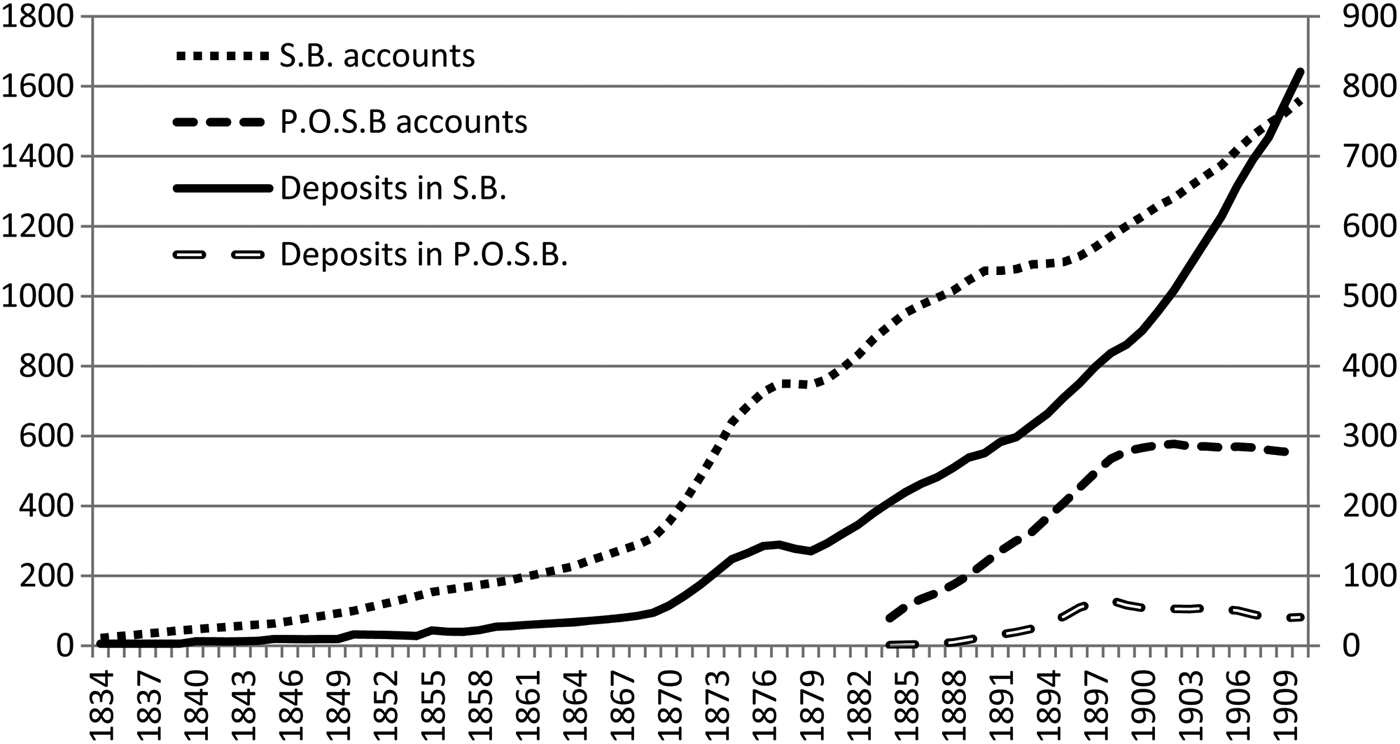
In 1850 there were 82 savings banks in Sweden, and by 1900 there were 388 (Lilja Reference Lilja2000, p. 33). Total deposits increased slowly in the first decades, and by 1850 there were only 100,000 accounts (Figure 2), averaging 0.13 accounts per household. From 1870, with increasing wages, total deposits and the number of accounts grew faster, and the number of accounts per household increased from 0.35 to 0.90 between 1870 and 1900.Footnote 3 Most accounts were small. In 1900 approximately 55 per cent contained at most 100 SEK (corresponding to a male worker's earnings for six weeks (Bagge, Lundberg and Svennilson Reference Bagge, Lundberg and Svennilson1933, p. 260)). Some of these small accounts belonged to children (Varifrån kommer…1946, p. 57; Lilja Reference Lilja2004, p. 208), but many belonged to workers. Although the majority were small accounts, they only comprised a minor part of total deposits, while accounts with more than 1,000 SEK constituted approximately 60 per cent of funds.Footnote 4
Savings banks and post-office savings banks, number of accounts (left axis, thousands) and total deposits (right axis, millions SEK)
It is of vital importance to remember that savings banks were never alone in the savings arena in Sweden. Traditional methods of investing money in real estate, in claims on outstanding debts, and in personal property were important before savings banks were established and were still of significance at the end of the nineteenth century. Meanwhile, new saving methods were introduced: commercial banks, sickness and burial funds (and other self-help associations), life insurance and endowment assurances (Lilja and Bäcklund Reference Lilja and Bäcklund2013; Bäcklund and Lilja Reference Bäcklund and Lilja2014).
Sweden is a good example of the role of savings banks in the nineteenth century. One reason for this is that they were the first modern, nationwide financial institutions in the Swedish credit market.Footnote 5 Another is that despite the competition from other small savings institutions, they continued to expand geographically as well as in total deposits and number of account holders, at least up to World War I. A third reason is that data from probate inventories enable us to study how individuals and groups chose between these banks and other saving methods.
III
Studies of savers and saving habits in the nineteenth century are often based on savings bank records (Alter et al. Reference Alter, Goldin and Rotella1994; Lilja Reference Lilja2004; Maltby Reference Maltby2011; Perriton Reference Perriton2012; Ross Reference Ross2013; Perriton and Maltby Reference Perriton and Maltby2015). These sources are very valuable for analyses of how different groups utilised their savings bank accounts, but give no information about other saving methods. Did some workers, for example, prefer mutual associations rather than savings banks, or did they not save at all? Estimates have been made for the macro level (Johnson Reference Johnson1985), but they still leave open the question of differences within the working class. The reason is lack of data for individuals (Schulz Reference Schulz, Conze and Engelhardt1981, p. 491), but such analyses are easier for Sweden as probate inventories are available for a large part of the population. Similar sources were used in a study of wealth concentration in Ireland, but in that case probate rates for the nineteenth century were very low (4–15 per cent, Turner Reference Turner2010). According to a Swedish law of 1734, probate inventories were supposed to be made for all decedents who were married or widowed. In fact, only those with assets were probated (Bringéus Reference Bringéus1977, pp. 3–10). For a study of how common saving was, and of the importance of savings banks compared to other saving methods, this is a minor problem, as savers by definition must have had assets.
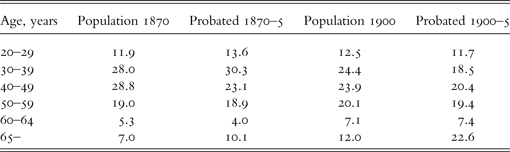
The inventories give detailed information about a decedent's name, occupation, marital status, heirs and sometimes age, as well as data for the household about the value of various kinds of assetsFootnote 6 and debts. This makes the material very useful for studies on methods of saving utilised. Furthermore, the age of married workers at probate was roughly similar to that of the married population, although the elderly were somewhat overrepresented in probates in the 1900s (Appendix Table A1). Consequently, by multiplying these with probate rates, data from the inventories can be used to approximate the percentage of married workers with savings and the amounts saved.
More problematic is the fact that probate inventories were not compulsory for the unmarried. For this group it is likely that some of those not probated had savings as well. This was taken into consideration in the analysis by assuming that savings for those not probated were at most half as common, and with half the amounts, as savings for those probated. This assumption may result in wide margins of error.
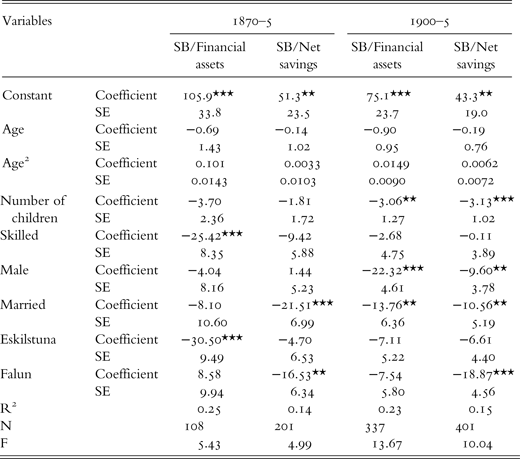
Probate inventories for 1870–5 and 1900–5 were studied. We chose the 1870s because savings banks at this time had been operating for almost half a century and real wages were very low (Figure 1). From then on, real wages increased rapidly, and between 1870 and 1900 several new small savings institutions were established. Consequently, conditions for workers' saving and for savings banks changed from the 1870s to the 1900s. Cross tabulation was used to compare the saving patterns of different groups of workers to get an idea of what functions savings banks fulfilled. To further control the significance of different characteristics a regression analysis was used (Appendix Table A2).
All probate inventories for workers in the three towns mentioned below were examined. ‘Workers' were grouped into skilled and unskilled (including semi-skilled) manual workers, categorised according to the standard occupational classification often used in the UK (for example, Clark et al. Reference Clark, Cummins, Hao and Diaz Vidal2014, p. 287). Both groups lived mainly from their own work, for example, master artisans, blue-collar workers, apprentices, journeymen and corresponding groups, but skilled workers received higher wages than the unskilled, and would have been able to save more, and perhaps used other saving methods.
In some cases data on occupation or marital status were missing, and these probates were excluded from the investigation. This led to omitting widowed workers as a group, as several widows had no occupation listed. Thus, this study includes married and unmarried workers only. Because it focused on those who lived from their own work, probate inventories with a net wealth of more than 10,000 SEK were excluded. In these cases wealth probably resulted from large inheritances or having owned a very profitable business.Footnote 7
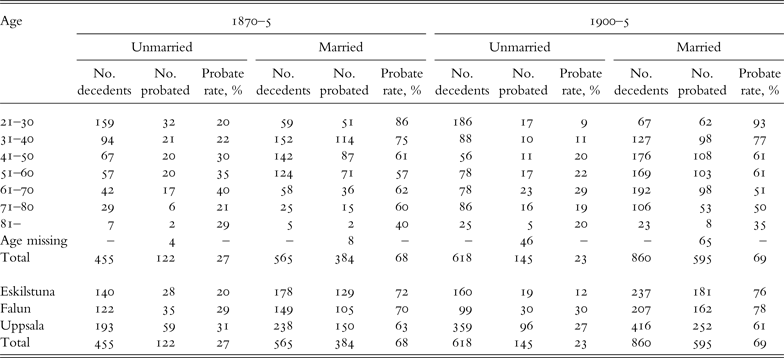
There remained 506 probates to be studied for 1870–5 and 740 for 1900–5. As can be seen in Table 1, differences in probate rates were significant between married and unmarried workers. Approximately two out of three married workers were probated, but only one unmarried worker out of four was. Probate rates also differed according to age, but these differences were generally much smaller than those relating to marital status. For 1900–5 data on age were missing for many workers. This deficiency is probably of less importance, as age does not seem to have influenced saving patterns in a significant way (Appendix Table A2).
Numbers of decedents, numbers of probated and probate rates for unmarried and married workers 1870–5 and 1900–5 in Eskilstuna, Falun and Uppsala
Sources: ULA. Bouppteckningar, Död- och begravningsböcker, 1870–5 and 1900–5 for Eskilstuna, Falun and Uppsala.
Three towns, in central Sweden were studied: Eskilstuna, Falun and Uppsala. In these towns savings banks were established in 1828, 1825 and 1830, respectively. Uppsala had one savings bank, while Eskilstuna and Falun had two each. In 1900 there were on average 239 savings bank account holders per 1,000 inhabitants in Sweden. Corresponding figures for the three towns were 797 (Uppsala), 539 (Eskilstuna), and 389 (Falun).Footnote 8 Figures are not quite comparable, as account holders from surrounding rural areas are included for the towns, but reveal that saving in savings banks was well established in all three towns.
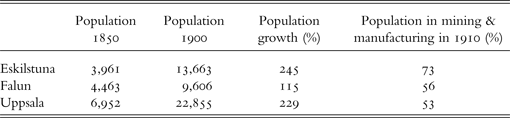
The three towns were middle sized for Sweden, ranking between seventh (Uppsala 1850) and twenty-fourth (Falun 1900) from a total of about 100 Swedish towns. They were all part of the industrialisation process and contained many industrial workers at the beginning of the twentieth century, but differed with regard to population growth and industrial structure (Table 2). In Eskilstuna the metal industry dominated, industrialisation was rapid and population growth fast (Table 2). At the turn of the twentieth century this was the most industrialised town in Sweden (Ohlsson Reference Ohlsson, Ohlsson, Ericsson and Magnusson2001, pp. 52–75). Falun was an old mining town. During the nineteenth century the mining industry stagnated, which greatly affected the economic life as well as population development. Railway connections were established from 1859 onwards, and at the very end of the century several manufacturing industries were located in the town (Lilja Reference Lilja2004, pp. 59–65). Uppsala was the administrative centre of the Swedish church and boasted Sweden's first university, founded in 1477. A relatively diversified manufacturing industry, mostly producing for the domestic market, expanded from the 1870s onwards (Ullenhag Reference Ullenhag1984, pp. 18–22). This led to rapid population growth at the end of the century (Table 2).
Population 1850 and 1900 and the percentage of population in mining and manufacturing 1910 in Eskilstuna, Falun and Uppsala
Sources: Historical Statistics of Sweden, part i: Population (1969); SOS. Folkräkningen 1910, part iii (1917).
In general probate rates were similar for the three towns as were the numbers of inventories (Table 1). The major exception was for unmarried workers in the 1900s, where Eskilstuna had very few, while probates from Uppsala made up nearly two-thirds of the total number. Nothing indicates that this uneven distribution strongly influenced the results, as saving patterns were approximately the same for unmarried workers in all three towns.
IV
Savings banks were supposed to teach workers to save. To what extent did this happen in Sweden? To answer this we need to examine whether net savings were more common among workers at the turn of the twentieth century than before savings banks were introduced. For this purpose data from probate inventories in the 1820s were used as a reference point.Footnote 9 Net savings were defined as assets minus debts minus personal property, which means that those with net savings had more wealth than the value of their personal property. This estimate was based on two assumptions. One was that personal property was mainly for consumption, and the other that those not probated had no net savings. Only married workers were included, and the figures for all married workers were calculated by multiplying probate rates and percentages of probated workers with net savings (see Section iii).
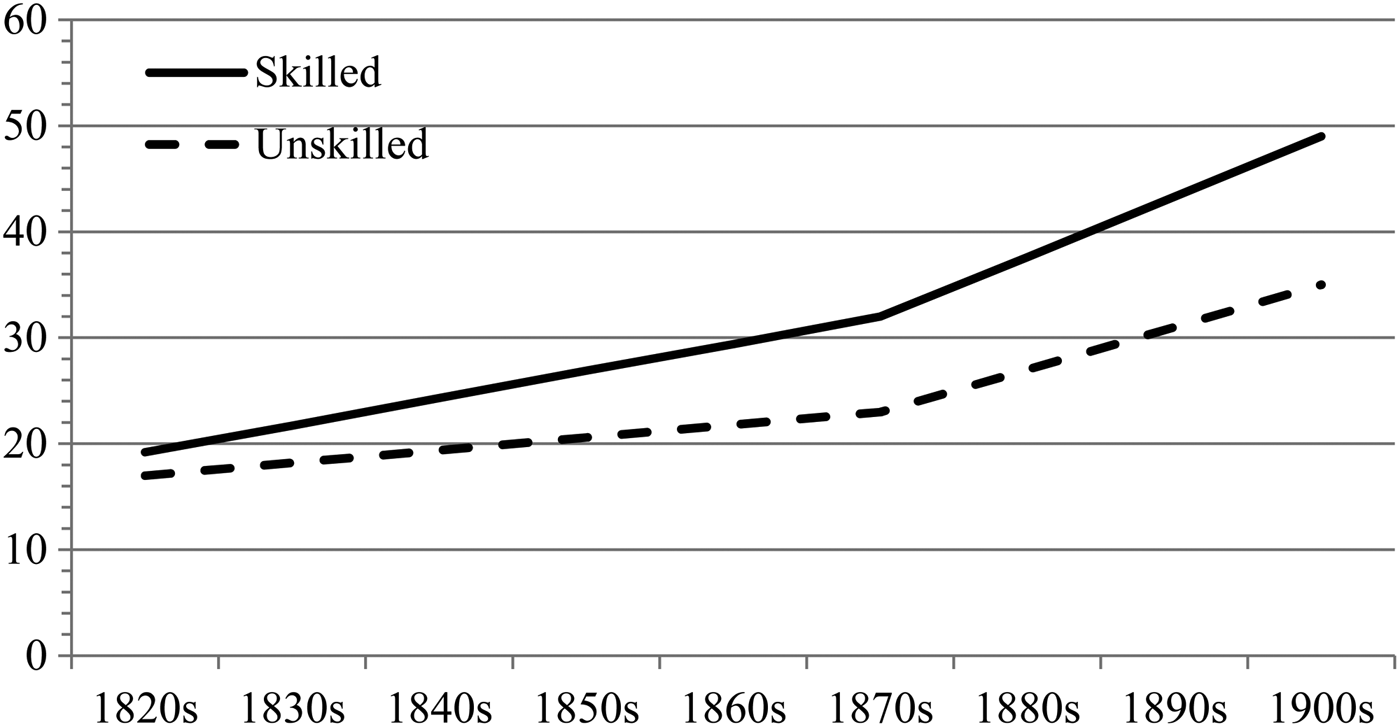
The results show that by the 1820s, before savings banks were introduced in Sweden, nearly one married worker in five had net savings (Figure 3). This increased to one-third of skilled and one-fourth of unskilled married workers in the 1870s, and by the 1900s it was one-half of skilled workers and one-third of unskilled workers. That the proportion increased faster at the end of the century corresponds well with the development of real wages (Figure 1). A growing difference between skilled and unskilled workers in the course of a century is also notable. How important were savings banks for these developments?
Percentage with net savings, married skilled and unskilled workers 1820–5, 1870–5 and 1900–5
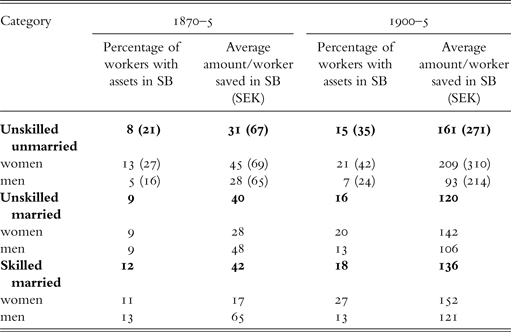
The next step in our analysis was to estimate the proportion for various groups of workers with assets in savings banks and the deposits per worker. In this case all probated workers, not only those with net savings, were included. Two estimates were made. For married workers, the percentage having assets in savings banks was calculated by analogy with net savings. For unmarried workers, the corresponding figures represent only the lower limits, as probate inventories were not compulsory. Probably, some who had not been probated had assets in savings banks, too. We assumed that this was at most half as common among this group as among those probated. Figures within brackets (Table 3) show the results of these estimates and give the upper limits. Savings bank assets per worker were calculated correspondingly. Skilled, unmarried workers were excluded because there were very few of them (fewer than 20 probates in both periods).
Percentage of workers with assets and average amount per worker in savings banks 1870–5 and 1900–5, constant prices 1900–5
Sources: See Table 1.
Note: 1. Figures within brackets show estimates, including also those not probated, assuming that assets were half as common and half as large as for those probated.
2. Assets deflated according to the consumer price index (Edvinsson and Söderberg Reference Edvinsson, Söderberg, Edvinsson, Jacobson and Waldenström2010, pp. 446–7).
According to the results, less than 20 per cent of all married and unmarried workers had assets in savings banks in the 1870s (Table 3). This holds true for all subgroups, with the possible exception of unskilled, unmarried women, for which the estimates show an upper limit of 27 per cent. Levels were somewhat higher at the turn of the twentieth century, but still under 30 per cent for all subgroups, with the only probable exception of unskilled, unmarried women (upper limit 42 per cent). These low percentages are puzzling, as public statistics indicate an average of almost one account per household in Sweden in 1900 (Section ii). Some households may have had several accounts (for husband, wife and children), while others had none. Furthermore, public statistics indicate that many account holders had extremely small deposits. For those with bank balances of at most 100 SEK, the average was only 26 SEK, which means that accounts with less than 10 SEK were very common.Footnote 10 Perhaps some of these had not been used for several years.Footnote 11 It is also possible that some accounts were used for running expenses only and not for saving. Studies show that recurrent deposits and withdrawals were relatively common at the turn of the twentieth century (Lilja Reference Lilja2004, pp. 112–13; Bäcklund and Lilja Reference Bäcklund and Lilja2014). This indicates that savings bank accounts acquired a new function at this time, being used for saving less frequently. In any case, it seems obvious that the number of savings bank accounts in public statistics highly exaggerates the number of active savers in these banks.
Probate inventories show that average deposits grew over time and were at a rough estimate three to four times as large in the 1900s as in the 1870s (Table 3). Consequently, rising real wages led to larger deposits, as well as higher percentages of people with assets in savings banks. Amounts saved were often small, however. In the 1870s deposits were 40–50 SEK per married worker, corresponding to an income for approximately one month. Thirty years later average amounts were larger, but still just equivalent to an income for two months (Bagge et al. Reference Bagge, Lundberg and Svennilson1933, pp. 260–1). This indicates that assets in savings banks were used by married workers mostly for precautionary or target saving, and that saving for old age was unusual.
Only 6 per cent of probated married workers had deposits in savings banks equivalent to earnings for a male industrial worker for at least one year. The corresponding figure for unskilled, unmarried women was 23 per cent. Even considering differences in probate rates, this indicates that unmarried women more often used savings banks to save for old age. Generally these women stand out as the group most dependent on savings banks. They had the largest amounts deposited, as well as the highest percentages with deposits (Table 3). Obviously the cause was not high wages, since female wages were often only 50 per cent of male wages (Prado Reference Prado, Edvinsson, Jacobson and Waldenström2010b, p. 499). Other factors were probably more important, for example, employers usually provided board and lodging for most unmarried women, and the risk of seasonal unemployment was small. It is also fairly safe to assume that males on average were less thrifty than unmarried females, possibly because of addiction to alcohol. This was a great problem in nineteenth-century Sweden. Public statistics reveal that males constituted as much as 97 per cent of those charged with drunkenness.Footnote 12
V
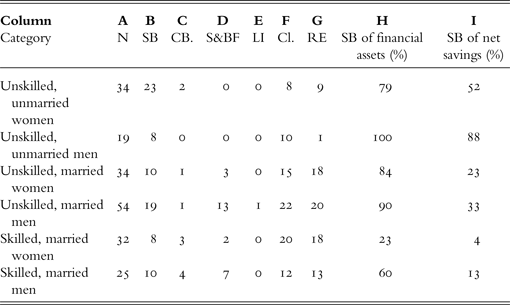
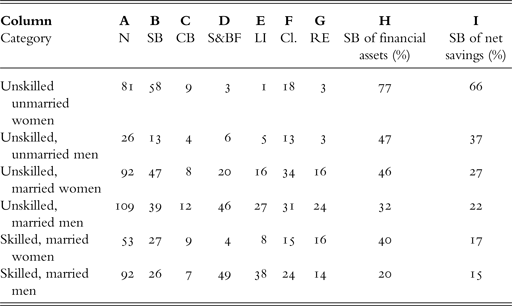
The third step in our analysis was to relate savings banks to other saving methods. It is likely that workers would have had a large share of their savings in these banks, if they had really been important. Thus, the comparison was limited to those probated with net savings, and assets in savings banks were related to net savings as well as to financial assets. In brief, the percentages of assets in savings banks in relation to net savings reveal that savings banks were important for unmarried savers, but not for married ones (Tables 4 and 5). The former had more than 50 per cent of their savings in savings banks, while the corresponding figure for married workers was about 20 per cent. This difference was probably owing to marital status as such and not to unmarried workers being younger, as age had no significant impact (Appendix Table A2). This also means that savings banks were not a main cause of the growth in married workers' net savings in the nineteenth century. Nor were they a determining factor for the growing difference in this regard between skilled and unskilled married workers, as few in both groups had assets in savings banks (Tables 4 and 5 and Appendix Table A2).
Workers with net savings, 1870–5: numbers with different kinds of assets, and savings bank deposits as a share of savings
Sources: ULA. Bouppteckningar, Död- och begravningsböcker, 1870–5 for Eskilstuna, Falun and Uppsala.
Note: SB = savings banks; CB = commercial banks; S&BF = sickness & burial funds; LI = life insurance; Cl. = claims on outstanding debts; RE = real estate.
Workers with net savings 1900–5: numbers with different kinds of assets, and savings bank deposits as a share of savings
Sources: ULA. Bouppteckningar, Död- och begravningsböcker, 1900–5 for Eskilstuna, Falun and Uppsala.
Note: See Table 4.
In the 1870s assets in savings banks comprised a very large part of workers' total financial assets, although average amounts were small (Table 4). This reflects a situation in which the financial market was still relatively undeveloped and alternatives were few. In the town of Eskilstuna, however, sickness and burial funds were already well established. As a consequence, workers in that town had significantly fewer financial assets in savings banks. Unskilled workers, unmarried as well as married, kept nearly all their financial assets in savings banks, while skilled workers had other kinds of financial assets as well, for example, in commercial banks (Appendix Table A2).
For unmarried, unskilled workers, deposits in savings banks constituted a large share of net savings in the 1870s (Table 4). Besides deposits in savings banks, this group often only had some sort of financial claims on outstanding debts, but they were of little importance for net savings. As a result current assets dominated, which corresponds with the life-cycle hypothesis and the idea that (young) unmarried persons saved for marriage and to set up a household, which was true for young women who had accounts in PSFS in 1850 (Alter et al. Reference Alter, Goldin and Rotella1994). It should be noted, however, that as many as one-fourth of the women in this group (mostly elderly who lived in Falun) owned real estate. Most deposits were probably inherited assets, but in some cases may have been a result of savings accumulated by the women themselves.
Assets in savings banks were considerably less important in the net savings of married workers (Table 4 and Appendix Table A2). Many of them used more than one method of, and did not look on savings banks as their preferred method. This was especially true for skilled, married workers. More of them had real estate or claims on outstanding debts than bank deposits. Accordingly, in the 1870s they still relied heavily on traditional methods of saving, and financial assets comprised on average only one-fourth of their net savings. Many married workers owned real estate, although this differed very much from town to town. In Eskilstuna and Uppsala about one-fourth of this group owned real estate, while as many as 85 per cent of married workers in Falun had this kind of asset.Footnote 13 Ownership of real estate was significantly positively correlated with having children (r = 0.26, p = 0.001), which shows that family considerations were important for the choice of saving method. Very likely the high percentages of workers with real estate, often minor dwellings, distinguish Sweden from many other countries in Western Europe at this time. The explanation is that urbanisation came relatively late to Sweden and was not a major factor until the last decades of the nineteenth century (Nilsson Reference Nilsson1989, p. 129).
Even though average assets in savings banks increased substantially in the final decades of the nineteenth century (Table 3), such assets made up a much smaller portion of financial assets in the 1900s than in the 1870s (Tables 4 and 5). This development sums up two processes. First, several new financial saving methods had recently become widespread in Sweden and were attracting working-class savers. Savings banks can be seen as market makers of this process. Among the newcomers, mutual associations such as sickness and burial funds and tusenmannaföreningar (thousand men's associations) were most common, but also life and endowment assurances became popular at the turn of the twentieth century (Bäcklund and Lilja Reference Bäcklund and Lilja2014). This means that savings banks encountered more intense competition within the modern sector. In the 1900s assets in savings banks made up 42 per cent of financial savings, which is close to what Johnson (Reference Johnson1985, p. 205) estimated for Britain in 1901. Second, traditional methods of saving were superseded by more modern methods at the end of the nineteenth century (Lindgren Reference Lindgren2002, pp. 810–32; Lilja Reference Lilja2004). This, together with rising wages, led to a substantial increase in financial savings between the 1870s and the 1900s. Financial assets constituted one-fourth of net savings in 1870–5 and more than half in 1900–5. The result of these two opposite processes was that savings banks maintained their share of net savings and at the turn of the twentieth century were still able to compete for working-class saving. This was probably because they were regarded as safe institutions, giving relatively high interest on deposits and accepting the individual disposition of funds. A further confirmation of their competitiveness was that very few probated workers (five unmarried and eight married) had assets in post-office savings banks.
Among traditional saving methods, claims on outstanding debts were still widespread among workers at the turn of the twentieth century, but not as common as in the 1870s. The proportion with claims had decreased by approximately one-third between the two periods. For real estate the decline was faster, by more than 50 per cent (Tables 4 and 5). In the 1900s it was almost exclusively married workers in Falun who owned real estate. Accordingly, assets in savings banks comprised significantly less of net savings in that town than in the other two (Appendix Table A2). Obviously, traditional saving methods were on the decline, but were still used by workers. The causes of the decline were probably that claims were a relatively unsafe method of saving, and that the price of real estate had risen as a result of urbanisation.
All groups except unmarried women had more dispersed financial savings in the 1900s than in the 1870s. For these women, financial assets as well as net savings continued to be highly concentrated in savings banks. Only a few had assets in sickness and burial funds. One reason was that many of them were employed in occupations where no such funds existed. However, this is probably not the full explanation. Sickness and burial funds were relatively uncommon among unmarried men, too, at least in comparison with married men (Table 5). The former were underrepresented in occupations where mutual associations were very common, for example, in engineering (Elmquist Reference Elmquist1899, p. 134; Reference Elmquist1904, p. 209). This illustrates that individual decisions about saving differed to a great extent from decisions based on family considerations. As breadwinners, married men normally had to guarantee family support also in case of loss in income. For this purpose sickness and burial funds based on mutual assistance were more suitable than savings banks based on individual deposits, as the former permitted disbursements greater than individual payments. This need for security was less acute for unmarried persons who only had to support themselves. Thus, they could rely on savings bank accounts and use these for precautionary savings, if necessary. The advantage was that such savings were individual and could be used for other purposes, too, while sickness and burial funds were mutual and earmarked for defined purposes.
Family considerations were also applicable to life insurance. Such policies were much more common among married than among unmarried workers. Furthermore, they tended to be most prevalent among married workers with children. Life insurance (including assets in tusenmannaföreningar) constituted 9 per cent of financial assets for unmarried workers in the 1900s, 21 per cent for married workers without children, and 39 per cent for married workers with children. Consequently, the saving behaviour of married workers without children was somewhere in between that of the unmarried and those married with children, respectively. This shows that male workers with families, and especially those with children, tried to facilitate support for those left behind. Obviously, life insurance was often chosen as an alternative to savings bank accounts. As a result, the number of children negatively affected the percentages of financial assets and net savings in savings banks (Appendix Table A1). Life and endowment assurances became even more popular among workers at the beginning of the twentieth century. Saving patterns, however, were unchanged. The cost-of-living investigation of 1913–14 showed that married workers with children prioritised this kind of assurance, while those without children more often saved in banks (Bäcklund and Lilja Reference Bäcklund and Lilja2014, pp. 630 and 641–2).
VI
Swedish savings banks never became chiefly workers' institutions. On the contrary, middle-class savers held one-half or more of deposits during the entire nineteenth century. Moreover, savings banks never came to dominate working-class savings or even receive most of their deposits. During the first 50 years, traditional saving methods (claims on outstanding debts and real estate) were more important. Later on, new financial institutions, such as sickness and burial funds and other types of mutual associations, competed with the savings banks for workers' savings. Life and endowment assurance made this competition even more intense at the beginning of the twentieth century.
On the other hand, savings banks did attract workers. Many workers were account holders at some time in their lives, assets increased over time, and in spite of the competition from traditional and new saving methods, savings banks continued to be an interesting alternative. Approximately one-third of probated workers' net savings were deposited in savings banks in the 1870s as well as in the 1900s. Meanwhile, total net savings had almost tripled between the two periods. The main cause was increasing real wages and greater economic surpluses for saving. Perhaps workers became thriftier, too, but this is speculation. However, it seems plausible that workers would have saved less without the savings banks. Otherwise, these banks would not have continued to be a competitive alternative to other saving methods in the period under study. Consequently, at least marginally, savings banks had a positive impact on total savings. Thus far, they did live up to some of the founders' expectations, but they never became the ‘vitamin injection’ for working-class saving that the founders initially hoped for.
Probate inventories reveal that savings banks suited different groups of workers to varying degrees. They were most well-matched for unmarried women. Many of these women worked as maids and were under their masters' authority and care. Accordingly, they did not have the same need for precautionary saving as factory workers did. Moreover, there existed no self-help associations especially for maids. Presumably, most of these women wished to marry and settle down eventually. For this purpose, assets in savings banks were appropriate. If the women did not marry, they could use their funds for old age. Advantages were that very small deposits were accepted and that assets in savings banks were movable. This combination of needs and lack of alternatives probably explains why savings banks were important for unmarried women.
Many unmarried men did not save at all, perhaps because they had very insecure incomes or were unthrifty. Those that did save, however, chose savings banks to a great extent. In this, unmarried workers clearly differed from married ones. For the latter, family considerations were crucial. In the 1870s this was reflected in real estate ownership. At this time some workers could still afford to buy a dwelling house, and this was an attractive alternative for those who had children. In the 1900s real estate had become too expensive. Instead, married workers prioritised some sort of insurance, such as life insurance or assets in sickness and burial funds. The purpose was security for the family against loss of income in case of illness or death. Of course, savings banks could be used for this purpose too, but then the saver could not benefit from the funds of a mutual association.
Savings banks were initially intended to facilitate savings for long-term purposes such as old age. Low and uncertain incomes made this almost unattainable for most workers. Many had accounts, however, and these were often used for short-term necessities and desires. Later on, this became even more frequent, as new, specialised small saver institutions took over some of the functions the savings banks had been intended to satisfy. This process led to a partly new function for savings bank accounts at the end of the nineteenth century, i.e. for running expenses and targeted saving. This indicates that savings banks were multifunctional and flexible, which probably was advantageous in a changing savings market arena.
To conclude, savings banks were principal solutions for the individual saver. As a consequence, they suited unmarried workers better than married ones. This stress on individualism was in keeping with the liberal ideas that generated savings banks. At the same time, it may have been an obstacle to attracting married workers and severely decreased the importance of savings banks for working-class saving. Nevertheless, it is worth remembering that all married workers had previously been unmarried. To the extent that savings banks laid the foundations for or reinforced saving habits among young, unmarried workers, they were important for working-class saving. In that sense they can be said to have taught the broad masses to save.
APPENDIX
Percentages of married population in Sweden and probated married workers of different ages
The regression model
To study what affected workers' saving patterns, a regression model was constructed from data from the probate inventories. The purpose was to differentiate between influences of age, gender, occupation, marital status, family structure and place of residence.
Dependent variables: assets in savings banks as a percentage of financial assets and net savings, respectively.
Independent variables: age and age2 (the age of the probated, in years).
Number of children.
Skilled (skilled = 1).
Male (male = 1).
Married (married = 1).
Eskilstuna (living in Eskilstuna = 1).
Falun (living in Falun = 1).
Determinants of assets in savings banks in relation to financial assets and net savings, respectively