In recent decades, official guidance regarding healthcare disaster preparedness has emphasized the importance of effective hospital planning to “surge” clinical capacities and capabilities to meet the needs of disaster events when they occur.Reference Kaji, Koenig and Lewis1-Reference Yamanouchi, Sasaki and Kondo3 In the United States (US), rules and standards from the Hospital Preparedness Program within the office of the Assistant Secretary for Preparedness and Response, from the Joint Commission, and from the Center for Medicare and Medicaid Services have all spoken of this need for “surge capacity” within the healthcare system.Reference Kaji, Koenig and Lewis1, 2 In Japan, the Health Care Plan within the Ministry of Health, Labour, and Welfare, and Business Continuity Plan at various levels have done the same.Reference Yamanouchi, Sasaki and Kondo3 In both systems, however, the extreme difficulty of rapidly mobilizing sufficient numbers of staff who can effectively care for disaster victims has been recognized as among the most difficult challenges in healthcare disaster planning. While it is a common recommendation for hospitals to reallocate staff and to recall many of their off-duty personnel in response to catastrophic events,2, Reference Paturas, Smith and Smith4 it is also commonly recognized that many hospitals will still require supplemental, external staff to provide care for patients in the largest of disasters.Reference Kaji, Koenig and Lewis1, Reference Yamanouchi, Sasaki and Kondo3, 5, Reference Tanihara, Kobayashi and Une6
In the United States, using locally available medical workers, such as those loaned from other less-affected facilities within a healthcare coalition or volunteers from a Medical Reserve Corps (MRC) has been recommended to supplement existing hospital staff.Reference Kaji, Koenig and Lewis1, 2, Reference Sheikhbardsiri, Raeisi and Nekoei-Moghadam7, Reference Watson, Selck and Rambhia8 However, there are significant challenges with this approach. External staff are typically unfamiliar with the affected hospital’s computer system, locations of supplies, existing staff members, and operating protocols. In addition, because relatively few MRC staff actively practice in an acute care hospital setting, their skills may not be similar to other personnel actively practicing in a hospital. Therefore, these external responders may not be effective in supporting surge care needs.Reference Watson, Selck and Rambhia8, Reference Williams, Trued and Duggan9
In Japan, disaster medical assistance teams (DMATs) have been developed as a resource to help with surge capability problems in disasters. Each DMAT team is comprised of a small number of healthcare professionals who are trained in disaster response, work regularly in hospitals, and have acute care skills.10, Reference Fuse and Yokota11 The teams are structured to have flexibility in the roles that they can fill in a disaster and to be able to function both at disaster scenes and at affected hospitals. These teams have played a substantial role in previous, real-world relief activities for acute phase disaster, including hospital support, and initial studies of their effectiveness have been encouraging.10-Reference Nagata, Himeno and Himeno12 Nevertheless, we have repeatedly experienced operational difficulties in practice to fulfill our potential at hospitals which we had not previously worked before. Because the integration of external staff into a local hospital’s disaster response can be so difficult in practice, it is essential to critically examine other methods of identifying and effectively using external staff who can respond into an overwhelmed hospital or a healthcare system following a disaster.
Following the 2016 Kumamoto earthquakes (a series of multiple tremors), 2 certified physicians of a DMAT team in Tokyo responded to a distant disaster base hospital that needed maximizing capabilities and provided surge support. Uniquely, however, these responders were already credentialed at the affected hospital and were familiar with its operations before the disaster based on a cooperative relationship of acute care physicians between the hospitals. They were able to effectively add to the hospital’s surge capacity because of their prior training and work experiences in that hospital. Therefore, in this report, we discuss the advantages and possibilities of pre-matching disaster response staff with potential hospitals in need as a mechanism for increasing effective hospital disaster surge capacity.
CASE REVIEW
The Earthquakes and the Oita Prefecture’s Response
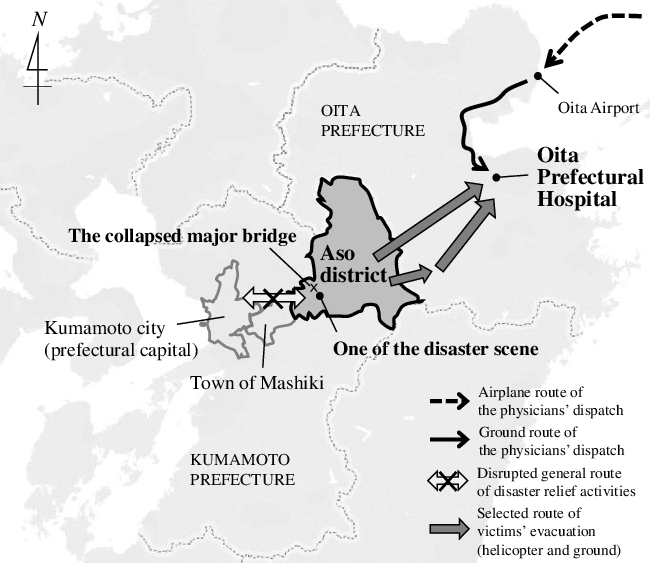
In April of 2016, a series of tremors, termed the Kumamoto earthquakes, damaged much of the Kumamoto Prefecture and, to a smaller extent, the western section of neighboring Oita Prefecture.13, 14 In Kumamoto Prefecture, many houses and buildings were destroyed, particularly in Kumamoto city, the town of Mashiki, and the Aso district.13 More than 100 people were killed in the acute phase of the disaster, and more than 10 hospitals required some degree of evacuation.Reference Nagata, Himeno and Himeno12, 13 The Aso district, which is in the northeastern area of Kumamoto Prefecture and borders Oita Prefecture, was severely affected by the earthquakes and was especially isolated from the metropolitan area because of infrastructure damage (Figure 1).13, 14 The roadway and other infrastructure damage in this district significantly disrupted relief activities from the central area of Kumamoto Prefecture.
A Map of Damaged Area and Information in the 2016 Kumamoto Earthquake

Although Oita Prefecture was also struck by the earthquakes, the damage sustained in the prefecture was less than that of Kumamoto. Therefore, despite sustaining some damage, Oita Prefecture was the most appropriate municipality to lead the disaster relief action and receive evacuated casualties from the Aso district in Kumamoto Prefecture (Figure 1). The Oita Prefectural Hospital (OPH), which is the core disaster base hospital in the prefecture, was relatively undamaged, with the exception of a few small ceiling collapses. Following the earthquake, the hospital rapidly prepared to receive casualties and evacuees from damaged areas, and also dispatched a disaster medicine coordinator to the prefectural disaster countermeasures office. The hospital staff created additional surge beds and mobilized staff to care for incoming casualties, per its disaster plan.
The Unusual Opportunity
Over the past 7 years, OPH and the Kyorin University Hospital (KUH) have had an exchange relationship of emergency physicians that aims to train young physicians and secure rural medical resources. After the main shock, OPH requested of KUH that they dispatch emergency physicians to expand the staff of OPH. OPH was able to identify 2 appropriate physicians on duty who had previously worked at the requesting hospital, and who were still credentialed to work there. After handing over their work duties to other staff members, the physicians immediately left their hospital with a basic kit of medical equipment and their bags. Because their relief activity was not based on a DMAT order nor a prestructured assignment, there were some loss of time and difficulties in their move. Nevertheless, they moved approximately 800 km and, despite severely damaged road and traffic networks, arrived at OPH 7 h after the request and 12 h after the main shock.
Upon their arrival, the physicians were given work assignments by the hospital leadership and were immediately able to begin practicing because they already had staff identification materials and had appropriate access to the electronic medical charts. They worked alongside the hospital’s other physicians providing care in the emergency room and intensive care unit. They were effectively able to supplement the staff for the hospital, helping care for additional patients, and providing the opportunity to rest for the existing on-duty staff.
DISCUSSION
Although hospitals always prefer to use their own staff in the response to disasters, there have been many historical examples where external, supplemental staffing was required for them to meet the needs of their patients.Reference Kaji, Koenig and Lewis1, 2, Reference Paturas, Smith and Smith4, Reference Watson, Selck and Rambhia8 Unfortunately, however, using external staff in a disaster is fraught with many well-described challenges, and external resources are often less effective than anticipated.Reference Williams, Trued and Duggan9 Our experience has shown that hospitals affected by disaster can effectively use external staff who have both previously been credentialed and had some experience working in those hospitals’ environment. Using such medical professionals can reduce the administrative burden of rapidly credentialing and training responding disaster workers. It can also limit the need for the overwhelmed hospital to use its scarce staffing resources to supervise the external responders.
Based on our experience, we suggest that hospital coalitions and disaster response authorities explore mechanisms of cross-credentialing and cross-training staff to make it easier to share staff in a disaster. Although such a system would create an additional administrative burden before disaster events happen, it would significantly lessen such burdens when disasters strike and could improve the overall speed and effectiveness of the overall response. In recent years, the Japanese Association for Acute Medicine officially mandated studying rural and community-based medicine in training concepts for certification.15 We believe that such public certification programs can also play a role in promoting enhanced disaster preparedness for both rural and urban communities. Thus, further discussions with the consideration of local healthcare conditions are required to encourage the practical use of external resources.
Conflicts of Interest
The authors declare no conflicts of interest related to this article.