Implications
The need for minerals in animal husbandry has led to the production of many different kinds and sources of mineral supplements. Although some caution is advised in the use of minerals (for environmental and health reasons), the recommended levels of supplementation are sometimes neglected. We feel that by carrying out studies such as the present one, we could help establish new recommendations or confirm previous ones in different conditions and in different animals. Studies like this will help reduce excessive and unnecessary mineral supplementation in animal feeding.
Introduction
The essentiality of cobalt (Co) in ruminant nutrition and its key function in ruminal vitamin B12 synthesis has been clearly demonstrated by previous literature (Marston, Reference Marston1952; Smith and Loosli, Reference Smith and Marston1957; Smith and Marston, Reference Smith and Loosli1970). The National Research Council (NRC) (2007) lists the dietary Co requirement of goat kids with 20 kg BW to be 0.07 mg Co/day; however, in lambs Bishehsari et al. (Reference Bishehsari, Tabatabaei, Aliarabi, Alipour, Zamani and Ahmadi2010) demonstrated that supplementing the diet with more than twice the NRC recommendations of Co sulfate increased plasma vitamin B12 concentration, final BW, average daily gain (ADG) and gain efficiency. It has also been demonstrated that increasing amounts of dietary Co supplementation causes elevated serum and liver vitamin B12 concentrations in sheep, however, in this case no benefits in animal performance were observed (Kawashima et al., Reference Kawashima, Henry, Ammerman, Littell and Price1997a).
The NRC (2007) recommendations of 0.1 to 0.2 mg Co/kg dry matter (DM) in sheep are based on observations in grazing animals (Wang et al., Reference Wang, Kong, Zhang, Zhu and Jia2007), and the dietary Co requirements for goats have not been adequately addressed (Mburu et al., Reference Mburu, Kamau and Badamana1992). For a long time, mineral requirements of goats have been considered as a halfway between those of cattle and sheep (Meschy, Reference Meschy2000). However, based on several reports (Kišidayová et al., Reference Kišidayová, Sviatko, Siroka and Jalč2001; Johnson et al., Reference Johnson, Al-Habsi, Kaplan, Srikandakumar, Kadim, Annamalai, Al-Busaidy and Mahgoub2004; Wang et al., Reference Wang, Kong, Zhang, Zhu and Jia2007; Bishehsari et al., Reference Bishehsari, Tabatabaei, Aliarabi, Alipour, Zamani and Ahmadi2010), the levels of 0.1 to 0.2 mg Co/kg DM do not meet rumen microbial Co requirements for vitamin B12 synthesis in sheep or goats. Some researchers (Johnson et al., Reference Johnson, Al-Habsi, Kaplan, Srikandakumar, Kadim, Annamalai, Al-Busaidy and Mahgoub2004; Al-Habsi et al., Reference Al-Habsi, Johnson, Kadim, Srikandakumar, Annamalai, Al-Busaidy and Mahgoub2007) have claimed that the common belief that goats are less susceptible to Co deficiency as compared with sheep (Clark et al., Reference Clark, Mantelman and Verkerk1986; Mburu et al., Reference Mburu, Kamau and Badamana1992) does not hold true for Omani goats.
Ruminant diets which are deficient in Co lead to decreased vitamin B12 (cobalamin) biosynthesis in the rumen and limit the amount of vitamin B12, which is available to microbes and the host animal (Tiffany et al., Reference Tiffany, Spears, Xi and Horton2003). A study on goats showed that low levels of dietary Co (0.10 and 0.12 mg Co/kg DM) resulted in lower apparent nutrient digestibility coefficients compared with goats supplemented with vitamin B12 (subcutaneous injections of 2000 µg of hydroxocobalamin at 8 weeks intervals). The researchers suggested that this is possibly due to several factors, including a reduction in number and type of rumen microorganisms (Gall et al., Reference Gall, Smith, Becker, Stark and Loosli1949), decrease in intestinal absorption of nutrients, and inadequate synthesis of the vitamin B12-dependent methylmalonyl CoA mutase and methionine synthase, the two enzymes essential for protein and energy metabolism (Kadim et al., Reference Kadim, Johnson, Mahgoub, Srikandakumar, Al-Ajmi, Ritchie, Annamalai and Al-Halhali2003). Co supplementation may improve ruminal fiber digestion by enhancing bacterial activity (Hussein et al., Reference Hussein, Fahey, Wolf and Berger1994). Divalent cations such as Co increase fiber digestion efficiency by creating cross-linkages between bacteria and feed particles (Somers, Reference Somers1973; Lopez-Guisa and Satter, Reference Lopez-Guisa and Satter1992) and also Co increases the population of anaerobic bacteria and the production of lactic acid in the rumen (Young, Reference Young1979). Co deficiency ultimately leads to vitamin B12 deficiency which clinically manifests as anemia, inappetence, poor production, weight loss and immune deficiency (Ulvund and Pestalozzi, Reference Ulvund and Pestalozzi1989; Vellema et al., Reference Vellema, Rutten, Hoek, Moll and Wentink1996).
There have been extensive studies in sheep and cattle considering Co supplementation and its effects on vitamin B12 concentrations in the body (Kincaid et al., Reference Kincaid, Lefebvre, Cronrath, Socha and Johnson2003; Tiffany et al., Reference Tiffany, Spears, Xi and Horton2003; Bishehsari et al., Reference Bishehsari, Tabatabaei, Aliarabi, Alipour, Zamani and Ahmadi2010; Akins et al., Reference Akins, Bertics, Socha and Shaver2013). However, there are limited studies on goats. Furthermore, there have been comparisons between different sources of Co supplements (e.g. Co sulfate v. Co glucoheptonate v. Co carbonate) in sheep (Ammerman et al., Reference Ammerman, Henry and Loggins1982; Henry et al., Reference Henry, Littell and Ammerman1997; Kawashima et al., Reference Kawashima, Henry, Ammerman, Littell and Price1997a and Reference Kawashima, Henry, Bates, Ammerman, Littell and Price1997b) and cattle (Akins et al., Reference Akins, Bertics, Socha and Shaver2013), but to our knowledge no conclusive studies have been carried out on goats. We hypothesized that greater concentrations of Co supplementation than those recommended by the NRC (2007) may improve vitamin B12 status of goat kids, and that different sources of Co may act in a different manner regarding some related parameters. Hence, the aim of this study was to compare two different sources of Co (sulfate v. glucoheptonate) at two different concentrations (0.25 and 0.5 mg/kg DM) in goat kids’ nutrition, and to evaluate the effects of these supplements on performance, serum vitamin B12, blood biochemistry and volatile fatty acid (VFA) concentrations in the rumen.
Material and methods
Animals and trials
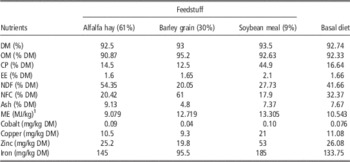
In total, 30 weaned male goat kids, with an average BW of 17.8±2.5 kg, were randomly allotted to five treatments. During the trial, animals were kept in individual holding pens for 75 days. After routine vaccinations and treatment for internal and external parasites, goat kids received the basal diet (Table 1) for the duration of 2 weeks as an adaptation period (basal diet contained 0.076±0.005 mg Co/kg). After the adaptation period, the treatment routines commenced which included (1) Control (basal diet with no supplementary Co); (2) 0.25 Co-S (basal diet+0.25 mg Co/kg DM as Co sulfate); (3) 0.5 Co-S (basal diet+0.5 mg Co/kg DM as Co sulfate); (4) 0.25 Co-G (basal diet+0.25 mg Co/kg DM as Co glucoheptonate); and (5) 0.5 Co-G (basal diet+0.5 mg Co/kg DM as Co glucoheptonate). Co glucoheptonate (COPRO, Zinpro Co., Minnesota, USA) was provided by Yasna Mehr Pvt. (Tehran, Tehran, Iran) and Co sulfate was supplied as CoSO4·7H2O. The basal diet (Table 1) comprised of 61% alfalfa hay, 30% barley grain and 9% soybean meal. It was formulated to meet or exceed all nutrient requirements (NRC, 2007). To monitor the basal diet, feed samples were taken on three occasions pooled and analyzed for DM, organic matter, CP, ether extract and non-fiber carbohydrate according to Association of Official Analytical Chemists (1990), whereas the NDF was measured according to Van Soest et al. (Reference Van Soest, Roberston and Lewis1991). Co supplements were administered daily via a rapidly consumed carrier meal (finely ground soybean meal) at morning feedings. The control treatment received the same amount of carrier meal without the added Co supplements. Feed was provided to the animals twice daily at 0800 and 1600 h, and animals had free access to fresh tap water. Feed consumption and refusals were closely monitored and recorded daily. Feed was supplied in an amount so that each kid would have about 10% orts. Goat kids were weighed at the beginning of the study and then weighed in 2-week intervals including the end of the experiment.
Ingredients and nutrient composition of the basal diet

DM=dry matter; OM=organic matter; EE=ether extract; NFC=non-fiber carbohydrate; ME=metabolizable energy.
1 ME was calculated using NRC (2007) recommendations for goats.
Sampling
Blood samples were drawn from the jugular vein of goat kids, on days 0, 35 and 75 before morning feeding, into two 10 ml Venoject vacuum tubes (TERUMO Co., Shibuya-ku, Tokyo, Japan) with 18 g needles; one heparinized for whole blood samples and the other without anti-coagulant for serum collection. After sampling for all animals ended, within 30 min of first sampling, blood samples were transferred to the lab where blood serum was separated, after clotting, by centrifuging the tubes for 15 min at 1811×g (3000 rpm). Tubes containing the samples required for vitamin B12 measurement were previously covered with aluminum wrappings and throughout the process of handling were kept away from light. Serum samples for vitamin B12 analysis were kept in −80°C, until analysis. Whole blood samples were transferred directly (within 1 h of first sampling) to a commercial lab in order to be analyzed for red blood cell count, white blood cell count, hemoglobin, packed cell volume, mean corpuscular volume, mean corpuscular hemoglobin concentration and lymphocytes using an automated hematology analyzer (SYSMEX KX-21N, Sysmex Co., Chuo-ku, Kobe, Japan). Serum biochemical parameters including glucose, aspartate transaminase (AST), alanine transaminase (ALT), alkaline phosphatase (ALP) and total serum protein (TP) were determined using an automatic analyzer (Hitachi 912, Roche Hitachi, Japan). To prevent loss of glucose in samples during storage due to factors such as glycolysis and high temperatures, samples were immediately, within 30 min of sampling, transferred to the lab in a cool flask container and analyzed.
Serum vitamin B12
Vitamin B12 was determined using a vitamin B12 ELISA kit (Monobind Inc., California, USA) and a microplate reader (Rayto RT-2100C, Shenzhen, China) according to manufacturer’s instructions. The principle of the assay is based on a delayed competitive enzyme immunoassay. The sensitivity of the test is 70.13 pg/ml with a correlation coefficient of 0.9506 in a range of 156 to 1830 pg/ml.
Rumen volatile fatty acids
Ruminal fluid samples were collected on days 35 and 75, before the morning feeding, via a stomach tube and filtered through four layers of cheesecloth. A 25 ml aliquot of each ruminal fluid sample was transferred to a 50 ml falcon tube containing 5 ml of sulfuric acid. Falcon tubes were then centrifuged at 3220×g (4000 rpm) for 20 min and the collected supernatant was then analyzed for VFAs using gas chromatography (GC-PU4410, Phillips, Cambridge, England) according to Ottenstein and Bartley (Reference Ottenstein and Bartley1971).
Statistical analysis
Data were analyzed as a 2×2+1 factorial experiment based on a completely randomized design using the GLM procedure of SAS (version 9.2). The statistical analysis is presented in the tables as the effect of treatments (five individual groups), the factorial comparison between sources of Co (Co glucoheptonate v. sulfate) and also concentration of Co (0.25 v. 0.5). The following model was used to analyze performance traits:
 $$Y_{{ijk}} \,{\rm {\equals}}\,\mu {\rm {\plus}}A_{i} {\rm {\plus}}B_{j} {\rm {\plus}}AB_{{ij}} {\rm {\plus}}\beta {\rm (}x_{{ijk}} {\minus}x_{{\rm \,\ldots\,}}^{{\minus}} {\rm ){\plus}}e_{{ijk}} $$
Where µ is overall mean; A i the effect of the ith Co source; B j the effect of jth concentration of Co supplement; AB ij the interaction of A i and B j ; β the regression coefficient of the trait on initial BW; x ijk the initial weight of kth replicate of ith Co source and jth Co concentration; x… the total mean of initial BWs and e ijk the residual effects.
The following model was used to analyze traits including ruminal VFAs, hematological parameters, serum vitamin B12 and serum biochemical parameters:
 $$Y_{{ijkl}} \,{\rm {\equals}}\,\mu {\rm {\plus}}A_{i} {\rm {\plus}}B_{j} {\rm {\plus}}AB_{{ij}} {\rm {\plus}}E$$
where µ is overall mean; A i the effect of the ith Co source; B j the effect of jth concentration of Co supplement; AB ij the interaction of A i and B j and finally E is main error.
Means were compared using Duncan’s multiple range test and P<0.05 was considered as the significant level. Performance traits and traits with missing values were compared using least square means.
Results
Performance
The effect of treatments on performance traits including daily feed intake (DFI), ADG and feed conversion ratio of goat kids are presented in Table 2. There were no significant differences between individual group treatments for DFI, with the exception of the 0.5 mg/kg Co-G group, which had significantly higher feed intake compared with control but not compared with other Co-treated groups. The factorial effect of Co concentration was significant (P<0.005) as the 0.5 mg Co/kg DM had higher feed intakes compared with 0.25 mg Co/kg DM groups. Co concentration significantly (P<0.0005) increased ADG, with both the Co-S 0.5 and Co-G 0.5 groups having higher weight gains compared with other Co receiving treatments and control.
Effects of dietary Co source and concentration on daily feed intake (DFI), average daily gain (ADG) and feed conversion ratio (FCR) of goat kids

Co-S=cobalt sulfate; Co-G=cobalt glucoheptonate; Conc.=concentration (mg/kg dry matter).
a,bMeans with different superscript letters in rows are significantly different, P<0.05.
Serum biochemical parameters
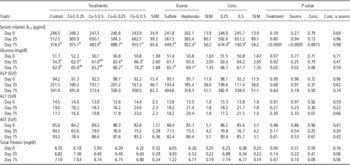
Serum vitamin B12, glucose and other biochemical parameters are presented in Table 3. Although the differences between individual treatments were not statistically significant on day 35, on day 75, individual treatment and factorial differences between Co-G and Co-S supplements were more pronounced as the two Co-G treatments regardless of concentration had greater serum vitamin B12 concentrations (P<0.0001). The factorial effect of source and concentration of Co were both significant on day 75 as the Co-G source and greater concentration of Co supplementation (0.5) led to greater vitamin B12 values (P<0.05). In general Co glucoheptonate supplements were more effective in increasing serum vitamin B12 levels. There were no significant interactions between concentration and source of Co.
Effects of dietary Co source and concentration on serum vitamin B12, glucose, alkaline phosphatase (ALP), aspartate transaminase (AST), alanine transaminase (ALT) and total protein in goat kids

Co-S=cobalt sulfate; Co-G=cobalt glucoheptonate; Conc.=concentration (mg/kg dry matter).
a,bMeans with different superscript letters in rows are significantly different, P<0.05.
Co supplementation increased serum glucose concentrations. On day 35, individual Co-supplemented treatments had higher (P<0.05) glucose levels as compared with control, with the exception of the 0.5 Co-S treatment. However, the factorial comparison between sources (Co-G v. Co-S) and concentrations (0.25 v. 0.5) of Co was not significant. This trend continued toward day 75 with the exception of sulfate treatments. On day 75, Co glucoheptonate individual treatments had greater glucose concentrations as compared with control (P<0.05). The factorial effect of concentration was not significant on serum glucose levels during the trial. Hematological parameters (data not presented), ALP, ALT, AST and TP were not affected by Co supplements throughout the trial.
Ruminal volatile fatty acids
Ruminal VFA concentrations are presented in Table 4. Propionic+iso-butyric acid concentrations increased with Co supplementation. The only individual treatment that differed significantly with control was the 0.5 mg Co glucoheptonate treatment (P<0.05). Although the factorial effect of Co source was not significant, the greater concentration of Co led to greater amounts of propionic+iso-butyric acid (P<0.05). Butyric, acetic, valeric and iso-valeric acids did not follow the same trend as above, as none of them were affected by Co supplementation.
Effects of dietary Co source and concentration on volatile fatty acids in the ruminal fluid of goat kids

Co-S=cobalt sulfate; Co-G=cobalt glucoheptonate; Conc.=concentration (mg/kg dry matter).
a,bMeans with different superscript letters in rows are significantly different, P<0.05.
1 Mean values pertaining to mean of days 35 and 75.
Discussion
Performance
In accordance to our results, Johnson et al. (Reference Johnson, Al-Habsi, Kaplan, Srikandakumar, Kadim, Annamalai, Al-Busaidy and Mahgoub2004) reported increased growth rates in Co-supplemented Omani goats receiving a basal diet of <0.1 mg Co/kg DM. Similarly, Bishehsari et al. (Reference Bishehsari, Tabatabaei, Aliarabi, Alipour, Zamani and Ahmadi2010) observed greater performance parameters in Co-supplemented lambs receiving a basal diet containing 0.088 mg Co/kg DM. Tiffany et al. (Reference Tiffany, Spears, Xi and Valdez2002) also reported better intake, ADG and gain efficiency in Co-supplemented steers receiving a moderately Co-deficient diet of 0.04 to 0.05 mg/kg DM. However, contrary to our results, Johnson et al. (Reference Johnson, Al-Habsi, Kaplan, Srikandakumar, Kadim, Annamalai, Al-Busaidy and Mahgoub2004) also reported physiological symptoms of Co deficiency in Omani goats receiving only the basal diet of <0.1 mg Co/kg DM. Based on the non-significant differences between treatments and control for serum liver enzymes ALP, AST and ALT and also blood hematological parameters (data not presented) in our study, it is clear that the goat kids in our study were not Co deficient. Anemia, inappetence, poor production and weight loss have been attributed to Co and consequently vitamin B12 deficiency (Ulvund and Pestalozzi, Reference Ulvund and Pestalozzi1989; Vellema et al., Reference Vellema, Rutten, Hoek, Moll and Wentink1996), clinical and physiological signs that were not observed in our study. Therefore, we could say that we observed the effects of Co supplementation in excess of requirements to Co adequate (or perhaps Co marginal) goat kids.
There have been reports of increased nutrient digestibility in Co/vitamin B12-supplemented goats (Kadim et al., Reference Kadim, Johnson, Mahgoub, Srikandakumar, Al-Ajmi, Ritchie, Annamalai and Al-Halhali2003) and lambs (Wang et al., Reference Wang, Kong, Zhang, Zhu and Jia2007; Bishehsari et al., Reference Bishehsari, Tabatabaei, Aliarabi, Alipour, Zamani and Ahmadi2010). Increased nutrient digestibility leads to improved performance in Co-supplemented animals. There are several underlying causes described for this effect. Diets deficient in Co reduce the number of rumen microorganisms (Gall et al., Reference Gall, Smith, Becker, Stark and Loosli1949; Marston and Lee, Reference Marston and Lee1952; Marston and Smith, Reference Marston and Smith1952) which in turn leads to lower rumen digestibility (Kadim et al., Reference Kadim, Johnson, Mahgoub, Srikandakumar, Al-Ajmi, Ritchie, Annamalai and Al-Halhali2003). Pond et al. (Reference Pond, Church and Pond1995) demonstrated that vitamin B12 deficiency causes a shortening of the intestinal villi in animals. The two vitamin B12-dependent enzymes, methylmalonyl CoA mutase and methionine synthase are likely to be involved in increased or decreased nutrient digestibility rates (Kennedy et al., Reference Kennedy, Blanchflower, Scott, Weir, Molloy, Kennedy and Young1992) as these enzymes are important for protein and energy metabolism. Furthermore, vitamin B12 is closely linked with folacin in the synthesis of methionine in both bacterial and animal cells (Pond et al., Reference Pond, Church and Pond1995). In addition to these factors, it has been shown that divalent cations such as Co may act as a bridge between the bacteria and plant cell walls, both of which tend to be negatively charged (Lopez-Guisa and Satter, Reference Lopez-Guisa and Satter1992), and serve as a link between the two negatively charged surfaces (Somers, Reference Somers1973). Therefore, the increased performance in 0.5 mg Co/kg DM groups (Co-G and Co-S) may have been an added effect of Co due to better ruminal performance.
Serum biochemical parameters
In ruminants, the efficiency of vitamin B12 production from supplementary Co is low, only about 3% (Smith and Marston, Reference Smith and Loosli1970). There have been few reports of comparisons between different sources of Co in animal studies. The carbonate, chloride, sulfate, nitrate and glucoheptonate forms of Co have been indicated to be effective supplemental sources of Co for ruminants but these are not always supported by comparative data (Henry, Reference Henry1995). The increase in Vitamin B12 from day 0 to day 35 in the control group, is believed to be related to the previous diet the goats had received before the onset of the study, which probably had been Co deficient. The greater vitamin B12 values observed in the Co glucoheptonate treatments in our study demonstrates that this source of Co may be more available to ruminal metabolism of vitamin B12. In general, Co-S treatments did not differ significantly from the control group which proves our hypothesis that the Co glucoheptonate treatment is more available to rumen microorganisms.
The differences observed for serum glucose levels in this study are in agreement with reports of glucose levels in lambs (Bishehsari et al., Reference Bishehsari, Tabatabaei, Aliarabi, Alipour, Zamani and Ahmadi2010) and steers (Tiffany and Spears, Reference Tiffany and Spears2005). Propionate is a major precursor of glucose in ruminants, and as previously reported (Kennedy et al., Reference Kennedy, Young, McCaughey, Kennedy and Blanchflower1991), Co-deficient diets in sheep caused a dramatic increase in ruminal succinate and decrease in propionate concentrations. Lower propionate concentrations can lead to lower blood glucose levels (Bishehsari et al., Reference Bishehsari, Tabatabaei, Aliarabi, Alipour, Zamani and Ahmadi2010). In the present study, contrary to Bishehsari et al. (Reference Bishehsari, Tabatabaei, Aliarabi, Alipour, Zamani and Ahmadi2010), blood glucose levels did not differ significantly with the control in the Co sulfate treatments. We speculate that the main reason for this may be that Co-S was not as efficient as the Co-G source in affecting rumen metabolism. It has been suggested that goats are less susceptible to low levels of dietary Co as compared with sheep (Mburu et al., Reference Mburu, Kamau and Badamana1992). Based on our results, we may conclude that the difference in results observed in our study with that of Bishehsari et al. (Reference Bishehsari, Tabatabaei, Aliarabi, Alipour, Zamani and Ahmadi2010) came down to some factors such as difference in livestock, lambs v. goats, or in the diet.
There were no significant differences for serum ALP and AST values between treatments. Johnson et al. (Reference Johnson, Al-Habsi, Kaplan, Srikandakumar, Kadim, Annamalai, Al-Busaidy and Mahgoub2004) reported increased ALP levels in Co-deprived Omani goats. The elevation of ALP has been reported as a sign of chronic liver disease, hepatic fibrosis, cholangitis, obstruction, cholestasis and most commonly with hepatic lipidosis (MacPherson et al., Reference MacPherson, Moon and Voss1976; Kramer and Hoffmann, Reference Kramer and Hoffmann1997; Johnson et al., Reference Johnson, Al-Habsi, Kaplan, Srikandakumar, Kadim, Annamalai, Al-Busaidy and Mahgoub2004). Therefore, goat kids in the present study received adequate amounts of Co from the basal diet to prevent liver damages. Vitamin B12 plays a significant role in overall protein metabolism and low vitamin B12 synthesis could lead to serum protein deficiency (Johnson et al., Reference Johnson, Al-Habsi, Kaplan, Srikandakumar, Kadim, Annamalai, Al-Busaidy and Mahgoub2004). However, in the present study, Co supplementation and the increase in vitamin B12 did not directly influence protein synthesis. So it seems the concentration of Co in the basal diet was adequate in preventing hepatic lipidosis which results in impaired protein metabolism.
Ruminal volatile fatty acids
Glucose is absorbed in little amounts from the digestive tract of sheep in its intact form (Roe et al., Reference Roe, Bergman and Kon1966). As a result, the animal is dependent on gluconeogenesis for much of its glucose supply. Propionic acid is the sole gluconeogenic VFA formed in the rumen which is absorbed and metabolized into succinate by a series of reactions (which mainly take place in the rumen). One of these reactions is catalyzed by methylmalonyl CoA mutase, a vitamin B12-dependent enzyme (Kennedy et al., Reference Kennedy, Young, McCaughey, Kennedy and Blanchflower1991). Therefore, in the present study, Co supplementation altered ruminal VFA concentrations, benefiting propionic acid (Table 4) and vitamin B12 (Table 3) production by the microbial population, which in turn led to the increase in serum glucose concentration in Co-supplemented groups (Table 3).
Although goats are not as sensitive to low levels of Co in the diet as sheep, we hypothesized that Co supplementation in excess of NRC recommendations may be beneficial to the animal. We also compared two sources of Co (Co glucoheptonate v. Co sulfate) at two concentrations (0.25 v. 0.5 mg Co/kg DM) to better understand the difference in these sources. Based on results obtained for Vitamin B12 and Glucose, both having levels higher than normal, we concluded that the goats in our study were not Co deficient during the trials. However, considering the elevated levels of those said parameters in the Co-treated kids, and also the increased performance of treated groups, we have come to the conclusion that higher levels of Co than those recommended by the NRC (2007) can prove beneficial to the animal. Our results suggest that, despite the two sources of Co proving mostly similar, the main advantage of Co glucoheptonate compared with Co sulfate was in the ruminal synthesis of vitamin B12. The overall data obtained by comparing the Co treatments shows that the concentration of 0.076 mg Co/kg DM of the basal diet seems to be marginally adequate for goats and the animals could benefit from additional Co. Nevertheless, although NRC recommendations maintained vitamin B12 levels above or at normal concentrations, Co supplementation to the Co sufficient basal diet increased vitamin B12 and glucose concentrations.
Acknowledgments
The authors would like to thank Bu-Ali Sina University for funding this study and providing the necessary financial and instrumental support along the way. The authors would also like to express their gratitude to Dr Khaled Qasem (Zinpro Corp.) and Dr Amir Hamidi (Yasna Mehr Pvt.) for providing us with the Co glucoheptonate required for our study. A special thanks also goes out to Dr Aliasghar Bahari (Bu-Ali Sina University) who provided veterinary supervision and support throughout the study. Neither of the authors are in conflicts of interest with the companies or individuals who supplied the initial requirements.