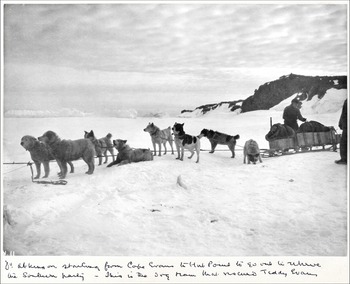
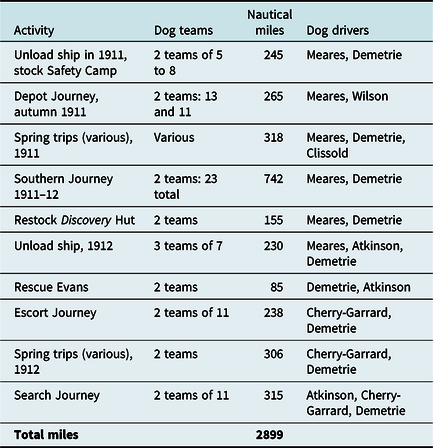
Introduction
This article tells the story of the dog teams of the British Antarctic Expedition 1910–13 (BAE) – their procurement, training, dog handling practices, major journeys, plans and instructions. Its purpose is to establish an accurate record of sledge dog involvement in the BAE. It is not concerned with hypotheses about how a better outcome for the BAE might have been achieved, aiming simply to assemble and analyse verifiable evidence in chronological order. It does not seek to apportion responsibility or blame to any individual expedition member, although it does identify actions by Scott, Evans, Simpson, Atkinson and Meares that in hindsight could be seen as questionable.
A substantial amount of research has been undertaken. Straightforward details have been summarised in tabular form as an accessible reference source for future work. Two appendices have been included as Supplementary Material, providing additional detail about several events in January–March 1912, without submerging the dogs’ story in abstruse details. A literature review has been undertaken, finding that none of the reviewed works accurately traces the evolving plans and instructions for the dog teams. This is disappointing as the question of dog team management is central to Scott’s wider reputation.
Cecil Meares, the in charge of dog transport, left no journal and very few letters. Material for this article comes from many primary sources. The journal of Doctor Edward Wilson (Wilson, Reference Wilson and King1972) is the primary source for the Depot Journey, on which he was a dog driver. Original information about dog teams on the main Southern Journey comes from the journal of James Dennistoun, who recorded Meares’ remarks as they travelled back from the Antarctic together (Dennistoun, Reference Dennistoun1912). The primary source for the Escort Journey is the 24 February–24 April 1912 sledging journal of Apsley Cherry-Garrard (Cherry-Garrard, Reference Cherry-Garrard1912c).
Much has been written about Scott and his men; far less has been written about the BAE dog teams. This article addresses that disparity. It has clear time boundaries, starting with Scott’s September 1909 public fundraising prospectus and finishing with the Terra Nova leaving the Antarctic in January 1913.
In summary, the dog teams and their handlers performed well in the Antarctic, successfully completing three of their four main journeys. They made a substantial contribution to the expedition.
To retain integrity with primary documents, this article uses imperial weights and measures, including nautical (geographic) miles, as used by the BAE men.
Literature review
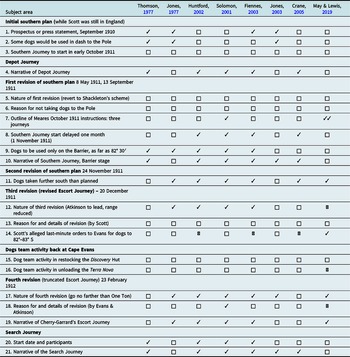
Eight texts have been reviewed against 21 subject areas to identify which elements of the plans and instructions for BAE dog teams have been addressed in each text. Results are shown in tabular form (Table 1) to facilitate comparison between texts as well as identifying the subject areas that are most commonly included and those frequently omitted or overlooked.
Literature review – plans and instructions for BAE dog teams

Legend: ✓ Text aligns with this article; ✓✓ Text exceeds detail of this article; □ Not addressed by the text; ✗ Not supported by this article.
The review is structured around the evolution of BAE Dog Party plans and is high level in nature. A tick in Table 1 indicates the writer has provided at least partial coverage of the subject area. There is a wide variation between texts in their depth of coverage.
The main findings are as follows:
-
The storylines of the Depot Journey, the Southern Journey (as per Scott’s first and second revisions), the Escort Journey (as per the fourth revision) and the Search Journey are covered by most writers, in varying levels of detail.
-
The fact that Scott initially planned to take dogs to the Pole was recorded by only three writers, Thomson (Reference Thomson1977, p. 219), Jones (Reference Jones1977, p. 263) and Jones (Reference Jones2003, p. 90). Several writers commented on the start of the Southern Journey being delayed because of concerns about the ponies’ hardiness, but none investigated Scott’s intended departure date (approximately 1 October 1911).
-
None of the writers investigated the reason(s) for Scott abandoning the idea of taking dogs to the Pole.
-
Only Solomon (Reference Solomon2001, p. 169) and May and Lewis (Reference May and Lewis2019, pp. 6–10) discuss Scott’s October 1911 instructions to Meares about three dog journeys. May and Lewis cover this subject area in detail.
-
Most writers mentioned the third revision (Atkinson to lead a reduced range journey to meet Scott’s returning Polar Party) but none investigated the rationale for the revision, the journey’s intended duration or meeting place.
-
None of the writers investigated dog team activities at base between their return from the Southern Journey and their departure on the Escort Journey. May and Lewis (Reference May and Lewis2019, p. 6) challenged the need for dogs to be involved in “inessential duties” such as unloading the ship.
-
Solomon (Reference Solomon2001, p. 250) and May and Lewis (Reference May and Lewis2019, pp. 7–10) are the only writers to investigate the reason for the fourth revision (truncation of the Escort Journey).
-
Huntford (Reference Huntford2002, p. 457, 520), Fiennes (Reference Fiennes2003, p. 308, 341) and Crane (Reference Crane2005, p. 497) all record, without citing any source, an erroneous idea that Scott gave last-minute orders to Lieutenant Edward Evans for the dogs to meet the returning Polar Party between 82° and 83° south (see Supplementary Material, Appendix A, “Scott’s last-minute verbal orders to Evans”). May and Lewis (Reference May and Lewis2019, p. 4) correctly identify this as an error.
This article contains few direct references to the eight texts, relying instead on evidence from primary sources wherever possible.
The recent article by Karen May and George Lewis (May & Lewis, Reference May and Lewis2019) touches on several matters covered in this article. As noted in “Introduction”, the purpose of this article is to tell the story of the BAE dog teams. It is not the purpose of this article to challenge the May-Lewis article, other than to highlight discrepancies between their article and evidence from primary sources cited in this article.
Scott’s initial plan: dog transport to the Pole
Upon his return to Britain in July 1909, Ernest Shackleton, whom Captain Robert Falcon Scott and his mentor Sir Clements Markham saw as a rival, became a popular hero. Shackleton had three Antarctic achievements to his name:
-
A new “farthest south”,
-
Location of the South Magnetic Pole and
-
Ascent of Mount Erebus.
Scott was already well advanced in preparing for his second Antarctic expedition. If he could reach the South Geographic Pole, that would be a crowning achievement to eclipse Shackleton. The expedition was backed and part-funded by the Royal Geographic Society and was to be led by Scott. Its public fundraising prospectus Antarctic Expedition for 1910, dated 15 September 1909, stated:
The main object of this expedition is to reach the South Pole, and to secure for the British Empire the honour of that achievement. (Scott, Reference Scott1909, p. 2)
On page 5 (of 6), the prospectus briefly identified several scientific objectives, secondary to the goal of reaching the Pole. Scott later explained to expedition members his rationale for downplaying science:
[T]he Scientific public as well as the more general public will gauge the “result” of the scientific work of the expedition largely in accordance with the success or failure of the main object. With success, all roads will be made easy; all work will receive its proper consideration. With failure, even the most brilliant work may be neglected and forgotten, at least for a time. (Scott, Reference Scott1911, p. 1)
Scott recognised that transport was the most important problem to be solved in attaining the Pole and provided a broad description of his scheme of advance:
The problem of reaching the South Pole from a wintering station is a problem of transport [emphasis added]. The distance to be covered, there and back, is about 1500 miles; the time at disposal in a single season is about 150 travelling days. An average of 10 miles per day can be easily maintained by men, provided adequate transport arrangements are made. […] Dogs, if not overladen, could be used for [Beardmore] glacier work, and might travel the whole distance to the Pole if properly husbanded by being lightly laden and well fed on the lower plateau. (Scott, Reference Scott1909, p. 3)
[P]onies will be taken in sufficient numbers to ensure a thoroughly adequate amount of food being taken to the base of the Glacier. A dog team with a relay of men will transport the loads over the Glacier surface, and a picked party of men and dogs will make the final dash across the inland ice sheet. (Scott, Reference Scott1909, p. 5)
Many national newspapers published these statements verbatim, for example, The Globe, 13 September 1909.
Scott had used Western Siberian dogs for his 1901–04 British National Antarctic Expedition (BNAE). He did not take any experienced dog handlers, relying instead on ad hoc decision making by various naval officers, concerning dog team organisation, driving practices, human–animal (master–servant) matters and dog nutrition. This approach initially met with limited success, “During the early days at Hut Point the Discovery dogs proved disappointing but not hopeless” (Fiennes, Reference Fiennes2003, p. 65). For the BNAE’s southern journey, the three men took an unusual approach by hitching a single team of 18 dogs (initially 19) to 5 sledges in a single chain. It became apparent Scott had been poorly advised about dog nutrition. The dogs became debilitated over time, and near the end of the return trip Scott wrote, “We dropped all the dogs out of the traces and pulled steadily ourselves […]. The rest of the animals walked pretty steadily alongside the sledges. It is a queer ending for our team; I do not suppose they will ever go into harness again, unless it is to help them along” (Scott, Reference Scott2009, 7 January 1903).
Presumably, Scott read Carsten Borchgrevink’s 1901 book “First on the Antarctic Continent”, which described the roles of his two Sami (Finnish) dog handlers. Bernacchi, who had been south with Borchgrevink, may have spoken with Scott about Sami dog driving methods, leading to a trial of different dog driving methods (Scott, Reference Scott2009, 18 February 1902). Perhaps the result motivated Scott to seek an experienced dog handler for his second expedition. He was most likely seeking expertise in dog team organisation and dog nutrition, both significant weaknesses in the BNAE.
Scott met Meares in September 1909 and hired him within three months (The Press (Christchurch), 16 September 1910). At that time, both men apparently thought it would be a one-man job to purchase about 50 animals in Siberia and transport them to New Zealand, but within six months, four men were involved in animal management. We have no information about Meares’ involvement (if any) in expedition planning. No information has survived about why Scott and Meares settled on 30 sledge dogs – in hindsight an inadequate number to meet the declared intention of using dog transport to the Pole.
Although Meares’ terms-of-engagement are not known, his later responses to reporters are illuminating: “Mr Meares will have control of them [the dogs] throughout, and will accompany the party on the dash to the pole” (Lyttleton Times, 16 September 1910) and, “They [the ponies] will take no part in the dash to the pole. That is where the dogs come in” (New Zealand Times (Auckland), 15 September 1910).
Scott presented a later version of his plan to a meeting of the Royal Institution on 27 May 1910. He emphasised the uncertainties surrounding such plans and the likelihood of revision as events unfold. Sufficient men and provisions would be taken in order to avoid the food shortages experienced by Shackleton’s southern party. He identified an autumn depot journey commencing in the third week of January 1911, with the idea of spending 60–70 days establishing depots for a southern journey.
[H]e did not propose to start upon the Southern Journey until the month of October. That month and the following would be spent traversing the Ross Ice Shelf [‘Barrier’] and ascending the glacier. He hoped to reach the upper plateau fairly early in December. An ideal day for reaching the South Pole would be the 22nd of that month [summer solstice]. (The Times, 28 May, 1910)
Small support parties would progressively return to base after completing their work of establishing depots for returning parties.
It is not known whether Scott intended to bring the dogs back from the Pole, but Meares commented wryly, “What is done with the last remaining dog may depend upon the extent of the commissariat of the sledge party. They may have to eat him” (New Zealand Herald (Auckland), 15 September 1910).
The Siberian Husky
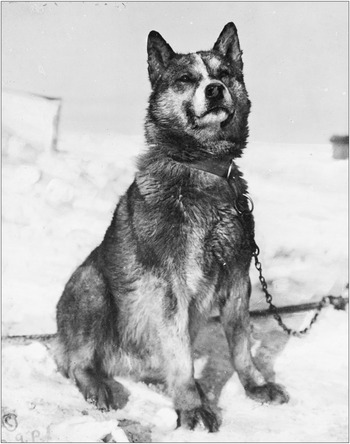
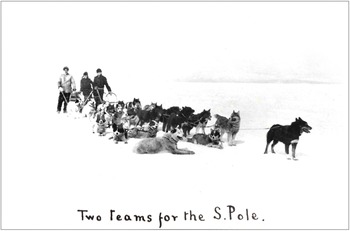
In January 1910, Cecil Meares travelled to Eastern Siberia to procure dogs and ponies. He purchased local working sledge dogs that would today be classified as “Siberian Husky”, distinct from the other formally recognised breeds of sledge dog such as Samoyed, Alaskan Malamute and Greenland Dog. Meares called them “Gilyak”. Krisarovitsa (Fig. 1) was assessed as being “purer to type than the rest” (Ponting, Reference Ponting1949, p. 178).
Krisarovitsa (Chris), one of the dogs. Photographer H. Ponting. Retrieved from the Library of Congress, https://www.loc.gov/item/90709437/.
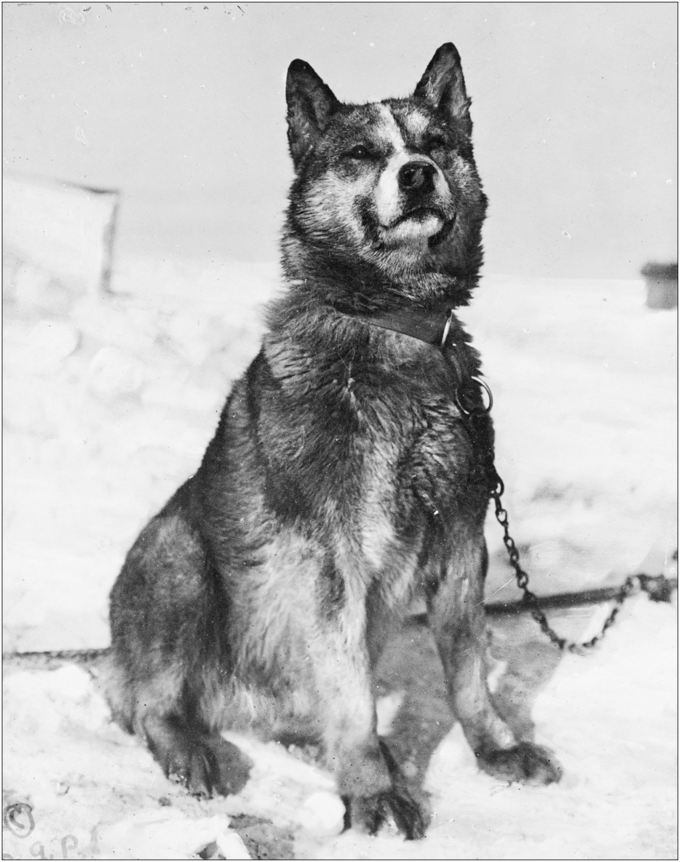
Meares’ dogs match modern-day descriptions of the Siberian Husky. The following paragraphs are based on a typical dog-enthusiast website (“Siberian Husky Dog Breed Information and Personality Traits”, n.d.).
The wolf-like Siberian Husky is a medium-sized dog, slightly longer than tall. Males range from 20 to 23.5 inches in height and weight from 45 to 60 pounds. It has erect ears and eyes of brown to blue or maybe even one of each colour. The neck is carried straight and the top-line is level. The well-furred tail is carried up in a sickle or sometimes straight out behind. They are classic northern dogs, intelligent and somewhat independent and stubborn. They are very alert and have a strong sense of freedom. They tend not to bark but do howl a lot.
These are dogs bred to run, and their love of running may override their love for their handler at times. Several photographs in this article show handlers holding the sledge in case of unexpected departure.
Siberians Huskies are social creatures. Their social system is a pack with a well-defined pecking order. The leader of the pack is the alpha dog or top dog. The leader gets to go first in everything, and other dogs respect the leader’s wishes. The driver must gain the respect of the pack. [If Scott had appreciated from the outset the importance of the social system then the Discovery expedition’s dog handling may have been more successful.]
Siberian Huskies have a high prey drive, often hunting and pulling down other animals. Meares’ dogs pulled down and nearly killed a horse near Nikolayevsk (Evans, Reference Evans1961, p. 27). They enjoyed chasing and attacking seals that crossed their path and consumed Adelie penguins whenever permitted. Meares’ team attacked the fallen pony Weary Willy on the Depot Journey (Scott, Reference Scott and Jones2006, p. 123).
Retired Colonel Henry Lyons, Chair of the Committee for the Publication of the Scientific Results, recorded “The average working dog with the Expedition weighed 60–70 lbs, but some of the bigger dogs weighed as much as 80-90 lbs” (Lyons, Reference Lyons1924, p. 61), presumably referring to the two ex-Peary Greenland Dogs. Meares apparently selected the largest Siberian Huskies from those available, in the interest of building the strongest possible teams.
Amundsen later spoke to reporters about his Greenland dogs, “They are fine animals. I have never used any other kind, but I believe, from what I have heard that the Siberian dogs are also excellent animals. They should be just as good as the Greenland dogs” (The Press, 27 April 1912). What Amundsen did not mention is that the typical Greenland Dog is significantly heavier than the Siberian Husky and has proportionately more pulling power.
Acquisition and training of sledge dogs: 1910
Meares travelled to Nikolayevsk to acquire Siberian dogs. Fortunately, he was a seasoned traveller, with proficiency in the Russian language. He was experienced in hiring and driving teams of dogs in cold climates, including the Russian sub-Arctic winter. He was therefore able to assess a dog’s pulling power, speed and manageability, but not necessarily competent in dog team training and dog nutrition, as noted below.
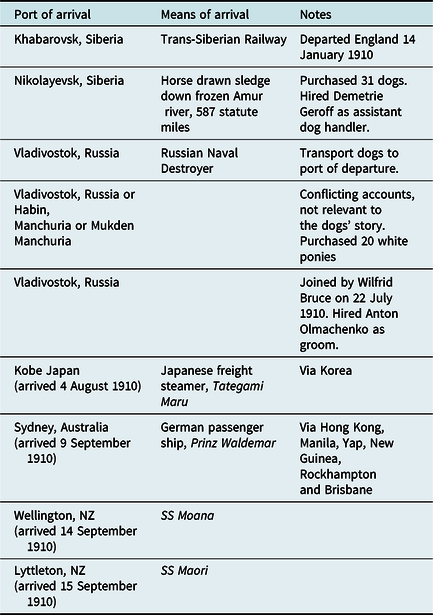
His nine-month trip to acquire and deliver the dogs and ponies is summarised in Table 2, derived from Wilfrid Bruce’s Blue Peter article (Bruce, Reference Bruce1932/2012) and Evans’ South with Scott (Evans, Reference Evans1961).
Procurement of Siberian dogs and ponies in 1910

Meares selected Siberian Huskies from the region of the Amur River estuary. The dogs were accustomed to sledge work in the winter mail service,
In Siberia, the mail-dog teams do about 50 miles a day for 6 days, then spell for day or two and start home again. Carrying about 50 lbs per dog including driver – 13 in team – they know the road, and houses and villages along route gives them interest and cheers them on. (Dennistoun, Reference Dennistoun1912, p. 260)
The mailmen rode astride the sledges because running alongside would be equivalent to running almost two full marathons every day, wearing cold weather clothing. They travelled along marked trails, without any risk of crevasses. They probably stopped overnight at a local guesthouse and so had no need to carry tents and food.
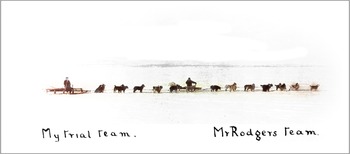
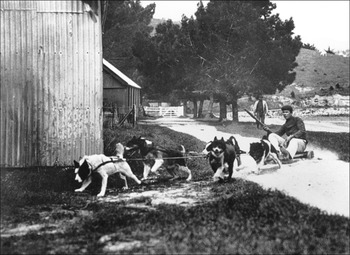
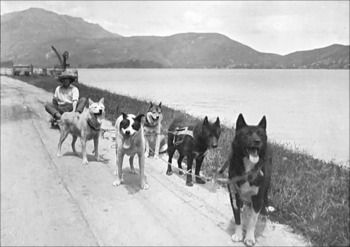
Meares worked closely with Mr Rogers, the English local manager of the Russo-Chinese Bank, to select the dogs (Evans, Reference Evans1961, p. 27). Both men drove trial teams, as shown in Figures 2 and 3. Meares wrote to his father on 18 March 1910:
I have been kept very busy collecting dogs, trying teams and picking out one or two dogs and making up a team and trying it on a run of 100 miles and throwing out the dogs which do not come up to the mark and collecting others. (Meares, Reference Meares1910)
Testing two dog teams in Siberia, a process repeated several times. Image courtesy of British Columbia Archives, Meares fonds, sub-series MS-0455.E.

Some of the dogs selected as suitable to travel to the South Pole. Image courtesy of British Columbia Archives, Meares fonds, sub-series MS-0455.E.

During the winter working season, the dogs were usually fed on dried salmon. Meares had replaced this with a diet of Spratt dog biscuits, in a quantity suitable for idle dogs, by the time they reached New Zealand (New Zealand Times, 15 September 1910).
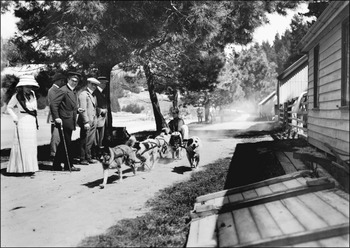
No animals died during the voyage from Vladivostok to New Zealand. Meares arrived in Lyttleton on 15 September 1910 with 31 Siberian Huskies (all male, aged 18–30 months) and 19 ponies (Otago Daily Times (Dunedin), 15 September 1910). He brought two young Russians – Demetrie Geroff (hereafter “Demetrie”, his preferred spelling) as assistant dog handler and Anton Omelchenko as groom. The animals were housed in the Quarantine Station on Quail Island in Lyttleton Harbour, where Demetrie commenced dog training (Fig. 4) well before Scott arrived. The local newspaper reported:
A small sledge, running partly on two wheels, has been made for exercising the dogs. … Armed with a heavy pole, shod with iron and a stout spike at one end, Demetri [sic] seats himself on the sledge and immediately he gives an order in some unintelligible monosyllable the dogs dash off at full speed. The pole appears to be used principally as a brake, and to some extent as a steering agent, […] Directions shouted repeatedly, and stones thrown accurately, appear to be the proper substitute for reins in guiding a sledge team. The dogs pulled fiercely, turning corners and passing over inequalities with an entire disregard of the feelings of the man seated upon the little sledge. (Lyttleton Times, 26 October 1910)
Demetrie training dogs on Quail Island (The Weekly Press (Christchurch)). Unpublished image courtesy of Stuff/Weekly Press Collection.

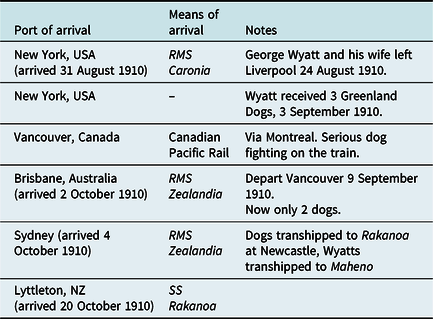
Scott had an amiable relationship with Robert E Peary, the American Arctic explorer. It was arranged for George Borup (Peary’s youngest expedition member) to meet the BAE’s Business Manager, George Wyatt, in America to hand over three of Peary’s young Greenland Dogs. Table 3 summarises the journey. BAE men named the two surviving dogs “Peary” and “Borup” (later “Cook”). During the winter and spring of 1911, Thomas Clissold managed these dogs, which Meares had pronounced “useless” (Scott, Reference Scott and Jones2006, p. 267), but they were later taken on the Southern Journey. The Siberian dogs disliked the Greenland dogs (Clissold, Reference Clissold1961).
Procurement of “Peary” dogs

The Terra Nova arrived in Lyttleton on 28 October 1910. Meares signed the expedition’s Agreement and Account of Crew document (Board of Trade, 1910) that day in the capacity of “Midn” [presumably Midshipman] at an annual salary of 250 pounds.
Several Samoyed dogs, descendants from Nansen’s 1895 Farthest North expedition, arrived in the Terra Nova (New Zealand Times, 15 September 1910). It was apparent that the Samoyeds were not as robust as Meares’ Siberian dogs and might not be accepted by them nor be fit for the rough times ahead. The Samoyeds were all given away as pets in Christchurch.
Scott visited Quail Island to see his dogs and ponies in action (Fig. 5), commenting on 31 October 1910, “I was exceedingly pleased with both horses and dogs. They are the finest set of animals ever got together for South Polar work” (New Zealand Herald, 1 November 1910). The sight of dogs in action moved Scott to write to Nansen, “As to the travelling, we might have improved matters by having more dogs and fewer ponies – it is difficult to say. The animals we have are splendid and all in good condition” (Scott, Reference Scott1910). Unfortunately, it was now too late to act upon afterthoughts.
Demonstration of dogs on Quail Island. (L-R) Kathleen Scott, unknown (behind), Scott, Oates, Meares and Demetrie. (The Weekly Press, 9 November 1910, p24), Image courtesy of Stuff/Weekly Press Collection.

A collie bitch “Lassie” was acquired in Christchurch and was housed in the crew’s quarters during the southern voyage, presumably as a pet, not a future sledge dog. In the Antarctic, she proved to be a poor mother when her first litter all died of her carelessness and neglect (Evans, Reference Evans1961, p. 126). Lassie brought the total to 34 dogs.
The Terra Nova left New Zealand for Antarctica on 29 November 1910. During a severe storm, one dog and two ponies died. The ship arrived at Ross Island on 4 January 1911. At this stage, Scott was still intending to take dogs to the Pole, as evidenced by what Wilson wrote on 14 January 1911,
He [Scott] wants me to be a dog driver with himself, Meares, and Teddie [sic] Evans, […] Moreover, if any traction except ourselves can reach the top of Beardmore Glacier it will be the dogs, and the dog drivers are therefore the people who will have the best chance of doing the top piece of the ice cap at 10,000 feet to the Pole. May I be there! (Wilson, Reference Wilson and King1972, p. 95)
Dogs on the Depot Journey: early 1911
The Depot Journey commenced on 24 January 1911, with 12 men, 8 ponies and 24 dogs (Hooper, Reference Hooper1912a, p. 9). The main objective was to advance the greatest weight of stores possible, as far as possible, ideally to at least 80° south. A second objective was to identify improvements to Scott’s plans for the coming Southern Journey.
The best 24 sledge dogs were selected from the 32 available. Meares recommended that the rejected dogs be destroyed, following conventional wisdom that working animals no longer earning their keep should be disposed of. Scott apparently had different ideas, transferring the rejected dogs to Clissold’s care (Clissold, Reference Clissold1961). Some of these dogs were subsequently deployed on the Southern Journey.
Scott’s “naval armada” organisation model for the Depot Journey, with all transport resources travelling the same route at the same time for the same daily mileage, had the virtues of simplicity of navigation and simplicity of control. The downside was that the weakest animals dictated the daily achievements of all, meaning that the better animals were underutilised and the Depot Party could not achieve its full potential. Even though dogs could operate in harsher conditions than ponies, that potential was wasted.
Dog drivers were Meares and Wilson, assisted by Scott and Evans, with teams of 13 and 11 dogs, respectively. Demetrie, the most experienced dog handler, was surprisingly omitted from the Depot Party.
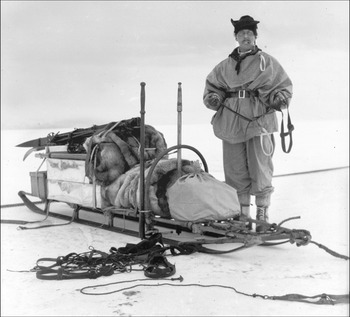
Scott had expected Meares to establish sound dog management practices and appropriate dog nutrition for hard-working animals in Antarctic conditions. For the Depot Journey, there was no pressure to follow the dog management practices of the Discovery expedition. Dog driving followed the orthodox Siberian pattern. The drivers sat astride or ran alongside the sledge, keeping contact via the hooped grab-handle. Verbal (Russian) commands were used and the whip was used only to break up fights. A stout five-foot driving stick (chui stick) was used to anchor the sledge when necessary and to act as a brake or limited steering device when in motion. Dog sledges were of the Nansen design (Lyons, Reference Lyons1924, p. 38), modified by addition of a cane grab-handle and grommets for the chui stick, as per the orthodox Siberian pattern. Figure 6 shows some details of a BAE dog sledge, including a second chui stick which was required at end of day – one stick to anchor the sledge and one to anchor the lead-dog end of the trace, keeping the dogs from wandering off or fighting the other team. [It may be noted that Amundsen used Nansen sledges, but without addition of the grab-handle, the grommets or chui sticks.]
Meares with a dog sledge. Photographer H Ponting/ Popperfoto image 79053664 via Getty images.

The dogs started with a total load of 977 pounds, (including sledges) plus drivers (Scott, Reference Scott and Jones2006, p. 106). This was increased after four days to 1400 pounds, plus sledges and drivers (Scott, Reference Scott and Jones2006, p. 110) which comes to about 75 pounds per dog, or about 50% more than Siberian mail-service workloads. Seemingly, Scott was increasing the dogs’ loads to relieve the ponies.
After starting the journey, Wilson happily recorded, “Dog driving like this in the orthodox [Siberian] manner is a very different thing to the beastly dog driving we perpetrated in the Discovery days” (Wilson, Reference Wilson and King1972, p. 100).
Evans wrote, “I never saw anybody less vicious than “Mother” Meares: he never knocked the dogs about unless it was absolutely necessary” (Evans, Reference Evans1961, p. 72).
Scott was initially sceptical about the dogs, “but certainly also the dogs will not pull heavy loads” (Scott, Reference Scott and Jones2006, p. 107). He became more trusting as the dogs increased in fitness, “The dogs are doing excellently – getting into better condition every day” (p. 109), and later “The way in which they keep up a steady jog trot for hour after hour is wonderful” (p. 129).
They reached 79° 29′ and established One Ton Depot on 17 February 1911, 31 miles short of the 80° target. They had averaged 7.5 miles per day over the 113 miles from Safety Camp to One Ton. As noted in “Scott’s initial plan: dog transport to the Pole” (above), a daily average of at least 10 miles per day, including non-travelling days, would be required on the Southern Journey.
Mediocre daily mileage was caused by several factors:
-
The weakest ponies had been included,
-
Only three weeks had been available for the ponies to acclimatise – they still had summer coats, not their shaggy winter coats, suffering terribly,
-
Captain Lawrence Oates, in charge of pony transport, did not believe in pony snow shoes so only one set was taken,
-
There was a mistaken reliance on the Geelong compressed chaff fodder, which had inadequate calorific value for animals working under such conditions. (Wilson, Reference Wilson and King1972, p. 104; Dennistoun, Reference Dennistoun1912, p. 241)
At no point were dogs recorded as a limiting factor. They delayed their departure for 1–2 hours every morning and always caught up with the ponies by end of day. It may be noted that Amundsen used dogs to place three tons of supplies across depots at 80°, 81° and 82° in the same season. His party comprised 8 men (all competent dog handlers), 7 sledges and 42 dogs.
By mid-February 1911, the returning Depot Party was divided, with four groups travelling independently back to Hut Point with either disabled men or disabled ponies. Six of the eight ponies perished.
On 20 February 1911, Scott was still contemplating dogs working on the Polar Plateau, “Meares has a refractory toe which gives him much trouble – this is the worst prospect for summit work” (Scott, Reference Scott and Jones2006, p. 127).
Scott, Meares, Wilson and Cherry-Garrard travelled back from One Ton with the dog teams. They conducted something of a speed trial, achieving over 77 miles in three days. On 21 February 1911, about 12 miles before Corner Camp, they took a short cut, leaving the established route and venturing through an area near White Island known for crevasses (avoidable by passing directly through Corner Camp). It was not long before the dog team driven by Meares and Scott went through the lid of a crevasse. Fortunately, the men and sledges did not follow. All the dogs were rescued, with Scott being lowered on an alpine rope to retrieve the last two. One dog died of its injuries a month later. This incident was to have far-reaching consequences, as discussed below.
On 22 February 1911, Evans spoke with Scott at Safety Camp, before they knew how many ponies had been lost on the Depot Journey. Scott was still expecting to take dogs to the Pole,
Scott was most enthusiastic about the capabilities of Meares’ dogs [presumably the speed trial], and he then expressed an opinion that he would probably run the dogs light on the Polar journey and do the final plateau march to the Pole itself with them. (Evans, Reference Evans1961, p. 76)
It was obvious by now that Meares was still providing inadequate rations for hard-working dogs – one pound of biscuits per dog per day (Wilson, Reference Wilson and King1972, p. 102), increased from the two-thirds of a pound that, prior to departure, Scott had criticised as being inadequate (Scott, Reference Scott and Jones2006, p. 107). On 22 February 1911, Scott wrote,
The dogs are as thin as rakes; they are ravenous and very tired. I feel this should not be, and that it is evident that they are underfed. The rations must be increased next year and we must [Scott's emphasis] have some properly thought out diet. The biscuit alone is not enough. Meares is excellent to a point but [a little pig headed and quite] ignorant of the conditions here. One thing is certain, the dogs will never continue to drag heavy loads with men sitting on the sledges; we must all learn to run with the teams and the Russian custom must be dropped. Meares [is loath to run and] I think, rather imagined himself racing to the Pole and back on a dog sledge. This journey has opened his eyes a good deal [and mine too. It is evident that I have placed too much reliance on his experience]. (Scott, Reference Scott and Jones2006, p. 134, 460) [Wording removed in Huxley’s lightly redacted official edition of Scott’s Last Expedition has been reinstated, in brackets, from Jones’ notes on page 460.]
Scott’s words are harsh, considering Edwardian conventions for “controlled politeness”, indirect requests and reluctance to voice criticism. He makes a valid point about dog nutrition and the tension with Meares in evident. Meares had not delivered the expertise in dog nutrition that Scott needed, perhaps reminding him [Scott] of the tragic under-feeding of the Discovery dogs.
Scott had more than two years of Antarctic experience to his credit, but apparently had not passed the benefits of that experience on, instead criticising Meares for not knowing the conditions to be expected. Scott’s insistence that men must run alongside the sledges, possibly as far as the South Pole, seems unworkable. Ponting’s film 90 Degrees South shows the BAE dog teams in action and illustrates the need for a driver to retain contact with his team at all times.
The dog teams returned to Hut Point on 3 March 1911 (Wilson, Reference Wilson and King1972, p. 112). Over the following two weeks, several parties joined them until there were 16 men, 2 dog teams and 2 ponies. They endured an uncomfortable wait of several weeks until the sea ice became solid enough to proceed (Wilson, Reference Wilson and King1972, pp. 112–122). Stores in the old Discovery hut were inadequate in both quantity and variety. Scott and eight men returned to Cape Evans at the first opportunity (11 April 1911) for relief supplies, travelling partly over solid sea ice and partly over the rugged landscape. Scott and seven men returned a week later with relief supplies. Scott, Wilson and six men then headed back to Cape Evans on 21 April 1911. Scott now knew the Discovery hut must be better stocked the following season, in case his returning Polar Party had to wait there for any length of time. His later instructions to Meares solved the problem.
The remaining men, dog teams and ponies returned to Cape Evans on 13 May 1911, once the sea ice had become solid all the way. The dog teams had successfully completed their Depot Journey tasks.
The basis of revision: do not risk the dogs on the Beardmore Glacier
Scott’s (Reference Scott1909) prospectus identified the problem of transport. He was confident that British men could march to the Pole and back, within 150 days, provided a chain of supply depots could be established along the entire return route. Scott’s “transport arrangements” involved provisions being distributed from Cape Evans along the entire route, using a combination of motor, pony, dog and human traction.
Scott’s original scheme of advance required ponies “in sufficient numbers” to perform all the heavy Barrier work, commencing in early October 1911. Ponies would haul most of the man food and dog food. Men and dogs, lightly loaded on the Barrier, were to relay provisions up the Glacier and a (smaller) party of men and dogs would make the dash for the Pole, aiming to reach it around 22 December 1911. The Southern Journey would be completed by the end of February 1912. Like Shackleton, Scott did not wish to travel on the Barrier in March, if possible.
By the end of the Depot Journey, difficulties with BAE transport resources were apparent. Lieutenant Henry Bowers wrote while three seemingly doomed ponies were drifting on an ice floe:
He [Scott] said … that he had no confidence whatever in the motors after the way their rollers had become messed up unloading the ship. He had had his confidence in the dogs much shaken on the return journey [presumably by the crevasse incident], and now he had lost the most solid asset – the best of his pony transport. (Bowers, Reference Bowers1911, 1 March 1911)
As Scott waited impatiently in the Discovery hut on 17 March 1911, he wrote about transport concerns and the relationship with Meares:
It is ill to sit still and contemplate the ruin which has assailed our transport. The scheme of advance [emphasis added] must be very different from that which I first contemplated. The Pole is a very long way off, alas!
Bit by bit I am losing all faith in the dogs [and much in Meares] – I’m afraid [neither he nor] they will ever go the pace we look for. [Meares is a real nice fellow but he hates exercise and doesn’t inspire any confidence to see the thing through]. (Scott, Reference Scott and Jones2006, p. 147, 462) [Wording removed in Huxley’s lightly redacted official edition of Scott’s Last Expedition has been reinstated, in brackets, from Jones’ notes on page 462.]
Scott may have mulled over Shackleton’s scheme of advance and decided that his own plans for the Southern Journey should perhaps build upon Shackleton’s success.
Winter 1911 was Scott’s last opportunity for thorough consideration of the Southern Journey. He had a copy of Frank Wild’s journal from Shackleton’s Nimrod expedition (Scott’s only source of information about the route beyond the Barrier) and his own learnings from the Depot Journey. Only 11 ponies remained and at least one of those was unlikely to be fit for a southern journey.
Scott had already constrained his options for the Southern Journey by leaving only 11 days’ worth of dog biscuits at One Ton on the Depot Journey – an inadequate quantity for a team intended to go all the way to the Pole. He had expended valuable effort taking 424 pounds of Geelong compressed fodder to One Ton, before realising it did not have adequate calorific value for hard-working ponies. He had not brought enough dogs and experienced dog drivers or established adequate depots of dog food beyond One Ton to be able to take dogs up the Glacier and across the Polar Plateau. In short, Scott was not in a position to deploy dogs to the extent announced in his public fundraising prospectus. Historian A.G.E. Jones put it plainly, “[Scott] then organised the expedition without thorough consideration of the transport problems, which were discovered only when he was in Antarctica” (Jones, Reference Jones1977, p. 263).
Scott publicly acknowledged several lessons learned on the Depot Journey (Scott, Reference Scott1911, p. 10), including the need for pony snowshoes, pony eye protection and an instrument to remove snow from pony hoofs.
In addition to the lessons acknowledged by Scott, four critical lessons stand out from the Depot Journey:
-
1. The ponies did not cope with extreme cold as well as hoped,
-
2. Dog rations and pony rations had proved inadequate for animals with heavy workloads in cold conditions,
-
3. Stores in the Discovery hut were inadequate to sustain returning parties waiting for the sea ice to became solid,
-
4. The crevasse incident had heightened Scott’s risk-awareness.
In response to the critical lessons, Scott made four logical decisions:
-
1. Pony work would be delayed until temperatures could be expected to be higher, and
-
2. Dog and pony rations would be modified. The dog ration would be increased to at least 1½ pounds per dog per day (Scott’s Table VIII) and a large quantity of seal-based dog pemmican would be made during the 1911 winter (Evans, Reference Evans1961, p. 102). During winter, the dogs would have both biscuits and seal meat.
-
3. The Dog Party would become responsible for restocking the Discovery hut and
-
4. Dog teams must not be needlessly exposed to “crevasse risk”. As the Glacier was known to have many huge crevasses, it was apparently decided the dogs should not be taken up the Glacier and therefore could not be used on the Polar Plateau.
The first three decisions are straightforward. The fourth marks an important turning point in the BAE dogs’ story, so it is elaborated in the following paragraphs.
Scott had Wild’s Nimrod diary as his guide to the route beyond the Barrier. He also used Shackleton’s day-by-day southward progress as “latest permitted dates” for a safe return. Wild’s entry of 7 December 1908 when the last pony, Socks, perished in a crevasse presumably caught Scott’s attention:
I suddenly stepped into space, felt a violent blow on my shoulder and a fearful rush of something past me, a vicious snap at my right hand, and found myself hanging by my left arm only, in a horrible chasm, Socks gone and the sledge with a broken bow very nearly following. I got out somehow, and [with] the other three running back, we quickly got the sledge into safety. Socks must have been killed instantly, as we could hear no sound from below, and see nothing but an intense black depth. […]. The surface continued to improve for pulling on, but got much worse for crevasses; every dozen yards or so we came across them, varying in width from 1 to 20 feet. (Wild, Reference Wild1908, pp. 39–40)
After his dogs went through the lid of the crevasse on 21 February 1911, Scott presumably recalled Wild’s vivid account of the loss of Socks. He may also have mulled over the incident during the Discovery expedition when he and PO Evans dropped unexpectedly into a crevasse, “We all agreed that yesterday was the most adventurous day in our lives, and we none of us want to have another like it” (Scott, Reference Scott2009, 14 December 1903). Despondently re-examining the crevasse incident as he waited impatiently in the Discovery hut, Scott seems to have decided he must not risk a similar disaster with dogs on the Glacier. Several years later, Cherry-Garrard annotated his typed journal, “Up to this day [day of crevasse incident] Scott had been talking to Meares of how dogs would go to the Pole. After this, I never heard him say that” (Fiennes, Reference Fiennes2003, p. 214).
Ranulph Fiennes commented on Cherry-Garrard’s annotation, “Not surprisingly, after seeing the near terminal effects on an entire dog team of a small Barrier crevasse and having read of Shackleton’s terrible experiences in the vast chasm fields of the Beardmore Glacier” (Fiennes, Reference Fiennes2003, p. 214). It should however be noted that within nine days of the crevasse incident, six ponies had died and it is unclear whether it was the loss of ponies or crevasse-risk worries that triggered Scott’s first revision of his southern plan.
Max Jones argues in his chapter “Of Dogs and Men” that Scott’s decision-making during the BAE was not influenced by Victorian sentimentality about the “nobility” of man-hauling (Jones, Reference Jones2003, pp. 117–120). I have found no evidence to suggest that Scott decreased the dogs’ role on the Southern Journey in order to increase the amount of man hauling required.
Two months after the crevasse incident, Scott took a pre-emptive step towards re-organising his scheme of advance. On 20 April 1911, he relieved Wilson of his dog driving duties and made Demetrie responsible for what had been Wilson’s team (Wilson, Reference Wilson and King1972, p. 122). Wilson’s three month of developing Siberian-style dog-driving skills, with the hope of driving a dog team to the Pole, came to naught. Scott was unlikely to make the swap if Wilson’s dog team was still to go to the Pole, as the Russian youth Demetrie would not be a contender for sharing the British glory of conquering the Pole.
The Southern Journey: a revised scheme of advance
On 8 May 1911, Scott lectured the men at Cape Evans about his plans for the Southern Journey (even though Meares, Demetrie, Day, Nelson, Lashly, Forde and Keohane were still at Hut Point (Wilson, Reference Wilson and King1972, p. 128)). His lecture notes (Scott, Reference Scott1911) are informative.
Although the introductory comments suggest an open presentation of problems for discussion, it was in fact a detailed exposition of how Scott proposed to adapt Shackleton’s scheme of advance. The lecture notes contain detailed arithmetic about timelines, distances, pony loads, pony food, man food and dates for killing ponies. Ponies would be the main haulers across the Barrier but would not be taken up the Glacier.
Scott had abandoned his initial scheme of reaching the Pole with dog transport and was now intending to scale up Shackleton’s 1908/09 scheme, relying solely on pony and human traction. By taking more men and ponies than Shackleton had taken, he intended to increase his range by at least 200 miles and by taking more provisions, he would avoid the food shortages Shackleton had experienced.
It is obviously desirable to have a basis from which the performance of these [three] stages can be calculated and it is equally clear that it is best to select as that basis the actual performance which has been made. I have therefore taken Shackleton’s Journey as a basis. (Scott, Reference Scott1911, p. 3)
Dogs and motors were surplus to requirements in this revised scheme – they were not included in any of the calculations, but simply noted as possible helpers for hauling pony food. By implication, dog and motor parties would have to haul their own provisions and create their own return depots, as the heavily laden ponies with 550 pounds per animal would be at maximum capacity. No explicit contingency plan appears in the lecture notes.
Starting from Hut Point on 3 November 1911, the return journey would be 1530 miles. Based upon Shackleton’s average speeds over each segment of the journey, they would take man-food for 144 days, allowing up to 84 days to reach the Pole, around 26 January 1912. At Shackleton’s rate, and allowing one day at the Pole, their forecast return date was 27 March 1912, well after the expected departure of the ship. [In the event, they left on 1 November 1911 and reached the Pole on day 77, seven days ahead of forecast. This represents a surplus of 28 man-days of food, enough to feed the fifth man.]
Scott did not give any reasons for omitting the dogs, but his scepticism had clearly returned.
I could not but hint that in my opinion the problem of reaching the Pole can best be solved by relying on the ponies and man-haulage. With this sentiment the whole company appeared to be in sympathy. Everyone seems to distrust the dogs when it comes to glacier and summit. (Scott, Reference Scott and Jones2006, p. 189)
It seems the dog handlers Meares and Demetrie had no opportunity, either that day or later, to respond to Scott’s concerns.
By keeping dogs from the Glacier, Scott had sidestepped a rather challenging part of the problem of transport – how to provide 1½ pounds of food per dog per day as they toiled up the Glacier and across the Plateau. Amundsen solved this problem by deploying an additional 24 dogs for glacier haulage and killing them once they had completed that task, but Scott had too few dogs for that approach.
One can imagine Meares’ reaction upon learning of Scott’s revised scheme of advance, noting Meares’ earlier confidence that he would be going to the Pole with the dogs. He and the dog teams had been relegated from their prestigious role of transporting essential equipment and provisions for the British conquest of the Pole. They were now to become a local support unit, transporting stores between depots relatively close to base. Meares’ expectations from recruitment-time had been shattered. Objectively, this was underutilisation of high-performance transport animals. Subjectively, it was a blow to Meares’ morale and conceivably deterioration in the relationship with Scott.
Meares seemed to lose heart at this stage. He notified Scott that he was likely to leave in March 1912. Scott included this information in his instructions for the Commanding Officer Terra Nova (Evans, Reference Evans1961, p. 153) and on 20 December 1911 gave charge of the dog teams to Naval Surgeon Edward Atkinson (Atkinson, Reference Atkinson and Gran1911, p. 235). With two simple steps, Scott had completed the necessary arrangements for Meares to leave in March 1912 (Supplementary Material, Appendix B, “Was Meares’ departure premature?”).
Scott lectured the men at Cape Evans on 13 September 1911 about final plans for the Southern Journey. Once again, the dog handlers were not included. In the period since his 8 May 1911 lecture, Scott had incorporated the Motor Party and the Dog Party into his detailed plan, hauling substantial loads of pony fodder. There would be staggered departures of several parties over a two-week period commencing about 22 October 1911. Men were named for each party. Planned dates, distances and cargo weights were set out in precise detail (Wilson, Reference Wilson1911, pp. 1–14).
In October 1911, Scott completed his written instructions for party leaders – Evans, Pennell, Simpson, Griffith-Taylor, Meares and Campbell (Evans, Reference Evans1961, pp. 142–165; Wilson, Reference Wilson1911, pp. 15–16).
This article will focus only on the instructions that affected the dog teams. In chronological order:
-
1. The Motor Party was to depart first. Their cargo included 500 pounds of dog food (about 15 days’ worth) to be taken to 80° 30′ (Wilson, Reference Wilson1911, p. 6). Scott’s instructions covered the possibility of the motors failing short of 80° 30′ (i.e. leave the dog food behind) but did not cover the possibility of motors reaching that latitude.
-
2. The departure date for the ponies was delayed until 1 November 1911. Ponting recorded, “His [Scott’s] original plans provided for leaving his base on October 1st … He, therefore, reluctantly postponed the start a month” (Ponting, Reference Ponting1949, pp. 289–290). This in turn determined the start date for the dog teams. Ponies would be used for dog food once they had served their transportation purpose or had become unfit for further work.
-
3. The dogs would be next to depart, several days after the ponies, aiming to catch up at One Ton or slightly beyond. They were then to follow the ponies, turning for home at 82° 30′, after establishing the expedition’s southern-most depot on the Barrier (Wilson, Reference Wilson1911, pp. 7–8). [Cherry-Garrard however believed the dog teams should have returned with Bernard Day and Frederick Hooper from 81° 15′ (Cherry-Garrard, Reference Cherry-Garrard2010, p. 397, 426). As Scott shared all his detailed plans with Wilson and none with Cherry-Garrard, Wilson’s account is more believable. Clearly, it would have been pointless to leave 850 pounds of cargo (mostly pony fodder) at 81° 15′ with the ponies unable to take additional cargo.]
-
4. The goal for the entire Southern Party was to reach 82° 30′ on the ponies’ 24th day out, 25 November 1911. (Wilson, Reference Wilson1911, pp. 7–8)
-
5. Upon returning to Cape Evans, the dog teams were to restock the Discovery hut with “emergency stores” (Evans, Reference Evans1961, p. 161). Scott was clear what he meant by “emergency stores”, “These stores are for the returning depots and to provision the Discovery hut in case the Terra Nova does not arrive” (Scott, Reference Scott and Jones2006, p. 301). The target stock level at the hut may be estimated as about eight weeks’ worth (from early March until early May) for the Polar Party (expected to be four men at the time), the Dog Party (two men), possibly the Western Geological Party (four men), possibly the Last Return Party (four men) and about 22 dogs. With daily food requirement of about two pounds per man and one pound per dog, this comes to well over one ton – a substantial dog transport job.
-
6. “Vital” provisions were then to be transported by the dog teams to One Ton (the “One Ton Relief Journey”, also called “Scott’s Second Dog Journey”) because the Motor Party had been instructed to take all existing One Ton stocks of man food and fuel further south (Evans, Reference Evans1961, p. 142). The One Ton Relief Party had to replenish the denuded depot, so it could sustain three returning parties from One Ton back to Hut Point.
-
7. The next task for the dog teams was to assist with landing stores from the ship – about a full week of heavy hauling with a proviso “do not tire the dogs”. There was no mention of what Meares and Simpson were expected to do about any newly arrived dogs.
-
8. The final section of Scott’s instructions to Meares outlined a trip to meet the returning Polar Party. They were to travel as far as 82° 30′ if necessary and escort them back to base (herein the “Escort Journey”, also called “Scott’s Third Dog Journey”). Scott’s Table III identifies rations for this journey as “2 men for 6 weeks” (Wilson, Reference Wilson1911, p. 3).
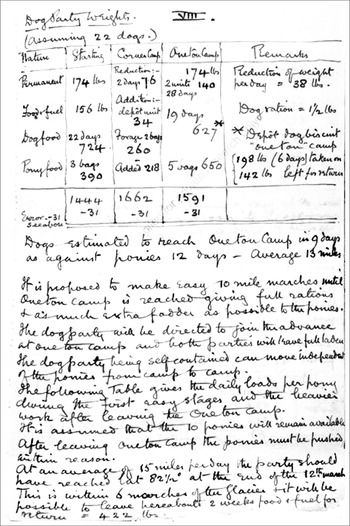
As well as the written instructions to party leaders, Scott had recorded supporting details in a series of planning tables named Table I through Table XII. The tables provided a common baseline for the written instructions to party leaders. Wilson copied the tables into his sketchbook on 20 September 1911 (Wilson, Reference Wilson and King1972, p. 169). To illustrate Scott’s attention to detail, Table VIII, “Dog Party Weights” has been included herein as Figure 7.
Scott’s Table VIII, “Dog Party Weights”, scanned from Wilson’s sketchbook. Reproduced by permission of the University of Cambridge, Scott Polar Research Institute.

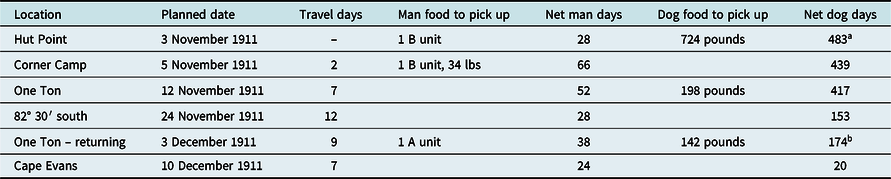
A corresponding table “Dog Party Rations Plan - Southern Journey” (Table 4) has been derived from Scott’s tables, to assist the reader in understanding the impact of delays.
Dog party rations plan: Southern Journey

Notes: Dog food: Spratt’s dog biscuits, supplemented by pony flesh when available. Dog pemmican not transported by the dog teams.
a Ration 1½ pound per dog per day on outward trip.
b Ration 1 pound per dog per day on return trip.
Assumptions: 22 dogs.
Ponies reaching 82° 30′ no later than 24 November 1911, as per Scott’s schedule.
No contingency days or rest days.
Dogs averaging 20 miles per day on return journey.
Workable plans for the dog teams were now in place for their limited Southern Journey.
Dogs on the Southern Journey: November 1911–January 1912
The Motor Party initiated the Southern Journey on 23 October 1911. Over several days, 16 men, 10 ponies, 2 motor tractors and 23 dogs departed. (Bowers, Reference Bowers1911, 21 November 1911)
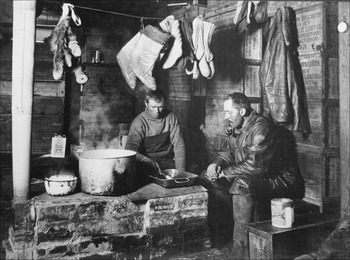
The Dog Party’s role was to support the advance as far as 82° 30′, then return to base (Wilson, Reference Wilson1911, p. 8). Cargo for the dog teams is listed in Scott’s Table VIII (Fig. 7). The maximum planned load was 1631 pounds plus drivers or about 82 pounds per dog. They were to leave after the ponies, waiting at Hut Point for several days before departure (Fig. 8).
Demetrie and Meares waiting in the Discovery hut at Hut Point on 3 November 1911. Note the damp footwear being aired. H. Ponting/Alamy Stock Photo/2ACXR37.

It had been intended that Demetrie and Anton would return with the ship in March 1911, but Scott changed his mind once it became apparent how much effort and expertise were required for animal management (Clissold, Reference Clissold1961). Demetrie was initially assigned to menial tasks at base, but on 20 April 1911 was appointed by Scott as a dog team driver (Wilson, Reference Wilson1911, p. 122). Demetrie flourished in this role, gaining the respect of many expedition members, for example:
Demitri [sic], the Russian dog driver, is quite different, full of fun and mischief, absolutely fearless, and very quick in his mind and movements. (Wilson, Reference Wilson and King1972, p. 183)
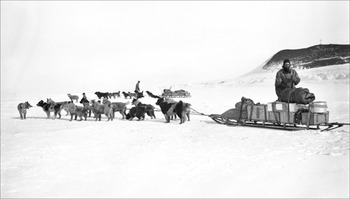
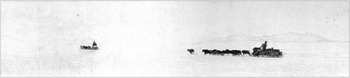
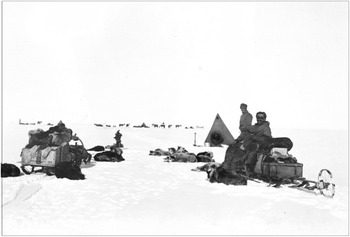
The dog teams under Meares and Demetrie started south on 5 November 1911 (Figures 9 and 10). As with the Depot Journey, dog teams were driven in the orthodox Siberian pattern, despite Scott’s concerns about men riding on the sledges.
Dog teams about to depart Hut Point. H. Ponting/Alamy Stock Photo/2ACXR2T.

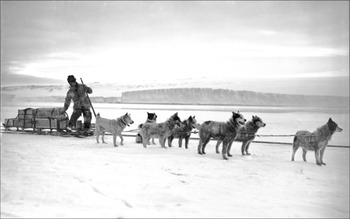
Dog teams heading into the great white south. H. Ponting/Alamy Stock Photo/PH5HDD.

With a start-date of 5 November 1911, their six weeks’ worth of provisions (four weeks on-board after Corner Camp, two weeks already cached at One Ton for return) could theoretically sustain the dog handlers until 17 December 1911. This is consistent with Scott’s instruction, “Under favourable conditions you should be back at Hut Point by December 19 at latest” (Evans, Reference Evans1961, p. 161). However, as One Ton was only one-week’s travel from base, the men could realistically use only five weeks’ worth. On his return trip, Meares left the surplus for returning parties, and Cherry-Garrard noted, “Meares had left quite a lot of extras”, as he took sugar, pemmican, cheese and butter from Meares’ surplus. (Cherry-Garrard, Reference Cherry-Garrard1912a, 15 January 1912)
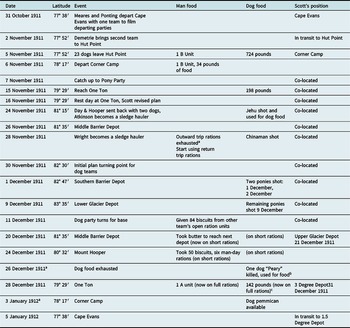
The general outline of the Southern Journey is well known. Finer details are set out in Table 5.
Diary of dog teams on the main southern journey

a Approximate date.
b “Peary” killed because he would not pull.
c Ration 1 pound per dog per day with light load.
The Southern Journey was easy going for the dogs, as the entire Southern Party proceeded at the daily mileage of the slowest pony. Scott had a strong belief in the virtue of hard work and it may have irked him to see the dog teams, including drivers, received a full day’s ration for half a day’s work. This may have been exacerbated by the sight of Meares and Demetrie drawn along by the dogs, while the ponies struggled.
The Motor Party was not as successful. The first motor broke down near Safety Camp and the second failed just south of Corner Camp, a distance of 51 miles (Evans, Reference Evans1961, pp. 171–173). They left 500 pounds of dog food behind as they commenced sledge hauling.
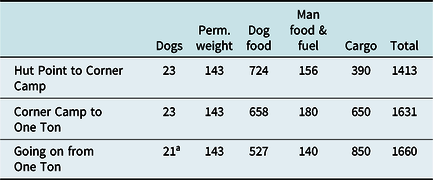
The armada rested for a day at One Ton while Scott and Bowers revised the plans again. Scott’s Table IX had set a target of 15 geographic miles per day beyond One Ton, but that target had to be reduced to 13 miles per day because of pony limitations, “After a discussion we have decided … to push forward at the rate of 13 geographic miles per day” (Scott, Reference Scott and Jones2006, p. 323). Dog team cargo was increased by 200 pounds (Table 6) to ease the ponies’ burden.
Revised dog party weights

Notes: Figures from Dennistoun (Reference Dennistoun1912, p. 258).
Refer to Figure 7 for pre-revision weights.
a 21 dogs remained after 2 were sent back from 81° 15′.
The dogs followed the pony groups and camped a quarter to a half a mile behind (Fig. 11).
Dog teams camped on the Barrier, behind nine ponies. Note the damp items being aired. Photograph by H. Bowers. Image from Kinsey Collection, Alexander Turnbull Library, Wellington, New Zealand, reference PA1-f-066-10-07.

Scott planned for Day and Hooper to turn for base from latitude 80° 30′ on about 16 November 1911, “If the cars broke down we were to take a 10 foot sledge and what food we could manage to man-haul to 80° 30′ Lat South. Day and myself were to return from there” (Hooper, Reference Hooper1912a, p. 15) but practical considerations took them further:
-
Scott needed to utilise every pony to its full potential.
-
Pony food was strictly limited. The weakest pony, Atkinson’s Jehu, would be killed first. By 21 November 1911, he could be fed for about three more days.
-
If Jehu lasted three days, he would have passed the latitude where Shackleton’s first pony was killed, a morale boosting achievement.
-
The Southern Party was reliant on Evans and his three sledge-haulers creating the trail and building route-marker cairns. Two of those men, Day and Hooper, were overdue to leave and were already consuming their return rations. Others would have to replace them in harness.
-
The dogs would soon need more food and pony flesh was the only option.
On 24 November 1911, at 81° 15′, Jehu was killed. Day and Hooper left that night, taking back two dogs that were not pulling and were getting in the way. Atkinson was assigned to man-hauling duties, to assist Evans and Lashly. The men enjoyed pony flesh and pony hoosh that day and the rest of Jehu made four days’ worth of dog food.
Scott sent a note to Simpson via Hooper, formalising his second alteration to the plan for the dog teams.
[T]he ponies [are] doing fairly well. I hope we shall get through to the Glacier without difficulty, but to make sure I am carrying the dog teams further than I intended at first. The teams may be late returning, unfit for further work or non-existent, so don’t forget that the 3 x XS [enriched summit] rations units must be got to One Ton Camp Lat 79½ somehow [Scott’s emphasis] …. (Simpson, Reference Simpson1912, p. 133)
The dog teams were performing well at this stage and Scott was appreciative, “The dogs are doing splendidly and will take a heavier load from tomorrow” (Scott, Reference Scott and Jones2006, p. 335) and “The dogs are simply splendid …” (Scott, Reference Scott and Jones2006, p. 338).
The dog team turned for base on 11 December 1911 from about 83° 40′. Surprisingly, Scott wrote “The dogs should get back quite easily; there is food all along the line” (Scott, Reference Scott and Jones2006, p. 345). He knew the dog-men had exhausted their outward rations by the end of November 1911 and were already consuming their return rations, which had to last until their single return depot (at One Ton). He gave Meares and Demetrie 84 biscuit (about seven days’ worth) from the open “ready bags”. Pony flesh cached on the Barrier was suitable for dogs and men, but pony flesh was not “all along the line”, as the first two ponies had already been well picked-over for men and dogs, with no pony flesh cached north of 81° 15′.
As Scott ascended the Glacier, he may have regretted his risk-based decision not to take the dogs further south. On 16 December 1911, five days after the dogs left and six days behind schedule, he wistfully wrote, “So far, since we got amongst the disturbances we have not seen such alarming crevasses as I had expected; certainly dogs could have come up as far as this” (Scott, Reference Scott and Jones2006, p. 351).
It is important at this point to review the Polar Party’s progress against schedule because the “news” conveyed back to base by Atkinson and Evans was to be used in determining the departure date of the Escort Party (Evans, Reference Evans1961, p. 162). Scott recorded on 16 December 1911 that he was six days behind schedule and on 20 December 1911 less than three days behind. By 30 December 1911, he was back on schedule (Scott, Reference Scott and Jones2006, p. 363). As noted previously, he reached the Pole seven days ahead of schedule.
Meares had a desperate 25-day trip home after the prolonged warm storm the previous week had left deep soft snow along the return route. He was not an experienced navigator and had to rely on dead reckoning navigation.
They hoped to get back in 18 days – doing 20 miles a day – but they had to rebuild the cairns, and had fog and no sun the whole way. Compass very little use. From one cairn to other often got agee [off to one side]. Sledge meter tell distance but then if could not pick it [the next cairn] up in bad light, try right and left etc. and use compass as well as possible then if no good just have to go back along [their own] track to last camp and wait there till light better or better luck next time. […] At ‘One Ton’ position getting serious as dog tucker [food] running out. Men and dogs were on short rations all the time. (Dennistoun, Reference Dennistoun1912, p. 261)
It seems Meares had been provided with details about all cairns along the return route – distances and bearings. He knew about the inherent risk of cumulative errors in dead reckoning navigation and ensured no cairns were missed.
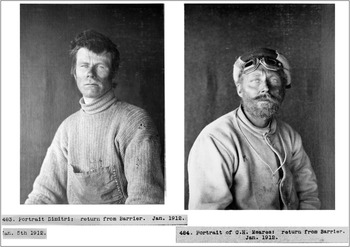
Figure 12, from the expedition album that Ponting presented to Kinsey, shows Demetrie and Meares the day they reached Cape Evans. Comparison with Figure 8 illustrates the physical toll exacted by the Southern Journey.
Demetrie and Meares upon returning from the arduous Southern Journey. Photograph by H. Ponting. Image from Kinsey Collection, Alexander Turnbull Library, Wellington, New Zealand, reference PA1-f-067-064-2-3.

Meares later poured out his grievances to Dennistoun. It is possible that Meares, grumpy and disillusioned with Scott’s leadership on the Southern Journey, overstated his woes and took a “poor me” stance.
As the [pony] fodder was removed from the dog sledges it was replaced by provisions [man-food from the pony sledges] and when they reached the Beardmore Glacier they were pulling 800 lbs cargo in addition to permanent weights, food, fuel etc. (Dennistoun, Reference Dennistoun1912, p. 258)
From foot of Beardmore they were taken on from day to day and did 3 days up Beardmore always without good ration or knowledge of distance going etc. Their sledges and gear too was always the ‘culls’ and their loads were increased as extras etc. were found and had to be taken by someone. (Dennistoun, Reference Dennistoun1912, p. 262)
Despite their difficulties, the dog teams arrived back at Cape Evans in good health on 5 January 1912, having successfully completed all their tasks on the Southern Journey.
Extra dogs for 1912/13
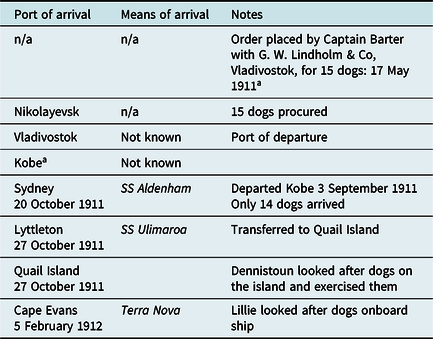
In January 1911, Scott, advised by Oates and Meares, ordered Indian transport mules and additional Eastern Siberian dogs for the 1912/13 season, in case a second attempt at the Pole might be needed. This was before Scott became aware of Amundsen’s presence in the Bay of Whales. His letters of 12 and 22 January 1911 were addressed to Joseph J. Kinsey, the BAE’s New Zealand Agent (Alexander Turnbull Library, Kinsey Collection, MS-Papers-0022). Kinsey organised the acquisition of 15 Siberian Huskies through Captain J.R. Barter (of Birt & Co, Sydney), who in turn engaged G. W. Lindholm & Co to be the BAE’s Vladivostok agent. No correspondence from Lindholm has survived.
Lieutenant Harry Pennell, Master of the Terra Nova, enlisted Dennistoun to assist with the new mules and dogs, writing on 7 October 1911, “I am very glad you are able to come; it will be a great load off my mind to have someone definitely in charge of the mules. Lillie will be looking after the dogs and you two will work together” (Pennell, Reference Pennell and Mannering1999, p. 212).
The Ulimaroa arrived in Lyttleton on 27 October 1911 bringing 14 Siberian Huskies (New Zealand Times, 26 October, 1911).
Table 7 summarises the acquisition of the extra dogs.
Procurement of dogs for second summer’s work

a Alexander Turnbull Library, Kinsey Collection, MS-Papers-0022.
With both of the expedition’s experienced dog handlers in the Antarctic, preparation of the new dogs for Antarctic sledging work was compromised. On the unaccompanied trip to New Zealand, they had been tended by ship’s officers. Upon arrival in Lyttleton, they were transferred to Quail Island where Dennistoun carried out a “course of exercise” (Lyttleton Times, 8 December 1911), using the training sledge from the previous season (Fig. 13).
Dennistoun exercising dogs on Quail Island. Image courtesy of Canterbury Museum, J.R. Dennistoun Collection, 1969.61.21.

Press photographs were taken of the new dogs (Fig. 14) but never published, possibly because Scott and Kinsey wished to downplay any suggestion of a race with Amundsen.
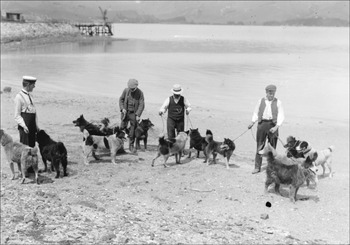
Fourteen dogs on the beach at Quail Island. (L-R) Pennell, unknown, unknown and possibly Dennistoun. Unpublished image courtesy of Stuff/Weekly Press Collection.

Fourteen new dogs were landed at Cape Evans on 6 February 1912. Meares was not impressed, as they were far less ready for sledge work than the previous season’s dogs, “Meares says they are a mixed crowd some being good others decidedly bad” (Dennistoun, Reference Dennistoun1912, p. 114). Six of them were soon added to teams unloading the ship and four went on the next major dog journey (Dennistoun, Reference Dennistoun1912, p. 114, 117).
Men and dogs back at base: January–February 1912
In Scott’s absence, Simpson was in charge of the Cape Evans base. He was therefore responsible for its re-provisioning when the ship arrived, as well as acting Head of Science in Wilson’s absence. He was not responsible for the any of the autonomous teams – the sledging parties, dog teams or the ship itself. Simpson did not maintain a full and reliable account of events at base for the period he was in charge (Supplementary Material, Appendix B, “Simpson’s journal mischaracterised”).
Scott had written to Simpson, reminding him of the three “XS” ration units that “must be got to One Ton Camp Lat 79½ somehow” (Simpson, Reference Simpson1912, p. 133). Simpson had therefore sent out the four-man One Ton Relief Party on 26 December 1911 to restock One Ton with three “vital” ration units, made up by Hooper (Hooper, Reference Hooper1912a, p. 38). Unlike the “A”, “B” and “S” ration units, which had been pre-packed at Cape Evans and mostly relayed out to the Discovery hut and depots further south, the “XS” units had not yet been assembled and their composition had not been specified. Cherry-Garrard’s sledging journal itemises pemmican with chunks of seal liver, chocolate, raisins and oatmeal in their “XS” unit, as enrichments over standard ration units (Cherry-Garrard, Reference Cherry-Garrard1912a, 15 January 1912). This may explain Atkinson’s comment about “certain delicacies” for the returning Polar Party (Atkinson, Reference Atkinson and Scott2011, p. 666).
As noted in “The Southern Journey: a revised scheme of advance” (above), Scott had issued instructions to the Dog Party leader for the period between returning from the Southern Journey and departure on the Escort Journey. The main tasks were:
-
1. Transportation of “emergency stores” to the Discovery hut,
-
2. Transportation of cargo to One Ton and
-
3. Landing of stores from the Terra Nova.
Two days after returning to Cape Evans, Meares and Demetrie took Ponting by dog sledge to Cape Royds for a few days to photograph Adelie penguins (Ponting, Reference Ponting1949, p. 250), which Scott had set as Ponting’s priority.
We have no record of when, and to what extent, the dog teams restocked the Discovery hut with “emergency stores”. Simpson’s journal shows no awareness of this activity and Meares’ journal has not survived. The restocking must have occurred to some extent at least, as several men camped there later in the season.
Meares did not depart immediately for One Ton as there was already a four-man One Ton Relief Party delivering the “vital” items specified by Scott.
On 17 January 1912, the Terra Nova was sighted. Scholars are not agreed on how Simpson weighed up his responsibilities to unload the ship and restock the Cape Evans base, versus other tasks Scott had stipulated. A case can be made that Simpson gave priority to unloading the ship (Supplementary Material, Appendix B, “Men and dogs unloaded the Terra Nova”). May and Lewis hypothesise that Meares invented a story about a ‘stock of luxuries’, in order to avoid a dog journey to One Ton before leaving the Antarctic (Reference May and Lewis2019, p. 6). The hypothesis has been investigated and no direct primary evidence can be found (Supplementary Material, Appendix B, “The ‘first obfuscation’ – ‘a stock of luxuries’”).
The four-man One Ton Relief Party arrived back at Cape Evans on 23 January 1912 (Hooper, Reference Hooper1912a, p. 41). They had deposited the three “vital” ration units at One Ton, repaired number one motor sledge with parts taken from number two and had driven it to the ice-edge, where it was to be picked up by the ship (Hooper, Reference Hooper1912a, pp. 39–40).
The Terra Nova had actually reached the entrance to McMurdo Sound on 12 January 1912, but further progress had been blocked by pack ice. Pennell described how the ship struggled to get through, “These three weeks were one long succession of being caught in the pack and struggling to get out again …” (Evans & Pennell, Reference Evans, Pennell and Scott2011, p. 723), until finally mooring near Cape Evans on 3 February 1912. In all, Terra Nova spent 22 days thwarted by pack ice, increasing the urgency of unloading. The delay in commencement of unloading was to have an unexpected flow-on effect for commencement of the next dog journey. The dogs would not now be free to leave base until mid-February 1912.
Meares met Atkinson’s Return Party just off Razorback Island on 28 January 1912. Cherry-Garrard’s record of the meeting is rather cryptic, as he was on the last page of his small sledging notebook, “The dogs are very fit and the news for Atch with respect to going out to meet the Owner [Scott] is also cheery …” (Cherry-Garrard, Reference Cherry-Garrard1912a, 28 January 1912). It seems Meares and Atkinson, who had been good friends throughout the expedition, agreed that Atkinson would lead the dog teams to meet Scott in one final dog journey of the season. The residual cargo from the One Ton Relief Journey would be taken south and Meares would leave in March 1912. Atkinson’s meagre journal does not provide any detail about the meeting with Meares as it finished on 28 December 1911 with the extremely brief entry “The rest uneventful. Arrived Cape Evans January 28” (Atkinson, Reference Atkinson and Gran1911, p. 235).
Wilfrid Bruce’s comment of 3 February 1912, when Simpson and Atkinson first came on-board, confirms the pressure on the ship’s timeline “Our orders are manifold, & many of them cannot possibly be carried out, under present ice conditions” (Bruce, Reference Bruce and Guarnieri1913, p. 96).
Unloading the ship commenced on 6 February 1912. Figure 15 shows Atkinson working on that task with a dog team. Note the smaller number of dogs and uncovered cargo, characteristic of short transport journeys. Unloading of essential stores was completed on 14 February 1912.
Atkinson and dog team transporting cargo across sea ice from ship to base. H. Ponting/Alamy Stock Photo/2ACXBKT.

The often-overlooked second version of the plan to escort Scott back to base
In October 1911, along with instructions for the Southern Journey, Scott had instructed the Dog Party leader to commence a journey “about the first week of February” travelling south to meet the returning Polar Party between 82° and 82° 30′, around 1 March 1912 (the Escort Journey). The object was to “hasten the return of the third Southern unit” (Evans, Reference Evans1961, p. 162). Scott’s provisioning scheme allowed six weeks’ man-food for this journey (Wilson, Reference Wilson1911, p. 3).
On 20 December 1911, Scott gave Atkinson charge of dog transport because he had already arranged for Meares to leave the Antarctic at the end of the season (Supplementary Material, Appendix B, “Was Meares’ departure premature?”). Scott instructed Atkinson to bring the dogs south later in the season, which Atkinson attempted to paraphrase as “proceed as far south as possible, taking into consideration the times of return of the various parties” (Atkinson, Reference Atkinson and Scott2011, p. 665). This is not a verbatim quotation of Scott’s words (indicated by absence of quotation marks) and omits key details like the journey’s duration and target meeting point. We have no record of Scott’s full briefing, or of any documents provided to Atkinson. Presumably, there would have been dead reckoning navigation instructions for the entire Escort Journey, setting out the length and bearing of every segment. Written instructions were essential. This was common practice in the BAE as it was a matter too complex and too important for unwritten instruction. For example, Evans created instructions for Wright to navigate Atkinson’s Return Party back to base, “I worked till nearly midnight getting out copy of route and bearings for Wright to navigate back on” (Evans, Reference Evans1961, p. 197). Wright created navigation instructions for Atkinson’s Escort Journey (third revision), “Atkinson has been busy making up dog weights for his trip to meet the last returning party, and also getting up the navigation from Silas [Wright]” (Cherry-Garrard, Reference Cherry-Garrard1912c, 31 January 1912), presumably replacing the “forgotten” instructions (Supplementary Material, Appendix A, “The often-overlooked second plan for the Escort Journey”). Somebody provided navigation instructions for Cherry-Garrard’s truncated (fourth revision) Escort Journey which he copied into his sledging journal (Supplementary Material, Appendix A, “Cherry-Garrard’s written instructions”). Somebody provided Meares with details of all the Southern Journey cairns on the Barrier.
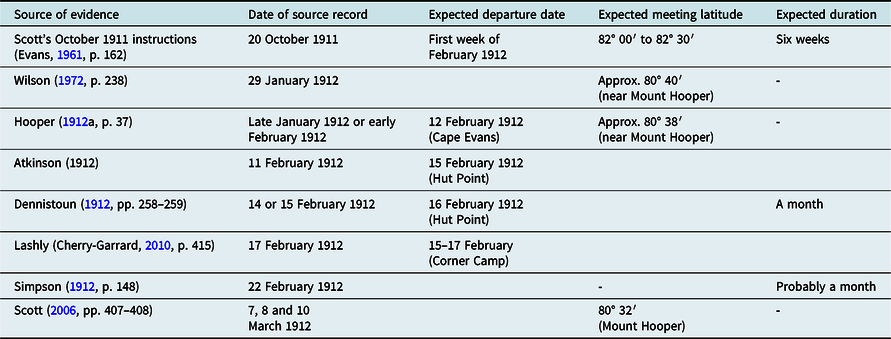
When briefing Atkinson, Scott apparently reduced the range of the Escort Journey and reduced its duration (Supplementary Material, Appendix A, “The often-overlooked second plan for the Escort Journey”). Table 8 shows that at least seven men knew of the revised Escort Journey plan.
Escort Journey – evidence of changes in third revision

The revised meeting point is understandable. With the dogs’ extended period on the Southern Journey, there was now no prospect of them completing all their tasks at base and then travelling over 300 miles to 82° 30′ by 1 March 1912. This is called the “third revision” in “Literature Review” (above), which shows it to be the least understood of the four revisions. All eight texts are silent about this revision.
Table 8 summarises the evidence indicating Scott’s October 1911 instructions to Meares had been revised. The 2019 May–Lewis article maintains that Scott’s original expectation for the dogs to travel as far as 82° 30′ was never revised, “It appears Scott never altered these orders” (May & Lewis, Reference May and Lewis2019, p. 9). They appear to be lone voices in this matter. It is surprising that they also wrote, “No record exists in Atkinson’s, Simpson’s or Scott’s (Reference Scott1911–12) journals of Scott’s cancelling/curtailing the dog teams’ future movements”(May & Lewis, Reference May and Lewis2019, p. 9) as Table 8 shows that Atkinson wrote about the changed start date, Simpson wrote about the changed duration and Scott wrote about the changed meeting place.
The notion of Scott giving last-minute verbal orders to Evans, stipulating that the Dog Party must be prepared to travel as far as 83° south on the Escort Journey, is not correct (Supplementary Material, Appendix A, “Scott’s last-minute verbal orders to Evans”). It would of course be unthinkable for Scott to order a journey that would exceed their (food-determined) limit of four weeks’ travel, with fatal consequences for men and dogs.
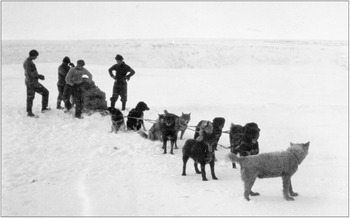
Dennistoun photographed the Escort Party’s departure from Cape Evans on 13 February 1912 (Figures 16 and 17). They intended to pick up four weeks’ worth of man food from Hut Point, enough to travel at least as far as Mount Hooper and return. Dog food would be picked up at Biscuit Depot and Corner Camp.
Demetrie and dog team about to leave Cape Evans on 13 February 1912 for the Escort Journey. Image courtesy of Canterbury Museum, J.R Dennistoun Collection, 1968.275.73.

Atkinson and dog team about to depart. Image courtesy of Canterbury Museum, J.R Dennistoun Collection, 1969.61.161.

Dennistoun wrote about the departure from Cape Evans,
After tea, all hands took over dogs (11 to a team with 4 of the new ones amongst them!) […]. They are to leave Hut Point on 15th or 18th about and go south for a fortnight about and try and pick up Scott and hurry him in (taking his loads and letting them just travel without hauling). They can only take 4 weeks food so can’t go much farther than 2 weeks outwards. (Dennistoun, Reference Dennistoun1912, p. 117)
Atkinson and Demetrie delayed their departure from Hut Point because of bad weather. While they waited, on 19 February 1912, Tom Crean staggered in with news that Evans and Lashly were stranded 30 miles to the south, Evans with a severe case of scurvy. The story of Evans’ rescue by the dog teams is well known and need not be repeated here.
The third version of the Escort Journey plan: truncation
Atkinson, as the sole doctor, decided Evans’ condition required close medical supervision. He called for reinforcements so he could stay with Evans. By the afternoon of 23 February 1912, there were seven men in the Discovery hut – Evans, Atkinson, Lashly, Davies, Keohane, Cherry-Garrard and Wright.
At this stage, the season was going more-or-less to plan. Four parties had already returned (Motor Party, Dog Party, Atkinson’s Return Party and Evans’ Return Party), albeit with two parties being delayed and one man seriously ill with scurvy, now on the road to recovery. The outlook for the Polar Party was promising (last seen 150 miles from the Pole, ahead of schedule and advancing strongly). The ship had arrived and essential over-wintering provisions had been landed.
Evans was recovering from scurvy and was compos mentis (Supplementary Material, Appendix A, “Evans’ state of health”). He and his party had delivered optimistic “news” about Scott’s likelihood of a rapid return.
On that day, the group of men at Hut Point made a fateful decision. They needed to update Scott’s instructions in light of “news” brought by returning parties. They apparently decided that the Escort Journey could be truncated and the dog teams now had no need to travel beyond One Ton, as Scott would surely beat them to that depot (Supplementary Material, Appendix A, “Decision to truncate the Escort Journey”). They decided on three weeks’ worth of dog food, even though the dog teams could have hauled four weeks’ worth. This last-minute truncation was a mistake and was not what Scott had intended. It is called the “fourth revision” in “Literature Review” (above).
Atkinson delegated the Dog Party leader’s role to Cherry-Garrard, instructing him to leave all the cargo at One Ton, unless Scott was encountered sooner (Cherry-Garrard, Reference Cherry-Garrard2010, p. 430). There was no need for advanced navigational skills on this journey (Supplementary Material, Appendix A, “Did Cherry-Garrard need advanced navigation skills?”).
The claim by May and Lewis (Reference May and Lewis2019, pp. 9–10) that the truncation was caused by Meares inventing a story “the dogs are not to be risked” has been investigated and no direct primary evidence can be found (Supplementary Material, Appendix A, “Was Scott misrepresented by ‘the dogs were not to be risked’?”). Surprisingly, they did not investigate the “news” brought by returning parties as being a possible influence in this matter.
Cherry-Garrard’s sledging journal (Cherry-Garrard, Reference Cherry-Garrard1912c) contains six pages of instructions for the journey (Supplementary Material, Appendix A, “Cherry-Garrard’s written instructions”). He and Demetrie set out on 26 February 1912. With 22 dogs, they took 21 days’ worth of dog food and slightly more man food (Cherry-Garrard, Reference Cherry-Garrard2010, p. 430). Cherry-Garrard was nominally in charge, but Demetrie took the leading role, locating cairns along the way, sorting out problems with the dogs and managing the dog rations. They arrived at One Ton on 4 March 1912, just as low temperatures set in.
At no point does Cherry-Garrard’s journal (Cherry-Garrard, Reference Cherry-Garrard1912c) record any wish to travel beyond One Ton. That concept came later, once the Polar Party’s fate was known. In any event, the men and dogs were in no fit state to venture beyond One Ton after waiting there, idle in the cold, for six days. They were in distress and needed to return to shelter as soon as possible.
Atkinson wrote about their state of health upon return:
Both men were in exceedingly poor condition, Cherry-Garrard’s state causing me serious alarm. The dogs were frostbitten, and miserably thin, while in many cases their harnesses were iced up and frozen to them. They were quite unfit for any further work that season. (Atkinson, Reference Atkinson and Scott2011, p. 670)
Had they spent more time out on the Barrier searching for the Polar Party, even if they had taken more dog food (four weeks’ worth was within the dog’ hauling capability), or even if there had been dog food already cached at One Ton, their outlook was bleak. Additional exposure to the elements would most likely lead to disablement and death.
The Escort Journey failed to achieve its primary objective of meeting the returning Polar Party. This failure was due principally to the flawed decision to truncate the journey at One Ton, sanctioned by Evans and Atkinson, rather than any deficiency in the performance of the dog teams or their handlers.
The Search Journey: October–November 1912
In preparation for the Search Journey, the dog teams relayed a large quantity of stores out to the Discovery hut in September 1912. Next month they established Demetri [sic] Depot, 12 miles south of Corner Camp, and in a further trip took additional stores to Corner Camp (Atkinson, Reference Atkinson and Scott2011, pp. 691–692).
Hooper wrote about the plan for the Search Journey:
We are to leave here, Cape Evans, on Oct 29th for Hut Point where we shall stay 3 days packing sledges for a start on the night of the 1st Nov, weather permitting. 7 mules, 2 dog teams and 11 men, 8 men with the mules, 3 men with the dogs are the party going south. Most of the food is at Hut Point, so we leave there finally. […]
The dogs will leave 2 or 3 days after the mules & hope to pick us up about 80 miles in on the Barrier. The program for the journey is made out by Dr. Atkinson. (Hooper, Reference Hooper1912b, pp. 3–4)
The 22 dogs departed as planned on 1 November 1912, driven by Demetrie, Atkinson and Cherry-Garrard. The dog teams found the surface challenging for the first four days, but after that had no difficulty in catching up with the mules.
They proceeded as planned, without major incident until the remains of Scott, Wilson and Bowers were discovered about 11 miles south of One Ton on 12 November 1912. After unsuccessfully searching further south for Oates, any thought of travelling further south was abandoned.
They arrived back at Hut Point on 25 November 1912. Once again, the dog teams had been successful in completing their tasks. This was the final dog journey of the expedition.
Conclusions
The purpose of this article is to establish an accurate record of sledge dog involvement in the BAE. This has been achieved by:
-
Providing an account of the procurement of all BAE dogs,
-
Providing the clearest insight to-date of the dog handling practices of the BAE,
-
Outlining salient facts about their main Antarctic journeys,
-
Bringing together a collection of images to illustrate the dogs’ story and
-
Tracing the evolving plans and instructions for the dog teams, providing the most complete account to-date.
The pre-departure planning by Scott and Meares for the dog teams to reach the South Pole was inadequate. They did not give thorough consideration in 1909/10 to the number of dogs required, the number of experienced dog handlers required and placement of dog food depots. As a result, their capacity to deploy dogs all the way to the Pole, as announced in the expedition’s public funding prospectus, was compromised.
Scott expected Meares to provide expertise in dog team organisation and dog nutrition. Meares fell short of the latter expectation.
By adopting orthodox Siberian dog handling practices, the Terra Nova expedition achieved superior results from its dog teams, as compared with the ad hoc approach to dog handling of the Discovery expedition.
The dogs were at times underutilised because of Scott’s “naval armada” organisation model for the Depot Journey and the Southern Journey, with all transport resources travelling the same route at the same time for the same daily mileage (except for the commencement of the Southern Journey). This had the drawback of placing great pressure on the slowest animals and underutilising the potentially higher performing animals.
Three of the four main dog journeys were successfully completed. The Escort Journey failed to meet the returning Polar Party because of a flawed decision, made by the seven men at Hut Point, sanctioned by Evans and Atkinson.
The dogs made a great contribution to the BAE, thanks to Meares’ performance-based selection of the dogs and Demetrie’s life-experience with dogs in a similar environment. The Siberian Husky teams were the expedition’s most successful transport resource. Many of them covered well over 1500 miles on long journeys plus another 1350 miles on shorter delivery jobs, as shown in Table 9. In comparison, only two ponies exceeded 600 miles.
Dog team mileage

Notes: Figures come from several sources, possibly with significant estimating errors.
Meares, Dennistoun and Evans used statute miles. Their figures have been converted to nautical miles in this table.
One may ask, “Whatever happened to the dogs after the expedition?” One dog was taken back to civilisation in 1912 and 13 more were taken back as pets at the end of the expedition in 1913 (Evans & Pennell, Reference Evans, Pennell and Scott2011, p. 742).
Acknowledgements
The author would like to acknowledge the generous and knowledgeable assistance provided by Frank Graveson, NZ Polar Medal. As an engineer and dog-handler with Antarctic Division, NZDSIR, Frank wintered at Scott Base in 1963 and in 1963–64 was a member of the Northern Victoria Land Expedition. (The Graveson Glacier was named after Frank). Dr. David Harrowfield, NZ Antarctic Medal, author of over 200 Antarctic-related articles and books, has consistently provided in-depth information and encouragement. (Harrowfield Hill, on Inexpressible Island, is named after David). Anne Strathie, researcher and author, has been a great “sounding board”, reviewer and source of valuable insights. Michael Tarver, FRGS, has consistently provided specialist information and encouragement. Rod Brown has been most helpful with research and photography carried out in British Columbia. The author would like to thank staff of the Alexander Turnbull Library, British Columbia Archives, Canterbury Museum (particularly Jill Haley), Scott Polar Research Institute (Laura Ibbett) and Stuff Archives for assistance in locating and providing historic documents and photographs.
Supplementary material
To view supplementary material for this article, please visit https://doi.org/10.1017/S0032247420000182.