




No CrossRef data available.
Article contents
Can health technologies be assessed using routine data?
Published online by Cambridge University Press: 02 March 2005
Abstract
Objectives: The potential of routine data for health technology assessment (HTA) in the United Kingdom was assessed.
Methods: Compiled were a comprehensive list of routine databases, their classification according to data characteristics, literature review on their current use, and their comparison with key topics identified as priorities for HTA.
Results: Two hundred seventy health-care databases for England or the English regions were identified. Twenty-four included data on both health technology and patient health state. Eleven found some published use in effectiveness evaluation. Of 140 prioritized health technologies, only 22 could be identified in routine databases.
Conclusions: Routine data are plentiful but of limited use in HTA. The data sets usually do not include the effect of treatments. Coding is inadequate, and confidentiality regulations will make matters worse. Both need urgent attention.
Keywords
Information
- Type
- GENERAL ESSAYS
- Information
- International Journal of Technology Assessment in Health Care , Volume 21 , Issue 1 , January 2005 , pp. 96 - 103
- Copyright
- © 2005 Cambridge University Press
Three decades of continuous growth of evidence-based medicine and health technology assessment (HTA), from Cochrane's critique of effectiveness and deficiency (6) to the birth and entrenchment of the National Institute of Clinical Excellence have amounted to a revolution in the knowledge-base health care, not just in Britain but internationally. This revolution is voracious in its appetite for information on the effectiveness of health technology. Conventional scientific wisdom favors ever more and larger randomized controlled trials (RCTs) collecting customized data. Concealed randomized allocation of interventions prevents selection bias and controls for confounders, both known and unknown. However, there are limitations to trials. First, the scale and pace of health technology developments is greater than the capacity to fund and carry out RCTs. Second, RCTs may occasionally be inappropriate, impossible, or inadequate for health technology assessment (4).
Observational studies, which wholly or in part use routine data, could provide a potential alternative or complement to randomized controlled trials. Particular RCT limitations relevant to routine data are that RCTs may not be generalizable to routine everyday practice and they are often not large enough or long enough to detect adverse events. However, routine data have been little used in HTA. A vicious circle applies: as the data are poor, they cannot be used; lack of use ensures they remain limited and of poor quality.
In this study, we explore the potential of routine data in health technology assessment care through identifying all United Kingdom and English routine data sets: (i) assessing how many of these data sets have prima facie characteristics necessary for HTA, (ii) reviewing the use that has been made of routine data in this way to date, and (iii) investigating what use could be made of routine data for a national set of prioritized health technologies for assessment (15).
METHODS
We define routine data to be data that have regular and continuing collection, use standard definitions, include some degree of obligation to collect the data completely and regularly, and are collected at the national or regional level. We, therefore, interpret the term routine data widely to include not only administrative data sets but also disease and health technology registers, adverse event reporting systems, and regular health-related surveys.
Identification of Routine Health and Health-Care Databases
No comprehensive list of routine databases was available in the United Kingdom. We compiled the list through a combination of the use of key literature sources, references from within those sources, and a network of people with experience of routine databases. The key literature sources in this field turn out to comprise mostly books, book chapters, and health service circulars and official publications rather than journal articles (1;5;9;14;16;18;22;32). Private-sector databases were explored using the published literature and a survey of the major UK health insurers.
Classifying Database Characteristics
To be of value in HTA, databases must at least identify both the health-care intervention or setting (“a health technology”) and user characteristics of patients receiving the technology, particularly their health state. We classify such databases as group 1 databases. We also classify as group 2 databases those that identify a health technology but not a health state, and group 3 as those databases identifying health states but not a health technology. The relevance of group 2 and 3 is limited in health-care evaluation but can be used for assessing diffusion and equity in the case of group 2 and, occasionally, for identifying adverse events in the case of group 3. These databases are not considered further here.
Current Use of Routine Data in Health-Care Evaluation
The use of databases in HTA was identified by literature searches, which both include synonyms of routine data plus use, and separately the title of each database as a key word. In addition, annual reports of databases were examined and database “keepers” were queried. Each identified use was checked by the three principal investigators.
Potential Use of HTA
The UK National Health Service (NHS) Research and Development (R&D) Health Technology Assessment program has been charged since 1992 with prioritizing key elements of health care of importance to the NHS, which require evaluation (8). Details of 142 topics funded up to February 2000 by the NHS R&D Health Technology Assessment program were reviewed by the principal investigators (15). Each project was scrutinized for the extent to which it could, in principle, be picked up by group 1 databases.
RESULTS
Identification of Routine Data Sets
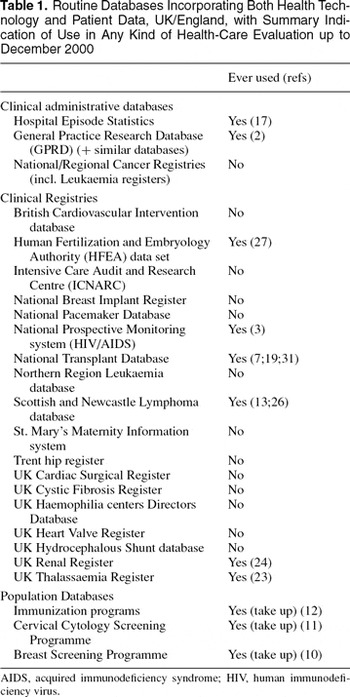
Two hundred seventy databases were identified that covered the United Kingdom, its constituent countries, or one or more of the English regions. To avoid duplicate analyses, we excluded over 700, which were duplicates for Scotland, Wales, or Northern Ireland. Data sets unique to any of these countries, meeting the definition, were included. Table 1 lists the 24 data sets (9%) classified as group 1, that is, they included some information on both health state and intervention. This group included three clinical–administrative databases: the Hospital Episode Statistics (HES), the General Practice Research Database (GPRD), and the National and Regional Cancer registries. It included eighteen clinical registries (such as the British Cardiovascular Intervention Society database and the Human Fertilization and Embryology Authority [HFEA] database). It also included three aggregated databases of interventions applied to whole populations that, although not identifying individual patients, could conceivably be used to assess the effectiveness of specific population-oriented interventions, such as screening and immunization program.

Current Use of Group 1 Databases
Of the twenty-four group databases, eleven had found some published use in effectiveness evaluation (Table 1). This group included two of the clinical administrative databases, that is, the HES and the GPRD, but not the National and Regional Cancer registries. However, for the HES and GPRD, only one reference that came close to HTA or health-care evaluation was found, for each (2;17). Among the qualifying disease registries, six had shown some use, notably the HFEA database, which has been used to show factors associated with a successful fertility treatment birth (27), and the National Transplant Database, which has been used to show the benefits of HLA matching (19;31) and to identify the best methods of cadaveric organ retrieval (7). The Scottish and Newcastle Lymphoma database has been used to evaluate treatment and outcome for all newly diagnosed patients with Hodgkin's disease (26) and to explore the long-term effects of autologous bone marrow and peripheral blood stem cell on the loss of fertility (13). The national prospective human immunodeficiency virus (HIV) monitoring survey has been used to assess intermediate outcomes such as viral load in HIV patients (3). The UK Thalassaemia register has been used to assess the outcomes of screening for affected couples (23). Of the aggregated population databases, use has been made of the immunization program's database, the cervical cytology screening program database, and the breast screening program database to measure uptake rates and, therefore, at least a proxy for the effectiveness of the program (10–12).
Potential Use
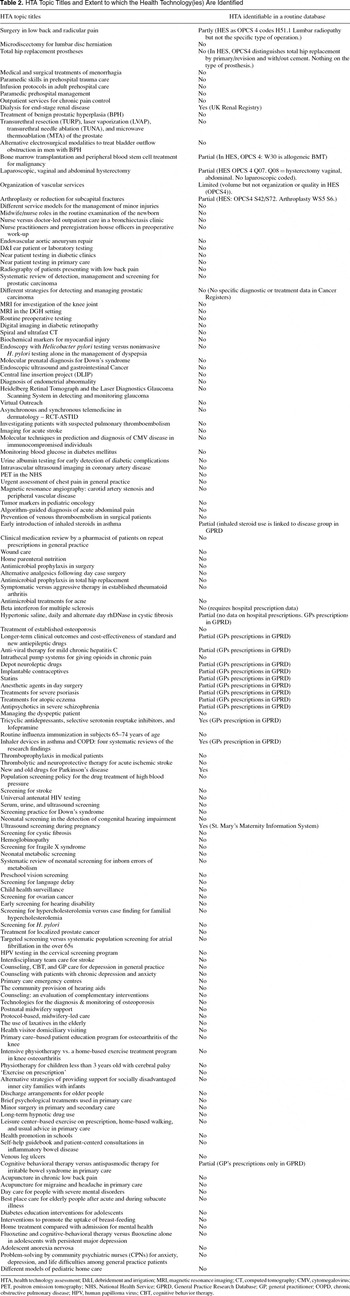
Table 2 shows the limited potential of current routine databases for capturing health technologies that were prioritized by the NHS R&D Health Technology Assessment program. Of over 140 technologies, only 22 could be identified in the routine databases. The bulk (sixteen) of these technologies were drugs prescribed in primary care, which are captured by the GPRD. The capture of these drugs by the Prescription Pricing Authority is of limited value for HTA, as this capture does not link the prescription to any disorder. No routine databases exist on hospital prescriptions. A few surgical procedures were identified but are limited by the imprecision of coding in the surgical procedure coding system, OPCS 4. In the registries, only dialysis in the UK Renal Registry and ultrasound in the St. Mary's Maternity Information system could be identified as specific interventions. However, even when technologies could be identified in any routine database, data were generally lacking on the relevant patient characteristics necessary to assess effectiveness.

DISCUSSION
There is clearly no shortage of routine data collected in the UK's NHS. But it is not so clear that there is a shortage of good routine data, that is, data that can be used for such exacting purposes as HTA. Although we were able to identify over 270 health-care databases covering the United Kingdom as a whole, one of the constituent countries, or an English region, only thirty-three of these databases both record a health technology and a patient health state—the basic minimum for evaluating the effectiveness of health care. These thirty-three, of course, include some important databases such as the HES and the cancer registries, but worryingly, when put to our two tests, that is, whether they are ever used and whether they are ever usable, there were very few positive findings.
Does the very low use of routine data for such purposes just reflect an ignorance or an unjustified skepticism of routine data or does it reflect their real flaws? In fact, routine data are widely used in clinical audit, that is, measuring the performance of individual units. But this use is not always consistent and well-defined and may not always demand impeccable data. More often that not, the data are supplemented by additional information such as case note review. In the case of HTA, the data requirements are very tight. Indeed, the requirements of randomized control trials for very high quality data throws into sharp contrast the quality of routine data.
The flaws in routine data are five-fold. First, health-care systems have historically lived in an “information-free” culture. The scale and diversity of health-care systems have hitherto limited data collection to highly aggregated returns. Most health-care systems have some data on the number of people admitted to hospital or drugs prescribed, often (particularly in the United States) for reasons to do with payment, but few have data on the effects of treatment.
Second, there are clearly data collection problems. Whereas details of patients' conditions and treatments are noted, they generally do not become available as data for analysis. They are usually held in bulky case notes, usually still hand-written, specific to the place of treatment, difficult to interpret, and sometimes hard to locate.
Third, there is the problem of inadequate coding. The International Classification of Diseases (ICD) and the OPCS 4 Classification of interventions are in general use. It is acknowledged that they are limited not only by the quality of the underlying data but also by the lack of detail in most standard coding definitions. ICD does not cover disease severity, and in practice, many conditions are coded as unspecified, whereas procedure codes (such as OPCS) specify surgical interventions, detail is lacking on the specific technology used. Furthermore, standard classification systems are very poor at identifying new technologies. There is always a lag before new diseases and procedures, the very ones one might wish to evaluate, are recognized. For example, coronary stenting is not picked up as a technology distinct from percutaneous transluminal angioplasty, and even when eventually it is, it is unlikely that drug-eluting stents will be classed as a distinct technology. Furthermore, no systems exist at all for outpatients, for diagnostic and imaging technologies, or for the range of types of contact in primary and community health services of the organization of health-care delivery.
Fourth, confidentiality presents a new challenge. Data on the use of certain health services have long been deliberately anonymized (returns for sexually transmitted diseases, for example) to prevent stigmatization and encourage uptake. Now, increased legal protection of the privacy of individuals has raised major issues around all health-care records and the degree to which consent is required before data can be entered.
Fifth, there is a vicious circle of quality of data and their use. The perceived lack of value of most NHS administrative databases, which creates a barrier to their use and, therefore, creates a barrier to their improvement.
The coding problem in particular is highlighted by our findings on the “potential use” of routine databases. Very few of the UK's HTA priorities could be identified in routine data. However, we have no reason to feel confident that, had the technologies been coded, the level of patient detail (before and after use) would have been satisfactory in any but those relatively specialized clinical registries that carefully collect patient baseline condition and outcome, and in those where the outcome is relatively stark (e.g., a successful pregnancy, a death, or a population screening program uptake rate).
So, do routine databases hold out any hope for the deficit in information on the effectiveness of health care? Are we entirely limited to randomized trials? There are some signs of hope, but these findings may not be sufficient to change the current pattern of use. Some of the health technology databases we found, that is, the HFEA's data set and the National Transplant Database, for example, have found selective value. The Hospital Episode Statistics have been used to explore variations in clinical outcomes, even if seldom linked to specific interventions. Linked routine data in Scotland, when validated, notably as part of the West of Scotland Coronary Prevention Study Group prospective trial of statins, proved as useful as reporting based on direct patient contact (29). Routine data have also been central to analyses of inequity in health care, and routine data are clearly central to analyses of the diffusion of health technology. The use of routine data has also found some success overseas. In the United States, the patient outcome research teams (PORT) studies (30) used administrative claims data to assess the effectiveness of a range of common treatments, although they have been criticized (25) for potential bias. Sweden has over forty quality registers (20), which include patient specific data on diagnoses, medical interventions, and outcome. Denmark has developed standards for use of its biobank, defined as all health-related databases that include personal identifiers (28), and Iceland provides an example of an attempt to develop a single computerized database linking medical records, family trees, and assorted genetic information.
Information Technology, in health care as elsewhere, offers the potential for major change. Some services, such as intensive care units, are collecting routine data electronically with much greater levels of detail than hitherto. Computerization, unique patient identifiers and linkage between data sets offer the prospect of improvements. They make it increasingly possible to chart patients' complex itineraries through health-care systems, provided the appropriate detail has been captured and coded. Against this background, issues around confidentiality of health-care data are working to diminish their use in health services research (24). Issues of confidentiality, coding, and the use of routine data all need addressing urgently.
CONTACT INFORMATION
Andrew J. Stevens, MSc, FFPH, Professor of Public Health and Head (A.J.Sevens@bham.ac.uk), Department of Public Health and Epidemiology, University of Birmingham, Birmingham B15 2TT, UK
James Raftery, PhD, Director, Health Economics Facility (J.P.Raftery@bham.ac.uk), Health Services Management Centre, University of Birmingham, 38 Edgbaston Park Road, Birmingham B15 2TT, UK
Paul Roderick, MD, Senior Lecturer (pjr@soton.ac.uk), Community Clinical Research Ddivision, University of Southampton, Highfield Road; Director, Health Care Research Unit, Southampton General Hospital, Tremana Road, Southampton SO15 4YD, UK
The authors acknowledge the support of the National Health Service Research and Development HTA program and the valuable assistance given by Michelle Qume, Nicola Foote, and Mary Rose Tarpey, who helped collect details on the various databases and write up accounts of each.
References
Al-Shahi R,
Warlow C.
2000
Using patient-identifiable data for observational research and audit.
BMJ.
321:
1031–
1032.Google Scholar
Bashford JN,
Norwood J,
Chapman SR.
1998
Why are patients prescribed proton pump inhibitors? Retrospective analysis of link between morbidity and prescribing in the General Practice Research Database [see comments].
BMJ.
317:
452–
456.Google Scholar
Beck EJ,
Mandalia S,
Williams I, et al.
1999
Decreased morbidity and use of hospital services in English HIV-infected individuals with increased uptake of anti-retroviral therapy 1996-1997. National Prospective Monitoring System Steering Group.
AIDS.
13:
2157–
2164.Google Scholar
Black N.
1996:
Why we need observational studies to evaluate the effectiveness of health care.
BMJ.
312;
1215–
1218.Google Scholar
Cartwright FF.
1977:
A social history of medicine.
New York:
Longman;
118.
Cochrane A.
1972.
Effectiveness and efficiency random reflections on the Health Service.
Leeds:
Nuffield Provincial Hospitals Trust;
Davis CL,
Marsh CL.
1999
Reduction of organ-retrieval damage and organ-discard rates.
Lancet.
354:
1136–
1137.Google Scholar
Department of Health NHS Executive.
1994.
Research and development in the new NHS: Functions and responsibilities.
London:
Department of Health;
Department of Health.
1992.
Assessing the effects of health technologies: Principles, practice, proposals.
London:
Department of Health;
Department of Health.
2000.
Breast Screening England 1998–1999.
London:
Department of Health;
Department of Health.
2000.
Cervical Screening programme, England, 1998–1999.
London:
Department of Health;
Department of Health.
1999.
NHS Immunisation Statistics, England 1998–1999.
London:
Department of Health;
Galloway MJ,
Taylor PR,
Proctor SJ.
1999
Implementing clinical governance in the United Kingdom: The role of a regional haematology group. Northern Regional Haematologists Group.
Br J Haematol.
107:
680–
684.Google Scholar
HTA Programme.
National Coordinating Centre for Health Technology Assessment.
HTA priorities.
Available at: http://www.hta.nhsweb.nhs.uk.
Hunt P.
2001.
Health and Social Care Bill.
London:
House of Lords;
26 February
Jarman B,
Gault S,
Alves B, et al.
1999
Explaining differences in English hospital death rates using routinely collected data.
BMJ.
318:
1515–
1520.Google Scholar
Knox E.
1991.
Information needs in public health.
In: Holland WW,
Detels R,
Knox G, eds.
Oxford textbook on public health.
2nd ed.
Oxford:
Oxford University Press;
Morris PJ,
Johnson RJ,
Fuggle SV,
Belger MA,
Briggs JD.
1999
Analysis of factors that affect outcome of primary cadaveric renal transplantation in the UK. HLA Task Force of the Kidney Advisory Group of the United Kingdom Transplant Service Authority (UKTSSA).
Lancet.
354:
1147–
1152.Google Scholar
National Board of Health and Welfare.
1999–2000.
National Health Care Quality Registers in Sweden.
Stockholm:
National Board of Health and Welfare;
Newton J,
Garner S.
2002.
Disease registers in England.
A report commissioned by the Department of Health Policy Research Programme in support of the White Paper entitled Saving Lives: Our Healthier Nation. 2002.
Oxford:
Institute of Health Sciences;
Office of Technology Assessment.
1976.
Development of medical technologies: Opportunities for assessment.
Washington, DC:
US Government Publishing Office;
Petrou M,
Modell B,
Shetty S,
Khan M,
Ward RH.
2000
Long-term effect of prospective detection of high genetic risk on couples' reproductive life: Data for thalassaemia.
Prenat Diagn.
20:
469–
474.Google Scholar
Renal Association.
2002.
The UK Renal Registry 2000.
London:
The Renal Association;
Sheldon TA.
1994
Please bypass the PORT [editorial, see comments].
BMJ.
309:
142–
143.Google Scholar
Taylor PR,
Angus B,
Owen JP,
Proctor SJ.
1998
Hodgkin's disease: A population-adjusted clinical epidemiology study (PACE) of management at presentation. Northern Region Lymphoma Group.
QJM.
91:
131–
139.Google Scholar
Templeton A,
Morris JK,
Parslow W.
1996
Factors that affect outcome of in-vitro fertilisation treatment.
Lancet.
348:
1402–
1406.Google Scholar
The Danish Medical Research Council.
1996.
Health Science Information Banks–Biobanks.
Copenhagen:
The Danish Medical Research Council;
The West of Scotland Coronary Preventive Study Group.
1995
Computerised record linkage: Compared with traditional patient follow-up methods in clinical trials and illustrated in a prospective epidemiological study. The West of Scotland Coronary Prevention Study Group.
J Clin Epidemiol.
48:
1441–
1452.
Warren KS,
Mosteller F.
1993
Doing more harm than good: The evaluation of health care interventions.
Ann N Y Acad Sci.
703:
341.Google Scholar
Wigmore SJ,
Seeney FM,
Pleass HC, et al.
1999
Kidney damage during organ retrieval: Data from UK National Transplant Database. Kidney Advisory Group [see comments].
Lancet.
354:
1143–
1146.Google Scholar
Williams JG.
1995
Making routine data adequate to support clinical audit. “Routine” is inadequately defined [letter; comments].
BMJ.
310:
665–
666.Google Scholar
Routine Databases Incorporating Both Health Technology and Patient Data, UK/England, with Summary Indication of Use in Any Kind of Health-Care Evaluation up to December 2000
HTA Topic Titles and Extent to which the Health Technology(ies) Are Identified
 You have
Access
- 5
- Cited by