


Highlights
-
Adjunctive intraarterial thrombolysis after endovascular thrombectomy may improve outcomes for stroke by large vessel occlusion.
-
This meta-analysis evaluated randomized controlled trials comparing adjunctive intraarterial alteplase, tenecteplase and urokinase, to standard care.
-
The analysis demonstrated improved excellent functional outcomes and complete recovery, without increasing safety risks.
Introduction
Endovascular thrombectomy (EVT) has revolutionized the management of acute ischemic stroke (AIS) due to large vessel occlusion (LVO). However, despite successful recanalization, a significant proportion of patients fail to achieve functional independence. EVT effectively restores macrovascular patency in proximal vessels, but persistent distal or microvascular occlusions can lead to incomplete tissue reperfusion, with subsequent infarct growth, and unfavorable clinical outcomes.Reference Dalkara and Arsava1,Reference Rubiera, Garcia-Tornel and Olivé-Gadea2 Although angiography can detect small distal occlusions, identifying microvascular-level “partial or no-reflow” phenomenon remains challenging, despite being reported in up to 25% of EVT-treated patients and its association with worse outcome. Reference Nie, Leng, Miao, Fisher and Liu3 Therefore, novel adjunctive therapy targeting microvascular reperfusion after EVT is required to improve clinical outcomes.
In this regard, targeted intraarterial (IA) thrombolysis has emerged as a promising adjunct to EVT. Observational studies and recent randomized controlled trials (RCTs) suggest potential benefit, as some reported significant improvements in functional outcomes, while others yielded neutral results. Reference Diprose, Wang and Ghate4–Reference Hu, Tao and Wang9 These findings highlight the potential benefit of IA thrombolysis but also underscore the need for further evaluation. The heterogeneity in patient population, study design, treatment approach and outcomes of available studies necessitates a comprehensive synthesis of available high-quality data to clarify the efficacy and safety of IA thrombolysis in contemporary EVT practice. This systematic review and meta-analysis aim to evaluate the current evidence from randomized clinical trials (RCTs), quantify treatment effects, and inform future research directions for the use of IA thrombolysis as an adjunct to EVT following successful reperfusion.
Methods
This systematic review and meta-analysis were conducted in accordance with the Preferred Reporting Items for Systematic Reviews and Meta-Analyses (PRISMA) guidelines and followed the methodology described in the Cochrane handbook for Systematic Reviews of Interventions to extract data and assess the validity of this meta-analysis (Appendix in Supplementary Materials). The included studies received approval for their protocols from their institutional ethics review boards. Additionally, all participants provided informed consent. Our protocol was registered with PROSPERO (CRD 420251006395).
Search strategy and eligibility criteria
Two authors (H.P and M.A.A.) independently searched MEDLINE and EMBASE for clinical studies published in English up to February 2025, evaluating IA thrombolysis as an adjunct to contemporary EVT techniques after successful reperfusion (modified Thrombolysis in Cerebral Infarction, mTICI 2b-3) in AIS. The following keywords were used in relevant combinations with Boolean operators (AND/OR): “intra-arterial thrombolysis,” “endovascular thrombectomy,” “tenecteplase,” “alteplase,” “urokinase,” “ischemic stroke” and “mechanical thrombectomy.” Additionally, reference lists of relevant articles and prior systematic reviews and Gray literature were screened manually for additional eligible studies. Disagreements between reviewers were resolved by consensus. Criteria for inclusion of a study in our meta-analysis were as follows: (1) the study design had to be a RCT published in full-text form or presented in abstract format; (2) the study population had to include patients with AIS due to LVO, treated with contemporary EVT techniques (stent retriever or contract aspiration; or both); (3) The intervention and comparator had to involve the administration of IA thrombolysis (tenecteplase, alteplase, urokinase or other fibrinolytics) at the end of EVT procedure versus a standard care group; and (4) the study had to compare comprehensive outcome measures between the IA thrombolysis group and the standard care group. Studies were excluded if they: (1) were not RCTs; (2) involved administering of IA thrombolysis prior to EVT completion (i.e., during primary EVT); (3) lacked a standard care group receiving EVT alone; or (4) presented duplicate data from already included trials (in which case, the most recent or largest data were used).
Study selection and data extraction
Results from all included RCTs were organized in a structured format, and any duplicate entries were removed. The two reviewers (H.P and M.A.A) independently extracted the following data from the included RCTs: (1) summary of the included RCTs, including study name, publication year, country conducting the study, presence of blinding, inclusion criteria, total number of participants, IA thrombolytic protocols and IA thrombolytic dose (recorded as both an absolute value and as percentage of the standard IV dose); (2) baseline participants characteristics, including age, sex, and National Institute of Health Stroke Scale (NIHSS) score and the location of LVO; (3) study outcome such as modified Rankin Scale (mRS) at 90 days and death anytime during the 90 days from study enrollment; (4) imaging findings, including Alberta Stroke Program Early CT Score (ASPECTS), presence of intracerebral hemorrhage (ICH) and hemorrhagic transformation after the end of procedure.
Outcomes
The efficacy outcomes were excellent functional outcome (mRS 0–1), functional independence (mRS 0–2) and recovery without any disability (mRS 0) at 90 days. The safety outcomes included death anytime during the 90 days from study enrollment, the occurrence of any ICH and symptomatic ICH.
Quality assessment
Each included study was assessed for quality using the revised Cochrane Risk of Bias tool (ROB 2.0), which encompasses five domains.Reference Crocker, Lam and Jordao10 These domains address potential sources of bias originating from the randomization process, bias due to deviations from the intended interventions, bias due to missing outcome data, bias in measurement of the outcome, and bias in selection of the reported results. Two independent researchers (H.P and M.A.A.) evaluated each domain, resolving any disagreements through discussion. The strength of evidence was further appraised according to the Grading of Recommendations Assessment, Development, and Evaluation (GRADE) guidelines as evaluated by two reviewers (H.P and M.A.A.).Reference Guyatt, Oxman and Vist11 The GRADE guidelines which consist of inconsistency, imprecision, indirectness, publication and risk of bias, were applied and resulted in downgrading the evidence where methodological limitations were identified.
Statistical analysis
Pooled effect estimates were calculated using a random-effects model (Restricted maximum–likelihood method), accounting for between-study heterogeneity. Given the relatively small number of included studies, the Hartung-Knapp-Sidik-Jonkman (HKSJ) method was applied to provide a more conservative estimate.Reference IntHout, Ioannidis and Borm12 A fixed effects model was applied as sensitivity analyses for each outcome. Effect sizes were reported as odds ratios (OR) with 95% confidence intervals (CIs) for dichotomous outcomes. Heterogeneity across studies was assessed using the I2 statistic. I2 statistic values of 0%–25%, 26%–50% and >50% were regarded as low, moderate and high heterogeneity, respectively. Subgroup and sensitivity analyses were conducted based on the type of thrombolytic agent (e.g., tenecteplase vs. alteplase), the dose of IA thrombolytic agent, and by employing fixed effect modeling. Additionally, meta-regression analyses were performed to evaluate the dose-response relationship across IA thrombolytic agent doses ranged from 10 to 50%. Regarding safety outcomes, given the low incidence of events across studies, a parametric bootstrap approach was applied, Reference Van Den Noortgate and Onghena13 and the results were compared with those obtained using the HKSJ method. Publication bias was not evaluated as the number of included studies is less than 10. Statistical analyses were performed using Stata MP 17.0 (StataCorp, TX, USA) the Cochrane collaboration’s Review Manager (RevMan, version 5.3; London, UK) and R software, version 4.2.2 (R Foundation for Statistical Computing, Vienna, Austria). Additionally, the GRADEpro GDT (GRADEpro Guideline Development Tool, McMaster University and Evidence Prime; www.gradepro.org) was used to evaluate the certainty of evidence for this meta-analysis.
Results
Study characteristics
A total of 490 studies were retrieved through database searches. After screening, 15 full-text articles were reviewed, of which four RCTs comparing IA thrombolysis with control or placebo following EVT met the inclusion criteria.Reference Renú, Millán and San Román5,Reference Liu, Guo and Li7–Reference Hu, Tao and Wang9 Three additional RCTs in abstract form were identified and included (Figure 1). Reference Hou, Huang and Wang14–Reference Yang, He and Pan17 Thus, a total of seven studies were published or presented between 2022 and 2025 that enrolled 2,130 patients.
The flow chart of preferred reporting items for systematic reviews and meta-analyses (PRISMA).

Figure 1 Long description
The flowchart titled PRISMA 2020 flow diagram for new systematic reviews outlines the identification of studies via databases and registers. The process begins with the identification phase, where 490 records are identified from databases. Records removed before screening include 97 duplicate records, 53 ineligible records, and 28 records removed for other reasons. The screening phase follows, where 312 records are screened, and 297 records are excluded. Fifteen reports are sought for retrieval, with 2 reports not retrieved. Thirteen reports are assessed for eligibility, and 6 reports are excluded: 5 not RCTs and 1 wrong intervention/population. Finally, 7 studies are included in the review.
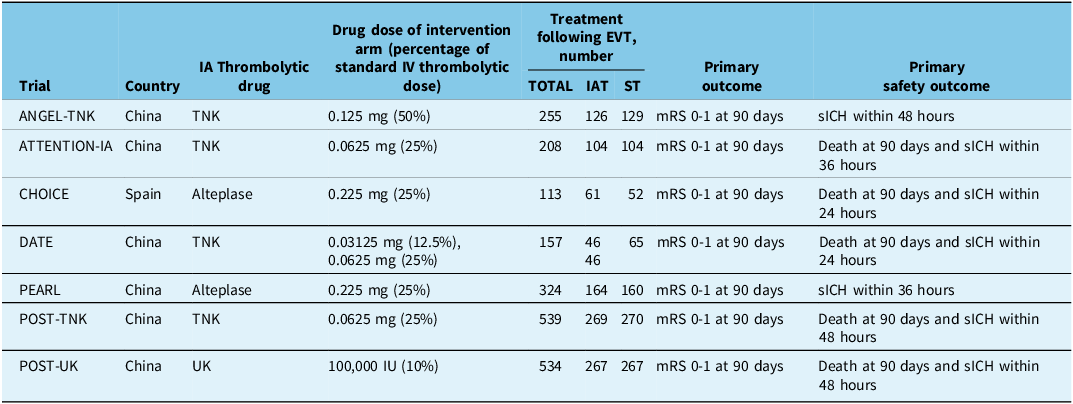
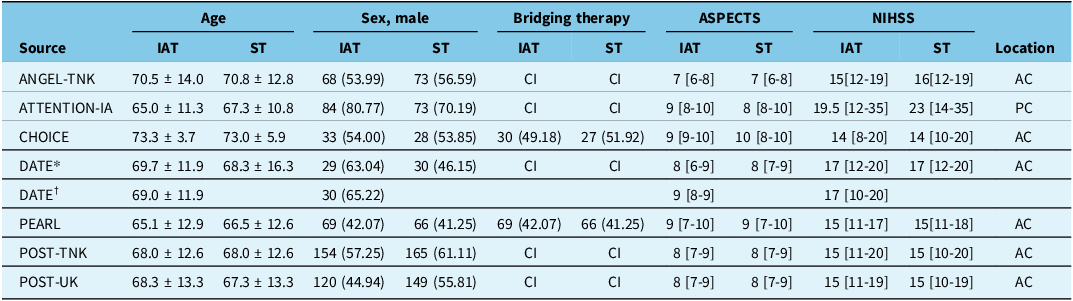
The included RCTs are summarized in Table 1. All studies evaluated the use of IA thrombolysis (alteplase, tenecteplase or urokinase) as an adjunct after EVT. Six of these trials (ANGEL-TNK, ATTENTION-IA, DATE, PEARL, POST-TNK and POST-UK) were conducted in China, Reference Huang, Yang and Liu8,Reference Hu, Tao and Wang9,Reference Hou, Huang and Wang14–Reference Miao, Luo and Song16 while one trial (CHOICE) was conducted in Spain.Reference Renú, Millán and San Román5 The EVT techniques and IA thrombolytic dosing protocols were variable. IA thrombolysis dose ranged from 10 to 50% of guideline-recommended IV dose of thrombolytics (Alteplase or Tenecteplase). EVT techniques included aspiration-first, stent-retriever-first or a combined approach. Among the baseline characteristics of included RCTs, the mean age ranged from 65 to 73 years, and 1,171 (54.98%) were males. Concurrent IV thrombolytic therapy was permitted in two studies (CHOICE and PEARL).Reference Renú, Millán and San Román5,Reference Yang, He and Pan17 The median baseline ASPECTS ranged from 7 to 8, and median baseline NIHSS ranged from 14 to 17. Only one study (ATTENTION-IA) exclusively enrolled patients with posterior circulation strokes (Table 2).
Summary of the included randomized controlled trials

Table 1 Long description
A table comparing randomized controlled trials of IA thrombolytic drugs. The table has 7 rows and 8 columns. Column headers are Trial, Country, IA Thrombolytic drug, Drug dose of intervention arm (percentage of standard IV thrombolytic dose), Treatment following EVT, number (TOTAL, IAT, ST), Primary outcome, and Primary safety outcome. Row 1: ANGEL-TNK, China, TNK, 0.125 mg (50 percent), 255, 126, 129, mRS 0-1 at 90 days, sICH within 48 hours. Row 2: ATTENTION-IA, China, TNK, 0.0625 mg (25 percent), 208, 104, 104, mRS 0-1 at 90 days, Death at 90 days and sICH within 36 hours. Row 3: CHOICE, Spain, Alteplase, 0.225 mg (25 percent), 113, 61, 52, mRS 0-1 at 90 days, Death at 90 days and sICH within 24 hours. Row 4: DATE, China, TNK, 0.03125 mg (12.5 percent), 0.0625 mg (25 percent), 157, 46, 65, 46, mRS 0-1 at 90 days, Death at 90 days and sICH within 24 hours. Row 5: PEARL, China, Alteplase, 0.225 mg (25 percent), 324, 164, 160, mRS 0-1 at 90 days, sICH within 36 hours. Row 6: POST-TNK, China, TNK, 0.0625 mg (25 percent), 539, 269, 270, mRS 0-1 at 90 days, Death at 90 days and sICH within 48 hours. Row 7: POST-UK, China, UK, 100,000 IU (10 percent), 534, 267, 267, mRS 0-1 at 90 days, Death at 90 days and sICH within 48 hours.
IA = intraarterial; IV = intravenous; EVT = endovascular thrombectomy; TNK = tenecteplase; tPA = tissue plasminogen activator; ST = standard treatment; IAT = intraarterial treatment; UK = urokinase; mRS = modified Rankin Scale; sICH = symptomatic intracerebral hemorrhage.
Baseline characteristics of the participants from the included randomized controlled trials

Table 2 Long description
The table presents baseline characteristics of participants from various randomized controlled trials. It has 8 rows and 11 columns. The columns are labeled as Source, Age, Sex (male), Bridging therapy, ASPECTS, and NIHSS. Each row corresponds to a different trial, with the following details: Row 1: Source, ANGEL-TNK; Age IAT, 70.5 ± 14.0; Age ST, 70.8 ± 12.8; Sex male IAT, 68 (53.99%); Sex male ST, 73 (56.59%); Bridging therapy IAT, CI; Bridging therapy ST, CI; ASPECTS IAT, 7 [6-8]; ASPECTS ST, 7 [6-8]; NIHSS IAT, 15 [12-19]; NIHSS ST, 16 [12-19]; Location, AC. Row 2: Source, ATTENTION-IA; Age IAT, 65.0 ± 11.3; Age ST, 67.3 ± 10.8; Sex male IAT, 84 (80.77%); Sex male ST, 73 (70.19%); Bridging therapy IAT, CI; Bridging therapy ST, CI; ASPECTS IAT, 9 [8-10]; ASPECTS ST, 8 [8-10]; NIHSS IAT, 19.5 [12-35]; NIHSS ST, 23 [14-35]; Location, PC. Row 3: Source, CHOICE; Age IAT, 73.3 ± 3.7; Age ST, 73.0 ± 5.9; Sex male IAT, 33 (54.00%); Sex male ST, 28 (53.85%); Bridging therapy IAT, 30 (49.18%); Bridging therapy ST, 27 (51.92%); ASPECTS IAT, 9 [9-10]; ASPECTS ST, 10 [8-10]; NIHSS IAT, 14 [8-20]; NIHSS ST, 14 [10-20]; Location, AC. Row 4: Source, DATE*; Age IAT, 69.7 ± 11.9; Age ST, 68.3 ± 16.3; Sex male IAT, 29 (63.04%); Sex male ST, 30 (46.15%); Bridging therapy IAT, CI; Bridging therapy ST, CI; ASPECTS IAT, 8 [6-9]; ASPECTS ST, 8 [7-9]; NIHSS IAT, 17 [12-20]; NIHSS ST, 17 [12-20]; Location, AC. Row 5: Source, DATE†; Age IAT, 69.0 ± 11.9; Sex male IAT, 30 (65.22%); Bridging therapy IAT, 9 [8-9]; NIHSS IAT, 17 [10-20]; Location, AC. Row 6: Source, PEARL; Age IAT, 65.1 ± 12.9; Age ST, 66.5 ± 12.6; Sex male IAT, 69 (42.07%); Sex male ST, 66 (41.25%); Bridging therapy IAT, 69 (42.07%); Bridging therapy ST, 66 (41.25%); ASPECTS IAT, 9 [7-10]; ASPECTS ST, 9 [7-10]; NIHSS IAT, 15 [11-17]; NIHSS ST, 15 [11-18]; Location, AC. Row 7: Source, POST-TNK; Age IAT, 68.0 ± 12.6; Age ST, 68.0 ± 12.6; Sex male IAT, 154 (57.25%); Sex male ST, 165 (61.11%); Bridging therapy IAT, CI; Bridging therapy ST, CI; ASPECTS IAT, 8 [7-9]; ASPECTS ST, 8 [7-9]; NIHSS IAT, 15 [11-20]; NIHSS ST, 15 [10-20]; Location, AC. Row 8: Source, POST-UK; Age IAT, 68.3 ± 13.3; Age ST, 67.3 ± 13.3; Sex male IAT, 120 (44.94%); Sex male ST, 149 (55.81%); Bridging therapy IAT, CI; Bridging therapy ST, CI; ASPECTS IAT, 8 [7-9]; ASPECTS ST, 8 [7-9]; NIHSS IAT, 15 [11-19]; NIHSS ST, 15 [10-19]; Location, AC.
Data are presented as n (%), mean ± SD or median [IQR]. ASPECTS = Alberta Stroke Program Early CT score; NIHSS = National Institutes of Health Stroke Scale; IAT = intraarterial treatment; ST = standard treatment; CI = contraindication; AC = anterior circulation; PC = posterior circulation. *TNK dose 0.0625mg/kg. †TNK dose 0.03125mg/kg.
Risk of bias assessment and certainty of evidence
The quality of included studies was assessed using the Cochrane Risk of Bias 2 (RoB 2) tool (Supplementary Figure 1 and 2). Among the seven studies, six had an unclear risk of bias in blinding of participants due to their open-label design, and one trial had an unclear risk of bias from other sources because of premature termination of study. Excluding concerns related to performance bias, all included studies were judged to have a low overall risk of bias. In addition, the certainty of evidence using the GRADE guidelines for each outcome showed mostly moderate to high level of certainty (Supplementary Table 1).
Efficacy endpoint
The proportion of patients achieving excellent functional outcome (mRS 0–1 at 90 days) was 44.82% in the IA thrombolysis group vs. 35.82% in the control group, with a pooled OR of 1.45 (95% CI, 1.19 to 1.76; p = 0.003) (Figure 2A). The pooled rate of functional independence (mRS 0–2 at 90 days) was 54.16% in the IA thrombolysis group vs. 51.85% in the control group, with an OR of 1.09 (95% CI, 0.99 to 1.20; p = 0.06) (Figure 2B). Recovery without any disability (mRS 0) at 90 days was 22.64% in the IA thrombolysis group vs. 17.91% in the control group, with an OR of 1.34 (95% CI: 1.09 to 1.64, p = 0.01) (Figure 2C). According to the GRADE guidelines, the certainty of evidence was high for excellent functional outcome, functional independence and recovery without any disability (Supplementary Table 1). Heterogeneity across studies was low for all efficacy outcomes (I2 = 0%). In sensitivity analyses using a fixed effects model, IA thrombolysis was significantly associated with excellent functional outcome and for recovery without any disability, but not for functional independence (Supplementary Figure 3).
Forest plot of the efficacy outcomes. (A) Excellent functional outcome (mRS 0–1). (B) Functional independence (mRS 0–2). (C) Recovery without any disability (mRS = 0). mRS = modified Rankin Scale; M-H = Mantel-Haenszel; CI = confidence interval.

Safety endpoints
The pooled symptomatic ICH rate was 5.05% in the IA thrombolysis group vs. 4.49% in the standard care group, yielding an OR of 1.14 (95% CI, 0.69 to 1.91; p = 0.53) (Figure 3A). Regarding the definition of symptomatic ICH, CHOICE used ECASS-III criteria,Reference Hacke, Kaste and Bluhmki18 five RCTs (ANGEL-TNK, ATTENTION, PEARL, POST-TNK and POST-UK) utilized the Heidelberg Bleeding classification, and DATE had an unclear definition.Reference von Kummer, Broderick and Campbell19 Similarly, the incidence of any ICH was 30.00% in the IA thrombolysis group vs. 25.69% in the standard care group, yielding an OR of 1.23 (95% CI-0.91 to 1.66; p = 0.14) (Figure 3B). The odds of death at 90 days did not differ between the treatment arms [(18.72% in the IA thrombolysis group vs. 18.71% in the standard care group, OR of 0.97 (95% CI: 0.77 to 1.23; p = 0.80)) (Figure 3C). The overall certainty of evidence in GRADE guidelines was moderate for symptomatic ICH, any ICH and death as safety outcomes (Supplementary Table 1). Heterogeneity for these outcomes was low (I2 = 0% in sICH, I2 = 20% in any ICH, and I2 = 0% in death). In sensitivity analyses using a fixed effects model, IA thrombolysis was not significantly associated with the occurrence of symptomatic ICH and death, but it was significantly associated with any ICH, with an OR of 1.24 (95% CI, 1.02 to1.51; p = 0.03) (Supplementary Figure 4).
Forest plot of the safety outcomes. (A) Symptomatic ICH. (B) Any ICH. (C) Death. ICH = intracerebral hemorrhage; M-H = Mantel-Haenszel; CI = confidence interval.

A comparison between parametric bootstrap and HKSJ methods showed differences in the direction of the possibility of symptomatic intracranial hemorrhage (sICH). The parametric bootstrap method yielded an OR of 0.84 (95% CI, 0.59 to 1.57; P = 0.77), whereas the HKSJ method resulted in an OR of 1.14 (95% CI, 0.69 to 1.91; P = 0.53). However, neither result was statistically significant. For any intracranial hemorrhage (ICH), both methods produced similar, nonsignificant outcomes. The parametric bootstrap method had an OR of 1.21 (95% CI, 0.95 to 1.54; P = 0.12), and the HKSJ method had an OR of 1.23 (95% CI, 0.91 to 1.66; P = 0.14). Similarly, for death, both approaches yielded comparable nonsignificant results, with an OR of 0.88 (95% CI, 0.65 to 1.18; P = 0.41) using parametric bootstrap and 0.97 (95% CI, 0.77 to 1.23; P = 0.80) using the HKSJ method.
Subgroup analyses
When the analyses were restricted to studies of anterior circulation strokes, the results remained unchanged for excellent functional outcome, recovery without any disability (Supplementary Figures 5A and 5C), and for symptomatic ICH, any ICH, and death (Supplementary Figure 6A, 6B, and 6C). However, the improvement in functional outcome for mRS 0–2 became significant with an OR of 1.11 (95% CI, 1.01 to 1.22; P = 0.04) (Supplementary Figure 5B). Subgroup analyses conducted based on the thrombolytic agent (tenecteplase vs. alteplase vs. urokinase) showed that both alteplase and tenecteplase had significant beneficial effects on excellent functional outcomes (mRS 0–1) while urokinase did not. In addition, trials using doses equivalent to 25% and 50% of the guideline-recommended IV thrombolysis dosing achieved significant improvement on mRS 0–1 while those using 10% and 12.5% did not, with high certainty of evidence according to GRADE guidelines (Figure 4) (Supplementary Table 1). Meta-regression analyses using dose as either a continuous or ordinal variable consistently indicated a small, nonsignificant increase in the odds of achieving mRS 0–1 with higher doses, both with an OR of 1.01 (95% CI, 0.99 to 1.03; P = 0.13). Two studies allowed concurrent intravenous (IV) thrombolytic therapy. A subgroup analysis showed no significant additional benefit of IA thrombolytics on excellent functional outcome when concurrent IV thrombolytic therapy was used (Supplementary Figure 7A and 7B). Further subgroup analysis based on reperfusion status according to the mTICI grade demonstrated no significant benefit of IA thrombolytics for excellent functional outcomes in patients achieving mTICI 2b vs. mTICI 2c-3 recanalization (Supplementary Figure 8A and 8B).
Forest plot of excellent functional outcome (mRS 0–1) according to the intraarterial thrombolytic agent and the dose as subgroup analysis. M-H = Mantel-Haenszel; CI = confidence interval; TNK = tenecteplase; UK = urokinase.

Figure 4 Long description
A table comparing the effects of different thrombolytic agents and doses on functional outcomes in patients undergoing endovascular treatment. The table has 12 rows and 7 columns. Column headers are: Study or Subgroup, Intervention Events, Intervention Total, Standard Events, Standard Total, Weight, and Odds Ratio. Row labels include different thrombolytic agents (Alteplase, TNK, UK) and doses (10 percent, 12.5 percent, 25 percent, 50 percent). The table presents data on the number of events and totals for both intervention and standard groups, along with the weight and odds ratio for each subgroup. Notable trends include varying odds ratios for different agents and doses, with some showing higher efficacy. The total events and overall effects are also summarized at the bottom of the table.
Additionally, subgroup analyses based on geographical distribution (China vs. Spain) consistently showed significant benefits for IA thrombolysis in achieving mRS 0–1, with an OR of 1.42 (95% CI, 1.16 to 1.74; P = 0.0006) in Chinese studies and an OR of 2.13 (95% CI, 1.00 to 4.51; P = 0.05) in the Spanish study (Supplementary Figure 9A). However, analyses of outcomes for mRS 0–1 and mRS 0 individually showed similar favorable trends for IA thrombolytics in both regions, with each individual comparison (China and Spain) being statistically nonsignificant (Supplementary Figure 9B and 9C). Regarding safety outcome, the directions of outcomes for symptomatic ICH, any ICH and death differed between regions, but none reached statistical significance (Supplementary Figure 10A, 10B and 10C).
Discussion
In this meta-analysis of seven RCTs investigating IA thrombolysis after EVT, IA thrombolysis was significantly associated with a higher likelihood of achieving excellent functional outcome (mRS 0–1) and complete recovery (mRS 0) at 90 days. Tenecteplase or alteplase at doses equivalent to 25% (tenecteplase at a dose of 0.0625mg/kg; maximum dose, 6.25 mg or alteplase at a dose of 0.225mg/kg; maximum dose, 22.5 mg) or 50% (tenecteplase at a dose of 0.125mg/kg; maximum dose, 12.5 mg) of the total dose of IV thrombolytics provided significant benefit for achieving excellent functional outcome. IA thrombolysis appears safe with no significant increase in the risk of symptomatic ICH, any ICH or death.
Adjunctive IA thrombolysis is promising to bridge the gap between successful angiographic recanalization and clinical outcomes through enhancing microvascular reperfusion. An imaging sub-study of the CHOICE phase 2b RCT revealed that 58% patients in the standard care arm experienced persistent hypoperfusion on MRI at 48 hours after successful EVT compared to only 24% after EVT plus intraarterial alteplase.Reference Laredo, Rodríguez and Oleaga20 However, current guidelines from major stroke organizations do not provide explicit recommendations regarding the routine use of adjunctive IA thrombolysis following successful EVT. The American Stroke Association acknowledges potential roles for IA therapy, such as addressing distal embolization during interventions, but does not offer specific guidelines on its routine administration following EVT.Reference Powers, Rabinstein and Ackerson21 Our meta-analysis, suggesting improved outcomes with adjunctive IA thrombolysis after EVT among those who achieved successful reperfusion, may provide justification for considering a role for this treatment approach in future guidelines.
Our analysis did not identify a statistically significant increase in symptomatic ICH or any ICH risk, which is a primary concern when administrating IA thrombolytic drug. This safety profile aligns with results from observational studies and case series. Another plausible explanation of this finding is that more effective reperfusion likely decreases the probability of hemorrhagic transformation, including sICH.Reference Hong, Kim and Kim22 Therefore, the enhanced reperfusion achieved by IA thrombolysis could balance out the potential risk of hemorrhage related to thrombolytic administration. However, given the limited sample size, our analysis might be underpowered to detect small yet clinically meaningful differences in hemorrhage risk. Even minor increase in risk, such as 1% absolute difference, could become clinically significant when applied to large patient population. Moreover, concerns about hemorrhagic complications might be heightened when IA thrombolysis is administered alongside IV thrombolysis. Among the seven RCTs, only two trials, CHOICE and PEARL, permitted concurrent IV thrombolytic therapy with a combined total of only 191 patients included.Reference Renú, Millán and San Román5,15,Reference Yang, He and Pan17 Given the limited available data, additional RCTs permitting concurrent IV thrombolytic therapy are warranted to better assess the risk of this combination.
Despite promising results from recent studies, several gaps persist regarding the routine use of adjunctive IA thrombolysis after EVT. Our analysis suggests that administering tenecteplase or alteplase at doses equivalent to 25% or 50% of the guideline-recommended IV dose significantly increases the likelihood of excellent functional outcomes. However, findings from the DATE dose-finding study indicate higher risk of intracranial hemorrhage with IA tenecteplase at 50% of the standard IV dose, underscoring the need for more evidence on the appropriate dosing.Reference Hou, Huang and Wang14 Additionally, the current body of evidence remains fragmented due to trial population heterogeneity, the restricted geographic representation, and inconsistencies in key functional outcomes. Included RCTs have all been conducted in China (n = 6) or Spain (n = 1), limiting their generalizability to diverse populations with different healthcare systems, stroke care pathways and thrombectomy practices. Furthermore, while some trials demonstrate a benefit in achieving mRS 0–1 at 90 days, this effect was not observed for mRS 0–2 or across the full ordinal distribution of disability outcomes. This finding can suggest that other factors may modify the effect of IA thrombolysis on clinical outcomes. For example, partial reperfusion can potentially lower the likelihood of achieving functional independence (mRS 0–2). However, this observation might also reflect statistical variability or a threshold effect, favoring recognition of an excellent functional outcome (mRS 0–1), or simply indicate that adjunctive IA thrombolysis yields only modest incremental effect. The benefit-risk balance of IA thrombolytic drugs across different mTICI reperfusion grades at the end of EVT also remains uncertain due to the small sample size and restricted patient population in these studies. Given these gaps, a large-scale, pragmatic and globally representative confirmatory trial is urgently needed to provide definitive evidence on IA thrombolysis, refine treatment protocols and establish clear clinical guidelines.
The planned large randomized controlled REACT (Reperfusion Enhancement After Completing Thrombectomy using IA thrombolysis) trial, nested within the ACT-GLOBAL adaptive platform trial (Clinicaltrials.gov: NCT 06352632), aimed to recruit up to 1500 globally, stratified by the IA thrombolytic used (tenecteplase or alteplase) and including patients with all reperfusion grades after EVT.Reference Lorenzi, Crawford and Anderson23 Additionally, other phase 2 and 3 randomized trials are under way. Together, these studies will help address current evidence gaps and optimize treatment protocols.
This study has limitations. First, most included RCTs in this meta-analysis were conducted in an open-label manner, with potential risk for bias. Second, this meta-analysis included a number of studies that were heterogenous with regards to study drug type, dose and inclusion criteria. Third, six of the seven studies were conducted in China, where the prevalence of LVO due to intracranial atherosclerotic disease is higher, thus limiting the generalizability of findings to other populations. Fourth, despite the importance of mTICI grading as an inclusion criterion and its impact on clinical outcomes, central and blinded adjudication was reported only in three studies (ATTENTION-IA, CHOICE and PEARL). Fifth, the statistical heterogeneity for each outcome in our analysis was consistently low. This may reflect similarities in treatment protocols across studies as well as the similar geographical distribution of patients, as six of the seven included RCTs were conducted in China. Nevertheless, an underlying heterogeneity is still possible despite low statistical heterogeneity. Finally, some of the included studies were not published in full, which limits the full assessment of their quality.
Conclusion
This meta-analysis of seven RCTs shows that adjunctive IA thrombolysis after EVT significantly improves excellent functional outcomes, especially when tenecteplase or alteplase is administered at 25%–50% of the guideline-recommended IV dose without increasing the risk of symptomatic ICH. However, despite these promising results, a large global trial is urgently needed to fill the remaining evidence gaps and confirm these findings across a broader patient population.
Supplementary material
Supplementary material. The supplementary material for this article can be found at https://doi.org/10.1017/cjn.2025.10354
Author contribution
Conceptualization: MAA, HP. Study design: MAA, HP, BMK. Methodology: MAA, HP, BMK. Data collection: MAA, HP. Statistical analysis: MAA, HP, BMK. Writing-original draft: MAA, HP. Writing-review, editing & critical revision: MAA, HP, NS, RL, UP, KI, JO, AG, MA, AMD, MDH and BMK. Funding acquisitions: HP. Approval of final manuscript: all authors.
Funding statement
This study was supported by a grant from the Korea Health Technology R&D project through the Korea Health Industry Development Institute (KHIDI), funded by the Ministry of Health & welfare, Republic of Korea (RS-2023-00265497).
Competing interests
BKM has received consulting fees from Boehringer Ingelheim and Roche and had a service agreement with Genentech. MAA is the principal investigator of the REACT trial.





Target article
Adjunctive Intraarterial Thrombolysis after Thrombectomy in Large Vessel Occlusion Stroke: A Meta-Analysis of RCTs
Related commentaries (1)
Reviewer Comment on Almekhlafi et al. “Adjunctive Intraarterial Thrombolysis after Thrombectomy in Large Vessel Occlusion Stroke: A Meta-Analysis of RCTs”