Management Implications
Aegilops triuncialis (barb goatgrass) is an invader of Mediterranean annual grasslands and serpentine soil plant communities in the western United States. It has little value as a forage plant, and there are downsides and challenges to controlling it with prescribed fire, mowing, and grazing. One herbicide option is glyphosate, but this can damage native forbs and forage grasses. Grass-specific herbicides are another option, but they also pose risks to forage grasses and may be ineffective unless applied at rates exceeding maximum label application rates.
In recent field studies, the herbicide aminopyralid applied just before flowering greatly reduced viable seed production of the invasive annual grass Taeniatherum caput-medusae (medusahead), a weed inhabiting many of the same grasslands as A. triuncialis. By reducing seed production in the current generation of plants, aminopyralid reduced T. caput-medusae cover in the subsequent generation of plants the following year. In this greenhouse study, we found the same aminopyralid treatment nearly eliminated viable seed production in A. triuncialis. This suggests aminopyralid could be used to control A. triuncialis in the field, as has been shown for T. caput-medusae in the field, though this requires field testing before treating large infestations.
In annual grasslands where A. triuncialis and T. caput-medusae occur, the desired forage grasses are generally exotic annuals that flower and produce seed before A. triuncialis and T. caput-medusae. By applying aminopyralid after annual forage grasses have mostly finished producing seed but before most T. caput-medusae flowers, it has proven possible to reduce T. caput-medusae seed production and cover without greatly reducing forage grass seed production. This strategy has increased forage grass cover in T. caput-medusae–infested grasslands and will likely do the same in A. triuncialis–infested grasslands. Moreover, because aminopyralid controls many invasive forbs, carefully timed applications should simultaneously control mixed stands of A. triuncialis, T. caput-medusae, and weedy forbs like Centaurea solstitialis (yellow starthistle). However, aminopyralid poses risks to desirable nonnative and native forbs. In past studies of annual grasslands, these forbs quickly recovered from aminopyralid damage, but this may not hold true in the serpentine soil habitats A. triuncialis has invaded, which support rare endemic forbs. Aegilops triuncialis maintains a seedbank, so 2 yr of treatment will likely be needed to partially control it, and even more years will be required to eradicate it. The relatively low cost of the low aminopyralid rate needed to constrain viable seed production should encourage repeated applications where necessary.
Introduction
Barb goatgrass (Aegilops triuncialis L.) is an exotic annual grass that has invaded grasslands of California and to a lesser extent Nevada and Oregon. Several Aegilops species that are invasive in the United States tend to respond similarly to management due to similarities in phenology and biology (Gornish et al. Reference Gornish, Case, Valle, Bean and Moore-O’Leary2018). In addition to Mediterranean annual grasslands in the region, A. triuncialis has invaded serpentine soil plant communities, oak (Quercus spp.) woodlands, and vernal pools (Drenovsky and Batten Reference Drenovsky and Batten2007; Lyons et al. Reference Lyons, Shapiro and Schwartz2010), where it threatens to displace rare endemic plants (Kruckeberg Reference Kruckeberg1985). Aegilops triuncialis has a relatively limited distribution, therefore making it a possible candidate for containment or local eradication. Due to its high silica concentrations and barbed awns that can injure grazing animals, A. triuncialis is considered poor forage for livestock and wildlife (Davy et al. Reference Davy, DiTomaso and Laca2008; Jacobsen Reference Jacobsen1929; Kennedy Reference Kennedy1928; Peters et al. Reference Peters, Johnson and George1996).
Prescribed fire, mowing, grazing, and herbicides have been evaluated for A. triuncialis control. Prescribed fire sometimes suppresses the weed and increases abundances of native species (DiTomaso et al. Reference DiTomaso, Heise, Kyser, Merenlender and Keiffer2001; Hopkinson et al. Reference Hopkinson, Fehmi and Bartolome1999; Marty et al. Reference Marty, Sweet and Buck-Diaz2015). However, properly timing burns is difficult. Insufficient fuel can prevent effective burns (DiTomaso et al. Reference DiTomaso, Heise, Kyser, Merenlender and Keiffer2001), and A. triuncialis seeds fall to the ground soon after maturation, where burn temperatures are lower and less likely to kill seeds. Mowing can partially control A. triuncialis but leads to defoliation of native forbs, which can limit their recovery (Aigner and Woerly Reference Aigner and Woerly2011). Also, mowing sometimes increases invasive forb abundances in annual grasslands (Valliere et al. Reference Valliere, Balch, Bell, Contreras and Hilbig2019). Heavy grazing of small plots at the A. triuncialis tillering stage has nearly eliminated seed production (Bean et al. Reference Bean, Davy, Kyser and Gornish2021), but heavily grazing large infestations during the brief tillering-stage period is infeasible.
Several herbicides have been tested against A. triuncialis and other Aegilops species (Gornish et al. Reference Gornish, Case, Valle, Bean and Moore-O’Leary2018). The nonselective herbicide glyphosate performs inconsistently. During the growing season of application, glyphosate nearly eliminated A. triuncialis seed production in one study (Bean et al. Reference Bean, Davy, Kyser and Gornish2021), reduced A. triuncialis frequency about 70% in another study (Peters Reference Peters1994), and provided no significant control in a third study (Aigner and Woerly Reference Aigner and Woerly2011). Additionally, glyphosate can damage desirable grasses and forbs that grow with A. triuncialis (Aigner and Woerly Reference Aigner and Woerly2011; Lym and Kirby Reference Lym and Kirby1991). The grass-selective herbicides clethodim and fluazifop do not damage forbs, and applying these herbicides in two consecutive growing seasons has provided some control of A. triuncialis (Aigner and Woerly Reference Aigner and Woerly2011; Case et al. Reference Case, Harrison and Cornell2016). However, herbicide rates of these studies exceeded maximum labeled rates (Aigner and Woerly Reference Aigner and Woerly2011; Case et al. Reference Case, Harrison and Cornell2016), and the product labels also prevent applying these herbicides before or during grazing, which limits use on grazing lands. Moreover, these herbicides are capable of damaging desirable annual and perennial grasses that grow with A. triuncialis (Aigner and Woerly Reference Aigner and Woerly2011; Case et al. Reference Case, Harrison and Cornell2016).
Another potential herbicide is aminopyralid, a growth-regulator herbicide that can be used before and during grazing. Aegilops triuncialis has invaded many of the same grasslands as the invasive annual grass medusahead [Taeniatherum caput-medusae (L.) Nevski] (Bean et al. Reference Bean, Davy, Kyser and Gornish2021). Aminopyralid applied to T. caput-medusae and several other invasive annual grasses at jointing, boot, or very early heading stages causes development of seed lacking endosperm and the ability to germinate (Rinella et al. Reference Rinella, Haferkamp, Masters, Muscha, Bellows and Vermeire2010a, Reference Rinella, Masters and Bellows2010b, Reference Rinella, Masters and Bellows2013, Reference Rinella, Bellows and Roth2014, Reference Rinella, Davy, Kyser, Mashiri, Bellows, James and Peterson2018). Consequently, it has proven possible to use aminopyralid to control T. caput-medusae by depleting its short-lived seedbank (Rinella et al. Reference Rinella, Davy, Kyser, Mashiri, Bellows, James and Peterson2018, Reference Rinella, Bellows, Davy, Forero, Hatler and James2021).
In the annual grasslands where A. triuncialis and T. caput-medusae occur, the desirable forage grasses are exotic annuals like wild oat (Avena fatua L.), soft brome (Bromus hordeaceus L.), and Italian ryegrass [Lolium perenne L. ssp. multiflorum (Lam.) Husnot], and these grasses usually flower and produce seed earlier in the growing season than A. triuncialis and T. caput-medusae (Bean et al. Reference Bean, Davy, Kyser and Gornish2021; DiTomaso et al. Reference DiTomaso, Heise, Kyser, Merenlender and Keiffer2001; McKell et al. Reference McKell, Wilson and Kay1962). By applying aminopyralid between when most desirable grasses produce seed and when T. caput-medusae flowers and produces seed, it has proven possible to greatly reduce T. caput-medusae seed production with little effect on desirable grass seed production (Rinella et al. Reference Rinella, Davy, Kyser, Mashiri, Bellows, James and Peterson2018, Reference Rinella, Bellows, Davy, Forero, Hatler and James2021). In response to controlling T. caput-medusae with this strategy, desirable grasses have increased the year following aminopyralid application (Rinella et al. Reference Rinella, Davy, Kyser, Mashiri, Bellows, James and Peterson2018, Reference Rinella, Bellows, Davy, Forero, Hatler and James2021). We believe this same strategy will work for A. triuncialis, presuming aminopyralid strongly limits A. triuncialis seed production.
Additionally, aminopyralid is less toxic to desirable perennial grasses than glyphosate, clethodim, and fluazifop. Aminopyralid is unlikely to damage perennial grasses beyond potentially reducing their seed production (e.g., Almquist and Lym Reference Almquist and Lym2010; DiTomaso and Kyser Reference DiTomaso and Kyser2015), and perennial grasses rely more on vegetative propagation than seed for population maintenance and growth. However, aminopyralid was developed and is widely used for controlling invasive forbs. So, unsurprisingly, aminopyralid often damages desirable forbs when used to control invasive annual grasses (Rinella et al. Reference Rinella, Davy, Kyser, Mashiri, Bellows, James and Peterson2018, Reference Rinella, Bellows, Davy, Forero, Hatler and James2021). However, forb species vary widely in their responses to aminopyralid, and in two studies, many forbs recovered from aminopyralid damage within 3 yr following application (DiTomaso and Kyser Reference DiTomaso and Kyser2015; Kyser et al. Reference Kyser, Peterson, Davy and DiTomaso2012).
We quantified effects of aminopyralid on viable A. triuncialis seed production in the greenhouse. Given results from other invasive annual grasses (Rinella et al. Reference Rinella, Haferkamp, Masters, Muscha, Bellows and Vermeire2010a, Reference Rinella, Masters and Bellows2010b, Reference Rinella, Masters and Bellows2013, Reference Rinella, Bellows and Roth2014, Reference Rinella, Davy, Kyser, Mashiri, Bellows, James and Peterson2018, Reference Rinella, Bellows, Davy, Forero, Hatler and James2021; but see Vermeire et al. Reference Vermeire, Rinella and Strong2021), we hypothesized aminopyralid applied shortly before A. triuncialis heading would nearly eliminate viable seed production.
Materials and Methods
Four runs of a greenhouse experiment were conducted between October 2019 and July 2021. Aegilops triuncialis seed was collected in June 2018 from Garin Regional Park near Hayward, CA (37.62797°N, 122.02606°W). Seeds were sown in flats (51 × 26 × 6 cm) containing commercial potting soil (Sunshine Mix no. 1, Sun Gro Horticulture, Bellevue, WA) and placed in a greenhouse with temperatures of 21 C (day) and 10 C (night). After about 8 d, when seedlings reached ∼6.5 cm in height, they were vernalized for 60 d in a growth chamber with an 8-h photoperiod (cool-white fluorescent bulbs, 20 W) at a constant temperature of 2 C, with soil kept moist. Following vernalization, seedlings (one per pot) were planted in pots (21-cm diameter × 21-cm height, 7.6 L) containing the previously described soil and placed in a greenhouse (21 C day, 10 C night). Pots received water when soil appeared dry.
Treatments were a no-aminopyralid control and aminopyralid applied at 0.069 kg ae ha−1 (22% of the maximum labeled rate) at the boot stage. Treatments were replicated four times, and pots were arranged in a randomized complete block design (4 experiments × 4 blocks × 2 treatments = 32 pots in the study). Herbicide was applied by walking next to pots arranged in a row holding a CO2-pressurized backpack sprayer with 4-XR TeeJet® 8200VS nozzles (TeeJet Technologies, Wheaton, IL) calibrated to deliver 131 L ha−1.
Spikes were clipped from plants when ripe (170 to 180 d postvernalization). Lower A. triuncialis spikelets typically contain one small seed and one large seed, and these two seeds can exhibit different dormancy characteristics (Dyer Reference Dyer2004). However, in this study, the two seeds were similarly sized, so it was not possible to assess germinability of small and large seeds separately. Seeds were removed from spikes and stored in paper bags at room temperature for ∼60 d, after which germinability was determined by incubating seeds in 100 x 15-mm petri dishes (≤50 seeds per dish) in a growth chamber with a 12-h photoperiod (cool-white fluorescent bulbs, 32 W) at temperatures of 22 C (light) and 15 C (dark). Each dish contained filter paper supported by a polyurethane foam disk. Distilled water was continuously supplied to seeds via a cotton wick inserted in a hole in the center of the disk. Seeds were recorded as viable and removed from dishes if radicles and coleoptiles >5 mm in length developed within 30 d.
The germination data contained zeros due to some treated plants producing no viable seed. Therefore, typical parametric statistical assumptions of normally distributed residuals with constant variance were not met, and we analyzed the data with a randomization test (Crowley Reference Crowley1992) conducted in Mathematica (Wolfram Research 2017).
Results and Discussion
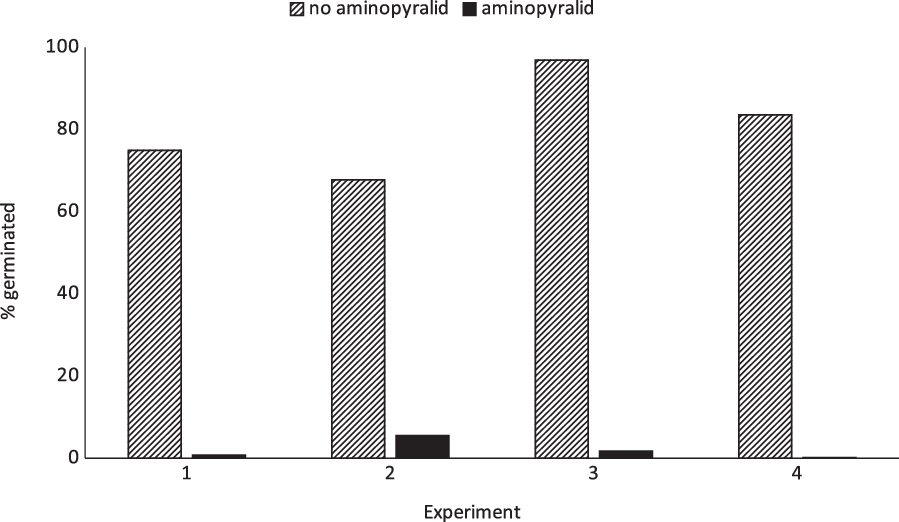
Depending on the experiment, aminopyralid reduced A. triuncialis germination from between 65% and 95% to between 1% and 5% (P < 0.001) (Figure 1). Aminopyralid similarly reduced T. caput-medusae germination in the greenhouse (Rinella et al. Reference Rinella, Bellows and Roth2014). This leads us to believe aminopyralid will control A. triuncialis in the field, as it does T. caput-medusae (Rinella et al. Reference Rinella, Davy, Kyser, Mashiri, Bellows, James and Peterson2018, Reference Rinella, Bellows, Davy, Forero, Hatler and James2021), particularly since A. triuncialis and T. caput-medusae exhibit similar growth patterns and inhabit some of the same grasslands (Bean et al. Reference Bean, Davy, Kyser and Gornish2021). However, in the Great Plains, aminopyralid is less consistently effective against the invasive annual grass Japanese brome (Bromus arvensis L.) in the field than in the greenhouse (Rinella et al. Reference Rinella, Haferkamp, Masters, Muscha, Bellows and Vermeire2010a, Reference Rinella, Masters and Bellows2010b; Vermeire et al. Reference Vermeire, Rinella and Strong2021), which opens up the possibility that aminopyralid will perform inconsistently against A. triuncialis in the field. Therefore, we are reluctant to recommend applying aminopyralid to large A. triuncialis infestations until field research is conducted. We likewise caution against applying aminopyralid to serpentine soils supporting rare endemic forbs. Although relatively common forbs have recovered from aminopyralid rather quickly (DiTomaso and Kyser Reference DiTomaso and Kyser2015; Kyser et al. Reference Kyser, Peterson, Davy and DiTomaso2012), this might not hold true for rare forbs.
Means and SEs quantifying effects of the herbicide aminopyralid on Aegilops triuncialis germination in four greenhouse experiments. Within each experiment, aminopyralid and no-aminopyralid treatments were significantly different (P < 0.001).

Applying aminopyralid to A. triuncialis–infested areas supporting invasive forbs may simultaneously control the grass and forb invaders. For example, A. triuncialis sometimes occurs with yellow starthistle (Centaurea solstitialis L.) as well as other invasive thistles, and aminopyralid is highly effective against C. solstitialis, even at the low rates applied in this study (Kyser et al. Reference Kyser, Peterson, Orloff, Wright and DiTomaso2011, Reference Kyser, Hazebrook and DiTomaso2013). Aegilops triuncialis also commonly occurs with T. caput-medusae, so aminopyralid could also potentially be used to simultaneously control both these grass invaders.
Aegilops triuncialis responses to aminopyralid will in part depend on seedbank dynamics. With T. caput-medusae, a plant that lacks persistent seedbanks, using aminopyralid to nearly eliminate seed production in one year nearly eliminated cover the following year (Rinella et al. Reference Rinella, Davy, Kyser, Mashiri, Bellows, James and Peterson2018). Aegilops triuncialis seeds exhibit varying levels of dormancy that can allow this plant to maintain seedbanks (Dyer Reference Dyer2004), so while a single aminopyralid application may modestly reduce A. triuncialis levels, greatly reducing or eradicating the weed will generally require multiple applications. Past research gives clues regarding the number of aminopyralid applications needed to control A. triuncialis. Aigner and Woerly (Reference Aigner and Woerly2011) found preventing seed inputs for 2 yr through hand pulling reduced A. triuncialis frequency from about 85% to 30%. That eliminating seed inputs did not eradicate A. triuncialis indicates some seeds can survive in soil for >2 yr. Based on observations from a natural area, Aigner and Woerly (Reference Aigner and Woerly2011) estimated 5 to 6 yr of hand pulling could be necessary to deplete seedbanks and eradicate A. triuncialis. Conversely, DiTomaso et al. (Reference DiTomaso, Heise, Kyser, Merenlender and Keiffer2001) found burning sites to prevent seed inputs for 2 yr nearly or completely eliminated A. triuncialis. These differing results indicate site conditions and other factors will dictate the number of aminopyralid applications needed to control or eradicate A. triuncialis. Perhaps the most important factor is environmental conditions affecting germination. If favorable conditions cause nearly all seeds to germinate over a (say) 2-yr treatment period, and two aminopyralid applications nearly eliminate seed inputs over that period, the seedbank will be depleted in 2 yr. On the other hand, if unfavorable conditions cause ungerminated seeds to remain in the seedbank during the treatment period, longer treatment periods will be required. Fortunately, it appears that just 22% of the maximum registered aminopyralid rate will greatly limit viable A. triuncialis seed production, and the low cost of this low rate should encourage repeated applications where necessary.
Acknowledgments
This research received no specific grant from any funding agency or the commercial or not-for-profit sectors. No conflicts of interest have been declared.