Introduction
Information on the extent and impact of lifetime alcohol misuse in older persons remains sparse, and especially so for countries in South America with an increasing older population (Mendoza-Sassi and Beria, Reference Mendoza-Sassi and Beria2003; Almeida Filho et al., Reference Almeida Filho2004; Vicente et al., Reference Vicente2006; Barros et al., Reference Barros, Botega, Dalgalarrondo, Marín-León and de Oliveira2007; Galduróz and Carlini, Reference Galduróz and Carlini2007; Laranjeira et al., Reference Laranjeira, Pinsky, Zaleski and Caetano2007; Silveira et al., Reference Silveira, Wang, Andrade and Andrade2007).
Studies indicate that moderate alcohol use may be beneficial, protecting cardiac and cognitive function, improving physical and functional performance, and reducing the risk of all-cause mortality (Cawthon et al., Reference Cawthon2007). However, the adverse effects of inappropriate alcohol use are of particular concern for the elderly because of association with the development of liver disease, various cancers, hypertension, falls, a decrease in bone density, cognitive impairment, psychiatric disorders, and drug interactions (Council on Scientific Affairs, 1996; National Institute on Alcohol Abuse and Alcoholism, 1998).
Our focus is Brazil, and in particular community residents aged 60 years and older in the southern wine state of Rio Grande do Sul. Here we examine self-reported lifetime alcohol misuse in order to ascertain the prevalence of this condition, identify the characteristics of such alcohol misusers, their current lifestyle and social environment, and health status.
Methods
Sample
This cross-sectional study of non-institutionalized persons aged 60 years and over was based on multistage, stratified random sampling in nine homogeneous areas covering the state of Rio Grande do Sul, Brazil. This is a notable wine region located in the southern Brazil, with a largely agro-industrial economy, populated primarily by descendents of European immigrants. Data were gathered in 1995 in face-to-face household surveys of 7920 residents of urban and rural counties. The structured interview included assessment of sociodemographic characteristics, activity (physical exercise and employment) and living arrangements, physical and mental health, functional status, and a five-item questionnaire on lifetime alcohol abuse and dependency, here called alcohol misuse. Details on methods have been reported previously (Conselho Estadual do Idoso, 1997; Blay et al., Reference Blay, Andreoli, Fillenbaum and Gastal2007). The study was approved by the Ethics Committee of the Federal University of São Paulo. Participants gave verbal consent.
Data gathering and quality control
Data were gathered by carefully trained, closely supervised, interviewers. Review of the database identified data entry problems in one region, which was then excluded from the analysis. In each of the remaining eight regions, 880 persons were approached, giving a total of 7040 persons. No proxy information was collected. Non-response was negligible: 79 persons (1.1%) did not take part in the assessment (mainly refusals), yielding an overall response rate of 99% (N = 6961). Two other people were dropped because of missing data.
Data obtained
Dependent variable: evaluation of alcohol use
Use of alcohol was determined by response (yes/no) to each of the following questions, of which questions 1, 3 and 4 address lifetime abuse of alcohol, and questions 2 and 5 address lifetime dependence (American Psychiatric Association, 1994; Hasin et al., Reference Hasin, Stinson, Ogburn and Grant2007):
1. Has your family, a friend, your physician or your priest ever commented or suggested that you were drinking too much?
2. Have you ever tried to stop drinking but been unable to do so?
3. Have you ever had trouble at work or school because of alcohol, such as drinking or missing work?
4. Have you ever been involved in fights or arrested for being drunk?
5. Has it ever seemed to you that you were drinking too much?
Participants were not asked when the situation occurred. Positive responses were summed, yielding a score that could range from 0 to 5. Scores were trichotomized as 0, 1, more than 1.
Independent variables
Independent variables were classified into three categories: sociodemographic (to determine the characteristics of users), lifestyle and social environment (to identify potentially protective and risky behaviors), and health (to identify any association with health status).
Sociodemographic measures included gender, age (60–69 years, 70–79 years, 80+ years), education (0–3 years, ≥4 years), income (low income < US$200/month, high income ≥US$200/month, where the cut-point represents a standard poverty level), race/ethnicity (Caucasian, African-Brazilian, Other), religious affiliation (Catholic, Evangelical, Other), and place of birth (urban vs. rural area).
Lifestyle included exercise, assessed by asking: “In the last three months did you practice a regular physical activity?” (yes (= once a week or more)/no); employment status (employed if they were still working (the type of work was immaterial), and inactive if they were not working or did not know the answer); and current use of tobacco (yes/no). Social environment included marital status (married, never married, no longer married/cohabiting), whether living alone or with someone else, the presence of children, and participation in social activities and religion-affiliated activities.
Health conditions. Participants self-reported on the presence of 18 medical conditions. Preliminary analysis indicated that the only conditions relevant in this population were vascular conditions (any mention of heart disease, hypertension, diabetes, stroke, varicose veins), respiratory problems (any mention of bronchitis or pneumonia), kidney problems, osteoporosis, and psychiatric problems. The presence of psychiatric problems was determined by response on a 6-item abbreviation of the Short Psychiatric Evaluation Schedule (Pfeiffer, Reference Pfeiffer, Hoffmeister and Muller1979; Blay et al., Reference Blay, Ramos and Mari1988), a valid measure for assessment of psychiatric status in Brazilian elderly persons. Problems with activities of daily living (ADL) were assessed by a 5-item unidimensional scale that sought information on whether participants could perform household activities (clean, maintain, cook); take their medicines; bathe/comb hair/dress; eat; walk/sit/lie down/get around indoors/walk upstairs. The number of impaired activities was recoded as 0, 1–2, and 3 or more.
Statistical analysis
Percentages were used to describe the sample, and χ2 to ascertain group differences. To determine which characteristics were associated with alcohol misuse (0, 1, 2 or more items endorsed) we used polytomous multivariable logistic regression. We first permitted all variables meeting criteria of P < 0.05 to enter the model, and then ran a final model including only those variables found to be significant in this preliminary analysis. Because of the number of analyses, in the final model we accepted as significant only those variables meeting the criterion of P < 0.01. All analyses were performed using SPSS 13.0.
Results
Lifetime alcohol use was ascertained for 6959 of the 6961 participants. Of these, 734 participants (10.55%) endorsed one or more of the five items indicating a problem with alcohol at some time, distributed as follows: one item endorsed, 314 (4.51%); two items, 229 (3.29%); three items, 126 (1.81%); four items, 47 (0.67%); five items, 18 (0.25%).
Examination of the individual alcohol questions showed that question 3 (Have you ever had trouble at work or school because of alcohol, such as drinking or missing work?) and question 4 (Have you ever been involved in fights or arrested for being drunk?) were endorsed by only 98 and 69 persons respectively, whereas question 5 (Has it ever seemed to you that you were drinking too much?) and question 1 (Has your family, a friend, your physician or your priest ever commented or suggested that you were drinking too much?) were endorsed by 566 and 456 persons respectively.
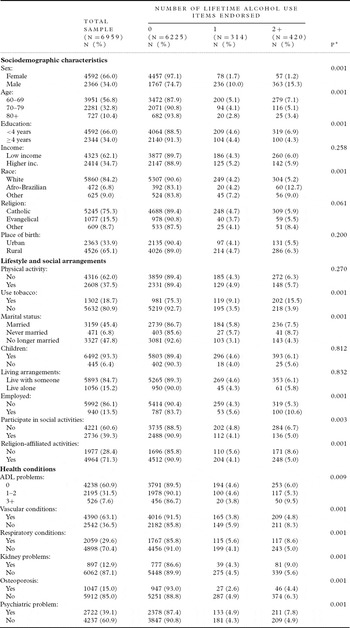
The basic characteristics of the sample, and whether they endorsed none, one or two or more items, are given in Table 1. Two-thirds were female, mainly younger (57% under age 70), of low education and low income, and born in a rural area. The majority were white (84%) and Catholic (75%).
Characteristics of the total sample, and by number of lifetime alcohol use items endorsed

Notes: Values may not total to 6959, and percentages may not sum to 100 because of missing data.
Vascular conditions include any mention of heart disease, hypertension, diabetes, stroke, varicosities; respiratory problems include any mention of bronchitis or pneumonia.
* – based on χ2 test.
Uncontrolled analyses indicated that men were more likely to report problems with alcohol than women (25.3% as compared to 2.9%), report of alcohol-associated problems declined with increasing age, and such problems were higher among persons with lower education, but did not differ significantly by income level. Race was a factor (more problems reported among non-whites), but religious affiliation, place of birth, physical activity, having offspring and living arrangements were not. Persons reporting lifetime alcohol misuse were more likely to be currently using tobacco, had never been married, were currently employed, and participated in religion-affiliated activities. With the exception of vascular conditions, where alcohol misuse was protective, misuse was associated with poorer functional and physical health status, and with psychiatric problems.
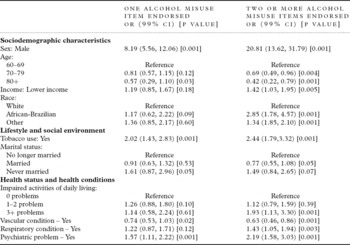
Polytomous multivariable logistic regression (Table 2), compared persons reporting one alcohol misuse item, and those reporting two or more misuse items, with persons reporting no misuse. While 21 characteristics were considered (seven sociodemographic, eight lifestyle and social environment, six health status and health conditions), only 10 entered the final model (four sociodemographic, two lifestyle and social environment, and four health status and health conditions). Of these only three (male gender, current tobacco use, current psychiatric problem) were associated (at the predetermined significance level of P < 0.01 or less) with endorsing only one alcohol misuse item, while all but one variable (marital status) was associated with endorsement of two or more items. For all variables there was a gradient of response from higher to lower association, going from two or more alcohol misuse items endorsed, to one item endorsed, to none endorsed. There was also a gradient within individual multilevel variables.
Polytomous logistic regression comparing endorsement of one item indicating alcohol misuse and of two or more items indicating alcohol misuse with endorsement of no items indicating misuse

The variables considered are the sociodemographic, lifestyle and social environment, and health conditions listed in Table 1. The significant variables entered into a prior analysis (which required P > 0.05) were selected for this final model.
OR = odds ratio; CI = confidence interval.
For sociodemographic characteristics, this controlled analysis indicated that men were more likely to be alcohol misusers than women (the odds were eight times greater when only one alcohol misuse item had been endorsed, but 20 times greater when more than one item was endorsed). While there were no age-related differences for endorsing a single misuse item, as age increased, endorsement of two or more items decreased. Odds of more severe alcohol misuse was higher among persons of lower income, and among non-whites, particularly African Brazilians, who were nearly three times as likely as white Brazilians to endorse more than one item. Tobacco users were twice as likely as non-tobacco users to report alcohol misuse. Endorsing two or more items doubled the odds of multiple ADL problems and of the presence of psychiatric problems. It increased the odds of respiratory problems, but reduced the odds of vascular conditions by a third.
Discussion
Data for the current study come from a large representative sample of community residents aged 60 years and older, in the state of Rio Grande do Sul in Brazil, who provided information on multiple aspects of aging. Included was a five-item questionnaire permitting assessment of lifetime alcohol misuse. Of the five items, three addressed aspects of alcohol abuse (put simply, the social consequences of alcohol misuse), and two addressed aspects of alcohol dependence (the physiological consequences). Since this measure does not meet diagnostic criteria for assessment of alcohol use disorder, we have summed the responses and examined how, compared with endorsement of no items, endorsement of one item compared with endorsement of two or more items, with respect to sociodemographic characteristics, lifestyle and social environmental conditions, and health status.
Comparison with other studies in Brazil, or even within the region, is difficult. Focus on lifetime use is infrequent; the samples rarely include residents over the age of 59; are often small, resulting in questionable findings; and use multiple different measures to assess alcohol use (Mendoza-Sassi and Beria, Reference Mendoza-Sassi and Beria2003; Vicente et al., Reference Vicente2006; Galduróz and Carlini, Reference Galduróz and Carlini2007; Silveira et al., Reference Silveira, Wang, Andrade and Andrade2007). Our findings that 10.6% of the sample report lifetime alcohol misuse compares with reports ranging from 2.7% in Campinas, southeastern Brazil (based on 93 sample members age 60 and over) (Barros et al., Reference Barros, Botega, Dalgalarrondo, Marín-León and de Oliveira2007) to 12% for frequent or heavy drinkers in a subsample aged 60 years and over in a national survey (Laranjeira et al., Reference Laranjeira, Pinsky, Zaleski and Caetano2007). Thus, our findings are not remarkable for Brazil. They tend to be lower than for participants of a similar age in nationally representative U.S. studies (using a variety of measures), which range from 8.4% to 16.1% (Hasin et al., Reference Hasin, Stinson, Ogburn and Grant2007; Kessler and Wang, Reference Kessler and Wang2008). In agreement with other studies, our rates for men (25.3%) are higher than for women (2.9%). Johnson (Reference Johnson2000) for instance, cites the highest rates as 17% for men and 2% for women, a ratio comparable to the findings of our study.
While population studies typically report that lifetime alcohol misuse declines with increase in age, we found none that explored this issue in persons aged over 60. Our data indicate that reported alcohol misuse continues to decline among those aged 60 and over. Why this is so is unclear. It may reflect a survival effect, unwillingness to acknowledge inappropriate behavior, forgetting, secular differences in acceptable behavior, or some other reason.
We found that alcohol disorder was more common in minority African Brazilians than in the majority white population. Comparison data from the U.S.A. is ambiguous, indicating that alcohol use may be curvilinear in African Americans (very little use and considerable use) (Mirand and Welte, Reference Mirand and Welte1996), or result in fewer problems in African American men (but not African American women) compared to their white counterparts (Hasin and Grant, Reference Hasin and Grant2004).
While uncontrolled analyses indicated that lower education, but not lower income, was associated with alcohol misuse, controlled analyses indicated the reverse, a finding confirmed by others (Council on Scientific Affairs, 1996; Mirand and Welte, Reference Mirand and Welte1996; Barros et al., Reference Barros, Botega, Dalgalarrondo, Marín-León and de Oliveira2007; Grant et al., Reference Grant2007; Hasin et al., Reference Hasin, Stinson, Ogburn and Grant2007; Silveira et al., Reference Silveira, Wang, Andrade and Andrade2007). Lack of association with religion, employment status, and an active lifestyle have been demonstrated previously (Mirand and Welte, Reference Mirand and Welte1996).
Our data agree with those of many other studies that tobacco use is associated with alcohol disorder (John et al., Reference John2003), although one study reported no association (Chou et al., Reference Chou, Grant and Dawson1996). Various suggestions have been proposed to explain the link between smoking and alcohol: cross-tolerance, shared genetic and environmental influences, ability of each substance to counteract some of the adverse effects of the other, mutual effect on metabolism, and alcohol-associated disinhibition that counteracts restraints against smoking (National Institute on Alcohol Abuse and Alcoholism, 2002).
Although moderate alcohol use has been found to have a protective vascular effect, it is unclear in the present study why it is more severe alcohol misuse that reduces the odds of vascular conditions. This may be a survivor effect, or reflect corrective action on cessation of alcohol misuse.
Severe lifetime alcohol misuse was associated with poorer functional status, possibly reflecting adverse impact on health conditions not included in analysis. Increased odds of respiratory disorders and psychiatric conditions confirm previous reports (Kyomen and Liptzin, Reference Kyomen, Liptzin, Copeland, Abou-Saleh and Blazer1994; Chou et al., Reference Chou, Grant and Dawson1996; Goldstein et al., Reference Goldstein, Herrmann and Shulman2006; Hasin et al., Reference Hasin, Stinson, Ogburn and Grant2007). The strong association between alcohol and depression (the most prevalent psychiatric disorder identified in the present sample) has been attributed to a number of factors, including the depression-inducing effect of alcohol, the use of alcohol to alleviate depression (Schuckit, Reference Schuckit2006; Goodwin and Jamison, Reference Goodwin, Jamison, Goodwin and Jamison2007), and possible common underlying genetic disposition (Maher et al., Reference Maher, Marazita, Zubenko, Kaplan and Zubenko2002).
This study has certain limitations. First, lifetime alcohol misuse was based on a screening questionnaire and not a comprehensive psychiatric diagnostic interview. Second, our prevalence estimates are probably conservative. We sampled only the non-institutionalized and did not include the homeless, so excluding groups where the prevalence of lifetime alcohol misuse is likely to be higher. Third, the widely differing cultural and socioeconomic backgrounds present in Brazil may not have been fully represented, reducing the generalizability of the findings. Fourth, we relied on self-report. Self-report, however, has been found to be valid for alcohol use and problems (Midanik, Reference Midanik1982) and for health conditions (Beckett et al., Reference Beckett, Weinstein, Goldman and Yu-Hsuan2000). Fifth, we do not know when the problems with alcohol use occurred, and the cross-sectional design prevents determination of the causative relationship between inappropriate alcohol use and the variables examined here.
In conclusion, this study is based on a large representative sample of community residents aged 60 years and older in Brazil. Just over 10% reported any lifetime alcohol misuse, a proportion comparable to that found by other studies in Brazil, but smaller than that reported in major U.S. studies. With the exception of vascular disease, where it is difficult to explain the positive effect of alcohol misuse, lifetime alcohol misuse was associated with poorer functional status, and respiratory and psychiatric (primarily depressive) disorders. Misuse was more likely to be reported by men, non-whites, persons with low income, and tobacco users. Alcohol misuse, probably occurring at a younger age, has implications for health status in older age.
Conflict of interest
None.
Description of authors' roles
S. L. Blay and G. G. Fillenbaum formulated the research questions, analyzed the data and wrote the paper. The study was designed and carried out by S. B. Andreoli and F. L. Gastal.
Acknowledgments
We thank Dr. Sergio Antônio Carlos, President of the State Council of the Elderly (Conselho Estadual do Idoso), for allowing us to use the dataset from the “Elderly of RS – a multidimensional study of their living conditions” study.
This study was supported by grants from Conselho Estadual do Idoso, Secretaria do Trabalho, Cidadania e Assistência Social, and by Governo do Estado do Rio Grande do Sul. Dr. Fillenbaum was partially supported by a National Institute on Aging grant number 1P30 AG028716-01 Claude D. Pepper OAIC. None of these sources had a further role in the current study design; in the collection, analysis and interpretation of data; in the writing of the report; or in the decision to submit the paper for publication.