Percutaneous pulmonary valve implantation is a transcatheter procedure used to treat right ventricle outflow tract dysfunction, which is less invasive and carries lower risks than surgery. Reference Lurz, Coats and Khambadkone1 Despite these lower risks, there are some reported complications, such as stent fracture and embolisation, conduit rupture, coronary compression, and endocarditis. Reference Balzer2
Case report
A 16-year-old boy born with Tetralogy of Fallot previously submitted to left modified Blalock-Taussig shunt and corrective surgery at 2 and 18 months of age, respectively, the latter requiring a transannular patch, was admitted for percutaneous pulmonary valve implantation. During the follow-up, he complained of tiredness, even with mild exercise and he was medicated with diuretics. He presented a complete right bundle branch block on electrocardiogram. Transthoracic echocardiography revealed severe pulmonary valve regurgitation, mild pulmonary valve stenosis (peak gradient of 46 mmHg evaluated with Doppler), and progressive right ventricle dilation and systolic dysfunction. The telediastolic volume of the right ventricle was 140 ml/m2 on cardiac magnetic resonance.
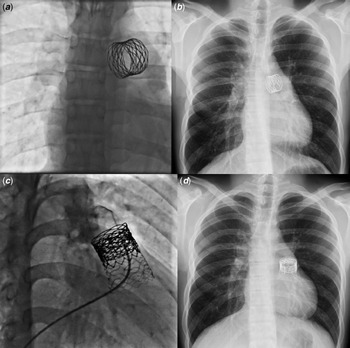
Left and right heart catheterisation was carried out, and the right ventricle outflow tract angiogram confirmed severe pulmonary regurgitation and a pulmonary valve annulus of 23 mm (measured with a sizing balloon). A 30 mm Bare CP Stent (NuMED®, United States of America), mounted on a 25/40 mm Nucleus balloon (NuMED®), was initially implanted. To further secure this stent, we implanted a second stent with the same characteristics. In doing so, these embolised as a unit to the distal pulmonary trunk (Fig 1a and b). After several, unsuccessful, attempts to reimplant the stents, we opted to terminate the procedure and attempt reimplantation at a later stage.
( a ) Fluoroscopy and ( b ) postero-anterior chest X-ray – embolisation of the CP stents to the distal part of the pulmonary trunk. ( c ) Fluoroscopy and ( d ) postero-anterior chest X-ray – final pulmonary valve Sapiens XT 29 mm (Edwards®, United States of America) in situ.

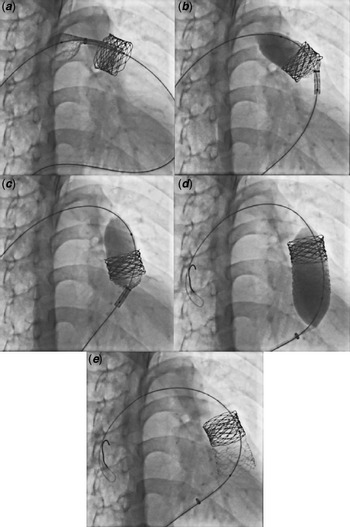
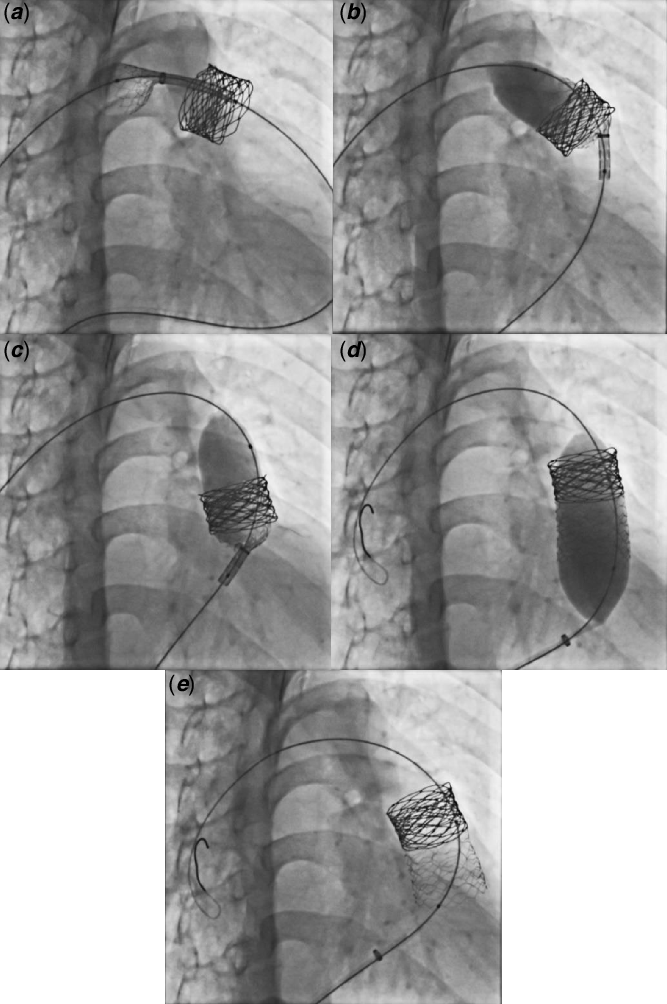
A week later the patient was taken back to the catheterisation laboratory, where the embolised stents were reimplanted in a satisfactory position. This was accomplished by passing an AndraStent XXL 57 mm (Andramed®, Germany) mounted on an AndraBalloon XL 28/60 mm (Andramed®, Germany) through the embolised stents, unsheathing it and inflating its distal part only. In doing so, the embolised unit was pulled back to the proximal part of the pulmonary trunk up to the “landing zone”. This was followed by inflating its proximal part, thus securely anchoring the embolised stent and subsequently the rest of the inner stent (Fig 2a–c). To further secure them, the proximal and distal part of the stent unit was again dilated, with an AndraBalloon XL 30/40 mm (Andramed®, Germany) (Fig 2d), thus creating a safe landing zone (Fig 2e) where the Sapiens XT 29 mm (Edwards®, United States of America) was implanted (Fig 1c and d). The post-implantation angiogram showed no pulmonary valve regurgitation or a stenotic gradient between the right ventricle and the pulmonary trunk.
Sequence to relocate and anchor the embolised stents. ( a ) Introduction of an AndraStent XXL 57 mm (Andramed®, Germany) mounted on a AndraBalloon XL 28/60 mm (Andramed®, Germany) through the embolised stents and inflation of its distal part; ( b and c ) pullback of the embolised unit to the proximal pulmonary trunk by means of a distally inflated AndraBalloon followed by its complete dilation, thus anchoring the AndraStent; ( d ) further inflation of the proximal part of the AndraStent with an AndraBalloon XL 30/40 mm (Andramed®, Germany); ( e ) final landing zone of the Sapien XT 29 mm pulmonary valve using the three stents as a scaffold.
Discussion
Stent embolisation is a known complication of percutaneous pulmonary valve implantation. Reference Giugno, Faccini and Carminati3 We report this case to highlight the use of previously embolised stents, safely positioned using a third, larger, stent, and, in doing so, creating an adequate landing zone for pulmonary valve implantation. As an alternative strategy, the embolised stents could have been left in-situ, as they were in a stable position and implant the pulmonary valve on the third stent. However, we thought that, under these circumstances, the risk of pulmonary embolism could not be ignored and, thus, opted for the abovementioned strategy.
With hindsight, the most likely cause of stent embolisation was due to the inadequate size of the stents used in relation to the diameter of the right ventricular outflow tract. In the past, a similar technique was described in adults, Reference Aparisi, Zunzunegui and Amat-Santos4 where an embolised stent to the pulmonary trunk was secured by a third, larger, stent. In contrast to our case, the embolised stent was not pulled back into the pulmonary annulus but remained in its embolised position.
Financial support
This research received no specific grant from any funding agency, commercial, or not-for-profit sectors.
Conflicts of interests
José Luis Zunzunegui is a proctor for Edwards Lifesciences.
Ethical standards
Not applicable.