I. Introduction
POLITICAL lotteries have a long history in the democratic tradition. In ancient Athens, over seven thousand government officials, including the governing assembly (the Council of 500), were chosen by lot in a practice known as sortition.Footnote 1 Ancient Rome also practiced variations of sortition, and so did medieval and Renaissance Italian city-states, notably Florence and Venice.Footnote 2 Both Spain and England used such procedures to select magistrates and municipal councils in the fifteenth and sixteenth centuries,Footnote 3 and regions in Switzerland appointed the office of mayor by lot as late as 1837.Footnote 4 Sortition affects political selection, behavior, and outcomes. Studies have shown that lotteries in the earliest democracy in Athens ensured equal opportunity for individuals from all socioeconomic groups,Footnote 5 and in the medieval Florentine Republic, leader selection by lottery ensured rotation among competing business elites.Footnote 6
The selection of entire governing bodies by sortition is no longer a common feature of contemporary democratic institutions.Footnote 7 Instead, random assignment has been incorporated into parts of the selection of political office. We call such practice a lottery-based procedure and define it as a selection process that incorporates an element of randomization but falls short of pure sortition. In this article, we focus exclusively on the use of such procedures in the selection of parliamentary or constitutional committees.
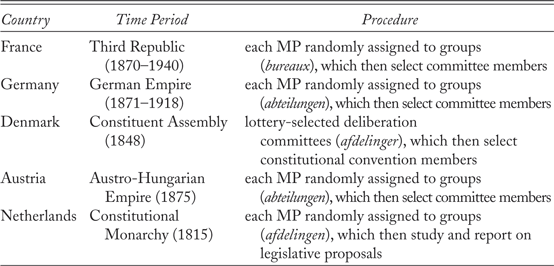
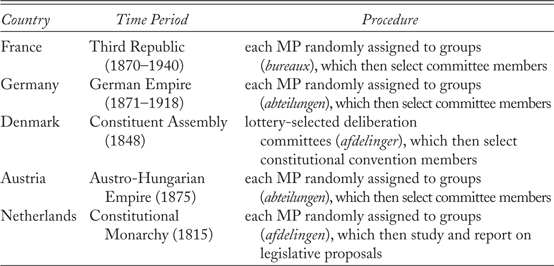
Lottery-based procedures played an important role in the development of nineteenth-century European parliaments. Table 1 shows that several countries used lottery-based procedures to select delegates to their constitutional conventions or to select members of legislative committees. These include the Netherlands (1815), Imperial Germany (1871), and the Austrian Empire (1875), all of which had legislative bodies under monarchies; Denmark (1848), in the case of its constitutional convention; and France (1789 and 1875), as it transitioned to Republican democracy. Why did each of these countries incorporate such rules into their committee systems in the early stages of parliamentary development in the context of fragmented or weak party systems? The historical evidence suggests that the rationale is strikingly similar across a variety of contexts. They were used to ensure more egalitarian distribution of key posts when there was widespread distrust of subversive political factions or influential elites.Footnote 8 These procedures were typically dismantled or subverted once the party system stabilized. Lottery-based procedures thus bridged a gap by regulating legislative activity during the transformation of emerging parliamentary groups into unified, cohesive political parties. Although their use was widespread in European democratization, empirical research on the effects of lottery-based procedures and their consequences for party development is missing. This article addresses this deficit by focusing on France, a country that regularized the use of lottery-based procedures in committee appointments during the Third Republic (1870–1940).
Nineteenth-Century European Examples
A small but related literature looks at the various uses of lotteries in contemporary legislative politics. Committee seniority rankings and assignment orders are partially determined by lottery in the US CongressFootnote 9 and the German Bundestag.Footnote 10 Lotteries are used to decide tied elections of presiding officers in eight European countries,Footnote 11 to select questions to the prime minister in India and the United Kingdom, and to choose the bills to be considered by the legislatures of Canada,Footnote 12 New Zealand,Footnote 13 and the UK.Footnote 14 The most relevant studies empirically analyze the effects of lottery-based procedures on the types of politicians selected and their subsequent policy choices. Studies of the randomization of seniority or committee exile in the US CongressFootnote 15 and of committee appointments in nineteenth-century FranceFootnote 16 focus on the individual benefits of committee service, but not on the incentives to change the rules this type of political selection gives to emerging parties. Are there strategic reasons to use lottery-based procedures? Could their strategic use be linked to the expected consequences of political selection and behavior in parliamentary committees? Why abolish such procedures? We discuss each of these questions below.
We argue that lottery-based procedures were used to prevent capture of early institutions by factions or groups of self-interested political elites. They were able to play such a role for two reasons. First, lottery-based rules decrease the potentially harmful influence of political factions by adding unpredictability to the selection process, thereby reducing the ability of a group to subvert a committee for its own ends. Second, lottery-based rules help to ensure more equal access to political office by giving a larger set of politicians either the opportunity to compete directly for office or the ability to influence the appointment of those who do.
We set our hypotheses of lottery-based procedures for political selection and behavior in a framework in which weak and strong parties hold different preferences. By design, lottery-based procedures emphasize individual skills or expertise over group affiliation and reduce the influence of organized groups. It is clear that organized parties favor institutional procedures—election or appointment—that give advantages to groups, but in the context of weak parties, early institution builders strategically use lottery-based procedures at least partly to protect their new institutions from potentially pernicious elites. As parties become stable and threat of factions diminish, the costs of lottery-based procedures outweigh the benefits. It follows that the organizational strength of parties drives the use of lottery-based procedures; their use and dissolution can be explained by changes in the parliamentarization of the parties.
We discuss the use of a lottery-based procedure to select members for the powerful budget committee in the French Third Republic using a microlevel data set of French deputies from 1877 to 1914. The budget committee was a yearly standing committee formed of thirty-three members tasked with reviewing and proposing amendments to the government’s budget proposals. For the first three decades of the Republic, a lottery-based procedure to select budget committee members was in place. Each year, the French legislature was divided into eleven randomly assigned bureaux; each bureau met briefly to appoint three members to the committee. Once the members were selected, the bureau was dissolved. We trace the use of this procedure to 1789 and use archival records and parliamentary debates to demonstrate that the bureaux system was purposely reintroduced in the Third Republic to reduce the influence of factional interests over legislative decision-making.
We find that while this procedure was in place, younger, centrist, and middle-class deputies were consistently more likely to be selected at the expense of wealthy, older, more experienced, and arguably, pre-regime elites.Footnote 17 The dismantling of the bureaux system in 1910 demonstrates the relationship between parliamentarization and party development. We show that parties that had become cohesive were more likely to support a reform bill that gave partisan control over committee selection. Further, once parties gained control over committee appointments, there is evidence that they not only favored elites in the selection process, but also used their power to select loyal party members.
The article proceeds as follows. In Section II, we discuss our theoretical expectations for how lottery-based procedures within committee structures affect political selection and the strategic use of such rules by early parliamentary groups. In Section III, we review the case of France, which we use to test our theoretical claims. In Section IV, we outline our data and research design. In sections V and VI, we present our results on political selection and legislative reform. In section VII, we discuss the timing of institutional reform. We conclude by discussing the contribution of our research to the literature on legislative institutions in new democracies and the use of lotteries in modern politics.
II. Lottery-Based Procedures
To study the use of lottery-based procedures in committee selection, we first distinguish it from other selection methods used to allocate higher office. We discuss four types of committee selection ranging from pure random selection to appointment: sortition, lottery-based procedures, election within parliament, and appointment by parties. Each selection method has different implications for both the probability of an individual obtaining a committee post and the resulting composition of that committee.
Political Selection under Lottery-Based Procedures
Although pure sortition of legislative committees is rare, it serves as an important conceptual counterfactual, and democratic theory has long argued the benefits of selection by lot.Footnote 18 In political theory, political lotteries are often motivated by criteria of fairness: the completely random allocation of committee positions ensures that each legislator has the same chance of being chosen, which might improve representation of diverse groups and more evenly distribute the benefits and training of political office.Footnote 19 Lotteries help to ensure more equal access to political officeFootnote 20 and thus are distinctly nonpartisan.Footnote 21 They also introduce uncertainty—neither individuals nor parties have influence over the selection process. This uncertainty shelters the process from potential corruption and removes the ability of a political party to use political office as a selective incentive to induce loyalty.
By contrast, the selection of political office using elections and appointments is driven by the preferences of organized—and often majority—groups. Selection probabilities are biased and unequal and entirely a function of the groups that control the majority in the chamber; the individual is either elected with the support of the party or directly chosen by party leaders. Wealthy and well-resourced elites often dominate the unrestricted pursuit of political office,Footnote 22 and under election or appointment, committee composition is more likely to reflect the preferences of these elites. For an individual politician trying to negotiate a spot on a committee, the incentive to invest in party membership and loyalty, as well as in political skill, is high. For a party, the use of these procedures transforms committee assignments into powerful selective incentives that can be used to reward or punish member behavior.
Lottery-based procedures share the characteristics of lotteries and human-choice selection. The lottery-based procedure we analyze is a two-stage process: in the first, the Chamber is randomly assigned into groups, and in the second, those groups select committee members. The first stage mirrors the expectations found in lotteries—equal selection probabilities and uncertainty resulting from randomizing that make it much more difficult for a specific group to stack the deck to advance its interests within a deliberative body—and undermines elite coordination and influence. The second stage involves a human-choice element. A successful campaign for a committee position, even within a small, randomly selected group, requires skill or expertise (as in election or appointment). Party affiliation could matter, depending on the draw, and centrist politicians perhaps could more easily appeal to a random group than would minority, partisan politicians.
Lottery-based procedures therefore greatly reduce the ability of parties to affect assignments significantly and result in distinct expectations for political selection. They combine institutional elements to incorporate more equal selection probabilities, emphasize investment in individual skill or expertise over group affiliation, and reduce the influence of specific parliamentary groups in the selection process. Hence, we expect that individual skill and relevant experience, rather than elite characteristics, lead to selection. Although lottery-based procedures ensure equal selection probabilities of minorities within each group, we also expect minority partisan extremes to be underrepresented in comparison to centrists. Therefore, the distinct features of lottery-based procedures could enhance the legitimacy of the new system among diverse groups, particularly if lottery-based selection is combined with regular rotation of those holding the office.
Strategic Use and Abolishment of Lottery-Based Procedures
The preferences of emerging parties concerning lottery-based procedures are a function of accurate expectations of political selection outcomes resulting from such rules. Under what circumstances can we expect parties to prefer such procedures? How do the use and dissolution of such procedures relate to partisan development? We argue the state of the party system, particularly the organization of the parties themselves, influences the use of lottery-based procedures. Such procedures are often used because they are feasible forms of legislative organization, particularly in contexts of low trust among factional interests. They serve the important purposes of keeping antisystem (and often better-organized) interests out while ensuring access to office, and insuring against the quick rise of minority party factions.
We take as our starting point a standard definition of political party, namely, a political group defined by a label and a stable membership that acts in concert to achieve goals of office, election, or policy.Footnote 23 Drawing from the literature on party institutionalization, we consider party development to be a function of (1) stability in membership and party label, (2) formal party organization, and (3) stable intraparty competition.Footnote 24 New democracies are often plagued by weak party systems with constantly changing party groups or members. Factionalism weakens a party’s ability to perform its representative function and undermines party cohesion; it is particularly worrisome in a new democracy, where party groups aren’t established enough to survive divisions. In a nascent democratic system, a new faction could rise, campaign, and gain electoral or legislative support very quickly.Footnote 25
As we demonstrate, the use of lottery-based procedures to appoint committees in France occurred in a context in which institution builders wanted to prevent capture of early legislative institutions by groups of self-interested and often antidemocratic political elites. These factions could take the form of extremist or militant parties or of divisions within a party group. When parties are weak, the process of establishing parliamentary or constitutional committees is susceptible to elite capture, and early institutional configurations can have path-dependent effects on the long-term development of the parliament. Such was the case in the United States, France, and Great Britain, where early political parties were viewed as elite-driven factions that were a threat to democracy and where maintaining the stability of new republican institutions was a serious concern.Footnote 26
Legislative institutional procedures also evolve to coordinate political activities when parties are weak.Footnote 27 In such an uncertain context (weak parties and a shifting party system), the chamber may be more willing to put in place formal procedures that ensure equal access to political office and that reduce the potential for partisan bargaining in selection.Footnote 28 Randomization is a decision rule that constitution writers can unanimously agree on—a consensus that is unlikely to hold for decisions by majority rule.Footnote 29 In the absence of strong parties, lottery-based procedures play an important role in regulating legislative committees.
Lottery-based procedures are an effective way to guard against elite capture because they play a sanitizing roleFootnote 30 by protecting the selection process from those who would “subvert the process for their own ends.”Footnote 31 Scholars argue that this antifactional, antipartisan role was the rationale behind the adoption of sortition for the governing committees in the early republics of Athens, Florence, and Venice because they reduced the ability of one party (or family) to develop a permanent power base.Footnote 32 Under this selection rule, the final composition of a committee may be uncertain because of biases in the selection process, but one particular group will not dominate it.
If the rationale for lottery-based parliamentary procedures is to protect the institution from weak or self-interested factions, it follows that their removal is related to party development. Better-organized parties aim for more legislative efficiency, for example, by gaining control over selective incentives once the antisystem threat is no longer credible. We know that politicians embrace institutional reform or change rules when so doing is in their interest.Footnote 33 In the context of weakly organized parties and high uncertainty, lottery-based procedures have clear advantages over election or appointment. Nevertheless, as parties become stable and the threat of capture disappears, the costs of lottery-based procedures outweigh the benefits. Parties want selection to depend on their membership and want control over assignments to use as selective incentives. Thus, it follows that the organizational strength of parties drives the choice to implement lottery-based procedures; the use and dissolution of lottery-based procedures can be explained by changes in the parliamentarization of the parties.
In the next section, we introduce the case of the French Third Republic and detail the lottery-based procedure used and the state of the nineteenth-century party system. To our knowledge, this article is the first to explore how lottery-based procedures might govern early institutions until parties can consolidate.
III. The Case of France and the Bureaux
The French Third Republic incorporated a lottery-based procedure for committee appointments to the powerful budget committee in the Chamber of Deputies in the latter part of the nineteenth century. The regime began in 1871 when the lower house of the Third Republic’s parliament was active and influential. Within the Chamber, the budget committee was an annually appointed standing body with such extensive control over the government’s budget that it rivaled the cabinet for influence.Footnote 34 It was also the only standing committee for much of the regime.
To select the committee’s thirty-three members, an element of randomization was incorporated in the first part of the selection process. The approximately 580 members of the Chamber were divided into eleven temporary and randomly assigned bureaux. Once assigned, each bureau met and within hours selected three members to serve on the budget committee. Although official minutes of bureaux meetings weren’t kept, primary source evidence indicates that deputies presented brief platforms and campaigned to be chosen.Footnote 35 Within each bureau, the three members were ultimately selected using majoritarian, at-large voting. After the selection, the temporary bureaux were dissolved until the next year, when they were drawn anew to select that year’s budget committee. In this way, members were not selected by pure sortition; they were elected by a random group of their peers—a lottery-based procedure.
France had a long history of using this unique form of legislative organization. The practice of division into random groups was established nearly a century before the Third Republic, during the French Revolution. Bureaux were first used in the National Constituent Assembly in 1789 and were subsequently incorporated in the organization of the first Legislative Assembly in 1791.Footnote 36 The system of bureaux and the idea of legislative organization via commissions were used in the various republics and empires prior to 1870.Footnote 37 When the Third Republic adopted its constitution and parliamentary rules were established in 1875, a bureaux system was again included. This lottery-based procedure remained in place for the next thirty-five years. Throughout this period, deputies debated the merits of the system. The debates demonstrate the strategic reasons for keeping the bureaux and reveal that reform was attempted multiple times. As we discuss below, there were significant debates in the mid-1880s and in 1902. In 1902, a reform that allowed the possibility of party lists was passed, but it was never invoked. The bureaux system was fully dismantled in 1910 because of legislative reform that gave party groups control over committee assignments.
The French Party System
To understand the use of this lottery-based procedure and the overall structure of the parliament, it is important to review the context of the party system at the time. Early in the Republic, French parties were seemingly defined by their lack of definition. They existed in the form of cadre or notable parties,Footnote 38 with few permanent extraparliamentary structures or vehicles for mass membership. Political associations in the electorate weren’t legalized until 1901; before then, politicians could hold multiple affiliations in various parliamentary groups. Yet these parliamentary groups played an important role in directing legislative activity. Raymond Huard and others show that these groups were co-hesive and fairly disciplined, with elected leaders and distinct policy goals.Footnote 39
The predominant conflict in the early days of the Republic was monarchism versus republicanism, as politicians fought over the shape of the new democratic Republic. Republicans agreed on liberty, equality, and fraternity, but struggled over the extent of democratic liberty on issues ranging from voting rights to term limits.Footnote 40 In contrast, proponents of the ancien régime advocated a return to monarchy or various configurations of constitutional monarchy. This conflict mapped the spatial divide—Radicals were the defenders of secularism and the Republic while parties on the right provided the conservative opposition. Early party groups also competed over other issues. One significant cleavage was religion, exemplified by issues like the Dreyfus Affair, the ralliement,Footnote 41 and the ultimate separation of church and state in 1901. Another was class, as the turn of the century brought about France’s industrialization and the rise of an urban working class. Individual deputies could campaign or legislate on these issues independent of parties, given the latters’ weaknesses. Still, both clericalism and class often mapped to parliamentary groups or were the driving forces behind intraparliamentary party splits. Republicanism and the design of democratic institutions remained salient throughout the regime.
On the political spectrum at the time, the right included extreme right, exemplified by the Monarchists; the more mainstream right; and center-right of the Progressives, typically the Opportunists and the Republican unions. Being on the right meant being against the Republic and so by default, all other groups (the majority) were on the left (even the Moderate Republicans, who are perhaps better classified to modern readers as centrist).Footnote 42 The extreme left comprised small but growing Socialist factions and other independents who voted with them. The left and center-left are more difficult to classify because of their fluidity. This space was occupied by the Radical Socialist and Moderate Republican blocs—from which the infamous Radical parties and politicians were drawn.
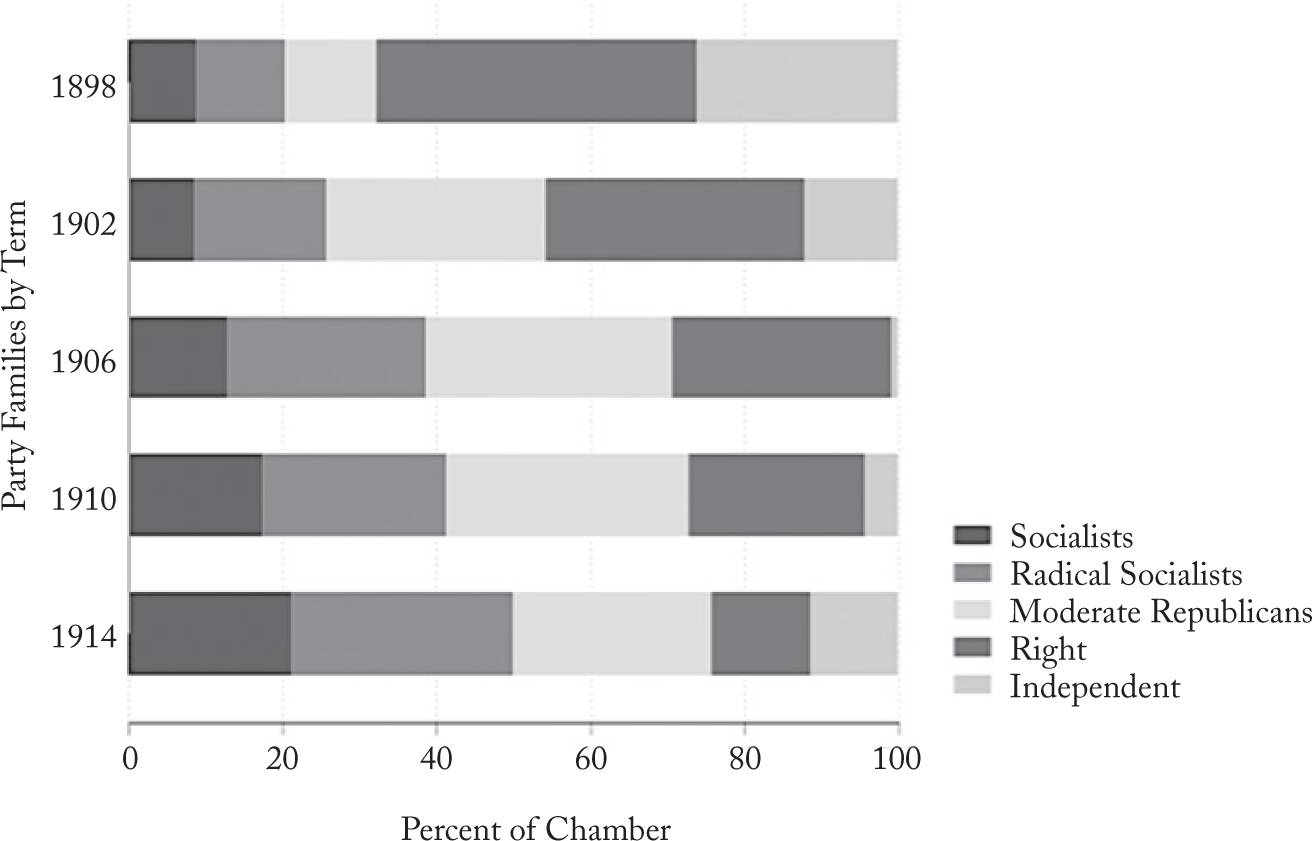
We analyze the party system at two levels: ideological blocs, or party families,Footnote 43 and the specific parliamentary groups within them, which we call parties. Party families had high levels of internal cohesion despite being composed of multiple groups; sometimes parliamentary groups acted as movements or tendencies and other times they considered themselves distinct political parties. Given the fluid nature of the party system, historians and other sources report the vote shares of the ideological blocs, but given that the legislative procedures we discuss would benefit the parties, it is important to consider both levels. Figure 1 shows the distribution of party families (ideological tendencies) by term after 1898, when it is possible to attribute single membership in parties.
Party Families
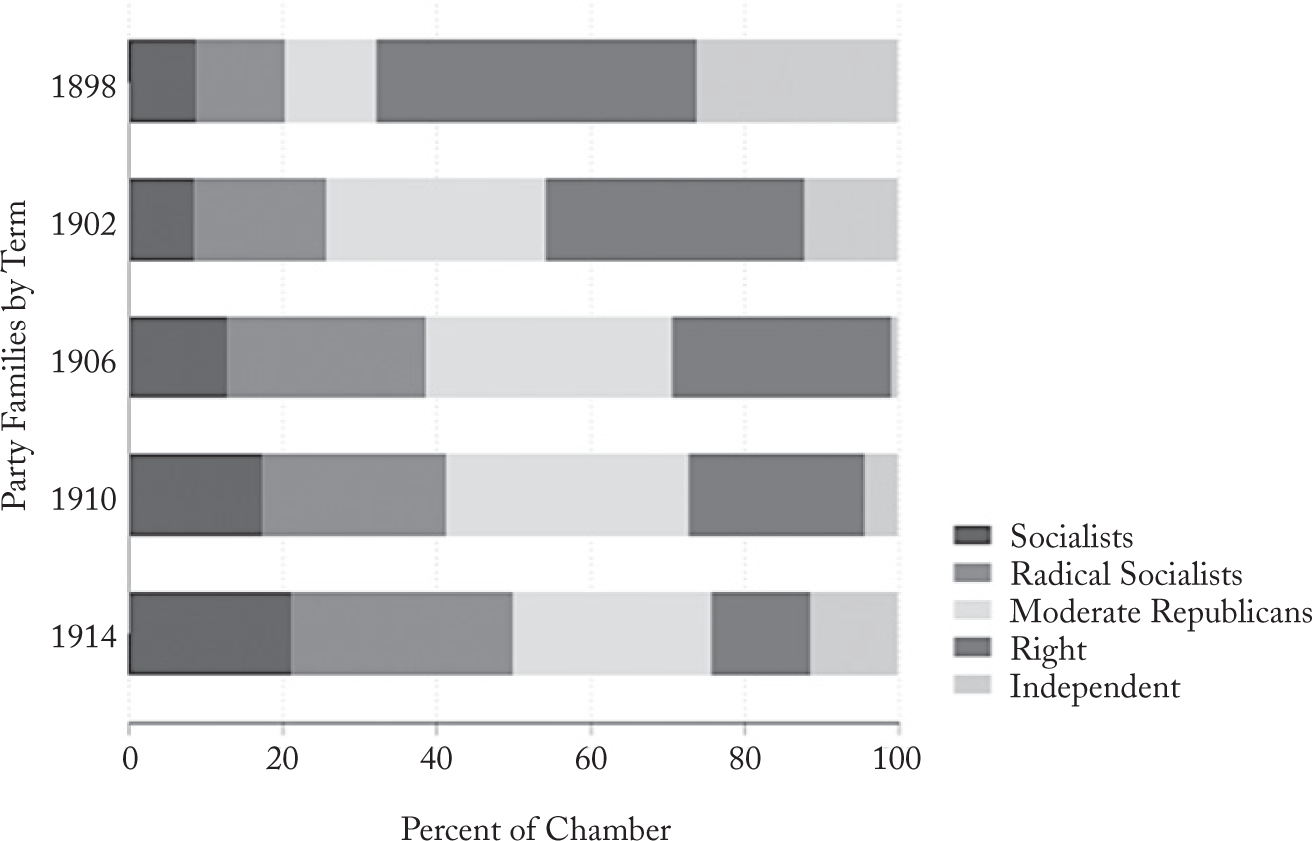
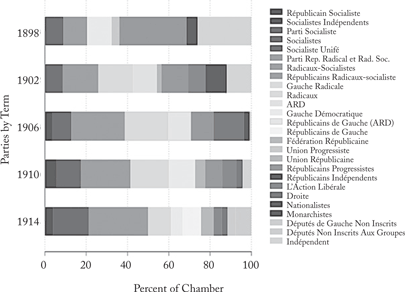
By contrast, Figure 2 plots the number of parties by term using individual parties, and thus demonstrates the uncertainty of the early system. Although there were four party families and many more parties—eight to nine—from 1898 to 1914, the effective number of partiesFootnote 44 ranged from six to nine. Some were consistently present and named, while others formed anew each term. As we demonstrate empirically in more detail in our results, parties had varying levels of continuity and cohesion. Radicalism was a dominant force, but it was far from a majority; in fact, no party family or party could govern on its own. Governments of the Third Republic typically consisted of bargains between Radical and Moderate Republican groups.Footnote 45 It is no wonder that French elites were worried about individual factions within parties splitting off, weakening the central blocs, and altering the uncertain coalition dynamics. Debates about parliamentary procedure and the structure of the Chamber occurred in this context.
Parties

History of the Bureaux
The rationale for the lottery-based procedure described above dates to the National Constituent Assembly. In 1789, bureaux drawn by lot reviewed proposals and elected committees responsible for drafting the text of the first constitution. The procedure was introduced for two reasons. First, as the Constituent Assembly consisted of over 1,200 members, dividing the groups into bureaux would both induce a form of organization and a more efficient division of labor. (This rationale is still used for the creation of modern-day committees.) Second and more important, the creation of the bureaux procedure directly related to power struggles in the new Republic. Random selection of deputies on a frequent basis would prevent the formation of “cliques and partisan behavior,”Footnote 46 and counteract “local and provincial loyalties.”Footnote 47
The minutes and archival records of the Constituent Assembly show that elites discussed the use of the procedure at length and underline the idea that factional influences were a primary driver. The historian François Aulard recorded the remarks of a member justifying randomization:
In order to prevent parties, to confuse interests and to destroy the provincial spirit which, like any other particular spirit, could produce dangerous effects, it was essential not to place several deputies of the same province in the same bureau.Footnote 48
Similarly, Maximilien Robespierre, on June 5, 1789, argued that without this system, factions would “strengthen the influence of certain personalities and would encourage intrigue.”Footnote 49 A month prior, Honoré Mirabeau, a deputy and a noble, referenced the egalitarian nature of the bureaux system when advocating for its adoption, arguing the Assembly must “… adopt a method of debating and of voting which will incontestably give the result of the views and opinions of all.”Footnote 50
When the Third Republic’s constitution was established in 1875, the bureaux system was incorporated into the legislative rules of procedure governing the budget committee. Historians and early twentieth-century political scientists agree that the role the lottery-based procedure played in the Third Republic was similar to its role in the revolutionary period of the eighteenth century. For over thirty years, the bureaux system was strategically retained to protect the unlimited individual initiative of deputies from partisan demands and, more broadly, to prevent capture of the committee by various political cartels.Footnote 51 Even Woodrow Wilson, in one of his seminal texts, wrote about the unique French system:
It will be seen that this arrangement, making the composition of the Bureaux dependent upon lot, as it does, and providing for the monthly reconstitution alike of the bureaux and of the committees which they select, must effectually prevent the recognition or maintenance of party lines in the formation either of the Bureaux or of the committees, and seems in that way very well adapted to check the factional ardors of the chamber.Footnote 52
But was this lottery-based procedure system passively inherited, or did subsequent deputies strategically adopt and later dismantle it? The deputies frequently discussed the procedure, including its eighteenth-century adoption, in parliament. In 1902, for example, the progressive Joseph Thierry reminded the Chamber about the bureaux’s revolutionary origins. In a speech to the Chamber, he warned of the dangers of lobbying for office and defended randomization:
To what guiding principles did the Assembly abide as it resorted to this specific lottery procedure for nominations to the Budget Committee? The main reason behind the Assembly’s choice—and we must have the courage to admit it—the desire to avoid the problem of having to respond to demands for nomination to the Budget Committee.Footnote 53
Further rationale for the use of the bureaux system was best presented by the deputies themselves during the parliamentary debates in the 1880s, 1902, and 1910 that discussed standing committees.
In 1881 and 1884, the Chamber discussed removing the bureaux system and instead nominating the budget committee by scrutin de liste (party lists). The debates revolved around the representation of groups in the minority, in particular the extreme right and the extreme left. Deputies from these groups argued that the bureaux system failed to ensure their inclusion in the financial processes of the state.Footnote 54 Importantly, deputies expressed concerns about the presence of extreme factions in parliamentary governance. After drafting petitions for reform in 1881 and 1884, the conservative deputy Théobald de Soland campaigned against the bureaux system. He brought evidence to the Chamber from other European countries with socialist or extreme groups to make the point that other countries were not afraid of including minorities in government. He argued,
In all these countries there are deputies who do not admit the form of government, who have anti-democratic opinions. This has never been used as an excuse to exclude those who profess them from the Budget Committee. I am therefore authorized to say that all the monarchical governments of Europe absolutely admit the right of financial control of the minorities that you, the only republicans, do not respect. Footnote 55
In both instances, de Soland’s colleagues in the Chamber failed to refute his point or the underlying argument that the bureaux system does serve to check extreme factions. The majority of the Chamber ignored the initiative, deemed the issue unlikely to be resolved, and closed the debate.
In 1902 and 1910 the debate resumed in a substantial way. Yet in both cases, it is clear the deputies were worried about the fledgling party system. Advocates of the bureaux invoked two important arguments for the preservation of the lottery-based procedure. First, that there existed some factions that were hostile to the Republic and the idea of democratic institutions. In 1910, the radical deputy Marcus Sibille urged the Chamber to protect itself against such groups:
But in our country, which has such a long historical past, we are very divided from a political point of view and at present, as you know, the Republic is not accepted by all; there are still political parties that dream of the restoration of royalty or empire. Well! What are you going to do? You will give these parties a legal existence; you will recognize them rights; you will decide that bills introduced by the Government of the Republic will now have to be examined not by representatives of the different groups of the House….Footnote 56
Second, deputies defended the system of bureaux by arguing that they should retain the nonpartisan freedom to represent local constituents as they saw fit and that parties were not yet unified enough to control committee assignments.
On the other side,Footnote 57 proponents of partisan control in 1910 again sought guaranteed minority representation on the budget committee, arguing that it would benefit the Chamber. Further, calls for reform came from groups that felt excluded from the process, a viewpoint notably championed by the Socialist leader Jean Jaurès.Footnote 58 Reform finally and narrowly prevailed in 1910, when the lottery-based procedure was dissolved, and the committee system was successfully modified to give parliamentary groups control over committee assignments. Instead of election via the bureaux, committee positions were allocated proportionally to political parties, which then filled these slots using partycontrolled lists. Importantly, this method ensured some representation of all factions. Although the bureaux system had been inherited, parliamentary debates demonstrate that deputies actively considered the rationale for and effects of the bureaux when building their parliamentary institutions.
IV. Empirical Analysis
Our empirical analysis explores the relationship of the bureaux system to French political parties in three ways. First, we analyze how the lottery-based procedure affected the composition of the budget committee over time, from 1881 to 1910. Second, we look at the effects of partisan control on committee selection to understand how the composition of the budget committee changed before and after partisan control. Third, we examine the partisan incentives behind institutional reform using an analysis of the roll call vote on the 1910 reform that dismantled the lottery-based procedure.
We rely on a microlevel data set of deputies in the Chamber from 1881 to 1914. We collected information on yearly committee appointments, bureaux lists, and legislative activity, and matched it to district-level electoral outcomes for the entire period. Further, because the types of politicians serving in a new democracy have a large impact on early institutional development, we also collected detailed biographical information on deputy qualifications, occupations, and careers.
We base our analysis of deputy selection on the categorization that mattered most to the new French Republic during its process of democratization: the division between the landholding elite and the bourgeoisie (the rising middle class). The Third Republic was designed to end the aristocratic hold on power, or as the historian Daniel Halévy put it, to be la fin des notables. In the nineteenth century, the major groups in French society were elite, middle class, peasant, and worker,Footnote 59 although realistically, only those from the first two groups could serve as a deputy. Nevertheless, this era and its political struggles were characterized by the rise of the middle-class politician at the expense of the elites.Footnote 60 The new politicians came from the ascending (liberal) professional occupations of the grand bourgeoisie—lawyers, doctors, professors, and bankers—and they played a dominant role in reshaping the new democratic Republic. In addition to partisan or ideological cues, social class was a crucial dimension; unlike the elites, who often came from rural areas, middle-class politicians were based in towns or villages and had distinct preferences for public goods and redistributive politics.Footnote 61
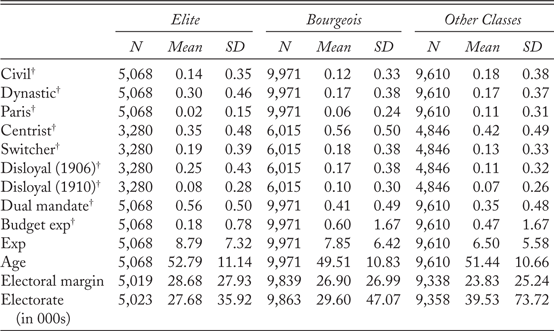
We identify several deputy characteristics that would indicate a member of the elite political class, and contrast these with characteristics of members of the rising middle class. We rely on occupational data generated by district-level electoral results that include candidate qualifications. We construct a set of mutually exclusive occupational categories. We first create a variable to measure the elite (landed classes). This is an indicator variable, elite, and includes landowners, landlords, and owners of capital (for example, factories).Footnote 62 As Table 2 demonstrates, this group tended to be older, from less competitive and smaller districts, and associated with the right or with Progressives. Importantly for our analysis, these elites had the wealth and influence to dominate early institutions.
Summary Statistics
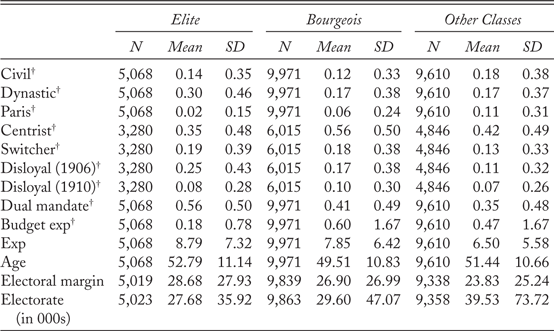
† dummy variable
Similarly, we create a variable to measure the upper middle class, bourgeois, or those non-landholding deputies with professional occupations. This group includes lawyers, bankers, doctors, journalists, and similar liberal occupations.Footnote 63 These deputies were younger, held professional degrees, were from more competitive districts, and were more likely to support Radical and pro-Republican ideals. Outside these two categories, the rest of the deputies, other classes, were more heterogeneous and had less clear predictions. This group includes middle class, but lower-ranking professionals, such as clerks and engineers, and alternative professions, such as the priesthood or military. This category is useful because by construction it is missing wealth and influence and thus provides a comparison group.
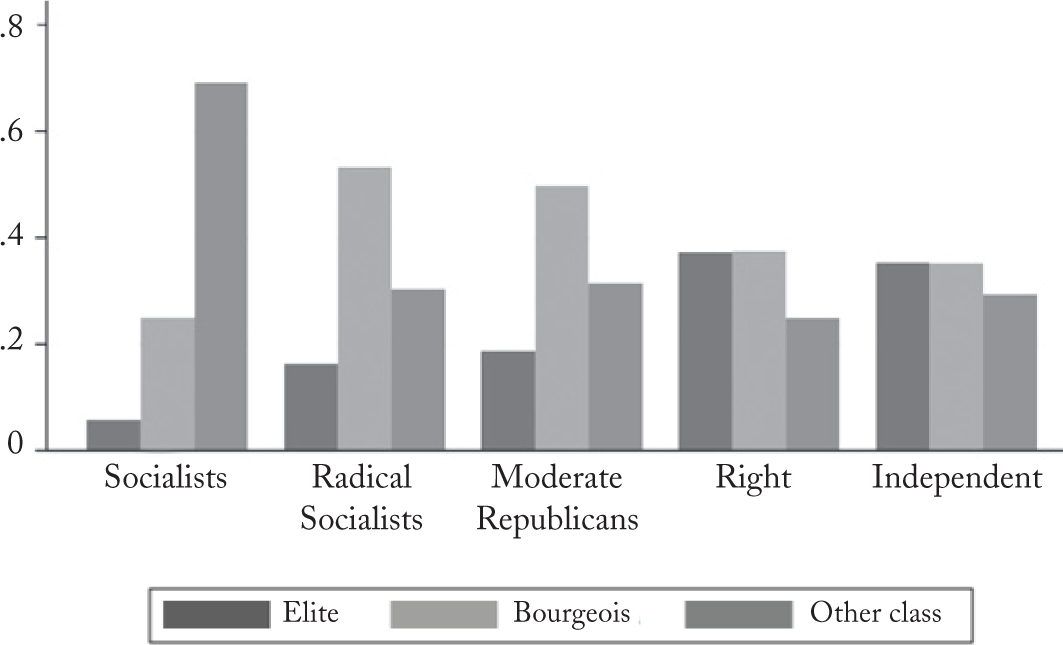
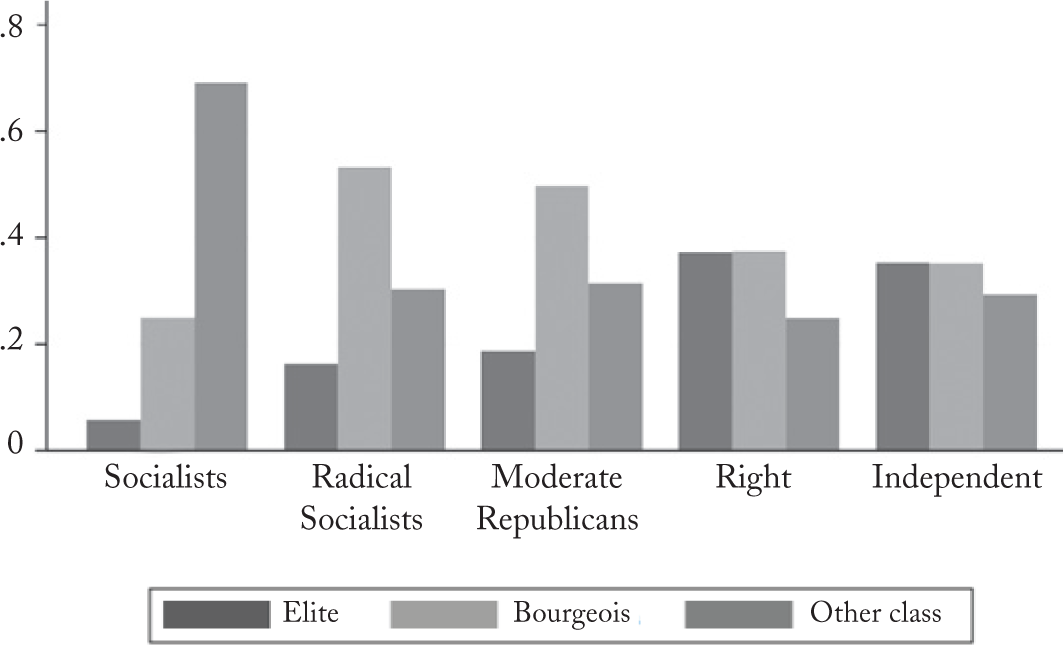
Further, we are interested in the extent to which the lottery-based procedure affected the representation of various parliamentary factions. In the French case, deputies could hold multiple affiliations for most of the period in question; reliable party affiliations began not in 1870, but at the turn of the century. We collect data on the ideological bloc (party family) of the deputy, as well as his parliamentary group. This data comes from parliamentary lists published in Journal Officiel cross-referenced with newspaper accounts and the biographical database of the National Assembly. To determine centrist tendencies of deputies, we create an indicator variable, centrist, to measure whether a deputy had any affiliation with a radical group (either the Moderate Republicans or Radical Socialists). Figure 3 demonstrates the breakdown of parliamentary currents by our occupational variables.
We also include a number of variables as controls that could measure political influence. We look at the age of the deputy, age, as well as his parliamentary experience, exp, both measured in years. Particularly in the early years of the regime, older deputies who had experienced the prior empire were more likely to be privileged and of a different mindset than the younger, new Republican generation. We also include the number of years of budget committee experience, budget exp.
Proportion of Deputy Type by Party Family, 1898–1919
We rely on a measure of partisan behavior by looking at the patterns of party switching for each deputy. Disloyal (1906) is an individual-level indicator that measures whether a deputy had switched parliamentary groups in the 1906 term, right before the reform gave parties control over budget appointments; disloyal (1910) is defined analogously. Switcher is a variable that measures by term whether a deputy switched parties (for more information on measuring party switching, see the detailed discussion in Appendix A). Access to political resources (whether the deputy held a local office, such as mayor or municipal councilor, in addition to his national post) is measured using dual mandate.Footnote 64 Civil measures whether the deputy had prior experience in the civil service, for example, serving as a tax collector, notary, postmaster, or any non-elected profession in local government. Dynastic measures whether a deputy had a relative in politics previously. Finally, we include a battery of district controls, including district size, margin of victory in the election, and whether the district was in Paris.
Any analysis of lottery-based rules requires the lottery to function; therefore we also verified that the randomization process was correctly implemented. A more detailed discussion of the finding that the deputies truly were randomly assigned across bureaux is in our earlier work.Footnote 65 We executed a number of robustness checks to ensure that bureaux were randomly assigned. We find no systematic differences across bureaux, and pretreatment covariates cannot systematically predict bureaux assignment. Furthermore, there is no historical evidence to suggest any occasions of fraud regarding the bureaux system.
V. Results: Committee Selection
We are first interested in the types of politicians selected for the budget committee as a result of the bureaux system. We show this by comparing the composition of the budget committee to the legislature across the entire period during which the bureaux system was in place. In the absence of a lottery-based procedure, our expectation is that endogenous selection should prioritize the “high demander” outliers,Footnote 66 in our case, experienced or wealthy elites who would have a distinct advantage in competing for office. We show that incorporating an element of randomization results in the selection of different types of politicians.
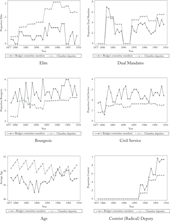
Using our data, we consider descriptive statistics. Figure 4 plots the composition of the budget committee and the composition of the entire chamber over several key characteristics. It is evident that the budget committee overrepresented middle class (bourgeois) deputies, not elites. The landed elites constituted anywhere from 10 to 30 percent of the deputies in the Chamber, but on average constituted less than 10 percent of the budget committee. Similarly, older deputies, who were more likely to be associated with the predemocratic empire, were much less likely to be selected, as were deputies with patronage networks through multiple office holding. Instead, selection in the bureaux overrepresented deputies who were middle class, young, and had prior civil service experience.
Deputy Characteristics: Chamber versus Budget Committee under Bureaux

We next examine how the bureaux system affected the partisan composition of the budget committee. One of the purported benefits of the bureaux system was that one parliamentary faction could not dominate the selection process. Looking at the data across the entire period, we find this to be true in the case of parliamentary groups. The centrist, Radical deputies were more likely than other deputies to be on the budget committee under the system of bureaux (the breakdown by each party family can be found in Appendix B, Figure B1). But these parties were also the least organized and most heterogeneous at the time, typically consisting of three to four factions within the Radical ideological bloc. Therefore, although one specific faction was unable to dominate the committee, the median and centrist deputies were overrepresented.
This result contradicts the expectations of the time. The economic historian Abbott Payson Usher, for example, argued that the budget committee was “more or less out of sympathy” with the majority because the system could not ensure the majority could control the committee.Footnote 67 We show that instead, groups in the plurality of the Chamber were more likely to be selected in the bureaux. What advantaged these centrist deputies in committee selection? Details surrounding selection within the bureaux were not recorded, and so the specifics of selection are unknown. But it seems likely that centrist deputies could more easily appeal to the cross section of deputies within each bureaux, which may explain why the budget committee overrepresented centrist preferences, but we have no counterfactual for this period. It could be that lottery-based procedures eroded elite advantage and allowed the newer political class the ability to compete or, rather, that these were the preferences of the Chamber at the time.
We try to unpack Chamber preferences by examining how selection changed in 1910, when parties gained control over committee assignments. We consider the change in the partial effect of each characteristic on the probability of selection, controlling for other characteristics, including centrist affiliation. Our expectation is that selection is more egalitarian under lottery-based procedures or before parties gain control over the nomination process, and that elites and bourgeois politicians are more likely to be selected after 1910.
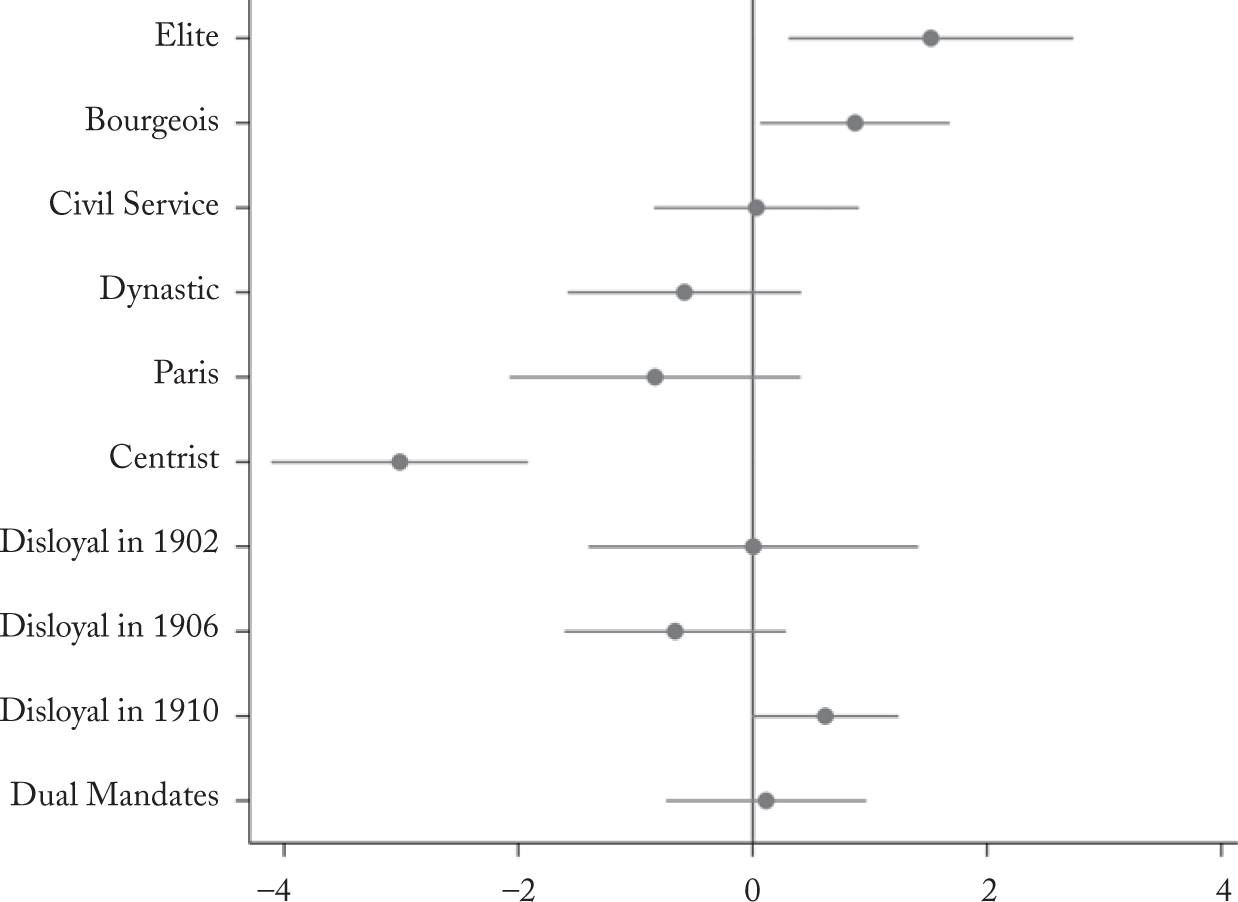
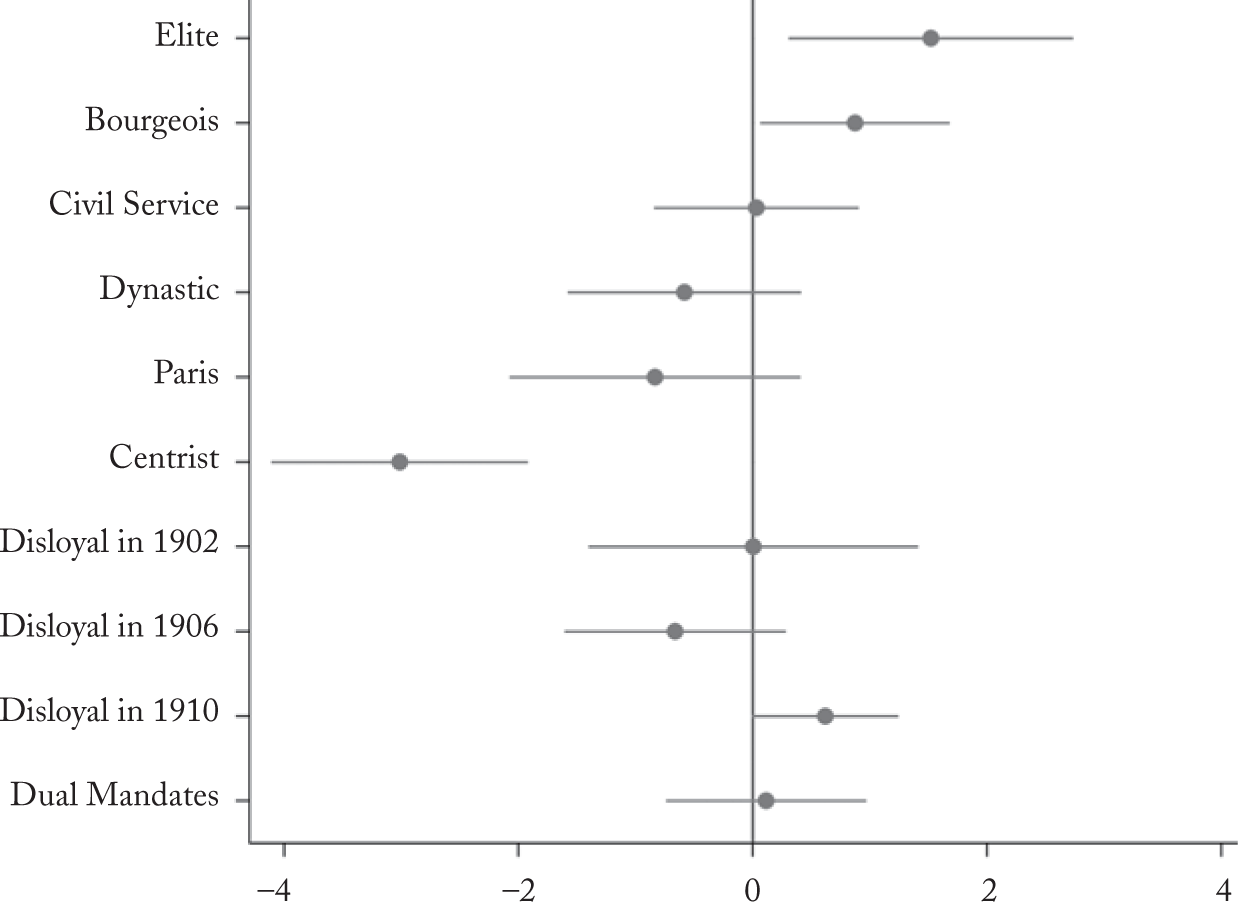
We compare the selection of the budget committee in the 1906 term (lottery-based procedure) to 1910 (party choice). We focus on a relatively short period, the term before the change and the term of the change, to see whether elites were more likely to be appointed by party leaders.Footnote 68 We estimate a logistic regression of chances of committee selection as a function of individual characteristics. Because these characteristics do not change over time for the same individuals in different selection years, we cluster standard errors by individual.
Figure 5 plots the estimates for interactions between our variables of interest and an indicator for the 1910 term. Each interaction measures the marginal change in the probability of being selected to the budget committee in 1910 after partisan control, given the characteristic. The key finding from this analysis is that elites were much more likely to be appointed under partisan control, even controlling for the fact that centrists in general were less likely to be selected after 1910. Although the bureaux system undermined the selection of elites, partisan control increased the likelihood of their selection. Bourgeois deputies were still likely to be selected, and experience in the civil service did not change the probability of serving on the budget committee. Unsurprisingly, centrist deputies were less likely to be selected because the proportional allocation of committee posts based on party strength ensured that minorities were going to be represented. Still, because of partisan control, Radical deputies lost some of their influence in the process of institutional reform.
Change in Log Odds of Budget Committee Selection, 1910 versus 1906
These results demonstrate the difference between lottery-based procedures and partisan-selection outcomes. Once parties gained control of committee assignments, the types of politicians appointed changed and elites returned to influential positions of power. Our evidence demonstrates that the bureaux system disadvantaged elites and overrepresented young, skilled members of the Chamber. At the time, committee service led to ministerial careers;Footnote 69 that the bureaux system appointed nonelite deputies may have meant it indirectly helped to professionalize the new political class, which was important for the stability of the newly democratic regime.
But the use of the lottery-based procedure may have come at a cost for party development. Committee assignments are an asset. They give parties the sticks and carrots to promote party discipline and internal party organization, which is the selective incentive needed for legislators to commit to cohesive behavior. The bureaux system purposefully removed this selective incentive from parties, which may have slowed their development. Yet it is unclear whether weak parties would be able to take advantage of committee assignments to promote cohesion. Did partisan selection immediately benefit political parties?
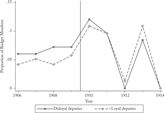
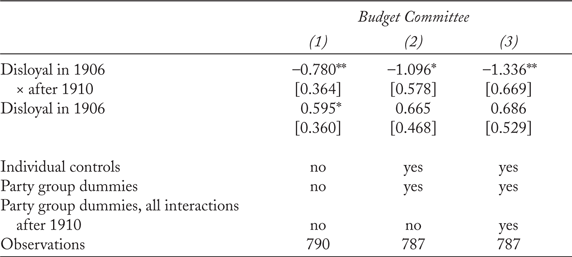
We turn to a behavioral measure to analyze how parties may have used committee posts as selective incentives. We use the disloyal (1906) variable, which measures whether a deputy switched party affiliation in the 1906 term before the reform, to see if parties rewarded those deputies who had joined their party before the reform by selecting them onto the budget committee. We conduct a simple difference-in-differences comparison for those deputies whom we observe over both the 1906 and 1910 terms. We compare those who changed their affiliation before 1910 to those who did not. Both groups were subject to the same treatment by which parties took control over nominations in 1910. Figure 6 demonstrates the parallel trends before and after the reform. We can only look at one term before the onset of the World War I, but the results are suggestive even in this short time span: parties increased their selection of loyal or new deputies at the expense of disloyal recruits. Although the lottery-based procedure played to the advantage of the disloyal switchers, the selection probability of loyal and new members increased more than that of disloyal recruits after parties gained control in 1910.
Change in Selection Probability in 1910 for Disloyal (in 1906) Deputies
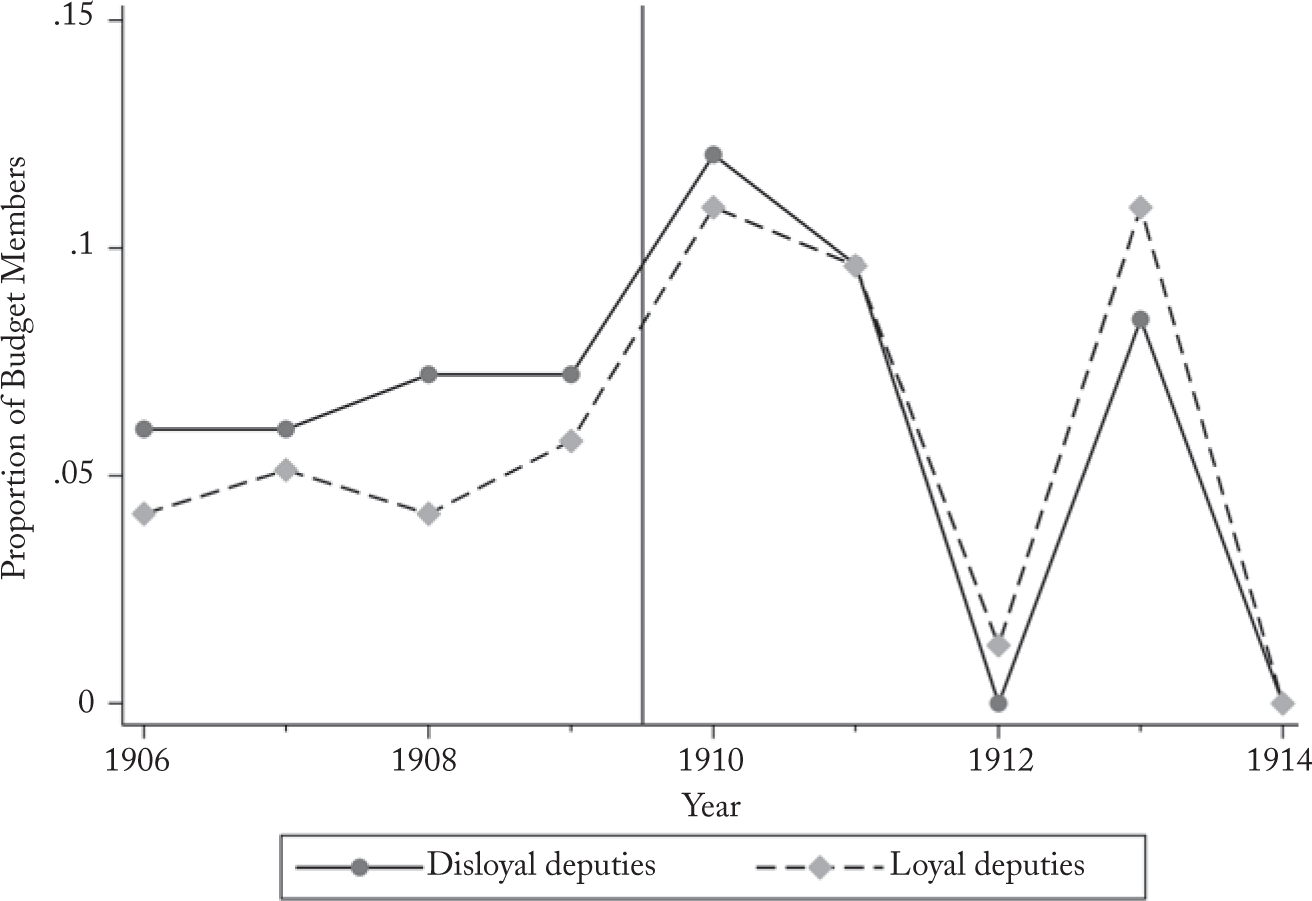
Figure 6 and Table 3 show the results of this difference-in-difference comparison. We find that party groups were less likely to appoint disloyal deputies to the budget committee, indicating that parties perhaps used their newly acquired power instead to reward loyal deputies. Note that this analysis only includes deputies who were present in both the 1906 and 1910 terms, thus it does not pick up party preferences toward first time deputies.
Logit Regression: Party Loyalty and Budget Committee Selectiona
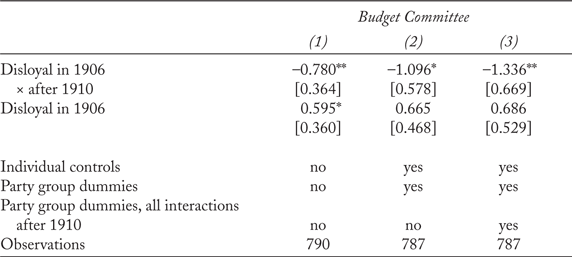
***p < 0.01, **p < 0.05, *p < 0.1
a Logit regressions. Individual controls as in Table 2, with the exception of switcher. Base category for party affiliation is independents. Column 3 includes all interactions with controls and dummies after 1910.
These results might suggest there are clear trade-offs between lottery-based procedures and partisan selection. Committee assignments are an important asset in the parliamentary arena and can be used by party groups as selective incentives to achieve discipline in voting or membership. Without such tools, early parties may find it more difficult to induce party cohesion among members. That parties were more likely to appoint loyalists suggests that they were using committee assignments this way. Our evidence is only suggestive; both the short time frame and changing parliamentary activity due to World War I make it difficult to test whether parties continued to use committee assignments as selective incentives. But it could indicate a trade-off in the use of lottery-based procedures in early party development. We leave this for future research.
VI. Results: Support for Bureaux Reform
A large literature in comparative politics has documented how parties strategically reform legislative procedures to achieve their political goals, particularly during periods of democratization and electoral reform.Footnote 70 Mildred Schlesinger put it best when she argued that French parties underwent constant “evolution and adaptation” and that the purposely flexible political structures reflected changing competition and power dynamics.Footnote 71 We concur with both views, and argue that parties supported parliamentary reform of the bureaux system in 1910 according to their interests and the level of party development. To test this argument, we analyze the support for the monumental legislative reform that removed the bureaux system. We argue that party organization drives reform: those deputies whose parties are organized and who believe they and their party stand to gain from controlling committee appointments will vote in favor of the reform.
First, we use our data to demonstrate the institutional development of parties within each party bloc. We do this by looking at the incidence of party switching within party families. Taking stable membership as an important characteristic of strong parties,Footnote 72 we consider the proportion of deputies within a party who switched as a measure of instability or party weakness. Parties comprising loyalists (deputies who remained in the same party as in previous legislative terms) or new deputies (recruited under the party label) will have an easier time maintaining cohesion than parties with a high number of deputies switching their affiliation.
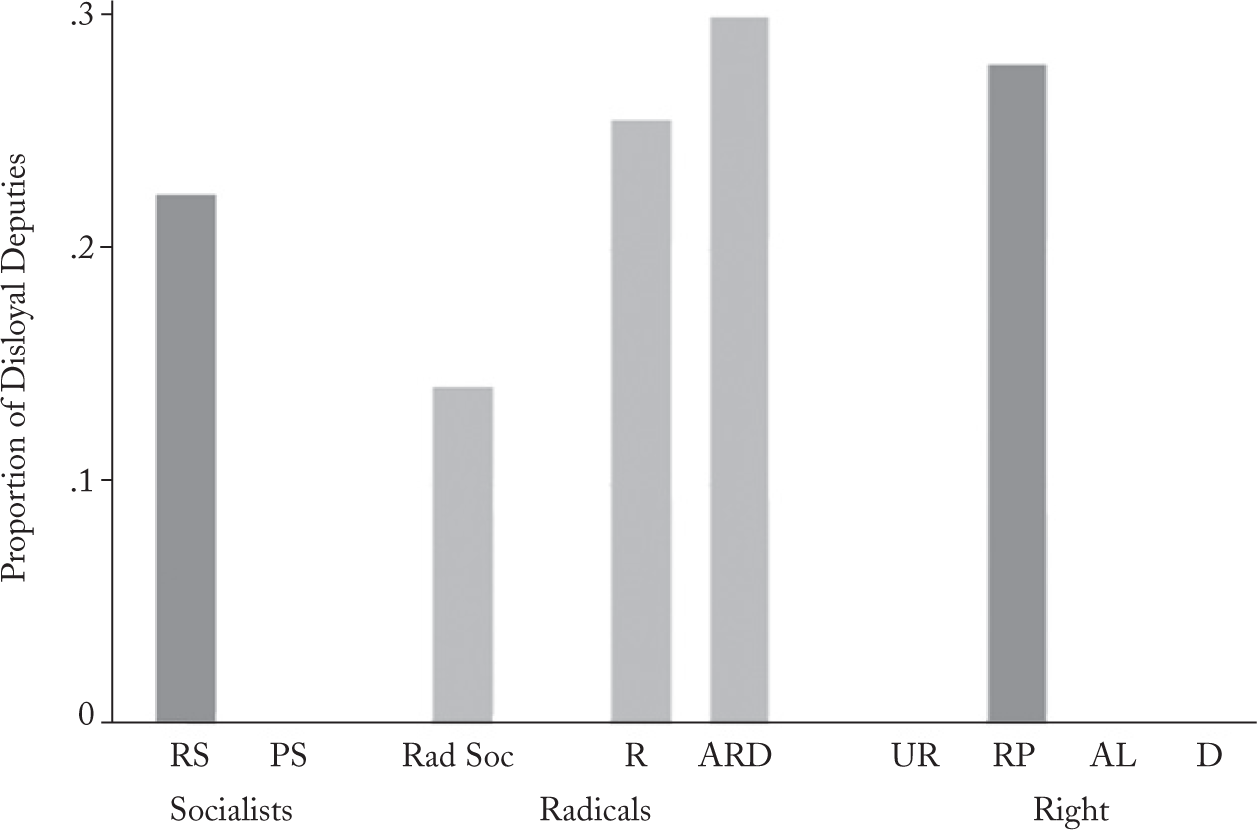
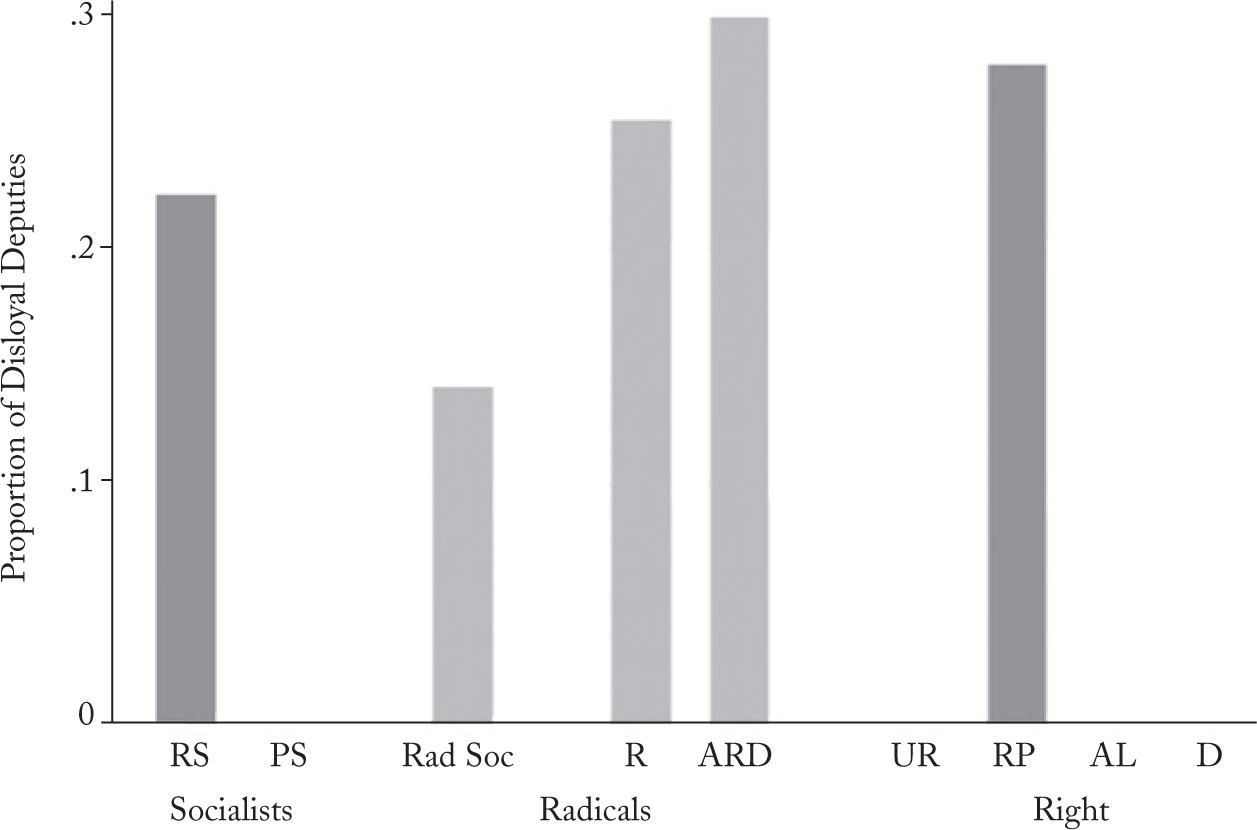
Figure 7 shows average deputy switching (party disloyalty) at the start of the parliamentary term compared to the previous legislature by parliamentary group. Note that indicative of a developing party system, the proportion of disloyal deputies in parties over our entire time period was fairly high. Yet in 1910, the bulk of party disloyalty happened in the Radicals (Moderate Republicans and Radical Socialists). Within the Socialist bloc, the Républicain Socialistes was a small group of independent Socialists (representing only 5 percent of the chamber) that had split from the main Parti Socialiste (sfio), which had zero switchers. Similarly, in 1910 the ideological-right bloc had its most stable membership since the start of the period of observation. Although the Progressives had some switchers,Footnote 73 the three other groups on the right had no disloyal deputies. By 1910, the right and Socialist factions were consistently and clearly defined, with stable membership and high internal organization. By contrast, although the Radicals were guaranteed a larger number of committee posts to allocate, their fluid membership and lack of formal governing structures meant higher uncertainty and, perhaps, an inability to use such a selective incentive properly. The more organized and cohesive the party, the less likely its members are to favor a lottery-based procedure.
Proportion of Disloyal Deputies by Partya
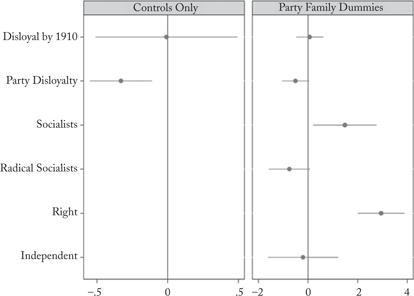
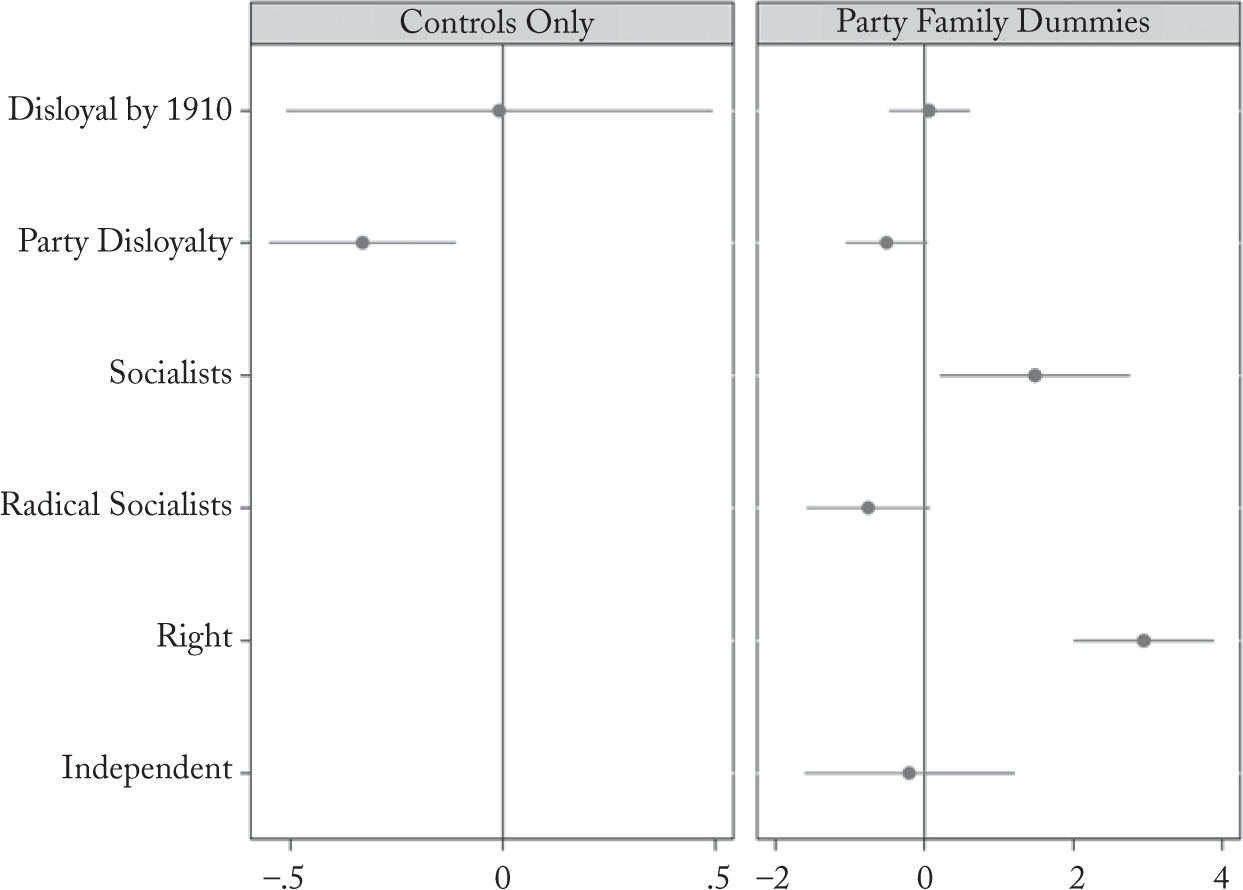
Second, we test whether stronger parties are less likely to favor lottery-based procedure using the roll call vote on the 1910 reform bill. The vote dismantled the bureaux system and replaced it with the election of the budget committee via party-controlled lists. Opponents of reform submitted a blocking amendment that would have preserved the lottery-based procedure, but it failed 196 votes to 300 and therefore paved the way for partisan control of committee selection. For a more intuitive interpretation of the 1910 blocking amendment, we rescale the indicator variable such that 1 indicates a vote to move away from the status quo of the lottery-based procedure. Using roll call voting data, we analyze voting for party reform with and without controls for partisan affiliation. Using party switching, we also control for our measure of party institutionalization. If our hypotheses about individual and party interests hold, partisan affiliation, in addition to individual characteristics, should be a very strong predictor of a deputy’s vote.
Figure 8 shows party disloyalty is still a significant predictor of voting against party reform at conventional levels. In 1910, the distribution of Chamber seats by bloc was Right, 22 percent; Moderate Republicans, 32 percent; Radical Socialists, 25 percent; Socialists, 19 percent; and independents, 3 percent. The two blocs in the center held the majority of seats and proportional allocation of committee posts would have advantaged them in selection. Yet the Radicals were against the reform and the smaller groups were in favor of it: the groups on the left and right cohesively voted for the reform and enough centrist deputies joined them to pass the proposal. Why was this the case?
Log Odds of Voting for 1910 Reform
The parties with the most stable membership voted in favor of a reform that would benefit parties. It has been well documented by historians that the smaller groups on each end of the ideological spectrum were much more institutionalized than the heterogeneous centrist-cadre parties in the middle.Footnote 74 The far left and far right factions had fewer members, were run by ideologically driven activists, and competed electorally by preserving clearly defined platforms—this applies to both the Droite and L’Action Libérale parliamentary groups, as well as to the unified socialists in the form of the sFIO.Footnote 75 These groups were better placed to use committee assignments as selective incentives and, as demonstrated above, the bureaux system underrepresented extremist groups.
By contrast, the various radical parties changed names and members switched at every election to win votes. As priest and social reformer Jules-Auguste Lemire argued in 1910:
“If I speak to you, Socialists, it is because you are the only ones who are unified. But when I address others, the Radical Socialists, for example, I do not know where the party starts!”Footnote 76
Because the large parties were less institutionalized and thus internally divided over the 1910 reform, 43 percent of the Radical Socialists and 39 percent of the Moderate Republicans voted against the bureaux system. By comparison, 90 percent of far right and left groups together voted in favor of it. Further, we have shown that centrist deputies were overrepresented in the bureaux, which could explain why Radical groups were divided about reform; some deputies did not want to relinquish control to party organizations because they were individually advantaged by the lottery-based procedure.
VII. The Timing of Institutional Reform
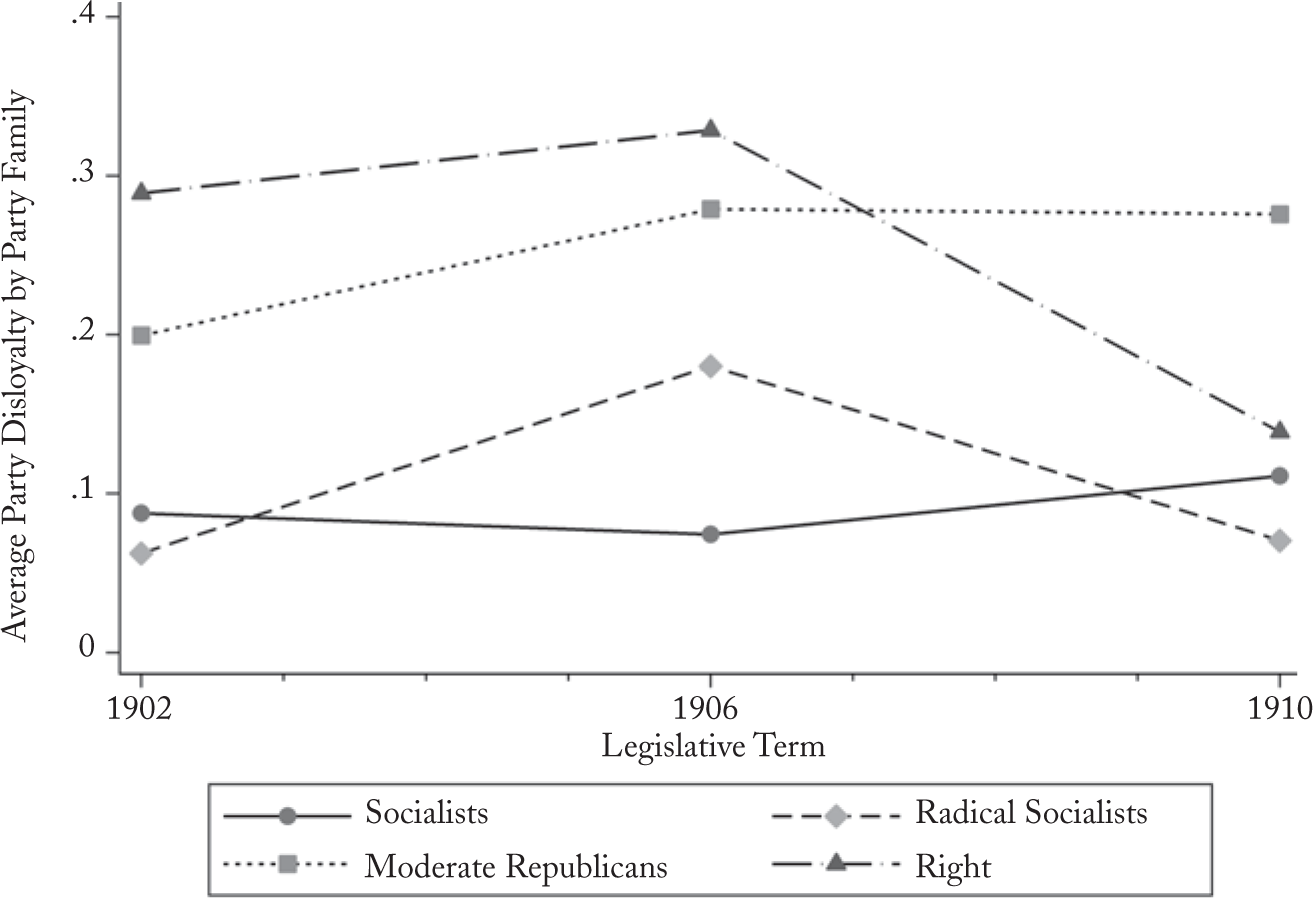
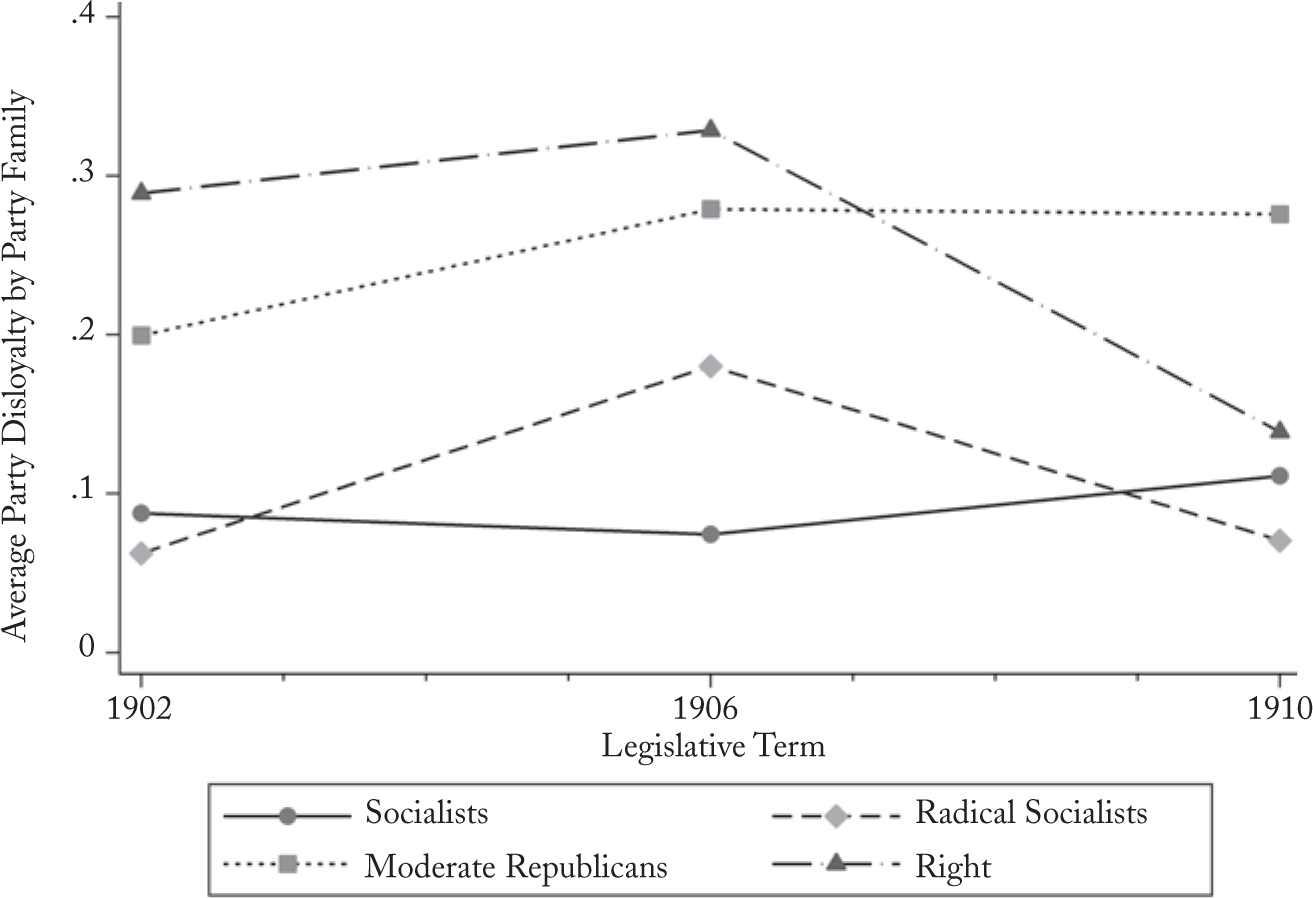
In the context of weakly organized parties and high uncertainty, lottery-based procedures have an advantage. But as parties stabilize and the threat of capture disappears, the advantages of partisan selection might outweigh the costs. Why was the bureaux system fully dismantled in 1910, and not in 1902? Measuring absolute party system development is subjective and there is no defined point for consolidation, but relative development is important. The successful reform coincides with the highest levels of membership stability and group continuity. Parliamentary groups were more clearly defined in 1910 and had consistently appeared in the two terms prior. Although in both 1902 and 1910 there existed nine distinct parliamentary groups, the effective number of parties varied widely: in 1902 it was 8.9 while in 1910 it was only 6.8. As Figure 9 shows, by 1910, the prevalence of party switching had declined.Footnote 77 In addition, deputies no longer held multiple affiliations, political associations had been legal for nearly a decade, and the widespread use of official party labels in the electorate began in the 1906 term.Footnote 78 Once parties consolidated into more unified actors, they removed the lottery-based procedure.
Average Disloyalty by Party Family over Time
These results also speak to a larger literature in comparative politics that studies when elites change institutional rules for strategic selfinterest, often in response to concerns about future oppositional gains.Footnote 79 In the first few decades of the French Third Republic, the antidemocratic extreme right was likely the most worrisome faction and a reason to keep the bureaux system in place. But was the timing of the bureaux dismantling a response to the decline of the right? It is true that the strength of the ideological-right bloc in the Chamber declined over the period of study, dropping from 34 percent in 1902 to 12 percent in 1914.Footnote 80 Moreover, the extreme right that had championed a return to monarchy was very weak in 1902 (10 percent of the Chamber) and declined rapidly thereafter. The antidemocratic rhetoric may have prevailed, but in 1902, when the bureaux system could have been dismantled but was not, the threat wasn’t credible.Footnote 81
It is more likely the case that French deputies were concerned about the stability of the system across all ideological tendencies; they worried about extreme groups and parliamentary groups becoming too powerful, and about nebulous party organizations being given control of the National Assembly. In the nineteenth century, conservative factions held monarchist or antirepublican sympathies, but by 1901 there was also great concern about the practices of extreme left factions like the Socialists. The unique aspect of the French case is the fluid nature of the party system across the spectrum. Parties and their membership changed from term to term; without consolidated parties, future threats were unknown. The lottery-based procedure served to bridge the gap by regulating legislative activity as the party system developed.
VIII. Conclusion
In this article, we highlighted the use of lottery-based rules in newly formed legislative institutions during the process of parliamentarization in Europe, focusing on the case of the French Third Republic. We presented evidence that partial randomization in the budget committee selection process resulted in the appointment of young, skilled, middle-class deputies instead of influential elites. Once party groups gained control of committees in 1910, elites were more likely to be appointed to the budget committee. We also showed that both the use and dismantling of this system were related to partisan politics—cohesive parties were more likely to vote for dismantling the bureaux system— and we provided evidence that parties used their newfound influence to reward loyal members with committee assignments.
Our results are relevant to contemporary scholarly and public debates regarding incorporating lotteries into democratic processes. For example, Akhil Amar proposes lottery voting in which a lottery is used to select legislators, but the probabilities are a function of the candidates’ electoral vote shares.Footnote 82 A number of studies also suggest that sortition can be used in the context of deliberative groups. Volker Britz and Hans Gersbach provide a game-theoretic rationale for lottery-based procedures by constructing an information-aggregation model that shows how public goods provision can be improved with an experimentation group.Footnote 83 In other studies, randomly assigned focus groupsFootnote 84 or deliberative pollingFootnote 85 are found to be as equally capable of analyzing the quality of public policy as are elites.
In the broader public debate, some consider sortition as a solution to democratic deficits and the perils of direct democracy.Footnote 86 Others argue for introducing a lottery element in the appointment processes of the European Union,Footnote 87 and selecting the second chamber by sortition has been suggested for the UK House of LordsFootnote 88 and for the French National Assembly (in Ségolène Royal’s 2007 presidential platform). Understanding the role of lottery-based procedures in the selection of political office or public policy is an important avenue for future research.
Using the French case, we empirically demonstrate that there are clear trade-offs between lottery-based procedures and partisan selection. Committee assignments can be an important tool used by political parties to reward loyal members and to develop long-term cohesion. In the French case, we show that party groups were more likely to select elites for the budget committee, and we provide suggestive evidence that they used committee posts to reward loyal members. Thus, the advantage of lottery-based procedures may be most salient in contexts of weak parties and developing institutions—used to bridge the gap until the regime is stable and political parties are consolidated enough to use the selective incentives inherent in committee posts.
DATA
Replication data for this article is available at https://doi.org/10.7910/DVN/GKPMOG.
Acknowledgments
We thank Amel Ahmed for inspiration, three anonymous World Politics reviewers, and audience members or discussants at the University of Bremen 2016, the Laboratory for Interdisciplinary Evaluation of Public Policies (Sciences Po) 2018, the University of Oslo Department of Political Science, and the Historical Political Economy Working Group 2017 for their useful comments.
Appendix A Party Switching
In general, party switching is coded as 1 if a deputy changed parliamentary groups from time t to t+1. Given the fluidity of the party system, parties evolved in different ways over time—some parties kept consistent names from term to term, some changed their name but were the same organization, some divided into two, and some saw the rise of factions or tendencies within their group (used to describe a subset of party members, but members of the subset were considered to be within the same party group). As a result, switching is based not on name matching, but on historical research. Since we don’t code tendencies as party switching, this can be considered a conservative measure of switching that understates the values of this variable.
All deputies who switched outside their party family are coded as switching. Within party families, there is variation. On the right, deputies who moved between L’Action Libérale and the various Groupe des Droites, or who were members of the Républicains-Progressistes/Union Républicaine, are not coded as switches because these were changes in name only; but deputies who moved to or from monarchist or nationalist groups are coded as switching because this change means becoming more or less extreme. In the Moderate Republican parties, name changes occurred each term, though there were two primary parliamentary groups—the Gauche Démocratique (ard) and Gauche Radicale (Radicaux). Deputies who moved between these groups were counted as switching. Radical Socialists retained the same name from term to term, and had no true splinter groups. Finally, Socialists were divided into two camps during this period, the Socialists Independants and Socialists Unifés. But until the creation of the sfio in 1905, these factions operated as a unit and thus moving between them is not counted as switching until 1906.
In France, deputies could technically hold multiple affiliations until 1902, though by 1898 only 25 percent of deputies were members of a single party group. Thus, our party data begins in 1898 and we attribute only party affiliations or switching data to deputies in that term that held a single affiliation. As a result, the 1902 switching data is a conservative measure and has fewer observations. Given this was the first time with single affiliations, deputies are not punished for moving within their party families. As a result, 1902 most likely understates the levels of switching, which can be seen in Figure 9.
Appendix B
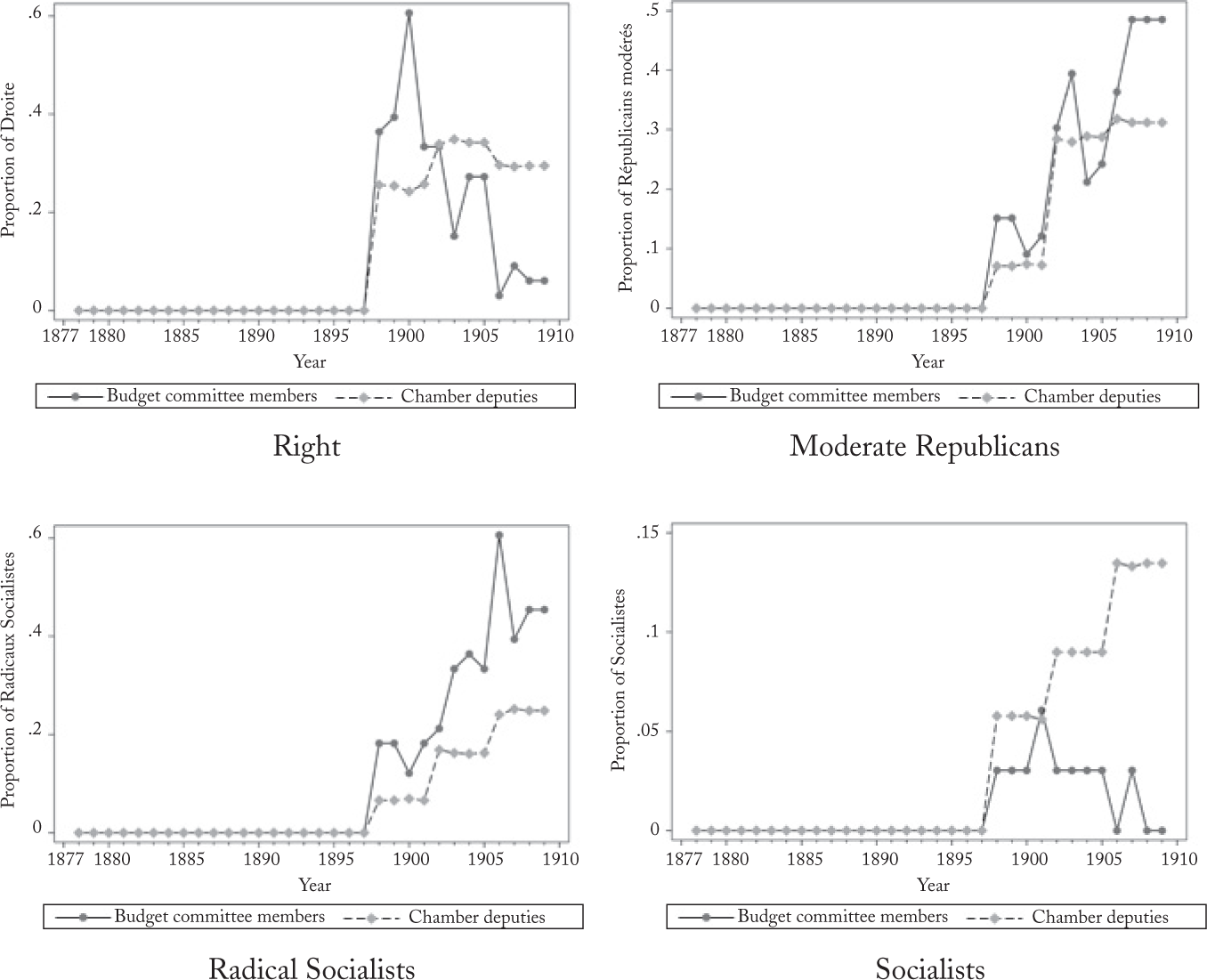
Deputy Party Affiliation: Chamber versus Budget Committee under Bureaux

Authors
Alexandra Cirone is an assistant professor and Himan Brown Faculty Fellow in the Department of Government at Cornell University. Her research interests center on historical political economy, democratization and party systems in new democracies, and multilevel governance in European politics. She can be reached at aec287@cornell.edu.
Brenda Van Coppenolle is an assistant professor of political science at the University of Leiden. Her research is concerned with the identities of politicians and how representation changes with the implementation of institutional changes. Her current research investigates political inequality and political careers in the United Kingdom and France. She can be reached at b.k.s.van.coppenolle@fsw.leidenuniv.nl.