Language skills contribute substantial and unique variance to reading development, in addition to phonological processing skills (Catts, Fey, Zhang, & Tomblin, Reference Catts, Fey, Zhang and Tomblin1999; Nation & Snowling, Reference Nation and Snowling2004). Several large-scale studies measuring language and phonological processing skills in students who hear normally have found that language development plays an enduring and central role in reading development (Dickinson & McCabe, Reference Dickenson and McCabe2001). Over and above phonological awareness skills in first and second grade, language difficulties are strongly associated with reading problems in middle childhood (Catts, Fey, Tomblin, & Zhang, Reference Catts, Fey, Tomblin and Zhang2002; Dickinson, McCabe, Anastasopoulos, Peisner-Feinberg, & Poe, Reference Dickenson, McCabe, Anastasopoulos, Peisner-Feinberg and Poe2003; Roth, Spence, & Cooper, Reference Roth, Speece and Cooper2002). Moreover, students who exhibit reading problems beyond the primary grades have been found to have language problems (Leach, Scarborough, & Rescorla, Reference Leach, Scarborough and Rescorla2003; Scarborough, Reference Scarborough1990). These findings converge to indicate that reading development has a linguistic basis that extends beyond the association between spoken phonology and orthographic patterning.
We know little about the relation of linguistic ability and reading development in individuals who are born deaf and whose language is signed. The median reading level for deaf students, regardless of whether they speak or sign, indicates a low level of achievement. Approximately 60% of students leaving high school read at or below fourth grade (Allen, Reference Allen, Schildroth and Karchmer1986, Reference Allen1994). About 10% of deaf students read beyond a Grade 8 level (Traxler, Reference Traxler2000). One factor proposed to impede reading development in deaf students is difficulty with spoken language, consistent with the above-cited research indicating that linguistic ability is the basis of reading development for hearing students (Allen, Reference Allen, Schildroth and Karchmer1986; LaSasso & Davey, Reference LaSasso and Davey1987; Quigley & Paul, Reference Quigley, Paul, Wang, Reynolds and Walberg1989; Waters & Doehring, Reference Waters, Doehring, Carr and Levy1990). Spoken language development is well documented to be problematic when severe (70–90 dB) to profound (>90 dB) hearing loss is present at birth (Geers & Moog, Reference Geers and Moog1987; Wolk & Schildroth, Reference Wolk, Schildroth, Schildroth and Karchmer1986).
The crucial question is whether sign language can function as the linguistic basis of reading development. Although demographic studies of deaf students' reading achievement include background information such as socioeconomic status (SES), ethnicity, and hearing level, information about sign language ability is unavailable. There are no standardized tests of sign language, so the sign language abilities of deaf students who read successfully or not are unknown.
Most adults who are deaf use some form of sign as their primary language (Karchmer & Mitchell, Reference Karchmer, Mitchell, Marschark and Spencer2003). Psycholinguistic research has accumulated detailed evidence that sign languages are natural languages with respect to grammatical structure (see Sandler & Lillo-Martin, Reference Sandler and Lillo-Martin2006). Research indicates that sign languages serve all the psychological functions of spoken language, including the ability to comprehend, remember, and produce words and sentences (see Emmorey, Reference Emmorey2002), engage in extended discourse on abstract topics, and create puns, metaphors, poetry, and drama (Perlmutter, Reference Perlmutter, DeLuca, Lindgren and Napoli2008). Sign languages are processed in brain areas that also process spoken languages, specifically the classic language areas of the superior temporal and inferior frontal areas of the left hemisphere (MacSweeney et al., Reference MacSweeney, Woll, Campbell, McGuire, David and Williams2002; Petitto et al., Reference Petitto, Zatorre, Gauna, Nikelski, Dostie and Evans2000; Poizner, Klima, & Bellugi, Reference Poizner, Klima and Bellgui1987).
Two clear differences between signed and spoken languages are the sensory–motor modality through which they are sent and received and the particular linguistic structures that make up their grammars. These two factors have been hypothesized separately or together to preclude sign language from functioning as the linguistic basis for reading. With respect to modality differences, some reading models posit that written word recognition requires phonological mediation of an articulatory, and perhaps acoustic, nature (Perfetti & Sandak, Reference Perfetti and Sandak2000). Within this framework the ability to speak is necessary for reading development but the ability to sign is tangential. However, deaf college students who use American Sign Language (ASL) have been found to use phonological coding for some reading tasks (Hanson & Fowler, Reference Hanson and Flowler1987), indicating that phonological analysis of written words is compatible with using sign language.
The focus of the present study is on the second difference between signed and spoken languages hypothesized to impede reading development in deaf readers, namely, that the grammatical differences between signed and spoken language are too great for sign language to function as the linguistic basis of reading (Mayer & Wells, Reference Mayer and Wells1996). In this framework, reading is conceived of as a process whereby meaning is extracted from print by matching the grammatical structures of the written language to the grammatical structures in the reader's mind, which are assumed to be identical to the structures of the reader's through the air language. A mismatch between the syntactic representations of written and through the air language are thus argued to impede reading development in deaf readers who sign.
Educators have long realized that written English grammar differs from that of ASL. Such recognition motivated attempts to change ASL grammatical structure into something more akin to written English, despite the fact that doing so yielded sign forms that were ungrammatical and phonologically impossible in any natural sign language.Footnote 1 ASL content signs are interspersed with invented signs to represent English grammatical and derivational morphology and word order. The resulting mix of invented and natural sign is produced simultaneously with speech to communicate with deaf students; the goal is to facilitate English acquisition, albeit in a signed form. This pedagogical signing is commonly referred to as Manually Coded English (MCE), and various versions of it have been used in North American classrooms.Footnote 2 Some students educated in a version of MCE (i.e., see Anthony, Reference Anthony1971) have been found to develop reading skills at or near-grade level when their parents used it at home as well (Schick & Moeller, Reference Schick and Moeller1992). Owing to its artificial nature, however, ASL signers who also know English report that MCE is difficult to parse and understand.
Research has begun to investigate the relation between ASL knowledge and English reading ability (Chamberlain & Mayberry, Reference Chamberlain, Mayberry, Chamberlain, Morford and Mayberry2000). Proficiency with ASL plural markers and knowledge of synonyms and antonyms correlated positively with reading achievement in a small sample of students educated in MCE (Hoffmeister, Reference Hoffmeister, Chamberlain, Morford and Mayberry2000). For students educated in ASL, a composite score of four comprehension and two production tasks in ASL predicted a composite score for English reading and writing tasks (Strong & Prinz, Reference Strong and Prinz1997). Recognition and memory of fingerspelled and initialized signs within ASL sentences correlated positively with reading achievement in a small sample of students educated in MCE or ASL (Padden & Ramsey, Reference Padden, Ramsey, Chamberlain, Morford and Mayberry2000).Footnote 3 One study found no relation between ASL and reading achievement in a college-age sample, but the null result may have been due to ceiling effects for the ASL measure, which was a 4-point proficiency rating scale (Moores & Sweet, Reference Moores and Sweet1990). These findings suggest that a variety of ASL skills relate positively to reading development. A direct test of ASL syntactic proficiency and English reading achievement is lacking, however.
In previous work, we found narrative comprehension of MCE and ASL to account for 48% of variance in reading achievement after the effects of age were removed. The sample included 48 deaf students ranging from 6 to 15 years old; half of the students had deaf parents who used sign language. Both ASL and MCE narrative comprehension better predicted reading achievement than other psycholinguistic measures of signed and written language including: short-term memory for signs, fingerspelling, and written words; working memory for sentences in ASL, MCE, and written English; and background measures including nonverbal IQ, hearing level, and speech sound production (Chamberlain & Mayberry, Reference Chamberlain, Mayberry, Chamberlain, Morford and Mayberry2000). Some students showed greater ASL than MCE comprehension but nonetheless read at grade level. Narrative comprehension may better predict reading ability than working memory tasks because it entails discourse comprehension, which may be more akin to reading comprehension (Hoover & Gough, Reference Hoover and Gough1990; Strich & James, Reference Strich, James and Pearson1984).
The present study extends previous work by making a direct comparison between ASL proficiency and reading comprehension in a sample of adults whose reading development is presumably complete. We test the hypothesis that sign language can serve as the linguistic basis of reading by testing adults who self-identify as using sign language for interpersonal communication, that is, members of the deaf community. We also adopt a research paradigm commonly used in reading research, namely, a comparison of skilled readers (SR) and less skilled readers (LSR). If the grammatical structure of the reader's through the air language must match that of the written language for skilled reading to develop, then deaf signers who have high levels of ASL syntactic and narrative skills should more often be identified as LSR than those with low ASL syntactic and narrative skills. Alternatively, if the linguistic basis of reading is abstract and transcends language modality and grammatical form, as does the nature of language itself, then the reverse outcome should be observed. Skilled deaf readers should show high levels of ASL proficiency but less skilled deaf readers should not.
To test the hypothesis, we measured the reading and sign language abilities of a sample of adults. All the adults were born deaf and reported relying on ASL as their primary language. We measured ASL and MCE narrative comprehension in addition to ASL syntactic proficiency. We took additional measures including a nonverbal IQ screening, education, hearing level, self-report of speech use and comprehension, and print exposure. To the best of our knowledge, this is the first reading study with a nonschool age sample of deaf adults and the first to assess print exposure in this population as well.
We did not know in advance what the reading levels of the sample would be. We categorized the participants as being SR or LSR, based on performance on a reading test widely used in educational programs for deaf students. We then compared their ASL syntactic, and ASL and MCE narrative skills along with background information including nonverbal IQ, hearing and speech ability, and exposure to print. Last, we analyzed the data with regressions to isolate the contribution of ASL syntactic proficiency to English reading ability.
METHODS
Background measures
Nonverbal IQ screening. Three subtests of the performance scale of the Wechsler Adult Intelligence Scale—Revised (WAIS-R; Wechsler, Reference Wechsler1981) were administered. Although no language response was required, the tasks were given in ASL to ensure that they were understood. The subtests served both to screen for below average cognitive ability and as a background measure and were: picture completion, picture arrangement, and block design. Participants were excluded if they scored more than 1 standard deviation below the mean on each of the three subtests (i.e., a summed scaled score of 21 or less).
Hearing status. An audiometric screening (pure tone thresholds for the frequencies of 250–4000 Hz at 70–95 dB) was conducted with a portable audiometer.
Speech use and comprehension. Speech use and comprehension was collected by means of a self-report measure adapted from a bilingual questionnaire (Weber-Fox & Neville, Reference Weber-Fox and Neville1996). Participants reported how often they used speech. They rated their speech-use frequency on a scale from 0 (never use speech) to 10 (use speech daily). They also rated their ability to comprehend speech on a scale from 0 (not at all) to 10 (perfect).
Reading measures
Stanford reading comprehension. The Stanford 9 (Psychological Corporation, 1995), normed for deaf students, was administered and used to categorize participants into the SR and LSR groups. Participants were first given a screening test to ensure that the appropriate test level was given. The reading comprehension subtest had 10 short passages with 4–6 multiple choice questions after each for a total of 54 questions.
Gates–MacGinitie reading tests. Two reading tests in addition to the one used to categorize the participants were also administered. The reading comprehension and vocabulary subtests of the Gates–MacGinitie Reading Tests, Second Canadian Edition (MacGinitie & MacGinitie, Reference MacGinitie and MacGinitie1992) were given to all participants. This test is widely used with deaf students. The reading comprehension subtest had 10 short passages with 4–6 multiple choice questions after each, for a total of 48 questions and a 35-min time limit. The reading vocabulary test had a total of 45 questions and a 20-min time limit. For the latter task, the reader matched a word underlined in a carrier phrase with one of four choices of synonyms. Although the Gates–MacGinitie does not have norms for deaf readers, it was standardized on 40,000 Canadian students and, as such, reflected Canadian curricula content.
Sign language measures
ASL syntactic proficiency. ASL syntactic ability was measured with an experimental grammatical judgment task used in a previous study (Boudreault & Mayberry, Reference Boudreault and Mayberry2006). The task assessed grammatical knowledge of 6 ASL sentence structures: simple, negative, inflecting verb, wh-questions, relative clauses, and classifier sentences. Although the simple sentences used subject–verb–object (SVO) word order, and thus were similar to English SVO structures, the remaining structures used morphosyntactic forms not found in English and used space and nonmanual (i.e., facial) markers grammatically. (See Appendix A for a description of the ASL structures.) Mastery of each of the 6 ASL structures was assessed with 24 stimuli (12 grammatical sentences and 12 ungrammatical counterparts, each containing the same syntactic violation), for a total of 144 stimuli. Stimuli were randomized and presented in movie files on a laptop computer, which also recorded accuracy. Participants decided with a button press whether each stimulus was a grammatical ASL sentence. An A′ score was computed for each participant's performance for each structure and then averaged.Footnote 4
ASL and MCE narrative comprehension. Two narrative comprehension tasks were adapted from a previous study with children. The tasks involved watching a story in sign language, answering questions, and then retelling it (Chamberlain & Mayberry, Reference Chamberlain, Mayberry, Chamberlain, Morford and Mayberry2000). One narrative was about a man driving through town in a van unaware that his horn was blaring. The second narrative was about a woman stuck in an elevator because she could not hear the door opening behind her. Each story used a simple story structure (Stein, Reference Stein, Katz, Glockner, Watkins and Spencer1979) and included the following story elements: a setting, a major deaf character, minor deaf and hearing characters, a problem arising for the main character related to deafness, two attempts by the main character to solve the problem, and a resolution. The plots were inspired by a collection stories by deaf storytellers (Bragg & Bergman, Reference Bragg and Bergman1981). Twelve questions probed different elements of story structure. Three questions asked about the nature of the problem, such as, “Why did people point and stare at Dennis?” Three questions asked about the characters and setting, such as, “Who told Mary her friend was in the hospital?” Three questions asked about extraneous information required for story understanding, such as, “Why would an elevator have two doors?” Finally, three questions required an inference based on story comprehension, such as, “Did Dennis's brother know sign language?”
In previous work, we found a ceiling effect on this task for 13- to 15-year-olds. To avoid ceiling effects and make the stories more appropriate for adults, we increased the number, length, and complexity of story episodes. Two sign versions were created of each story, one in ASL and one in MCE, by ASL consultants who were deaf native signers. A deaf native ASL signer produced each story, once in ASL and once in MCE, and was videotaped. The MCE stories were signed with simultaneous mouthing of English words without vocalizing, which was the consultant's manner of expressing MCE. The comprehension questions were signed in the same sign language as the story, ASL or MCE. The ASL and MCE story versions were presented to participants in a counterbalanced fashion. If a participant saw the elevator story in ASL then he or she saw the van story in MCE, and vice versa. Each story was 3 to 4 min in length. Participants watched the story on a laptop computer and then answered 12 comprehension questions, also presented on the laptop. Participants' responses were videotaped and then scored for accuracy, strictly correct or not, by a deaf research assistant.
We analyzed the variance associated with the reading and sign language measures with Cronbach alpha. Alpha for the entire set of measures, three reading tests and three sign language measures, was .8. The Cronbach alpha for ASL grammatical judgment was .91 and for the ASL and MCE narrative comprehension measures were .91 and .91, respectively, indicating that the variance associated with the three sign language measures was similar to that associated with the three reading tests. Cronbach α values were .88 for the Stanford reading comprehension subtest, .89 for the Gates–MacGinitie reading comprehension subtest, and .89 for the vocabulary comprehension subtest of the Gates–MacGinitie.
Print exposure measures
Author Recognition Test. Because skilled reading development is influenced by reading frequency (Stanovich, Reference Stanovich1986), we administered the Author Recognition Test (ART; Stanovich & West, Reference Stanovich and West1989) to measure reading practice. The test uses recognition of popular authors' names as the dependent measure. The Canadian version listed 45 popular authors (including popular Canadian authors, e.g., Pierre Burton, Margaret Atwood) and 41 foils to control for guessing.Footnote 5 Instructions included a warning against guessing because not all listed names were popular authors. Scoring of the checklist was the number correct minus the number of foils checked.
Magazine Recognition Test. As a second measure of reading frequency, we administered the Magazine Recognition Test (MRT; Stanovich & West, Reference Stanovich and West1989), which uses familiarity with popular magazine titles (e.g., Vogue, Rolling Stone, Time) as the dependent measure. The Canadian version included 60 popular magazines titles. Participants checked all magazines with which they were familiar.5 To control for guessing, the list included 34 foils that were fictional names but could be magazine titles (e.g., Reader's Choice, Digital Sound). Instructions warned against guessing; scoring of the checklist was the number of correct magazine titles checked minus the number of foils checked.
Reading and Media Habits Questionnaire. All participants filled out an 11-item questionnaire designed to ascertain amount of exposure to print and TV media (Stanovich & West, Reference Stanovich and West1989). Questions included amount and frequency of book, magazine, newspaper reading, frequency of bookstore and library visits, and amount and type of TV watching habits.Footnote 6 For the present study we used participants' responses to three questions: “How often do you read a newspaper? How many books do you read a year? How often do you read for pleasure?”
Participants
Participants were recruited several ways, through flyers posted at deaf centers, direct contacts by research assistants, and recruiting previous research participants. The institutional review board of the McGill University Faculty of Medicine approved the protocol. The participants resided in various locales across Quebec and Ontario. They had attended a wide range of educational programs, thereby making educational program a random effect in the sample. All participants were educated in English and used ASL as a primary language, although several participants also knew and used French and/or Langue des Signes Québecoise (LSQ), which are the majority spoken and signed languages in Quebec.
Forty adults volunteered. They reported being deaf from birth and that ASL was their primary language, which they had used daily for a minimum of 10 years. Four participants did not complete the experimental protocol, which required two testing sessions, so their data were excluded. The data from four other participants were excluded because they performed one standard deviation below the normed average on the nonverbal IQ screening task. The data from one participant were excluded because of equipment failure. The remaining 31 participants included 12 women and 19 men between the ages of 17 and 53 years with average age of 32 years.
Procedure
A research assistant fluent in ASL who was deaf tested participants individually in a nondistracting room at several testing sites conforming to the same arrangement. A second researcher who was hearing (the first author) was present for all testing sessions and conducted the hearing screening and computer tasks. All instructions, including the informed consent, were given in ASL, and questionnaire items were translated into ASL upon request. The ASL grammatical judgment task and sign language narratives and questions were presented on an Apple G3 PowerBook. The deaf research assistant was the interlocutor; the hearing researcher controlled the presentation of the stories and questions. Participants watched the sign language narrative uninterrupted. Next, the questions were shown one at a time on the laptop. Participants then signed the answer to the deaf research assistant who responded neutrally with comments such as, “anything else,” or “that's fine.” There was no time limit. Participants were free to answer in their language of choice, and everyone answered in ASL.
Reading group assignment
Each participant was categorized as being either an SR or LSR using the reading comprehension subtest of the Stanford 9 (Psychological Corporation, 1995). A standard score of 680 or above (Grade 8 equivalent or above) was the criterion for classification as an SR. Any participant scoring below criterion was categorized as an LSR. An eighth-grade cutoff was selected prior to analyzing the data because it represents the official definition of functional literacy by the Canadian government (Statistics Canada, 1996).
Data analyses
For statistical analyses, the data took the following forms. For the ASL grammatical judgment task, the participant's accuracy was converted into a mean A′ score. Narrative question accuracy was converted to proportion (12 total for each story), one for ASL and one for MCE. Nonverbal IQ subtest performance was converted to scaled scores, as were the reading comprehension and vocabulary comprehension subtests of the Gates–MacGinitie, and the reading comprehension subtest of the Stanford. All other measures were in raw score or numerical rank (for the self-assessment of speech use and comprehension skill).
RESULTS
We analyzed the data three ways. First we categorized the participants into two groups, SR (performance ≥ Grade 8) and LSR (performance < Grade 8). Next we compared the SR and LSR groups on all the measures: reading, background, sign language, and print exposure. Third, we analyzed the relations among measures with multiple correlations. Last, we analyzed the data with regressions to determine the degree to which sign language proficiency predicted reading proficiency, and print exposure predicted sign language proficiency, as we explain below. We begin with a description of the SR and LSR groups.
SR and LSR group comparisons
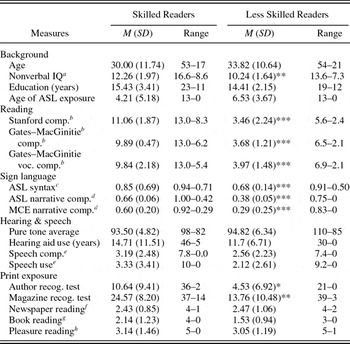
Categorizing the participants as reading above or below the Grade 8 criterion provided a clear distinction between the groups, resulting a bimodal distribution of reading ability in the sample. Mean reading level for the SR group was grade 11.06 compared with 3.46 for the LSR group. No Stanford score among the LSR participants was close to eighth-grade criterion for being an SR (see Table 1). Three LSR participants performed at a Grade 5 level; all the other LSR participants performed at or below a Grade 3.5 level.
Background, reading, sign language, and print exposure measures for the skilled and less skilled reader groups

aScaled score for three subtests of the WAIS (block design, picture arrangement, picture completion), M = 10.0, SD = ±3.
bGrade-level equivalent score.
cMinimum score = 0.50.
dMinimum score = 0.
eRating 0 to 10 = never to always.
fRating 0 to 4 = never to more than 2 newspapers daily.
gRating 0 to 4 = none to 40 or more.
hRating 0 to 4 = never to daily.
* p < .05. **p < .01. ***p < .001.
Background measures. Table 1 shows all the measures for the two reader groups. The SR group was on average 30.0 years old and the LSR group was on average 33.8 years old, which was not significantly different, F (1, 29) = .903, p = .35. The SR group performed at higher levels on the nonverbal IQ screening, with a mean of 12.26, than that the LSR group, 10.24, F (1, 29) = 9.78, p < .01). Note that a scaled score of 10 is the normed average with a standard deviation of 3.0, indicating that both groups' mean nonverbal IQ performance within the average range for the hearing population (Weschler, Reference Wechsler1981). The groups did not differ in mean years of education, 15.43 and 14.41 years for the SR and LSR groups, respectively, F (1, 29) = 1.02, p = .32. The SR group reported a younger mean age of ASL exposure, 4.2 years compared with the LSR group, 6.5 years, which was not significantly different, F (1, 29) = 2.11, p = .156. Seven participants in the SR group had deaf parents; two participants in the LSR group had deaf parents.
Reading measures
As expected, given the eighth-grade criterion for being a skilled reader, the SR group significantly outperformed the LSR group on the reading comprehension subtest of the Stanford with means of 11.06 and 3.46, respectively, F (1, 29) = 197.73, p < .001. Differences in reading achievement were corroborated with two additional reading tests. The SR group significantly outperformed the LSR group on the Gates–MacGinitie comprehension subtest with grade equivalent means of 9.89 and 3.68, respectively, F (1, 29) = 85.80, p < .0001. The same was true for performance on the vocabulary subtest where the SR group performed at a significantly higher grade level, 9.84, than the LSR group, 3.97, F (1, 29) = 69.25, p < .0001). Given the substantial difference in reading ability between the SR and LSR groups, the crucial question is whether they differed in sign language profic iency.
Sign language measures
ASL syntactic proficiency. Mean A′ score on the ASL grammaticality judgment task for the SR group was .85, indicating a high degree of receptive control over ASL syntactic structures, whereas that of the LSR group performance was .68, indicating weak control over ASL syntax (where .50 represents performance at chance), F (1, 29) = 19.36, p < .0001.
ASL and MCE narrative comprehension. On the ASL narrative comprehension task, the SR group's performance was .66 and that of the LSR group was .38. On the MCE narrative comprehension task, SR group mean performance was .60 and that of the LSR group was .29. Two participants in the LSR group could not answer any questions for the MCE narrative; one LSR participant declined the task. The two stories were thus of sufficient difficulty to avoid ceiling effects even among the best sign language comprehenders in the sample. A two-way analysis of variance for the between-subjects factor of reading group, SR and LSR, and the within-subjects factor of sign language type, ASL and MCE, showed the SR group to comprehend both ASL and MCE narratives at significantly higher levels than the LSR group, F (1, 25) = 21.1, p < .0001, with no significant interaction between group and sign language type (see Table 1).
Hearing and speech measures
No participant was excluded for having less than a severe loss. The majority, 94%, of the sample had profound loss. Mean hearing loss for the SR group was 93.5 dB (12 of 14 participants had a profound loss) and 94.82 dB for the LSR group (14 of 17 participants had a profound loss), and was not significantly different, F (1, 29) = 0.413, p = .525. The SR group reported more years of hearing aid use, 14.7, than the LSR group, 11.74, which was not significantly different, F (1, 29) = 0.767, p = .388 (see Table 1).
On the self-report scale of everyday speech comprehension and use (0 = not at all, 10 = always), the SR group reported a mean speech use of 3.3 and the LSR group reported a mean speech use of 2.1, which did not differ, Kruskal–Wallis z = 1.022, p = .31. The reported mean speech comprehension of the SR group was 3.2 and that of the LSR group was 2.6, which also was not significantly different, Kruskal–Wallis, z = .76, p = .45.
Thus, the SR group showed significantly higher sign language proficiency in ASL and MCE than the LSR groups, but the two groups did not differ in residual hearing level, hearing aid use, or how easily and often they could use and understand speech in daily life.
Print exposure measures
The SR group recognized more authors, with a mean of 10.64, than the LSR group, with a mean of 4.53, F (1, 29) = 4.34, p < .05. The SR group also recognized more magazine titles than did the LSR group, with means of 24.58 and 13.76, respectively, F (1, 29) = 9.88, p < .01 (see Table 1). Although the SR group recognized more authors and magazine titles than the LSR group, both groups reported reading newspapers daily to several times a week (2.43 and 2.47 for the SR and LSR groups, respectively; Kruskal–Wallis, z = −.52, p = .60). Both groups reported reading one to three books on average a year (2.14 and 1.53 for the SR and LSR, respectively; Kruskal–Wallis, z = 1.54, p = .12). Both groups reported reading for pleasure at least once a week (3.14 and 3.05 for the SR and LSR groups, respectively; Kruskal–Wallis, z = .33, p = 74).
In sum, the SR and LSR groups primarily differed in mastery of ASL syntax, narrative comprehension in both ASL and MCE, and print exposure as measured by author and magazine recognition, but not in the amount of newspaper, book, or pleasure reading. They also differed in mean nonverbal IQ, which was however within the normal range for both groups. The next question is how these measures relate to one another.
Relationships among the measures
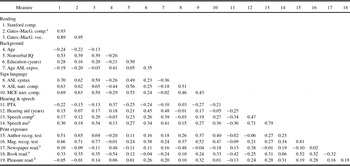
We analyzed the relationships among the measures with multiple correlations using Pearson product moment for the continuous variables and Spearman rho for the categorical variables, which are shown in Table 2. The three reading measures correlated with the three sign language measures (r = .59–.70). The three reading measures further correlated with the print exposure measures, ART and MRT (r = .51–.77). The Gates–MacGinitie reading subtests also correlated with book reading (r = .35). In addition, the three sign language measures correlated with the MRT print exposure measure (r = .37–.52), and the ASL and MCE narrative comprehension tasks correlated with the ART print exposure measure (r = .37 and .40, respectively). These correlations indicate that reading proficiency is related both to sign language proficiency and print exposure, and importantly, that sign language proficiency is related to print exposure as well.
Intercorrelations among the measures

Note: Correlations >.45 and >.35 in absolute values are significant at the .01 and .05 levels, respectively (two tailed).
a Pearson product moment unless otherwise noted.
b Spearman rho.
The only background measure to correlate with the reading measures was nonverbal IQ (Stanford, r = .53; Gates–MacGinitie subtests, r = .39). Nonverbal IQ, in addition, correlated with the sign language measures (r = .49–.56) and years of education (r = .50). Neither years of education nor any hearing and speech measure correlated with any reading or sign language measure.
The correlation results are thus consistent with the SR and LSR group contrasts in showing that reading ability is related to sign language proficiency. The correlation results further suggest that print exposure and nonverbal IQ may influence the reading proficiency of deaf signers.
Reading achievement prediction
The crucial question is the extent to which ASL syntactic proficiency predicts English reading ability. Because ASL grammar entails syntactic structures not found in English, it has been hypothesized to impede, or be unrelated to, skilled reading in deaf signers. To measure the contribution of ASL syntactic proficiency to English reading performance, we conducted stepwise regressions, one for each reading test because they differed in salient ways. The Stanford comprehension subtest was normed for deaf readers. The Gates–MacGinitie reading comprehension subtest was normed for hearing readers. Although the same was true for the Gates–MacGinitie vocabulary subtest, the nature of the task was different, specifically, inferring word meaning from sentence contexts rather than comprehending passages.
Following the same procedure for each regression, we controlled for nonverbal IQ by entering it on the first step. Next we controlled for the effects of print exposure by entering it on the second step. We used the MRT because it correlated more highly with reading performance than the ART; however, the results were consistent regardless of which print exposure measure was used (see Table 2). In the third step, we controlled for the effects of MCE narrative comprehension because it has been argued to facilitate reading development, whereas ASL has been argued to impede it. On the fourth and last step, we entered ASL syntactic proficiency to determine whether it made a unique contribution to reading performance, after the effects of nonverbal IQ, print exposure, and MCE narrative comprehension were controlled.
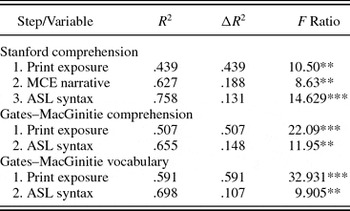
Three variables predicted 76% of the variance in performance on the Stanford reading comprehension subtest; print exposure contributed 44%, MCE comprehension contributed an additional 19%, and ASL syntactic proficiency uniquely contributed 13% to the variance, as Table 3 illustrates. Within the context of these variables, nonverbal IQ was not a significant predictor of reading performance (p = .47), regardless of the order in which it was entered into the stepwise regression.
Regression analyses predicting reading comprehension

**p < .01. ***p < .001.
For performance on the Gates–MacGinitie reading comprehension subtest, two variables predicted 66% of the variance (see Table 3). Print exposure contributed 51% and ASL syntactic proficiency uniquely contributed 15% to the variance beyond the effects of print exposure. Nonverbal IQ was not a significant predictor of reading performance, regardless of the order in which it was entered into the regression (p = .75) and MCE comprehension was marginal (p = .06).
Regression results for the Gates–MacGinitie vocabulary subtest were similar. Two variables accounted for 70% of the variance (see Table 3). Print exposure contributed 59% and ASL syntactic proficiency uniquely contributed 11% of the variance in vocabulary knowledge beyond the effects of print exposure. Neither nonverbal IQ nor MCE narrative comprehension predicted vocabulary knowledge regardless of the order in which they were entered into the regression (p = .96 and .19, respectively).
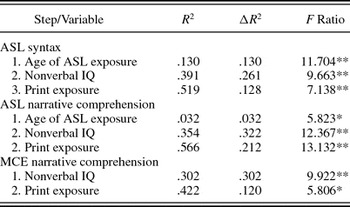
Next we analyzed the unexpected correlation between the print exposure and sign language proficiency with a second set of regressions, one for each sign language task. Using the same procedure for each regression, we controlled the effects of age of ASL exposure by entering it on the first step. Next we controlled the effects of nonverbal IQ by entering it on the second step. Last we entered print exposure. Three variables predicted 52% of the variance on the ASL grammatical judgment performance (see Table 4). Age of ASL exposure contributed 13% and nonverbal IQ contributed an additional 26% of the variance. Print exposure uniquely contributed 13% to the variance in ASL syntactic proficiency.
Regression analyses predicting sign language proficiency

*p < .05. **p < .01.
The same variables predicted 57% of the variance on ASL narrative comprehension (see Table 4). Age of ASL exposure contributed 3% to the variance and nonverbal IQ contributed an additional 32%. When the effects of age of exposure and nonverbal IQ were controlled, print exposure uniquely contributed 21% to the variance in ASL narrative comprehension.
Finally, two variables accounted for 42% of the variance in MCE narrative comprehension. Nonverbal IQ contributed 30% and print exposure contributed an additional 12% to the variance. Age of ASL exposure was not a significant predictor of MCE narrative comprehension regardless of the order in which it was entered into the regression (Table 4).
To summarize the regression results, the first set indicated that reading performance was uniquely predicted by ASL syntactic proficiency when the effects of MCE comprehension, and print exposure were controlled. The second set of regressions corroborated and extended these results. After the effects of age of exposure and nonverbal IQ were controlled, print exposure uniquely predicted ASL and MCE proficiency. These regression results show that nature of the relationship between ASL proficiency and English reading is reciprocal.
DISCUSSION
We tested the hypothesis that sign language proficiency predicts reading ability in a sample of adults who were born deaf and used ASL as their primary language. Using Grade 8 as the criterion for skilled reading, we found the SR and the LSR groups to read at the 11th and 3rd grade levels, respectively. They differed primarily with respect to three variables, sign language proficiency, print exposure, and nonverbal IQ. The regression results showed that nonverbal IQ was not a significant predictor of reading proficiency, however. Skilled reading was predicted by a combination of print exposure and sign language proficiency. These results provide evidence that the basis of reading in deaf signers is proficiency in their through the air language, as we now explain.
First, the SR group showed higher levels of sign language proficiency than the LSR group. The SR group outperformed the LSR group on narrative comprehension in ASL and MCE, and in grammatical judgment of ASL syntax. Performance on all three sign language measures positively correlated with performance on all three reading tests. These results corroborate previous findings showing that reading and sign language proficiency are correlated in deaf children who sign (Hoffmeister, Reference Hoffmeister, Chamberlain, Morford and Mayberry2000; Padden & Ramsey, Reference Padden, Ramsey, Chamberlain, Morford and Mayberry2000; Strong & Prinz, Reference Strong and Prinz1997). The present results extend these findings by showing that the positive relationship between sign language proficiency and reading holds for readers who are deaf adults. Sign language proficiency thus shows a positive relationship to reading ability across the lifespan.
Second, we found that reading ability correlated positively with print exposure. Performance on all three reading tests was predicted by print exposure. Print exposure reflects the frequency with which deaf signers read. We thus find a commonality between skilled readers who are deaf signers and those who are hearing speakers (Stanovich, Reference Stanovich1986). Skilled readers read, regardless of whether they can hear or not, and regardless of whether their language is signed or spoken. Print exposure was not the only variable to predict reading ability in deaf adult signers, however. After the effects of print exposure were controlled, we found that reading skill was uniquely predicted by ASL syntactic proficiency. Thus, ASL syntactic proficiency plays a crucial role in the development of skilled reading of deaf signers. Skilled readers are proficient in the syntax of their primary language, even when it is a natural sign language.
A predictive relationship between reading and syntactic proficiency is not a new finding. For example, syntactic ability predicted reading performance in a sample of adults with average to below reading performance, R 2 = .695 (Gottardo, Siegl, & Stanovich, Reference Gottardo, Siegel and Stanovich1997). Moreover, syntactic measures have been widely reported to predict the reading performance of hearing children (Catts et al., Reference Catts, Fey, Zhang and Tomblin1999; Leach et al., Reference Leach, Scarborough and Rescorla2003; Scarborough, Reference Scarborough1990). The novelty of the present finding is that the predictive relationship between syntactic proficiency and reading performance is between two different languages in two different modalities, ASL and English. These results indicate that the linguistic basis of reading can be bilingual, and relates to the phenomenon of being able to read a foreign language without the ability to speak it, as learning to read a foreign language for degree requirements, or the ability to read languages that are no longer spoken such as Latin.
Third, another key result is that print exposure relates to sign language proficiency. Print exposure predicted performance on ASL grammatical judgment and ASL and MCE narrative comprehension, to some degree. Among adult readers who are deaf and sign, those with higher sign language proficiency (in comprehending ASL and MCE narratives and making meta-linguistic judgments of ASL syntax) showed higher reading frequency. At first glance a relationship between print exposure and sign language proficiency seems counterintuitive. How can reading one language, such as English, boost proficiency in another language, such as ASL? In pondering the nature of this reciprocal relationship, it is important to consider three facts. First, ASL signers live, work, and are immersed in an English milieu so that their read language is English, not ASL. Second, a reciprocal relationship between print exposure and spoken language comprehension has been well documented and reflects the fact that much vocabulary learning occurs through the print medium (Stanovich, Reference Stanovich1986). Thus, deaf readers learn vocabulary in print that they use in sign, and vice versa. ASL and English vocabulary overlaps, as it does for any two languages. Third, the reciprocal relationship between ASL and print exposure is consistent with previous research showing that print exposure bolsters a host of cognitive skills, including mathematics performance and nonverbal analogical reasoning (Stanovich & Cunningham, Reference Stanovich and Cunningham1993). The reciprocal link between sign language and written language spans no greater a divide than that between written language and geometric analogies or mathematics. After all, sign language and written language are both instantiations of language.
Fourth and finally, and most logically, the predictive relationship of print exposure and sign language proficiency is the reverse of the predictive relationship between sign language proficiency and reading performance. Skilled readers read; skilled readers are proficient comprehenders of through the air language. Proficient language comprehenders can become skilled readers. These findings indicate that the linguistic basis of reading is bilingual and bimodal. The reciprocal relationship of print exposure and spoken language encompasses the case of sign language as well.
If the linguistic basis of reading is bimodal and bilingual, then why is the median reading level of the deaf population not higher? The probable reason, and the hypothesis motivating the present study, is that a significant proportion of individuals who are born deaf have underdeveloped language proficiency in any language. In other research, we have found substantial variation in sign language comprehension among adults related to a variety factors including age of exposure and input (Mayberry, Reference Mayberry2007; Mayberry & Lock, Reference Mayberry and Lock2003; Mayberry, Lock, & Kazmi, Reference Mayberry, Lock and Kazmi2002). The present results suggest that the low median reading achievement reported for the deaf student population is due to incomplete language acquisition, signed or spoken. In other words, skilled deaf readers are proficient sign language comprehenders. Reading does not develop to skilled levels in the absence of through the air language proficiency, as indicated by the present results and case studies of deaf adolescents who received sparse language sign language input in childhood in their home countries prior to immigrating to North America. These exceptionally late learners of a first language show low levels of sign language development and cannot read (Gates, Reference Gates2002; Hargraves, Reference Hargraves2002). An empirical question is whether some threshold level of syntactic and narrative proficiency is necessary for the reciprocal bolstering of reading and language development to occur.
The present results provide an initial characterization of the reading habits of less-skilled, adult readers who are deaf. Although the mean reading level of the LSR group was Grade 3 to 4, they reported reading on a regular basis. They read newspapers and read for pleasure like their peers with proficient reading skills. It would be a mistake to conclude that deaf adults with weak reading skills never read nor benefit from it, just as hearing adults with weak reading skills have been found to read and profit from it (Stanovich & Cunningham, Reference Stanovich and Cunningham1993). The inability to hear language increases the need to interact with print in daily life.
The present results also underscore how little we know about how deaf signers learn to read. Educational practice based solely on how hearing children learn to read cannot harness the rich linguistic proficiency many deaf students bring to the reading task in the form of sign language, and may discourage the search for linguistic causes of reading problems unrelated to speech. Equally important, these results underscore the necessity of creating and validating measures of sign language proficiency. Not all signers are proficient in sign language comprehension, as the present results show, just as hearing speakers show wide variation in spoken language comprehension. The link between sign language and reading cannot be investigated, either from a research or an educational standpoint, without adequate measures of sign language proficiency.
Language skills play a central and enduring role in the skilled reading of children who hear and speak. The present results both confirm and extend theory by showing that sign language proficiency plays a central and enduring role in the skilled reading of adults who do not hear and sign. The linguistic basis of reading is clearly bilingual and bimodal.
APPENDIX A: ASL SYNTACTIC STRUCTURES
The following are brief descriptions and examples of the ASL structures used in the grammatical judgment task. The ASL gloss is indicated by words in capital letters; the abbreviations above the gloss indicate head and facial grammatical markers; the sentence below the ASL gloss is an English translation (for more details, see Boudreault & Mayberry, Reference Boudreault and Mayberry2006).
1. Simple Sentences
FOUR BOYS FROM DEAF SCHOOL CHAT
Four boys from the deaf school are chatting.
2. Negative Sentences (neg indicates a co-occurring headshake):

Some thin people in jail don't eat.
3. Verb-Inflected Sentences (hand orientation of the verb stem indicates person and case):
MAN BALL BLUE 3-THROW-1
The man threw the blue ball over there.
4. Questions (yes–no questions can be signaled with furrowed brows, wh):
Do you read medical science journals?
5. Relative Clause Sentences (an embedded clause can be signaled with a co-occurring RC facial marker involving raised eyebrows and nasolabial fold creasing):
The dog that recently chased the cat came home.
6. Classifier sentences include classifier predicates (which are verbs forms inflected here for location and manner of handling):
ROPE MONKEY CL:/1/i CL:/Vc/i [SWING]
The money swings on a rope trapeze.

ACKNOWLEDGMENTS
The research reported here was based on part of a doctoral dissertation by C. Chamberlain and supported by grants from the Social Science and Humanities Research Council of Canada (401-2001-0621, 401-2004-1775) to R. Mayberry. We thank the participants for their gracious participation, Patricia Viens for testing help, and Pamela Witcher for ASL transcription help.