Introduction
Anhedonia and avolition have long been identified clinically in patients with schizophrenia, and constitute core features of the negative syndrome of the disorder (Andreasen, Reference Andreasen1989). Integrating the two-facet ‘wanting–liking’ model (Berridge, Reference Berridge2003, Reference Berridge2007), Kring & Barch (Reference Kring and Barch2014) conceptualized a cognitive–behavioural framework that underpins the negative syndrome. Within this framework, translation of ‘in-the-moment’ pleasure into goal-directed behaviour is believed to depend on efficient operations of different domains including liking, wanting, remembering of emotional salience, value computations, effort computation and action plan formulation (Fervaha et al. Reference Fervaha, Foussias, Agid and Remington2013; Kring & Barch, Reference Kring and Barch2014).
Laboratory studies have demonstrated that patients with schizophrenia experience similar levels of pleasure compared with healthy participants in emotion-inducing paradigms, though they might experience higher levels of negative emotions compared with their healthy counterparts (Cohen & Minor, Reference Cohen and Minor2010; Llerena et al. Reference Llerena, Strauss and Cohen2012). However, previous research suggests that patients with schizophrenia are impaired in translating liking into goal-directed behaviour (Heerey & Gold, Reference Heerey and Gold2007; Heerey et al. Reference Heerey, Bell-Warren and Gold2008; Trémeau et al. Reference Trémeau, Antonius, Cacioppo, Ziwich, Butler, Malaspina and Javitt2010; Gold et al. Reference Gold, Strauss, Waltz, Robinson, Brown and Frank2013). One plausible mechanism to explain why emotion decouples with behaviour is the presence of working memory deficits, which have been consistently found in patients with schizophrenia (Lee & Park, Reference Lee and Park2005; Gold et al. Reference Gold, Hanh, Zhang, Robinson, Kappenman, Beck and Luck2010), and are thought to limit an individual's ability to represent and maintain motivational salience of pleasure for motivating effortful behaviour (Strauss et al. Reference Strauss, Frank, Waltz, Kasanova, Herbener and Gold2011a , Reference Strauss, Robinson, Waltz, Frank, Kasanova, Herbener and Gold b ). However, there is a dearth of empirical evidence in this area.
One previous study (Heerey & Gold, Reference Heerey and Gold2007) demonstrated that, in patients with schizophrenia, better working memory predicted higher efficiency in translating emotion into motivated behaviour. Another study (Heerey et al. Reference Heerey, Bell-Warren and Gold2008) found that patients with schizophrenia had poor ability to weigh different potential outcomes of actions, and working memory was correlated with the ability to use affective experiences in making the decision to expend effortful behaviour. These and other previous studies (Heerey & Gold, Reference Heerey and Gold2007; Heerey et al. Reference Heerey, Bell-Warren and Gold2008; Trémeau et al. Reference Trémeau, Antonius, Cacioppo, Ziwich, Butler, Malaspina and Javitt2010; Strauss et al. Reference Strauss, Frank, Waltz, Kasanova, Herbener and Gold2011a , Reference Strauss, Robinson, Waltz, Frank, Kasanova, Herbener and Gold b ; Gold et al. Reference Gold, Strauss, Waltz, Robinson, Brown and Frank2013) have limitations because of the recruitment of samples with chronic instead of first-episode schizophrenia, as such samples are usually subject to long-term dopamine-blocking agents which affect wanting (Kapur et al. Reference Kapur, Mizrahi and Li2005).
Aims of the study
The present study rectifies the above-mentioned limitations, by examining manifestations of anhedonia and avolition in the early phase of schizophrenia and clarifies the role of working memory in translating emotion into behaviour. We employed an emotion-inducing laboratory-based paradigm (Heerey & Gold, Reference Heerey and Gold2007) to measure pleasure-seeking and aversion-avoiding behaviour in patients with first-episode schizophrenia in a Chinese setting. We hypothesized that emotion–behaviour decoupling would be present even very shortly after illness onset (i.e. the first illness episode), and that patients with schizophrenia who have poorer working memory would show more difficulties in translating emotion into actions than patients with better working memory, despite similar levels of ‘in-the-moment’ emotional experience.
Method
Participants
We recruited 72 out-patients with Diagnostic and Statistical Manual of Mental Disorders, 4th edition (DSM-IV) first-episode schizophrenia from the joint research-based first-episode psychosis programme (Lui et al. Reference Lui, Sham, Chan and Cheung2011) between Castle Peak Hospital of Hong Kong and the Key Laboratory of Mental Health, Institute of Psychology, Chinese Academy of Sciences in Beijing led by the two senior authors (R.C.K.C. and E.F.C.C.). A best-estimate approach was used to ascertain psychiatric diagnosis, based on structured clinical interviews (First et al. Reference First, Spitzer, Gibbon and Williams1996) by two qualified psychiatrists supplemented by review of medical records. Patients in this study were assessed at the time of clinical stabilization, i.e. their antipsychotic medications had not been changed in the last 4 weeks and they were reported to be stable by the treating psychiatrists. We recruited 61 demographically matched healthy individuals from the neighbouring community as controls, who were screened by a qualified psychiatrist using structured interviews to ascertain the absence of lifetime or family history of psychosis. Exclusion criteria were history of substance abuse in the past 12 months, history of electroconvulsive therapy in the past 6 months, history of neurological disorders, history of head injury with loss of consciousness for more than 30 min, and mental retardation. All participants were ethnic Chinese. This study was approved by the Ethics Committees of the Institute of Psychology, Chinese Academy of Sciences and Castle Peak Hospital. All participants provided written informed consent before the assessments. No monetary incentive was provided to the participants.
Assessments
Computerized ‘Anticipatory and Consummatory Pleasure’ (ACP) task
The ACP task has been described in detail elsewhere (Heerey & Gold, Reference Heerey and Gold2007; S.S.Y. Lui et al. unpublished observations). This paradigm measured participants' ‘in-the-moment’ emotion using emotion-inducing pictures, and measured the effort participants expended in seeking pleasurable and avoiding aversive pictures. Participants first viewed 14 positive, 14 neutral and 14 negative slides, each consisting of three similar pictures (e.g. beautiful butterflies) drawn from the International Affective Picture System (IAPS; Lang et al. Reference Lang, Bradley and Cuthbert2005) and rated identically in valence and arousal. The IAPS pictures used in the ACP task differed in normative valence and arousal according to IAPS norms and have been found to effectively elicit a range of emotion valences and arousal levels in healthy populations. Participants rated their experiences of each slide's valence on a nine-point, ‘bipolar’ scale anchored by extremely ‘unpleasant’ (negative) and extremely ‘pleasant’ (positive). Participants also rated the degree to which they experienced each slide as arousing on a nine-point unipolar scale anchored by extremely ‘calm’ and extremely ‘arousing’.
In the first phase of the ACP task, participants were informed that some of the same slides would appear again later in the task but they could alter the probability of stimulus exposure by rapidly pressing buttons on the keyboard. They could press buttons ‘m’ and ‘n’ in rapid succession to seek the future presentation of a slide, or buttons ‘x’ and ‘z’ to avoid a slide in the future. The response window for button pressing in this phase was 2 s. They viewed and could respond to 42 slides in this phase. Because participants pressed buttons only after stimulus offset, this response-phase is termed representational responding.
In the second task phase, participants viewed 10 positive, 10 neutral and 10 negative slides, and had the opportunity to prolong or shorten stimulus exposure by completing the same button-press procedure while viewing the slide. The slides shown during this task phase were a subset of those presented in the first task phase. All participants viewed the same slides, despite their earlier responses. The response window for button pressing in each trial of this phase varied from 2 to 10 s. The more rapidly participants pressed the ‘m’ and ‘n’ buttons, the longer the slide presentation time became; likewise, the more rapidly participants pressed the ‘x’ and ‘z’ buttons, the shorter the presentation time became. If no buttons were pressed, the slide was visible for 5 s. Because participants pressed buttons while viewing the stimuli, this response-phase is termed evoked responding.
Working memory
Working memory was assessed by the Letter–Number Span Test (LNST; Gold et al. Reference Gold, Carpenter, Randolph, Goldberg and Weinberger1997), in which a series of alternating letters and numbers were read to participants and they were asked to rearrange the letters and numbers in successive order. We recorded LNST correct responses as well as the longest category passed.
Clinical and intelligence assessments
Sociodemographic and clinical variables such as years of education, duration of untreated psychosis, duration of illness, current medications and dosage were gathered from medical records. Clinical symptoms of the patients were rated by trained psychiatrists using the Positive and Negative Syndrome Scale (PANSS; Kay et al. Reference Kay, Fiszbein and Opler1987). Participants’ intelligence was estimated using a prorating method based on the Arithmetic, Similarities and Digit span subscales of the Chinese version of the Wechsler Adult Intelligence Scale-Revised (Gong, Reference Gong1992).
Statistical analysis
To examine group differences in self-reported liking, valence and arousal ratings were subjected to 2 [diagnostic group (between-subject factor): schizophrenia, healthy individuals] × 3 [slide valence (within-subject factor): positive, neutral, negative] mixed-model analyses of variance (ANOVAs).
To analyse the motivational salience of emotion valence, slide valence was determined on a participant-by-participant basis, as in Heerey & Gold (Reference Heerey and Gold2007). We transformed valence ratings of 1–3, 4–6 and 7–9 into negative, neutral and positive slide valences, respectively. A trial was deemed invalid if participants rated a slide as negative but ‘incongruently’ exerted effort to seek or prolong the stimulus exposure (>4 incongruent button presses), and vice versa for positive slides. Button-pressing for both pleasure-seeking or aversion-avoiding were deemed valid for slides rated as neutral. Notably, during representational responding, button pressing occurred for a fixed period of 2 s; whereas the response window during evoked responding varied between individual trials (ranged from 2 to 10 s). In order to equate button pressing across these variable response windows, we calculated button-pressing speed on each trial as ‘presses per s’. We analysed the average button-pressing speeds with 2 [diagnostic group (between-subject factor): schizophrenia, healthy group] × 2 [responding condition (within-subject variable): representational versus evoked] × 3 [slide valence (within-subject variable): negative, neutral, positive] mixed-model ANOVAs.
It is logical to expect that strongly evocative stimuli, of both positive and negative valence, would generate greater levels of motivated behaviour than less evocative and more neutral stimuli. We therefore estimated the correspondence between button-pressing speed and pleasantness rating using correlational analyses. We calculated the correlation between pleasantness ratings and button pressing to seek/retain the stimuli as well as the correlation between pleasantness ratings and button presses to avoid/remove the stimuli. We used Fisher's r to z transformation on all correlation coefficients prior to analysis. To examine the correspondence between self-reported liking and behaviour, the average z-transformed correlation coefficients were subjected to a 2 [diagnostic group (between-subject factor): schizophrenia, healthy group] × 2 [responding condition (within-subject variable): representational versus evoked] × 3 [slide desirability (within-subject variable): desirable versus undesirable] mixed-model ANOVAs.
To examine the role of working memory, we classified first-episode schizophrenia participants (n = 72) into two groups, i.e. participants with impaired working memory and participants with intact working memory. Using the mean (LNST correct responses: 17.54; LNST longest category passed: 6.57) and s.d. (LNST correct responses: 3.48; LNST longest category passed: 1.16) of the working memory performance of the control group (n = 61), we calculated the standardized z scores of LNST correct responses and LNST longest category passed in the cohort with first-episode schizophrenia (n = 72). Based on the standardized z scores of LNST correct responses and longest category passed, we identified 30 schizophrenia participants whose LNST correct responses and longest category scores were both more than 1 s.d. below the mean of the group and were therefore considered to be relatively impaired in working memory. The remaining 42 schizophrenia participants were considered to be relatively preserved in working memory. We examined differences between the schizophrenia groups with and without working memory impairments and the control group in terms of self-reported liking, motivational salience of emotion valence, and correspondence between self-reported liking and behaviour.
Results
Sample characteristics
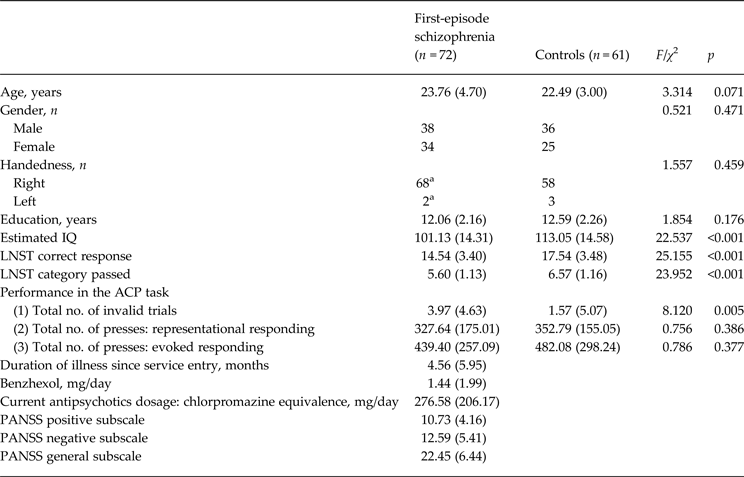
As shown in Table 1, schizophrenia participants (n = 72) had an average age of 23.73 (s.d. = 4.70) years and an average illness duration of 4.56 (s.d. = 5.95) months. They matched the 61 healthy controls in age, gender and years of education. Compared with controls, schizophrenia participants had poorer working memory (p's < 0.01). Of the schizophrenia participants, 66 were receiving second-generation antipsychotic (SGA) medications, one was receiving first-generation antipsychotic medication, and five were antipsychotic-free at the time of assessments.
Characteristics of participants

Data are given as mean (standard deviation) unless otherwise indicated.
IQ, Intelligence quotient; LNST, Letter–Number Span Test; ACP task, computerized Anticipatory and Consummatory Pleasure task; PANSS, Positive and Negative Syndrome Scale.
a Two data missing.
Throughout the entire ACP task, schizophrenia participants made a similar number of button presses (representational responding: mean = 327.64 presses, s.d. = 175.01; evoked responding: mean = 439.40 presses, s.d. = 257.09) compared with controls (representational responding: mean = 352.79 presses, s.d. = 155.05; evoked responding: mean = 482.08 presses, s.d. = 298.26) (p's > 0.05). However, compared with controls, schizophrenia participants' button-pressing behaviour appeared to be more ‘incongruent’ to their emotions, reflected by the larger number of invalid trials excluded in the schizophrenia group (mean = 3.97 presses, s.d. = 4.63) than in the control group (mean = 1.57 presses, s.d. = 5.07) (t = 2.849, p = 0.005).
Spearman's correlation analyses found that none of the average z-transformed correlation coefficients of the correspondence between self-reported liking and behaviour was correlated significantly with the dosage of antipsychotic (in terms of chlorpromazine equivalence) or anticholinergic (mg/day) medications in participants with schizophrenia. We also found that none of the average z-transformed correlation coefficients of the correspondence between self-reported liking and behaviour was correlated with PANSS negative subscale scores (p's > 0.05) in participants with schizophrenia.
Self-reported liking in patients with first-episode schizophrenia
Fig. 1a shows the valence and arousal ratings. For valence ratings, the group main effect (F 1,131 < 0.001, p = 0.990, partial eta squared < 0.001) was not significant, and the group × valence interaction showed a trend of statistical significance (F 2,130 = 2.696, p = 0.071, partial eta squared = 0.040). Follow-up ANOVAs found that schizophrenia participants gave lower valence ratings than controls, as they responded to positive slides (p = 0.036, Cohen's d = 0.369) but not to negative and neutral slides (p's > 0.05, Cohen's d < 0.321). These results did not survive Bonferroni adjustments and indicated that these groups did not differ in how they rated slide valences. Likewise, there were no group differences in arousal ratings (group main effect: F 1,131 = 0.194, p = 0.662, partial eta squared = 0.004; group × valence interaction: F 2,130 = 2.261, p = 0.108, partial eta squared = 0.034).
Two-group analysis results. (a) Pleasantness and arousal ratings for participants with first-episode schizophrenia and healthy participants across slides of negative, neutral and positive valence. (b) Motivated behaviour (button presses per s) across slide valence and condition (representational, evoked responding), split by participant group. (c) Correspondence (correlational coefficient) between motivated behaviour (button presses per s) and liking (valence rating) across slide desirability and condition (representational, evoked responding), split by participant group. Values are means, with standard errors represented by vertical bars.

Motivational salience in patients with first-episode schizophrenia
Button-pressing speeds for slides of different valences are shown in Fig. 1b . As expected, the group main effect was not significant (F 1,127 = 0.130, p = 0.719, partial eta squared = 0.001). However, the predicted group × valence interaction was significant (F 2,254 = 27.384, p < 0.001, partial eta squared = 0.177), meaning that participants with schizophrenia pressed buttons at speeds that were more similar across slides of different valences than did healthy participants. The group × behaviour condition interaction (F 1,127 = 0.284, p = 0.595, partial eta squared = 0.002) and the three-way (group × behaviour condition × valence) interaction (F 2,254 = 1.501, p = 0.226, partial eta squared = 0.012) were not significant, suggesting that behaviour did not differ across evoked and representational responding based on slide valence. When button-pressing speeds during different behaviour conditions were averaged, ANOVAs found that schizophrenia participants pressed buttons at speed significantly slower than controls, as they responded to negative slides (p < 0.001), but faster than controls, as they responded to neutral slides (p < 0.001). The groups pressed buttons at comparable speeds, as they responded to positive slides (p = 0.756).
Correspondence between self-reported liking and behaviour in patients with first-episode schizophrenia
We used correlation to estimate the correspondence between button-pressing speed and pleasantness ratings for slides that were desirable and undesirable (see Fig. 1c ). The group main effect was significant (F 1,120 = 44.144, p < 0.001, partial eta squared = 0.269), meaning that there was better correspondence amongst controls than participants with schizophrenia. The responding condition main effect was also significant (F 1,120 = 23.570, p < 0.001, partial eta squared = 0.164), meaning that correspondence between liking and behaviour was stronger in evoked responding than in representational responding. The slide desirability main effect reached statistical significance (F 1,120 = 85.317, p < 0.001, partial eta squared = 0.416), implying that undesirable slides elicited stronger correspondence than desirable slides. The predicted group × behaviour-condition interaction reached statistical significance (F 1,120 = 10.236, p = 0.002, partial eta squared = 0.079), as did the group × stimulus-desirability interaction (F 1,120 = 13.308, p < 0.001, partial eta squared = 0.100). The three-way interaction effect also reached statistical significance (F 1,120 = 5.451, p = 0.021, partial eta squared = 0.043). Follow-up ANOVAs showed that, during evoked responding, schizophrenia participants' emotions corresponded with behaviour more poorly than controls in both pleasure-seeking and aversion-avoiding conditions (p's < 0.001); whereas during representational responding, schizophrenia participants and controls showed similar level of correspondence between liking and pleasure-seeking behaviour (p = 0.092, corrected with Bonferroni adjustments), although patients' emotion corresponded with aversion-avoiding behaviour more poorly than controls (p < 0.001).
Differences in performance on the ACP task between patients with schizophrenia with and without working memory impairment
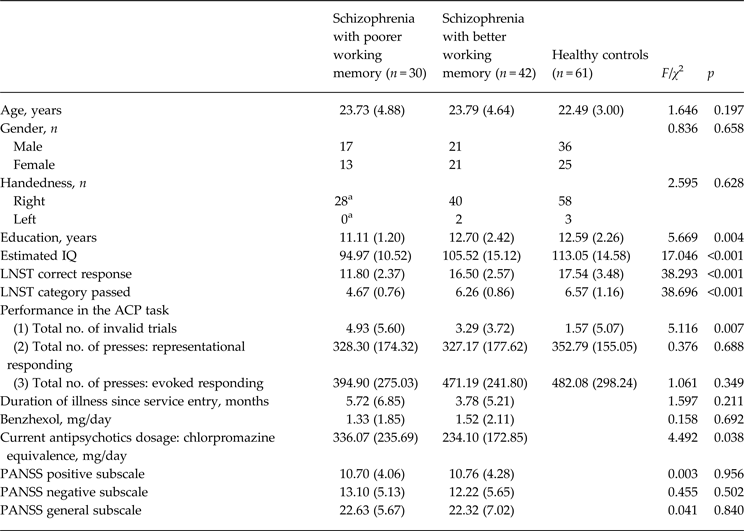
As shown in Table 2, the three subgroups did not differ in age, gender and handedness, and the total number of buttons pressed in evoked responding and representational responding in the ACP task (p's ranged from 0.197 to 0.688). Post-hoc Hochberg GT2 pairwise comparison found that the schizophrenia subgroup with impaired working memory (n = 30) showed worse performance in both LNST correct responses (p < 0.001) and LNST longest category passed (p < 0.001) than did the schizophrenia subgroup with intact working memory (n = 42), but the two subgroups did not differ in the number of incongruent responses in the ACP task (p = 0.395). As expected, schizophrenia participants with intact working memory did not differ from controls in both LNST correct responses (p = 0.232) and LNST longest category passed (p = 0.315).
Characteristics of subgroups of participants (first-episode schizophrenia with poor working memory, first-episode schizophrenia with intact working memory and healthy controls)

Data are given as mean (standard deviation) unless otherwise indicated.
IQ, Intelligence quotient; LNST, Letter–Number Span Test; ACP task, computerized Anticipatory and Consummatory Pleasure task; PANSS, Positive and Negative Syndrome Scale.
a Two data missing.
Fig. 2a shows the self-reported liking of the three groups. For valence rating, the group main effect (F 2,130 = 2.106, p = 0.126, partial eta squared = 0.031) and the group × valence interaction (F 4,256 = 1.475, p = 0.210, partial eta squared = 0.023) were not significant. For arousal rating, the group main effect (F 2,130 = 0.002, p = 0.998, partial eta squared < 0.001) and group × valence interaction (F 4,256 = 1.385, p = 0.240, partial eta squared = 0.021) also failed to reach statistical significance.
Three-subgroup analysis results. (a) Pleasantness and arousal ratings for participants with first-episode schizophrenia having poor working memory, participants with first-episode schizophrenia with intact working memory, and healthy participants across slides of negative, neutral and positive valence. (b) Motivated behaviour (button presses per s) across slide valence and condition (representational, evoked responding), split by participant group. (c) Correspondence (correlational coefficient) between motivated behaviour (button presses per s) and liking (valence rating) across slide desirability and condition (representational, evoked responding), split by participant group. Values are means, with standard errors represented by vertical bars.

Fig. 2b shows button-pressing speeds for slides of different valences and Fig. 2c shows the correspondence between liking and button-pressing behaviour for pleasure-seeking or aversion-avoidance. When the average z-transformed correlation coefficients were subjected to a 3 (between-subject factor: schizophrenia group with impaired working memory, schizophrenia group with intact working memory, healthy group) × 2 (within-subject variable: representational versus evoked responding condition) × 2 (within-subject variable: desirable versus undesirable stimulus) mixed-model ANOVAs, the main group effect was significant (F 2,119 = 23.151, p < 0.001, partial eta squared = 0.280). Both the group × behaviour interaction (F 2,119 = 7.949, p = 0.001, partial eta squared = 0.118) and group × stimulus desirability interaction (F 2,119 = 8.323, p < 0.001, partial eta squared = 0.124) also reached statistical significance, as did the three-way (group × behaviour × stimulus desirability) interaction (F 2,119 = 3.501, p = 0.033, partial eta squared = 0.056).
Follow-up ANOVAs found that the three groups differed significantly in the z-transformed correlation coefficients in evoked responding for seeking pleasure (p < 0.001) and avoiding aversion (p < 0.001). The three groups also differed significantly in representational responding for avoiding aversion (p = 0.001) but not for seeking pleasure (p = 0.073).
Post-hoc Hochberg GT2 pairwise comparison found that, compared with their counterparts with intact working memory, those schizophrenia participants with impaired working memory exhibited more severe emotion–behaviour decoupling in evoked responding for avoiding aversion (p = 0.010) but not for seeing pleasure (p = 0.490). Schizophrenia participants with and without working memory impairment showed similar levels of emotion–behaviour decoupling in representational responding for avoiding aversion (p = 0.845). Interestingly, post-hoc Hochberg GT2 pairwise comparison found that, compared with controls, schizophrenia participants with intact working memory exhibited more severe emotion–behaviour decoupling in evoked responding for seeking pleasure (p = 0.004) and avoiding aversion (p < 0.001) as well as in representational responding for avoiding aversion (p = 0.010).
Discussion
To the best of our knowledge, this study is one of the largest in scale to systematically examine how emotion couples with behaviour in patients with schizophrenia. Compared with many previous studies (Heerey & Gold, Reference Heerey and Gold2007; Heerey et al. Reference Heerey, Bell-Warren and Gold2008; Trémeau et al. Reference Trémeau, Antonius, Cacioppo, Ziwich, Butler, Malaspina and Javitt2010; Strauss et al. Reference Strauss, Frank, Waltz, Kasanova, Herbener and Gold2011a , Reference Strauss, Robinson, Waltz, Frank, Kasanova, Herbener and Gold b ; Gold et al. Reference Gold, Strauss, Waltz, Robinson, Brown and Frank2013), we recruited first-episode schizophrenia patients, and therefore our results are less likely to be confounded by effects of long-term dopamine-blocking agents on wanting. We also sought to examine the role of working memory on translating emotional salience into motivated behaviour. The main findings of this study appear to show that there is a defective translation of emotional salience into motivated behaviour in patients with first-episode schizophrenia. The emotion–behaviour decoupling in first-episode schizophrenia affects evoked responding more than representational responding, and it also affects aversion-avoiding more than pleasure-seeking behaviour.
Consistent with previous research using the same paradigm (Heerey & Gold, Reference Heerey and Gold2007; S.S.Y. Lui et al. unpublished observations), we found no significant differences between patients with schizophrenia and healthy participants in self-reported affective experiences to the slides, in terms of valence (Cohen & Minor, Reference Cohen and Minor2010) and arousal ratings (Llerena et al. Reference Llerena, Strauss and Cohen2012). Therefore, the less discriminant effort expended by schizophrenia participants could not be attributed to any difficulty in experiencing ‘in-the-moment’ emotion. In the previous study of Heerey & Gold (Reference Heerey and Gold2007), this paradigm elicited similar level of effort expended, in terms of the total number of button pressed, by patients and controls. Our findings corroborate previous results, and suggest that extra-pyramidal side-effects or slow psychomotor speed are unlikely to have affected results. Consistent with the previous study of Heerey & Gold (Reference Heerey and Gold2007), our findings regarding motivational salience of emotion valence show that patients with schizophrenia pressed buttons at speeds that were more similar across slides of different valences than healthy participants. However, unlike the previous study, our findings only show a reduced salience effect of negative valence but not of positive valence. Moreover, our findings regarding the correspondence between liking and behaviour are generally consistent with the previous study of Heerey & Gold (Reference Heerey and Gold2007), that is, the level of effort expended corresponds poorly to the degree of pleasure experienced in patients with schizophrenia. Contrary to the findings of Heerey & Gold (Reference Heerey and Gold2007) that patients with chronic schizophrenia, compared with healthy individuals, showed less correspondence in representational responding than in evoked responding, our findings show that first-episode schizophrenia patients, compared with healthy individuals, exhibited less correspondence in evoked responding rather than in representational responding. Consistent with the study of Heerey & Gold (Reference Heerey and Gold2007), we found that first-episode schizophrenia patients, compared with healthy individuals, exhibit more impairments in emotion–behaviour coupling for aversion-avoiding behaviour than for pleasure-seeking behaviour.
In relating the findings of Heerey & Gold (Reference Heerey and Gold2007) to our own, it is apparent that schizophrenia patients' emotion couples poorly with behaviour, but patients in the first episode of illness (in this study) show more difficulty coupling emotion and behaviour during evoked responding than in representational responding. This finding runs contrary to those patients with chronic schizophrenia (Heerey & Gold, Reference Heerey and Gold2007) whose emotion–behaviour decoupling mainly affects representational responding across aversion-avoiding and pleasure-seeking conditions. It is plausible that long-term dopamine-blocking agents disrupt ‘wanting’ more than ‘liking’, and aggravate emotion–behaviour decoupling in representational responding more than evoked responding. Therefore, patients with chronic schizophrenia who are subject to long-term antipsychotic medications may show a relatively severe emotion–behaviour decoupling in representational responding.
Heerey & Gold (Reference Heerey and Gold2007) reported a correlation between working memory and the correspondence between liking and behaviour in representational responding. However, our findings suggest that emotion–behaviour decoupling is present even in first-episode schizophrenia patients who have intact working memory. This interesting finding suggests that working memory deficit alone could not fully explain the impairment in emotion–behaviour coupling in schizophrenia. It should be also noted that the subgroup of schizophrenia participants with impaired working memory showed a poor correspondence between negative emotion and aversion-avoiding behaviour in evoked responding, compared with their counterparts with intact working memory. In the light of such findings and consistent with the previous study (Heerey & Gold, Reference Heerey and Gold2007), our work implicates the role of working memory, albeit a minor one, on emotion–behaviour decoupling in schizophrenia. Therefore, by recruiting a larger sample with first-episode schizophrenia and identifying a schizophrenia subgroup with intact working memory, our work contributes to the growing body of evidence about the relationship between working memory, anhedonia and avolition in schizophrenia.
It is understandable that working memory impairments affect evoked responding more than representational responding. Working memory refers to the ability of on-line updating and manipulation of various modalities of internal and external information (Baddeley, Reference Baddeley2003). The slide presentation time during the evoked responding phase varies with the effort expended, whereas the slide presentation time during the representational responding phase remains unchanged (2 s for each trial). The variations in slide exposure time during the evoked responding phase could provide additional sensory inputs to participants, and these inputs might modulate participants' behaviour. Patients who are impaired in working memory are therefore less likely to respond to these additional inputs during the evoked responding phase of the ACP task.
Contrary to the study of Heerey & Gold (Reference Heerey and Gold2007), our findings do not support an association between negative symptoms, dosage of antipsychotic medications and emotion–volition coupling. The recruitment of exclusively first-episode patients who were relatively clinically stable and receiving low-dose SGAs might have contributed to these negative findings.
This study has several limitations. Many different types of pleasure (such as monetary incentives, olfactory stimulations, interpersonal/social pleasures, sex and food) are relevant in motivating behaviour. However, this study only focused on pleasure derived from visual slides. Future work should therefore seek to translate this paradigm to measure emotion–behaviour coupling for other rewards. Second, only the LNST was used to assess semantic working memory in this study. To better assess the role of working memory in linking emotion and behaviour, the working memory task should be incorporated directly into the paradigm designed to capture how emotion couples with behaviour, because this may directly tap into participants' ability to remember the ‘motivational salience’ of the stimuli, which traditional working memory tasks appear unable to capture. While traditional working memory tasks (such as the LNST) involve the dorsolateral prefrontal cortex, ‘working memory for value’ depends on the orbitofrontal cortex (Frank & Claus, Reference Frank and Claus2006; Wallis, Reference Wallis2007). Although the defective translation of emotion into behaviour appears to exist in first-episode and chronic schizophrenia, it remains unclear how this putative marker would evolve as symptomatology changes with treatment. Therefore, a longitudinal follow-up study to capture the trajectory of emotion–volition decoupling in first-episode schizophrenia is needed. Moreover, this study did not measure and account for ‘value computation’ and ‘effort computation’, but recent research has demonstrated that the lack of motivated behaviour in patients with schizophrenia might be related to their tendency to choose low-effort behaviour and to overestimate the cost of effort (Gold et al. Reference Gold, Strauss, Waltz, Robinson, Brown and Frank2013; Gard et al. Reference Gard, Sanchez, Cooper, Fisher, Garrett and Vinogradov2014). Finally, although our participants were in the first episode of schizophrenia, the majority of them were medicated with antipsychotics.
Using a large sample of first-episode schizophrenia and a sophisticated behavioural paradigm to capture how emotion couples with behaviour, this study provides strong evidence for the presence of avolition in schizophrenia patients shortly after psychosis onset. Although working memory deficit could not explain fully the impairments in emotion–behaviour coupling, it apparently plays a role in contributing to avolition in schizophrenia. The findings enhance our understanding of the underlying mechanism of avolition in schizophrenia. Further work is needed to devise cognitive remediation which may offer promise for helping patients recouple emotion with behaviour to improve functionality and long-term outcome.
Acknowledgements
This study was supported by grants from the Strategic Priority Research Programme (B) of the Chinese Academy of Science (XDB02030002), the National Science Fund China (81088001, 81571317 and 91132701), the Key Laboratory of Mental Health, and a grant from Beijing Training Project for the Leading Talents in S & T (Z151100000315020). This study was also supported by a donation from the Philip K. H. Wong Foundation granted to E.F.C.C. of Castle Peak Hospital. These funding agents had no further role in the study design; in the collection, analysis and interpretation of the data; in the writing of the manuscript; and in the decision to submit the paper for publication.
Declaration of Interest
None.