Beethoven's String Quartet in E-flat of 1824–25, the first of his late quartets, consists of the customary four movements, including a slow second movement and a scherzando third movement. This is in contrast to his next three quartets, each of which included more than four movements, and it is easy to assume that, when he renewed his interest in the string-quartet genre in the 1820s after a gap of over ten years, he decided from the outset to write one with a conventional structure before embarking on more original designs. Such assumptions have been undermined in recent years, however, for several biographers have made references to a possible six-movement structure, which supposedly included a movement entitled ‘la gaieté’. William Kinderman wrote in 1995:
Beethoven considered including two additional, alternative movements – a character piece in C major entitled ‘La gaieté’ that was evidently planned at one point as the second movement, and a slow introduction to the finale in the key of the Neapolitan, E major.Footnote 1
Similar reports have since appeared in two subsequent Beethoven biographies:
Beethoven also contemplated structural innovations for Op. 127, such as having six movements instead of the usual four; and even when the first movement was nearly finished, he was sketching a fast second movement entitled ‘la gaieté’ before the slow movement.Footnote 2
In the long course of planning and writing the quartet Beethoven thought at one time that it might have as many as six movements, including a slow introduction to the finale and a middle movement to be called ‘La Gaieté’. Strangely enough this heading was applied to a sketch for a jocular movement in 2/4 whose theme he transformed into the profoundly moving 12/8 main theme of the Adagio movement of the quartet.Footnote 3
Unfortunately, general biographies such as these cannot allow space for detailed discussion of such information, and consequently all three books provide no further details, apart from references to an article by Sieghard Brandenburg and to an older one by Gustav Nottebohm.Footnote 4 Many readers, however, might be intrigued by these tantalizing glimpses into the thought processes behind the creation of this quartet, and in particular might wonder how ‘la gaieté’ could have sounded in its original state, and how it was somehow ‘transformed’ into the slow movement of Op. 127. Yet, even if they are able to consult the Brandenburg and Nottebohm studies, they will find only brief indications of the very complex sketching processes involved in the creation of this abandoned musical material. Nottebohm quotes several passages but with little commentary, while Brandenburg's article, an excellent and detailed examination of all the sources that facilitate study of the creation of Op. 127, was never followed up by an investigation based on his findings.
It is noteworthy that none of the three biographers quoted refers directly to the relevant sketch material, but only to the studies by Brandenburg and Nottebohm, which are the only ones based on direct examination of the original sources; thus, the three accounts might need modification in the light of what the sources actually show. In fact, the sketches for the quartet do not exhibit quite what one might expect from the three descriptions. For example, Brandenburg noted a possible six-movement scheme, but he did not say that the slow introduction to the finale was part of this scheme. Moreover, one might question whether ‘la gaieté’ or a finale introduction figures as prominently amongst the sketch material as might be implied in the above accounts, or whether Beethoven considered numerous other possibilities, too, that happened not to be mentioned. There is also some confusion in Kinderman's suggestion that there were two ‘additional, alternative movements’, since they cannot be both additional to the four-movement structure and also alternatives to two of the movements.
Thus questions of how the four-movement structure of Op. 127 eventually emerged from among other possible structures, and what role ‘la gaieté’ played in the creation the work, have not been addressed. What were Beethoven's initial plans for the quartet, at what stage and in what manner did ‘la gaieté’ appear, and how did it come to be removed or transformed? Such questions require examination of the development of his ideas for the whole quartet through all the early sketches. This is no easy task, for by the time of his late quartets he was using four different sketch formats concurrently.Footnote 5 Throughout his composing career he had been writing sketches on loose sheets of manuscript paper, but from 1798 he also used large sketchbooks, prepared specially for the purpose. These are written mainly in ink, and they seem to have been used at his desk, which he kept near his piano. From 1811, if not earlier, he began using pocket-sized sketchbooks, too, in which the sheets of manuscript paper were folded in half so that he could carry them around, jotting down ideas in pencil immediately they occurred to him. In both types of sketchbook nearly all his sketches were notated as single-stave drafts, although they often continue on to subsequent staves. When he came to write his late quartets, however, he began making extensive use of score sketches, with four staves at a time to represent the four instruments, and often covering a substantial number of bars. These score sketches were normally written in ink but on loose bifolios rather than in sketchbooks. Since the four formats were used concurrently, one cannot presume that extended score sketches for a movement are later or more advanced than odd jottings of just a few bars for the same passage in a sketchbook. To deduce the chronology of the sketches, one must take into account not only the position of those in the sketchbooks (allowing for the fact that each sketchbook was usually though not invariably filled up in the order in which the pages appeared), but also the musical content. For judging this content, the main guide is its sophistication and its similarity to the final version, for Beethoven's ideas usually (though again not invariably) show a clear progression from basic ideas to more complex ones that are closer to the final version.
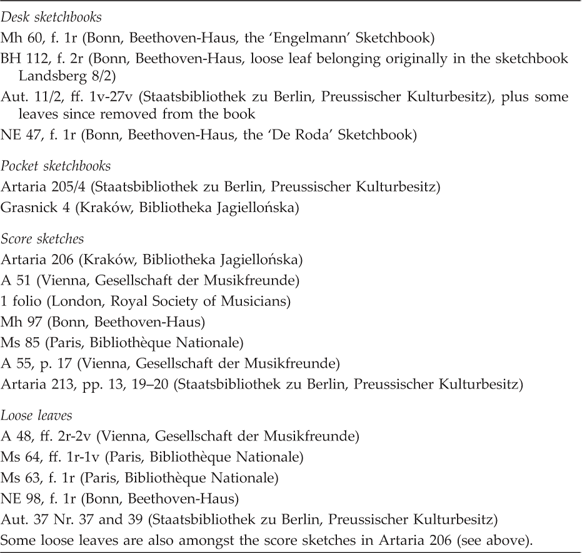
For Op. 127, as for all Beethoven's late quartets, a large number of sketch sources survive, including examples of each of the four formats. A descriptive account of them all has been provided by Brandenburg,Footnote 6 although the account gives very little description of the music itself and includes no music examples. From it a succinct list of sketch sources can be produced, as in Table 1; here the desk sketchbooks and pocket sketchbooks are shown in chronological order while the other sources are in no particular order. The gradual evolution of the quartet can be traced through these sources. Another possible source not mentioned by Brandenburg is London, British Library, Add. MS 29997, f. 34, which contains the score of an abandoned
 movement in E-flat major, but this score was probably drafted much earlier, with no connection to Op. 127.
Sketch sources for Op. 127

Sketchbooks with early work on Op. 127
The first suggestions of a late string quartet occurred in the latter part of 1822. At this time Beethoven was concentrating on composing Die Weihe des Hauses and producing a package of works for the publisher Carl Friedrich Peters, as his sketches and correspondence indicate. He also offered Peters a not-yet-written string quartet in a letter dated 5 June 1822, promising it could be sent ‘very soon’. Then a month later he informed Peters that the quartet was ‘not quite finished’; but Peters quickly rejected the offer of a string quartet, asking for other works instead,Footnote 7 and Brandenburg's survey of Beethoven's sketches of 1822 found no sign of a quartet from that period.Footnote 8 Thus Beethoven should perhaps have described the unfinished quartet as ‘not quite started’ in July 1822. No further progress was apparently made until 25 January 1823, when he replied positively to a request from the Russian Prince Galitzin for one, two or three new string quartets. Beethoven agreed to write three, adding that he would complete the first one ‘at the end of February, or at the latest in mid-March’.Footnote 9 The period of five to seven weeks that he was allowing himself seems to indicate the time he expected to take to write the complete quartet; and since he was generally over-optimistic about completion dates, he had probably not started the work at that time. As things turned out, he was probably wise not to mention the year in his estimate, for Op. 127 was not finally ready until February or March 1825.
The first signs of a new quartet are in the ‘Engelmann’ Sketchbook (Mh 60), as Brandenburg points out. The book was begun about February 1823, and the quartet sketch appears on the very first page. Brandenburg suggests that it could have been written down at a somewhat earlier date, before Beethoven incorporated the page into the sketchbook.Footnote 10 This is unlikely, however, since it is preceded by a sketch for the Diabelli Variations, a work that Beethoven had set aside in 1819 and apparently did not resume until 1823. The sketch could possibly have been written shortly before Beethoven's letter to Galitzin of 25 January, but more probably dates from early February. It corroborates the supposition that there had been no significant work on Op. 127 before then, for it is very different from the final version, and its heading, ‘quartet un poco maestoso’, also implies that Beethoven was just beginning to work on the quartet, for he would not have needed such a heading, nor clef and key signature, once the work was properly under way. The opening maestoso bars are followed by an ‘all[egr]o’ (see Ex. 1), and the sketch probably represents a slow introduction and main sonata-form movement. Although the themes bear little resemblance to the final version, several features link this sketch with Op. 127: the
 time signature, the key of E-flat, and above all the double-stopped fifths in the cello part, which play such a prominent role in the opening sonority of the finished work. The jerky two-note rhythmic gestures in violin then viola also foreshadow the short–long rhythmic pattern at the start of Op. 127, though in the finished work the placement of the rhythmic pattern is far less regular. The following allegro is marked ‘2do’, indicating a theme in the second violin (not the second movement, which Beethoven normally indicated by ‘2tes Stück’). This theme shows no obvious motivic connection with Op. 127, though it contains curious rhythmic echoes of the first Allegro theme of his Septet Op. 20 (also in E-flat).
Bonn, Beethoven-Haus, Mh 60, page 1
Immediately below these sketches is one that was probably intended for the ensuing slow movement (Ex. 2), although this is questionable since one note in the tenor part is below the range of the viola. The key of E major may seem improbable in an E-flat major quartet, but such a relationship had already been used as early as Haydn's E-flat piano sonata Hob. XVI:52 of 1794. More significantly, the key was also to be used in the highly expressive central variation (Var. 3) of the slow movement of Op. 127, and the sketch seems to share some of the same qualities and sonorities. Particularly noteworthy is the somewhat similar texture at the end of the variation (bars 75–76: Ex. 3), with slowly moving inner parts, descending chromaticism and quaver suspensions. Thus Beethoven seems already to have had an inkling of one of the most profound moments in any of his late quartets.
Bonn, Beethoven-Haus, Mh 60, page 1
Beethoven, Op. 127, mvt ii, bars 75–76 (from the autograph score)
Following the sketch in Example 2 is an idea for a fugue whose key cannot be confirmed. Further down the page are three more fugue themes, including one in E major and one in F minor that was added somewhat later (judging by the change of ink). Next to this last, at the foot of the page, Beethoven developed from it an idea in E-flat in
 time that may also have been intended for the quartet, but nothing from it found its way into Op. 127. These sketches together imply a kind of possible synopsis for a new string quartet in E-flat that eventually became Op. 127. With this as a starting-point, Beethoven could conceivably have completed a draft for a whole quartet within the time span promised to Galitzin, if he had worked continuously on it at the same pace as he had done many years earlier with his ‘Razumovsky’ Quartets. Instead, however, he was distracted by other works – first the Diabelli Variations, then the Ninth Symphony, then his final set of bagatelles, Op. 126. It was not until 19 June 1824 that he indicated, in a letter to his brother, Johann, that the bagatelles were at last ready,Footnote 11 and there is no clear evidence that he resumed work on Op. 127 before this date. On the contrary, in a letter to the publishers Schott's dated 3 July 1824, he indicated that he could send a quartet only within six weeks,Footnote 12 which implies that he had made virtually no further progress since his 1823 letter to Galitzin promising the quartet in five to seven weeks.
The sketchbooks again support the evidence from Beethoven's correspondence. The two main desk sketchbooks for 1824 are Landsberg 8/2, which covers the period from about May 1823 to about June 1824, and Aut. 11/2, which was begun between early August and late October 1824 and lasted until January 1825.Footnote 13 The only sketches for Op. 127 in the former book appear almost at the very end, after the last sketches for the bagatelles (thus around June 1824), on a page that has become separated from Landsberg 8/2 and is now in the Beethoven-Haus (BH 112, folio 2r). They show a considerable advance over those made in early 1823: the slow introduction and main Allegro theme of the first movement are readily recognizable, and so Beethoven must have already devoted some time to its creation, either in his head or on paper now lost. On the other hand the movement still appears in a very rudimentary state at this stage, with only about 13 bars of the main theme approximately in place (staves 1–3), followed by a further eight bars or so added at a later stage (staves 3–4). A possible continuation (stave 5) contains material soon abandoned. A seven-bar sketch (staves 7–8) indicates an Adagio in C major, presumably for a slow movement for the quartet, while a theme in
 (stave 9) may represent a third or fourth movement. Like the group of sketches in Mh 60, therefore, this is a kind of synopsis for most of the movements of the quartet, but there is no sign here of any music that was eventually used for any of the later movements. The sketches thus confirm that the quartet was barely begun at the time when Beethoven completed the bagatelles.
To observe subsequent progress on the quartet it is necessary to turn to the other sources. The next desk sketchbook, Aut. 11/2, contains no further sketches for the first movement of the quartet but extensive work on the last three. There must therefore have been a period after Landsberg 8/2 was finished but before Aut. 11/2 was started, in which Beethoven sketched the first movement only in other formats, around July and perhaps August, September and even early October 1824. Such gaps between consecutive desk sketchbooks are common with Beethoven. Overlapping both sketchbooks, however, is the pocket sketchbook Artaria 205/4, which dates from about February to September 1824. Closely following it is Grasnick 4, dating from about October to December.Footnote 14 Neither pocket sketchbook is mentioned by Nottebohm, but both contain significant material for Op. 127.
Artaria 205/4 contains sketches for the Ninth Symphony (first performed on 7 May 1824) in its early pages, but these have been folded around so that they are now at the end of the manuscript (pages 37–44), while what is now the first part of the manuscript (pages 1–36) contains sketches for Op. 127 added later.Footnote 15 The bagatelles composed between the Ninth Symphony and Op. 127 were not sketched at all in this sketchbook, while the first sketches for Op. 127 in it are significantly more advanced than those described above that followed the bagatelles in BH 112. Thus there is a short gap in the pocket-sketchbook record between the Ninth Symphony and some not-very-early sketches for the first movement of Op. 127. Any additional material for the bagatelles, together with early ideas for Op. 127, must have been entered elsewhere.
How far the desk sketchbook Aut. 11/2 overlaps with the end of Artaria 205/4 has not previously been established. As Robert Winter has explained, Brandenburg hypothesized that Aut. 11/2 may have been begun as late as October 1824; this would mean that it did not significantly overlap with Artaria 205/4 but was roughly contemporary with Grasnick 4. Alternatively it may have been begun as early as the end of July or August. Thus Winter noted that Aut. 11/2 and Artaria 205/4 ‘should be compared carefully to determine the extent of the overlap between them.’Footnote 16 Such a comparison shows that there was indeed considerable overlap: pages 19–21 of Artaria 205/4 correspond closely to folios 2–8 of Aut. 11/2 (see below), and therefore all the remaining pages in the pocket sketchbook (pages 22–36) are roughly contemporary with the next portion of Aut. 11/2. Since the beginning of Aut. 11/2 was written well before the end of Artaria 205/4 (which was finished in September), it must date from about August, rather than October, 1824. On this basis, the previous section (pages 1–18) of Artaria 205/4 probably dates from about July–August.
Early score sketches for Op. 127
Contemporary with the sketchbooks are groups of score sketches for Op. 127, and a few loose leaves. The loose leaves need no discussion here: all contain late ideas for the finale, except A 48, which contains a minimal amount of what may be early and unused ideas for the first movement.Footnote 17 The score sketches, however, are substantial and significant. The main groups of them have been collected together in a rather jumbled order in the composite manuscript Artaria 206, while several are in A 51 and a few others elsewhere, as indicated above. These score sketches are mostly written on single bifolios, but a few occupy a gathered pair of bifolios, such as Artaria 206, pages 51–58. Although the content of each group of score sketches was summarized briefly by Brandenburg, he did not attempt to provide a detailed discussion of Beethoven's progress on the quartet. There has also been some confusion about how many leaves there are in Artaria 206: Winter reported that one account recorded 52 leaves and another recorded 49, whereas ‘Brandenburg found 50…. The total of 56 given by Hans Schmidt (SV 18) is incorrect.’Footnote 18 Brandenburg actually noted 50 leaves of score sketches and also two leaves (pages 59–62) used as loose pocket sketches. Four further leaves are missing from his list. Two (pages 73–76) were omitted because they contain no sketches for Op. 127 (they are for Beethoven's next quartet, Op. 132); the other two leaves (pages 93–96), containing score sketches for the first movement of Op. 127, seem to have been inadvertently overlooked. Thus Schmidt's total of 56 leaves is correct after all, even though the manuscript was missing when his account was published in 1969.Footnote 19
Most of these score sketches contain drafts of passages that can be matched up at least approximately with short sections of the finished version of the quartet, and they therefore shed no light on the creation of its overall structure. One group, however, is clearly earlier than the rest and is of great interest. Unusually, Beethoven here placed four bifolios of manuscript paper in a single gathering – thus sixteen pages, 97–112. The paper, which contains sixteen staves per page, is also unusual in being in upright rather than oblong format (Brandenburg lists it as paper type XI,Footnote 20 and it differs from the rest of the paper in Artaria 206). Within this gathering Beethoven created an early overview of the entire quartet. This overview, though much more extended and detailed than the previous synopses, looks as if it was written in a single day, judging by the consistency of the handwriting, nib and ink, which elsewhere often vary considerably between adjacent sketches. Page 97 contains earlier work on the Gloria of the Missa solemnis (completed in early 1823), and pages 106–112 were left blank, but the intervening pages (98–105) are all devoted to the overview of Op. 127.
Page 98 contains a continuity draft on single staves for the whole of the exposition of the first movement of Op. 127, leading into the first four bars of the development section; there are also a few brief ideas for later in the movement. The draft is clearly quite early, for although the first part shows many features that were preserved to the final version, including the slow introduction and first subject, the exposition modulates to B-flat major for a second subject very different from the one eventually used. The last 33 bars of the sketch, from the second subject onwards, are quoted in Example 4, and show the music remaining in and around B-flat major until the end of the exposition before modulating abruptly to G major for the start of the development, where the opening of the slow introduction reappears. None of this material survived to the final version apart from the start of the development in G major.
Kraków, Bibliotheka Jagiellońska, Artaria 206, page 98
Later sketches and the final version of the movement show a different second subject in G minor and the music remaining in that key to the end of the exposition. This later form can already be seen in the first draft in Artaria 205/4 (pages 2–3), which shows a complete exposition conspicuously more advanced than the one on page 98 of Artaria 206, duly modulating to G minor for the second subject and end of the exposition as in the final version, and with most of the final version of the exposition in place apart from minor details of figuration. A score sketch closely matching this draft can be found on pages 93–96 of Artaria 206.
Thus, if the whole of the overview on pages 98–105 of Artaria 206 was written in one day, as suggested above, it must precede all or almost all of the quartet sketches in the pocket sketchbook Artaria 205/4. It probably therefore dates from July or even the end of June 1824, at a time when the exposition of the first movement was still in a rudimentary state and concluded in B-flat. The remaining sketches in the overview bear this out, for they, too, appear significantly less developed than sketches in the pocket sketchbook. In other words, the missing link between the quartet sketches at the end of the previous desk sketchbook (Landsberg 8/2) and the earliest ones in Artaria 205/4 can be found on pages 98–105 of Artaria 206, in the overview of the entire quartet in rudimentary form.
Having outlined the essential details of the first movement through the continuity draft on page 98, Beethoven focused much attention on the second on pages 99–102. This draft is particularly ample and is the only one in the overview that shows a complete movement. It is written in open score throughout and is headed ‘la gaiete allegro grazioso’. This appears to be the sole source for the title of the movement, but since this heading and most of the following sketches were transcribed by Nottebohm,Footnote 21 it has infiltrated much modern literature on the quartet. (Beethoven was often casual with French accents, and here he omitted the one in ‘gaieté’; thus it will be omitted henceforth in the present study, although Nottebohm silently added it in his transcription, which has been followed by later writers apart from Brandenburg.) The title and tempo mark of the movement indicate that it is a substitute for a scherzo, placed second as in the recently completed Ninth Symphony, and it follows a series of other recent substitute-scherzos in Beethoven's output, such as the Vivace in the Piano Sonata Op. 101 and the Allegro molto in the Piano Sonata Op. 110.
The ‘gaiete’ movement is worth exploring in some detail and is transcribed complete in Example 5 (editorial additions are shown in square brackets, and stem directions have been normalized since they do not indicate part writing). The draft shows 89 bars in C major,
 time, with a few added variants or alterations. As with many of Beethoven's score sketches, only occasionally are more than one or two of the four staves filled in. Nottebohm quoted 60 bars in short score,Footnote 22 and also a da capo instruction at one point. This occurs after bar 26, where Beethoven wrote ‘da capo semplice alsdenn gleich’ (‘from the beginning simply then immediately’) followed by the next bar. This must indicate that there is to be a reprise of the first eight bars at this point, as shown in square brackets in Example 5, and therefore the next bar actually sketched becomes bar 35 rather than 27, immediately after the reprise of the opening eight bars. Thus, the movement consists of 97 bars altogether, ending with a perfect cadence in C major and a double bar. In bar 9, the downward stem (omitted by Nottebohm) to the first note of the cello would create an interesting but far from insuperable technical challenge, thanks to the layout of the open strings. In bars 21–26 an alternative version that omits the figure in bars 21–22 is sketched on the second-violin stave (not shown in Example 5), and these same six bars also include on the cello stave some extraneous pencil sketches. A few other notes are uncertain, as in nearly all Beethoven sketches, and a few of those in Example 5 differ from Nottebohm's reading; but the gist of the movement is clear enough. Yet it is strangely meagre and undeveloped, even if one allows for the fact that it is probably a first draft and contains many blank bars that represent reprises of the main eight-bar theme, which as Nottebohm showed will fit almost exactly into the empty bars (see the phrases placed in brackets in Ex. 5). It is also rather short for a whole movement, though not quite as short as the second movement of the Quartet in B-flat, Op. 130.
Kraków, Bibliotheka Jagiellońska, Artaria 206, pages 99–102
continued
continued
The main eight-bar theme is initially in the cello in its tenor register, accompanied by the viola beneath it while the two violins are apparently silent. The prominence given to the cello at this point recalls Beethoven's comment in his aforementioned letter to Prince Galitzin, who had commissioned the work: ‘As I see that you cultivate the cello, I shall take care to content you in this point.’Footnote 23 The main theme then appears four more times in quick succession with very little variation – apparently unchanged at bar 27, then played by cello and viola in octaves (bar 35), then by first violin (bar 43) and finally by second violin (bar 51). The accompaniment is only slightly more varied; the second appearance is evidently the same as the first, and the remaining three show triplet semiquaver figuration that changes little, played in turn by first violin, second violin, and then by viola and cello in thirds. In this entire section the music hardly strays from the tonic except for a brief excursion into E-flat major (significantly the key of the quartet) at bars 17–20.
The second part of the movement, from bar 59, is equally basic, with simple rising scales in imitation but with hardly any proper counterpoint worked out. Each of the first three entries covers a rising sixth, clearly relating to the scale in bar 1, but after this the scales may be extended to over an octave, or conversely reduced to only a fifth before turning back. The key has changed abruptly to C minor, but then changes back to C major even more abruptly at bar 85, where the initial theme reappears in the cello and viola. The coda shows the first violin developing semiquaver figuration loosely derived from the main theme, before a rather sudden final cadence.
Beethoven's initial sketches for a work are often rather bland, but few are blander than these, and it is unusual to find what looks like a complete movement at such a primitive level of sophistication. He must have recognized as he wrote this draft that it was merely a skeletal foundation on which to build, and that it did little more than mark out thematic outlines and possible tonal areas, presenting ideas that could be developed into a much more complex movement. In the end the distance travelled from this draft to the final version of the second movement, where an adagio theme in A-flat in
 forms the basis of a series of variations, was even greater than usual. Nevertheless, a direct line of continuity can be traced.
Before following the path from ‘la gaiete’ to the Adagio of the final version, let us look briefly at the rest of the overview in Artaria 206. Immediately after the draft for ‘la gaiete’ there appear some score sketches for a slow movement in A-flat major, in
 time (pages 102–104), followed by a score sketch for the beginning of a ‘leztes Stück’ (‘last movement’) on page 105. Thus Beethoven was here notating the possible shape of the work as a whole, perhaps for the first time, and at this stage he clearly had only a four-movement structure in mind. The long double bar that concludes the ‘gaiete’ movement is of the type that he sometimes used to end movements that were not fully conclusive, as distinct from the type he used at the end of complete works;Footnote 24 hence it is shown in Example 5 as a thin-thin double bar, and he may have intended the ensuing slow movement to follow as an attacca. On the other hand the inscription separating the two movements, ‘alsdenn adagio in as dur’, avoids the word ‘gleich’ that had been used in the middle of ‘la gaiete’, and so Beethoven probably envisaged a short break before the
 movement. This third-movement Adagio is similarly written in open score with largely blank lower staves. In that its main theme begins with a figure that rises from tonic to submediant, it is distantly related to the theme of ‘la gaiete’, but the similarity does not continue much beyond the first bar of the theme, and the fourth bar of the theme is largely blank (see Ex. 6), although the theme picks up again after a completely blank fifth bar. Accompanying the theme are some off-beat repeated notes that were eventually incorporated in the second movement of the quartet, but otherwise there is no direct connection to that movement. Preceding the theme in the sketch is a two-bar descending scale shared by the lowest three instruments; Beethoven considered using similar scales in Op. 130 the following year, to precede the Cavatina theme, in a few sketches (as, for example, London, British Library, Eg. 2795, folios 15v–16v), but in both works such introductory scales were abandoned. The sketches for the
 Adagio extend to some 20 bars, but they are somewhat disjointed, with fragments on any one or more of the four staves in different places. The finale sketch that follows them begins, like the actual finale, with a short introduction before the main theme, but the main theme itself (Ex. 7) shows no connection with the finished work.
Kraków, Bibliotheka Jagiellońska, Artaria 206, pages 102–103
Kraków, Bibliotheka Jagiellońska, Artaria 206, page 105
The unusual format of Artaria 206, pages 97–112, in terms of both gathering structure and presentation of musical content, indicates that Beethoven had not at this stage settled into his customary method of using score sketches, which normally consist of extended drafts of sections of a movement written on single or paired bifolios. Here, instead, the four gathered bifolios contain score sketches for the last three movements of the quartet, including a complete second movement but only the beginnings of the last two. These are probably his very first significant score sketches for his late quartets, since they follow immediately after what appears to be his first single-stave continuity draft for the exposition of the first movement of Op. 127, and they thus occur at a very early stage in the creation of the quartet. The gathering indicates that he had made the decision to use score sketches for his late quartets, but was still experimenting with how best to do so. He had realized the advantages of score sketches for quartets during the composition of his previous quartet, Op. 95, in 1810, when he noted amongst its sketches: ‘To familiarize oneself with the whole right away, draft all voices as they appear in my head.’Footnote 25 Now, as he began detailed work on Op. 127, he was able to experiment with ways of putting this idea into practice, and many more score sketches were to follow.
The transformation of ‘la gaiete’
The theme of ‘la gaiete’ also appears in several sketches in the desk sketchbook Aut. 11/2, still in C major. Nottebohm naturally assumed that these sketches were preliminary ideas written earlier than the full movement in score in Artaria 206, and that the ‘gaiete’ movement found its ‘origin’ in these C major sketches.Footnote 26 In fact, however, the ‘gaiete’ draft, even though it was a score sketch, must have been written first, since it precedes the beginning of the pocket sketchbook Artaria 205/4, of which pages 19–21 correspond roughly to the early pages of Aut. 11/2, as noted above. The melodic line of ‘la gaiete’ is also very primitive in Artaria 206 but in Aut. 11/2 comes to resemble much more closely the final version of the Adagio of Op. 127. For example, the second half of the theme in Artaria 206 does little more than repeat material already heard (see bars 5–8 of Ex. 5 above); but in Aut. 11/2 one can see several efforts to refine these bars. A notable example is on folio 4r, staves 6–7, marked ‘adagio’ instead of allegro and with note values doubled, where a new idea appears in bars 5–8 (Ex. 8), as well as repeat signs for both halves of the theme. Similar modifications in other sketches for the theme bring it, even in its C major version with semiquavers, much closer than before to the Adagio theme of the final version.
Staatsbibliothek zu Berlin, Aut. 11/2, folio 4r
Another remarkable thing about these C major sketches in Aut. 11/2 is that they are interspersed with several
 sketches in A-flat major in which the ‘gaiete’ theme is evident but completely transformed and resembling the actual theme of the Adagio.Footnote 27 This is in contrast to the ‘gaiete’ draft in Artaria 206, which had been followed by sketches for a different Adagio in
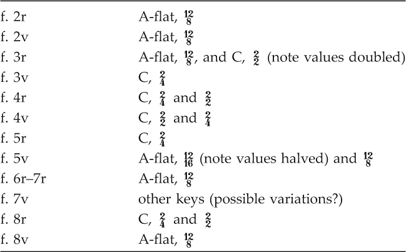
 time (Ex. 6 above), with little thematic resemblance to it. The mingling of C major and A-flat versions of what is essentially the same theme occupies folios 2–8 of Aut. 11/2 and is quite extensive, as can be seen in Table 2.
C major and A-flat versions of ‘gaiete’ theme in Aut. 11/2
A similar intermingling of
 sketches in C major and
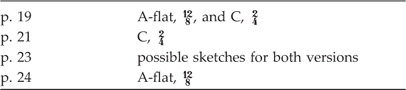
 sketches in A-flat major also appears in the pocket sketchbook Artaria 205/4, though more briefly, at pages 19–23, as in Table 3.
C major and A-flat versions of ‘gaiete’ theme in Artaria 205/4
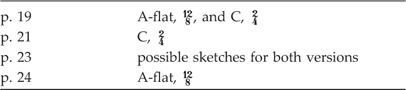
In both sketchbooks only the A-flat version in
 is found in subsequent sketches, and it becomes established as the second movement. The distinctive octave leap in the third bar of the Adagio theme makes its first appearance in a sketch in A-flat on page 19 of Artaria 205/4 before disappearing again in the next few sketches, but in later ones it is firmly in place in both sketchbooks. Thus it is clear that the above sections of the two sketchbooks, where the two versions of the theme are intermingled, are roughly contemporary, having been sketched during the same stage of composition. Although a single idea might be resurrected several pages or several days later, this would not happen when there is a whole complex of sketches that match in two sketchbooks, as here. Moreover, since the ‘gaiete’ draft in Artaria 206 apparently preceded the first-movement exposition sketch on pages 2–3 of Artaria 205/4, the ‘gaiete’ theme must have been held in abeyance for some quite considerable time while Beethoven sketched pages 2–18 of Artaria 205/4, before he returned to it on pages 19–23 and on folios 2–8 of Aut. 11/2. During this time he worked on completing the first movement and on jotting down other possible ideas for the quartet or other works, as revealed in the early pages of Artaria 205/4. Such a combination of late sketches for one movement plus individual ideas for possible later movements is entirely characteristic.Footnote 28 These ideas include a ‘3tes Stück’ in C minor in
 (Artaria 205/4, page 1, stave 2), which is followed on the next stave by an Allegro in B-flat (thus implying at least five movements, since this one is not in the tonic); a
 Adagio (page 14) whose theme bears little resemblance to either the
 sketch in Artaria 206 or any other idea for the slow movement; a theme in
 (page 16) that shows no connection to the ‘gaiete’ theme; and a theme in common time (
 or
 ) accompanied by slow chords in C major (page 17).
All these ideas were quickly abandoned, but the A-flat and C major complex extends over several pages in both sketchbooks. Such intermingling of two groups of sketches in different keys is so unusual that it calls for explanation. Since Beethoven did not normally sketch two movements in alternation, nor use the same theme in different transformations as the basis for consecutive movements, the sketches suggest that he was vacillating over which type of second movement to have – a scherzo-like one in C major, a profound adagio in A-flat major, or conceivably even an adagio in duple rhythm in C major as in Example 8 above. In these pages he began by transforming the opening of the ‘gaiete’ movement into A-flat,  , sketching several possible versions (Aut. 11/2, folios 2r–3r). He then returned to the C major
 version, sketching several forms, including that shown in Example 8 above, where the phrase structure has become four repeated bars followed by an answering four-bar phrase also repeated – a structure essentially the same as the final adagio version of the theme, but in a different key and metre. A slightly later sketch (folio 4v) shows a more extended theme of 8 bars, all repeated, plus an answering 8 or 9 bars and then a minore section in C minor, but this plan was promptly discarded.
The rapid alternation of A-flat and C major sketches that soon followed, however (Aut. 11/2, folios 6r–8v, and Artaria 205/4, pages 19–23), suggests something more profound: a movement in some kind of double variation form, in which the theme was to appear first in A-flat major at a slow tempo in
 , then transformed at a much faster tempo in C major in
 . Beethoven had recently composed the Diabelli Variations (completed in 1823), where the theme is rhythmically transformed from a waltz to several other metres and characters, and in 1802 he had composed a set of variations (Op. 34) in which each successive variation was in a different key and metre from its predecessor. In another line of compositional development, he had recently completed a double-variation slow movement in the Ninth Symphony, where two strongly contrasting themes are in different keys and metres from each other; and a similar structure was to appear in the slow movement of his next quartet, Op. 132 in A minor. In these sketches for Op. 127, therefore, he appears to have considered fusing these two ideas: a double-variation movement in which the two themes are in different keys and metres, with strikingly different characters, and yet one is a thematic transformation of the other. That this was for a time his plan is apparently confirmed by a note in Aut. 11/2, folio 9r: ‘abwechselnd in
 u
 tel’ (‘alternating in
 and
 time’), which seems to indicate pretty clearly a double variation movement based on two versions of the same theme. This fusing of two separate concepts, thematic transformation and double variation, would have been typical of his approach to composition, in which he often builds on ideas used in earlier works to create a new concept.Footnote 29 The fact that this concept was in this case abandoned illustrates the enormous range of possibilities that he created, and not all of them could be worked into his compositions. He did retain, however, one element of it in the final A-flat version of the slow movement, where the third variation transforms the theme in a different key and metre from the other variations; but it is in E major and
 rather than C major and
 . Significantly, the key contrast is still between two keys a major third apart, and the three keys involved are the same as those that conclude his recently completed piano sonatas, Opp. 109–111.
Another passage in the final version of the quartet can also be linked to the ‘gaiete’ sketches. This is the coda of the finale. Here in bar 259 the finale theme appears transformed and in C major (Ex. 9), just as the Adagio theme might have been if its C major version had appeared in alternation. In addition, the similarity to bars 35, 43 and 51 of the ‘gaiete’ draft in Example 5 is patent: in both cases the main theme uses regular semiquavers while a countermelody appears in running semiquaver triplets, beginning with a small leap followed by a run in the opposite direction; and the mood in Example 9 is unmistakably again one of gaiety. It is significant, too, that the thematic transformation of the finale theme appears successively in three different keys in bars 259–266, the same three as those mentioned above – C major, A-flat major, E major – before returning to the tonic of E-flat. Thus the ‘gaiete’ movement acted as a kind of catalyst for the quartet as a whole, assisting with the creation of two different movements but eventually not appearing in either.
Beethoven, Op. 127, mvt iv, bar 259 (from the autograph score)
Creation of the overall structure of Op. 127
Despite its important role for the quartet, the ‘gaiete’ movement does not appear at any stage as a separate movement within a six-movement or even five-movement structure. At the time when it was a separate movement, a four-movement structure was envisaged (Artaria 206, pages 98–105). When it was sketched as part of a double-variation movement, little attention was being given to the overall structure of the quartet. The only clear hint of a possible six-movement structure occurs on page 24 of Artaria 205/4, by which time the ‘gaiete’ theme had been absorbed into the A-flat Adagio or else abandoned. On this page the A-flat Adagio is considered as a possible third movement, followed by ideas for three further movements that were jotted down below it: a Presto as ‘4tes Stück’, a ‘serioso’ movement as ‘5tes Stück’ and a final ‘leztes Stück’. It seems extremely unlikely that Beethoven was planning here to restore the ‘gaiete’ movement as the unspecified second movement, having considered incorporating it into an adagio movement based on a transformation of the same theme.
Apart from this one group of sketches, abandoned as soon as it had been written down, there seems to be no clear sign of a possible six-movement structure, and none of the last three movements in this structure reappears in either the pocket sketchbook or the contemporary desk sketchbook. Thus it would be unwise to place much emphasis on this fleeting idea. Nevertheless, the eventual shape of the quartet as a whole emerged only gradually. Amongst the sketches that appear after the  Adagio had been established are many extraneous ones that bear no resemblance to any of the four movements. Some of these are for other works, including the songs Opferlied and Bundeslied (Opp. 122 and 121b), a Mass in C-sharp minor, and a BACH overture, all of which appear on folios 17–20 of Aut. 11/2.Footnote 30 Others, however, are clearly not for any of these works, and some of those noted after the second movement was under way may well be precursors to the third and fourth movements of the quartet, or else extra middle movements that would raise questions about the overall structure. There are more of these extraneous ideas than usual, such as a lively theme in E major in
 (Grasnick 4, folio 15r,Footnote 31 stave 3), and a theme in two-part counterpoint in A-flat (Aut. 11/2, folio 14v, staves 5–6). If either of these ideas was intended for the quartet, as seems likely, it must have been for a middle movement (either additional or alternative to the Scherzando), since they are not in the tonic. The theme of the actual third-movement Scherzando first appears on folio 16r of Aut. 11/2, and in a slightly more advanced form on page 32 of Artaria 205/4.
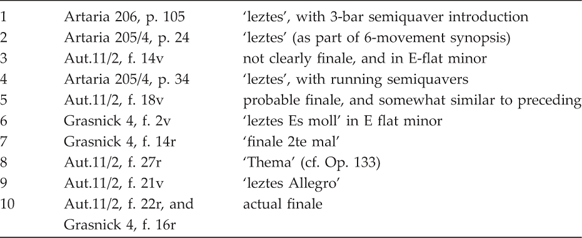
As in many of his works of the 1820s, Beethoven had difficulty in establishing the theme of the finale, and tried many options. The main ones are listed in Table 4, in approximately chronological order. Some are headed ‘leztes’, confirming they are ideas for the finale, but there is less certainty with the others.
Possible themes for finale of Op. 127
Two of these themes are in E-flat minor (nos. 3 and 6), with one specifically labelled as the finale. Another one (no. 9) begins on the dominant of F minor before working its way round to E-flat major, somewhat like the finale of the quartet Op. 130, which begins on the dominant of C minor before working its way to B-flat major. The theme labelled ‘Thema’ is located on folio 27r of Aut. 11/2, several pages after the actual finale theme first appears. However, it appears at the top of a page, and such entries often resulted from Beethoven turning ahead several pages to write out a completely new idea that, as here, does not belong with what is underneath. This ‘Thema’ was quoted by Nottebohm since it was eventually taken up and used as the main theme of the Grosse Fuge, Op. 133, and it has been much discussed since.Footnote 32 It seems almost certain, however, that this theme was devised while Beethoven was still looking for a finale theme for Op. 127, before he wrote down the actual finale theme for the first time; this theme is first seen on folio 22r of Aut. 11/2 and on folio 16r of Grasnick 4.
According to Brandenburg, ‘the finale of the E-flat quartet was originally to be introduced by a mysterious Adagio in E major, with use of thematic material from the following Allegro’;Footnote 33 but neither of these two earliest sketches for the finale, in Aut. 11/2 and Grasnick 4, is preceded by such an introduction. The nearest thing on either of these pages is an ‘alla marcia’ apparently in B major, but with a four-sharp key signature, on the top staves of Aut. 11/2, folio 22r (the first four bars are shown in Ex. 10). This seems to be a foretaste of the Alla marcia that was to follow the slow movement of Beethoven's next quartet (Op. 132 in A minor), and it was probably conceived as a possibility for a similar role in Op. 127, thus again implying a structure of more than four movements. A sprinkling of other sketches clearly in E major but not obviously related to the finale can also be found. Some are for Opferlied, some are for the E major variation in the Adagio, and a few are loose ideas, such as a  theme headed ‘E dur’ (Grasnick 4, folio 7r, stave 5) and a
 theme with a four-sharp key signature (Grasnick 4, folio 15r, stave 3). These two themes may represent ideas for an additional middle movement, but neither is thematically related to the finale, nor indicated as being an introduction to that movement. Other sketches that could represent ideas for an introduction for the finale around these parts of the sketchbooks are not in E major, and figuration that is very close to the actual introduction was established quite quickly. Brandenburg's ‘mysterious Adagio’ therefore remains a mystery.
Aut. 11/2, folio 22r
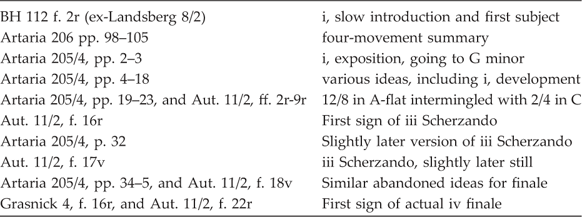
Thus the notion of a six-movement quartet that includes both a ‘gaiete’ movement and an E major movement is a conflation of several fleeting ideas from different sketches, none of which achieved any durability. What can be established, however, at least more clearly than before, is a sense of the sequence of the disparate sketch sources, and of the evolution of the quartet, as summarized in the chronological list in Table 5.
Chronological summary of the structural evolution of Op. 127
As the list shows, Beethoven was still working on the slow introduction and first subject at the end of Landsberg 8/2 (BH 112, folio 2r). In Artaria 206 pages 98–105 he devised a summary of the whole quartet, with the exposition of the first movement going to B-flat major and with a second movement entitled ‘la gaiete’. The exposition was soon revised to end in G minor (Artaria 205/4, pages 2–3), and was developed extensively in the following pages of this pocket sketchbook. He then considered a second movement in which a  theme and its transformation into
 in C major were heard in alternation (Artaria 205/4, pages 19–23, and Aut. 11/2, folios 2r–9r), with both themes based on that of ‘la gaiete’. After further work on the second movement, where the C major version had been jettisoned, the third-movement Scherzo theme first appeared in Aut. 11/2, folio 16r, then slightly modified in Artaria 205/4, page 32, then modified further on folio 17v of Aut. 11/2. Thus these pages of the two sketchbooks are contemporaneous. Similarly, two abandoned ideas for the finale which have much in common (Artaria 205/4, pages 34–35, and Aut. 11/2, folio 18v) are contemporaneous, as are the two earliest appearances of the finale theme (Grasnick 4, folio 16r, staves 3–4. and Aut. 11/2, folio 22r, staves 3–4), which are almost identical. Assigning precise dates to any of these pages is problematical, but as a body they cover roughly the period from June/July to October/November 1824.
With such a complex body of sketches, it will be many years before all the available clues to the secrets of the quartet's creation have been understood. Nevertheless, several issues have now become much clearer. During most of the sketching Beethoven envisaged a four-movement work, although for a long time he did not close his mind to the possibility of five or even six movements. The work evolved more or less in parallel in pocket sketchbooks and desk sketchbooks, and certain pages in the two formats can be matched up as being contemporaneous. Each of the two formats has conspicuous gaps, but these are partly filled by sketches in the parallel format, and one important gap that occurs in both formats can be filled by the overview in Artaria 206, so that only relatively minor stages in the sketching process are still unaccounted for. As for the ‘gaiete’ sketches, their role as catalyst in the creation of the quartet, prompting important ideas in both the Adagio and the Finale while not actually functioning directly, has now become much more apparent. They also show that Beethoven's early plan as outlined in Artaria 206 was to have a fast, energetic second movement. This feature is common in his late works, even though it was eventually abandoned here: four of his last five piano sonatas, the Ninth Symphony, and all his four final quartets have a fast second movement. Op. 127 is in fact the only work from his late period to adopt the conventional structure of fast – slow – minuet/scherzo – fast. This structure had earlier been so prevalent that it appears in all six works in his Op. 1 and Op. 2, but by 1824 he had not used it for over ten years: his last previous work with it was the Violin Sonata Op. 96, of 1812. At a time when this ‘normal’ structure had become so abnormal, it is therefore scarcely surprising that he should consider other possibilities for Op. 127, including a fast second movement in  and one or more additional movements, perhaps in remote keys. The standard structure could be reached only after he had distanced himself from it by considering numerous alternatives. This distancing from the conventional was therefore yet another way in which ‘la gaiete’ contributed to the creation of the quartet.