The routine use of contact precautions (CP) for methicillin-resistant Staphylococcus aureus (MRSA) and vancomycin-resistant enterococcus (VRE) is recommended by the Centers for Disease Control and Prevention to prevent transmission in the healthcare setting.Reference Siegel, Rhinehart and Jackson 1 US hospitals have maintained a heterogeneous approach to implementation of this recommendation. A facility’s decision to implement routine CP for MRSA and VRE is complex and not simply a question of whether or not to adhere to the recommendations of the Centers for Disease Control and Prevention. Both internal and external pressure, including regulatory standards and state law, may drive screening and isolation for MRSA or VRE.
Healthcare epidemiology has experienced a shift in recent years to a mixed vertical and horizontal approach to prevention that includes interventions like chlorhexidine gluconate bathing.Reference Climo, Yokoe and Warren 2 The healthcare environment as well is a target for technology that reduces bioburden (eg, disinfection with ultraviolet-C light) and thus reduces risk of transmission.Reference Hayden, Bonten and Blom 3 – Reference Nerandzic, Thota and Sankar 5 Additionally, the literature describing CP’s negative impact on patient care has continued to proliferate. Studies have suggested that CP may increase patient adverse events such as falls and pressure ulcers,Reference Gandra, Barysauskas and Mack 6 , Reference Karki, Leder and Cheng 7 isolation, and depression,Reference Day, Perencevich and Harris 8 perhaps because healthcare workers do not spend as much time in direct patient care with patients in CP.Reference Dashiell Earp, Bell and Ang 9 , Reference Morgan, Pineles and Shardell 10 Facilities have reported delayed bed assignment,Reference Shenoy, Walensky and Lee 11 patient perceptions of poor coordination of care,Reference Mehrotra, Croft and Day 12 and decreased healthcare worker adherence to isolation precautions with increasing numbers of patients on CP.Reference Dhar, Marchaim and Tansek 13
Given the availability of a bundle of interventions of which CP is just 1 component, published evidence pointing to negative impact on care, and voiced concern regarding effort vs value, we set out to determine (1) whether CP remains a widely used intervention for MRSA and VRE, (2) how facilities use CP, and (3) what other key interventions are in place to reduce the risk of transmission.
METHODS
We distributed an 8-question electronic survey to physician members of the Emerging Infections Network who had reported interest or involvement in infection prevention/infection control or who belonged to the Society of Healthcare Epidemiologists of America and had ever responded to a survey (http://www.int-med.uiowa.edu/Research/EIN/ContactPrecautions_finalquery.pdf). Recipients had 3 weeks to respond and were not required to answer all questions. Question formats included discrete answer choices plus free text fields for comments. Respondents were able to select more than 1 answer choice where applicable. Two reminder emails approximately 1 week apart were sent to those recipients who had not responded. Survey data were analyzed in an electronic spreadsheet (Excel; Microsoft).
RESULTS
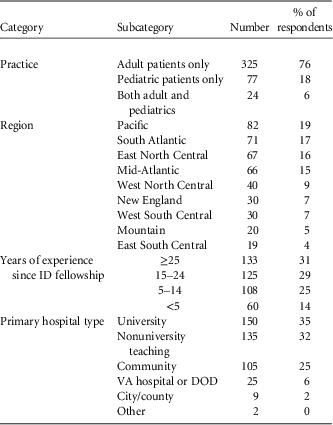
Seven hundred fifty-one US-based physicians were surveyed, and 426 (57%) responded. Respondent characteristics are outlined in Table 1. Most were adult infectious disease physicians from several US regions with more than 15 years postfellowship experience from university or nonuniversity teaching hospitals. Of the 426 respondents, 67 (16%) indicated that they were not involved in infection prevention. These respondents were excluded from further analysis.
Characteristics of 426 Survey Respondents

NOTE. A total of 67 respondents indicated that they were not involved in infection prevention/infection control. These respondents are excluded from all remaining data shown. DOD, Department of Defense; ID, infectious disease; VA, Veterans Affairs.
We found 337/364 (93%) and 335/364 (92%) report using routine CP for MRSA and VRE, respectively. Triggers for initiation of CP include clinical culture results (97% MRSA, 98% VRE), active surveillance testing results (87% MRSA, 65% VRE), preexisting alert in electronic health record (91% MRSA, 85% VRE), and suspicion of infection (36% MRSA, 20% VRE) (Table 2A). Active surveillance testing is performed for MRSA by 81% for any inpatient population and for VRE by 34% for any inpatient population.
Triggers for Initiation of Contact Precautions (CP)

NOTE. [open-text field for other triggers for placement on CP]: Preexisting alert only lasts for 1 year; CP for methicillin-resistant Staphylococcus aureus (MRSA) requires draining/open wounds (by 2) or sputum positivity (by 1); nursing home residents and transfers from other facilities until negative surveillance cultures available; vancomycin-resistant enterococcus (VRE) CP only in intensive care unit and oncology unit; CP for VRE requires open wound or culture from urine; confirmed report from outside institution (by 2); international patients (by 1).
a Answered by 336.
b Answered by 333.
Duration of isolation was reported to be indefinite once positive (18% MRSA, 31% VRE), until cleared or decolonized (69% MRSA, 54% VRE), for 1 year past last positive clinical culture (17% MRSA, 13% VRE), or for specific inpatient encounter only (7% MRSA, 8% VRE) (Table 2B). Free text responses indicate a wide variety of population- and specimen-based practices (Table 2B).
Duration of CP

NOTE. Comments on the details of duration of CP were typed in by 74 individuals, each of whom had a slightly different variation, such as these:
Last clinical culture answer range: 1 week–5 years, sometimes driven by state law.
Active clearance process answer range: 2–3 negative cultures, some require surveillance cultures only, others a combination of surveillance and clinical. Must be off applicable antimicrobials for range 2 days-1 week before testing.
Other: disagreement between physicians and infection control, using masks for all MRSA patients, duration of CP as state mandate, duration of CP case by case basis.
a Answered by 325.
b Answered by 319.
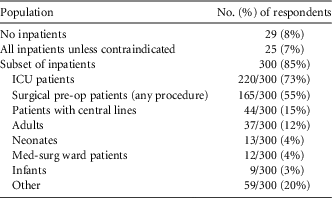
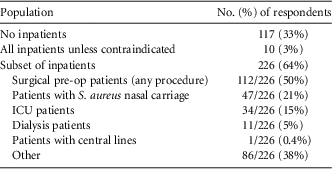
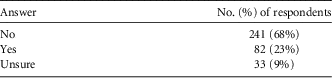
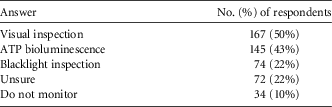
Use of adjunctive measures to reduce the risk of transmission is reported in Tables 3–5. Chlorhexidine gluconate bathing for 1 or more subsets of inpatients was reported to be used by 85%, most commonly in intensive care unit (73%) and preoperation (55%) patients (Table 3). We found that 64% perform S. aureus decolonization with intranasal mupirocin in 1 or more subsets of inpatients (Table 4), and 23% use either ultraviolet-C light or hydrogen peroxide vapor to disinfect patient rooms at discharge (Table 5A). To monitor performance of patient room discharge cleaning, 47% use visual inspection, 41% use adenosine triphosphate bioluminescence, and 21% use blacklight inspections (Table 5B).
Survey Respondents Performing CHG Bathing on Any Inpatient Population

NOTE. Answered by 354. [open-text field for Other]: bone marrow transplant patients, burn unit, hematology/oncology, abdominal transplant ward, all adult intensive care unit (ICU) patients, isolation patients, leukemics with central lines, orthopedic joint replacement, cardiac surgeries, total joint replacement surgery with positive methicillin-resistant Staphylococcus aureus screen, all dialysis patients, only certain ICUs, pediatric neurosurgery, spinal cord patients, ventilated patients. CHG, chlorhexidine gluconate.
Survey Respondents Performing Staphylococcus aureus Nasal Decolonization on Any Inpatient Population

NOTE. Answered by 353. [open-text field for Other]: coronary artery bypass graft, total joint replacements, cardiothoracic surgery, all orthopedic surgery, posterior spinal fusions, ventriculoperitoneal shunts, intensive care unit (ICU) with positive nasal carriage, patients who have infectious disease consult, methicillin-resistant S. aureus (MRSA)+total joint replacements, MRSA+neonates in neonatal ICU (NICU), all NICU patients, obstetrics, pre-op and post-op for 3–4 days, recurrent infections, hip/knee implant pre-op, high-risk surgeries, neurosurgery only, special care nursery, certain vascular procedures.
Environmental Interventions: Methods for Discharge Cleaning Does your facility use ultraviolet light or hydrogen peroxide vapor disinfection in any patient rooms at time of discharge?

NOTE. Answered by 356.
Environmental Interventions: Method of Cleaning Performance Monitoring

NOTE. Answered by 335. ATP, adenosine triphosphate.
DISCUSSION
In this large, nationwide survey of more than 400 physicians with an interest in infection prevention, substantial heterogeneity in application of CP was identified. Despite increasing evidence of the negative impact of CP, routine CP for MRSA and VRE remains commonplace. Our findings are similar to those reported by Morgan et al.Reference Morgan, Murthy and Munoz-Price 14 Although their sampled population was smaller and varied slightly from ours, both surveys reveal a high percentage of respondents using CP (more than 90%) yet expressing interest in alternative approaches.
Variation in the way CP is used was evident and likely driven by these factors: institutional (eg, infection rates, facility experience, workplace culture), patient (eg, population served), scientific (eg, evidence regarding duration of colonization), and regulatory (eg, state requires active surveillance testing for MRSA, so hospitals use CP).
We were surprised by how many respondents report using CP routinely. We perceive from the literature plus conversations with healthcare epidemiology colleagues that CP for MRSA and VRE is falling out of favor. However, although many institutions may contemplate discontinuing routine CP for MRSA and MRE, the effort involved may be a significant disincentive to change.
One of our facilities, a tertiary academic center, discontinued using routine CP for MRSA and VRE in 2014. It took 6 months to carefully plan, educate staff on the change, and implement. The overarching educational message was 2-pronged: (1) adherence to excellent hand hygiene is crucial, (2) though use of CP for MRSA and VRE is no longer routine, CP may be appropriate if implemented as part of standard precautions (eg, with drainage that can’t be contained, use CP). After the extensive educational effort, discontinuation of CP was met with mostly applause and has allowed staff to better understand and apply the nuances of standard precautions. Preliminary data show no increase in rates of MRSA or VRE infections by laboratory-identified method since the change.Reference Martin, Russell, Rubin and Uslan 15
This study has several limitations. Fist, this was a cross-sectional study conducted in 2014; data represent 1 point in time and could have changed by now. Second, we do not know whether more than 1 person from any given facility responded. As such, some facilities could be overrepresented and cause some skew of the data. Third, respondents may have interpreted questions differently. Lastly, respondents were not required to answer all questions. As such, they could be selective in choosing which questions to address, potentially biasing results.
Although routine CP for MRSA and VRE remains a standard at most hospitals across the country after decades of use, robust studies demonstrating the benefits of CP for these organisms, outside of the outbreak setting, are lacking in the medical literature, especially in comparison with horizontal interventions, such as universal chlorhexidine gluconate bathing. Additionally, studies demonstrate that the use of CP may result in substandard care for patients. In 2014, Daishell Earp et alReference Dashiell Earp, Bell and Ang 9 published the results of a time-motion study of internal medicine interns. The study found that interns visited less frequently and spent less time with patients on CP compared with patients not on CP. Less healthcare worker time in a patient’s room could lead to unintended consequences such as those reported by Karki et al,Reference Karki, Leder and Cheng 7 who found that patients on CP had a significantly higher risk of nonpressure injuries, such as falls and skin tears, and of medication administration errors.
Nevertheless, before we relegate routine CP for MRSA and VRE to the dustbin of history, there are a number of questions regarding its use that remain unanswered with large-scale, quality trials. Studies should address the relative importance of CP versus emerging horizontal interventions, such as chlorhexidine gluconate bathing, electronic hand hygiene monitoring, and nasal decolonization for S. aureus. Clarity is needed on whether some particular segments of the hospitalized patient population benefit more than others. As the current survey shows, there is heterogeneity in the application of CP for MRSA and VRE, especially surrounding how long institutions should continue CP after a positive culture. As additional studies better elucidate the risks and benefits of CP relative to horizontal interventions in the future, professional societies and regulatory agencies should take into account the trade-offs of routine CP and guide healthcare facilities to take a more personalized, risk-based approach to applying these measures.
ACKNOWLEDGMENTS
Financial support. Centers for Disease Control and Prevention (grant FOA CK11-1102).
Potential conflicts of interest. All authors report no conflicts of interest related to this article.
Disclaimer: These contents are solely the responsibility of the authors and do not necessarily represent the official position of the Centers for Disease Control and Prevention or the Department of Health and Human Services.