Introduction
The genus Mazosia is a small genus with 23 known species (Lücking Reference Lücking2008) in the Roccellaceae. Most species are known only from living leaves, but a few occur both on smooth bark and leaves; so far only two species are described that are known only from bark (Sparrius Reference Sparrius2004).
During ecological studies by the authors in NE Brazil, mostly on the Chapada do Araripe in Ceará State and in Mata do Crasto, an Atlantic rainforest remnant in the state of Sergipe, three corticolous Mazosia species were found to occur. Their internal structures are almost identical, but the aspect and immersion of the apothecia and the thallus surface differ, from smooth to minutely verrucose to roughly warted. As such thallus structures are among the main species characters in foliicolous Mazosia species (Lücking Reference Lücking2008), these species were deemed worthy of recognition. However, only two corticolous Mazosia species are currently recognized (Sparrius Reference Sparrius2004), which differ in ascospore length and thallus structure. A further, undescribed species from Hong Kong was reported by Sparrius (Reference Sparrius2004). We examined this material but do not treat it here in the genus Mazosia as it has a very pale, non-carbonized hypothecium.
After making descriptions and provisional names for the two additional corticolous species, we encountered increasingly more specimens, and not only from NE Brazil. We decided to investigate the type specimens of the corticolous species already described, particularly of the three species synonymized with M. ocellata (Nyl.), R. C. Harris by Sparrius (Reference Sparrius2004), and a further species, the oldest epithet among them, which was cited by Tehler (Reference Tehler1993) to be identical with M. ocellata. Somewhat to our surprise, they represented two different species.
Here we reinstate one species and make the appropriate combination in the genus Mazosia for the oldest epithet available, and provide descriptions and a key to all corticolous species of Mazosia including similar foliicolous ones.
Material and Methods
Identification and descriptive work were carried out in Itabaiana, Universidade Federal de Sergipe, using a Leica EZ4 stereomicroscope and a Leica DM500 compound microscope, and also in Soest using an Olympus SZX7 stereomicroscope and an Olympus BX50 compound microscope with interference contrast, connected to a Nikon Coolpix digital camera. Sections were mounted in tap water, in which all measurements were also taken. The chemistry of the types of the new species and a few other specimens was investigated by thin-layer chromatography (TLC) using solvent A (Orange et al. Reference Orange, James and White2001).
The Species
Mazosia carnea (Eckfeldt) Aptroot & M. Cáceres comb. nov.
MycoBank No.: 805956
Basionym: Thelotrema carneum Eckfeldt, Bull. Torrey Bot. Club 21: 394 (1894).—Ocellularia carnea (Eckfeldt) Zahlbr., Cat. Lich. Univ. 2: 585 (1923).—Enterographa carnea (Eckfeldt) R. C. Harris, in Egan, Bryologist 90: 163 (1987); type: USA, Louisiana, St Martinsville, 1894, Langlois 1006, 1051, x164 (NY—isotypes, illustrations seen).
Chiodecton cyclocarpum Zahlbr., Sitzungsber. K. Akad. Wiss. Wien. math.-naturw. Kl. 111(1): 375 (1902).—Enterographa cyclocarpa (Zahlbr.) Redinger, Feddes Repertorium 43: 69 (1938); type: Brazil, Rio de Janeiro, on tree trunk in Botanical Garden, 1902, Höhnel 171 (W—holotype, illustration).
Gymnographoidea suborbicularis Fink, in Hedrick, Mycologia 22: 249 (1930); type: USA, Puerto Rico, near Rio Pedras, on branch, 1916, Fink 2194 (NY—holotype, illustrations seen; L—isotype).
(Fig. 1)
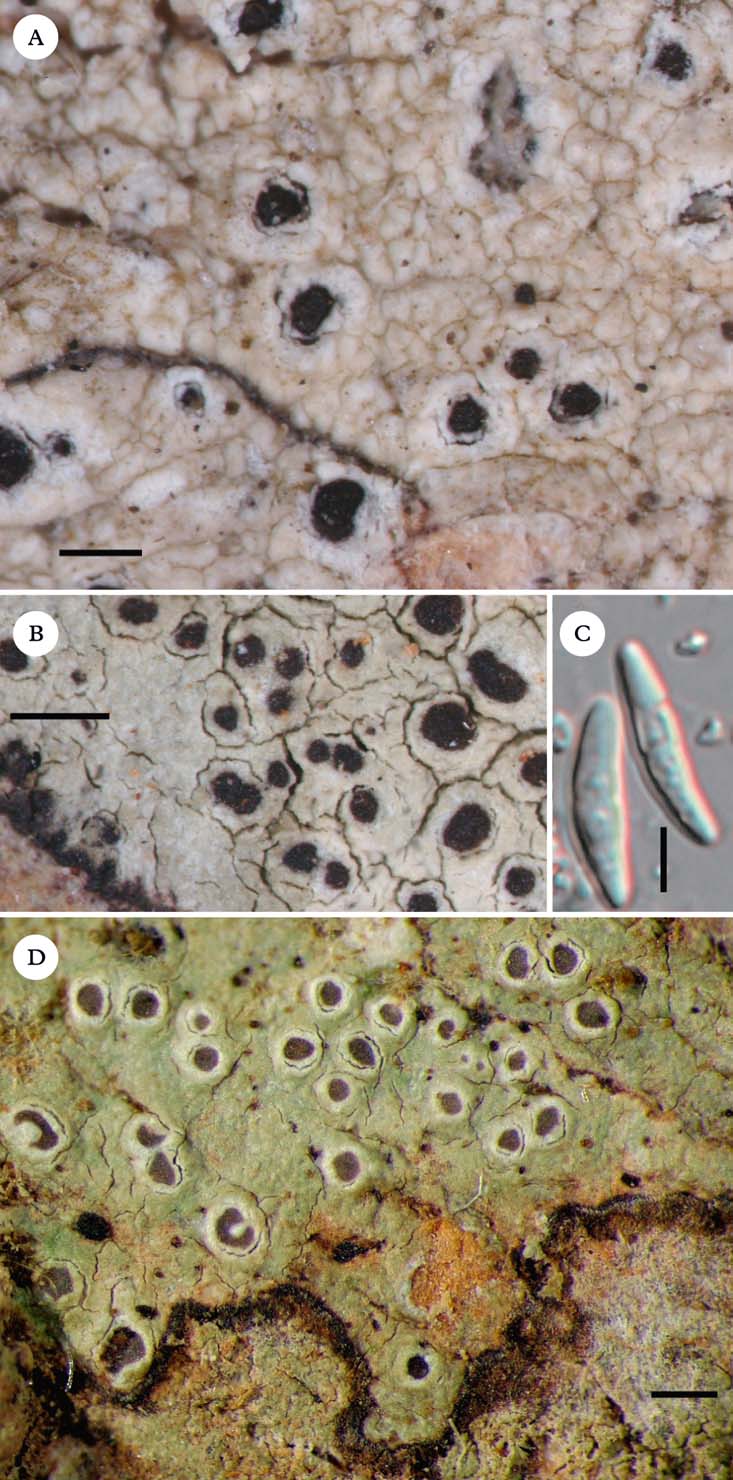
Mazosia carnea. A, holotype, habitus; B, holotype of Gymnographoidea suborbicularis, habitus; C, Cáceres & Aptroot 18359, ascospore; D, Cáceres 2040b, habitus. Scales: A, B & D=0·5 mm; C=5 μm. In colour online.
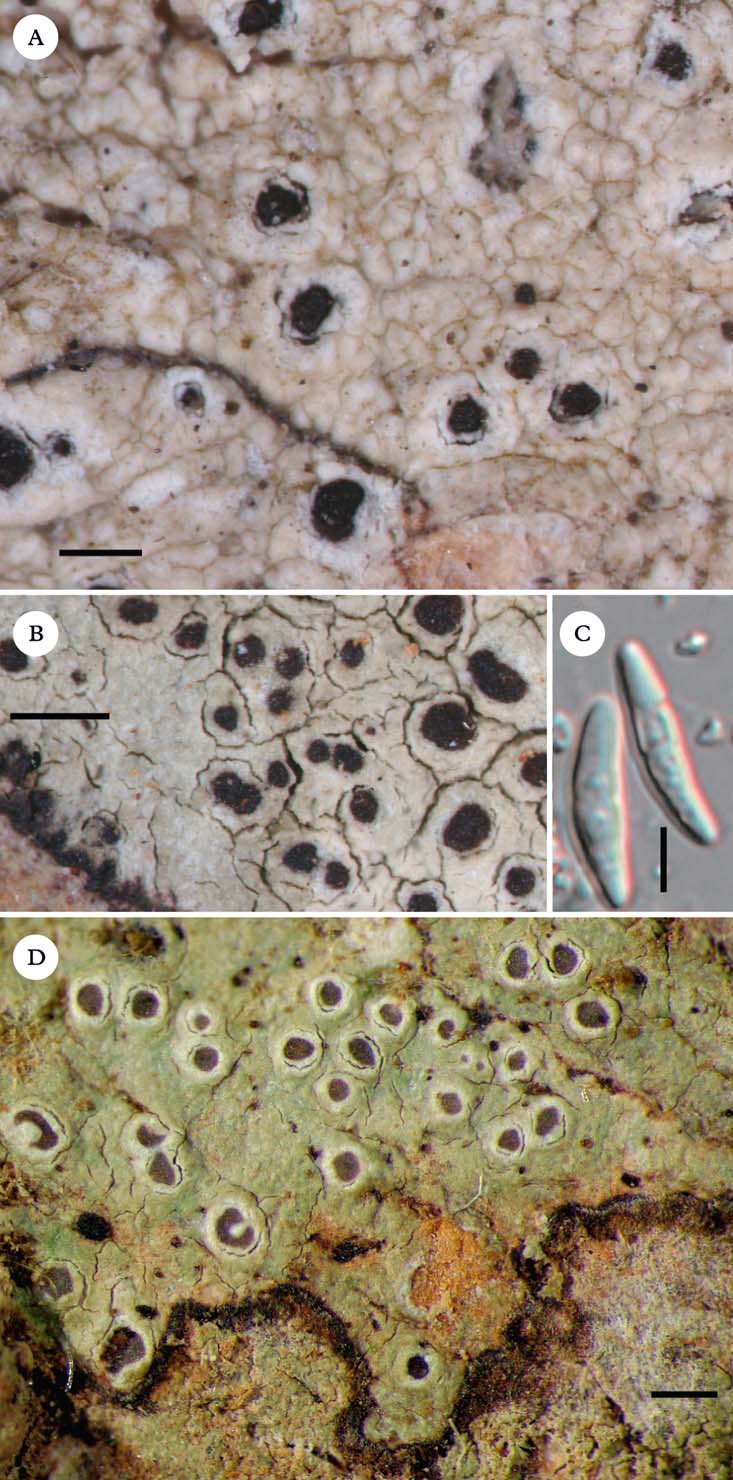
Thallus crustose, not corticate, dull, greyish green to whitish grey, mostly rather thick, at least minutely fissured or wrinkled, usually surrounded by a narrow black prothallus line. Algae trentepohlioid.
Ascomata superficial, round, 0·2–0·4 mm wide; disc flat, brownish grey (often rather pale) to dark grey or black, not pruinose, margin pronounced, not raised above the disc, whitish, c. 0·1 mm wide. Excipulum hyaline, with globose lumina of up to 12·5 µm, with clusters of large hyaline crystals and with algal cells. Hypothecium black, 35–55 µm high, often with large hyaline crystals, extending as a thin to thick (up to c. 50 µm wide) parathecium between the hamathecium and the excipulum. Epihymenium brown, with tiny fuscous crystals. Hamathecium not inspersed, yellowish, filaments 1·5–2·0 µm wide. Asci clavate, 40–50×11–14 µm. Ascospores 8 per ascus, hyaline, clavate, 3-septate, 15–18×4–6 µm, constricted at the septa, ends somewhat rounded.
Pycnidia not observed.
Chemistry
Thallus and ascomata UV−, C−, P−, K−. TLC: no substances detected.
Ecology and distribution
On smooth bark of trees, pantropical; in NE Brazil in Mata Atlântica and Brejo de Altitude forest.
Discussion
This species differs from all other Mazosia species by the often rather thick, usually irregularly but finely fissured thallus. This is one of the main reasons that it has always been recognized as a separate species, as it could not be accommodated in any of the known foliicolous taxa.
Selected additional material examined. USA: Louisiana: Baton Rouge, Burden Research Plantation, S. Tucker 28595 (B).—Costa Rica: Puntarenas: Parque Nacional Corcovado, Estación Biológica Sirena, disturbed forest along the beach, 0 m, H. Sipman 51138 (B); Cordillera de Tilarán, Monteverde, forest relicts, 1450 m, H. Sipman 12077 (B).—Puerto Rico: Mayagüez District: Reserva Forestal Maricao, low forest on dry slope, along trail to fish hatchery, c. 800 m, H. Sipman 25953, 25985 (B).—Netherlands Antilles: Saba: Sandy Cruz Trail at The Bottom, secondary forest, 400 m, H. Sipman 54711, 54722 (B).—Brazil: Alagoas: Pilar, Reserva Particular do Patrimônio Natural Fazenda São Pedro, Mata Atlântica (closed forest), 50 m, M. Cáceres & R. Lücking 01-0157b (F), M. Cáceres 2000 (B), 2013 (F), 2014 (URM), A08-061 (F), A21-187 (F, URM), A38-cortex (F), A45-366a (F), A45-367a (F). Pernambuco: Bonito, Parque Municipal de Bonito, Brejo de Altitude (high altitude rainforest), 800 m, M. Cáceres & R. Lücking 00-0332 (F); Igarassu, Refúgio Ecológico Charles Darwin, Mata Atlântica (closed forest), 20 m, M. Cáceres & R. Lücking 00-0400 (B), 00-0413 (F), 00-0389 (URM), 00-0420 (URM). Rio Grande do Norte: Baía Formosa, Reserva Particular do Patrimônio Natural Mata Estrela Senador Antônio Farias, Mata Atlântica (closed forest), 0 m, M. Cáceres 01-0170 (B). Sergipe: Ribeira, Mata Atlântica, M. Cáceres 2040b (F); Povoada Pedrinhas, Mata da Fazenda Cafuz, M. Cáceres & A. Aptroot 18359 (ABL, ISE, tlc!).—Guyana: Upper Takutu District: southern Rupununi savannah, c. 3 km N of Dadanawa ranch headquarters, on scattered shrubs around pond in savannah, c. 120 m, H. Sipman 57524; same area, Kusad mountain, SE-side, sheltered, little disturbed forest in valley at foot of the mountain, 150–250 m, H. Sipman 57638 & 57937. East Demerara District: along Linden Highway, E of Timehri airport, in savannah bush, c. 10 m, H. Sipman & A. Aptroot 19560 (all B).—Seychelles: Cousine, 31 iii 2001, J. Gerlach (BR).—Fiji: Viti Levu, along valley road near Mauka of Belo, O. & I. Degener 31901w (B).
Mazosia endonigra A. A. Menezes, M. Cáceres & Aptroot sp. nov.
MycoBank No.: MB 802579
Mazosia on bark with smooth, often greyish green thallus, dark grey to black apothecia, black hypothecium, yellowish hymenium and ascospores 3-septate, 15–18×4–6 µm.
Type: Brazil, Ceará, Chapada do Araripe, on bark of tree, c. 900 m, 24 January 2011, A. A. Menezes 8294 (ISE—holotype).
(Fig. 2)
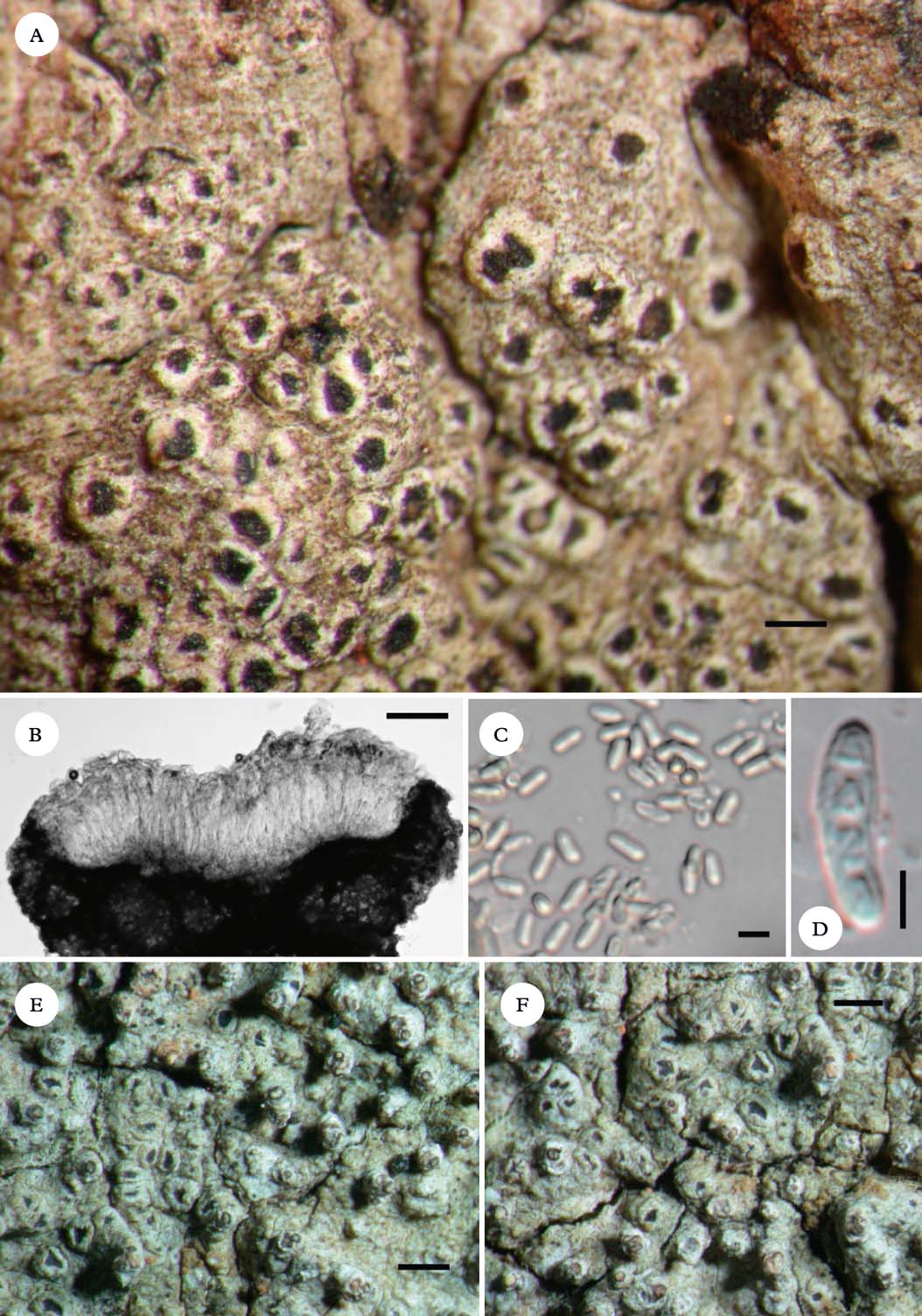
Mazosia endonigra, A, B & D, holotype; C, E & F, Alves 1117. A, E & F, habitus; B, section through apothecium; C, conidia; D, ascospore. Scales: A, E & F=0·5 mm; B=50 μm; C & D=5 μm. In colour online.
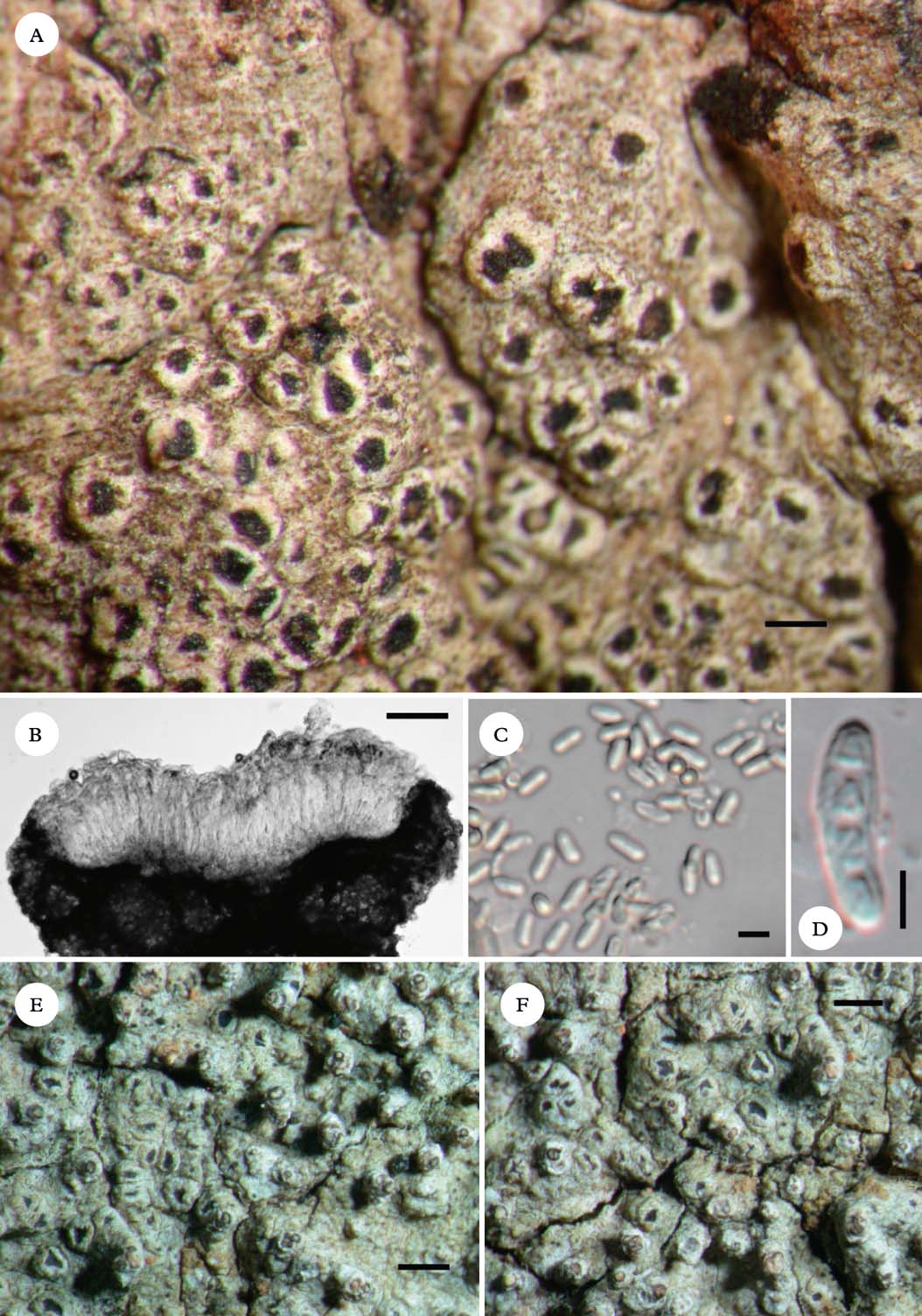
Thallus crustose, not corticate, dull, greyish green to whitish grey, rather thick, smooth, surrounded by a narrow black prothallus line. Algae trentepohlioid.
Ascomata superficial, round, 0·2–0·4 mm wide; disc flat, dark grey to black, not pruinose, margin pronounced, not raised above the disc, whitish, c. 0·1 mm wide. Excipulum hyaline, with globose lumina of up to 12·5 µm, clusters of large hyaline crystals and algal cells. Hypothecium black, 35–55 µm high, often with large hyaline crystals, extending as a thin (c. 5 µm) parathecium between the hamathecium and the excipulum. Epihymenium brown, with tiny fuscous crystals. Hamathecium not inspersed, yellowish, filaments 1·5–2·0 µm wide. Asci clavate, 40–50×11–14 µm. Ascospores 8 per ascus, hyaline, clavate, 3-septate, 15–18×4–6 µm, constricted at the septa, ends somewhat rounded.
Pycnidia occasionally present, sessile, semiglobose, black, higher than wide; conidia hyaline, ellipsoid, c. 5·5–6·5×2·0 µm.
Chemistry
Thallus and ascomata UV−, C−, P−, K−. TLC: no substances detected.
Ecology and distribution
On smooth bark of trees, in NE Brazil in Caatinga forest. Occurring together with, for example, Lecanora caesiorubella Ach.
Discussion
This species is somewhat similar to Mazosia phyllosema (Nyl.) Zahlbr. (Lücking Reference Lücking2008) and has previously been reported as corticolous material of the latter (Cáceres Reference Cáceres2007), but it differs by, for example, the pronounced apothecium margin, the thicker, dull thallus that is not dispersed into rounded patches at the margin but entire and surrounded by a black hypothallus line, trentepohlioid photobiont and by the smaller ascospores.
Selected additional material examined. Brazil: Ceará: Chapada do Araripe, on bark of tree, c. 800 m, 2012, A. A. Menezes 8298, 15899 (ISE); same area, 2013, M. M. E. Alves 251, 1026, 1028, 1029, 1031, 1041, 1046 (all ISE), 1117 (apothecia and pycnidia, ABL), 1156, 1186 (all ISE). Piauí: Parque Nacional Serra das Confusões, 2012, M. Cáceres 9462, 9474 (ISE, both only pycnidia).
Mazosia leptosticta (Nyl.) Sparrius
Biblioth. Lichenol. 89: 97 (2004).—Stigmatidium leptostictum Nyl., in Triana & Planchon, Ann. Sci. Nat., Bot., sér. 4, 19: 382 (1863).—Chiodecton leptostictum (Nyl.) Zahlbr., Cat. Lich. Univ. 2: 479 (1923); type: Colombia, Barranquilla, Lindig 2646 [“2606” in publication] (H-NYL 4624—lectotype, Sparrius Reference Sparrius2004).
(Fig. 3)
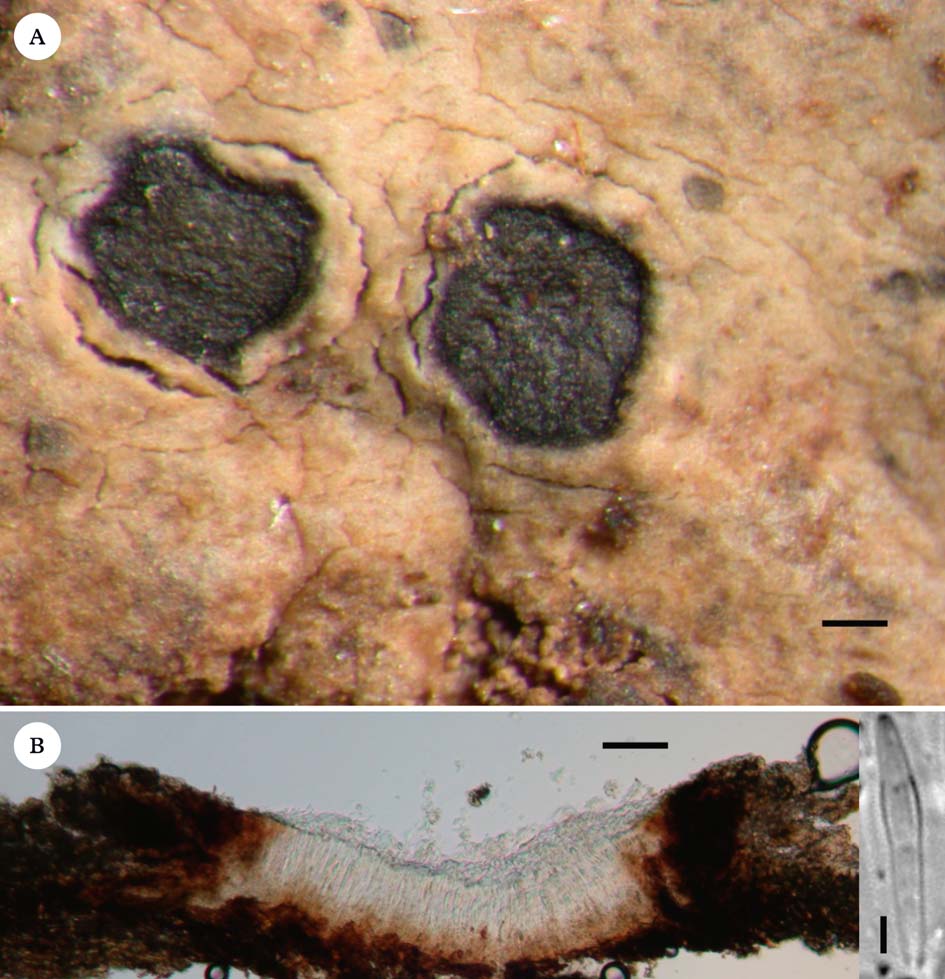
Mazosia leptosticta, Sipman & Aptroot 18638. A, habitus; B, section through apothecium; inset, ascospore. Scales: A=0·5 mm; B=50 μm, inset=5 μm. In colour online.
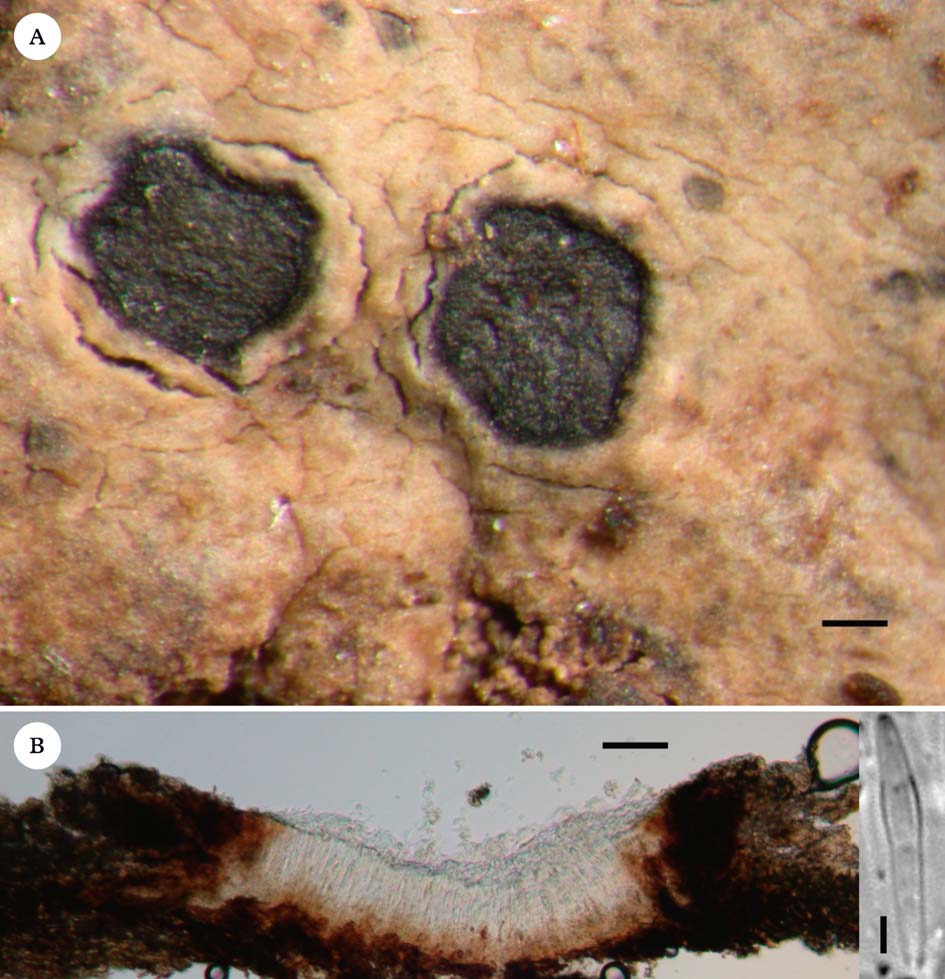
Thallus crustose, not corticate, dull, greyish green to whitish grey, very thin, smooth, without prothallus line. Algae trentepohloid.
Ascomata superficial, round, 0·1–0·6 mm wide; disc flat, dark grey to black, not pruinose, margin thin, not raised above the disc, whitish, less than 0·1 mm wide. Excipulum black inside, hyaline and with algae outside, without crystals. Hypothecium black, 15–25 µm high. Epihymenium hyaline. Hamathecium not inspersed, filaments 1·5–2·0 µm wide. Asci clavate, 50–65×11–15 µm. Ascospores 8 per ascus, mostly in one bundle, hyaline, clavate, 3-septate, (22–)28–35×4–7 µm, constricted at the septa, ends somewhat rounded.
Pycnidia not observed.
Chemistry
Thallus and ascomata UV−, C−, P−, K−.
Ecology and distribution
On smooth bark of trees in the Neotropics. Known from Colombia and Guyana.
Discussion
This species differs from all other corticolous Mazosia species by the longer ascospores.
Additional specimen seen. Guyana: Upper Mazaruni District: E-bank of Waruma River, 12 km S of confluence with Kako River, on roots in river bank, c. 550 m, 1985, H. Sipman & A. Aptroot 18638 (B).
Mazosia viridescens (Fée) Aptroot & M. Cáceres comb. nov.
MycoBank No.: MB 805954
Basionym: Urceolaria viridescens Fée, Essai Crypt. Écorc.: 104 (Reference Fée1824); Urceolaria bonplandiae Fée, Essai Crypt. Écorc.: tab. 25 (Reference Fée1824), nom. nud.—Gomphospora viridescens (Fée) A. Massal., Ricerc. Auton. Lich. Crost.: 40 (1852).—Dirina viridescens (Fée) Müll. Arg., Flora 68: 506 (1885).— Platygrapha viridescens (Fée) Müll. Arg., Soc. Phys. Hist. Nat., Genève 29: 14 (1887).—Schismatomma viridescens (Fée.) Zahlbr., Cat. Lich. Univ. 2: 566 (1923); type: South America, on Bonplandia trifoliata (G—holotype, not seen).
Platygrapha ocellata Nyl., Acta Soc. Sci. Fennica 7: 478 (1863).—Schismatomma ocellatum (Nyl.) Zahlbr., Cat. Lich. Univ. 2: 560 (1923).—Mazosia ocellata (Nyl.) R. C. Harris, Some Florida Lichens: 43 (1990); type: Colombia, 2000 m, Lindig 2699 (H-NYL 4776—holotype).
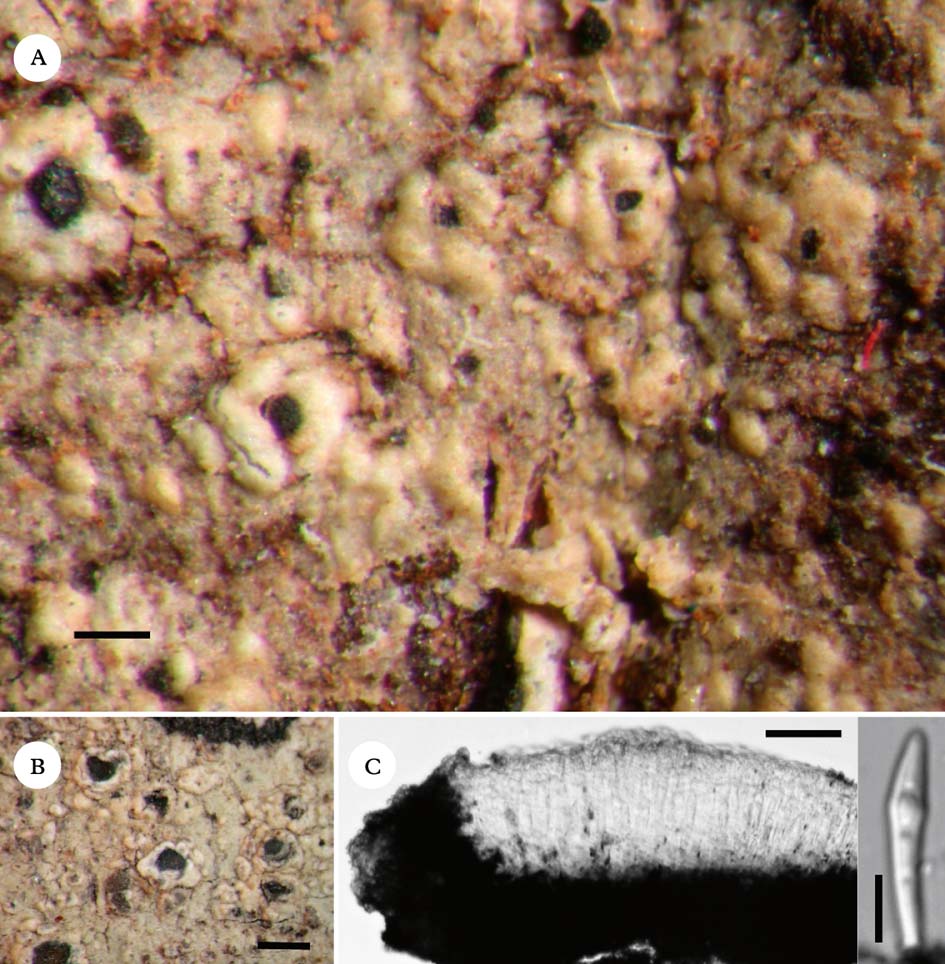
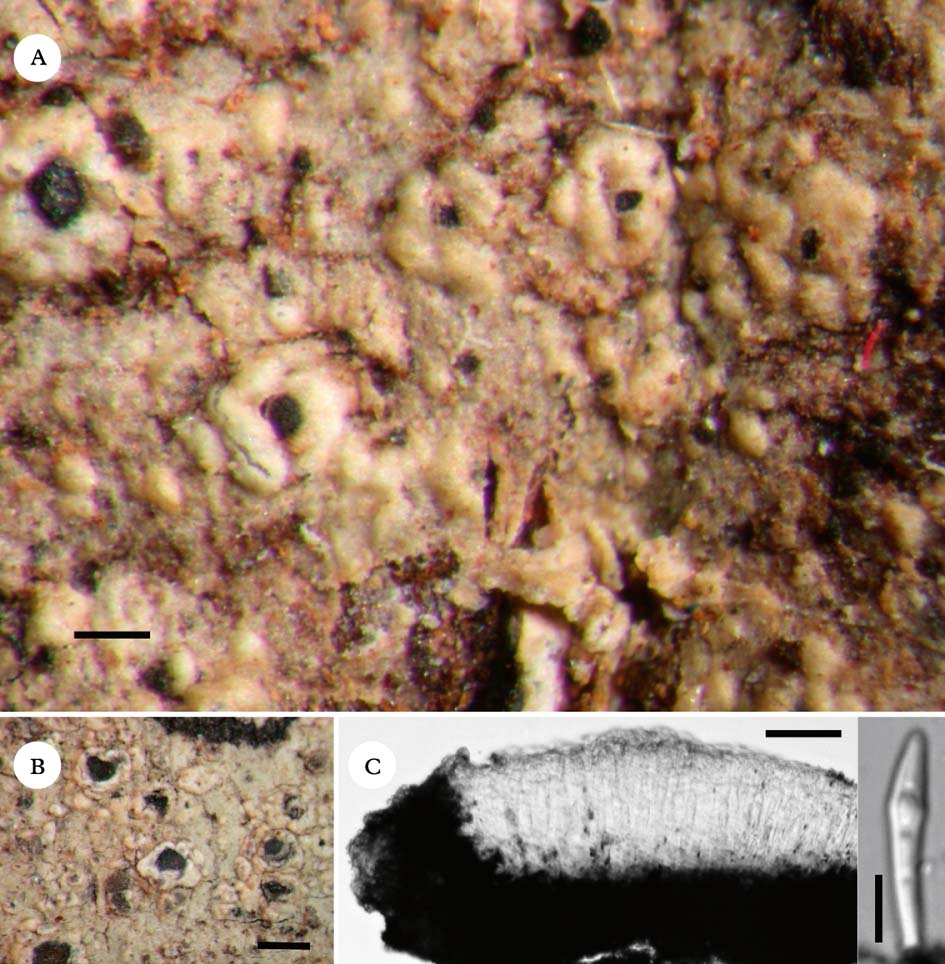
Mazosia viridescens, A, C & D, Santos & Lisboa 12900; B, holotype of Platygrapha ocellata. A & B, habitus; C, section through apothecium; inset, ascospore. Scales: A & B=0·5 mm; C=50 μm, inset=5 μm. In colour online.
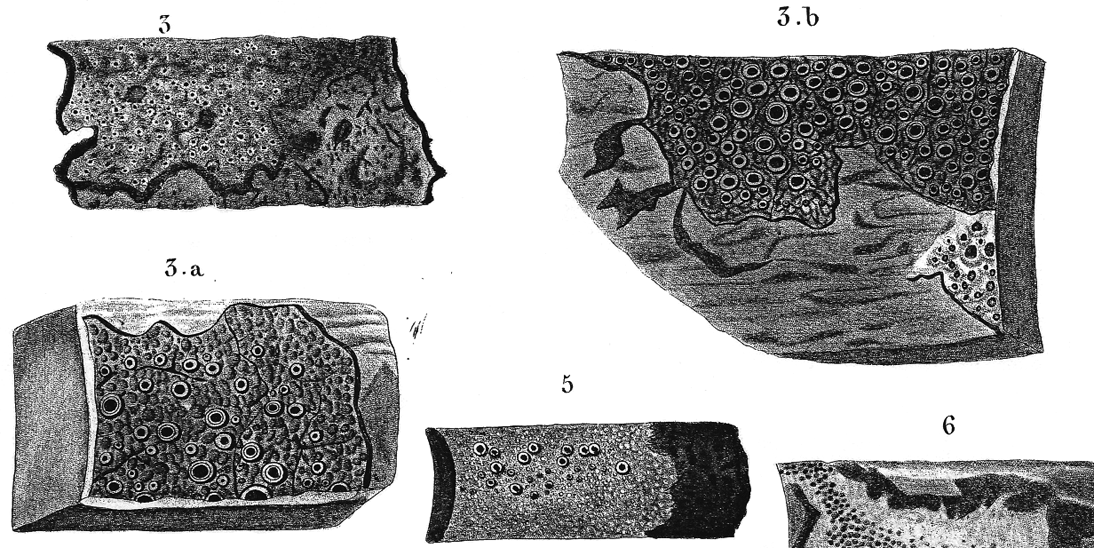
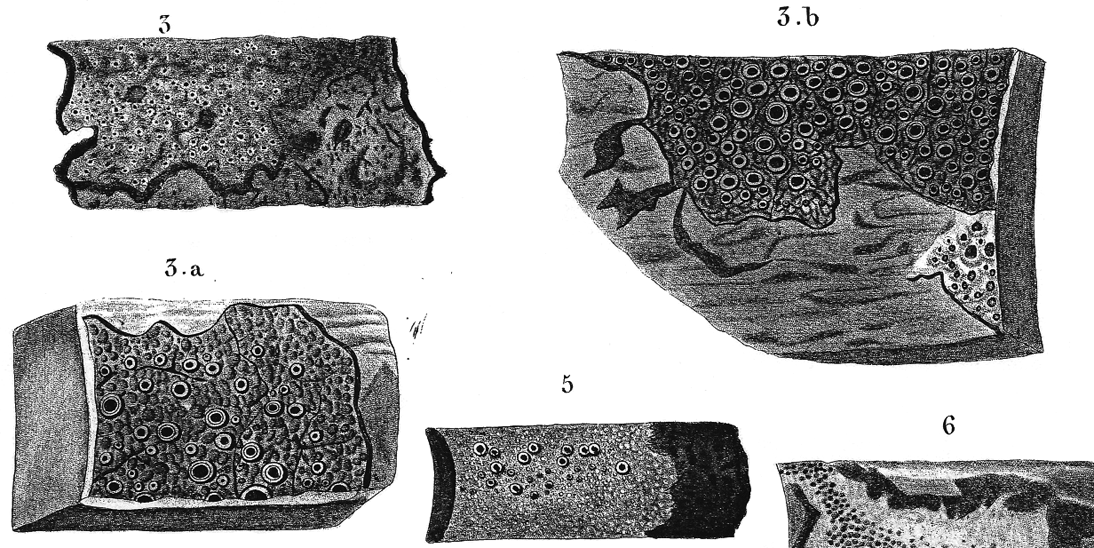
Mazosia viridescens, ‘3’, ‘3a’ & ‘3b’, illustration of holotype, from Fée Reference Fée1824: tab. 25.
Thallus crustose, corticate, slightly shiny, grey, rather thick, with irregular and partly confluent warts c. 0.1 mm diam. which are filled with hyaline crystals, surrounded by a black prothallus line. Algae trentepohlioid.
Ascomata immersed in the thallus to slightly emergent, round to usually angular, 0·2–0·4 mm wide; disc concave, dark grey to black, not pruinose, margin slightly raised above the disc, grey, often warty and irregular (because of partly confluent thallus warts), c. 0·2 mm wide. Excipulum hyaline, with tiny hyaline crystals and algal cells. Hypothecium black, 45–75 µm high, with large hyaline crystals, extending as a rather wide (c. 20 µm) parathecium between the hamathecium and the excipulum. Epihymenium hyaline to pale brown, without conspicuous crystals. Hamathecium not inspersed, yellowish, filaments 1·0–1·5 µm wide. Asci cylindrical, 50–58×9–12 µm. Ascospores 8 per ascus, hyaline, clavate-fusiform, 3-septate, 15–18×4–5 µm, not constricted at the septa, with pointed ends, second lumen from above bulging out.
Pycnidia not observed.
Chemistry
Thallus and ascomata UV−, C−, P−, K−. TLC: no substances detected.
Ecology and distribution
On smooth bark of trees in the Neotropics, in NE Brazil in transition forest from Mata Atlântica to Caatinga. Occurring together with, for example, Anisomeridium americanum (A. Massal.) R. C. Harris.
Discussion
This species is somewhat similar to Mazosia tumidula (Stirt.) Müll. Arg. (Lücking Reference Lücking2008) but differs by, for example, the more irregular apothecium margin and apothecium outline, the thallus that is not dispersed into rounded patches at the margin but entire, surrounded by a black hypothallus line and having a trentepohlioid photobiont.
Additional material examined. Mexico: Chiapas: Parque Nacional Lagunas de Montebello, Paso del Soldado, 1500 m, J. Wolf & H. Sipman 2055 (B).—Guatemala: Depto. Alta Verapaz: NE of Cobán-Aragon, at the borders of Rio Cahabon, cloud forest, on Liquidambar styraciflua, 1700 m, 13 ix 2002, C. Andersohn (B).—Brazil: Sergipe: Santa Luzia do Itanhy, Mata do Crasto forest, on bark of tree, 0 m, 2012, V. M. Santos & M. Lisboa 12900 (ISE); Parque Nacional Serra da Itabaiana, c. 400 m, 24 iii 2012, K. A. de Jesus (ISE); Povoada Pedrinhas, Mata da Fazenda Cafuz, M. Cáceres & A. Aptroot 18366 (ABL, ISE, tlc!).
Discussion
Most Mazosia species are obligately foliicolous, partly common and abundant on living leaves, and rarely occurring on other smooth substrata, such as paint or plastic.
We compared the corticolous species of the genus to similar foliicolous species, and found structural differences between all species. Four corticolous Mazosia species can be recognized, and none of them seem to be corticolous specimens of normally foliicolous species.
Only four species so far are known exclusively from bark. It cannot be ruled out a priori that they occur also on living leaves. Therefore all similar species are included in the key below, but it is clearly indicated which ones are foliicolous and which are corticolous.
Repeatedly, two different corticolous Mazosia were observed side by side in the field, confirming that the observed differences are not phenotypic variation. In the Chapada do Araripe, M. endonigra and M. viridescens grow together without intermediates and in the Mata da Fazenda Cafuz, M. carnea and M. viridescens.
There are relatively few distinguishing morphological characters in the ascospores and other internal apothecium characters. The majority of the species, including all corticolous ones, have fusiform, 3-septate ascospores that are constricted at the septa and of which the cell above the middle is the largest.
These species differ markedly, however, in apothecium morphology and thallus surface. A few species deviate from the general ascoma shape by a more pronounced thalline margin. A key is given here to all 3-septate species of Mazosia. For detailed descriptions and nomenclature of the foliicolous species, see Lücking (Reference Lücking2008).
Note: all foliicolous species have radiating cells of Phycopeltis, while all corticolous species have Trentepohlia s. lat. as photobiont.
World key to Mazosia species with 3-septate ascospores
-
1 Thallus with hairs ... 2
Thallus without hairs ... 3
-
2(1) Thallus with fine verrucae. Foliicolous ... M. tenuissima Lücking & Matzer
Thallus smooth. Foliicolous ... M. pilosa Kalb & Vězda
-
3(1) Thallus with radiating ridges. Foliicolous ... M. rotula (Mont.) A. Massal.
Thallus without ridges, at most with some ellipsoid warts ... 4
-
4(3) Thallus with fine to coarse warts/verrucae ... 5
Thallus smooth ... 9
-
5(4) Thallus warts fine, regular, c. 0·02–0·05 mm; prothallus usually present ... 6
Thallus warts coarser, c. 0·07–0·15 mm, or thallus irregularly verrucose ... 7
-
6(5) Thallus warts dark brown. Foliicolous ... M. bambusae (Vain.) R. Sant.
Thallus warts pale. Foliicolous ... M. pseudobambusae Kalb & Vězda
-
7(5) Apothecium margin gently sloping. Foliicolous ... M. melanophthalma (Müll. Arg.) R. Sant.
Apothecium margin steeply sloping ... 8
-
8(7) Apothecia round, thallus with a yellowish tone. Foliicolous ... M. tumidula (Stirt.) Müll. Arg.
Apothecia irregular in outline, thallus without yellowish tone. Corticolous ... M. viridescens (Fée) Aptroot & M. Cáceres
-
9(4) Ascospores 10–13 µm long. Foliicolous ... M. conica Sérus.
Ascospores 15–32 µm long ... 10
-
10(9) Ascospores 22–35 µm long, apothecium margin steeply sloping. Corticolous ... M. leptosticta (Nyl.) Sparrius
Ascospores 15–25 µm long, when spores over 22 µm long, then apothecium margin gently sloping ... 11
-
11(10) Thallus unevenly cracked to minutely verrucose, apothecia sessile. Corticolous ... M. carnea (Eckf.) R. C. Harris
Thallus smooth, apothecia immersed, not much higher than the thallus ... 12
-
12(11) Ascospores 15–18 µm long, apothecium margin steeply sloping. Corticolous ... M. endonigra A. A. Menezes et al.
Ascospores 15–25 µm long, apothecium margin gently sloping. Foliicolous ... M. phyllosema (Nyl.) Zahlbr.
The CNPq (Conselho Nacional de Desenvolvimento Científico e Tecnológico) is thanked for a research grant to MESC (Processo 501633/2009-0), for financial support to the collecting trips (CNPq-PPBio/Semiárido Processo 558317/2009-0) and for supporting AA's stay as visiting professor in the laboratory of MESC (Processo 454175/2013-2). The Coordenação de Aperfeiçoamento de Pessoal de Nível Superior (CAPES) is also thanked for Master's scholarships to AAM and ABXL. We are grateful to the Hugo de Vries-fonds for travel support to AA. The curators of H, NY and W and Robert Lücking are warmly thanked for sending type specimens and/or illustrations, and the curator of B for sending many additional specimens.