Introduction
The verb is a central lexical category of human languages (Schachter, Reference Schachter and Shopen1985), expressing the relationships between individuals, objects, and terms. Carrying temporal, lexico-semantic, and morpho-syntactic information, verbs constitute the “architectural centerpiece” of grammar, as they determine the argument structure of the sentence (Golinkoff & Hirsh Pasek, Reference Golinkoff and Hirsh-Pasek2006, p. 4). The current study focused on early verb learning in Hebrew, based on a corpus of densely recorded naturalistic interaction within two pairs of toddlers and their respective parents.
Three main themes frame our morpho-lexical construal of Hebrew verb acquisition in the current analysis. First, in language-general terms, we are guided by the literature indicating that the major source of child morphology and semantics is the linguistic input, or child-directed speech (CDS) (Behrens, Reference Behrens2006; Hoff-Ginsberg, Reference Hoff-Ginsberg1985; Maslen, Theakston, Lieven, & Tomasello, Reference Maslen, Theakston, Lieven and Tomasello2004). Usage-based analyses have shown that children detect patterns in the speech they hear and form generalizations by using socio-cognitive abilities of intention reading coupled with statistical learning and consequent schematization (Saffran, Reference Saffran2003; Tomasello, Reference Elman2003, Reference Tomasello, Siegler and Kuhn2006, Reference Tomasello and Bavin2009). Abstract categories gradually emerge out of the items children have learned, based on the distributional and frequency properties of the input (Behrens, Reference Behrens2006, Lieven, Reference Lieven and Behrens2008; Lieven, Behrens, Speares, & Tomasello, Reference Lieven, Behrens, Speares and Tomasello2003; Tomasello, Reference Tomasello2004). One way CDS guides language learning is by fine-tuning prosodic, lexical, and grammatical features of the language addressed to the child (Ko, Reference Ko2012; Snow, Reference Snow, Fletcher and MacWhinney1995). In Hebrew, specifically, toddlers have been shown to rely on stable, frequently occurring inflectional verb affixes in maternal input to gain salient information on the opaque, irregular verbs they frequently encounter (Ashkenazi, Ravid, & Gillis, Reference Ashkenazi, Ravid and Gillis2016). The current study examines input–output relations in verb acquisition based on the typology of Hebrew verbs, where many grammatical and lexical notions are encoded in word-internal structures. Specifically, we investigate the connection between lexical and morphological development from both inflection and derivation perspectives. Thus, the second theme organizing this study is the notion of the typological impact on the process of language learning (Berman, Reference Berman and Levin1986; Talmy, Reference Talmy and Shopen2007), according to which, in the natural course of language acquisition, children develop ‘explanatory systems’ directing them towards typologically characteristic patterns of conceptual categorization, lexicalization, and grammaticization (Slobin, Reference Slobin, Bowerman and Levinson2001, pp. 441–2). The typological distribution of inflections across languages in acquisition is a case in point. Xanthos et al. (Reference Xanthos, Laaha, Gillis, Stephany, Aksu-Koc, Christofidou and Dressler2011) found that the morphological richness of CDS – combining several inflectional affixes in a single word-form, with a large number of formally distinct word-forms per lemma – affected the speed of acquisition of noun and verb forms by children in nine typologically different languages. Likewise, morphological richness was highlighted as the typological factor that influenced the rate and manner of verb acquisition (Bittner, Dressler, & Kilani-Schoch, Reference Bittner, Dressler and Kilani-Schoch2003). This means that, for Hebrew-speaking children acquiring a language with rich and complex morphology (Berman, Reference Berman and Slobin1985a; Ravid, Reference Ravid1995; Schwarzwald, Reference Schwarzwald2002), the grammatical structure of verbs is of extreme importance.
Derivation too has been shown to be guided by typological considerations, given that languages package semantic material into words so as to align lexical semantics with derivational verb morphology (Koptjevskaja-Tamm, Reference Koptjevskaja-Tamm2012). Importantly for the current investigation, comparable lexical meanings can be expressed differently in different languages with varying degrees of morphological complexity. This complexity determines the typology of the derivational verbal system and the conceptualization of verb meanings in a given language, hence its essential typological characteristics. Verb semantics thus interfaces with verb morphology, taking into account the meaning of each derivational component, so that a simple form correlates with a simple meaning, while a complex, derived form correlates with a complex derived meaning (Kibrik, Reference Kibrik2012; Talmy, Reference Talmy and Shopen2007). In line with these ideas, in learning to express Hebrew verb semantics, children need to pay attention to its rich inflectional and derivational verb morphology from early on (Ashkenazi, Ravid, & Gillis, Reference Ashkenazi, Ravid and Gillis2016; Berman, Reference Berman1985b, Reference Berman and Levi1993b; Ravid, Reference Ravid1995; Ravid et al., Reference Ravid, Ashkenazi, Levie, Ben Zadok, Grunwald, Bratslavsky, Gillis and Berman2016).
A third theme guiding the current study is the inter-relation between grammatical and lexical development in verbs. Children's grammar emerges in tandem with their lexical growth, as demonstrated by the close affinity between lexical frequency and the formation of grammatical generalizations (Ambridge, Pine, Rowland, & Young, Reference Ambridge, Pine, Rowland and Young2008; Borovsky, Elman, & Fernald, Reference Borovsky, Elman and Fernald2012; Matthews, Lieven, Theakston, & Tomasello, Reference Matthews, Lieven, Theakston and Tomasello2005). In another sense, across languages, vocabulary size has been found to be the single most powerful predictor of children's grammatical development (Caselli, Casadio, & Bates, Reference Caselli, Casadio and Bates1999; Devescovi et al., Reference Devescovi, Caselli, Marchione, Pasqualetti, Reilly and Bates2005). In Hebrew, derivational morphemes critically contribute to the structure of the lexicon, in fact providing its infrastructure (Ravid et al., Reference Ravid, Ashkenazi, Levie, Ben Zadok, Grunwald, Bratslavsky, Gillis and Berman2016). Thus, in the current context, we examine the inter-relation of inflectional and derivational verb facets in early acquisition.
Moreover, grammatical verb morphology, which marks the expression of temporality and the relationship between a verb and its argument structure, is among the richest in languages (Haspelmath & Sims, Reference Haspelmath and Sims2010; Timberlake, Reference Timberlake and Shopen2007). It thus stands to reason that the presence of a wide range of inflectional forms encoding temporality semantics and agreement information should contribute to the acquisition of verb semantics. For example, research on French and German has shown that the ability to use inflected verbs is preceded and accompanied by an increase in children's verb lexical diversity as well as diversity in other lexical classes (Bassano, Reference Bassano2000; Bassano, Laaha, Maillochon, & Dressler, Reference Bassano, Laaha, Maillochon and Dressler2004; Bittner, Dressler, & Kilani-Schoch, Reference Bittner, Dressler and Kilani-Schoch2003).
This relationship is especially relevant in a language such as Hebrew, where the overwhelming majority of verb tokens are inflected (Berman, Reference Berman and Slobin1985a; Ravid, Reference Ravid1995). For example, early on in CDS and CS (Child Speech), Hebrew verb meaning is highlighted by the canonical inflection it tends to take: telic verbs canonically appear in the past tense, while ongoing events, activities, and states typically take present tense forms (Berman & Armon Lotem, Reference Berman and Armon Lotem1996; Dromi & Berman, Reference Dromi and Berman1986; Ravid et al., Reference Ravid, Ashkenazi, Levie, Ben Zadok, Grunwald, Bratslavsky, Gillis and Berman2016; Weist, Reference Weist, Fletcher and Garman1986). It is only in older children and their caregivers that verb tense applies to a wider range of meanings (Ninio, Reference Ninio2008). Obviously, experience with many examples of inflected verbs in both CDS and CS is needed to forge this connection (Lieven, Reference Lieven2010). A study of the use of mental verbs in Hebrew by two- to eight-year-old children (Egoz-Liebstein, Reference Egoz-Liebstein2010) illustrates the relations between lexical and grammatical growth in verbs. With age, mental verbs occurred with greater frequency and diversity in children's peer talk. At the same time, there was an increase in the paradigm size and frequency of mental verbs’ inflection (e.g., more variegated tense and agreement markers), indicating children's increasing ability to relate to their own and other people's mental states underlying their actions. These findings point to both grammatical and lexical facets of Hebrew verb structure and meaning as relevant to our investigation of CDS–CS relations in acquisition.
Hebrew verb structure
Derivation
Hebrew verb stems are formed by the non-linear combination of a consonantal root with one of seven verb conjugations (binyan-im – literally ‘building-s’), traditionally named Qal, Nif'al, Hif'il, Huf'al, Pi'el, Pu'al, and Hitpa'el (Berman, Reference Berman1993a). The rootFootnote 1 usually conveys the semantic core of the verb, while binyan conjugations classify verbs by syntactico-semantic and Aktionsart (lexical aspect) functions (Berman, Reference Berman1993a, Reference Berman and Levi1993b; Bolozky, Reference Bolozky and Kaye2007; Ravid, Reference Ravid and Shimron2003). For example, higdil Footnote 2 ‘enlarge’ (in Hif'il) and gidel ‘raise’ (in Pi'el), sharing the root g-d-l, are highly transitive, causative verbs; nirga ‘calm down’ (Nif'al) and hitraga ‘relax’ (Hitpa'el), sharing root r-g-‘, are low-transitivity, inchoative verbs; while hitkatev ‘correspond’ (root k-t-b) and hitxabe (ħ-b-Ɂ) ‘hide’ (both in Hitpa'el) are respectively reciprocal and reflexive. As a derivational system, there is a great deal of unpredictability and idiosyncrasy in the semantic–syntactic relations the binyanim convey. For example, some Hif'il verbs are intransitive (himtin ‘wait’) or less transitive (hicli'ax ‘succeed’), while some Nif'al verbs might be agentive, e.g., nidxaf ‘push oneself forward’. However, this morphological organization is strongly linked to verb argument structure, and is one of the major requirements for expressing syntactic relations in Hebrew (Berman, Reference Berman1978; Dattner, Reference Dattner2015; Ravid et al., Reference Ravid, Ashkenazi, Levie, Ben Zadok, Grunwald, Bratslavsky, Gillis and Berman2016).
Roots and binyan conjugations combine non-linearly to create derivational verb families of various sizes. For example, root g-z-r ‘cut’ combines with two different binyan conjugations to create a family of two verbs: basic Qal gazar ‘cut’, and passive Nif'al nigzar ‘be cut’; root l-m-d ‘learn’ combines with four different binyan conjugations to create a family of four verbs: basic Qal lamad ‘learn”, passive Nif'al nilmad ‘be learned’, causative Pi'el limed ‘teach”, and middle voice Hitpa'el hitlamed ‘to apprentice’. Root g-d-l ‘grow’ yields a family of six different verbs (that is, with six binyan conjugations): basic Qal gadal ‘grow up’, causative Hif'il higdil ‘enlarge’, passive Huf'al hugdal ‘be enlarged’, causative Pi'el gidel ‘raise’, Pu'al gudal ‘be raised’, and middle voice Hitpa'el hitgadel ‘self-aggrandize’. Much of the Hebrew verb lexicon is organized by roots connecting such derivational families sharing a consonantal structure and basic lexical reference, while also grouping together verbs sharing a binyan conjugation, i.e., templatic structure and shared syntactico-semantic and Aktionsart semantics (Berman, Reference Berman1993a; Schwarzwald, Reference Schwarzwald1998). Verb learning in Hebrew consequently requires paying attention to the two basic components – roots and binyan conjugations – as well as to their specific configuration in derivational verb families.
Temporal inflection
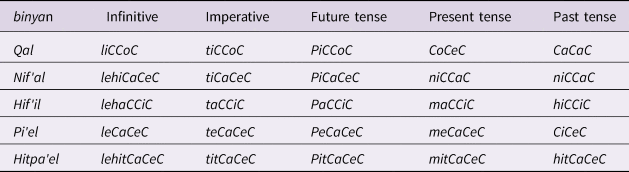
Root-and-pattern structure also serves the inflectional expression of verb temporality, as each binyan conjugation actually consists of a set of unique temporal patterns (Ashkenazi, Ravid, & Gillis, Reference Ashkenazi, Ravid and Gillis2016). Table 1 presents the binyan-specific temporal patterns of the five non-passive binyan conjugations (as verbal passive is a very late acquisition in Hebrew and thus not relevant here; see Ravid & Vered, Reference Ravid and Vered2017). For example, lamad, lomed, and li-lmod serve as the respective morphological forms of past tense, present tense, and infinitive forms of Qal; while nilmad and yi-lamed denote the respective past and future tense forms of Nif'al. This means that temporal shifts within the same binyan paradigm – across the modal cluster (future tense, imperative, and infinitive forms), present, and past tenses – require the use of the same root in stems with different patterns (Table 1). To sum up, non-linear structure serves both derivation and temporal inflection, highlighting the essential connection between grammatical and lexical word-formation in the Hebrew verb system. This connection is at the heart of the current inquiry.
The temporal stems of the five non-passive binyan conjugations (P = future tense / person prefix)

Agreement inflection
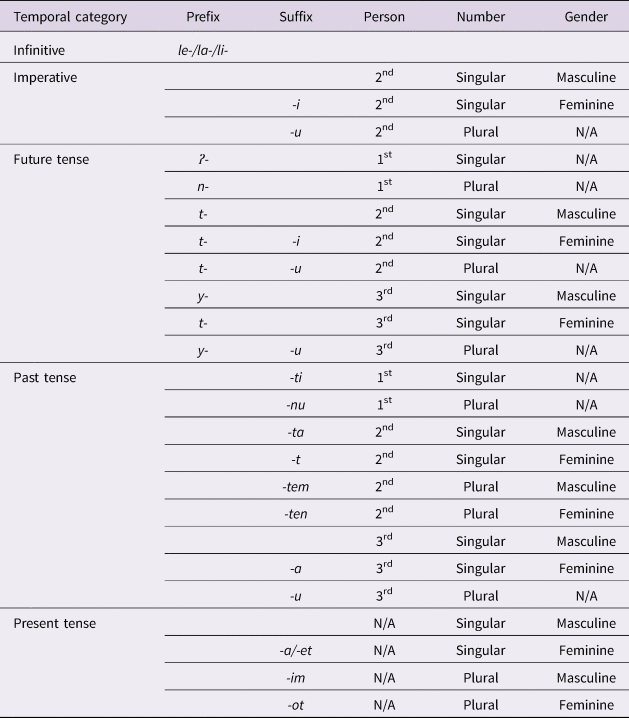
Hebrew verbs agree with their grammatical subjects in person (in past and future tenses), gender (feminine and masculine), and number (singular and plural). Agreement is marked uniformly across all binyan conjugations by linear prefixes and suffixes attached to the temporal stems, as shown in Table 2. Agreement markers are mostly portmanteau morphemes marking the cluster of person, gender, and number. For example, suffix -ta marks past tense, second person masculine singular, while prefixal n- marks future tense, first person plural. Thus, limádta ‘you, sg, masc taught’ in past tense, and nelamed ‘we will teach’ in future tense are two of the verb forms in Pi'el. The combination of temporal stems with their agreement markers yields the set of inflected word-forms of a verb in a binyan conjugation, i.e., its paradigm. Altogether, the Hebrew verb paradigm consists of 25 inflectional markers, (while in literate, mature Hebrew there are three more categories marking plural feminines, which are absent in conversational, let alone child-directed usage), presented in Table 2. The current study examines the relationship between the distribution of these markers and lexical verb development.
Agreement markers on Hebrew verbs

The findings of two recent studies of early verb development in Hebrew are relevant to the current query. Ravid et al. (Reference Ravid, Ashkenazi, Levie, Ben Zadok, Grunwald, Bratslavsky, Gillis and Berman2016) was a first attempt at characterizing verb structure in spoken and written input to Hebrew-speaking children. This analysis revealed that most verbs in parental CDS and in children's story-books were non-root related (‘singletons’ – e.g., tipes ‘climb’), while about 1/4 of them constituted small (two-member) root-related families (e.g., nirdam ‘fall asleep’ / hirdim ‘put to sleep’). From a different perspective, Ashkenazi et al. (Reference Ashkenazi, Ravid and Gillis2016) examined root categories and temporal stems in Hebrew CDS and CS in order to solve a long-standing puzzle in early Hebrew verb acquisition: How can children ‘break’ into the verb system given the pervasive opacity and inconsistency of verb structure in CDS and in their own usage? The study showed how inflectional affix boundaries in prevalent structurally opaque irregular root based infinitives, imperatives, and modal future forms, which serve as a central theme in parent–child interactions (Aikhenvald, Reference Aikhenvald2010), act as distributional cues, facilitating verb acquisition in Hebrew child speech.
Root categories
These same studies also strongly pointed to the importance of structural root categories in the acquisition of the Hebrew verb lexicon (Ravid, Reference Ravid1995; Schwarzwald, Reference Schwarzwald2002). So-called full roots (illustrated by all previous examples) may be regarded as regular: they consist of three or four consonantal radicals, constructing canonical, transparent stems where root and pattern structure can be easily identified (Ravid, Reference Ravid1995). In contrast, defective roots may be considered as irregular. They mostly contain the weakly consonantal radicals y, w, h, and ʔ, or the weak nasal n, yielding non-canonical, opaque stems (Berman, Reference Berman and Shimron2003; Ravid, Reference Ravid1995, Reference Ravid2012).Footnote 3 This is illustrated by the following verb family based on the defective root r-w-c ‘run’: Qal rac ‘run’ (cf. full gadal ‘grow up’), Hif'il heric ‘run,tr’ (cf. higdil ‘enlarge’), Huf'al hurac ‘be run’ (cf. hugdal ‘be enlarged’), Pi'el rocec ‘run through’ (cf. gidel ‘raise’), and Hitpa'el hitrocec ‘run around’ (cf. hitgadel ‘self-aggrandize’) (Berman, Reference Berman1993a; Schwarzwald, Reference Schwarzwald1998). The family of root n-p-l ‘fall’ illustrates irregularity in a different way: all root radicals show up in nafal ‘fell’ in the past tense of Qal, while the initial radical n- is absent in Qal future tense yipol. Both Ashkenazi et al. (Reference Ashkenazi, Ravid and Gillis2016) and Ravid et al. (Reference Ravid, Ashkenazi, Levie, Ben Zadok, Grunwald, Bratslavsky, Gillis and Berman2016) found that irregular, defective root tokens prevailed in younger speakers (76%) and in the speech of their caretakers (72%). In terms of root types, however, the picture was reversed – children's output had 36% defective root types, while their parents had 27% defective root types. This means that a small number of defective roots were highly repetitive in the input and output, but their small number was soon exhausted in learning, so that what remained to be learned was mostly regular, full root types (Ashkenazi, Reference Ashkenazi2015). Thus, full roots carry most of the burden in the development of the Hebrew verb lexicon.
The morphological categories described above formed the basis for the current study on CDS–CS relations in early Hebrew verb acquisition.
Aims and hypotheses
The portrayal of Hebrew verb structure and meaning in the preceding sections underscored the close relationship between Hebrew verb lemmas and their morphological components in terms of roots, binyan conjugations, derivational verb families, and inflectional tense/mood and agreement paradigms. Against this background, the current study aimed to explore patterns of lexical, derivational, and inflectional growth in the Hebrew verbs produced by toddlers aged 1;8–2;2 and their parents. Specifically, our goal was to contextualize CDS–CS relations in the distributional characteristics of Hebrew verbs, from a developmental perspective.
We hypothesized two overarching relationships in the context of the current inquiry. First, we expected to find correlated patterns within and between CDS and CS corpora. Second, we expected to find these patterns across verbs and verb components – structural root categories, binyan conjugations, derivational families, and inflectional paradigms.
Method
Participants
The analyses reported below are based on a densely recorded longitudinal corpus of naturalistic interactions in two monolingual Hebrew-speaking parent–child dyads – a boy dyad and a girl dyad (Ashkenazi, Reference Ashkenazi2015; Ashkenazi et al., Reference Ashkenazi, Ravid and Gillis2016). The boy dyad was recorded between the ages of 1;8.27 (1 year, 8 months, and 27 days, or 635 days) and 2;2.3 (2 years, 2 months, and 3 days, or 795 days), yielding 49 recording sessions. The girl dyad was recorded between the ages of 1; 9.25 (664 days) and 2;2.19 (810 days), yielding 47 recording sessions. The different child genders were chosen so as to explore gender (in addition to person and number) agreement in Hebrew verb inflection. Both families recorded were from mid-high socioeconomic status (SES) background, living in central Israel. The two sets of parents, who did not know each other, were monolingual native speakers of Hebrew, and spoke only Hebrew at home. They volunteered for the study and did not receive any monetary remuneration for their participation.
Both children were first-born and had no siblings at the time of recording. Both had normal cognitive, communicative, and linguistic development according to parental report (including the Hebrew MacArthur Bates Communicative-Developmental Inventories (CDI) checklist, see Maital, Dromi, Sagi, and Borenstein, Reference Maital, Dromi, Sagi and Bornstein2000, administered before the beginning of the recording sessions), periodic assessment at the local neonate and children's health clinic, and assessment by the first author (a certified senior speech language pathologist). Neither of them had a history of ear infections or any other major health issues. The boy attended nursery school for the entire recording period and the girl attended nursery school for the last two months of the recordings.
Data collection
Dyadic interactions were audio-recorded at home during bath time, playtime, and mealtime, using an MP3 recorder supplied to the family by the first author. Each dyad was recorded approximately three times a week, for 45–60 minutes each time, for 6 months between ages 1;8 and 2;2 as detailed above. Recordings of both dyads started when each child started producing two-word utterances and some verbs, based on parental reports (Maital et al., Reference Maital, Dromi, Sagi and Bornstein2000). Transcriptions of the recordings (see below) ceased when each child produced subject–verb agreement in number and gender in two subsequent recordings, including two different person agreements in the past tense, on at least two different verbs. This morpho-syntactic criterion indicated that the child was gaining command of the basic components of verb structure and semantics by productively using temporal stems, which involve root-pattern alternations, as well as agreement markers (Lustigman, Reference Lustigman2013; Ravid et al., Reference Ravid, Ashkenazi, Levie, Ben Zadok, Grunwald, Bratslavsky, Gillis and Berman2016).
Transcription
All dyadic interactions were transcribed in broad phonemic transcription following the CHILDES conventions (MacWhinney, Reference MacWhinney2000), adapted to take into account Hebrew-specific phonemic, phonological, prosodic, and orthographic features (Albert, MacWhinney, Nir, & Wintner, Reference Albert, MacWhinney, Nir and Wintner2013). The recordings were thoroughly checked by the first author and corrected when necessary, with an estimated 5% error rate. Next Hebrew MOR was run over the transcripts. The verb forms that were not analyzed by the program were identified and manually coded.
Coding
Verb-form coding
Verbs in CDS and CS were represented by a code line including information on all morphological components in the following order: root, binyan, temporal category (binyan-specific stems of past, present, and future tense, or mood – imperative and infinitive), person, gender, and number inflection markers. Each such unique combination was considered a separate verb-form type. For current purposes, the following verb features were extracted from the code line and calculated in CDS and CS for each day of recording in types and tokens: root, binyan, and verb lemma, defined as the unique combination of a root and a binyan.
Structural root categories
Roots were coded as either full or defective, following the criteria detailed in Ashkenazi et al. (Reference Ashkenazi, Ravid and Gillis2016).
Derivational verb families
Verbs with shared roots were grouped into derivational families of same-root verbs in different binyan conjugations, ranging from singletons (one root = one verb in one binyan, e.g., tipes ‘climb’) to families potentially consisting of up to seven members, given the seven binyan conjugations.
Semantic coherence coding
Roots relate morphological families with different degrees of semantic coherence or transparency. For example, the relationship between nirdam ‘fall asleep’ (Nif'al) and hirdim ‘cause to sleep’ (Hif'il) (both based on root r-d-m) is transparent both structurally and semantically, whereas this relationship in shilem ‘pay’ (Pi'el) and hishlim ‘complete, make up’ (Hif'il) (based on root š-l-m) is less semantically coherent. To determine the semantic affinity of verbs sharing the same root skeleton in a derivational family, we calculated the degree of semantic coherence in pairs of root-sharing verbs. To this end, all root-sharing verbs were identified in the compiled database of the two dyads and arranged in pairs. In cases of families larger than two members, all possible pairings were obtained. For example, regarding the four verbs based on root ħ-š-b ‘think’ in the database, xashav ‘think’ was paired with xishev ‘calculate’, with nexshav ‘be considered’, and with hitxashev ‘be considerate’, respectively; xishev ‘calculate’ was paired with all the other three ħ-š-b-based verbs.
All root-sharing verb pairs were presented in ten sets of randomized lists to 64 native-speaking experts in Hebrew developmental psycholinguistics. Each list contained not more than two pairs of verbs sharing the same root, placed far apart from each other. Verb pairs in each list were ranked by eight to ten judges on their degree of semantic coherence on a scale of 1–5, with 1 = no meaningful relationship and 5 = a strong semantic relationship between the two verbs. For example, axal ‘eat’ and he'exil ‘feed’ share a strong semantic relationship (5), whereas he'emin ‘believe’ and hit'amen ‘practice’ cannot be said to be semantically coherent (1).
Derived values
Cumulative vocabulary count
The cumulative verb lemma count represented the child's or the parent's cumulative vocabulary count for each day of recording. For example, if the CS verbs yarad ‘go down’ and axal ‘eat’ were present on day one, and the verbs patax ‘open’ and yashan ‘sleep’ were added on day two, then the cumulative vocabulary count for day one would be two, and for day two, four.
MSP
The MSP (Mean Size of Paradigm) metric (Xanthos & Gillis, Reference Xanthos and Gillis2010) assesses the inflectional diversity of morphologically analyzed language transcripts and makes extensive use of random sampling procedures for normalization purposes and controlling for sample size. It was used in the current study in order to assess the development of inflectional complexity and richness of verbs in CS and CDS, and their relationship. The basic version of MSP quantifies the diversity of word-forms related to a given lemma. The set of all inflected forms in a system was termed the inflected lexicon, represented by the symbol F. The set of lemmas in the context of the Hebrew verb refers to root + binyan distinct combinations, denoted by L. Thus /F/ and /L/ represent the number of word-forms and lemmas, respectively, and the simplest form of MSP is defined as the ratio of the size of the inflected verb lexicon to the size of the lemma lexicon:
 $${\rm MSP}={\rm } \vert {\rm F} \vert {\rm /} \vert {\rm L} \vert$$
This value corresponds to the mean number of inflected forms per lemma, and considers only type frequency. Therefore, consider a sample consisting of 5 Hebrew inflected verb tokens: oxel ‘eats’, oxlim ‘they eat’, axal ‘ate’, axalti ‘I ate’, and he'exil ‘fed’. This sample represents two lemmas and four word-forms, yielding an MSP of 4/2 = 2 forms per lemma. The notion of entropy, defined as a measure of the diversity of a paradigm that accounts for differences in token frequencies between word-forms in this paradigm, was used for this analysis. We used weighted entropy-based MSP (WE), a measure of diversity based on the entropy associated with the paradigm of each lemma l, in order to take into account the differences in the frequency of use of different verb-forms in a particular paradigm. A low-entropy paradigm is strongly skewed with one frequent form and X not frequent forms, and a high-entropy paradigm contains several forms of similar frequencies (for a more detailed description of MSP calculations, see Xanthos & Gillis, Reference Xanthos and Gillis2010).
Results
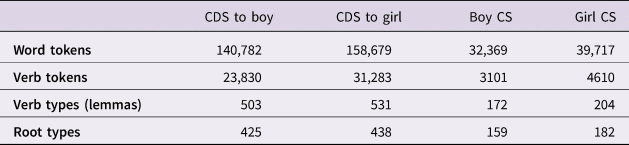
We first present quantitative information regarding word tokens, verb types and tokens, and root types (Table 3). The data in this table served the analyses delineated below – structural root categories, MSP, derivational verb families, and semantic coherence.
The database

Verbs and their roots
The boy produced 172 verb lemmas and 159 different roots, and the boy's parents 503 verb lemmas and 426 roots. The girl produced 172 verb lemmas and 182 roots, and the girl's parents 531 verb lemmas and 438 roots. Within each dyad, all CS verb lemmas and roots also occurred in the respective CDS.
Structural root categories
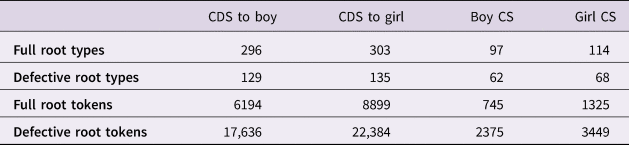
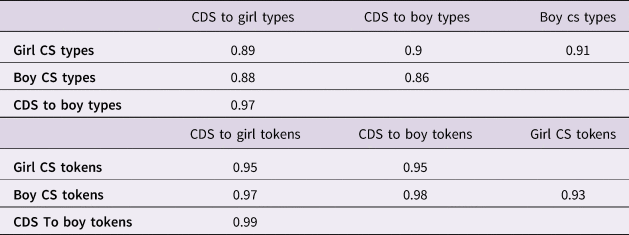
Given the central role of roots as lexical entities in the Hebrew verb system, and the importance of the changing full/defective proportions across development, Table 4 presents the structural root categories in types and tokens across both CDS and CS corpora. Type and token frequencies of roots were calculated for each recording session of each of the two dyads. Root type frequency was calculated as the sum of the number of single occurrences of roots in each structural category per sesssion. For example, three occurrences of full roots in CDS (e.g., s-g-r ‘close’, p-t-ħ ‘open’, and k-t-b ‘write’) in one session would yield a type frequency of three for the category of full roots in that session. Token frequency was calculated as the sum of all occurrences of roots in each structural category per sesssion. For example, if the full roots s-g-r, p-t-ħ, and k-t-b had five, seven, and three occurrences respectively in a certain sesssion, then the token frequency value of the category of full roots for that session would be 15 (5 + 7 + 3). Table 4 shows that, in both dyads, for both CDS and CS, type frequency of full roots was higher than that of defective roots, and token frequency of defective roots was higher than that of full roots. Moreover, Spearman rho correlation analyses on the percentages of the 13 structural root categories (four full root categories and nine defective root categories) (Ashkenazi et al., Reference Ashkenazi, Ravid and Gillis2016) showed highly significant correlations in their distribution (both types and tokens) within and between the dyads, as shown in Table 5: not only were each child's root categories correlated with those of his/her own parents, but also with the other parent, and with the other child's categories.
Types and tokens of structural root categories across CDS and CS corpora

Spearman rho values for root categories’ type and token frequencies (p < .001)

MSP analyses
MSP, child's age, root, and cumulative vocabulary count analyses
A set of analyses was carried out in order to determine the developmental aspect of the relationship between lexical, derivational, and inflectional verb features, while further looking into CDS–CS relations. To this end, the following values were calculated for each day of recording, for CDS and CS: MSP, proportions of cumulative number of root types of full and defective roots, and cumulative vocabulary count (cumulative verb lemma count). These variables were analyzed for CS vis-à-vis CDS over child's age.
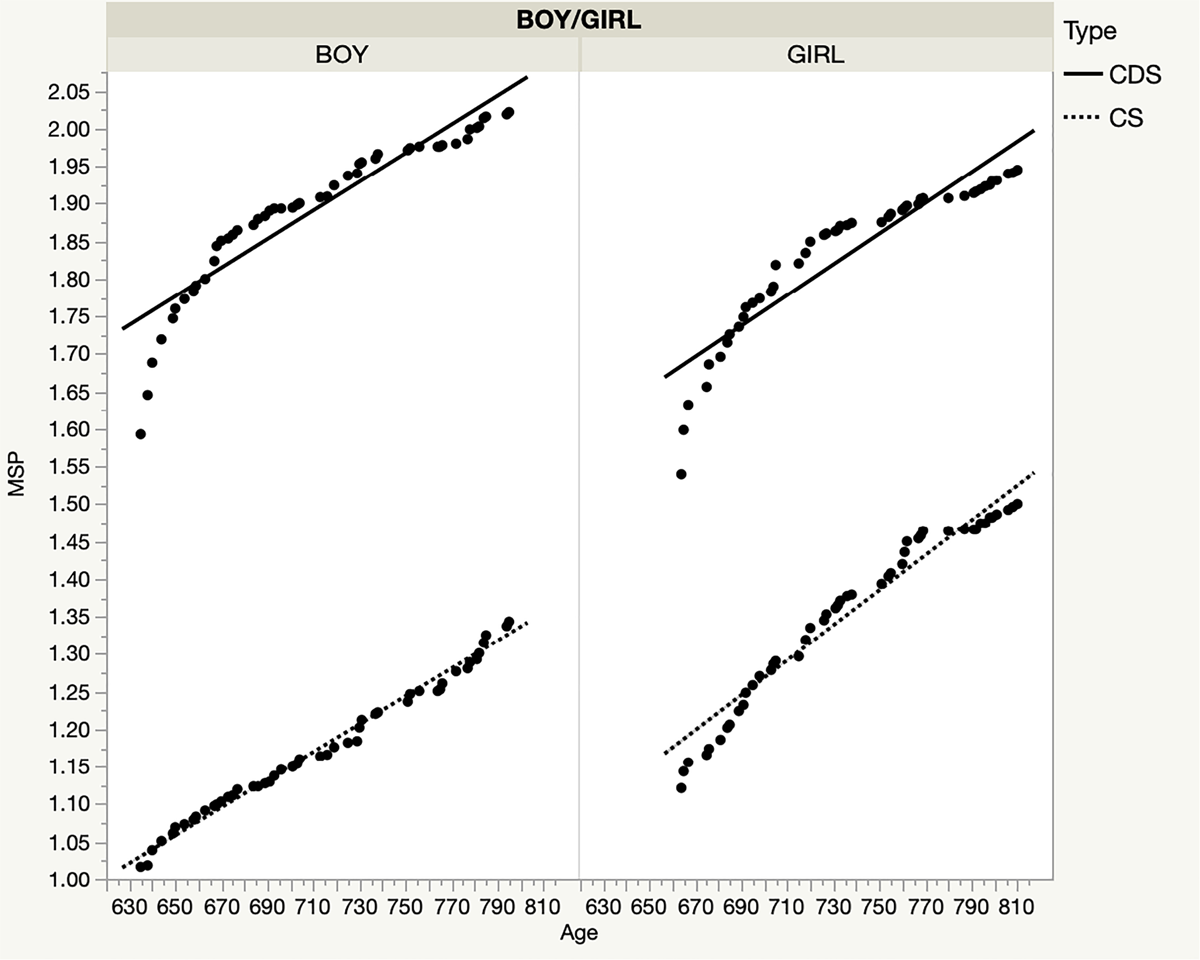
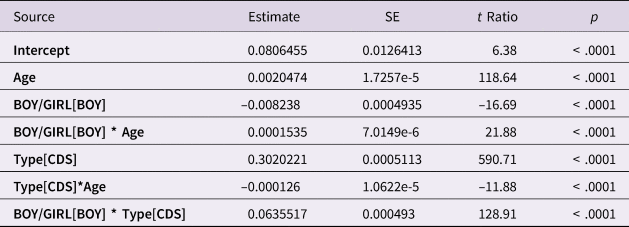
CDS MSP ranged between approximately 1.4 and 2.0 in the boy dyad, and 1.6 and 1.9 in the girl dyad. CS MSP ranged between 1 and 1.4 in the boy dyad, and 1.1 and 1.5 in the girl dyad. Figure 1 depicts CDS and CS MSP over child's age in the boy and girl dyads, showing that CDS MSP and CS MSP rose with child's age in both children. A multilevel model was fitted with MSP as dependent variable and age, Child (Boy/Girl), type (CDS/CS) and the interaction between child and age as well as type and age, and the interaction between Child and types as fixed effects was run. The random effects were verb lemmas (estimated with random intercepts and slopes). The fixed parameter estimates are shown in Table 6. Not surprisingly, parents' MSP appears to be significantly higher than the children's, but the parents' MSP increases significantly slower than children's MSP. The boy's MSP is significantly lower than the girl's, but it has a steeper slope. Finally, the significant interaction between BOY/GIRL and Type was further analyzed in post-hoc Tukey HSD analyses, revealing that the boy's CDS MSP is higher than the girl's, while the opposite holds for CS.
CDS and CS MSP over child's age in the two dyads.

Multilevel analysis of MSP vs. age with fixed effects Child, type (CDS/CS)

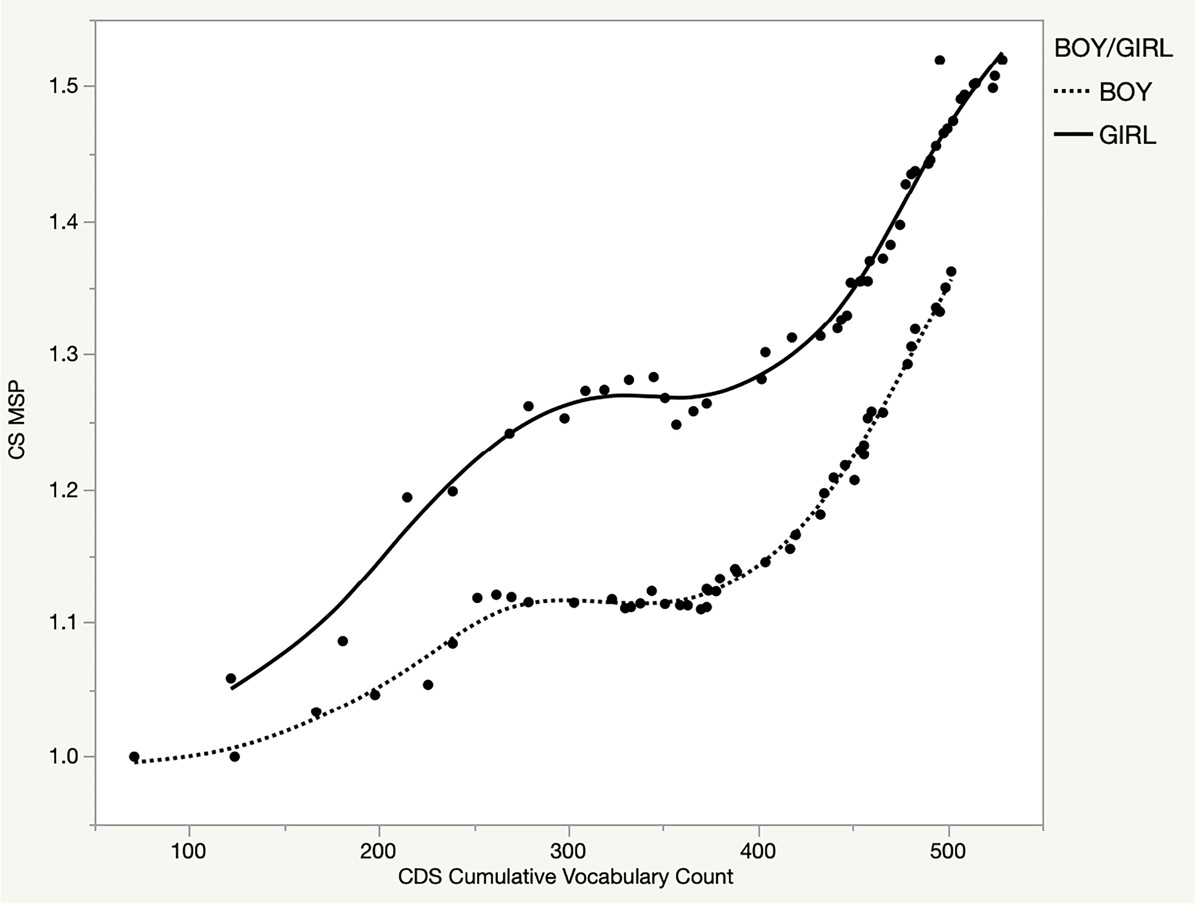
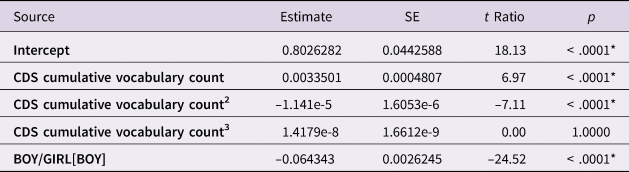
Figure 2 shows CS MSP vs. CDS cumulative vocabulary count in both dyads. A multilevel model with CS MSP as the dependent variable and CDS cumulative vocabulary count and child as predicting variables showed a significant difference between the boy and the girl, where the girl's MSP is higher than the boy's, and no significant interaction between child and cumulative vocabulary count, indicating similar patterns in the two dyads. Furthermore, CDS cumulative vocabulary count is a good predictor of CS MSP in both dyads, and there is a quadratic effect of cumulative vocabulary count on CS MSP, supporting the leveling out of CS MSP shown in Figure 2. The fixed parameter estimates are shown in Table 7.
CS MSP over CDS lexical age in two dyads.

Multilevel analysis of CS MSP vs. CDS cumulative vocabulary count

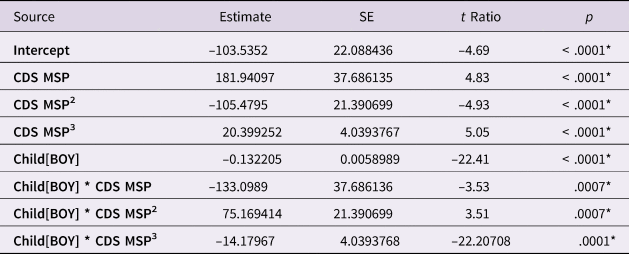
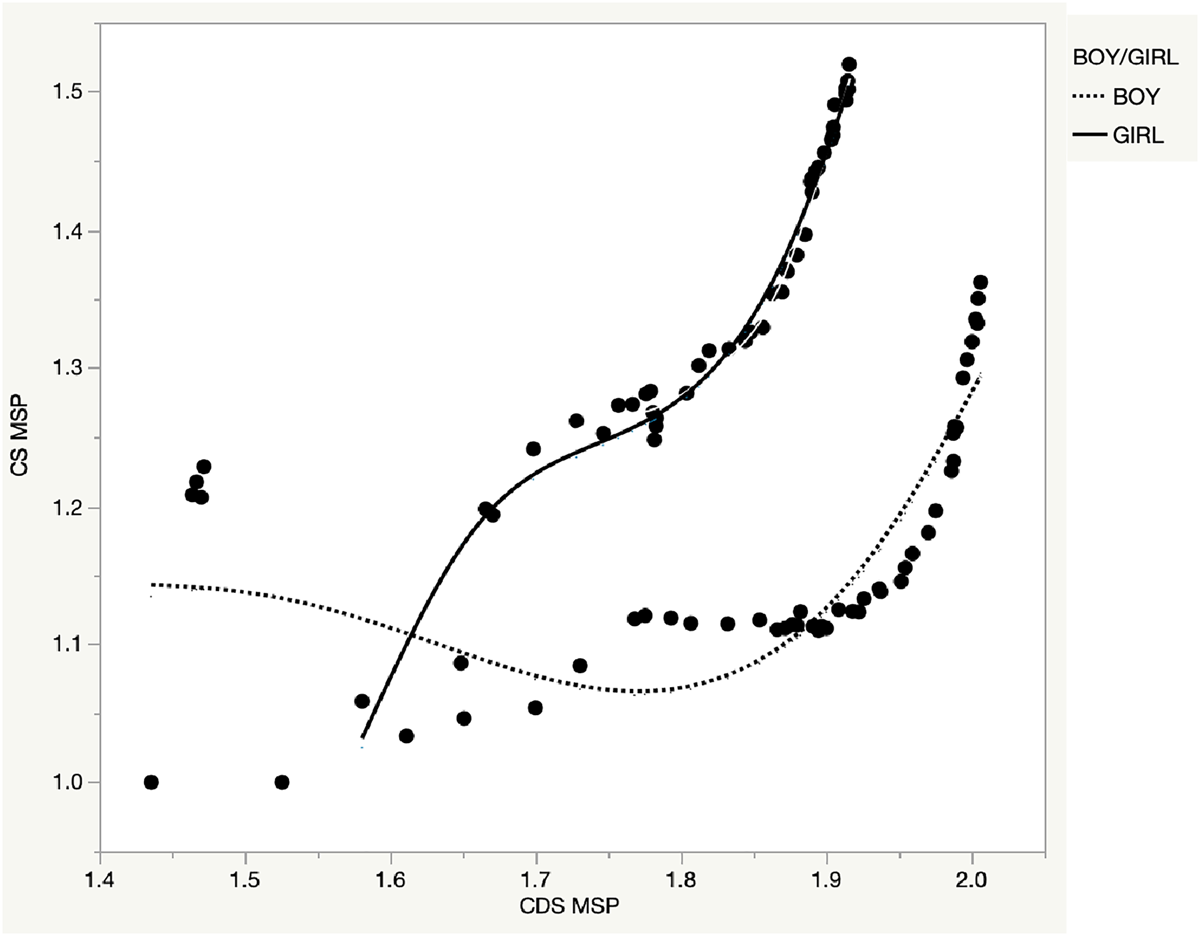
The relationship between CDS MSP and CS MSP was further investigated in a multilevel model with CS MSP as dependent variable, and Child (BOY/GIRL), CDS MSP, and their interaction as fixed effects. In order to chart out non-linear effects, CDS MSP quadratic and cubed were also entered. The fixed parameter estimates are shown in Table 8. The analysis shows that CDS MSP is a significant predictor of CS MSP; moreover, the relationship differs between the two children. There is a squared and cubic effect, meaning that the relationship is not simply linear and evolves differently for the two children. These effects are clearly depicted in Figure 3.
Multilevel analysis of CS MSP vs. CDS MSP

CDS MSP vs. CS MSP in the two dyads.

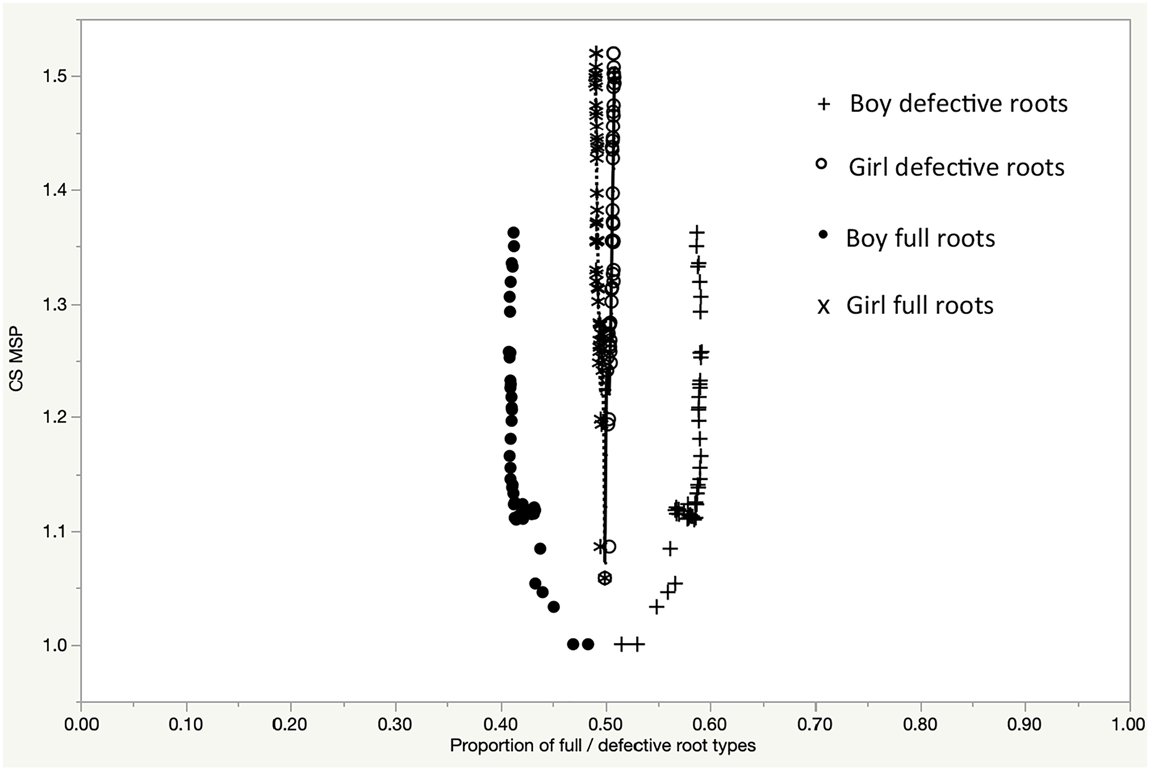
Figure 4 depicts the relations between CS MSP and CDS root type frequency (in proportions) in both dyads, showing the following pattern: the higher the cumulative defective root type frequency in CDS, the lower was the CS MSP; while the higher the type frequency of full roots in CDS, the higher was CS MSP.
CS MSP vs. CDS defective and full root type frequency in the two dyads.

Derivational family analyses
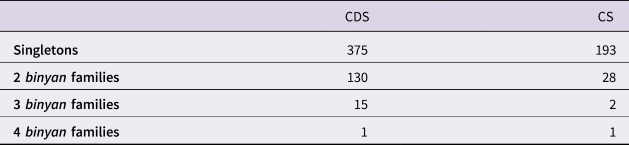
To characterize verb development in CDS and CS, we asked whether this development was morphological or lexical in nature. In Hebrew, this question translated into the proportions of verbs related by morphological families (i.e., sharing the same root in different binyan conjugations) versus singleton verbs with no morphological families. To this end, root types were classified according to their occurrence in singleton verbs versus morphological families across the corpora in CDS and CS. Given the high affinity between the two dyads (Table 5) and the fact that this analysis was not developmental in nature, it was carried out on the compiled boy and girl dyad corpora. Table 9 shows that the overwhelming majority of roots in the study corpus (around 70% in CDS and 90% in CS) occurred in one binyan only, that is, most roots occurred in singleton verbs. For example, root m-ħ-q appeared in CDS only in the Qal verb maxak ‘erase’, and root c-l-m appeared in CS only in the Pi'el verb cilem ‘take a photo’. Only a minority of root types composed root-related morphological families, mainly consisting of two binyan conjugations per root in both CDS and CS. For example, root š-p-k appeared in CDS in the Qal verb shafax ‘spill,tr’ as well as in the telic Nif'al verb nishpax ‘get spilled’.
Verb families in the compiled (two dyads) corpus

Semantic coherence in derivational verb families
A final analysis concerned the semantic facet of derivational verb families. To this end, we calculated the degree of semantic coherence in each pair of root-related verbs. For example, for the family af / he'if / hit'ofef ‘fly / make fly / fly away’, semantic relations within three pairs were investigated – af / he'if, af / hit'ofef, he'if / hit'ofef. This analysis too was conducted on the compiled boy and girl corpora.
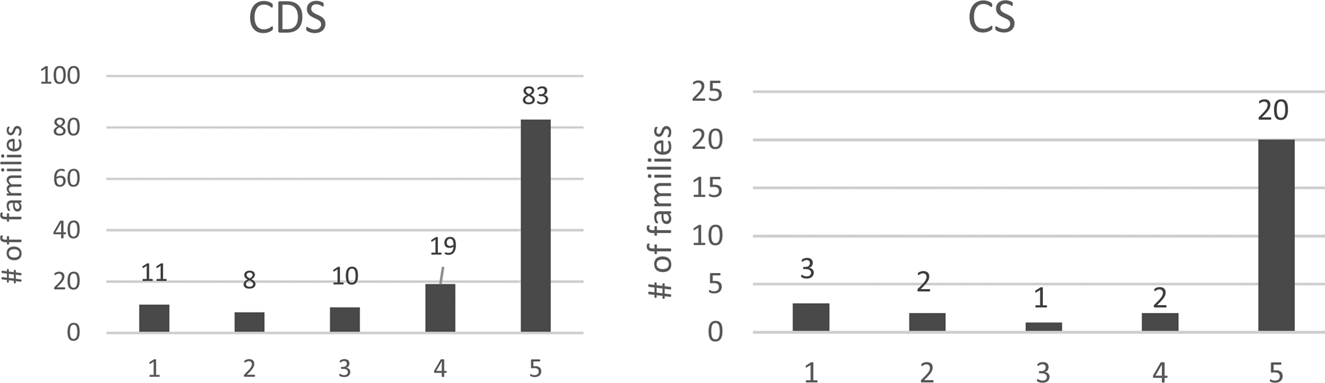
An average closeness rate for each pair was calculated, ranging from 1 to 5, and the pairs were grouped into five clusters by a Model Based Latent Class Analysis (LCA) procedure. An LCA enabled the identification of unobservable subgroups that are similar, based on observed characteristics – in the current case, mean semantic coherence ranks for each of the verb pairs. Figure 5 presents the distribution of five levels of sematic coherence in our database, showing that most families (78% in both CDS and CS) were composed of semantically coherent verbs (ranks 4–5), such as gilgel ‘roll.tr’– hitgalgel ‘roll.int’ and yarad ‘get down’ – horid ‘put down’. Most such families were based on high-frequency roots, expressing canonical valence-changing perspectives on prominent scenarios in children by implementing the most typical binyan transitivity modulations of transitive/middle-voice, and basic/causative.
The distribution of five levels of sematic coherence in the compiled corpus of the two dyads.

Discussion
The current study investigated the morphology–lexicon interface in Hebrew verb acquisition, highlighting CDS–CS inflectional and derivational verb relations. Three assumptions guided this investigation: the significance of parental input in the acquisition and development of child language; the strong relationship between grammatical and lexical development; and the critical role of morphology in the early Hebrew verb lexicon.
Parental input and child speech in Hebrew verb development
As predicted, we found correlated patterns within and between CDS and CS corpora across verbs and verb morphological components. Altogether, results pointed to the centrality of parental input as the child's main source of information about the Hebrew verb system. Across the board, all measures used in the current study were found to be similar and/or highly correlated in parental and child speech.
Recall that, in Hebrew, not only verbs but also verb roots constitute lexical units (Berman, Reference Berman and Berman2016; Frost, Reference Frost, Treiman and Pollatsek2015; Schiff & Ravid, Reference Schiff and Ravid2013). In the current study, all verb roots and verb lemmas produced by the children also occurred in their parental input. Moreover, in structural terms, full and defective roots displayed extremely similar distributions in parental input and child speech in both types and tokens. Specifically, the array of structural root categories (for example, quadrilateral roots, glide-medial defectives; see Ravid et al., Reference Ravid, Ashkenazi, Levie, Ben Zadok, Grunwald, Bratslavsky, Gillis and Berman2016) was highly correlated within and across dyads. That is, regular and irregular root categories are patterned in exactly the same way over the early verb lexicon shared by parents and children and in its usage.
From a different perspective, the relationship between the development of inflectional complexity and richness of verbs was measured in CS and CDS by the MSP (Mean Size of Paradigm) metric. This analysis provided further evidence regarding the inherent relationship between children's developing language abilities and their parental input. The inflectional complexity of verbs increased in tandem in both of the children as well as in their respective parents. In addition, as parents produced a more variegated verb lexicon, their children's inflectional complexity increased, and parents’ MSP level increased with their children's age, fine-tuned to approximate children's linguistic abilities (Ackerman & Malouf, Reference Ackerman and Malouf2013). Finally, the structure and semantics in morphological families clustering around the same root showed very similar trends in CDS and CS – namely, mostly singletons, with a small number of semantically coherent two-verb families.
These converging findings from several perspectives, shown for the first time for Hebrew, reinforce the powerful relationship between child language acquisition and parental input. Our results support previous findings about the way CDS affects the course of language learning through adults’ corrections, reformulations, and expansions, through children's uptake and imitations and in conversations characterized by mutual attention and responsiveness (Clark, Reference Clark, Hickmann, Veneziano and Jisa2017; Clark & de Marneff, Reference Clark and de Marneffe2012; Veneziano & Parisse, Reference Veneziano and Parisse2010).
The similarities and correlations found in the current study between verbs and their morphological components in children's speech and their parental productions may be attributed to either one, or both, sources, as follows. One explanation is based on the view of language as embedded in shared cognition and of language acquisition as joint action among interlocutors (Beckner et al., Reference Beckner, Blythe, Bybee, Christiansen, Croft, Ellis and Schoenemann2009; Hoff, Reference Hoff2010; Luce & Callanan, Reference Luce and Callanan2010). Specifically, it highlights the centrality of dyadic interaction in language acquisition in general (Tomasello, Reference Tomasello, Siegler and Kuhn2006, Reference Tomasello and Bavin2009) and the reciprocal nature of these interactions (Orvig et al., Reference Orvig, Marcos, Morgenstern, Hassan, Leber-Marin and Parès2010). In many cases, an examination of the occurrence patterns of verbs in the database indicated that a verb was either initiated by the parents and picked up by the child, or initiated by the child and elaborated by the parent. See below four examples, two from the boy dyad (age 2;0.10), and two from the girl dyad (2;0.08): (1) a parental-initiated sequence, with the child resonating the mother; and (2) a child-initiated sequence, with the mother either repeating or repeating and expanding the child's statement using interrogative intonation for clarification.
(1)
(a) mother: tir'e, bo natxil im ha-rosh
See.imp come.imp will-start.pl,1st with the-head
‘Look, let's start with the head’
boy: ani matxil im ha-rosh
I start.pres with the-head
‘I am starting with the head’
(b) mother: od pa'am ze hitkalkel
more once it broke-down
‘It has broken down again’
girl: ze mitkalkel
It break-down.pres
‘It is breaking down’
(2)
(a) boy: axshav ima torid
Now mommy will-bring-down.fm,3rd
‘Now mommy will bring (it) down’
mother: axshav ima torid?
Now mommy will-bring-down.fm,3rd?
‘Will mommy now bring (it) down?’
(b) girl: lo laga'at!
not to-touch!
‘do not touch’
mother: at omeret le-shaked lo laga'at?
You.fm tell.pres,fm,sg to-Shaked not to-touch?
‘Are you telling Shaked not to touch?’
Another possible explanation for the high affinity in verb use between parents and their children is that these distributions of roots, verb lemmas, and, to a certain extent, morphological verb families, all reflect the composition of the core Hebrew lexicon. The cross-correlations found between the CDS and CS of both dyads regarding the distribution of root categories lends some support to this explanation, suggesting that the root category distribution of verbs used by both parents and their children is the distribution that characterizes Hebrew verbs. Furthermore, it may well be that verbs and verb components in this corpus are the most frequent in the spoken language used by Israeli children and their parents, including most of the basic semantic/pragmatic verb categories known from the literature on other languages (Stephany, Reference Stephany1983). The ten most frequent verbs found in parental input were as follows: come, want, do, see, put, say, bring, walk, eat, and sit. The ten most frequent verbs in child output were come, want, take, sleep, bring, do, put, fall, take, and walk. In fact, a similar patterning of verbs, roots, and derivational families, as well as binyan conjugations, was found in a study of multiple Hebrew corpora, including children's peer talk, children's story-books, and students’ written texts across elementary and high school (Ravid et al., Reference Ravid, Ashkenazi, Levie, Ben Zadok, Grunwald, Bratslavsky, Gillis and Berman2016).
Relating grammatical and lexical development
An important insight coming from usage-based accounts is the inherent interface of grammar and lexicon in language use, language change, and language acquisition (Bybee, Reference Bybee1998; Beckner et al., Reference Beckner, Blythe, Bybee, Christiansen, Croft, Ellis and Schoenemann2009; Ellis, Reference Ellis and Ellis2008; Goldberg, Reference Goldberg2006). This makes sense, as content words, which fill designated syntactic positions in clauses and phrases, constitute the heads of syntactic phrases, and provide the stems for morphological inflection. The growing ability to form new words and to organize words into morphological families is thus sustained and fed by the increasing ability to express morpho-syntactic relations in inflection and the concomitant emergence and consolidation of phrase and clause structure (Arnon & Clark, Reference Arnon and Clark2011; Borovsky, Ellis, Evans, & Elman, Reference Borovsky, Ellis, Evans and Elman2016). A different facet of this developing ability was presented in Ashkenazi et al. (Reference Ashkenazi, Ravid and Gillis2016), where the emergence and consolidation of temporal categories accentuated the related growth of the root and binyan system as the fundamental organizing principle of Hebrew verbs.
In the current context, this means that the increasing richness of the inflectional paradigm goes hand in hand with the growth of the child's lexicon (Bittner, Dressler, & Kilani-Schoch, Reference Bittner, Dressler and Kilani-Schoch2003). Our findings lend support to this view, relating Hebrew lexical and derivational development to inflectional enrichment in input–output relations. Recall that, in Hebrew, both verb lemmas and verb roots constitute lexical units (Bolozky, Reference Bolozky1999; Velan, Frost, Deutsch, & Plaut, Reference Velan, Frost, Deutsch and Plaut2005; Ravid, Reference Ravid and Shimron2003), so that children encounter and produce more verbs and more verb roots in the course of lexical acquisition. From a different perspective, each Hebrew verb is composed of about 25 inflectional forms expressing tense and mood, and marked for person, number, and gender agreement. In actual usage, some of these inflections are more frequent or used with specific verb lemmas and in specific communicative contexts (Aikhenvald, Reference Aikhenvald2010; Ashkenazi, Reference Ashkenazi2015; Clark, Reference Clark2004; Sereno & Jongman, Reference Sereno and Jongman1997; Stephany, Reference Stephany1983). This means that, as children encounter and produce more verbs, they also experience and use more verb inflections. In our study, child MSP, an inflectional measure, rose in tandem with parental cumulative vocabulary count – meaning that, as parents produced a more variegated verb lexicon, their children's inflectional abilities improved. Moreover, as parents used increasingly more verbs with full (regular) roots, children's MSP was higher; and as they used more verbs with defective (irregular) roots, children's MSP was lower. This finding relates to the fact that full roots have a larger type frequency in the Hebrew lexicon than defective roots (Bolozky, Reference Bolozky1999), carrying the main lexical increase over child's age in both CDS and CS (Ravid et al., Reference Ravid, Ashkenazi, Levie, Ben Zadok, Grunwald, Bratslavsky, Gillis and Berman2016), thus making a major contribution to children's derivational and lexical growth (Ashkenazi, Reference Ashkenazi2015). What we found here was that full roots not only carry the lexical burden of the verb lexicon, but are also the principal supporters of inflectional development in Hebrew verbs. This has been previously demonstrated in other languages (Bittner, Dressler, & Kilani-Schoch, Reference Bittner, Dressler and Kilani-Schoch2003; Bassano et al., Reference Bassano, Laaha, Maillochon and Dressler2004), but to date, not for Hebrew.
Conclusion: morphology in the early Hebrew verb lexicon
A central theme guiding the current study is the inherent morphological complexity of the early verbs Hebrew-speaking children experience and produce in their language. What we have found in our analyses is that Hebrew-speaking children, like their peers in other languages, experience and produce a smaller and simpler lexical array of verbs than their parents, and in comparison to the general inventory in the language. However, as we show below, this simplified lexicon is by definition morphologically complex.
Beyond the restricted nature of inflectional forms, children in this study experienced and produced (represented by MSP values), their entire verb lexicon was simplified to meet their cognitive and linguistic levels. The children's verb lexicon, a subset of the parents’ lexicon, consisted of 259 verb lemmas and 224 roots (a ratio of 1.16). The verb lexicon the two parents used consisted of 684 verb lemmas and 521 roots (a ratio of 1.31). This parental lexicon was by itself a subset of a 1,500-verb and 1,000-root lexicon (a ratio of 1.5) extracted from a larger database that comprised several age groups up to adulthood in spoken and written language (Ravid et al., Reference Ravid, Ashkenazi, Levie, Ben Zadok, Grunwald, Bratslavsky, Gillis and Berman2016). Thus, the children produced half of the parents’ verbs and roots, while the parents too produced about a half of the verb and root lexicon of the larger database, which of course does not comprise the entire Hebrew verb lexicon.
Another facet of this simplified exposure is the extremely high proportion of singleton verbs in the children's and their parents’ lexicons – 90% and 70%, respectively, whereas the larger database described above contained about 47% singletons. That is, most early verbs Hebrew-speaking children heard and produced did not share a root with other verbs in the analyzed CDS–CS corpus. Moreover, virtually all of the remaining verbs were organized in semantically coherent two-member families, whereas, in the larger database about 40% of the verbs had derivational families, of which 75% were two-member families and the rest had larger, less semantically coherent families.
The simplified nature of the Hebrew verbs delivered to young children is further exemplified by previous analyses (Ashkenazi, Reference Ashkenazi2015; Ravid et al., Reference Ravid, Ashkenazi, Levie, Ben Zadok, Grunwald, Bratslavsky, Gillis and Berman2016), showing that most verbs children were exposed to and produced in this corpus were in a single binyan verb pattern, i.e., Qal (80% tokens, 70% types in child speech, and 70% tokens, 60% types in parental input). In the general database, Qal constituted 70% of the tokens, but less than 30% of the types. Thus young children and their parents produce verbs highly restricted and repetitive in their binyan pattern distribution, while the mature lexicon is more variegated.
All facets of simplification concur with the general literature showing how young children start acquiring a highly complex morphology by starting small – mostly singleton verbs in Qal (Ackerman & Malouf, Reference Ackerman and Malouf2013; Elman, Reference Elman, Tomasello and Bates2001, Reference Elman2003). From a general (rather than Semitic) perspective, the large frequency of singleton verbs found in Hebrew CDS and CS can be said to support the idea of item-based language learning (Abbott-Smith & Tomasello, Reference Abbott-Smith and Tomasello2006). Such verbs can be thought of as associated form-and-function units that are learned, exemplar by exemplar, until abstract schemas such as roots, binyan patterns, and morphological families emerge (Ellis, O'Donnell, & Römer, Reference Ellis, O'Donnell, Römer, MacWhinney and O'Grady2015; Goldberg, Reference Goldberg2006). Note, however, that this restricted repertoire is nonetheless inherently Semitic in being morphologically compositional. All verbs, including the large proportions of singletons and in the Qal conjugation, were internally complex, composed of root and pattern structure both across the temporal paradigm and across the small number of root-sharing derivational families. That is, they all shared child-accessible, repetitive structural characteristics pointing at systematically meaningful referential and grammatical information. Thus the Qal-dominant, often singleton verb structures can be learned without the burden of semantic diversity, as roots in the early lexicon vary mostly across the temporal paradigm within the same verb lemma (Ashkenazi et al., Reference Ashkenazi, Ravid and Gillis2016). The few non-Qal verbs were often highly frequent in usage, providing children with the opportunity to observe and inter-relate more, and different, within-binyan temporal patterning other than Qal. Thus, Semitic structure and semantics can already be gauged from singleton verbs in early acquisition.
To conclude, we have explored early verb learning in Hebrew, supporting findings in the general literature regarding the close relationship between parental input and child speech, on the one hand, and the affinity between lexical and grammatical growth, on the other. Above all, lexical learning in Hebrew is shown to be morphologically oriented, with both inflectional and derivational learning supporting and being supported by the development of the verb lexicon.
Acknowledgment
Orit Ashkenazi was supported by ISF grant number 219/17 to Dorit Ravid.