Introduction
Citrobacter infections are infrequent and usually nosocomial.Reference Mohanty, Singhal, Sood, Dhawan, Kapil and Das1 Several species are pathogenic in humans, Citrobacter freundii being the most common.Reference Lipsky, Hook, Smith and Plorde2 Infections are often polymicrobial, with citrobacter making up one element.Reference Samonis, Karageorgopoulos, Kofteridis, Matthaiou, Sidiropoulou and Maraki3 Immunodeficiency and foreign bodies are risk factors.Reference Samonis, Karageorgopoulos, Kofteridis, Matthaiou, Sidiropoulou and Maraki3, Reference Canario, Remé and Cunha4
Most citrobacter infections involve the urinary tract. However, meningitis, soft tissue infections and abscesses have also been described, all as relatively uncommon occurrences.Reference Samonis, Karageorgopoulos, Kofteridis, Matthaiou, Sidiropoulou and Maraki3, Reference Martínez-Lage, Martínez-Lage Azorín, Almagro, Bastida, Reyes and Tellez5–Reference Tomita, Osada, Miya and Matsuo8 Only three cases of oropharyngeal infection secondary to citrobacter have been reported: an isolated retropharyngeal abscess without extension in a diabetic patient (C freundii); acute tonsillitis complicated by retropharyngeal and thyroid abscess (C mutans); and peritonsillar and retropharyngeal abscess, mediastinitis and myonecrosis of the strap muscles (polymicrobial, including C diversus).Reference Aderdour, Hassani, Nejmi, Elfakiri, Maliki and Droussi9–Reference Civen, Väisänen and Finegold11
To our knowledge, there has been no previous report of C freundii causing primary pharyngitis with secondary retropharyngeal and intrathoracic abscesses extending to the diaphragm and involving the thoracic aorta and oesophagus. We describe the presentation, atypical course and management of such a case.
Case report
A 66-year-old, Caucasian woman presented to the ENT department with a four-day history of sore throat and a one-day history of left-sided facial swelling. She had no difficulty breathing.
Examination revealed a firm, generalised swelling of the left parotid region, without extension. There was no peritonsillar abscess or tonsillar medialisation.
Flexible nasendoscopy showed left pharyngeal wall medialisation, but no glottic obstruction, supraglottic inflammation or oedema. The patient's white blood cell count was 26.5 × 10⁹/l and her C-reactive protein (CRP) level was 387 mg/l, but she was afebrile. She reported no trauma or foreign body ingestion. Comorbidities included coeliac disease and hypothyroidism.
The patient was diagnosed with left parotitis and secondary parapharyngeal abscess, and was commenced on intravenous co-amoxiclav.
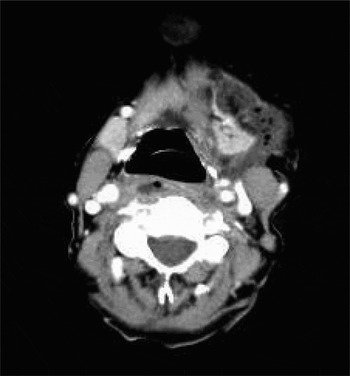
However, computed tomography (CT) scanning of the patient's neck showed an extensive abscess, most voluminous within the left masseteric space lateral to the mandible, extending posteriorly to the mandibular angle, laterally through the carotid and retropharyngeal spaces to the right carotid space, and inferiorly to the level of the supraglottis, with displacement of the right tonsillar space anteriorly (Figure 1).
Axial computed tomography scan of the head, showing diffuse swelling, purulent collections in the left masseteric space, and pus in the retropharyngeal space.

Therefore, on day two an attempt was made to drain the abscess through a left cervicotomy, under general anaesthetic. Only 2 ml of pus was expressed, despite extensive dissection. However, on oropharyngeal examination a large amount of pus was encountered, of unclear origin. A corrugated neck drain was placed, and pus sent for microbiological analysis.
On day four, left facial swelling was still apparent, and inflammatory markers, although lower, had not returned to normal (white blood cell count 17.3 × 10⁹/l; CRP 203 mg/l). However, the patient remained afebrile and seemed clinically well, complaining only of some dysphagia. Ultrasonography showed no parotid abscess, but pus was still present around the masseteric region.
On reviewing the previous neck CT, the retropharyngeal portion of the abscess was noted to extend into the mediastinum posterior to the oesophagus.
Microbiological assessment showed mixed flora, including a heavy growth of C freundii and mixed anaerobes. Based on antibiotic sensitivity results, the patient's antibiotic was changed to gentamicin.
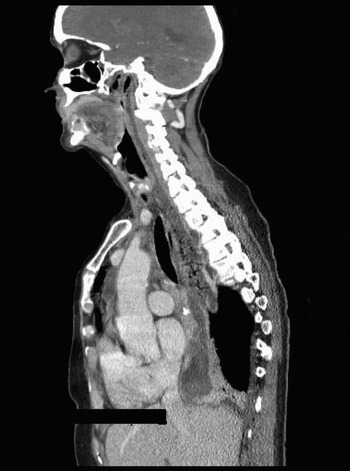
On day five, the patient's inflammatory markers began to rise again (white blood cell count 21.6 × 10⁹/l; CRP 248.2 mg/l). A repeated CT of the neck and a CT of the chest confirmed the presence of an abscess extending for 35 cm craniocaudally from the left parotid region, inferiorly through the neck and mediastinum, to the diaphragm. The abscess completely encircled the thoracic aorta and oesophagus in portions (Figure 2). The cardiothoracic team from a neighbouring tertiary referral centre was consulted with a view to performing combined cervico-thoracic abscess drainage; however, due to a bed shortage, transfer was not immediately possible. The decision was thus made to repeat the cervicotomy, and to perform thoracotomy semi-electively.
Sagittal computed tomography scan of the head, neck and thorax, showing the extent of the abscess: a 35-cm, contiguous column of pus from the retropharyngeal space to the diaphragm.

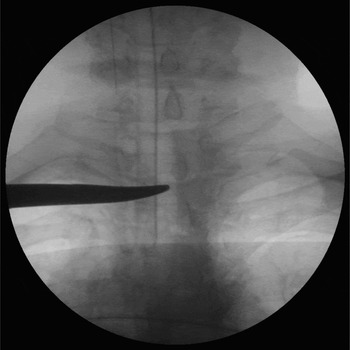
At the second cervicotomy, again, only minimal pus was evident, although some was expressed on ‘milking’ the left masseteric region. However, a per-oral incision into the posterior pharyngeal space, released copious pus. Placing the patient in a reverse Trendelenburg position increased the pus flow. After draining more than 200 ml of pus, a suction catheter was advanced through the incision into the superior mediastinum, and a further 100 ml of pus was aspirated. Location of the catheter tip was facilitated by threading the stylet of a nasogastric feeding tube into the lumen of the catheter before advancement, and by fluoroscopic image intensification (Figure 3). After aspiration, the catheter was repositioned to enter the pharyngeal incision via the nose, and the stylet was removed. This facilitated repeated aspiration in the intensive care unit, where a further 80 ml of pus was aspirated. Nasogastric feeding was commenced.
Intra-operative fluoroscopic image showing guidance of the suction catheter into the posterior mediastinum. An artery forceps is used as an external marker.

On day seven, a further CT showed resolution of the neck portion of the abscess, and significant reduction of the mediastinal portion, but also bilateral pleural effusions and a possible empyema.
On day eight, the patient was transferred to the cardiothoracic centre, where ultrasound-guided drainage of her pleural effusions was performed. Approximately 100 ml of clear effusion was aspirated from several left-side, loculated collections. Microbiological analysis showed white cells only, with no bacterial growth, and cytology was negative for malignancy.
All further management was conservative. Teicoplanin was added to gentamicin on the microbiologist's advice, following a solitary rise in inflammatory markers on day 10 (white blood cell count 23.6 × 10⁹/l; CRP 185 mg/l). On day 14, oral feeding was recommenced, and a new CT confirmed full resolution of the mediastinal collections, with no further neck collections. Inflammatory markers continued to normalise.
The patient was transferred back to our care and made a full recovery, being discharged on day 20.
Discussion
Our patient developed a retropharyngeal abscess secondary to C freundii pharyngitis. The infection extended to the left masseteric region, causing local inflammation and oedema, before extending caudally to rupture into the ‘danger space’. This space communicates closely with the retropharyngeal space; it is formed anteriorly by the alar fascia and posteriorly by the prevertebral fascia, and extends through the mediastinum to the diaphragm, and it provides a pathway for potentially fatal infection of the thoracic cavity.Reference Ridder, Technau-Ihling, Sander and Boedeker12 One such infection is descending necrotising mediastinitis, a rare disease caused by a spreading, diffuse inflammatory reaction (phlegmon) to a primary head and neck infection, usually of odontogenic or deep neck space origin. Its mortality rate has been quoted as 25–40 per cent, despite advances in antibiotics, surgical and resuscitation procedures, and critical care techniques.Reference Mora, Jankowska, Catrambone, Passali, Mora and Leoncini13
Our patient's presentation was uncharacteristic: despite extensive purulent collections, she was afebrile at presentation and remained so throughout the course of her illness. Also, she presented primarily with a four-day history of left facial swelling, only disclosing her sore throat as an afterthought. In an account of their 10-year (1993–2003) experience with descending necrotising mediastinitis, Mora et al. describe similar findings, with three of 21 patients remaining afebrile throughout their disease course, and one patient presenting primarily with only left-sided, erythematous neck oedema.Reference Mora, Jankowska, Catrambone, Passali, Mora and Leoncini13 A thorough history and high degree of clinical suspicion is therefore needed in cases of atypical soft tissue neck swelling; an afebrile state does not negate the possibility of more serious underlying disease.
Co-amoxiclav was initially administered to our patient, but was changed to gentamicin based on bacterial culture sensitivities. Teicoplanin was later added following a rise in inflammatory markers. Citrobacter is a genus of Gram-negative coliform bacteria within the enterobacteriaceae family. Many of the species, including C freundii, have a high prevalence of extended spectrum β-lactamase, AmpC and metallo-β-lactamase, rendering them resistant to ampicillin and first-generation cephalosporins.Reference Rizvi, Fatima, Rashid, Shukla, Malik and Usman14 In addition, some citrobacter isolates may be resistant to multiple antibiotics due to plasmid-encoded resistance genes.Reference Minarini, Poirel, Cattoir, Darini and Nordmann15 Early microbiology input is therefore advisable, and combination therapy possible.
Surgical management of retropharyngeal abscesses with mediastinal extension is controversial. Some authors have advocated drainage via cervicotomy only, whilst others feel thoracotomy should be performed but as a second stage procedure, it being too extreme a measure for critically ill patients.Reference Civen, Väisänen and Finegold11, Reference al-Ibrahim16 Still others have claimed that morbidity in the post-cervicotomy period remains high, and that early thoracotomy in conjunction with cervicotomy reduces mortality.Reference Mora, Jankowska, Catrambone, Passali, Mora and Leoncini13, Reference Wheatley, Stirling, Kirsh, Gago and Orringer17 Estrera et al. have suggested that thoracotomy should be performed only when infection has extended below the carina anteriorly and beyond the fourth posterior vertebra posteriorly.Reference Estrera, Landay, Grisham, Sinn and Platt18 In our patient's case, following initial discussion with the cardiothoracic surgeons, a combined approach was considered due to lack of improvement after the initial cervicotomy. However, due to a bed shortage at the cardiothoracic hospital, a compromise of repeated cervicotomy with delayed thoracotomy was decided upon.
At surgery, mediastinal suction via the posterior pharyngeal wall incision was considered as a novel intermediary way to further reduce the risk of patient morbidity, pending cardiothoracic input. This procedure has been described once before, but in a paediatric patient.Reference Adelson and Murray19 It is our belief that, used in conjunction with cervicotomy, this procedure can in carefully selected cases be considered for primary intervention to drain a mediastinal abscess, instead of open thoracotomy, as it carries much lower morbidity and can result in a favourable outcome, as reported. Under image intensification monitoring, the catheter can be advanced safely into the mediastinum under direct vision, and, by leaving the catheter in situ, continued drainage and repeated aspiration are facilitated. In addition, because this procedure itself adds little extra morbidity to the cervicotomy procedure, in the event of non-resolution of mediastinal collections the patient may still be considered for thoracotomy as a delayed second procedure.
It is difficult to comment on which patients would ideally benefit from this procedure, given the reported case's singularity; however, it may be of most benefit for patients who are neither grossly septic nor haemodynamically unstable despite extensive disease, as in our patient. Arguably, in more clinically unstable patients, a more radical approach may be appropriate.
Conclusion
Citrobacter freundii is a rare cause of deep space neck infection which can present atypically and have an aggressive course. This bacterium may exhibit multiple antibiotic resistance, and senior microbiologist input is advisable. Early combined cervico-thoracic drainage is likely to be the ideal surgical intervention for these patients. However, if facilities are not immediately available, the above-described, minimally invasive technique is simple to perform and can greatly reduce morbidity, and even obviate the need for thoracotomy.