Introduction
Aim and Scope
In a society steadily globalizing, modernizing and getting technologized, transhumant shepherding tends to become an occupation of past times. Many causes, which varied from one region to the other, led to this evolution. Among the most common causes were the different quality of pastures and hayfields, sheep dynamics which produced fluctuations in the pasturing surface-area, and some conflicts connected with the taxation regime and property of the agro-pastoral area. In addition, changes occurring over time in the feeding regime and in the type of clothes, a consequence of global trends, caused a considerable restriction in using shepherding-provided products.
Currently, transhumance is still practised, but with much lesser intensity and in far smaller areas (Velcea et al., Reference Velcea, Toderaş, Crăcea and Negoescu2016; David et al., Reference David, Semuc, Vlad, Şerban, Săvulescu, Vrăjitoriu, Săvescu and Munteanu2021). Hence, this study is aimed at highlighting the dynamics of this occupation in a Romanian Carpathian region that is representative of pastoral activities, namely the region of Mărginimea Sibiului. Pastoral dynamics has been described from the early feudal times to this day, and future trends have also been outlined. In the past, this vast movement has entailed the population of most Mărginimea Sibiului villages: Boiţa, Fântânele (Cacova), Galeş, Gura Râului, Jina, Orlat, Poiana, Poplaca, Răşinari, Rod, Sălişte, Sibiel, Tălmăcel, Tilişca, Vale. Today, transhumance is still a large-scale practice only in Poiana Sibiului, Tilişca, Jina and Răşinari. Concomitantly, sheep livestock and the areas in which they are moved have been great diminished (Shirasaka and Urushibara-Yoshino Reference Shirasaka and Urushibara-Yoshino2015).
The paper aims to contribute to the development of awareness regarding the current characteristics of shepherding activities in the Mărginimea Sibiului, a traditional economic area of this mountainous region in southern Transylvania (Romania), compared with the past, and to make predictions about their future evolution. Thus, our study joins and connects with similar studies developed for other regions in the Alps, the Pyrenees, the Carpathians and the Caucasus, against the background of increasingly globalized and interdependent mountain economies, which are also more vulnerable to global and regional risks, be they pandemics or wars.
Literature Review
The old traditional agricultural activity, namely, transhumant pasturing, was practised in the past on vast areas at many high and medium altitudes of Europe. This explains why studies on shepherding and transhumance, representative of the European area, have been developed since the beginning of the twentieth century (Fribourg, Reference Fribourg1910; Demangeon, Reference Demangeon1932 – with particular focus on the Spanish Pyrenees); Kubijovic, Reference Kubijovic1926 (referring to the Eastern Beskids); Dedijer, Reference Dedijer1916 (on transhumance in the Dinaric Alps); Arbos, Reference Arbos1923; Evans, Reference Evans1940 (on transhumant shepherding in Europe).
At present, pastoral areas have shrunk considerably due to changes in the local economies and the transition from extensive to intensive agriculture. Studies have been devoted to the pastoral activities in the local economies of the French and Italian Alps (Arbos Reference Arbos1922; Gallois Reference Gallois1923; Morariu Reference Morariu1942; Gardelle Reference Gardelle1973; Cleary and Delano-Smith 1990; Brisebarre Reference Brisebarre2007; Avram Reference Avram2009; Biber Reference Biber2010), Austrian and Swiss Alps (Shirasaka Reference Shirasaka, Umesao and Yamamoto2004; Jurt et al. Reference Jurt, Häberli and Rossier2015), the Spanish Meseta (Lopez-Santiago et al. Reference Lopez-Santiago, Oteros-Rozas, Martin-Lopez, Plieninger, Gonzales-Martin and Gonzales2014), the Polish Carpathians (Berezowski Reference Berezowski1964; Sendyka and Makovicky Reference Sendyka and Makovicky2018), or to the comparison between European and North-American pastoral systems (Rinschede Reference Rinschede, Allan, Knapp and Stadel1988).
In the Romanian Carpathians, transhumant pasturing is part of a much larger agro-pastural area, extending southwards in the mountainous regions from the West Balkans (Isnard Reference Isnard1961; Matley Reference Matley1968; Kobayasky 1974; Urushibara-Yoshino Reference Urushibara-Yoshino2006 and Mihevc Reference Mihevc and Urushibara-Yoshino2013), Bulgaria (Guechev and Dinev 2006; Hirata and Rakshieva, Reference Hirata and Raskshieva2017), Albania, Northern Macedonia and Greece (Blanc Reference Blanc1963; Chang Reference Chang2009; Hadjigeorgiou Reference Hadjigeorgiou2011), an area which is one of the most representative of its kind in Europe.
Studies on the pastoral activities in the Romanian Carpathians have an old tradition, the first studies being those of the French geographer Emm. de Martonne (1904, 1912) and poet and ethnographer O. Densuşianu (Reference Densuşianu1913). In the inter-war period, a study worthy of note is A. Veress’ (Reference Veress1927) work on the pastoral migrations of those from Transylvania to Moldavia and Wallachia, and there is a series of regional pastoral monographs: e.g. Dan (Reference Dan1923) speaks about pasturing in Bukovina; Popp (Reference Popp1929) about the region between the Carpathian and the Subcarpathian Bending area, Subcarpathian Oltenia (Popp Reference Popp1933), Argeş-Muscel area (Popp Reference Popp1934), the Polish Carpathians (Popp Reference Popp1935) and the plainlands (Popp Reference Popp1941a). Opreanu (Reference Opreanu1930) describes pasturing in the Eastern Carpathians; Someşan (Reference Someşan1934) in the Călimani Mountains. and Romanian provinces (Someşan Reference Someşan1935); Kubijovic (Reference Kubijovic1934) and Georgeoni (Reference Georgeoni1936) in Maramureş; Nandriş (Reference Nandriş1934-35) deals with Romanian pasturing in the Northern Carpathians; Precup (Reference Precup1926) and Morariu (Reference Morariu1937) in the Rodna Mountains, Conea (Reference Conea1937, Reference Conea1939) in the Haţeg Land and mountain and Subcarpathian Oltenia (Conea Reference Conea1943). In addition, Herseni’s studies discuss pastoral organization in Romania (Herşeni Reference Herşeni1936) and pastoral sociology (Herşeni Reference Herşeni1941).
After the Second World War, more and diverse studies would deal with this topic. Pastoral history studies would continue (Rusu 1958; Constantinescu-Mirceşti Reference Constantinescu-Mirceşti1976; Totoianu Reference Totoianu2010; Emilciuc Reference Emilciuc2017, etc.), simultaneously with the establishment of some theoretical-methodological approaches (Dunăre Reference Dunăre1956, Reference Dunăre1963; Donat, Reference Donat1966). A wide range of studies focused on pastoral typology (Vuia Reference Vuia1964, Reference Vuia1980), pastoral development (Hotea Reference Hotea2013), pastoral shelters (Vulcănescu Reference Vulcănescu1965), pastoral migrations (Dunăre Reference Dunăre1969, Reference Dunăre1977; Canureci Reference Canureci2010; Budrală and Sterp Reference Budrală and Sterp2006; David et al. Reference David, Semuc, Vlad, Şerban, Săvulescu, Vrăjitoriu, Săvescu and Munteanu2021), or pastoral-connected toponymy (Vlad and Vişan Reference Vlad and Vişan1996; Matei et al. Reference Matei, Ursan and Bogdănel1998; Creţan Reference Creţan2000; Boamfă Reference Boamfă2011).
Simultaneously, regional pastoral studies would continue: Morariu et al. (Reference Morariu, Dihor and Idu1973) for the lowland Banat area; Latiş (Reference Latiş1993) Maramureş; Iosep (Reference Iosep1995) the Câmpulung area; Idu (Reference Idu1999) the Carpathians of Maramureş and Bukowina; Buza (Reference Buza2000) the Cindrel Mountains; David (Reference David2016) the Rucăr-Bran Corridor, etc.
The identity of shepherding activities in the context of contemporary mountain economies and the claims issued by shepherds were highlighted in Triboi’s (2017) work on how shepherding in Romania and Central and Eastern Europe has changed the lives of shepherding workers in small urban areas. The study shows that small urban settlements in Romania and Eastern Europe use shepherding as a form of sustainable development.
O’Brien and Creţan (Reference O’Brien and Creţan2019) highlight the way in which Romanian shepherds protested in 2015, defending their rights. The authors criticized the fact that modernization imposed by the European Union limits the free and full-scale materialization of traditions and can even lead to their loss, such as transhumance, and shepherds have been forced to protest for the rights to label products as traditionally pastoral and of access to pastures. Additionally, shepherding dogs have borne the brunt in Romania in the past decade, due to the policy of eradicating stray dogs (Creţan Reference Creţan2015).
Issues related to investment and social risk in the disadvantaged areas of the Romanian Carpathians have been extensively studied by Creţan et al. (Reference Creţan, Guran-Nica, Platon, Turnock and Turnock2018), who show how Romanian foreign investments and state programmes can help pastoral development, especially in economically disadvantaged areas, where former factories built during the centralized economy have been closed. The study by Rîşteiu et al. (Reference Rîşteiu, Creţan and O’Brien2021) goes along the same lines, showing that, in the former mining regions, shepherding remains an alternative source of economic development, especially in places where the population emigrates and there is a demographic decline. Furthermore, the study by Vesalon and Creţan (Reference Vesalon and Creţan2013) shows that mono-industrialization is a development limit for many rural mountain settlements such as mining communities, and that shepherding is a good alternative for the future.
Light et al. (Reference Light, Creţan, Voiculescu and Jucu2020) analyse the way in which pastoral products and festivals for the promotion of pastoral products influence the development of tourism, and even tourism in the big cities bordering pastoral areas (Sibiu, Brasov).
In view of this, given the importance and representativity of Mărginimea Sibiului for pastoral activities in Romania, this area benefited from several comprehensive studies: Haşeganu (Reference Haşeganu1941); Irimie et al. (Reference Irimie, Dunăre and Petrescu1985); Voicu-Vedea (Reference Voicu-Vedea1998); Conea and Badea (Reference Conea and Badea2004); Lupaş (Reference Lupaş2004) and Lăcătuşu and Stanciu (Reference Lăcătuşu and Stanciu2016) (with the emphasis on pastoral migrations); Buza et al. (Reference Buza, Cojocaru-Costea and Turnock2009); Cocean (Reference Cocean2009); Ciangă (Reference Ciangă2009) (with the emphasis on tourism), Velcea et al. (Reference Velcea, Toderaş, Crăcea and Negoescu2016) and Constantin (Reference Constantin2019).
Methods and Data
For the purpose of this research, recognizable methods and approaches were used for collecting, analysing and comparing data. For data collection, different sources were employed: old censuses of Transylvania during the Austro-Hungarian Empire (1850, 1857, 1869, 1880, 1890, 1900, 1910 and the agricultural census of 1895), censuses from the interwar period (1930 and 1941), the agricultural census of 1948, population censuses from the period of the centralized economy in Romania (1948, 1956, 1966 and 1977), as well as the censuses from the post-communist period (the population censuses of 1992, 2002 and 2011, the agricultural censuses of 2002 and 2010 and the Farm Structure Survey of 2016).
Historical maps were analysed and compared with the present situation: the Siebenbürgen map (1:28,000), compiled on the basis of the Josephine topographic surveys (1769–1773); the Nagy-Szeben/Hermannstadt map (1:75,000) (1889–1890); Sibiu – harta topografică/Sibiu – A Topographic Map (1:75,000) (1952), a reproduction of the Austrian map (1881–1893); the topographic maps of Romania (1:50,000, 1973 and 1:100,000, 1996) and the topographic map of Hermannstadt/Sibiu und das ‘Alte Land’ aktualisiert, mit deutschen Ortsnamen (1:50,000, 2010). In addition, the land use maps from Mărginimea Sibiului were analysed based on the works written by Voicu-Vedea (Reference Voicu-Vedea1998) and Cocean (Reference Cocean2009).
Analysing the maps consisted of interpreting them in order to highlight the changes taking place at the level of land use during the past two centuries. These were correlated with changes in sheep numbers, as shown by the bibliographic sources analysed.
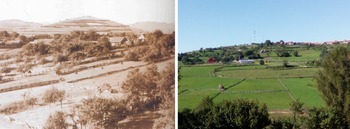
Comparisons have been made with past land use based on old photographs from the Archive of the Institute of Ethnography and Folklore of the Romanian Academy or, more recently, from the works of Cojocaru-Costea (Reference Cojocaru-Costea2002), Shirasaka (Reference Shirasaka and Urushibara-Yoshino2006), Akeroyd (Reference Akeroyd2006) and Urushibara-Yoshino and Mori (Reference Urushibara-Yoshino and Mori2007). Photographs taken by the authors during the field research conducted in 2012 and 2021 were also used (see Figure 1).
The dynamic of pastoral land use within the Poiana Sibiului village. Left: 1964 (source: the Archive of the Institute of Ethnography and Folklore of the Romanian Academy, Collection I. Drăgoescu). Right: 2021 (photograph by M. Persu).

Past and current laws and regulations concerning the topic discussed were examined (Law No. 8 of 1895, based on which the agricultural census of the same year was conducted: A Magyar Korona országainak mezőgayzdasági statisztikája, gazdacímtár, vol. I, 1997); the decree-law of 15 December 1918 on the expropriation and transfer of expropriated lands to villagers, which was the basis of the agrarian reform of 1921 (Cristea Reference Cristea1999); the agrarian law of 1945, the basis of the agrarian reform of the same year (Şandru Reference Şandru2000), as well as the Land Fund Law No. 18 of 20 February 1991, which was the stepping stone for the changes that have taken place in the way of land use in Romania in the past three decades (1991–2021) (Terzea Reference Terzea2007). The analysis focused on the content of these laws and on the impact that the agrarian reforms they have generated have had on land use.
The law on the management of stray dogs was also analysed (Law No. 258 of 26 September 2013), which had a major negative impact on shepherding dogs, underlying shepherds’ protests in January and in September–October, 2014, as well as in December 2015 (Creţan Reference Creţan2015) and October 2018 (O’Brien and Creţan Reference O’Brien and Creţan2019).
Contributions to the evolution of shepherding in Romania, and in the Romanian Carpathians in particular, were reviewed with special attention to researches into politics and its impact on territorial planning and the rural physiognomy. Data and information on transhumant shepherding have been documented based on older (Evans Reference Evans1940; Popp Reference Popp1941b; Ionescu-Sachelarie Reference Ionescu-Sachelarie1941; Morariu Reference Morariu1963) and more recent (Voicu-Vedea Reference Voicu-Vedea1998; Dănuleţ Reference Dănuleţ2006; Huband et al. Reference Huband, McCracken, David and Mertens2010; Işfănoni Reference Işfănoni2010; Preda Reference Preda2016; Velcea et al. Reference Velcea, Toderaş, Crăcea and Negoescu2016; Mathe-Kiss Reference Mathe-Kiss2016 and David et al. Reference David, Semuc, Vlad, Şerban, Săvulescu, Vrăjitoriu, Săvescu and Munteanu2021) bibliographic sources. Moreover, the websites of the town halls of some communes from Mărginimea Sibiului are representative of shepherding activities (Poiana Sibiului, Răşinari, Sadu) and provided the authors with useful data and information on the use of land and sheep herds, as well as the distribution of grazing land.
The findings were compared with statistical data and publications by Romanian and international authors discussing this problem.
Study Area
Mărginimea Sibiului – Regional Individuality
Mărginimea Sibiului lies in the south-east of Sibiu County, where the Sibiu Depression and the Cindrel Mountains meet. The term ‘Mărginimea Sibiului’ has historical connotations, referring to the villages situated between the mountain and the relatively smooth depressions, with a plain-like aspect on the ‘margin’ of Sibiu Land, an area centred on Sibiu city. The inhabitants of these villages are named mărgineni, being famous for their shepherding (Irimie et al. Reference Irimie, Dunăre and Petrescu1985: 14).
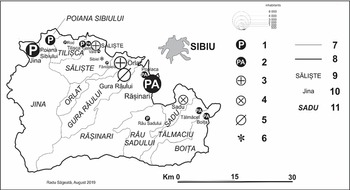
Mărginimea Sibiului extends between the Olt Valley in the East and the Sebeş Valley in the West, covering about 1335 km2 (Velcea et al. Reference Velcea, Toderaş, Crăcea and Negoescu2016). It includes 17 localities (16 villages and one town) with a population of 31,034 inhabitants (census data: 2011) and about 30,000 inhabitants (estimation: 2021) who belong to eight functional typologies: pastoral, pastoral-agricultural, agricultural and forestry, agricultural and with hydro-energy industry, agricultural with textile industry, agricultural with food industry, agro-tourism and complex (Figure 2).
Demographic size and functional types of human settlements in Mărginimea Sibiului.Legend: 1. Pastoral villages, 2. Pastoral-agricultural, 3. Forest settlements, 4. Settlement with hydroenergy industry, 5. Settlement with textile industry, 6. Agro-tourist village, 7. Commune boundary, 8. Mărginimea Sibiului boundary, 9. Town name, 10. Village name, 11. Commune name.

The historical unity of Mărginimea Sibiului derives from the region’s function during the Austro-Hungarian and subsequent Habsburg periods, basically a border area with Transylvania, having a defence role for the Empire. This role went on mostly in the eighteenth century when Empress Maria Theresia decided to set up a Border Regiment at Orlat, this locality becoming then the polarizing centre of Mărginimea, and the inhabitants of the villages under the Orlat influence, situated on the old Imperial border from the south of Transylvania, were given the name of mărgineni. So, in the case of Mărginimea Sibiului, the term designates a marginal border area of the Habsburg Empire, featuring a functional unity: the frontier and defence area of the Empire (Conea Reference Conea1965).
Its ethnical unity is due to the fact that Mărginimea Sibiului, a rural border area, did preserve over time the Romanian ethnical element, in opposition to the urban-type German and Hungarian cities from the south of Transylvania. Most soldiers belonged to the Romanian autochthonous population, while the officers, by far fewer, were of Hungarian and German origin. Thus, in time, an ‘island’ of predominantly Romanian population emerged, distinguishing this region by assuming some autochthonous denominations by the Feudal administration in the fourteenth century and translating them into Latin, German, or Hungarian documents (Sălişte, Orlat, Săcel, etc.) (Irimie et al. Reference Irimie, Dunăre and Petrescu1985: 75).
Mărginimii Sibiului Economic Unity
The region has a predominantly Romanian population; the relief is rough, surrounded by mountain massifs. In time, the area has preserved an old occupation: transhumant shepherding. While, until 1918, the military function was imposed by historical and geopolitical events, the pastoral function is the outcome of the natural environment in which the traditional rural communities of Mărginimea appeared and developed. Therefore, the region’s shepherds were called mocani or ţuţuieni. The Sibiu Saxons named them ‘Gebirgswalachen’ (Walahi or mountain Romanians), or ‘Die Tzuzuianen’ (‘Zuzujanen’), a toponymic argument that proves the ethnical unity of this population group.
The pastoral function, transmitted from one generation to the next up to this day, is characteristic of the area, a linking feature of the area which individualizes it in connection with the neighbouring lands; Mărginimea Sibiului appearing in time as Romania’s most characteristic pastoral region. The inhabitants of Mărginimea would periodically cross the Carpathian Mountains with their flocks, a situation that contributed to maintaining constant relations between the Romanian communities from the north and the south of the mountains due to the population movements (Conea Reference Conea1960: 90–91).
The practice of transhumance in Mărginimea Sibiului was also stimulated by the economic cooperation between the Romanian villages and towns from the south of Transylvania. The area’s traditional textile industry was for centuries determined by this important economic potential between the urban economic development and the expansion of transhumance in the eighteenth century, both being closely inter-connected (Pascu Reference Pascu1954: 152–153). That is why the Mărginimea shepherds found a protector in the Transylvanian towns directly interested in securing some advantages and removing some restrictions on transhumance (Moga Reference Moga1939; Constantinescu-Mirceşti Reference Constantinescu-Mirceşti1976: 21). Transhumant shepherding became a large-scale practice beginning in the eighteenth to nineteenth centuries, and also determining a certain homogeneity and anthropization of the landscape, with land-use having a greater share of meadows and glades (Buza Reference Buza1974).
Cultural and Ethnographic Unity in Mărginimea Sibiului
The area has preserved in time an exceptional wealth of customs and traditions. The area stands out as a distinct ethnographic zone with an individual folk costume, a traditional architecture, and painting on glass – an occupation that got momentum in the eighteenth century due to the introduction of glassware items by the Austrian Imperial authorities.
Connected with the traditional occupation, namely shepherding, the inhabitants used to make a number of traditional cheese items which in time became local brands, contributing to the development of a homogeneous local mental entity entailing all the inhabitants in spirituality, traditions and occupations.
The cultural and spiritual background is reflected in a wealth and variety of tourist objectives (ancient wooden churches, ethnographic museums, a museum of glass icons, memorial houses, archaeological complexes). Mărginimea Sibiului is also a unitary tourist zone, having its own historical and cultural identity.
Results and Discussions
Shepherding at Mărginimea Sibiului: Past
According to sociologist T. Herşeni (Reference Herşeni1941), agriculture and shepherding are the oldest forms of social life and Romanian civilization, with shepherds preserving the old traditions and folk culture.
The first mention of the Mărginimea Sibiului shepherds is made in the Andrian Diploma (1224) which gives the Saxons the right to use, together with the Romanians, the mountains and forests (Voicu-Vedea Reference Voicu-Vedea1998: 127). According to Conea and Badea (Reference Conea and Badea2004: 55), the old-time practice of pastoral activities made Mărginimea Sibiului ‘certainly one of our Carpathian sectors where the local Daco-Roman population stayed in place and continued to develop in connection with the mountains even after the Roman rule left, beyond the Danube’. What contributed to it was primarily the exceptionally favourable background of the ‘submountainous lowland’ which ends northwards with the Sibiu Mountains, their altitudes by far lower southwards, leaving in place a wild hilly relief propitious to grazing. Dragomir (Reference Dragomir1938) described them as ‘massive mountains with bridges extended as a table over huge distances […] rich in pastures and springs up to the top’, hence favourable to intense human pressure. Therefore,
within the northern slope of the Southern Carpathians, the Sibiu Mts. and together with them and their western neighbours, i.e. the Şureanu Mts. Looking very special, primarily because they are by far the most inhabited ones of all the mountains of this slope, that is, from Caransebeş to the Ⓘntorsura Buzăului ending area (and perhaps more than that, the most inhabited one even in the past), also showing the same physico-geographical conditions, the groundwork of the same historical and human geography. (Conea and Badea Reference Conea and Badea2004: 56)
Historical documents from the fourteenth to fifteenth centuries mention the intensification of human pressure in the mountains through transhumant shepherding, practised especially by the Romanian population, concomitantly with the development of crafts connected with the processing of wool. At the same time, more shepherding led to forest cutting in order to extend pastures and hayfields, which also favoured wood-processing activities. This situation is attested by the presence of many local toponyms standing for deforestration. The most representative of these is the toponym Poiana Sibiului (from the word ‘poiană’, meaning ‘clearing’ – a place in the forest devoid of trees and covered with grass and flowers) (Vlad, Reference Vlad1996: 104–105), which is a standout village for shepherding activities in Mărginimea Sibiu. This name also engendered toponyms in the mountains bordering Mărginimea Sibiu, where the shepherds of the area would lead the flocks: Poiana Brăneasa, a peak in the Şureanu Mountains (1131 m), Poiana Făgeţel and Poiana Tisa, slopes in the Lotrului Mountains at an average altitude of 1500 m. Oaşa Depression, located between Şureanu and Cindrel Mountains (1260 m average altitude) and Oaşa Mare Peak in Cindrel Mountains (1731 m) (from ‘oaş’/deforested slope – a place in a forest, cleared of vegetation to be cultivated) are other representative toponyms which prove deforestation. The Şureanu Mountains, with large grazing areas, used by the people of Mărginimea Sibiului, abound in such toponyms: Curata Mare (peak, 1326 m) (from ‘curătură’ – a name bearing the same meaning); Ciungu (peak, 967 m) (from ‘ciungi’ – trees with branches cut or defoliated by intentional or accidental burning); Prisaca (peak, 1219 m) (from ‘prisacă’ – also with the meaning of ‘clearing’); Preluca (ridge, 1200 m) and Prelucele (peak, 1225 m) (from ‘prelucă’/glade – deforested land ploughed and ready to be sowed); Pleşu (peak, 996 m) (from ‘pleş’, ‘pleaşă’ – bald, naked, devoid of vegetation); Runcuri (peak, 788 m) (from ‘runc’/clearing – meaning a place in a forest where trees have been cut down, burned or felled by the wind; deforested place used as pasture or agricultural land); Smida Mare and Smida Mică (peaks, 1774 and 1509 m, respectively) (from ‘smidă’ – small, cut forest) and Seciuri (peak, 993 m) (from ‘seciu’, ‘seciuri’ – name given to places where the forest was cut down and a grazing ground was left behind). In the Loviştei Depression and the Lotru Mountains, located in the east of Ţinutului Mărginimii, deforestation is indicated by the names of various villages: Lazaret, Boiţa commune, Sibiu County, (from ‘laz’, ‘lazuri’/clearing – cleared land, transformed into hayfield or arable area) and Priloage, Câineni commune, Vâlcea county (from ‘prilog’ – clearing), as well as by the toponym Dealul Runcului (a peak in Lotrului Mountains, 1200 m).
The intensity of deforestation in the Sibiu area was documented by Crăcea and Crăcea (Reference Crăcea and Crăcea2010), who demonstrated, on the basis of cartographic documents, that in two centuries (between 1769/1773 and 1973) the forest areas in the Sibiu Depression were reduced from 24% to 14% of the total land area (that is, from 79.6 km2 to 48.9 km2).
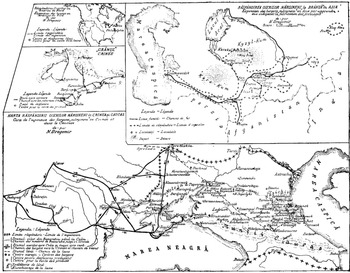
Transhumance appeared at the beginning of the feudal period and got momentum in the eighteenth and nineteenth centuries, becoming a specific form of pastoral economy (Conea Reference Conea1960; Laffront Reference Laffront and Laffront2006; Brisebarre Reference Brisebarre2007). It developed mostly in those local communities where animal breeding was the main living resource, and where grazing was not sufficient (Popa Reference Popa1979). Transhumance led to the considerable expansion of the shepherding area, the Mărgineni shepherds travelling long distances. Thus, in the nineteenth century, special consulate offices were opened at Hârşova (Dobrogea) and Rusciuc (presently Ruse in Bulgaria) for the Transylvanian shepherds, Hârşova hosting ‘Starostia Mocanilor’ ever since the seventeenth century (Vâlsan Reference Vâlsan1928). The apex of transhumance was in the eighteenth to nineteenth centuries, when the number of sheep kept growing, with transhumance being practised freely on vast territories, beyond the present borders of Romania, as far as Croatia, Bulgaria, Hungary, Ukraine (Voicu-Vedea Reference Voicu-Vedea1998: 140), Caucasus, Crimea and even North America (Dragomir Reference Dragomir1938) (Figure 3).
The shepherds’ roads from Mărginimea Sibiului to the north of the Black Sea, the Caucasus, Central Asia and North America (according to Dragomir, Reference Dragomir1938).

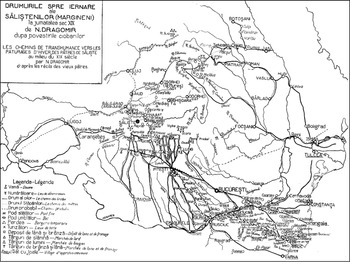
By the Treaty of Adrianople (1829), trade on the Danube was free so that cultivated areas expanded into Wallachia and Oltenia. The importance of transhumant shepherding was constantly diminished, especially after the Russian–Turkish War (1877–1878) which led to the independence of Romania, to the drastic limitation of migrations in the south of the Danube, and to the economic conflict with Hungary (1885–1896) that caused the closing of the old border with that country. The shepherds who remained at Mărginimea Sibiului sold their flocks and turned to additional activities (Buza et al. Reference Buza, Cojocaru-Costea and Turnock2009) (Figure 4).
The wintering roads of the shepherds from Sălişte (Mărginimea Sibiului) in the middle of the nineteenth century (Drumurile spre iernare ale săliştenilor (mărgineni) la jumătatea secolului al XIX-lea by Nicolae Dragomir, according to the shepherds’ stories) (source: Dragomir, Reference Dragomir1926).Legend: (from top) customs, sheep counting place, sheep road, the way of the Masters, probable road, fixed bridge, mobile bridge, temporary sheep fold, place for shearing sheep, wool and cheese warehouse, bacon fairs, light fairs, cheese and wool fairs, supply villages.

The downwards trend of pastoral activities in Mărginimea Sibiului continued in the twentieth century, first because of the destructions caused by the two world wars, then because of collectivization during the socialist-type central-based economy, and finally traditional products and activities could not compete with the products of the global consumption market. For all that, shepherding has been going on to this day as one of the main traditional forms of the rural economy in the Mărginimea Sibiului villages, giving the region a particular ethno-culture. In the commune of Răşinari, for example, the number of sheep had decreased in 1899 to only 10,429 head. In the years 1910–1920 there was an increase reaching 35,000 head; in the period 1920–1940 there were 150,000 sheep declared, but the real number was, according to some estimates, about 30,000 (source: file no. 346 from the Răşinari City Hall archive). After the Second World War, the number of sheep had dropped to 21,000 head (in 1948) and even 14,964 head (in 1955). In 1957 there were 16,000 sheep in the village, in 1959 their number was 12,085, reaching 17,645 head in 1960 (idem., https://primaria-rasinari.ro)
Shepherding at Mărginimea Sibiului: Present and Future
While, in the past, shepherds owned large flocks and took part in transhumance over great distances, usually in the Romanian Plain, the Oltenia Subcarpathians or the Dobrogea Plateau (Popp Reference Popp1933), in the contemporary period this occupation has been considerably reduced. Thus, in the eighteenth to nineteenth centuries, when pasturing was flourishing, there were over 1,000,000 sheep heads in Mărginimea Sibiului, at Poiana Sibiului, with annual variations between 150,000–300,000 head (Voicu-Vedea Reference Voicu-Vedea1998). Sheep flocks began decreasing at the beginning of the inter-war period, rising to a maximum during the central-based economy period and after the 1989 Revolution, with a historical minimum in 1990, down to a total of 90,000 head. Legislative protection measures for traditional activities started being introduced in the 1990s (Shirasaka Reference Shirasaka2007), and the number of sheep doubled in Mărginimea Sibiului in the next two decades up to nearly 190,000 head in 2010 (Velcea et al. Reference Velcea, Toderaş, Crăcea and Negoescu2016), proving the effectiveness of this traditional activity in the current social-economic conditions.
Given the industrial decline between 1990 and 2010, the Romanian foreign investments and state programmes have contributed to the rehabilitation and development of various traditional economic branches, whose viability was confirmed over time, and which contributed to the mitigation of social risks (Creţan et al. Reference Creţan, Guran-Nica, Platon, Turnock and Turnock2018). Thus, shepherding remains an alternative source of economic development in regions such as Mărginimea Sibiului, which were severely affected by emigration and demographic decline (Triboi Reference Triboi2017; Rîşteiu et al. Reference Rîşteiu, Creţan and O’Brien2021). The centralized economy has shown that mono-industrialization is a limitation in the development of many rural settlements or small towns in mountain areas, and shepherding is a viable alternative to economic reconversion (Vesalon and Creţan Reference Vesalon and Creţan2013). In addition, pastoral products and festivals promoting them contribute to the development of tourism both in the respective rural areas and in the large cities bordering said pastoral areas (Sibiu and Braşov, etc.) (Light et al. Reference Light, Creţan, Voiculescu and Jucu2020).
The largest sheep flocks were and continue to be at Răşinari, Tilişca, Poiana Sibiului, Jina, Tălmăcel, Sadu and Râu Sadului, these villages hold 77% of all the head of sheep. Sheep flocks are directly proportional to the size of the pastoral area, the number of animals depending on the share of pastures and hayfields in the agricultural use of the communes (Bărbulescu, Motcă Reference Bărbulescu and Motcă1983). Thus, in Sadu commune, for an area of 963 hectares of hayfields and 703 hectares of natural pastures (45.9% and 33.5%, respectively, of the agricultural area of the commune) in 2016 there were 9,500 sheep, 110 more than in 2011. The commune has two pastures in the lowland (depression) area with a total area of 400 hectares and seven pastures in the alpine area totalling 659.7 hectares (https://sadu.ro). Răşinari commune, one of the most representative settlements for shepherding in Mărginimea Sibiului, had 33,977 sheep in 2020 (of which 30,146 were females), owned by 157 breeders. Their number had decreased slightly compared with 2004, when the village had 40,000 sheep, but increased substantially compared with 1982, when there were only 18,000 head (https://primaria-rasinari.ro). In 2018, in the commune of Poiana Sibiului, there were 8147 head of sheep and goats with a grazing area of 1,418.79 hectares (872.79 hectares of pastures – 38.8% of the agricultural area of the commune – and 546 hectares of hayfields – 24.3% of the agricultural area) and a stable population of 2894 inhabitants (of which 96.3% were engaged in agriculture and animal husbandry) (https://comunapoianasibiului.ro). In Jina commune, there were 1700 sheep and 58 families involved in sheep husbandry, out of a total of 168 families (https://comunajina.ro). Over the entire area, the number of sheep from Mărginimea Sibiului total around 200,000 head, in relation to a grazing area of 40,400 hectares (Velcea et al. Reference Velcea, Toderaş, Crăcea and Negoescu2016).
The reinvigoration of the shepherding tradition in the Mărginimea Sibiului rural area was determined primarily by replacing state property for private property after the socio-political changes in 1989, and government support. In view of this, this agricultural branch has, over the past few years, benefited from financial support through economic development programmes for the Romanian rural area (Drăgănescu Reference Drăgănescu2006; Juler Reference Juler2014; Triboi Reference Triboi2017). Thus, during 2016–2020, Romanian farmers received some €5 million (24 million lei) to buy rams and goats under a support scheme to raise the efficiency of meat-and-milk production in the zoo-technical sector (Revista Fermierului 2016).
The villages that have a large number of sheep are Poiana Sibiului, Jina, Răşinari and Tilişca, and the town of Sălişte, with 158,240 head, i.e. 84% of all the sheep registered in Mărginimea Sibiului in 2010. In Jina and Poiana Sibiului alone they totalled 106,762 sheep – 56%. Elsewhere, values were below 10,000 head; it is noteworthy that another group at Gura Râului, Orlat, Râu Sadului, Sadu and Tălmaciu, had 4500–7000 head (Velcea et al. Reference Velcea, Toderaş, Crăcea and Negoescu2016: 92).
At Mărginimea Sibiului transhumance involved all the 17 settlements, with intensities varying in terms of period and number of animals.
Currently, transhumance is practised only in four villages Jina, Poiana Sibiului, Tilişca and Răşinari, and it takes on two-types (Huband et al. Reference Huband, McCracken, David and Mertens2010):
-
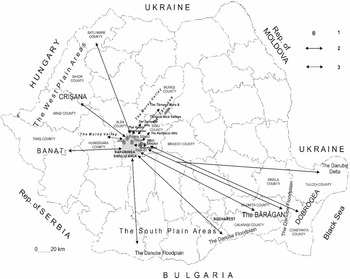
large-scale transhumance (mountain-lowland), summering in the west plain area (Banat, Crişana and Satu Mare) and south plain areas (the Bărăgan, the Danube Floodplain and Dobrogea), differing from village to village in terms of the land possessed. The large-scale transhumance begins after 15 September, traditionally lasting for 30 days; the luggage is carried by donkeys or horses; and the return is after 15 April. According to European norms, sheep must be carried by car (Popa Reference Popa2010) (Figure 5).
-
small-scale transhumance is practised in Spring and Autumn, yet over far smaller distances, usually in the settlements around Sibiu County and the neighbouring counties (Alba, Mureş, Braşov), in depressions and tableland areas (the Mureş, Târnava Mică, Târnava Mare valleys, Sibiului and Apold depressions, Hârtibaciu, Târnave and Secaşelor hills).
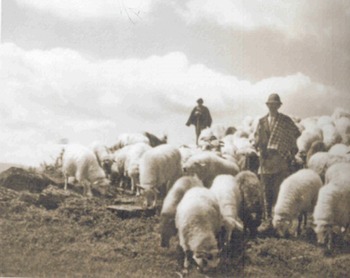
The shepherds that have few animals do not go on transhumance, but alternate between mountain and valley (residential village). Transhumance can be simple, i.e. over small distances (mountain–village), or twofold, when in transitional seasons (spring or autumn) the flocks reach the pastures or hayfields at certain distances from the village, then they go up or down, depending on the season, along the mountain–valley route. Representative of pastoral activities among Mărginimea villages are Poiana Sibiului and Jina, boasting complex mechanisms of moving the flocks and practising large-scale transhumance (Voicu-Vedea Reference Voicu-Vedea1998) (Figure 6).
The summering in the Cibin Mountains (văratul în Munţii Cibinului) in 1937 (P. Begia and I. Fishner collection), a reproduction of the Romanian Ethnographic Atlas (vol. II – Occupations, 2005).

The large-scale and the small-scale transhumance in the current period.

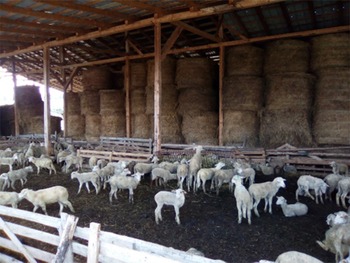
After 1990, transhumance declined as private property replaced the state-owned property, a situation that made movement more difficult. And yet, despite reduced territorial areas versus the sheep flock size, Poiana Sibiului and Jina are still engaged in transhumance during the transitional seasons (Figure 7).
Temporary shelter for sheep in the Cindrel Mountains (Jina Commune) (photo: M. Persu).

The modernization imposed by the accession to the European Union has contributed to the considerable limitation of several ancient traditions, such as transhumance (O’Brien and Creţan Reference O’Brien and Creţan2019) and, in the absence of measures to stimulate shepherding, this can even lead to the disappearance of transhumance. In addition, the adoption of the Law on the management of stray dogs (Law No. 258/2013), although having a positive impact on urban areas affected by demolition during the communist period, in pastoral areas such as Mărginimea Sibiului it contributed to the decrease in the number of shepherding dogs, leading to protests, which occurred in January, September–October, December (Creţan Reference Creţan2015), and October 2018 (O’Brien and Creţan, Reference O’Brien and Creţan2019).
Even if the animal movements have to cope with several difficulties, many sheep-owners who had bought terrains in the west of Romania, in Timiş, Arad, Bihor, Satu Mare and Sălaj counties, where they permanently kept their flocks, preserved their old residences (Velcea et al. Reference Velcea, Toderaş, Crăcea and Negoescu2016).
Pastoral activities led to a specific territorial organization in the villages practising this activity, adapted to the particularities of the natural environment (Cocean Reference Cocean2009). Thus, in each village, each household tends to benefit from all natural areas (forest, pasture, hayfields, cultivation sites, settlement, tall mountains), thus giving the opportunities for developing complementary economic activities. The villages of Mărginimea Sibiului have the following economic areas: village built-area, cultivation terrain, hayfield places with huts, grazing area, forest and tall mountains (Irimie et al. Reference Irimie, Dunăre and Petrescu1985: 119).
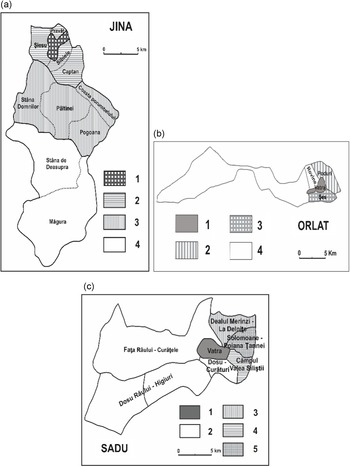
In the past, when transhumance was a large-scale practice, cultivated lands – agricultural rotational systems (with two or three fields) (Figure 8(a)-(c)) – were used. This solved soil recovery on the one hand, and annual grazing, on the other. Analysing the structure of village territories, of the estate – built-area relations in terms of their regional layout – and of the complexity of each village, coupled with oral statements gathered by interviewing the local population, with toponymic measurements and documentary attestations, it can be proved that Mărginimea Sibiului villages have evolved throughout history from the social-historical units of the traditional peasant community.
Patterns of village territorial organization in Mărginimea Sibiului. Legend: (a) Jina: 1. Village hearth, 2–3. Pasturelands; 2. ‘Lower Boundary’ – with lower altitudes close to the village hearth, pasturing small flocks; 3. ‘Upper Boundary’ with higher altitudes, situated close to mountain area, pasturing large flocks; 4. The mountain – pasturing in summertime. (b) Orlat. 1. Village hearth; 2–3. Alternative rotation cultures (‘The two fields’) fields; 4. The mountain (pastureland, hayfields, alpine void). (c) Sadu. 1. Village hearth; 2–3. Alternative rotation cultures (‘The three fields’) fields; 4. The mountain (pastureland, hayfields, alpine void).

Shepherding at Mărginimea Sibiului is the result of a complex of natural and socio-historical factors that have characterized this area, triggering its economic functionality. Given the context, this study highlights the viability of this traditional activity in the current economic and social context, marked in 1990–2000 by the decline of industry as a result of the transition from the centralized economic system to the market economy, and later by the impact of the global economic and financial recession (2008–2012), by the pandemic crisis (2019–2022) and by the geopolitical tensions generated by the Russian invasion of Ukraine.
This article complements, develops and updates similar studies for this region by Irimie et al. (Reference Irimie, Dunăre and Petrescu1985), Voicu-Vedea (Reference Voicu-Vedea1998), Cocean (Reference Cocean2009), Buza et al. (Reference Buza, Cojocaru-Costea and Turnock2009) and Velcea et al. (Reference Velcea, Toderaş, Crăcea and Negoescu2016). The lack of current data and information regarding the shepherding activities pertaining to the entire studied area was the main limitation of our study, the latest data being provided by the websites of the town halls of some communities being representative of the shepherding activities in Mărginimea Sibiului and by the field research performed by the authors.
The future research directions that this article can engender are related to the enhancement of the challenges generated by the pandemic crisis, which triggered a decline in tourist activities in the area and in pastoral tourism in particular, as well as those related to the need to develop the Romanian agricultural-pastoral sector against the backdrop of the conflict in Ukraine and the diminishing contribution of this country to the world’s agri-food market.
Conclusions
Mărginimea Sibiului villages have a threefold function imposed by environmental factors: transhumant shepherding, forest exploitations and tourism.
Shepherding is the traditional occupation specific to Mărginimea Sibiului inhabitants, a phenomenon that has influenced the region’s social life and economic particularities. A basic element that preserved local traditions was the absence of forced collectivization in certain villages with a very limited arable surface area.
The deep twentieth-century social changes, including modernization, industrialization and urbanization, the coming to power of a restrictive political regime relying on a centralized economy, considerably diminished transhumant shepherding, which became rare. This decline was enhanced after 1989 when land restitutions replaced state property with private property, making it difficult for shepherds to travel long distances.
The future development of settlements in Mărginimea Sibiului requires relaunching traditional economic activities, shepherding and more tourism, potentially a representative economic activity in the area. It is mountain tourism and ecological agro-tourism in addition to classical tourism, which should benefit from a substantial contribution of management knowledge and financial facilities (tax reduction, advantageous credits, subventions to farmers, European projects, etc.).
Changing feeding practices for ecological practices would increase the demand for traditional agricultural products in Bucharest, Romania’s capital city, and in other cities, that also have export opportunities. It is therefore necessary to increase the popularity of the region abroad, its particularities and specific products.
Acknowledgements
The research for this paper was conducted under the research plan of the Institute of Geography ‘Geographical studies on the evolution of the ethnical structure of population in Romania after 1990. The authors contributed equally to the paper.
About the Authors
Radu Săgeată, PhD, is Senior Researcher at the Institute of Geography, Romanian Academy, Human Geography and Regional Development Department. Radu’s main fields of work are: urban geography, geography of population, and regional development. Radu is the author or co-author of 21 scientific books, 200 scientific articles published in scientific journals (44 indexed in International Databases, 14 indexed in Thomson Reuters Database), and 40 scientific volumes; and is director of four research projects/grants; a team member in more then 15 research projects/grants.
Mihaela Persu, PhD, is Senior Researcher, Institute of Geography, Romanian Academy, Human Geography and Regional Development Department. Mihaela’s main fields of works are: rural geography; population and settlements geography; local and regional development. She was part of some national research projects and her studies are have been published in various books, and over 40 scientific papers on rural space and population; changes in structure of population; demographic aging; systems of human settlements; green spaces; cross-border cooperation, and so on.
Bianca Mitrică, PhD, is Senior Researcher, Institute of Geography, Romanian Academy, Head of Human Geography and Regional Development Department. Her main fields of works are: urban geography, geography of population, economic geography and regional development. She written over 150 papers and book chapters on urban development, urban functionality, metropolitan areas, urban industry, population, socio-economic disparities, and population vulnerability to different natural hazards. She contributed in the accomplishment of 40 national research grants and international projects.
Nicoleta Damian, PhD, is Senior Researcher, Institute of Geography, Romanian Academy, Environment and GIS Department. Her main fields of work are: geography of human settlements, geography of population, social geography and economic geography. She has been involved in different national and international research projects and published 19 chapters/books, and over 40 scientific articles focused on her different fields of interest (e.g. population geography, socio-economic vulnerability, rural geography, regional development).
Irena Mocanu, PhD, is Senior Researcher, Institute of Geography, Romanian Academy, Human Geography and Regional Development Department. She has contributed to the accomplishment of 20 national research projects, and three international projects. She has published 14 chapters/maps in books, atlases, scientific monographs, and over 100 scientific articles focused on different field of interest (e.g. geography of labour, economic geography, socio-economic vulnerability to different natural hazards, rural geography, and regional development).