Improvements in congenital heart surgery and advances in perfusion techniques have substantially reduced the procedural mortality rates in children with complex cardiac defects. Compared to the past, these children are more likely to survive after surgery, and this led to focus on targeting lower morbidity levels. Reference Pettitt1 Although it is still unclear whether children undergoing complex cardiac surgeries can continue their lives with good functional and psychosocial capacity, there have been studies to measure psychological stress aiming to form the basis for future resources. Reference Kumar, Das, Chauhan, Kiran and Satapathy2,Reference Latal, Helfricht, Fischer, Bauersfeld and Landolt3
Few studies on psychological status of children undergoing paediatric cardiac surgery demonstrated how severe anxiety and depression these children experience with the help of self-reported and parent-reported inventories. Reference Gupta, Giuffre, Crawford and Waters4–Reference Huang, Xu and Huang6 It has been reported that children with advanced cardiac failure are psychologically affected to the extent that they need support during the treatment process. Reference Martínez-Quintana, Girolimetti, Jiménez-Rodríguez, Fraguela-Medina, Rodríguez-González and Tugores7 However, perioperative dynamics and variability of stress markers in children undergoing paediatric cardiac surgery have not sufficiently addressed. Reference Cobham, Hickling, Kimball, Thomas, Scott and Middeldorp8
In the clinical setting, salivary hormone measurement has a reliable reflection of stress-related serum cortisol levels in certain patient groups. Salivary cortisol may be more suggestive than serum cortisol, as it reflects the free hormone level and does not emerge the stress response induced by needle prick during blood sampling. Reference Blair, Adaway, Keevil and Ross9 The role of salivary cortisol in measuring the stress response in children with CHD or undergoing congenital heart surgery has been understudied. This study aimed to provide baseline information on the potential role of salivary cortisol in reflecting the stress response in children undergoing congenital heart surgery.
Patients and methods
This study was a prospective cohort study performed in a tertiary care hospital, and it was made up of consecutive patients who underwent paediatric cardiac surgery between September 2020 and August 2021. Local ethical committee approval was obtained. Children undergoing paediatric cardiac surgery aged between one and seventeen years were included. The indication for surgery was decided by the council with the participation of an experienced paediatric cardiac surgeon, paediatric cardiologist, paediatric anesthesiologist, and intensivist. Afterwards, the parents were informed about this research, and their signed consent was obtained if they volunteered, by ensuring that only laboratory analysis would be performed and no intervention would be made for the research. Preoperative diagnosis of the patients and the operations performed were recorded. Exclusion criteria were emergency surgery, severely advanced heart failure, critical preoperative state in the intensive care, systemic infection or sepsis, reoperation, and patients with an endocrinological disease.
Morning saliva samples were collected by the same health caregiver immediately after the children woke up (07:00–09:00 am) and 06:00 pm in the evening after 30 seconds of chewing a cotton swab on pre- and postoperative day. It was instructed that the children should not eat, drink, or brush their teeth for at least 30 minutes before salivary collection. Salivary cortisol level was analysed by competitive enzyme immunoassay (ELISA, DiaMetra®, Perugia, Italy). This kit measures salivary cortisol levels in the 0.5–100 ng/dl range. Blood samples for serum cortisol were also collected at the same time as saliva samples. Blood was separated and serum cortisol was measured using electrochemiluminescence immunoassay (Elecsys® Cortisol II assay, Roche Diagnostics GmbH, Mannheim, Germany).
Statistical analysis
All statistical analyses were performed using SPSS (Statistical Package for Social Sciences) version 19.0. Categorical variables were presented as number and percentages. Continuous variables were tested for normality using visual histograms and Shapiro–Wilk test and presented as median and interquartile range. Chi-square test was used to compare categorical variables between acyanotic and cyanotic patients, and independent samples Mann–Whitney U test was used to compare continuous variables. The related samples Wilcoxon Signed-Rank test was used to determine whether there was a significant difference in serum and salivary cortisol levels in the postoperative period compared to the baseline. One-sample Wilcoxon Signed-Rank test was used to test whether there was a significant difference in salivary cortisol levels from the reference index values provided by The CIRCORT database Reference Miller, Stalder and Jarczok10 for different age and gender groups. A p value of less than 0.05 was considered as statistically significant.
Results
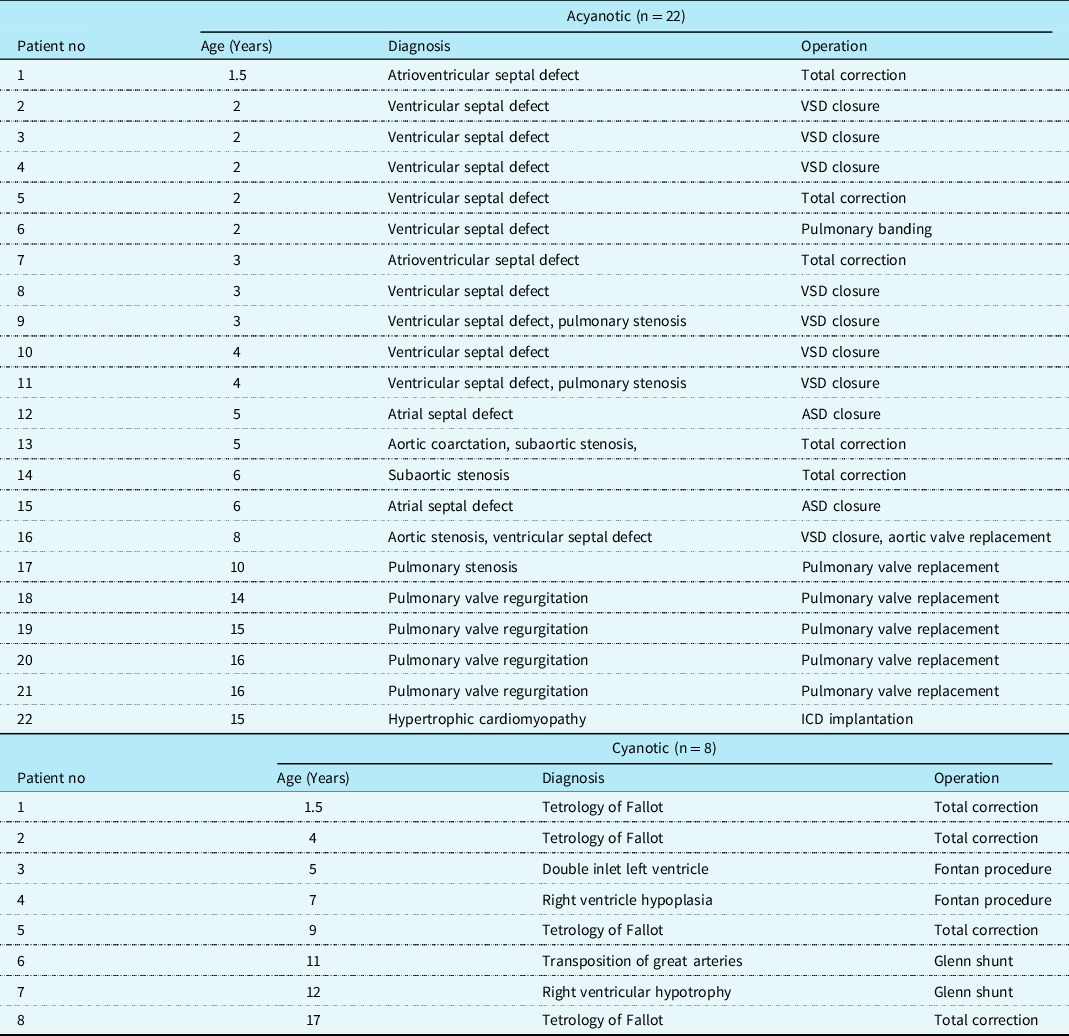
Thirty patients between 1 and 17 years were included in the study. Preoperative diagnosis of the patients and operative procedures are presented in Table 1. Twenty-two (73.3%) patients had acyanotic CHD, whereas the remaining had cyanosis at presentation. There were 12 patients (40%) who underwent surgery for a combined heart defect. Twenty-four patients (80%) underwent total corrective surgery, whereas a palliative operation was performed in the remaining (Fontan procedure in two patients, Glenn shunt in two patients, pulmonary banding in one patient, and intracardiac defibrillator implantation in one patient).
Preoperative diagnosis of the patients before congenital cardiac surgery and the operations performed

VSD: ventricular septal defect, ASD: atrial septal defect, ICD: implantable cardioverter defibrillator.
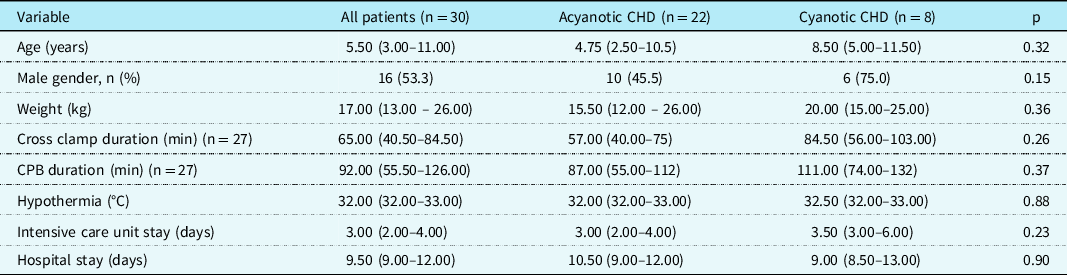
Baseline characteristics and clinical data are presented in Table 2. Median age was 5.5 (interquartile range, 3.00 to 11.00) years and there were 16 males (53.3%). Age, gender, and weight distribution were not significantly different between acyanotic and cyanotic patients (p = 0.32, p = 0.15 and p = 0.36, respectively). Cardiopulmonary bypass and cross clamping the aorta were used in 27 patients (90%). There were no significant differences between acyanotic and cyanotic patients regarding median cross clamp duration (p = 0.26) and cardiopulmonary bypass duration (p = 0.37). Median postoperative intensive care unit stay was 3 days (interquartile range, 2 to 4 days), and median postoperative hospital stay was 9.5 days (interquartile range, 9 to 12 days).
Baseline characteristics and clinical data

Note: Data presented as median (interquartile range) or n (%). Abbreviations: CPB = cardiopulmonary bypass. Independent samples Mann–Whitney U Test was used for comparison.
In the postoperative period, three patients received haemodynamic assist with extracorporeal life support due to cardiopulmonary failure, and two patients eventually died from the same cause.
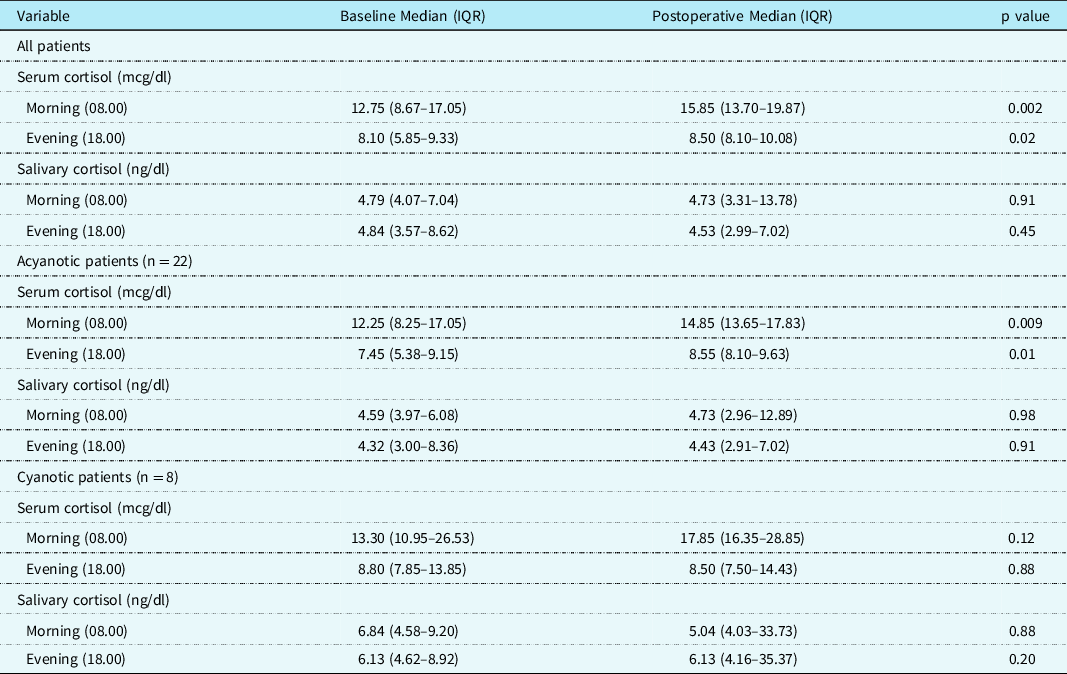
Serum cortisol and salivary cortisol levels showed no correlation (r = 0.34, p = 0.06 for preoperative morning measurement, r = 0.31, p = 0.08 for postoperative morning measurement, and r = 0.04, p = 0.83 for postoperative evening measurement) except for preoperative evening measurement (r = 0.46, p = 0.01). Median baseline serum cortisol of the entire group was 12.75 (interquartile range, 8.67 to 17.05) mcg/dl in the morning and 8.10 (interquartile range, 5.85 to 9.33) mcg/dl in the evening. There were no significant differences between acyanotic and cyanotic patients regarding median baseline serum cortisol levels, both in the morning and in the evening (p = 0.50 and p = 0.12). In the entire group, there was a significant increase in postoperative serum cortisol levels both in the morning measurements (increase up to median 15.85 [interquartile range, 13.70–19.87] mcg/dl, p = 0.002) and in the evening measurements (increase up to 8.50 [8.10 to 10.08] mcg/dl, p = 0.02). The postoperative increase in median serum cortisol was significant in the acyanotic patients (12.25 [interquartile range, 8.25 to 17.05] to 14.85 [13.65 to 17.83] mcg/dl in the morning, p = 0.009 and 7.45 [5.38 to 9.15] to 8.55 [interquartile range, 8.10–9.63] mcg/dl in the evening, p = 0.01), but the difference was not significant in the cyanotic patients (p = 0.88) (Table 3).
Comparison of serum and salivary cortisol levels between baseline and postoperative measurements

Note: Data presented as median (interquartile range). Related samples Wilcoxon Signed-Rank test was used for comparison.
Median baseline salivary cortisol of the entire group was 4.79 (interquartile range, 4.07 to 7.04) ng/dl in the morning and 4.84 (interquartile range, 3.57 to 8.62) ng/dl in the evening preoperatively that there were no significant differences between acyanotic and cyanotic patients (p = 0.11 and p = 0.11, respectively). There was no significant postoperative change in median salivary cortisol levels in the entire group (Table 3). Postoperative salivary cortisol levels showed no correlation between cross clamp duration (r = -0.78, p = 0.70 in the morning and r = 0.17, p = 0.37 in the evening) and cardiopulmonary bypass duration (r = 0.004, p = 0.98 in the morning, r = 0.19, p = 0.32 in the evening).
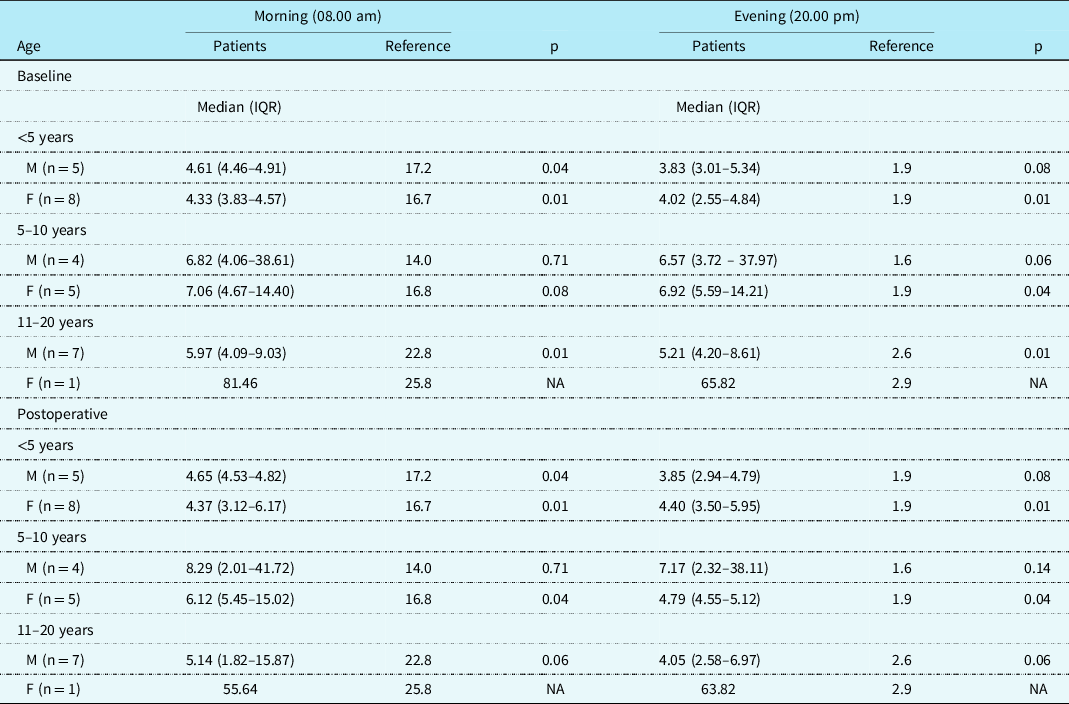
When compared to the 95th percentile index reference value, preoperative median baseline morning salivary cortisol levels were significantly lower in both females (p = 0.01) and males (p = 0.04) under the age of five. Median baseline morning salivary cortisol level was also significantly lower in males between the ages of 11 and 20 (p = 0.01). Median baseline preoperative evening salivary cortisol levels were significantly higher than the reference value in under five years old females (p = 0.01), between 5 and 10 year-old females (p = 0.04), and between 11- and 20-year-old males (p = 0.01). Median postoperative morning salivary cortisol levels were significantly lower than the reference value in both females (p = 0.01) and males (p = 0.04) under five years of age and females between 5 and 10 years of age (p = 0.04). Median postoperative evening salivary cortisol levels were significantly higher than the reference value in females under 5 years of age (p = 0.01) and females between 5 and 10 years of age (p = 0.04) (Table 4).
Comparison of patients’ median salivary cortisol levels with 95th percentile index reference values (concentrations are given in ng/dl)

Note: All values are presented in ng/ml. Data presented as median (interquartile range). One-sample Wilcoxon Signed-Rank test used for comparison. Abbreviations in the age column M = male, F = female.
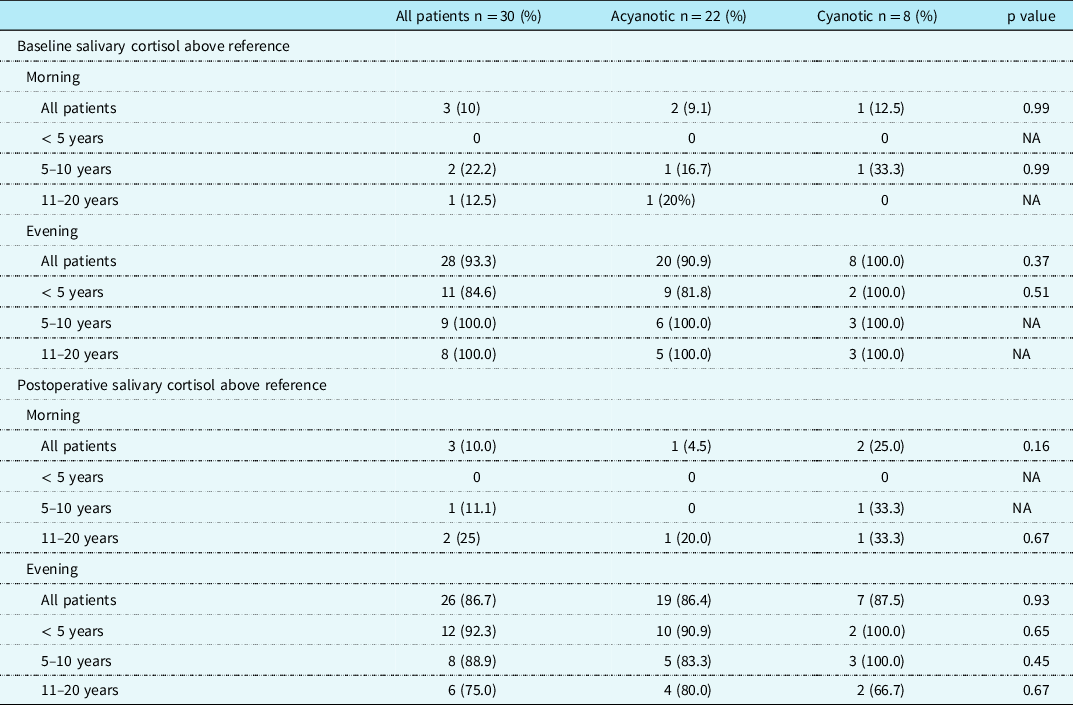
Baseline preoperative salivary cortisol level was above the reference index value in morning measurements in three patients (10%), in evening measurements in 28 patients (93.3%), and postoperative salivary cortisol levels in three patients (10%) in morning measurements and in 26 patients (86.7%) in evening measurements, and the frequencies were not significantly different between acyanotic and cyanotic patients (Table 5).
Number of patients with salivary cortisol levels above the reference index limit by age and gender

Discussion
We hypothesised that salivary cortisol may be more consistent and suggestive in the perioperative period than serum cortisol in children with CHD, in terms of reflecting the level of psychological stress experienced by children scheduled for surgery, as well as the pathophysiological stress arising from the mechanism of cardiac disease. We considered both the diurnal variability of salivary cortisol levels and their distance from reference values. Since the hypoxic state in CHD may alter the regulation of the hypothalamic–pituitary–adrenal axis, we compared salivary cortisol levels between cyanotic and acyanotic patients.
We found that salivary cortisol levels were significantly lower than the index reference values reported by CIRCORT database, Reference Miller, Stalder and Jarczok10 which is a very large series derived from 15 field studies, in morning measurements and significantly higher in almost all age and gender groups in evening measurements preoperatively. However, salivary cortisol levels do not show a positive correlation with serum cortisol levels either in the preoperative or postoperative period and the significant increase in serum cortisol levels in the postoperative period was not observed in salivary cortisol levels. That means salivary cortisol is an alternative marker against serum cortisol.
There have been several studies reporting normal ranges of salivary cortisol levels in healthy children and rarely in patient series. The mean values or reference ranges reported for children are equivocal across studies, due to the use of different kits and devices and the noncompliant behaviour of children and parents during the saliva collection protocol. Reference Kaitz, Sabato, Shalev, Ebstein and Mankuta11–Reference Titman, Price and Hawcutt17 Kaitz et al. Reference Kaitz, Sabato, Shalev, Ebstein and Mankuta11 investigated the effect of noncompliance on measurement levels during saliva collection in 181 preschool children around the age of 4 years. They reported that 12% of the children acted non-compliant in at least one collection trial, and the salivary cortisol levels of those who were noncompliant but did not refuse to give samples were higher than the compliant children. In this study, the average salivary cortisol level reported in compliant children by taking the average of four samplings was 2.10 ng/dl. Reference Kaitz, Sabato, Shalev, Ebstein and Mankuta11
The “cortisol awakening response,” which is called the cortisol rise that occurs within 1 hour after waking up in the morning, has recently aroused interest as an important marker of psychobiological stress in humans. Compared to serum cortisol, salivary cortisol measurement is thought to better quantify the cortisol awakening response in children, since it does not cause fear of needle sticks. However, since this response is unique to the individual, the morning increase in salivary and cortisol levels will not occur at the same time in every child. Reference Kudielka, Gierens, Hellhammer, Wüst and Schlotz12 Michels et al. Reference Michels, Sioen, De Vriendt, Huybrechts, Vanaelst and De Henauw13 reported that morning median salivary cortisol levels were around 8 to 12 ng/dl in 444 children aged between 5 and 11 years. In the study, it was emphasised that all eight samples to be taken from each child could be completed only in 78.8% of the children because the time points did not correspond to the waking time of the children (time non-compliance). In this study, it was determined that there was no morning peak in almost half of the children. Reference Michels, Sioen, De Vriendt, Huybrechts, Vanaelst and De Henauw13 When we compared the morning salivary cortisol levels of our patients with the recently published CIRCORT database data, which is a very large series derived from 15 field studies, we found that only 10% of the children had morning salivary cortisol levels above the index reference value. Reference Miller, Stalder and Jarczok10 When compared by grouping according to age and gender, we found that our patients’ morning salivary cortisol levels were well below the reference values. In the evening measurements, the decrease in reference values did not occur in the values of our patients, on the contrary, we found that our patients’ salivary cortisol levels were statistically significantly higher. Our finding that the morning rise and evening decrease in salivary cortisol levels were not observed in children with CHD may be due to sampling non-compliance as well as the loss of diurnal regulation of the hypothalamic–pituitary–adrenal (HPA) axis due to the underlying disease in these children.
Congenital heart surgery operations are essential for survival of children with CHDs and to achieve a functional capacity close to their peers, but it is almost inevitable that patients in such early childhood will be exposed to psychological and physiological trauma during the treatment process. Reference Menahem, Poulakis and Prior18 We also tried to shed some light on whether salivary cortisol can be used as a marker of stress response in children following congenital heart surgery. As we mentioned above, evening salivary cortisol levels were above the reference values in most patients both preoperatively and postoperatively. However, we found no significant changes in morning or evening salivary cortisol levels in the postoperative period, neither in cyanotic patients nor in acyanotic patients. Moreover, salivary cortisol levels were not correlated with cross-clamp and cardiopulmonary bypass times as parameters indicating the complexity of the surgery. We interpret these findings as surgical stress may not have caused a further increase in cortisol levels in the postoperative period, as HPA axis regulation was already lost due to underlying CHD.
Our study had several limitations. Small sample size, age and diagnosis heterogenity, and lack of a normal healthy control group are major limitations. In a narrower age group, salivary cortisol values obtained from children with a specific type of CHD could produce a more reliable and consistent data output. Comparison with a control group of healthy volunteers matched for age and physical trait could clarify the quality of salivary cortisol as a stress marker in children undergoing congenital heart surgery.
There are two major limitations in our study design. First, although there are cyanotic and acyanotic patients in the study group preoperatively, due to the palliative procedures, right-to-left shunt is persistent postoperatively in patients who underwent palliative procedures. Second, all of the patients were not operated on utilising cardiopulmonary bypass. These two limitations may affect the postoperative salivary cortisol levels.
In conclusion, diurnal variability of salivary cortisol levels in children undergoing congenital heart surgery may be different from normal reference values. Variability of salivary cortisol levels on both pre- and postoperative period may be a useful indicator of stress and anxiety status of children who undergoing paediatric cardiac surgery. Stress response to cardiac surgery is an unvalued but important parameter especially in children. We believe that our results are important in that they show that salivary cortisol is a useful stress indicator. With these findings, it will be possible to make suggestions especially on postoperative stress management in children. Further study is needed to determine reference values and to assess whether salivary cortisol reliably reflects the stress response in these children.
Acknowledgements
None.
Financial support
This research received no specific grant from any funding agency, commercial or not-for-profit sectors.
Conflicts of interest
None.
Ethical standards
The authors state that all procedures contributing to this work comply with the ethical standards of the relevant national guidelines on human experimentation and with the Helsinki Declaration of 1975, as revised in 2008.