





India’s geographic diversity and demographic density render it highly vulnerable to recurrent disasters, including floods, cyclones, earthquakes, landslides, heatwaves and industrial accidents, making psychosocial disaster preparedness a pressing public health priority. The psychological consequences of such events are substantial and well documented: epidemiological reviews demonstrate elevated rates of post-traumatic stress disorder, depression, anxiety disorders and prolonged grief among disaster-affected populations. Reference Norris, Friedman, Watson, Byrne, Diaz and Kaniasty1,Reference Galea, Nandi and Vlahov2 Indian disaster psychiatry literature similarly reports considerable psychiatric morbidity following major disasters, with prevalence varying according to exposure intensity and contextual vulnerability. Reference Math, Nirmala, Moirangthem and Kumar3
The Inter-Agency Standing Committee (IASC) estimates that 15–20% of individuals affected by humanitarian emergencies develop mild to moderate mental disorders requiring focused psychosocial intervention, with a smaller proportion developing severe disorders requiring specialist care. 4 These needs occur within the context of severe pre-existing treatment gaps characteristic of many low- and middle-income countries (LMICs) where mental health professionals are concentrated predominantly in urban centres, leaving rural and resource-constrained populations with severely limited access.
India’s disaster governance framework has evolved substantially over two decades, with the National Disaster Management Guidelines on Mental Health and Psychosocial Support Services in Disasters 5 representing its most comprehensive articulation to date, aligning with international standards, including the IASC Guidelines on Mental Health and Psychosocial Support in Emergency Settings. 4 Despite advances in policy frameworks for psychosocial care in disasters, challenges remain in translating policies into action at the district and community levels. Limited attention has been paid to defining activation pathways, clarifying roles and integrating trained personnel into disaster governance – a gap with direct relevance for LMIC health systems broadly.
This Special Paper presents a reflective implementation commentary informed by the authors’ participation in a state-level, multicentre, residential training programme conducted by the National Institute of Mental Health and Neurosciences (NIMHANS), India, combined with a narrative review of relevant policy documents and published literature. Sources were identified primarily through Indian disaster policy documents, World Health Organization (WHO) and IASC guidance and recent LMIC-focused implementation reviews published within the past decade.
Accordingly, this article does not report formal evaluation data, competency assessments or implementation outcomes, but synthesises experiential observations and published evidence to examine the gap between psychosocial training initiatives and operational integration within disaster response systems. Although LMICs differ substantially in governance arrangements and workforce capacity, comparable implementation challenges involving resource mobilisation, referral continuity and integration of psychosocial services within emergency response structures have been documented across humanitarian settings and developing-country contexts, Reference van Ommeren, Hanna, Weissbecker and Ventevogel6,Reference Rowe and Nadkarni7 and the Indian experience is presented as illustrating potentially transferable lessons rather than a uniform LMIC pattern.
Capacity building and the implementation gap
Under India’s central scheme on Health Sector Disaster Preparedness, the Department of Psychosocial Support in Disaster Management at NIMHANS, an Institute of National Importance and WHO Collaborating Centre, conducts state-level residential training on psychosocial disaster care. In one western Indian state, the programme was delivered across three centres for decentralised participation. The authors joined one centre as part of an interprofessional cohort including medical officers, psychiatric nurses, public health professionals and health administrators.
The 5-day curriculum progressed from foundational concepts to applied competencies, covering hazard, risk and vulnerability mapping; psychological first aid; recognition of disaster-related psychological reactions; and stepped-care psychosocial intervention. Dedicated modules addressed the specific needs of vulnerable groups, including women, children, persons with disabilities, older adults and individuals with pre-existing mental illness, alongside referral planning, documentation standards and provider self-care. The interprofessional residential format facilitated collaborative learning across institutional roles, enabling discussions to evolve towards coordination, role clarity and referral planning – processes that closely mirror team-based disaster response functioning.
Such initiatives represent meaningful efforts to operationalise Mental Health and Psychosocial Support (MHPSS) guidelines at the state and district level. However, participation in structured training also reveals a consistent systemic constraint: many trained professionals return to institutions where psychosocial responsibilities are not formally embedded within district disaster management plans. India’s District Mental Health Programme (DMHP) operates in most districts nationally, yet its integration within district disaster incident command systems remains variable and inconsistently operationalised, potentially limiting the systematic mobilisation of psychosocial support during emergencies. This gap between individual competency development and institutional deployment readiness reflects a structural challenge documented across LMIC disaster health systems. Reference Rowe and Nadkarni7 These observations highlight the fact that capacity-building initiatives must be paired with clear operational pathways to deploy trained personnel effectively during disasters.
Systems-level gaps in psychosocial activation
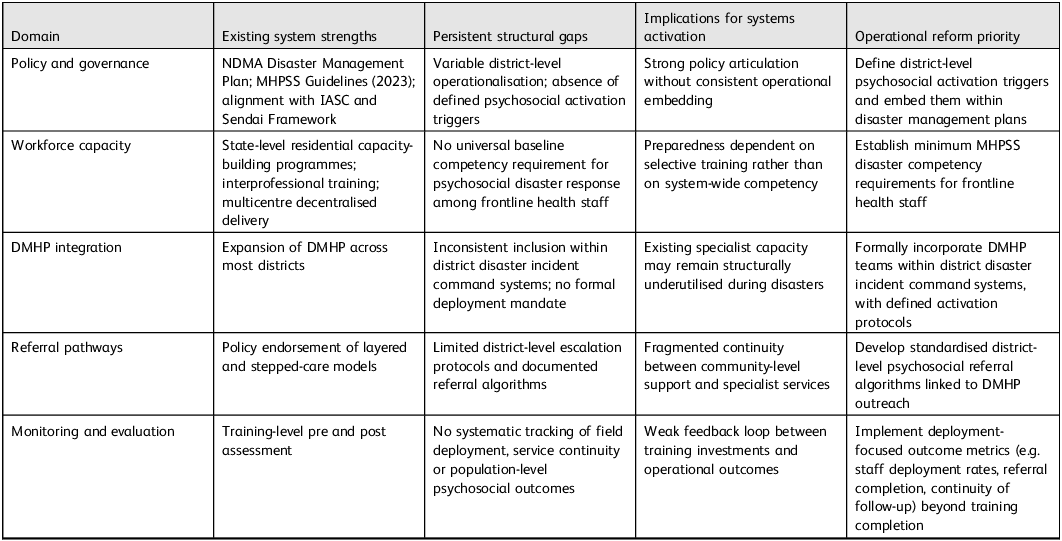
In the Indian context, the persistent disconnect between capacity-building initiatives and operational deployment can be understood across five systemic domains: policy and governance, workforce capacity, DMHP integration, referral pathways and monitoring and evaluation. As summarised in Table 1, each domain reveals a consistent pattern in which existing policy and programme strengths are not matched by operational embedding at the district level, resulting in preparedness that remains selective rather than systemic.
Systems-level gaps in psychosocial disaster preparedness in India

Table 1 Long description
A table summarizing systemic gaps in psychosocial disaster preparedness across five domains in India. The table has five rows and five columns. The columns are labeled Domain, Existing system strengths, Persistent structural gaps, Implications for systems activation, and Operational reform priority. The rows are labeled with the domains: Policy and governance, Workforce capacity, DMHP integration, Referral pathways, and Monitoring and evaluation. Each cell contains detailed text describing the specific aspects of each domain. Row 1: Policy and governance, NDMA Disaster Management Plan; MHPSS Guidelines (2023); alignment with IASC and Sendai Framework, Variable district-level operationalisation; absence of defined psychosocial activation triggers, Strong policy articulation without consistent operational activation triggers and embed the level within disaster management plans, Define district-level psychosocial activation triggers and embed the level within disaster management plans. Row 2: Workforce capacity, State-level residential capacity-building programmes; interprofessional training; multicentre competency delivery, No universal baseline competency requirement for psychosocial disaster response among frontline health staff, Preparedness dependent on selective training rather than on system-wide competency, Establish minimum MHPSS disaster competency requirements for frontline health staff. Row 3: DMHP integration, Expansion of DMHP across most districts, Inconsistent inclusion within district disaster incident command systems; no formal deployment mandate, Existing specialist capacity may remain structurally underutilised during disasters, Formally incorporate DMHP teams within district disaster incident command systems, with defined activation protocols. Row 4: Referral pathways, Policy endorsement of layered and stepped-care models, Limited district-level escalation protocols and documented referral algorithms, Fragmented continuity between community-level support and specialist services, Develop standardised district-level psychosocial referral algorithms linked to DMHP outreach. Row 5: Monitoring and evaluation, Training-level pre- and post-assessment, No systematic tracking of field deployment, service continuity or population-level psychosocial outcomes, Weak feedback loop between training investments and operational outcomes, Implement deployment-focused outcome metrics (e.g. staff deployment rates, referral completion, continuity of follow-up) beyond training completion.
NDMA, National Disaster Management Authority; MHPSS, Mental Health and Psychosocial Support; IASC, Inter-Agency Standing Committee; DMHP, District Mental Health Programme.
These structural gaps indicate that psychosocial preparedness remains insufficiently institutionalised within disaster governance frameworks. In the absence of clearly defined activation pathways and role delineation, trained personnel may face uncertainty about their responsibilities during emergencies, constraining coordinated deployment and continuity of care. Psychosocial response efforts consequently risk dependence on individual initiative rather than structured institutional mechanisms – a pattern that limits scalability, sustainability and effective mobilisation of available mental health expertise.
Systematic reviews in other LMIC settings have similarly found that psychosocial components are frequently activated later and less systematically than physical health services, with continuity of care disrupted during the transition from acute to recovery phase. Reference Purgato, Uphoff, Singh, Thapa Pachya, Abdulmalik and van Ginneken8,Reference Troup, Fuhr, Woodward, Sondorp and Roberts9 In many LMICs these barriers are compounded by fragmented health governance, competing humanitarian priorities and the absence of dedicated mental health budgets within national disaster management frameworks. Reference Troup, Fuhr, Woodward, Sondorp and Roberts9 From an implementation perspective, these recurring barriers can be understood as challenges related to organisational readiness, service integration and sustainability of care – factors that influence the extent to which psychosocial services become embedded within routine disaster response systems. Addressing these gaps requires not only expanded training but also institutional mechanisms that formally embed psychosocial functions within disaster governance structures.
A stepped-care psychological triage framework
Layered models of mental health and psychosocial support emphasise a continuum of care ranging from community-based psychosocial assistance to specialised psychiatric services, with international frameworks providing decision-support tools for non-specialist providers in emergency contexts. 4 However, frontline providers in district disaster settings require simplified, action-oriented decision-support tools that directly link psychological presentations to referral pathways and provider responsibilities. Without such operational guidance, psychosocial responses risk fragmentation and delayed escalation.
Although the widely used MHPSS pyramid provides a valuable organising framework, it offers limited practical direction for frontline personnel who must rapidly assess presentations and determine appropriate response levels under field conditions. 4 The stepped-care model, in which intervention intensity is matched to clinical need and escalated only when lower-intensity responses prove insufficient, offers a resource-efficient organising principle well-suited to LMIC resource constraints, Reference Berger, Fernando, Churchill, Cornish, Henderson and Shah10 with evidence from South Asian humanitarian contexts supporting the feasibility of non-specialist delivery at lower tiers with appropriate supervisory support. Reference Rahman, Hamdani, Awan, Bryant, Dawson and Khan11
Drawing on these frameworks and Indian disaster psychiatry literature, Reference Math, Nirmala, Moirangthem and Kumar3,5 we propose a conceptual, implementation-oriented, stepped-care, psychological triage framework for district disaster response systems. This framework complements existing MHPSS models by translating broad service-delivery principles into practical referral and escalation pathways for frontline providers working in resource-constrained settings. Unlike the IASC layered model or the WHO Mental Health Gap Action Programme decision-support tools, which provide broad guidance on service delivery, the present framework explicitly links tier-based responses to district-level structures, including DMHP teams and incident command systems.
The framework is intended to support documentation, supervision and coordination with district disaster command structures while explicitly avoiding diagnostic labelling by non-specialist providers. It remains a conceptual, implementation-oriented heuristic and its triage thresholds, provider role boundaries, escalation criteria and follow-up intervals – particularly the distinction between tiers 2 and 3 – will require local piloting, empirical evaluation and contextual refinement through implementation research before broader adoption.
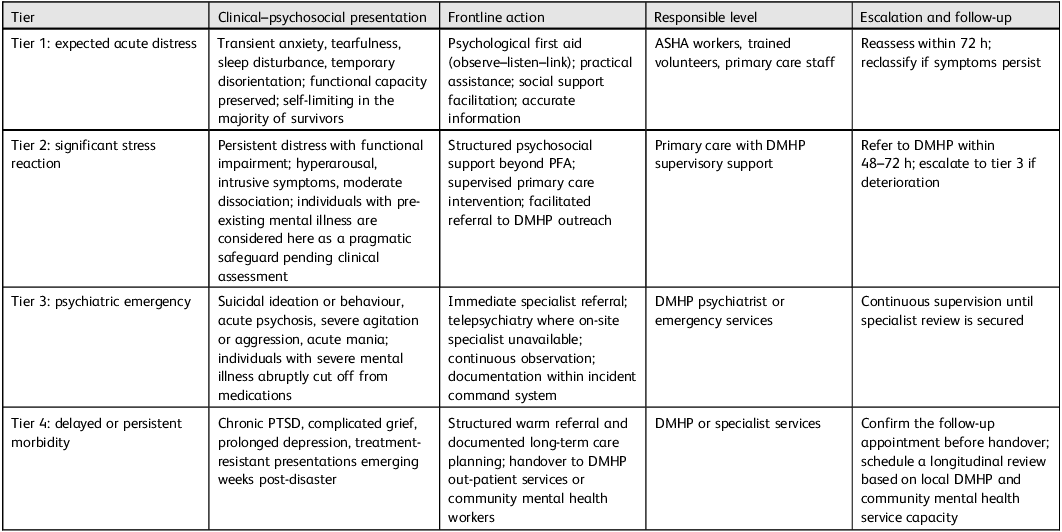
Table 2 presents the framework’s structure, organising psychosocial presentations across four tiers from expected acute distress through deferred intensive care, with each tier specifying frontline actions, responsible care levels and escalation thresholds within district disaster response systems. Particular attention is warranted for groups who may face heightened psychological impact and additional barriers to accessing support – including women, children, persons with disabilities, older adults and individuals with pre-existing mental illness – for whom a lower threshold for referral to higher tiers of care is appropriate. Importantly, tiers 1 and 2 interventions are supportive and non-specialist in nature and are not intended to substitute for formal psychiatric or psychological treatment when clinically indicated.
Operational stepped-care psychological triage framework for district-level disaster response in India

Table 2 Long description
The table has four rows and four columns. The columns are labeled ‘Tier’, ‘Clinical-psychosocial presentation’, ‘Frontline action’, ‘Responsible level’, and ‘Escalation and follow-up’. The rows are labeled ‘Tier 1’, ‘Tier 2’, ‘Tier 3’, and ‘Tier 4’. Row 1: Tier 1, expected acute distress, Transient irritability, tearfulness, sleep disturbance, temporary disorientation, functional capacity preserved, self-limiting in the majority of survivors, Psychological first aid (observe-listen-link); practical assistance, social support facilitation, accurate information, ASHA workers, trained volunteers, primary care staff, Reassess within 72 h; reclassify if symptoms persist. Row 2: Tier 2, significant stress reaction, Persistent distress with functional impairment, hyperarousal, intrusive symptoms, moderate dissociation, individuals with pre-existing mental illness are considered here as a prognostic safeguard pending clinical assessment, Structured psychosocial support beyond PFA; supervised primary care intervention; facilitated referral to DMHP outreach, Primary care with DMHP supervisory support, Refer to DMHP within 48–72 h; escalate to tier 3 if deterioration. Row 3: Tier 3, psychiatric emergency, Suicidal ideation or behaviour, acute psychosis, severe agitation or aggression, acute mania, individuals with severe mental illness abruptly cut off from medications, Immediate specialist referral; telepsychiatry where onsite specialist unavailable; continuous observation; documentation within incident command system, DMHP psychiatrist or emergency services, Continuous supervision until specialist review is secured. Row 4: Tier 4, delayed or persistent morbidity, Chronic PTSD, complicated grief, prolonged depression, treatment-resistant presentations emerging weeks post-disaster, Structured warm referral and documented long-term care planning; handover to DMHP out-patient services or community mental health workers, DMHP or specialist services, Confirm the follow-up appointment before handover; schedule a longitudinal review based on local DMHP and community mental health service capacity.
ASHA, Accredited Social Health Activist; PFA, psychological first aid; DMHP, District Mental Health Programme; PTSD, post-traumatic stress disorder.
Policy and systems implications
Three priorities emerge from this analysis, each with relevance beyond the Indian context. First, formal integration of DMHP within district disaster management plans with explicit activation triggers, role delineation within incident command systems and standardised referral algorithms would transform existing specialist capacity into a deployable psychosocial rapid-response resource. This structural reform is largely achievable within existing institutional architecture, although the pace and feasibility of integration will vary with district-level staffing, financing and administrative capacity.
Effective implementation would require modest investments in coordination mechanisms, supervision arrangements and protected operational responsibilities. Each DMHP district team, comprising a psychiatrist, psychologist, psychiatric social worker and psychiatric nurse, constitutes an established interdisciplinary unit whose potential for disaster deployment remains largely unrealised. Potential barriers to this integration – including competing mandates and limited disaster-specific funding – may be addressed through mechanisms such as state-level initiatives, joint training exercises and coordination among health and other departments responsible for disaster management.
Second, the integration of psychological first aid and recognition of mental health emergencies into routine training for community health workers – such as India’s Accredited Social Health Activists – would extend psychosocial reach to the community level at scale, consistent with evidence on task-shifting in global mental health. Reference Purgato, Uphoff, Singh, Thapa Pachya, Abdulmalik and van Ginneken8,Reference Ndlovu, Lind, Patlán, Upadhaya, Leku and Akellot12 Strengthening coordination and leadership in disaster governance would improve accountability and continuity of care. Multi-country reviews indicate that comparable reforms, such as community health worker integration and intersectoral coordination, have been shown to be feasible in other LMIC disaster responses, supporting the transferability of this approach. Reference Rowe and Nadkarni7,Reference Ndlovu, Lind, Patlán, Upadhaya, Leku and Akellot12
Third, monitoring frameworks must move beyond measuring training completion to evaluating operational deployment rates, referral pathway functionality and psychosocial service continuity across disaster phases. This shift from output to outcome measurement would generate the implementation evidence needed to drive systemic reform – and is essential for any LMIC seeking to demonstrate that investment in psychosocial preparedness translates into meaningful service-level impact, with population-level outcomes remaining a longer-term aspiration requiring empirical evaluation. Evidence from LMICs confirms that MHPSS implementation is shaped by systemic barriers, including workforce limitations and resource constraints, whereas task-shifting, culturally adapted community engagement and structured referral pathways consistently emerge as facilitating elements directly applicable to the strengthening of disaster mental health architecture across LMICs. Reference Rowe and Nadkarni7,Reference Ndlovu, Lind, Patlán, Upadhaya, Leku and Akellot12
Conclusion
India illustrates challenges that may be relevant across many LMIC settings: despite substantial progress in psychosocial disaster policy and training capacity, activation mechanisms at district and community levels remain underdeveloped. The extent and nature of these challenges may vary across settings depending on governance structures, workforce capacity and disaster response systems. Embedding mental health within disaster governance structures, formalising referral pathways and scaling community-level task-shifting are not aspirational goals – they are achievable reforms within existing institutional architecture. The stepped-care triage framework proposed here offers one practical implementation tool, requiring field validation to realise its potential. Future implementation research should evaluate not only training completion but also operational deployment rates, referral pathway functionality and psychosocial service continuity across disaster phases. Mixed-methods implementation studies, pre–post evaluations of activation protocols and realist approaches may provide useful models for generating the evidence base needed to transition psychosocial preparedness from policy commitment to measurable systems performance in India and comparable LMIC settings.
Data availability
Data availability is not applicable to this article because no new data were created or analysed in this study.
Acknowledgements
The authors thank the faculty and resource personnel of the Department of Psychosocial Support in Disaster Management, NIMHANS, Bengaluru and the Department of Medical, Health and Family Welfare, Rajasthan, for organising the multicentre, capacity-building programme on psychosocial care in disaster management. The interprofessional cohort of participants at the Jodhpur centre, Rajasthan, India – whose diverse professional insights and sustained collegial engagement during the programme significantly informed the perspectives presented in this article, is acknowledged with particular appreciation.
Author contributions
A.S.: conceptualisation, investigation, methodology, writing – original draft, review and editing, guarantor. S.D.: investigation, writing – review and editing, final approval. N.P.: investigation, writing – review and editing, final approval.
Funding
This research received no specific grant from any funding agency, commercial or not-for-profit sectors.
Declaration of interest
None.

 Open access


eLetters
No eLetters have been published for this article.