Introduction: The End of the Lone Grainger
Towards the end of his life Percy Grainger declared that two of his best-known works, Shepherd’s Hey and Molly on the Shore, were so good ‘because there is so little gaiety & fun in them. Where other composers would have been jolly in setting such dance tunes’, he continued, ‘I have been sad or furious’.Footnote 1 His publisher, Schott Music Ltd, however, would beg to differ. It suggests that a work like Shepherd’s Hey is the ideal encore piece for an orchestra ‘that wishes to make its audience leave the concert hall with a smile on their faces’.Footnote 2 Or, more expansively – as John Blacking wrote in the 1980s – such music invites us to turn our attention ‘away from the Sturm und Drang of Germanic composers and the associated violence and torment of the European continent’ towards a civilized world of ‘English tennis parties, village fêtes, plus-fours, and home-made clothing of the 1920s and 1930s’.Footnote 3
Even a cursory glance at Grainger’s voluminous commentary on his own music reveals, however, that Grainger believed he was doing something very different indeed and it was a sincere belief, not the result of mere antipodean contrariness or attention-seeking. Composition, after all, was not an activity for which he was best known professionally during his life. Instead, it seems he did it precisely because it gave him a means of critiquing aspects of the civilized world that otherwise sustained him. Today, that critique can usefully inform our broader understanding of the anxieties and tensions about national identity, emotional authenticity and cultural loss that were common to many artists at the end of the nineteenth century. In this respect we might usefully place him alongside other fin de siècle composers such as Charles Ives, Gustav Mahler and Béla Bartók, who similarly explored the tensions between well-established romantic and nationalistic cultural impulses of the nineteenth century and the ever-growing internationalism and modernity of the twentieth.
By end of his life, however, Grainger feared that his chosen medium had got in the way of the message. In an outburst of frustration penned in 1951 he declared that ‘the entire musical world is entirely oblivious of the whole world of bitterness, resentment, iconoclasm & denunciation that lies behind my music’. Its worth, he continued, would ‘never be guessed, or its value to mankind felt, until the approach to my music is consciously undertaken as a pilgrimage to sorrows’.Footnote 4
Pilgrimage or not, a new, more rounded, consensus about Grainger’s music may now be emerging. A pivotal moment, perhaps, was the publishing of Wilfrid Mellers’ 1992 study of the composer.Footnote 5 It has as one of its foundational premises the notion that the often child-like and naïve quality of Grainger’s music does indeed belie an underlying seriousness of purpose. This is music, Mellers argues, which spoke to – and continues to speak to – very contemporary concerns.
More recently, Sarah Collins and Simon Perry’s contribution to Grainger the Modernist (Ashgate, 2015) – a title that would also have been unthinkable only a few decades ago – argues that Grainger’s pessimistic assessment of his own art directs us in particular to its relevance to wider cultural struggles at the end of the nineteenth century. Grainger, they posit, was signalling an oppositional relationship not only to the aesthetic and political prejudices of his audience, but also to many of the fraught social, sexual, political and racial issues of his times.Footnote 6
These shifts in attitude towards the claim to seriousness of Grainger’s art have been accompanied by shifts in performance culture (particularly in the UK and Australia). The most striking example is the undertaking of a now nigh-complete edition of recordings of his music by Chandos that began in 1992. Just as significantly, repertoire now regularly performed or broadcast extends far beyond the aforementioned Shepherd’s Hey and Molly on the Shore, and the ubiquitous Country Gardens; a state of affairs that, according to one early commentator on his posthumous legacy, had ‘obscured utterly the spirit and accomplishments of the man’, slowly driving ‘his reputation into the ground’.Footnote 7 There has also been a parallel shift in interest in academic circles, with several new books of Grainger’s writings appearing at the same time, spearheaded in particular by Malcolm Gillies and David Pear.Footnote 8 In those geographical centres most closely associated with his life (the United States, the United Kingdom, and Australia) there now seems to be a desire to look at and listen to Grainger’ music with fresh eyes and ears.
Furthermore, some of the broader historical assumptions that buttressed more traditional views of Grainger and his music have also been reassessed. Histories of the British Empire are now more likely to give weight not only to tracing the various ways people, goods and military and economic power were imposed and disseminated around the world, but also the ways in which the resulting contact between peoples and cultures ‘engendered new, more transnational, ways of thinking’, including new forms of sentiment and subjectivity.Footnote 9 The idea of a ‘British World’ that lies alongside the ‘British Empire’ has emerged, one that presumes the existence of a global community of shared cultural interests and experiences that extends beyond rigid geo-political borders and ethnic divisions. It encompasses ‘familial, cultural, commercial, and professional networks; flows of information, people, and ideas; and a sense of a shared identity and culture’.Footnote 10 The editors of Grainger the Modernist rightly, therefore, criticize those who have previously characterized Grainger as a ‘self-sufficient entity’, a ‘man out of his time. It is time, they say, to ‘de-bunk’ the ‘customary idea of Grainger as a lone individualist’.Footnote 11
Being in and of one’s time, however, is not the same as being in accord with it. To that end, Grainger’s repeated claims that he put his music at the service of ‘the complicated facts & problems of modern life’ invites further attention.Footnote 12 In the expository discussion that follows I want to suggest ways in which this and similar pronouncements he made about his music might be better understood in relation to his engagement with, or – equally – his opposition to, the cosmopolitan ‘British World’ culture he encountered at the turn of the century, and how such a perspective, in turn, might help us better understand some of the characteristics of his music.
Keeping the Jungle Law
Grainger’s particular interest in the poetry of another emblematic figure of fin de siècle British culture, Rudyard Kipling, here provides both a useful foundation and a key point of comparison, if only because Grainger occupied himself on and off with Kipling settings for 60 years and considered the Jungle Book Cycle to be ‘one of my very best works’.Footnote 13 But David Josephson flagged as early as 1973 that such a comparison would be especially useful because the problem we have with Kipling’s verse, as he saw it, was ‘exactly our problem’ with Grainger’s music. To properly assess the work of both men, he argued, we ‘are not provided with the proper critical tools’. We are inclined instead to dismiss their art by reference to criteria ‘which do not apply’. In the case of Kipling his verse presents us with a critical challenge that is:
the opposite of that with which we are ordinarily faced when attempting to defend contemporary verse. We expect to have to defend a poet against the charge of obscurity: we have to defend Kipling against the charge of excessive lucidity … we must defend Kipling against the charge of writing jingles.Footnote 14
In an extended appendix devoted to Grainger in his 1917 monograph The Philosophy of Musical Modernism, Cyril Scott had noted that Grainger, too, was not afraid of foregrounding in his art the obvious or commonplace. But it was only because he recognized and elevated forms of expression that lay in vernacular musical culture that he could ‘draw people to his musical heart, so to speak, whose own musicality is of the most meagre sort. In other words, Grainger appeals to the unmusical, just as Kipling appeals to the illiterate’.Footnote 15
According to Scott,
Grainger, then, unblushingly likes vulgarity, and I wish to emphasise the fact, because when the obvious and the vulgar appear in his music at times, it is not because nothing ‘occurs to him’ (to use a foreign idiom) but because, as with Kipling, the vulgar evidently means to him a certain strength.Footnote 16
Foregrounding the commonplace was, of course, no mere abstract aesthetic choice. It implied a criticism of established culture, of metropolitan sophistication, and of the social and economic forces that sustained it. For both men, commonplace culture pointed to a life-attitude of a kind they felt was ebbing away at the dawn of the twentieth century. Kipling found in India the continuation of an aspect of European culture now lost, a ‘world where our subjective and mutually alienated existences are comprehensible through common ritual and tradition’.Footnote 17 His poetry strived to reconcile this ‘old’ world with the emerging new one by promoting ‘a benevolent globalism in which all men are mutually dependent brothers, in place of a corrupting global market through which all become mutually alienated free agents’.Footnote 18 Grainger, similarly, looked forward to a time when an idealized pre-industrial past and alienated present could be reconciled:
the bulk of civilized men and women will come to again possess sufficient mental leisure in their lives to enable them to devote themselves to artistic pleasures on so large a scale as do the members of uncivilized communities. Then the spectacle of one composer producing music for thousands of musical drones (totally uncreative themselves, and hence comparatively out of touch with the whole phenomenon of artistic creation) will no longer seem normal or desirable, and then the present gulf between the mentality of composers and performers will be bridged.Footnote 19
In a more unguarded moment, in the wake of the critical failure of a performance of his setting of Kipling’s ‘The Inuit’ from the Second Jungle Book, Grainger wrote bitterly that ‘primitiveness is purity and civilization filthy corruption’, passing its ‘blighted hand over the wild’. We are left with not so much the ‘“the survival of the fittest” but “the survival of the fetidest”’.Footnote 20 The heart of Grainger’s argument, however, is not so much that pre-modern communities enjoyed art in ways that modern society no longer do, but rather that in such communities there had been need for a demarcation between everyday life and creative life at all.Footnote 21
The biographical parallels between Kipling and Grainger are also striking. Grainger considered Kipling to be ‘something like an Australian’ because of their shared experiences of being born on the fringes of the British Empire.Footnote 22 Both men had experienced major geographical dislocations from a young age, and although their childhood educational experiences were very different, in both cases they were encouraged to develop precociously wide-ranging literary interests by way of coping with those dislocations. Having avoided formal schooling, Grainger had been introduced by his parents and tutors to an impressive array of literature from Walt Whitman through the Nordic sages and eventually to Kipling himself.Footnote 23 Kipling was sent to England for his schooling, but he credits his unhappiness there and his consequent longing for a return to India for providing an early incentive to develop a similarly capacious literary imagination.Footnote 24
It is not surprising, then, that Grainger came to feel a strong personal as well as aesthetic connection to Kipling. Cyril Scott, a close friend from Grainger’s studies in Frankfurt, believed that ‘in finding Kipling he found also himself; or I should add, at any rate a great part of himself’.Footnote 25 As a result, he continued, ‘it is evident that his very marked style is largely called into being through his intense admiration for Rudyard Kipling the spirit of whom he has, I feel, translated into music in a way nobody else has’.Footnote 26
Since at least the 1970s, however, mainstream criticism of Kipling has been complicated by the rise of post-colonial discourse, so much so that it can be hard to appreciate the contemporary significance of his works beyond acknowledging, as we indeed must, the extent to which they gave literary voice to British imperial interests in all their racial and hegemonic crudity. Grainger himself wrote that as a result of his encounter with Kipling ‘I became what I have remained ever since, a composer whose musical output was based on patriotism and racial consciousness’.Footnote 27 And, as the work of Gillies and Pear has shown, there is no way we can avoid the realization that, if anything, Grainger’s racial views over his lifetime went ‘from being a naïve even playful, racialist to becoming an increasing intolerant racist’ which drew not only on Kipling’s example but also that of the American Nordicists and ideas he found in books like Madison Grant’s The Passing of the Great Race or The Racial Basis of European History (1916).Footnote 28 These excesses neither require nor deserve any special pleading.
But they are not the whole story. Alongside Grainger’s free-wielding, bombastic, and often contradictory rhetoric on race can also be found a concern with much more subtle and sophisticated understandings of social identity that, as in Kipling’s works, is expressed in a focus on the experiences of the ordinary men and women of Empire, and on the tragic elements of their lives, the ‘drownings, hangings, jailings, partings’ and so on. Perhaps these works still speak to us notwithstanding the problematic background because, as Kipling scholar W.J. Lohman Jr. puts it, the problems of the citizen of Empire – ‘loneliness and isolation – are [also] the problems of existential man’.Footnote 29 For all their outwardly reactionary and chauvinistic tendencies, Grainger and Kipling alike were ‘in fact dealing with one of the more serious problems of modern life long before Sartre and Camus brought it to general public attention’.Footnote 30 His settings also offer what Bob van der Linden has called an ‘imperial counterculture’, an unmistakably cosmopolitan colonial gaze that bore witness, in particular, to experiences of estrangement, violence and loss.Footnote 31 Or, as Grainger put it directly in a programme note for a performance his setting of Kipling’s The Widow’s Party (1939), he wished his works to speak to ‘the tragedy, not the splendours of imperialism’.Footnote 32
To take just one example, his setting of Kipling’s ‘Love Song of Har Dyal’ which appeared in the latter’s Beyond the Pale of 1888, tells of the disastrous consequences when an English man becomes involved with an Indian widow. ‘Come back to me, Beloved, or I die!’, the widow exclaims, but the musical setting of this refrain, through sense of growing urgency in the accompaniment, and ultimately, through a wrench of tonal centre from the home key of F minor to F-sharp minor, help underline what is already implicit in the poem itself, that there is not going to be any happy resolution to her fate. The conception of such a protagonist may well be viewed critically today through the filters of empire, race, class and gender, but we can also hear that accompanying her cry for her lover is already a cry, sotto voce, of protest.
Another explanation for why an interest in suffering is such a focus of these works (albeit one that deserves more expansive investigation on its own) might also lie in Grainger’s and Kipling’s shared experience of physical cruelty as children. In Grainger’s case this was largely at the hands of his mother Rose, something which is also cited by biographer John Bird as the origin for his own interest in sadomasochism. In Kipling’s case it was courtesy of fellow pupils and staff at the School he attended in Devon.Footnote 33 Not only were all of Grainger’s Kipling settings to be dedicated to his mother, a theme from his Kipling Setting No. 1, Dedication, which is a hymn to filial affection, is quoted by Grainger in each of his two Hill Songs. The text that accompanies the original is ‘Mother o’ mine!’.Footnote 34 The last of the ‘Jungle Book’ works, Mowgli’s Song against People, composed for Rose’s forty-second birthday in 1905, is a setting of Kipling-inspired ‘protest against civilization’.Footnote 35 But it is also implicitly a protest against the restrictions his mother placed on his personal life and the distressing compromises he had to make as a result. In combining the two, however, Grainger appears to be suggesting a more substantive connection between the autobiographical and societal critiques – they shared an origin in the alienated condition of the individual in modern society.
Such a dual critical purpose is even more explicit in The Bride’s Tragedy a birthday gift for Rose in 1908 (which he scored some six years later). It is a setting not of Kipling but of a poet closely associated with Kipling in Grainger’s own mind, A.C. Swinburne.Footnote 36 Grainger later wrote that when he composed it he ‘felt it was (in a way) describing my own case – the young man who loses his sweetheart because his mother delays him. I even dedicated the work to mother, as if to say “This is partly your work”’.Footnote 37
The Bride’s Tragedy premiered in May 1922 at the Evanston Festival, just a month after Rose committed suicide in New York.Footnote 38 It recounts the story of a girl who is rescued at the church door from an arranged marriage by her lover. The pair is pursued by the bridegroom and her own family and are drowned while trying to make their escape across a flooded river. In a letter to Alfhild Sandby several years later, however, he explained that it was also:
my personal protest against the sex-negation that our capitalist world … offered to young talents like me. A man cannot be a full artist unless he is manly, & a man cannot be manly unless his sex-life is selfish, brutal, wilful, unbridled. But the main stream of thot in our age sets its face against such manliness as has always seemed right and proper to me. Well, there was no need to lose one’s temper about it. But the situation called for a protest, I felt, & The Bride’s Tragedy was my protest, & the angry chords on the brass (at the first singing of ‘they lie drowned & dead’) is my personal bitterness.Footnote 39
All the same, Grainger recognized that acts of self-realization often came at a severe cost to others, what he called ‘love’s ruthless sway’. Psychoanalytical theory, too, would support Grainger’s contention that the masculine desire for independence ‘corresponds to the role of destroying and negating in erotic domination’.Footnote 40 In turn that implied self-resourcefulness and mastery over the environment-at-large. Indeed, if we accept a key thesis of John Kucich’s Imperial Masochism: British Fiction, Fantasy, and Social Class, it is also possible to connect Grainger’s interest in personal self-abnegation and suffering with a broader critique of mainstream culture of the time. Both share, in the private and public sphere respectively, an investment in scenarios of sacrifice and submission.Footnote 41 Grainger believed he had not been brought up by Rose to be able competently to negotiate these circumstances, instead he was made ‘to become a worldfamed whim-tickling wonderchild & artman, earning a lordly spongeguestful living off the back of a mad, sad, sick, rotten world’.Footnote 42
Not surprisingly, Grainger’s views on state-sponsored violence were also both critical and pessimistic, even more explicitly so than Kipling’s.Footnote 43 The latter’s Barrack-Room Ballads (1889–91) while undeniably written from the soldier’s point of view, are nevertheless premised on the idea that violence is an unavoidable aspect of humanity, one that has to be both ‘simultaneously encouraged and disciplined if the soldier is to enter battle with a realistic attitude toward danger and a knowledge of what he must do to survive’.Footnote 44 Grainger, on the other hand, believed his art should be not so much an emollient in the face of the inevitability of state-sanctioned violence as a direct protest against it:
We live in an art-rich age because of all the heart-breaking things that are happening all around us – young men needlessly killed in the wars, people dying before their time because of their silly eating-wonts & living wonts, millions of tame-beasts murdered every day, countless love-stirs & art-stirs bootlessly squelched because of the mood of vie-ment & sin-search we live in. In such an age the only thing an art-man can do is let out one everlasting grumble-shout. And the sourer the grumble, the louder the shout, the greater the art man. That is why I feel myself to be an over-soul, because ever since I was about 7 years old I have felt the cruel-hoods & mean-nesses of the world like a knife going through me.Footnote 45
His most explicit anti-war work, albeit one towards which the composer had decidedly mixed feelings, is The Power of Rome and the Christian Heart.Footnote 46 Grainger writes in the programme note:
Just as the early Christians found themselves in conflict with the power of ancient Rome so, at all times and places, the Individual Conscience is apt to feel itself threatened or coerced by the Forces of Authority–and especially in wartime. Men who hate killing are forced to be soldiers, and other men, though not unwilling to be soldiers, are horrified to find themselves called upon to fight in the ranks of their enemies. The sight of young recruits doing bayonet practice in the First World War gave me the first impulse to this composition which, however, is not in any sense program music and does not portray the drama of actual events. It is merely the unfoldment of musical feelings that were started by thoughts of the eternal agony of the Individual Soul in conflict with the Powers That Be.Footnote 47
In an interview with Daniel Sternberg in 1946 he expanded further:
Well, while I was in the band, I use to see young boys doing bayonet practice, and I thought of all the different people who’d been forced into the various armies of the world. For instance, Danes, who happen to be born across the border, being forced into the German army, and other people who’d just come here from Europe being forced into the American army. And finding themselves fighting against the people they’d been brought up with … And that seemed to be very sad, and it … I thought about it a great deal and it started a mood. It also made me think of all those other situations, such as that of the early Christians in Rome. Anybody who has any strong beliefs or any strong feelings is always likely to find themselves in conflict with the authorities that exist at the moment. And it isn’t a question whether those authorities are right or wrong, or whether the young people are right or wrong. But it’s very … it’s a very torturing kind of condition … I wrote [The Power of Rome and the Christian Heart] out of the depression that was generated in me by the sight of all these things … It has no meaning. It just has no … It points [to] no paths. It offers … no solution. It simply is grouchy. It simply grumbles at the sad condition of tyranny and torturing.Footnote 48
For Mellers, the score The Power of Rome and the Christian Heart bears the signs of this divided mind, fluctuating between stark diatonicism and ‘oleaginous chromaticism’, as Grainger does between feelings of resignation and protest in the face of violent oppression. He suggests, however – and rightly in my view – that such a ‘problematic nature is fundamental to the Grainger experience’. It helps us understand Grainger’s instinctive understanding of (and the will to seek the means of expressing) some of the deep conflicts of his, and indeed our, age.Footnote 49
Love’s Ruthless Sway
Dark themes of violence and loss also dominate his folk-song settings. Here people are betrayed by love or die (or frequently both) with depressing regularity. In part, of course, this is a reflection of the source material itself. Folk-songs are often ‘saturated in apprehension or even dread’ a reflection, perhaps, of their possible ritualistic function; ‘the phantom of death, always just around the corner, defines the life’.Footnote 50 Grainger certainly recognized their capacity to give ‘voice the painfulness of human life’, but he also wanted to give them a contemporary frame, declaring that his ‘chief musical interest’ lay not in fact in such music or ‘any other form of single line melody’ per se, rather in the ‘group-melodiousness’ that arose from his arrangements, and the expressive harmony that it brings forth.Footnote 51 There was an explicitly critical political programme to this focus because ‘[w]e see on all hands the victorious on-march of our ruthless Western civilization (so destructively intolerant in its colonial phase) and the distressing spectacle of the gentle but complex native arts wilting before its irresistible simplicity’.Footnote 52
Grainger’s folk-song reviving was not, therefore, driven principally by chauvinistic sentiment, but in fact by desire to play against the tendency of both capitalist and imperialist interactions to undermine local cultures.Footnote 53 In a broadcast from 1933 entitled ‘Can Music Become a Universal Language?’, Grainger wrote that he believed that music might
someday become a ‘universal language’. But it will not become so as long as our musical vision is limited to the output of 4 European countries between 1700 and 1900. The first step in the right direction is to view the music of all peoples and periods without prejudice of any kind, and to strive to put the world’s known and available best music into circulation.Footnote 54
And of course, he practised what he preached; the fieldwork he undertook on English and Danish folk-song and the music of the peoples of the South Pacific remains one of his most important achievements and legacies.
That being said, he did particularly value Nordic folk music, and that attraction was undoubtedly empowered by his own racial preferences. He argued, nonetheless, that it had a particular claim to ‘depth, intensity, beauty and complexity’, because, the Scandinavian races, unlike his own culture, demonstrated the most ‘willingness to face the greatest possible sadness’.Footnote 55 A supreme example of this interest can be found in his setting of the Danish folk-song ‘The Power of Love’. It was composed immediately after his mother’s death in April 1922 in no small part because it seemed to match Grainger’s ‘own soul-seared mood of that time – my new-born awareness of the doom-fraught undertow that lurks in all deep love’.Footnote 56 A sort of Danish Romeo and Juliet, the original ballad, as Grainger describes it, ‘tells the story of a maiden who has a clandestine lover. Her seven brothers challenge him to combat, because he has courted and made love to their sister without “asking their rede”. In the fight that follows, however. he kills the seven brothers’. Returning to his beloved, he confesses:
It’s I have struck down thy brothers all seven;
What answer to that wilt though give me?
She answers:
Yea, hadst thou struck down my father as well,
I ne’er would be minded to leave thee.Footnote 57
Grainger sets only the final verse – the only one that the original singer, Ane Nielsen Post, remembered, but also one symbolic, as he says, of ‘love’s ruthless sway’ –
A green-growing tree in my father’s orchard stands,
I really do believe it is a willow tress
From root to crown its branches together bend and twine,
And likewise so do willing hearts at love’s decree,
In summer-time.
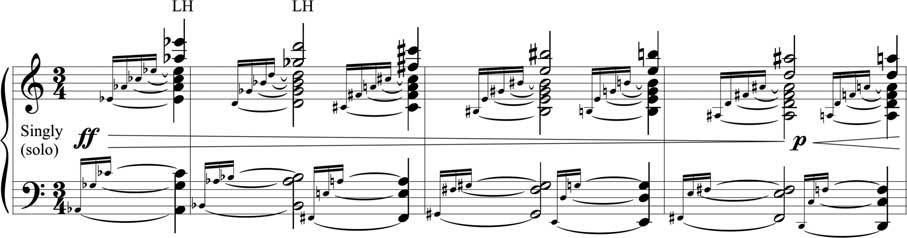
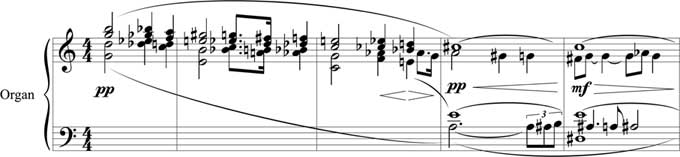
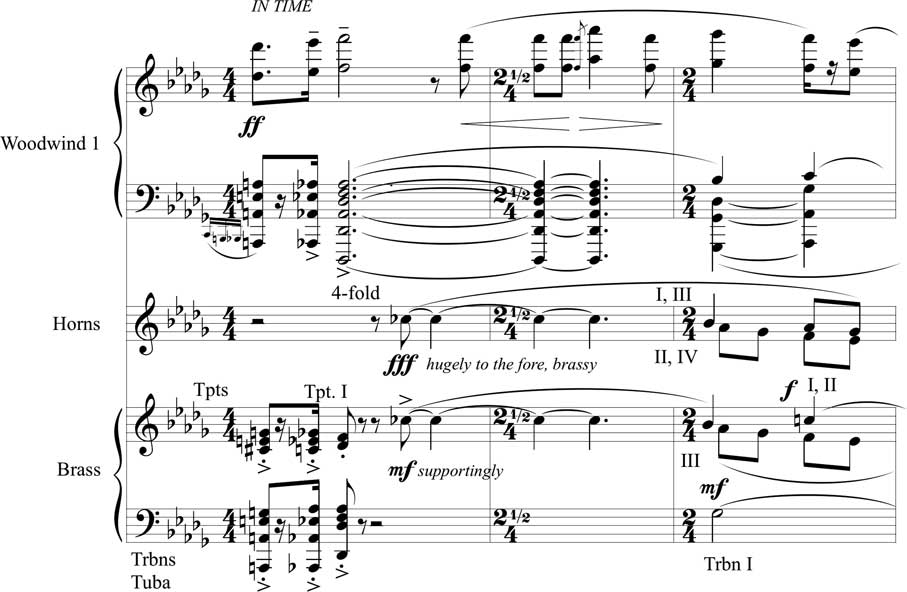
For a composer commonly cited for the concern he takes to capture the nuances of the original folk singer, this setting is especially notable for having one of the more rarified accompaniments.Footnote 58 For most of the setting, indeed, we hear only the accompaniment, commencing with a series of chromatically saturated broken chords descending in sequence played on the pianoforte (Ex. 1). The rhetorical effect of such an opening is not dissimilar to that of the opening of The Power of Rome and the Christian Heart, which also begins with a solo keyboard instrument (here an organ) playing a sequence of chromatically descending harmonies (Ex. 2). Similar to the perambulatory gestures that open each of Chopin’s four Ballades, they provide an introductory context for what follows that suggests the image, and function, of a bard improvising an opening verse. The fact that they are both slow chromatic descent suggests, furthermore, that the story that follows will have both pathos and gravitas. And, like his setting of The Love Song of Har Dyal, The Power of Love also concludes in a tonal centre a semitone higher from where it began. In this case the harmonic shift occurs before the second appearance of the original tune and text. This repetition is marked out as a tragic apotheosis by being cut apart by an entry of a forte-fortissimo flattened-seventh note (Ex. 3).
Percy Grainger, The Power of Love. Danish Folk-Music Settings No. 2 (1922, rev. 1941), version for full orchestra. Schott, bars 1–7.

Percy Grainger, The Power of Rome and the Christian Heart (1918, rev. 1943). Bardic Edition, bars 1–5.

Percy Grainger, The Power of Love. Danish Folk-Music Settings No. 2 (1922, rev. 1941), version for full orchestra. Schott, bars 35–7.

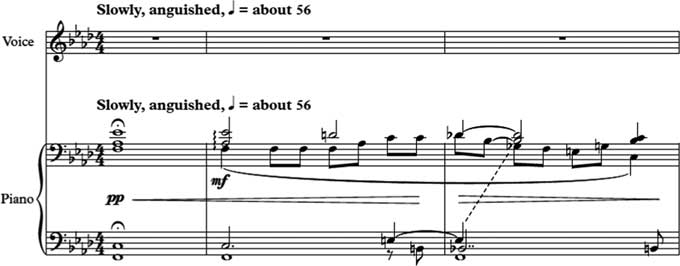
Grainger’s setting of the tune of Early One Morning is another good example of this technique. From its very opening minor seventh chord and ‘anguished’ rendering of the famous tune (an unequivocal example of musical estrangement if there was ever one), it seems to be asking us to consider what the words of the folk-song are saying (‘How could you use a poor maiden so?’), a valuable service if the tune’s anodyne use in popular culture today is any guide (Ex. 4).Footnote 59 As Wilfrid Mellers has astutely observed, the ‘authenticity of Grainger’s folk-song settings … lies precisely in their apparent non-authenticity’.Footnote 60 He suggests that Grainger over-presents them so that they are received by us ‘in a manner closer to ritual festivity than to a concert performance, so that they become valid now, as they had been then’.Footnote 61
Percy Grainger, Early One Morning. Set for voice (man’s or woman’s) and piano (1940). Bardic Edition (BDE 431), bars 1–3.

This is the key to their on-going fascination for us, I think. As Nietzsche once wrote concerning our evergreen interest in Ancient Greek literature, what useful meaning can an interest in any culture of the past have for us if it is not ‘untimely – that is to say, acting counter to our time and thereby acting on our time and, let us hope, for the benefit of a time to come’.Footnote 62 Or, as Malcolm Chase and Christopher Shaw note about the folk-song revival more generally, far from being ‘half-remembered, quaint, and archaic’, it was ‘actively organized to speak to current anxieties and tensions’.Footnote 63 For Grainger, this was exactly the point:
Not only does the commercial slavery of our civilization hold out to the average man insufficient leisure for the normal growth of the habit of artistic expression (unless he shows talents exceptional enough to warrant his becoming a professional artist) but the many decorums of modern society deny to most of us any very generous opportunities for using even our various (unartistic) life-instincts to the full; ‘sich ausleben’ as the Germans so well put it. It is therefore not surprising that with us art frequently becomes the vehicle of expression for accumulated forces, thoughts and desires, which, under less civilized conditions, more often find their normal outlet in actions.Footnote 64
To return briefly, then, to that supposed jollity in Shepherd’s Hey and Molly on the Shore, Grainger’s apparent desire to reproduce the ‘happy good-will and tireless physical merriment of the country dance’, as one commentator put it in 1937, belies an underlying desire to protest at our own culture’s loss of equivalent examples of communal artistic expression.Footnote 65 The resulting arrangements can indeed be both performed and heard as ‘sad and furious’ (as well as vibrant and energetic), if we so choose.
Conclusion
Artistic representations of suffering and loss are indeed a recurring theme throughout Grainger’s compositional output. For Grainger, it seems, music was ultimately an ‘art of agony’.Footnote 66 Thus, it was ‘[o]ut of this world of war, violence, cruelhood & tragedy my longing to compose arose’.Footnote 67 In turn he grimly speculated whether ‘man’s filthy appetite for war & competition … [might] cease only when man has been drenched in an artistic presentation of the sadness of life?’.Footnote 68
To be sure, as Nigel Spivey notes in his 2001 book on art and pain, a creative interest in dismal subject matter is nothing new, it has been a fixation of Western art from well before the Ancient Greeks (although it was the Greeks who first raised the notion of contemplating another’s pain into a particular virtue).Footnote 69 But for one contemporary American commentator at least, Grainger was nevertheless noteworthy for setting out on such a melancholy creative path in an age that had otherwise ‘learned to shun frank emotion for irony and burlesque. … No other composer’, he claimed, ‘is so willing to speak frankly, directly’.Footnote 70
That is quite a call, and I doubt even the most ardent support of Grainger’s music would try to make it today. Nevertheless, in facing some uncomfortable truths a good deal of his music does also seem to proffer something akin to what Bob van der Linden has suggested is a ‘therapeutic means of coping with life in an increasingly urban, industrial and modern world’.Footnote 71 Or, were we inclined to be bolder, perhaps Grainger’s music thereby approaches the condition of ‘great art’ as defined by Leonard B. Meyer, a means via which ‘we can approach this highest level of consciousness and understanding without paying the painful price exacted in real life and without risking the dissolution of the self which real suffering might bring’.Footnote 72 That is, perhaps because, not despite, the composer’s manifold idiosyncrasies and infelicities, his music offers a challenging and occasionally compelling perspective on what he recognized as fissures in the modern psyche (his own not least) and what it might take to continue to live an undamaged – as well as undamaging – life in the modern world.