Introduction
[C]ontemplating the cup in his hand, [de la Havre] smiled at Barbara and leaning towards her, murmured the phrase he had found the other day to describe the contents of a cup of tea: ‘The hunger, the sweat and the despair of a million Indians!’Footnote 1
This article opens with the words of the fictional character Mr de la Havre to contrast ‘the hunger, the sweat and the despair of a million Indians’ as contained in a cup of tea with the content envisioned by the officially appointed marketers of Indian tea in late-colonial India. Whereas the 1937 novel by Mulk Raj Anand, from which the quote is taken, depicts tea estates as sites of oppression of disempowered indentured labour migrants from the Gangetic plain, young girls in particular, such a narrative of exploitative practices is absent in the ways the drinking of Indian tea was imagined in advertisements found in the Hindi literary monthly Sudha (Nectar/Ambrosia, 1927–41).Footnote 2 This is not to say that the working and living conditions of (indentured) labourers were of no concern to the editors of Sudha. On the contrary, a plethora of articles and fiction addressed precisely this topic. When it came to the advertisement section of the periodical, more specifically the marketing of Indian tea, the processes involved in bringing the leaves and buds of Camellia Sinensis from the plantation to the middle-class home were not addressed by the advertisers. Instead, by the late 1930s, the Indian Tea Market Expansion Board (ITMEB) that took out the advertisements ascribed to tea a new significance for the lives of North Indians from the upper, middle, and lower classes. A cup of tea in the eyes of the ITMEB no longer contained ‘hunger, sweat and despair’, but energy and force (shakti). Moreover, the ITMEB promoted Indian tea as a national beverage, served by women and savoured by women, men and children to rejuvenate, replenish, and enjoy with company and in a quiet moment. In placing the consumption and not production of tea at its centre, the designers of the ITMEB imagined the nation as one of consumers and no longer one of producers enmeshed in exploitative colonial relationships.
Tea crops had been produced in India since the mid-nineteenth century exclusively for export purposes to Britain. The exploration of Indian markets in the North and the Northeast and the official promotion of Indian tea within India were an immediate reaction to the production surplus that had emerged from the decline of Britain's economy during the Great Depression. With the mandate to enter a new market outlet in North India, the ITMEB in the late 1930s launched an unprecedented campaign to promote Indian tea. It commissioned surveys on tea-drinking habits amongst the Indian population, placed advertisements in vernacular periodicals and handed out tea samples amongst the urban and rural population.Footnote 3 Indian tea advertisements in Sudha first appeared in August 1938 and ran up to the last available issue in October 1941.Footnote 4 This article focuses on advertisements intended for the urban, upper-middle-class Hindu and Hindi-speaking consumer population in the United Provinces. It is embedded in recent scholarship on advertising in British India as it gained momentum specifically in the 1930s with the establishment of advertising as a profession.Footnote 5 This development can be witnessed in women's, literary, and political periodicals and newspapers all over British India, which at times excessively advertised books and periodicals, musical instruments, the ever popular wrist watch, gramophones, bicycles, photo cameras, tennis balls, jewellery, health products, tonics, and toiletries, amongst other items. These advertisements are all testimony to the perception of middle-class women and men as consumers. While purchases were likely to have been made after consultation with the male members of a family, in targeting women, the advertisements were ascribing to them a specific responsibility as well as authority. Whether women were capable of navigating this responsibility is not the issue in the discourse accompanying the tea advertisements under consideration.Footnote 6 Instead, the focus in the tea advertisements was on establishing tea as a ‘drink of unity’Footnote 7 and women were given a special responsibility to achieve this objective. Thus, the tea advertisements urged the middle-class female reader to introduce tea into her home and establish a culture and habit of tea consumption. This responsibility of guarding and establishing a proper routine in the home was well in line with the ‘nationalist resolution of the women's question’ that envisioned women's responsibility within the private and domestic sphere not only for the well-being of the individual family, but for the good of the nation-to-be.Footnote 8 The gender depictions used to establish this mainstream (patriarchal) nationalist agenda, however, were not limited to the middle-class setting. They acknowledged women's roles beyond the middle class in the private-domestic and also in the public-professional sphere—all with the objective of promoting Indian tea as a national beverage.
Scholarship on the topic of advertising has explored how professional advertisers took account of the socio-cultural values of their consumers, including their desires and anxieties.Footnote 9 The economic agenda of the ITMEB notwithstanding, nationalizing the consumption of tea as a tradition-in-the-making for Indians was another important objective of the Board. Even more than targeting the consumer, then, as may have been the case with other products entering the Indian consumer market such as hair oil, soap, and other frequently used household and personal care items, tea advertisements of the ITMEB targeted the supposed homemaker, guardian, and creator of tradition. Compared to the bulk of advertisements in periodicals of the time period, the physical appearance of the ITMEB advertisements in Sudha was much more elaborate, including text, a visual (drawing and/or photograph), and two catchy slogans. They were always placed on a full page. It was clearly the preparation and consumption of the beverage and not any specific brand that were being promoted in these advertisements. And yet, this campaign was a complicated matter considering the good that was at stake. After all, Indian tea, like other imported items such as chocolate, tobacco, soap, and even coffee, was an imperial good consumed primarily by the British people in Britain and the empire. It had in fact once been constructed as an imperial drink, which made it impossible to simply replicate existing tea advertisements.Footnote 10 The beverage was at the most associated with the nobility and social strata close to the British and that also only in North India.Footnote 11 It was not (yet) a drink of middle-class homes. In public nationalist discourse of the time, there was also much reservation against the consumption of black tea (and coffee). In an air of anti-colonial sentiment, nationalists and reformers had condemned the consumption of tea (and coffee), notwithstanding that it was grown in India, as a foreign beverage produced under exploitative colonial (indentured) labor conditions.Footnote 12 Moreover, tea was considered to have dubious impacts on health.Footnote 13 Such anti-tea propaganda was of course invisible in the official tea advertisements of the ITMEB. Only hints of a response to such critique were noted through assurances that drinking tea was not harmful, but healthy, even for children. How did the nationalization of an imperial good come about in a vernacular periodical targeting the Hindi middle-class reader? How did the ITMEB validate the promotion of an imperial beverage in a period marked by anti-colonial sentiment and nationalist activism? What types of feminized modernity emerged from the visuals of this campaign? These questions will be pursued through an investigation of Hindi advertisements placed by the ITMEB.
Creating a custom of tea consumption
As the habit (aadat) and custom (rivaaj) of tea drinking were not common amongst the Indian population of the early twentieth century, advertisements and signage focused on the creation of a culture of ‘proper’ tea preparation and ‘correct’ consumption by means of slogans, explanatory paragraphs, and visual depictions of different setups of tea consumption. The ‘proper’ way of brewing tea, as prescribed in numerous advertisements in periodicals and on public posters, required fresh boiling water, a clean, pre-warmed teapot, and one spoon of leaves of ‘best Indian tea’ per cup with one additional spoon ‘for the teapot’. The tea was to steep for five minutes before it was ready for consumption. The preparation instructions in the late 1930s foresaw that milk and sugar were added separately (see the instructions box in Figure 1). Correspondingly, the tea table in advertisements always showed a milk jug and a sugar bowl. Specific brands of tea, such as Brooke Bond or Lipton, were not promoted. The ITMEB exclusively promoted the product itself and thereby avoided any identification with non-Indian companies. Whether specific tea companies had reached out to the managing editor of Sudha’s Advertising Department cannot be determined. The periodical relied heavily on revenue generated from advertisements and, even though these were mainly Indian businesses and companies, including a diversity of publishers, these occasionally included international companies such as Lever Brothers with their soap products or Cadbury's food drink. Advertisements from tea companies (Indian and non-Indian alike), however, have not been spotted in Sudha.
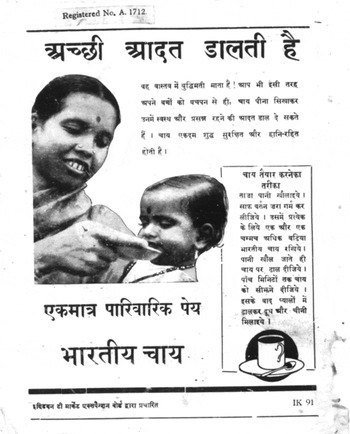
Photograph of a woman feeding her toddler tea from a saucer: ‘She inculcates a good habit. This is truly an intelligent mother! Like her, you should also teach your children from childhood on to drink tea so they can stay healthy and happy. Tea is completely clean, safe and not harmful. The only family drink. Indian tea.’Footnote 14 Source: Sudha, August 1938.

The nine advertisements that were placed repeatedly over the span of three years either on the last page of the periodical (early years) or in the middle advertisement section (later years) provide much detail on the agenda of the ITMEB to promote tea as a beverage for mind, spirit, and body to be drunk with company or savoured in private. They strike as eye catchers through their size, the diverse font sizes, and particularly due to their visuals that always depicted drawings and photographs of women. Sudha, the periodical in which they were featured, was not a women's periodical even though it carried numerous columns for the female reader and also used plenty of visuals featuring women not only as guardians of culture, or icons, but as active makers of the periodical. In focusing on the woman who was either consuming tea herself or preparing it for her family (including children) and friends, the advertisements lay the responsibility of creating a culture of tea consumption into the hands of women. Women had also featured in early twentieth-century advertisements for Indian tea targeting the British tea drinker in the colonies with images of the female Indian labourer offering freshly plucked leaves to a British gentleman, a female Indian labourer pouring a blond British woman a cup of tea from between the plantation terraces, or the guests at a British colonial garden party sipping on cups of tea.Footnote 15 As a vernacular periodical, Sudha had a different target clientele, namely the Hindi reader. Consequently, Indian tea was dissociated from its production process and British-imperial garden parties and located away from the plantation into the middle-class family room or veranda, the upper -class parlour, or another quiet retreat such as backstage. The Indian woman of the tea advertisements was no longer dark-skinned, possibly tribal, and located at the producing end. She came in a number of embodiments of the modern Indian woman (including the female labourer) who herself consumed tea. The accompanying slogans of the advertisements are testimony to efforts to create a culture and habit around tea drinking: ‘Making it a good habit’ and ‘An essential and obligatory routine’ and projecting the beverage as ‘The only family drink’ that was consumed ‘For familial gratification’.
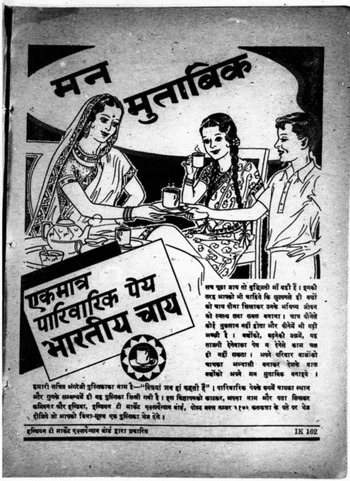
While tea drinking was not solely considered a female pastime, the advertisements for Indian tea clearly centre on the Indian woman. Not every woman featured in them, however, was a middle-class housewife. Apart from the ‘modern Grihalakshmi’ (goddess Lakshmi of the home), who prepared tea for her family and served it to family and friends, the beverage was also associated with the Indian elite and with circles of nobility with access to what was once an imperial beverage exclusively for Western use. Moreover, tea was presented as an elixir, served to the actress of repute to enjoy, relax, and reenergize when taking a break. Even the labouring woman became part of fostering a newly invented tradition by ‘inculcating a good habit’ in her toddler whom she let sip tea from a saucer in a blanked-out setting.Footnote 16 Whereas middle-class women and their families were depicted in line drawings in the domestic sphere, the labouring woman and her child had been photographed. The photograph strikes through its clear indication of the mother and child's dark skin colour, hairstyle, and possibly rural background. Markers of middle-class and high-caste identity such as an identifiably light skin colour (best indicated in drawings by making the colour of the person's skin the same as the background of the image) are clearly absent in this advertisement (Figure 1). And yet, this woman was considered a model for the middle-class reader who was urged to follow her example. I do not read this advertisement that strikes through its ambiguity as out of place or coincidental. True, it was the first and one-time-only advertisement featuring a labouring woman. There are, however, several links of this advertisement to others situated more clearly in the domestic sphere (Figure 2) such as the figures of child and mother as well as the message that accompanied both advertisements. Hence mothers beyond class and caste served their children tea. They were described as intelligent and wise. Moreover, in promoting tea as a nutritious beverage for children of different ages, the ITMEB was responding to a common stigma commonly used in nationalist and anti-colonial contexts of tea as unhealthy and addictive. In response, tea was projected as a nutritious and essential beverage, especially for children.
Drawing of a middle-class woman serving her school-aged children tea: ‘This is truly a wise mother. Like her you should also teach your children to drink tea right from childhood so that they will be healthy and strong in their future life. There is no harm in drinking tea and it is very tasty. Without giving growing children this refreshing drink, nothing will work out properly. In making your family members consumers of tea, the country's children will follow your way of thinking. The only family drink. Indian tea.’Footnote 19 Source: Sudha, October 1941.

The consumption of Indian tea as depicted in advertisements of the ITMEB focused on three groups of women from different class and professional positions, all clad in traditional modern Indian attireFootnote 17 : (1) the domestic woman and her family, (2) the genteel, upper-class lady representing the nobility and awaiting company, and (3) the movie actress on a break with her ‘best friend’, namely tea. In the following, I take a closer look at text and visuals of the advertisements and the messages that were being sent out by the ITMEB.
A family beverage of the middle-class home
The consumption of tea had not always been attributed to women. Paintings and literary descriptions of tea consumption had long featured Indian men, most notably from the Bengali male elite and middle class.Footnote 18 Advertisements of private tea companies such as Lipton Tea and Brooke Bond moreover projected tea as a drink of civilization and associated it with British tea parties and other social gatherings in the colonies.Footnote 20 In the late 1930s, however, the ITMEB worked towards a new marketing strategy that increasingly dissociated tea from its imperial ties and began projecting it as a national Indian drink. Consequently, a series of tea advertisements featured different ethnic groups engaged with sipping tea. They were generally situated in identifiable landscapes spanning the mountains to the coastal regions or regional architecture. Tea presented itself as a link between different Indian cultures and regions.Footnote 21 It is also in this period of time that depictions of women feature increasingly in advertisements issued by the ITMEB. These women serve in the capacity of uniting the yet imagined nation.
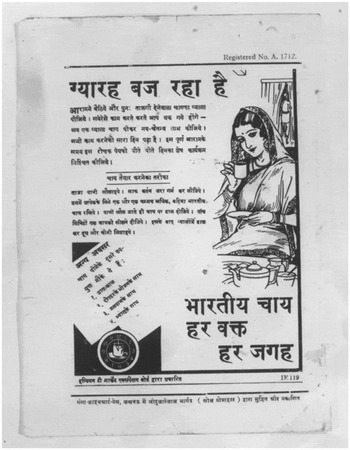
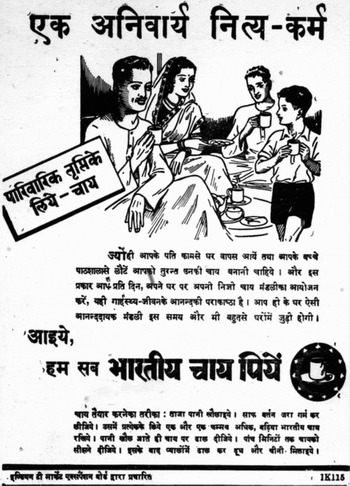
In the following advertisement grouping in Sudha, tea was represented as a modern, middle-class, family drink to be prepared and served by the wife and mother of the home. Drinking tea was not only a pleasure, ‘safe and clean’, and for familial gratification, but worthy of turning into a routine. ‘It is eleven o'clock’ was the title of an advertisement, which was also a direct reference to the British elevenses (morning tea). At this hour of the day, a middle-class woman was urged to take her first break after a busy morning (Figure 3). Despite the fact that the image depicted a servant in the background who may have been the person who prepared the tea, the modern domestic woman carried the responsibility for overseeing the household and for tea preparation. She was, however, also granted the leisure and time to herself (albeit to reenergize for upcoming domestic duties). For the afternoon ‘high-tea’, women were urged to organize their private tea circle with their family. In serving tea to the husband and children (Figure 4), the advertisements repeatedly held that women were not only serving a healthy drink; they were fostering a civilized and cultured habit. Recommendations on when to serve Indian tea accompanied the advertisements.
A woman sipping tea: ‘It is just eleven o'clock. Make yourself comfortable and drink a cup of reenergizing tea. You must be exhausted from working since early in the morning—now experience fresh energy from drinking a cup of tea. A lot of work is waiting for you. At this time of complete relaxation drink this exciting beverage and plan the order of chores for the day. Indian tea: Anytime, anywhere.’ Source: Sudha, August and December 1938.

Teatime: ‘An indispensable routine. For familial gratification—tea. As soon as your husband returns from work and your children come home from school, you should prepare their tea. In this manner, you should also organize your private tea circle everyday in your home. This is the climax of happiness in domestic life. At this time, the pleasurable gathering in your home is also taking place in many more homes. Come, let us all drink Indian tea.’ Source: Sudha, May and July 1940, January and July 1941.

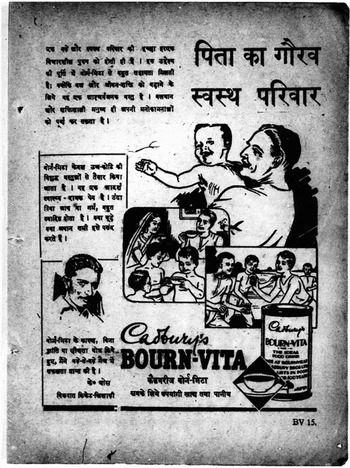
While Indian tea advertisements may well be categorized as advertisements targeting the middle-class female consumer, the consumption of tea also distinguished itself from other gendered consumer items. Household items and products for personal body care and health, such as soaps, shampoos and hair oil, tonics for the improvement and maintenance of health and beauty, as well as detergents, were promoted to the woman for her own benefit or for the benefit of the household and its family members.Footnote 22 Nutritious foods and snacks and other beverages such as Cadbury's Bourn-Vita (Figure 5) and Ovaltine, like tea, were considered to be beneficial to the entire family. The slogan of the Bourn-Vita advertisement declared ‘A father's pride—A healthy family’ and depicted a smiling father lifting his laughing and waving son. Bourn-Vita was also projected as a family drink. The advertisement depicted an image of a middle-class family seated around a table sipping Bourn-Vita. It also served as an energizer for male athletes as the image of a group of male adolescents engaged in sports suggests. The energizing qualities of the beverage for athletes were promoted by the renowned Bengali cricket player Kartik Bose (1906–84), who attributed his success to drinking Bourn-Vita. Another drawing depicted young boys at play. In a separate box, preparation and consumption methods were laid out and the quality of ingredients and health benefits of the beverage were highlighted. Bourn-Vita, however, was not projected as a national drink beyond class in the way that Indian tea was.
Cadbury's Bourn-Vita: ‘The ideal food and drink.’ Within the family setting, Bourn-Vita was promoted as a nutritious beverage for young and old family members, making the head of the family proud: ‘A father's pride—A healthy family.’ Source: Sudha, August 1938.

The beverage of the nobility
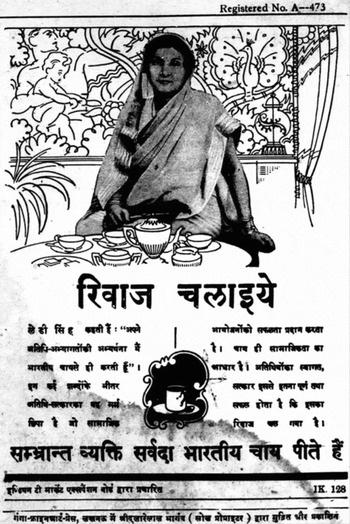
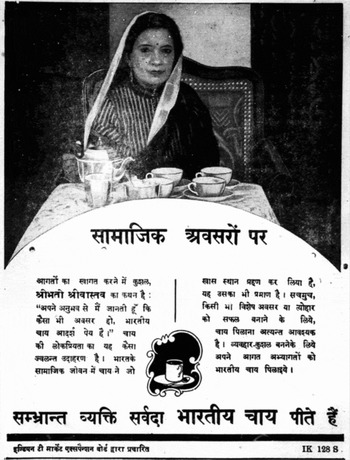
With the slogans ‘begin a custom’, ‘at social occasions’, and ‘the elite always drinks Indian tea’, a number of tea advertisements projected the consumption of tea not only as a sign of modernity (‘Tea is the attribute of modernity’),Footnote 23 but as one of tradition and hospitality. Bypassing specifically British tea-drinking occasions, the ITMEB drew on the Indian aristocracy in order to establish tea consumption as an Indian tradition that was not yet readily available to middle-class homes. Like industrially produced soap, tea was a sign of civilization and upper-class culture. But, rather than linking to British-imperial contexts—in fact distancing tea from any Western imperial connotation (except for perhaps the elevenses in Figure 3)—tea consumption was associated with the Indian nobility. Hence, the setting of this grouping of advertisements was aristocratic, as in the photographs of two women of style seated at a set table (drawn in one instance and photographed in the other) and ready to enjoy tea with company (Figures 6 and 7). Women who were accustomed to performing representative roles praised the social and noble benefits of tea: ‘From my experience, I know that Indian tea is the ideal beverage for any occasion’, Shrimati Shrivastav held, and also Lady Sinha of Raipur took to tea. Accompanying their quotes, the advertisers addressed the middle-class reader and promoted tea as important for successful social gatherings and the ideal beverage for guests. Tea was projected as so popular that any social occasion, including religious festivals, could not even be imagined without it. Tea signified hospitality and was a guarantor for the success of any social gathering. The middle-class woman was urged to emulate the genteel lady who was projected as a traditional and modern woman.
‘Begin a custom. Lady Sinha says: “I only treat my guests and visitors with Indian tea.” The meaning of hospitality towards guests is contained within these few words, which lay out the success for social events. Tea is the essential to sociality. It has become a custom for successfully showing hospitality and welcoming guests. The elite always drink Indian tea.’ Source: Sudha, February 1940.

‘For Social Occasions. Experienced in welcoming guests, Shrimati Shrivastav says “From my experience I know that Indian tea is the perfect beverage, regardless of the occasion.” What a brilliant example for the popularity of tea. It is also evidence for the special place that tea has acquired in India's social life. Undoubtedly, serving tea is essential to make any special occasion or festival a success. Become an expert and serve your guests Indian tea. The elite always drink Indian tea.’ Source: Sudha, August 1940, February, May, and August 1941.

What characterizes the design and layout of this grouping of advertisements and the one to follow is the photographic montage that situates female celebrities into sitting rooms. Whereas commercial photography depicted tea consumption in middle-class families only in the decades following Indian Independence,Footnote 24 the advertisements that associated tea with the nobility and celebrities from the world of film, and even the labouring woman from the advertisement discussed earlier, predated this promotional approach.
Whereas the nobility poured tea from a silver teapot, it was not so much the culture of drinking tea in good company that was central in the following set of advertisements, but the beneficial qualities inherent in black tea. Once again, several links to the middle-class woman can be established despite the advertisements of this third grouping focusing not on the domestic, but on the professional woman who frequented the public sphere. The reader will also notice that, unlike the middle-class and aristocratic women of the advertisements who always had their heads covered with the end of their saris, film stars displayed their fashionable hairstyles.
The reenergizing beverage for the film star
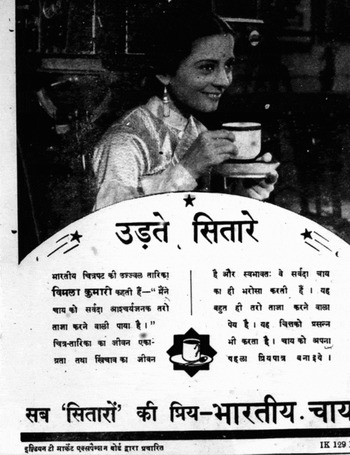
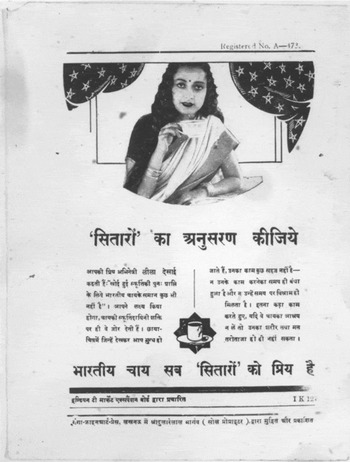
The marketing strategy of the ITMEB did not simply emphasize the consumption of tea within the home. Moreover, tea was not only a social drink enjoyed in the family and with friends or at larger social gatherings. In its revitalizing and reenergizing capacity, it became an important beverage for the working man, the studying child, and—as depicted in this grouping of advertisements—the woman working in the film industry. Tea was projected as ‘Dear to all “stars”’. Vimla/Bimla Kumari (dates not available), called ‘The bright star on the Indian screen’, said: ‘I have experienced tea as always wonderfully recharging and refreshing’ (Figure 8) and Leela/Lila Desai (dates not available) assured readers that ‘Nothing equals Indian tea to regain lost energy’ (Figure 9). Both advertisements depicted the movie stars holding a cup of tea in their hands. One of them was looking directly into the camera while the other had her smile directed elsewhere. There was a slogan urging women to make tea their best friend. Falling slightly out of the roster of the movie actress, but still part of the cinematic discourse, one advertisement depicted Mira Sanyal, wife of the renowned Bengali character actor Pahadi Sanyal, in the parlour about to have tea. A German Shepherd dog was standing next to her.Footnote 25 The slogan held that ‘The modern woman is fond of tea’. Tea, with its reenergizing potential, was enabling women not only to better perform and fulfil their responsibilities at home and at work, but to participate in creating the modern nation. The reenergizing qualities of black tea were particularly useful in reference to social reformist and nationalist idioms of the time that had urged women to awaken and emerge as subject-citizens of the nation-to-be. What better beverage to stir up nationalist activity than tea and the special moment of tranquillity associated with drinking a cup thereof before delving back into ‘action’?
‘Flying Stars. The bright star on the Indian screen Vimla Kumari says “I have experienced tea as always wonderfully recharging and refreshing.” The life of a film star requires concentration and is filled with tension. Of course she always trusts in tea. It is a refreshing drink. It also makes the heart happy. Make tea your best friend. Dear to all “stars”—Indian tea.’ Source: Sudha, August 1940, March 1941, and September 1941.

‘Follow the “stars”. Your dear actress Lila Desai says: “Nothing equals Indian tea to regain lost energy”. You may have noticed that she is emphasizing the reenergizing force of tea. She may delight you in the photograph, but her work is not easy, nor are her working times settled and she doesn't have scheduled breaks. If she didn't seek the support of tea, her hardworking body and mind would not be able to refresh. Indian tea is dear to all “stars”.’ Source: Sudha, January 1940.

Associating a good with stardom had also been a marketing strategy of other companies promoting goods for middle-class women, such as Lever Brothers and their soap products Lux and Sunlight, amongst others. The international advertising campaigns of Levers Brothers Soaps in the 1930s had first drawn from female Hollywood film stars, before turning to Indian women, including film stars or to female deities from the Hindu pantheon.Footnote 26 For rising film stars, additional promotion opportunities in the advertising sector were equally aspired to.Footnote 27 Female stardom and iconic representations of film stars were certainly eye catchers to the Hindi reader. Promoting the consumption of tea in the middle-class home, however, remained the primary objective in advertisements endorsing celebrities. It may have been a specificity of the Hindi vernacular and its objective to ‘nationalize’ women's occupations that film stars were positioned not as glamorous or eroticized women, as they had often been in soap advertisements, but as female professionals on a break.Footnote 28 The setting resembled that of the domestic sitting room even though the text made it clear that the tea was sipped on backstage. Vimla Kumari and Lila Desai were clothed in the latest fashion. Mira Sanyal (not displayed in this article) is even applauded for her good taste in fashion. The accompanying text, however, suggests that Indian tea was not a fashionable or luxury item, but essential for those who needed to reenergize in order to better perform while at work. This also applied to the domestic woman. Both advertisement groupings thus had a common denominator: Indian tea was energizing, refreshing, healthy, and tasty—regardless of where and by whom it was drunk.
Conclusion
The advertisements placed by the ITMEB in the Hindi literary periodical Sudha in the late 1930s and early 1940s contributed towards the construction of tea as a healthy, civilized, and modern (but not Western) beverage consumed across established boundaries of gender, age, and class. As the advertisements addressed by default upper-caste Hindu readers, a slogan on the uniting aspect of tea beyond caste and religion, such as that of a Bengali tea company, ‘Diverse castes, diverse creeds—but about Tosh tea, all are of one mind!’, was not to be found in Sudha. Footnote 29 Tea was dissociated from its colonial associations and artfully placed within the mainstream nationalist and patriarchal discourse of the time. This marketing strategy was especially reflected in the recurring Hindi slogan ‘Come, let's all drink Indian tea’.
In their efforts to create a culture of tea consumption in North and Northeast India, the ITMEB confronted the political and cultural realities of the first half of the twentieth century. More than that, the designers of these advertisements also turned into active shapers of middle-class consumer identities. While the advertisements placed in Sudha appealed to the specific middle-class consciousness and identity of female and male Hindi readers, the motives of the advertisements in their entirety contributed towards constructing Indian tea as a national beverage that was envisioned as a tradition in the lives not only of the middle classes, but of all Indians. Contrary to what one might expect when imagining the middle-class consumer, the visuals designed for them were not uniform: they displayed middle-class housewives, women from the nobility, professional actors, and a woman with her child from the labouring class. Taken as a whole, these advertisements evoked the idea of Indian tea as a national beverage and part of modern Indian culture. Tea advertisements thus shaped middle-class female and familial identities without breaking the links to other segments of Indian society. Whereas scholars have often pointed to the self-conscious creation of a middle-class identity that distinguished itself from the aristocracy and from lower segments of society such as workers, artisans, and peasants, the construction of class identity in tea advertisements did not follow this pattern. Tea advertisements targeting the middle-class family may thus be conceptualized in the context of a modernity of which women beyond the middle-class and domestic setting were also a part.Footnote 30 As a slogan held, ‘The modern woman drinks tea’, and this woman belonged not only to the middle class.
Was the projection of Indian tea as a ‘truly’ unifying drink for the nation-to-be more than a marketing strategy of the ITMEB? Who in the end accepted and who rejected this tradition-in-the-making? How ‘smooth’ was the transition from imperial to national good? Constructing a national identity for a beverage was not unique to the ITMEB. Creating a clientele for Indian tea in fact resembled the fashioning of coffee in late-colonial Tamil society. Initially produced as export crop for Europeans, coffee began to be promoted as an Indian beverage targeting first the upper classes and later also the rural population, including women labourers.Footnote 31 Tea in the South was constructed as the counterpart of coffee drunk by the upper castes.Footnote 32 This parallel development testifies to the limits of constructing tea as a national beverage: tea was the drink of the nobility, the modern family, and the modern woman in the North of the country, whereas, in the South, it was institutionalized as an urban working-class beverage served in canteens at low monthly rates.Footnote 33 Moreover, as a survey result of the ITMEB revealed, tea was considered to be drunk more in Muslim households than in Hindu ones, which may have led to different marketing campaigns in Hindi and Urdu vernaculars.Footnote 34 Only a closer look at vernacular discourses on tea consumption in different regions of the Indian subcontinent can trace a more comprehensive, complex, and intricate history of the emergence of Indian tea as a national beverage and the construction of Indian national, gender, class, and caste identities, including the gendered identity of tea.
Before vernacular periodicals are bound and stored in archives, certain segments—advertising included—are often removed, regarded as ancillary and dispensable. A more sustained look at the promotion of other consumer goods (through text and visuals)—that remain traceable—will certainly prove valuable not only for scholars writing the history of advertising and consumption, but for cultural history of the colonial and post-colonial periods as a whole.