Education is considered to be one of the most effective factors in a society’s development, as it encompasses knowledge about world culture and technological knowledge, and promotes the values of education, academic success and becoming a productive individual in society. Consequently, it has become one of the basic needs for human development and to escape from poverty (Sivakumar & Sarvalingam, Reference Sivakumar and Sarvalingam2010). To create all these dimensions and to be successful, high quality, uninterrupted, flexibly arranged, contemporary education systems need to be established. Students are involved at the core of all education systems. In general, students are at school for long hours, where they have to complete assignments, take exams, and receive different lessons that need a high performance to be successful. A number of students are unwilling to engage with educational requirements and continue the education process intermittently due to different reasons such as poor academic achievement, low school efficiency, low self-esteem or depression symptoms (Reid, Reference Reid2014). At this point, school absenteeism begins, which is a global problem in education.
Ensuring regular attendance by students at lessons is one of the duties of the school management, teachers, and psychological counselling and guidance service at schools. The aim of the psychological counselling and guidance service, directed by specialists in school psychology, is to deal with student behaviours and guide students to be successful during their education. For this aim, the psychological counselling and guidance service prepares a study plan for schools in coordination with the Ministry, including the provision of group or personal psychological counselling and personality evaluation tests for students, holding and attending conferences, conducting research, providing guidance for careers, and ensuring that students attend school regularly. School counsellors develop a rapport with students and maintain a professional trustworthy relationship, listen and pay attention to students’ complaints, and help students inside and outside the school environment (Nkechi et al., Reference Nkechi, Ewomaoghene and Egenti2016). It is clear, however, that the education system has some problems and that some of these problems originate from absenteeism.
This study aimed to investigate the reasons for school absenteeism, and practices and proposed solutions of school counsellors for reducing school absenteeism. With the research findings of this study, it is hoped that school counsellors will be able to improve their practices to reduce school absenteeism, focus on different reasons for absenteeism, and solve many of the absenteeism problems at school.
School absenteeism is a worldwide educational problem and one of the main concerns of school directors, teachers, psychological guidance services and researchers at high schools today. It is one of the main educational problems of many developed countries, and draws the attention of educators and policy makers (Askeland et al., Reference Askeland, Haugland, Stormark, Boe and Hysing2015). School absenteeism is also called ‘school nonattendance’, ‘school dropout’, ‘school absence’, ‘absence from school’ and ‘school truancy’. In this research, the term ‘school absenteeism’ is used. The concept of school absenteeism, reasons for school absenteeism and solutions for school absenteeism have been investigated by different researchers. School absenteeism can be defined as students’ failure to attend school due to problems at school, personal reasons, parental factors and economic reasons. School absenteeism is a student behaviour that is associated with social, economic and health-related problems in adulthood (Rocque et al., Reference Rocque, Jennings, Piquero, Ozkan and Farrington2017). Children usually miss school for prolonged periods due to personal, social and academic experiences (Kearney & Graczyk, Reference Kearney and Graczyk2014). When the definitions of school absenteeism are investigated, it is clearly seen that health issues, social reasons, economic factors and cultural differences seriously affect school absenteeism of students in the educational system.
Reasons for School Absenteeism
School absenteeism is caused by different factors that are social or contextual (Maynard et al., Reference Maynard, Heyne, Brendel, Bulanda, Thompson and Pigott2018). The social factors include family, influence of friends, entertainment and work; the contextual factors include psychological reasons (e.g., health, puberty, laziness) and institutional reasons (e.g., school change, bullying, school program and exams, discipline, teachers, dropout desire; Reid, Reference Reid1983). Singh (Reference Singh2012) classified school absenteeism into three categories: health issues, authorised absence and unjustified absence. The reasons for school absenteeism can be further categorised depending on different factors. Learners who lack discipline are often those who yearn for attention — whether it is from teachers, parents or peers (Segalo & Rambuda, Reference Segalo and Rambuda2018); there can also be health problems, and psychological, environmental or social reasons (Ingul et al., Reference Ingul, Klöckner, Silverman and Nordahl2012). Balfanz and Byrnes (Reference Balfanz and Byrnes2012) classified the reasons for school absenteeism as health issues, family involvement or housing problems, unsafe school conditions, disturbance, embarrassment, viewing school as useless, or choosing something else to do instead of attending school. According to researchers, school absenteeism can be classified and categorised by different reasons as the most significant factors of school absenteeism.
Parental Reasons
Parental involvement is one of the main reasons for school absenteeism. Parents have responsibilities for children, especially during their educational period. Students having parental support have a high level of school commitment, academic success and low school absenteeism rates. Family involvement positively affects students’ school attachment (Teasley, Reference Teasley2004). Parents’ education level is an important factor of school absenteeism (Henry, Reference Henry2007). Family environment risk factors are indicators of high levels of absenteeism (Fornander & Kearney, Reference Fornander and Kearney2019). Parents’ abuse and neglect of children are a reason for school absenteeism (Tabuchi et al., Reference Tabuchi, Fujihara, Shinozaki and Fukuhara2018). Lack of parental engagement, absenteeism follow-up, interest in assignments and academic support are some of the reasons for school absenteeism (Hendron & Kearney, Reference Hendron and Kearney2016). Parental absence from work is also a reason for school absenteeism. As seen in previous research, parental involvement in the educational system positively affects students’ academic success, school motivation, health issues and school commitment, and reduces the school absenteeism rate.
School Reasons
Students aim to find a comfortable school environment for education at school. The school syllabus, teachers’ behaviour, school management and school climate can be reasons for school absenteeism. Environmental reasons, such as friendships or bad experiences related to school, can affect school absenteeism (Özbaş, Reference Özbaş2010). Schools have important roles in socialising students and creating interaction among peers (Jacobs & Collair, Reference Jacobs and Collair2017). School climate factors, such as students’ interpersonal relations, lack of school connectedness, poor teacher-student relations and lack of participation in social activities at school, are reasons for school absenteeism (Van Eck et al., Reference Van Eck, Johnson, Bettencourt and Johnson2017). Effective school directors, clear and fair school rules, community support and academic sufficiency are evidence of positive school climate and student behaviours (Haynes et al., Reference Haynes, Emmons and Ben-Avie1997). The school climate has an effect on developing students’ social behaviours and reducing risk factors for students (Bellici, Reference Bellici2015). The syllabus, type of education and instructor are reasons for school absenteeism (Gase et al., Reference Gase, DeFosset, Perry and Kuo2016). When previous research results are investigated, it is seen that the syllabus, school climate, teaching skills and school management are apparent reasons for school absenteeism.
Academic Failure and Health Issues
The main aim of an educational system is academic success. However, students might fail in exams or miss school due to the illness, which can push them towards school absenteeism. Students with somatic complaints such as headache, stomach ache, vomiting or fatigue are some of the reasons for absenteeism in high schools (Cristopher, Reference Cristopher2008). Health issues can also include dental problems, chronic headaches, pain and overweight (Vervoort et al., Reference Vervoort, Logan, Goubert, De Clercq and Hublet2014). Disinterest in school, social beliefs and health issues are all reasons for school absenteeism (Uppal et al., Reference Uppal, Paul and Sreenivas2010). Reasons for school absenteeism can also include holidays, disasters and academic failure (Heyne et al., Reference Heyne, Gren-Landell, Melvin and Gentle-Genitty2019). Students who have teachers who are well prepared for lessons and who are active in the classroom environment and good at teaching are more successful academically (Kimani et al., Reference Kimani, Kara and Njagi2013). School attendance has an important effect on students’ academic success (Demir & Akman Karabeyoglu, Reference Demir and AkmanKarabeyoglu2015). According to current research, academic failure and health issues play an important role in academic absenteeism. For these reasons, educational specialists should focus on academic failure and health issues to reduce school absenteeism.
Proposed Solutions for School Absenteeism
Today, among the main educational issues for educational specialists, policy makers and governments are school absenteeism, reducing school absenteeism, increasing school attendance and providing a better school climate. Governments have recently been working on improving students’ school attendance worldwide (Birioukov, Reference Birioukov2016). Solutions for school absenteeism are collected under the headings of social and cultural activities, school management, academic success, parental engagement, the syllabus, mentoring and counselling. Researchers have been studying solutions for school absenteeism and have put forward some solutions recently, including increasing the number of social and cultural activities, improving physical conditions, creating a better school environment and climate, organising motivational activities at school, developing parental cooperation, and establishing a centre for preventing school absenteeism (Gül et al., Reference Gül, Kıran and Nasirsi2016). Several factors, such as school culture, workload, teachers and teaching strategies, play an important role in school absenteeism (Lukkarinen et al., Reference Lukkarinen, Koivukangas and Seppälä2016). School climate strategies, safety strategies, health strategies, character education, family involvement, school readiness programs, cultural approaches, psychological approaches, students’ engagement approaches, peer and mentoring programs, alternative education programs and legal strategies are all methods to prevent or reduce school absenteeism (Kearney & Graczyk, Reference Kearney and Graczyk2014). Determining students with poor attendance early, providing transition programs, and academic support and group interventions are recommendations to prevent school absenteeism (Blount, Reference Blount2012). Successful schools meet the needs of students, support students’ participation in activities and engage students in schools (Şanlı et al., Reference Şanlı, Altun and Tan2015). Social skills activities, schools’ academic competence, academic monitoring and class size are also factors that can reduce school absenteeism (Balu & Ehrlich, Reference Balu and Ehrlich2018). Ricking (Reference Ricking2014) found that the social climate, a positive atmosphere, a good communication environment, and an active learning environment have positive effects on school attendance. A better communication environment at school, and among students and parents also is of critical importance for reducing school absenteeism and creating a better learning environment (Povey et al., Reference Povey, Campbell, Willis, Haynes, Western, Bennett, Antrobus and Pedde2016). Finally, a better designed syllabus, flexible school hours and courses, and better educational practices can increase school attendance of students (McGregor & Mills, Reference McGregor and Mills2014).
Method
Participants
In this research, the study group was formed using the criterion sampling strategy, which is a purposive sampling method. Purposive sampling methods involve selecting specific participants to collect important information (Maxwell, Reference Maxwell1996). Criterion sampling is a method of selecting participants or cases that meet predetermined criteria (Patton, Reference Patton2014). One of the criterions of this research was determined as participants working at high schools in city centres and having over 5 years of counselling experience. In total, this study was conducted with 21 school counsellors who were coded as P1, P2, P3 and so forth, so that the aim of the study could be achieved at an optimum level by using a study group who were sufficiently experienced with dealing with a great number of cases and with working in crowded schools. School counsellors are psychological counsellors and guidance teachers at the same time. School counsellors having over 5 years of experience are able to choose the correct approaches, have adequate methodological knowledge, and use efficient evaluation techniques.
Research Model
This research was conducted using a qualitative research method. Qualitative research models aim to infer meanings from participants’ perspectives by using an expository and inductive method (Miles & Huberman, Reference Miles and Huberman1994). Since the participants’ experience regarding absenteeism was the aim of the research, a phenomenological methodology was used. Phenomenology is an approach that concentrates on the experiences of individuals or a specific group (Christensen et al., Reference Christensen, Johnson and Turner2011). Phenomenological research is the description of experiences about a phenomenon by participants in research and stems from philosophy and psychology (Creswell, Reference Creswell2003). Within this framework, in this research, the reasons for high school students’ school absenteeism were analysed in depth within the context of school counsellors’ experiences.
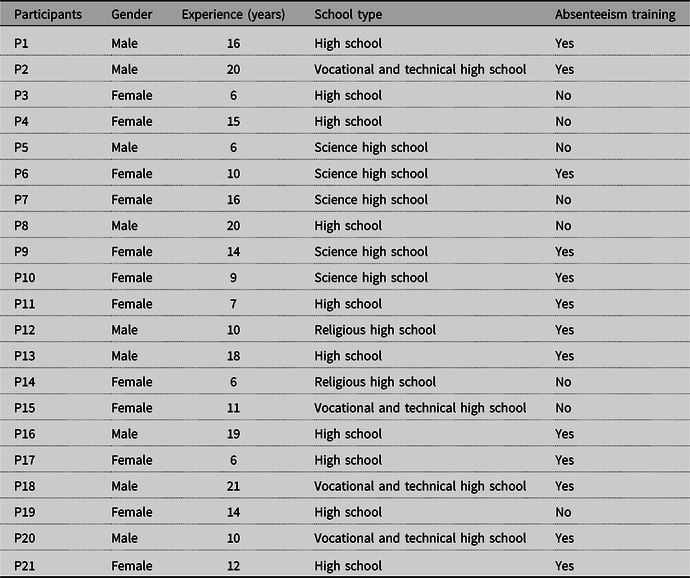
According to Table 1, the categories of the school counsellors are distributed in balance; 21 school counsellors participated in this research and 12 (f = 57%) of the participants were female and 9 (f = 43%) of the participants were male. Regarding the experience variable, 9 (f = 43%) of the participants had 6–10 years of school counselling experience, 5 (f = 24%) had 11–15 years of school counselling experience, 6 (f = 28%) had 16–20 years of school counselling experience and 1 (f = 5%) had 21–25 years of school counselling experience. In terms of the school type variable, 10 (f = 47%) participants were school counsellors at high schools, 5 ( f = 23%) were at science high schools, 4 (f = 20%) were at vocational and technical high schools, and 2 (f = 10%) were at religious high schools. When distribution of the variables and participants is examined, it is seen that in this research, the findings will represent the case as much as possible.
Participants’ Demographics

Data Collection Tool and Process
The data of the research were collected by interview. During the interview stage, a semistructured interview form was used. Interviews were conducted in the 2018–2019 academic year and each interview took 30–45 minutes. At the preparation stage of the interview, the ideas of three science education experts and two language experts were taken into consideration. Participants were informed about the research aim and confidentiality of the interview by the researcher. The data were collected from school counsellors who agreed to participate in the study. A semistructured form was finalised with a pilot study performed by three school counsellors. In the form there were four questions about school counsellors’ demographic information, which were related to gender, experience, school type and whether any seminars on absenteeism had been attended, and four questions about school absenteeism, which were related to general reasons for school absenteeism, reasons for school absenteeism at participants’ schools, participants’ practices to reduce school absenteeism, and participants’ proposed solutions for reducing school absenteeism. Themes and subthemes were investigated depending on the questions, as the questions investigated different situations.
Data Analysis and Interpretation
In this research, the data were analysed using Miles and Huberman’s (Reference Miles and Huberman1994) method, which aims to explain reasons for social cases. According to this method, data collection is the first phase and involves collecting research data from research participants using a qualitative research method. These data can be collected by means of a form, record, interview, observation or note taking, which will contribute to the research (Lonkila, Reference Lonkila and Keller1995), and data should be formed in a systematic arrangement (Strauss & Corbin, 1988). The second phase of Miles and Huberman’s (Reference Miles and Huberman1994) method is research data reduction. Data reduction is the process of organising, splitting up or dividing, and summarising the research data. The third phase of the method is data presentation. At this phase, the researcher presents the data with themes and subthemes, and then puts the research data in an order that can be used during the research. These data are the results of interviews, observations, discussions or conversations (Best & Kahn, Reference Best and Kahn1998). The research data are examined and divided into parts, and the meaning of each part is interpreted (Büyüköztürk et al., Reference Büyüköztürk, Çakmak, Akgün, Karadeniz and Demirel2017). At the fourth phase, the collected data are interpreted by the researcher who has followed the data collection process. According to this model, a relationship can be established in an order and sequence which are groundable and combinable (Creswell, Reference Creswell2003). To calculate the reliability of the research, Miles and Huberman’s (Reference Miles and Huberman1994) P (Reconciliation Percentage) = Na (Consensus)/[Na (Consensus) + Nd (disagreement)] × 100 formula is used and coding consistency was calculated as .92.
Reliability and Validity
To establish reliability and validity of the research, Lincoln and Guba’s (Reference Lincoln and Guba1985) trustworthiness method, which covers credibility, transferability, confirmability and dependability, was used.
Credibility
In this study, the member checking method was used by asking participants to check their answers with regard to the researcher’s findings.
Transferability
This was enabled by explaining the method of sampling, research environment, participants’ demographic descriptions and participants’ statements in quotations without comment. The research results should be transferable to similar participants and cases in the environment (Houser, Reference Houser2015).
Confirmability
The data were collected from participants who were suitable for the study, findings were categorised in a systematic way, the study plan was described in stages, and the aim and scope of the study, process of developing open-ended questions, pilot study and interviews were explained in detail.
Dependability
In this study, the research method, findings and results were explained in stages and findings were compared with previous studies.
Results
This study aimed to investigate school counsellors’ ideas about the reasons for school absenteeism, participants’ practices to reduce school absenteeism, and proposed solutions for school absenteeism at high school. Findings are presented with tables, figures and direct quotations.
General Reasons for School Absenteeism
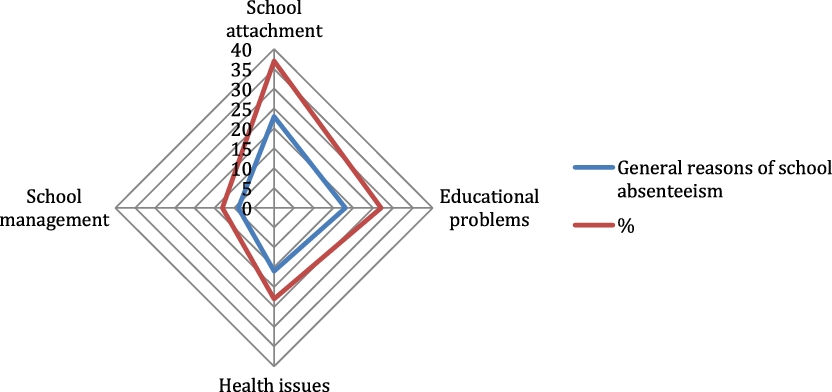
The first question of the research investigated general reasons for school absenteeism, and four themes were revealed. As shown in Figure 1, the themes of the first research question were found to be school attachment (f = 23, 37%), educational problems (f = 18, 27%), health issues (f = 16, 23%) and school management (f = 9, 13%).
General reasons for school absenteeism.

In Table 2, four themes and their subthemes are revealed with regard to the answers of participants to the first research question: ‘What are the general reasons for school absenteeism?’ These themes were school attachment, educational problems, health issues and school management. The themes and subthemes are presented below with quotations from participants’ answers.
Reasons for School Absenteeism

School attachment was the first theme of the first research question. According to participants, school attachment is one of the most important reasons for school absenteeism. The subthemes of school attachment were lack of school belonging, ideas about school, holidays, missing lessons, anxiety and unwillingness. School counsellors presented their opinions as follows.
Students should have a sense of belonging in the education system. I mean the sense of belonging affects education positively. To create this feeling, schools should organise some activities. Students should also feel a part of school. Any case that doesn’t add a sense of belonging will be revealed with the school absenteeism problem. (P16)
As far as I can observe, students’ attendance at school is an important issue. If they regularly attend school, their academic success increases. Unfortunately, school absenteeism of more than 3 days spoils students’ school attachment. (P6)
The second theme of the first research question was educational problems. Participants stated that schools having educational problems faced more absenteeism. The subthemes of educational problems were attitudes towards school, obligation, intensive lesson content, missing lessons and senior students’ attitudes.
Educational systems should be designed properly. I observe that school absenteeism increases especially in the second term of senior classes. This happens because they take the national university exam and try to prepare for it. At this time they want to study at home or in the library. Some of the students do not even study but they are still absent. (P14)
I am a school counsellor at a private school. This school gives importance to compliance of students and students objecting to this compliance do not come to school regularly. (P10)
Health issues was the third theme of the first research question. Participants stated that health was one of the important reasons for school absenteeism. The subthemes of the health issues theme were being sick, tiredness, sleeplessness, fatigue and drug addiction.
As students come to school in winter months as well, they usually become ill and this illness affects other students. I sometimes check the classes and see that even a quarter of the class is absent. When this process is repeated a few times during the year, the academic process is seriously disrupted. Teachers have to repeat the units. (P11)
Reasons for School Absenteeism at Participants’ Schools
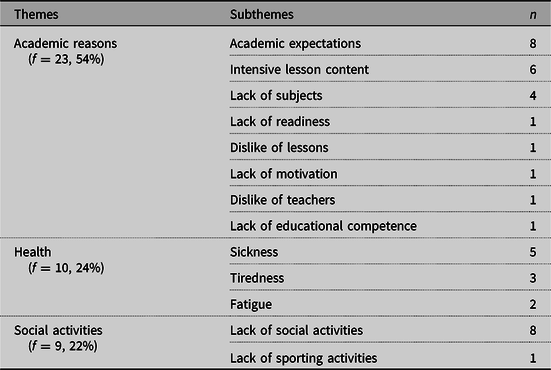
The second question of the research investigated reasons for school absenteeism at participants’ schools, and three themes were revealed. The three themes are academic reasons (f = 23, 54%), health (f = 10, 24%) and social activities (f = 9, 22%). The themes of the second research question are shown in Figure 2.
Reasons for school absenteeism at participants’ schools.

In Table 3, the three themes and their subthemes are revealed with regard to the answers of participants to the second research question: ‘What are the reasons for school absenteeism at your school?’ The themes were academic reasons, social activities and health. Below, the themes and subthemes are presented with quotations from participants.
Reasons for School Absenteeism at Participants’ Schools

The subthemes of the academic reasons theme were academic expectations, intensive lesson content, lack of subjects, lack of readiness, dislike of lessons, lack of motivation, dislike of teachers and lack of educational competence. School counsellors presented their opinions as follows.
In my opinion, lack of school culture, unnecessary academic knowledge, insufficient social and sporting activities, and expectation of academic success beyond students’ ability are the main reasons at this school. I think the education system is established mostly on academic success in this school. (P1)
I observe that the main reasons for school absenteeism at this school are discipline, disliking of school and teachers, and lack of school readiness. Teachers should plan their lessons by considering students’ conditions. Interaction should be established between school and students. (P8)
The second theme found to be a reason for absenteeism at participants’ schools was social activities. Students who are overloaded with academic knowledge need to have a rest and at this phase, social activities play an important role. The subthemes of the social activities theme are lack of social activities and lack of sporting activities.
Students in high schools are active and need some activities to do. We try to organise sporting activities to keep students at school not only for academic reasons but also for social activities. Still this is not enough and students, as soon as school time finishes, want to leave school. Students do not feel attachment to school. This problem must be examined. (P6)
When I examine our school program, I see that it is an overloaded academic schedule with only one or two social activities in a year, which is not enough. Students become tired of academic studies and find excuses not to come to school. (P19)
The third theme found to be a reason for absenteeism at participants’ schools was health. Health emerged as an important issue affecting school absenteeism. The subthemes of the health theme were sickness, tiredness and fatigue.
Winters are generally cold in this city and students become ill a few times in a year. In the school environment they transmit illnesses to each other. Another issue is psychological conditions. Students at this school are between 14 and 18 years old and they are in the puberty period. They are more emotional and fragile. (P4, P20)
Students at high school are mostly in the puberty period and this affects them mentally and psychologically. (P10)
Practices of School Counsellors to Reduce Absenteeism
The third question of the research investigated school counsellors’ practices to reduce school absenteeism at their own schools, and four themes were revealed. As summarised in Figure 3, these themes are counselling (f = 17, 40%), social activities (f = 11, 26%) absenteeism follow-up (f = 9, 22%) and academic support (f = 5, 12%).
Practices to reduce school absenteeism at participants’ schools.

In Table 4, the four themes and their subthemes are revealed with regard to the answers to the third research question: ‘What are the practices to reduce school absenteeism at your school?’ The themes of counselling, social activities, absenteeism follow-up and academic support and subthemes are presented below with quotations from participants’ answers.
Practices to Reduce School Absenteeism at Participants’ Schools

For the theme of counselling, it was found that school counsellors mostly undertake this duty at schools. The subthemes of the counselling theme were parent counselling, student counselling, cooperation between family and school management, active counselling service and family visits.
As the counselling service, I call parents if a student is absent. Students do not behave freely as they know that their parents are informed directly. If this situation happens a second time, I call the student and ask the reason for it. (P4)
Our school management and counselling service are quite sensitive on the absenteeism issue. For that reason, teachers are informed frequently to behave positively towards students, teach units that are appropriate to students’ levels, and use effective techniques in classroom environment. (P17)
For the second theme of social activities, the subthemes were activities, conferences, workshops, arranging social activities, and increasing the number of social activities.
I try to organise conferences once a month according to students’ needs. These conferences give students a feeling of being a social person. These seminars can sometimes be replaced with movies, student concerts and workshops. (P2)
At school, the management is quite active regarding social activities. Every week, students join in a forum and discuss a problem about school together. This lets students create their own school. Teachers are not allowed to attend this forum. Only one school director and school counsellor are allowed to attend. Students feel free to discuss the topic. (P5)
For the third theme of absenteeism follow-up, the subthemes were informing parents, following up students and improvisation monitoring.
Our school management department directly informs parents and calls students to fill in the reason for absence form. This is very effective. Students then know that absenteeism is not easy to get away with and is monitored by parents and school management. (P21)
We have a program for absenteeism. Teachers add absent students’ names to the program and a direct message goes to three people who are parents or relatives. This is quite an effective method. Also, one school manager and one school counsellor pay home visits and discuss the problem together with the family. (P2)
The fourth theme was academic support. Students who are unsuccessful do not want to come to school, and so school absenteeism occurs. School counsellors support students to be successful academically as well to reduce school absenteeism.
I try to work with the school management and keep students at school without an idle class. Idle classes affect school absenteeism. Students who have an idle class try to go out of school or don’t come to school all day. (P3)
I advise teachers to give additional assignments to students. This practice helps towards students’ academic achievement. (P6)
School Counsellors’ Proposed Solutions for Reducing School Absenteeism
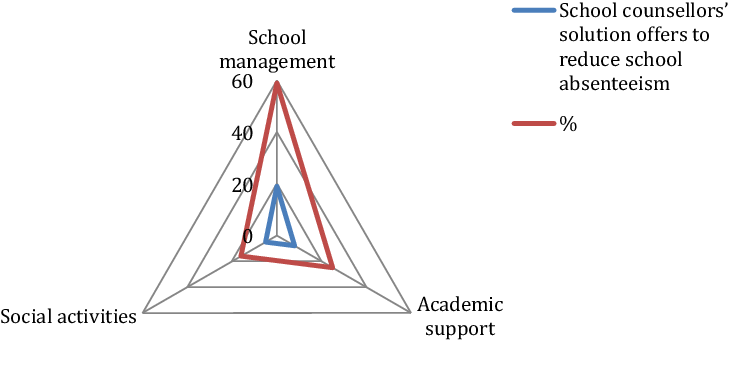
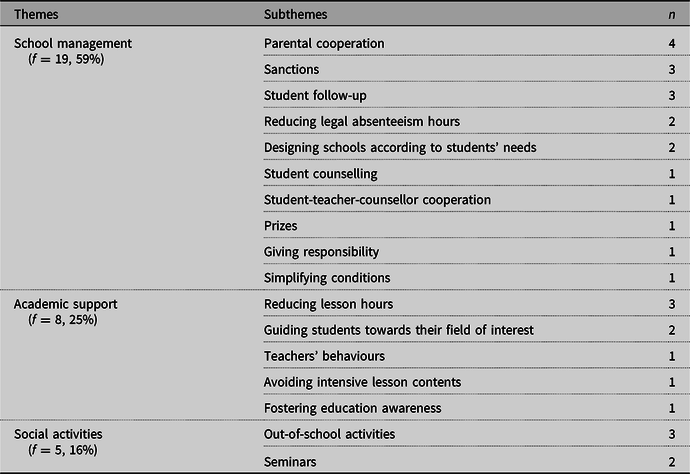
The fourth question of the research investigated school counsellors’ proposed solutions for reducing school absenteeism, and three themes were revealed. These themes are shown in Figure 4 as school management (f = 19, 59%), academic support (f = 8, 25%) and social activities (f = 5, 16%).
School counsellors’ proposed solutions for reducing school absenteeism.

In Table 5, three themes and their subthemes are revealed with regard to the answers of participants to the fourth research question, ‘What are your proposed solutions for reducing school absenteeism?’ The themes of school management, academic support and social activities and their subthemes are presented with quotations from participants’ answers.
School Counsellors’ Proposed Solutions for Reducing School Absenteeism

The first theme of school management was found to be an important factor in reducing school absenteeism, according to school counsellors. The subthemes of the school management theme were parental cooperation, sanctions, student follow-up, reducing legal absenteeism hours, designing schools according to students’ needs, student counselling, student-teacher-counsellor, cooperation, prizes, giving responsibility and simplifying conditions.
School is not a place for loading information. Lesson contents should be designed according to the needs of students by the school management. (P1, P20)
The school management should organise activities to keep students at school willingly during school hours and out of school hours. (P3)
Academic support was the second theme. Students need to be supported academically to reduce absenteeism, either by school counsellors or by teachers and school management. The subthemes of the academic theme were reducing lesson hours, guiding students towards their field of interest, teachers’ behaviours, avoiding intensive lesson contents and fostering education awareness.
Teachers should plan the lessons according to students’ academic levels. Students will be bored if the lesson plan is prepared at a low academic level and will feel anxious at a high academic level. (P2)
Content of lessons should be easier than in the present schedule. Students feel tired of academic overloading. (P16)
Social activity was the third theme. According to school counsellors, activities organised at school or outside school time are a solution for school absenteeism. The subthemes of the school activity theme are out-of-school activities and seminars.
Schools should organise activities especially out of school hours. Students can spend their time mostly at school. (P2)
Social activities can be organised during school hours by reducing lessons and hours. (P20)
According to the research findings, school absenteeism is not an insoluble situation as long as practices can be conveniently applied. There are some key components for the solutions and for a better education system. These are school management, academic support, school counselling, social activities, absenteeism follow-up and student-parent-school- and management-school-counsellor interaction. Active cooperation and practices can resolve most of the school absenteeism problem so that students will continue at school willingly and the system can focus on education.
Discussion and Conclusion
This study aimed to investigate the reasons for high school students’ school absenteeism and school counsellors ‘practices and proposed solutions for reducing absenteeism. Having five years’ experience as school counsellors and working at state high schools were the criteria for the participants. In addition, this study focused on school absenteeism of students at high schools, and interviews were conducted with 21 school counsellors. Four questions were asked to the participants which were related to general reasons for school absenteeism, reasons for school absenteeism at participants’ schools, school management practices to reduce school absenteeism and participants ‘proposed solutions for reducing school absenteeism. The themes and subthemes were formed depending on the responses to the questions. The discussion and conclusion section is designed in accordance with the research questions.
The first research question investigated the reasons for school absenteeism in general. According to the first research question, the lack of attachment, educational problems, health issues and school management themes were revealed as reasons for school absenteeism. One aspect of a lack of school attachment includes students feeling a lack of belong to school. This may include a lack of academic and social activities. School management are encouraged to address this by organising activities such as book collecting, sports tournaments, school newspapers and school trips. Another reason for poor school attachment may be anxiety. Lessons, exams and assignments may cause stress and anxiety in students. Teachers are encouraged to prepare lessons, exams and assignments suitable for students’ learning levels to address these types of anxiety issues in students. Students who are frequently absent face learning difficulties, are more likely to fail at courses and be less attached to the school, with a potential impact on the school climate (Cristopher, Reference Cristopher2008; Teasley, Reference Teasley2004; Yıldız & Kula, Reference Yıldız and Kula2012). Interpersonal relationships have an important effect on students’ sense of belonging to school (Jacobs & Collair, Reference Jacobs and Collair2017). In parallel with previous studies, this study revealed that the reasons for school absenteeism are due to learning difficulties, health issues, school management approaches and school climate. From these findings, it can be stated that the general reasons for school absenteeism are similar worldwide.
The second research question investigated reasons for school absenteeism at participants’ schools. Academic success, social activity and health themes were revealed as reasons for school absenteeism. School psychologists and counsellors stated that the academic inefficacy was the main reason of school absenteeism. They surmised that the school curriculum may not be suitable for all students’ learning level and should be rearranged to suit students’ learning ability and interest. Lack of motivation was another reason given for absenteeism, as students may not have enough motivation for learning. Teachers can set a variety of objectives in parallel with students’ interests that may increase students’ motivation and create a conscious desire to attend school. Teachers might be conducting dull lessons and need in-service training for new teaching strategies. These factors can be some of the academic reasons of absenteeism. Students having learning difficulties tend towards school absenteeism (Adıgüzel & Karadaş, Reference Adıgüzel and Karadaş2013; Bellici, Reference Bellici2015). Heyne et al. (Reference Heyne, Gren-Landell, Melvin and Gentle-Genitty2019) found that being reluctant to go to school, emotional distress and anxiety were also reasons for school absenteeism. Previously, researchers have found similar school absenteeism problems to those in this study, such as lack of social activities, health issues, academic insufficiency, poor school climate and dissatisfaction with school, as important reasons for school absenteeism.
The third research question investigated the practices of participants at schools, which found that counselling, social activities, absenteeism follow-up and academic support themes were practices of the school management used to reduce school absenteeism rates. School psychologists and counsellors stated that counselling is the most effective implementation to reduce absenteeism. Family is also an important factor for students. Having an active counselling service and counselling with parents and students can be effective to reduce absenteeism. Additionally, counselling can be done with family visits and by establishing an effective interaction between school management and family. Students may then feel the importance of school attachment, lessons and education. School managements’ use of force on students, lack of social activities, block scheduling and boring school environment are factors of school absenteeism originating from the school management (Reid, Reference Reid1985). School programs designed and managed by school counsellors and aimed at students’ success can be effective for preventing school absenteeism (Blount, Reference Blount2012). Family involvement plays an important role in school absenteeism (Fornander & Kearney, Reference Fornander and Kearney2019). Sporting and cultural activities, giving convenient breaks to meet students’ needs and creating a safe school environment can effectively reduce students’ school absenteeism (Şanlı et al., Reference Şanlı, Altun and Tan2015). In previous studies, it was clearly revealed that identifying negative school practices and exchanging them with positive school practices that incorporate students into social activities, providing academic support, creating a positive school climate, using student-centred school management approaches and monitoring students’ school attendance can reduce school absenteeism rates and are vital practices for school management.
The fourth research question, which investigated proposed solutions for reducing school absenteeism, found that school management, academic support and social activities were school counsellors’ proposed solutions for reducing school absenteeism. School psychologists and counsellors stated that school management is one of the effective factors to reduce school absenteeism. As parents have an important role in preventing absenteeism, students may feel a greater responsibility towards school when parent-school management cooperation is established. Additionally, increased communication and support for targeted students may reduce school absenteeism hours and help students to realise the importance of education and school. Communication with parents and organising information seminars can reduce school absenteeism, as well as strengthening schools’ educational infrastructure and organising social activities (Aküzüm et al., Reference Aküzüm, Yavaş, Tan and Uçar2015). Compulsory school attendance plays an important role in students’ academic success (Lukkarinen et al., Reference Lukkarinen, Koivukangas and Seppälä2016), therefore the school environment support for academic development, establishing environments for social relations, introducing problem-solving for students, and accomplishing goals can reduce school absenteeism (Kearney & Graczyk, Reference Kearney and Graczyk2014). According to research findings, academic achievement programs, school counselling services, after-school education, absenteeism follow-up practices, behaviour management, occupational education and alternative school programs are practices that can reduce school absenteeism. Similar to the last research question, the researchers recommend academic support, development of the academic syllabus, active counselling services and occupational education to prevent school absenteeism. Educational policy makers, school managements and educational specialists should focus on these issues to reduce school absenteeism at high schools.
In this study, an attempt has been made to reveal the main reasons for school absenteeism. These reasons can be ranked as school nonattachment, unsatisfactory school climate, heavy school schedules, insufficient social activities, lack of parental involvement, health issues, social and economic level of families, and peer groups.
Although school absenteeism is an important factor affecting success in education, the solution is not beyond reach. Teachers should be aware of students’ academic abilities and their social and economic levels. School management and school counselling services should have an active role. Schools should organise more activities of different types such as social, cultural, sporting, health and academic activities. Finally, parents, school management and school counselling services need to interact with students to discuss the situation and find a solution.
Limitations of the Research
This study investigated the absenteeism reasons of high school students with regard to school counsellors’ experiences. Research was limited by school counsellors’ experiences of high school students’ absenteeism reasons. Future research could investigate reasons for high school students’ absenteeism by focusing on school directors’ experiences to investigate administrative reasons, family experiences to investigate parental reasons, and teachers’ experiences to investigate instructional reasons.