Introduction
Dementia encompasses several distinct progressive brain diseases, with Alzheimer's disease (AD) and vascular dementia (VaD) being the most prevalent types. During the course of the disease, patients become more dependent in their activities of daily living (ADLs), which ultimately can result in institutionalization (de Vugt et al., Reference de Vugt2005; Gilley et al., Reference Gilley2004). Because dementia mostly affects the elderly, its prevalence and costs are expected to rise steeply over the coming years (Wimo et al., Reference Wimo2006). Given the limited funds available to expand care further for institutionalized residents with dementia, it is urgent to develop best practices.
In addition to cognitive decline, patients with dementia show behavioral and psychological symptoms, also referred to as neuropsychiatric symptoms (NPS). NPS occur in up to half of community-dwelling patients with dementia (Aalten et al., Reference Aalten2005; Lyketsos et al., Reference Lyketsos2002; Savva et al., Reference Savva2009), which can result in earlier institutionalization (de Vugt et al., Reference de Vugt2005). The prevalence of NPS in nursing home residents with dementia is even higher, at up to 80% (Selbaek et al., Reference Selbaek2007; Zuidema et al., Reference Zuidema2007b). In nursing homes, NPS include five main clusters: agitation, psychosis, mood disorders, psychomotor agitation and apathy (Zuidema et al., Reference Zuidema2007a). These can result in increased demands on staff resources, increased job-related stress, burnout, and staff turnover. Furthermore, NPS can result in the application of physical restraints (Werner et al., Reference Werner1989) and use of psychotropic drugs (PDs) (Bartels et al., Reference Bartels2003), which can lead to a decrease in the caregiver's and patient's quality of life (Banerjee et al., Reference Banerjee2006). PD use, of which antipsychotics (APs) are the most frequently prescribed (Kamble et al., Reference Kamble2009; Nijk et al., Reference Nijk2009), has come under intense scrutiny. Recent evidence has indicated that APs have a limited benefit in long-term therapy and can cause severe side effects such as stroke and increased mortality (Ballard et al., Reference Ballard2009; Schneider et al., Reference Schneider2006).
Although several studies have looked at the course of NPS in community-dwelling patients with dementia (Aalten et al., Reference Aalten2005; Devanand et al., Reference Devanand1997; Marin et al., Reference Marin1997; Ryu et al., Reference Ryu2005), most studies, however, have institutionalization as a primary endpoint. A detailed knowledge of the course of a wide range of NPS can help clinicians to better understand the clinical course of individual NPS, to make better treatment decisions of NPS (including the prudent use of psychotropic drugs), to provide continuous support to patients and caregivers and to inform patients and caregivers on prognosis. Therefore, this study specifically addresses the period after institutionalization. The objective of this study was to undertake a systematic review of the literature on the course of a wide range of NPS in residents with dementia in long-term care institutions.
Methods
Search strategy
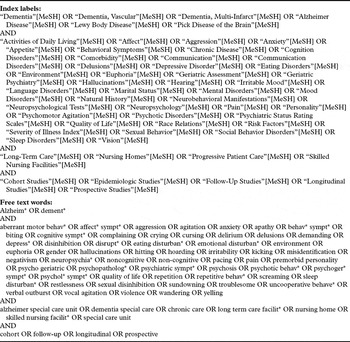
A computerized search was carried out in MEDLINE (1966–September 2008), PsychInfo (1806–September 2008), EMBASE (1980–September 2008), and Cinahl (1982–September 2008). An extensive list of index labels (MESH-terms) and free text words, indicating a wide range of NPS, including agitation and other behavioral problems, depression, psychosis, anxiety and apathy, was searched to retrieve relevant papers (Table 1). Additionally, the reference list of selected articles was screened to identify other relevant articles.
Overview of computerized search strategy: terms used

Inclusion criteria
Two reviewers (RBW and IJJ) independently screened all abstracts retrieved. Both reviewers used the following five criteria for inclusion:
(a) English or German-language;
(b) established diagnosis of dementia, by chart diagnosis or according to international accepted criteria, e.g. DSM-IV (American Psychiatric Association, 1994), NINCDS-ADRDA (McKhann et al., Reference McKhann1984), NINCDS-AIREN (Román et al., Reference Román1993);
(c) residents had to be institutionalized in a (skilled) nursing home, a long-term care facility, a progressive patient care facility, dementia special care-, chronic care-, or (Alzheimer) special care unit;
(d) NPS had to be repeatedly measured in at least two consecutive measurements, and
(e) studies had to include at least 25 patients.
The two reviewers compared the initial lists of selected abstracts in order to reach a consensus. In cases of doubt all full text articles were retrieved, and a final list of selected papers was made after a consensus meeting. Also, the fully blinded-placebo groups of medication intervention studies conducted among institutionalized residents with dementia were also included but not the intervention groups. The follow-up of NPS in the placebo groups were believed to reflect the natural longitudinal course of NPS.
Exclusion criteria were: outpatients or community dwelling patients and cross-sectional studies looking at NPS.
Quality assessment
The reviewers independently assessed the methodological quality of the selection of papers using two sets of criteria. The STROBE statement (Vandenbroucke et al., Reference Vandenbroucke2007) provides an extensive checklist on reporting observational studies and provides criteria for judging methodological quality. Although the STROBE list has been designed to strengthen the reporting of observational studies, not all items applied to assess the quality of articles reporting the longitudinal course of NPS discussed in this review. Also, we incorporated another set of criteria that included the type of longitudinal design, length of the time lags between measurements, quality of the measures, statistical analysis, and non-responder analysis (de Lange et al., Reference de Lange2003; Taris, Reference Taris2000).
Quality was assessed using both sets of criteria to ensure validity and generalizability for the papers ultimately selected for this review:
Study population:
• homogeneity of study population and setting
Assessment instruments:
• confirmation of dementia diagnosis, and description of dementia stage
• reliability of instruments used
Longitudinal design:
• length of interval and duration of follow-up
Statistical analysis:
• non-response analysis at baseline and through measurements.
Data extraction
We grouped NPS into clinically meaningful clusters, i.e. agitation consisting of aggression, disinhibition, irritability, aberrant motor behavior; psychosis consisting of hallucinations and delusions; and mood disorders including depression, anxiety, sleep disorders, apathy, affect, anger, sadness, and euphoria.
From each selected paper, we extracted the following frequency parameters: baseline and follow-up prevalences, persistence, and cumulative incidences of NPS. The point prevalence was defined as the proportion of residents with NPS at any assessment. The cumulative prevalence was defined as the proportion of residents exhibiting NPS on at least one assessment. The incidence was calculated as the proportion of residents who showed an NPS at one assessment but not on the preceding assessment. The cumulative incidence was calculated as the proportion of residents with no NPS at baseline who developed NPS in the follow-up assessments. An NPS was considered persistent if it was present on at least two subsequent assessments, and persistence was calculated as the proportion of residents who showed NPS at one assessment and again at the following assessment. Resolution was calculated as the proportion of residents who showed an NPS at one assessment but not at the following assessment.
Because some frequency parameters were missing from the reviewed studies, and we wanted to enhance the comparability of the studies' results as much as possible, we calculated the missing relevant parameters from the frequency parameters available or transformed some percentages into subgroup percentages instead of group percentages. In the majority of studies, however, frequency parameters could not be calculated.
Results
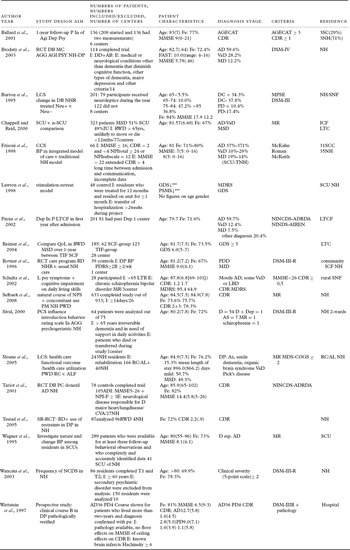
The search strategy initially identified 1982 abstracts including duplicates. After two consensus meetings, 18 papers met the inclusion criteria (Table 2).
Residents characteristics and study design of 18 studies investigating the course of NPS in chronic care institutions

Study design/aim: AB = aggressive behavior, AD = Alzheimer dementia, AGG = aggression, AGI = agitation, ALF = assisted living facility, B = behavior, BP = behavioral problems, CCS = case-control study, DB = disruptive behavior, DB = double blind, D = dementia, DC- = dementia without complication, DC+ = dementia with complication, Del = delirium, Dep = depression, Delu = delusions, DP = dementia patients, E = exclusion, Hal = hallucination, In = incidence, I = inclusion, L = longitudinal, LCS = longitudinal cohort study, LTCF = long term care facility, MC = multicentre, MSD = moderate to severe dementia, NCDS = non-cognitive dementia symptoms, Neu+ = received neuroleptics, Neu- = received no neuroleptics, NH = nursing home, NHR = nursing home residents, NPS = neuropsychiatric symptoms, P = prevalence, PCS = prospective cohort study, PD+ = psychiatric disorder, PD- = no psychiatric disorder, PM = psychotropic medications, Psy = psychosis, PWD = patient with dementia, QoL = quality of life, RC = residential care, RCT = randomized clinical trial, RWD = residents with dementia, SB = single-blind, SCF = special care facility, SCU = special care unit, TIF = traditional institutional facility.
Numbers of patients included/excluded and centers: CMAI = Cohen-Mansfield Agitation Inventory, CSDD = Cornell scale depression in dementia, DD = dementia diagnosis, E = exclusion, MMSE = mini mental state examination, NPI = neuropsychiatric inventory, PDRS = psychogeriatric dependency rating scale.
Patients characteristics: B = baseline, B-ADL = Barthel-ADL, CDR = clinical dementia rating, F = follow-up, FAST = functional assessment staging, Fe = female, MDRS = Mattis dementia rating scale, PSMS = physical self-maintaining scale.
Diagnosis/stage: AGECAT = computer based diagnostic system formulation 8 diagnostic clusters, AS = amnesic syndrome, CDR = clinical dementia rating, DD = dementia diagnosis, DSM = Diagnostic Statistical Manual, GDS = global deterioration scale, LBD = Lewy body disease, LTR = long term resident, MD = mixed dementia, MID = multi-infarct dementia, MR = mental retardation, MSD = moderate or severe dementia, PD = Parkinson dementia, PDD = primary degenerative dementia, MDRS = Mattis dementia rating scale, MR = medical record, VaD = vascular dementia.
Criteria: DSM = Diagnostic and Statistical Manual of Mental Disorders, MPSE = modified present state examination, MR = medical record, NINCDS-ADRDA = internationally accepted criteria for AD, NINDS-AIREN = internationally accepted criteria for VaD.
Residence: AL = assisted living, ALF = assisted living facilities, CF = care facilities, ICF = intermediate care facilities, IU = integrated unit, LTCI = long term care institutions, NH = nursing home, RC = residential care, SC = social care, SCF = specialized care facilities, SCU = special care unit, SNF = skilled nursing facilities, TCI = traditional care institution.
* = p<0.05; ** = p<0.01; *** = p<0.001; **** = p<0.0001.
Resident population
The residents were predominately female (ranging from 67% to 82%) aged 75 years and older. The number of included residents ranged from 26 to 323.
Assessment instruments
Twelve different assessment instruments were used to follow the course of NPS. Seven of these were used in more than one study: Cohen-Mansfield Agitation Inventory (CMAI)(Brodaty et al., Reference Brodaty2003; Chappell and Reid, Reference Chappell and Reid2000; Frisoni et al., Reference Frisoni1998; Lawton et al., Reference Lawton1998; Reimer et al., Reference Reimer2004; Rovner et al., Reference Rovner1996; Sloane et al., Reference Sloane2005), Neuropsychiatric Inventory (NPI)(Ballard et al., Reference Ballard2001; Frisoni et al., Reference Frisoni1998; Selbaek et al., Reference Selbaek2008; Tariot et al., Reference Tariot2001), Cornell Scale of Depression in Dementia (CSDD)(Frisoni et al., Reference Frisoni1998; Payne et al., Reference Payne2002; Sloane et al., Reference Sloane2005), Philadelphia Geriatric Centre Apparent Affect Rating Scale (PGCAARS), Behavioral Pathology in AD (BEHAVE-AD), Psychogeriatric Dependency Rating Scale (PGDRS), and Multidimensional Observation Scale for Elderly Subjects (MOSES). Although the CMAI was used in six studies, comparison of these studies was difficult because different versions were used. Three different NPI-versions were used. An additional five different assessment instruments were used once in the remaining articles.
Longitudinal design
The follow-up period ranged from three months to one year. The number of assessments ranged from two to five. Several studies did not statistically analyze the same group of residents over time. Several studies showed only graphics instead of tables. Group ratings were reported in some studies instead of individual ratings, and aggregated symptom scores were described in several studies instead of specific symptoms.
The course of NPS
Agitation
Ballard et al. (Reference Ballard2001) analyzed three types of agitation using the NPI items aggression, aberrant motor behavior, and overall agitation (either type of agitation). After one year of follow-up, both types of agitation changed: prevalence of aggression decreased from 40% to 29%, and aberrant motor behavior from 33% to 24%. For individual patients, resolution was comparable for aggression (59%) and for aberrant motor behavior (57%), as was persistence (41% v 43%), but in others new development was different (22% vs. 14%), indicating that aggression showed a more intermittent course than aberrant motor behavior. The cumulative prevalence of aggression was higher than aberrant motor behavior (53% v 42%).
Burton et al. (Reference Burton1995) studied nine types of agitation using the Psychogeriatric Dependency Rating Scale (PDRS) including wandering, various types of verbal agitation, and various types of physically aggressive behavior. Cumulative incidences ranged from 5.1% to 20% and cumulative prevalences ranged from 22% to 31.9%, pointing to an intermittent course of the different types of agitation. Overall, persistence was more stable ranging from 3.9% to 7%.
Selbaek et al. (Reference Selbaek2008) studied agitation/aggression and related symptoms. Prevalences at subsequent assessments over a one-year period showed variable courses: in individual patients, aberrant motor behavior (20.8%–19.4%) remained stable as did aggression (27.4%–28.0%), disinhibition (22.2%–23.2%), and irritability (30.0%–33.4%).
Wancata et al. (Reference Wancata2003) studied six aggressive-psychotic symptoms using the Clinical Interview Schedule (CIS) over a six-month observational period. The overall prevalences showed increases (17.5%–22.1%), although some patients showed low persistence (12.8%).
Psychosis
Ballard et al. (Reference Ballard2001) studied the course of psychosis with the NPI items of delusions and hallucinations using frequency parameters. The overall prevalence of delusions remained stable (15%–15%). In individual subjects, delusions persisted (43%) and in others it resolved fully (57%) or newly developed (10%). On the other hand, prevalence in hallucinations increased from 3% to 7%. In individual patients, hallucinations resolved (75%), in some it remained stable (25%) and others showed new onset (6%). Cumulative prevalences of 23% and 9% were found for delusions and hallucinations respectively.
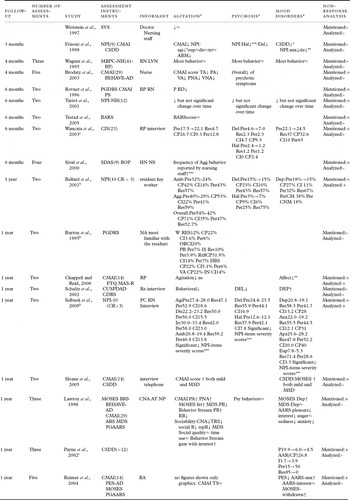
Course of NPS in residents with dementia in chronic care institutions (percentages are prevalences in subgroups)

Assessment instrument: ARS = activity rating scale, B = baseline, BARS = brief agitation rating scale, BEHAVE-AD = behavioral pathology in AD, BOP = validated Dutch version of the Stockton Geriatric Rating Scale, BRS = behavior rating scale, CIS = Clinical Interview Schedule, CSDD = Cornell Scale Depression in Dementia, CMAI = Cohen-Mansfield Agitation Inventory, CUSPDAD = Columbia University scale psychopathology-AD, FAST = functional assessment staging, FTQ = feeling tone questionnaire, FU = follow-up, GMSS = geriatric mental state schedule, MASR = multi-focus Assessment Scale Revised, MBPC-NH = memory behavior problems checklist-NH, MDRS = Mattis dementia rating scale, MDS-COGS = minimum data set cognition scale, MMSE = Mini-mental State Examination, MNCAS = modified nursing care assessment scale, MOSES = multidimensional observation scale for elderly subjects, NM = none mentioned, NPI = neuropsychiatric inventory, PES-AD = pleasant event scale-AD, PGCAARS = Philadelphia geriatric centre apparent affect rating scale, PGDRS = Psychogeriatric Dependency Rating Scale, SVS = Socialverhaltensskala.
Informant: AT = activity therapist, CNA = certified nurse aides, LVN = licensed vocational nurse, N = nurse, NP = nurse physician, PC = primary carers, RP = research personnel.
Agitation: Agi = agitation, Agg = aggression, Amb = aberrant motor behavior, CI = cumulative incidence, CP = cumulative prevalence, DA = demanding attention, Dis = disinhibition, Eup = euphoria, HBS = hitting biting scratching, irr = irritability, IS = interfering staff: preventing from doing their work, MIN = making intolerable noises, OB = objectionable behavior, PA = physical aggression, PB = passive behavior, per = persistence, PNA = physical non-aggression, PR = paces restlessly, RB = repetitive behavior, Re = recurrence, Res = resolution, RtfI = refusing to follow instructions, TS = total score, VA = verbal aggression, W = wandering.
Psychosis: Delu = delusions, Hal = hallucination.
Mood disorder: Anx = anxiety, Apa = apathy, Dep = depression, Sle = sleep.
Predictors: PD = psychotropic drugs.
Medication/restraint: PD = psychotropic drugs.
Loss to follow-up: NCDS = non-cognitive dementia symptoms.
* = p<0.05** = p<0.01*** = p<0.001**** = p<0.0001
a Percentages denote prevalences at subsequent assessments.
b Parameters were calculated from the frequency parameters shown in the tables.
c Parameters were transformed to subgroup percentages instead of group percentage.
Selbaek et al. (Reference Selbaek2008) also studied psychosis with the NPI items of delusions and hallucinations using frequency parameters. Prevalence for both delusions and hallucinations remained stable: 24.4%–23.5% for delusions, 12.6%–12.1% for hallucinations. In individual patients, resolution for delusions and hallucinations were comparable (55.9% and 57.9% respectively), in other patients, persistence was also comparable (44.1% and 42.1%), but in others, new onset delusions (16.9%) developed more frequently than hallucinations (7.8%).
Mood disorders
Ballard et al. (Reference Ballard2001) studied the course of depression using the NPI. The overall prevalence of depression decreased slightly (18%–15%), but in individual patients depression resolved fully (67%), in some it persisted (32%), whereas in others it newly developed (11%).
Selbaek et al. (Reference Selbaek2008) studied the course of depression, anxiety, apathy and euphoria with the NPI. Overall, prevalence of depression and anxiety remained almost stable over time (20.8%–19.1% and 22.0%–19.2% respectively) as did euphoria (7.8%–5.3%). Apathy, on the other hand, increased (25.6%–28.2%) in some individual patients, persisted (52.2%) or resolved (47.8%) in others, or developed anew (20.0%).
Payne et al. (Reference Payne2002) studied depression using the Cornell Scale of Depression in Dementia over a one-year period with three measurements. They found in individual patients a high rate of resolution (85%), persistence in some (15%), and new onset in others (3.7%).
Wancata et al. (Reference Wancata2003) studied five different depressive symptoms using the Clinical Interview Schedule. Overall symptom prevalence increased (22.1%–24.5%) and a high persistence was found in individual patients (63%).
Discussion
This is the first systematic review of the longitudinal course of NPS in residents with dementia in long-term care institutions. Of the 18 included studies in this review, only six had the primary objective to study the course of NPS over time (Ballard et al., Reference Ballard2001; Burton et al., Reference Burton1995; Payne et al., Reference Payne2002; Selbaek et al., Reference Selbaek2008; Wagner et al., Reference Wagner1995; Wancata et al., Reference Wancata2003). Only three of these evaluated a broad range of NPS (Ballard et al., Reference Ballard2001; Selbaek et al., Reference Selbaek2008; Wancata et al., Reference Wancata2003). Furthermore, pooling of data was impossible due to the heterogeneity of the resident populations studied and the methods used. However, we extracted frequency parameters whenever possible. We found that aberrant motor behavior, depression, anxiety, and euphoria showed declines over time, but psychosis remained constant. Apathy increased as did agitation, irritability, and disinhibition. All symptoms showed specific intermittent courses. The high cumulative prevalence of agitation, in particular, underscores the importance of this symptom for residents in long-term care facilities.
The representation of the course of NPS in the selected articles needs some consideration. Generally, studies dealt with NPS according to the assessment instrument used. This can have a major drawback: symptoms not covered with the assessment instrument will not be assessed and therefore remain unaccounted for; for example, apathy was studied in only one study. The frequency parameters merely take into account the presence or absence of NPS instead of the actual severity. A loss of information is therefore unavoidable, as is encountered with the use of graphics instead of tables. In addition, there could be incomparability or misinterpretation when it is not transparent how parameters were calculated (e.g. cut-off points, percentages of groups or subgroups, observation period). General conclusions regarding the course of NPS can be made more accurately if patients are described clearly in terms of their residential setting, dementia diagnosis, etiological differentiation and dementia stage. Different NPS are represented according to the etiology of diagnoses (Caputo et al., Reference Caputo2008; Fernandez-Martinez et al., Reference Fernandez-Martinez2008) and might follow different courses over time. The objective of examining the course of NPS is to identify significant changes over time. Therefore, it is mandatory that the statistical analyses are carried out on the same group of residents instead of on different groups of residents (Burton et al., Reference Burton1995). In this review, the randomized controlled trial (RCT)-placebo groups were included because these groups allowed the observation of the natural courses of NPS without interventions. Although this sounds reasonable on the surface, several drawbacks hamper the interpretation from such data. First, in RCTs, the extra attention the participants receive alone can be enough to act as an intervention to affect the natural course of NPS at subsequent measurements (Hawthorne effect). Second, the administration of assessment scales per se is an intervention; therefore, a placebo group is not entirely free from any kind of intervention (Sival et al., Reference Sival2000). Finally, regression to the mean could occur when a group of residents exhibiting a high frequency of a behavior or severe form of behavior is selected and followed over time (Bland and Altman, Reference Bland and Altman1994). Also noteworthy is the time between admission and inclusion in the study, since admission into a nursing home can be a stressful moment accompanied with NPS. After some adjustment to the new surroundings, a dementia patient might express fewer or less severe NPS. Several studies included residents within 14 days of admission (Frisoni et al., Reference Frisoni1998; Wancata et al., Reference Wancata2003), or required a minimum stay of 14 days (Selbaek et al., Reference Selbaek2008), and another study included residents from whom CSDD was administered within one month after admission (Payne et al., Reference Payne2002). One can speculate about how the expression of NPS might have been influenced by this short interval. Of particular interest and importance in interpreting change scores are the psychometric properties of the assessment instruments such as reliability, validity, and responsiveness to change (Demers et al., Reference Demers2000). The reliability and validity of most assessments instruments have been incompletely assessed, and longitudinal data are not available to assess responsiveness to change (Perrault et al., Reference Perrault2000). This lack of information might hamper clear and unambiguous interpretations of NPS change scores. Finally, NPS are frequently treated with psychotropic drugs (PD). PD use can possibly influence the course or severity of NPS, which makes comparison with the non-PD group difficult. On the other hand, previous studies question the influence of PD use on the actual course of NPS (Ballard et al., Reference Ballard2001; Selbaek et al., Reference Selbaek2008).
Results so far indicate that individual NPS follow different courses over time. The implications for current practice are not obvious, but addressing the high persistence on the one hand and trying to resolve or prevent the development of NPS on the other hand warrant constant monitoring of current pharmacological interventions.
There is a need to study a larger group of institutionalized residents with dementia looking at a broad spectrum of NPS over longer periods. Moreover, at present, studies have only observed NPS over time, but future longitudinal prospective cohort studies looking at the course of NPS should also account for their association with ADLs, cognition, PD use, quality of life, and other clinical and personal characteristics, and also identify subgroups. These studies should give detailed insights into the actual course of NPS in residents with dementia, indicate causal relationships between these variables, ensure more efficient therapeutic interventions, and help to enhance daily care given to residents and family members.
Conflict of interest
None.
Description of authors' roles
R. Wetzels, S. Zuidema, F. Verhey and R. Koopmans initiated the study concept and design; R. Wetzels and I. Jansen collected the data and undertook the literature search and interpretation; R. Wetzels wrote the paper, and it was critically reviewed by I. Jansen, S. Zuidema, F. Verhey and R. Koopmans.
Acknowledgments
This study was financed by the Joannes de Deo Foundation, Netherlands Organization for Health Research and Development (ZonMW), Foundation for the Promotion of Science in Nursing Home Care (SWBV), and the Department of Primary and Community Care of Radboud University Nijmegen.