

1. Introduction
Natural disasters (e.g. floods, cyclones, and earthquakes) create significant shocks in the usual economic life of households, but especially so in developing countries where people are typically not insured against these shocks.Footnote 1 In developing countries, natural disasters can have dramatic impacts on household well-being due to the absence of a sufficient safety-net (e.g., savings and assets, insurance, credit, public intervention through relief and rehabilitation) to protect against such shocks. As a prominent example, in 1998 Bangladesh experienced the ‘flood of the century’. Two-thirds of the country remained under water for more than four months, risking food security for millions of people. Households exposed to flooding had major crop failure, suffered from water-borne diseases, lost their shelter and other basic assets (e.g., livestock and poultry), and lost purchasing power for meeting basic needs (del Ninno et al., Reference del Ninno, Dorosh, Smith and Roy2001).Footnote 2 In this study, we explore whether informal social responses through private transfers allow households to cope with the post-flood situation.
Bangladesh is prone to various natural disasters (mainly floods and cyclones) due to its meandering river systems and deltaic formation.Footnote 3 Flooding is argued to be one of the main contributing factors to the poverty trap in Bangladesh (Sen, Reference Sen2003). There is a strong link between adverse riverine ecology and chronic poverty in Bangladesh. The historical persistence of poverty in Bangladesh is found in river-erosion areas with vulnerability to severe flooding.Footnote 4 Poorer households are more vulnerable as they are less equipped to deal with these shocks. Consequently, they rely on various types of informal social insurance mechanisms to recover. Given that, in this study we examine the role of informal social insurance mechanisms in households’ coping responses to shock created by massive flooding. Our particular focus is on exploring the role of private transfers that occurred as inter-household gifts exchanges. Based on multiple rounds of unique household survey data collected after the 1998 flooding in rural Bangladesh, we find that private transfers were not only altruistically provided, but were calibrated to the severity of flood exposure. We also find that private transfers significantly contributed to reducing households’ consumption variability.
2. Background and related literature
The literature on inter-household transfers is rich both in developing and developed country contexts, and in exploring the motivation behind such transfers. Cox and Jimenez (Reference Cox and Jimenez1990) note that in developing countries inter-household transfers form a significant share (20–50 per cent) of household income. Two types of transfer motives have been identified in the literature: (1) altruism and (2) reciprocal exchange. The amount of private transfers can be quite large, particularly when the poorest households are considered, and provide various social and economic benefits similar to different public welfare programs (e.g. unemployment benefit, disaster relief, and rehabilitation).
The empirical evidence exploring transfer motives is mixed in the developing country context, while it is mainly driven by the exchange motive in the developed country context. In the US context, Cox (Reference Cox1987) and Cox and Rank (Reference Cox and Rank1992) find that the empirical pattern of private transfers is more consistent with exchange than altruism. In a developing country context, Mitra (Reference Mitra2004) shows that reciprocal exchange behavior is the strongest determinant of private transfers among the slum dwellers in urban India. Cox et al. (Reference Cox, Eser and Jimenez1998) also report similar findings analyzing Peruvian data. In contrast, in an Indonesian context, Ravallion and Dearden (Reference Ravallion and Dearden1988) find evidence of transfers to the sick, elderly, and unemployed households that are interpreted as providing support for an altruistic motive. Foster and Rosenzweig (Reference Foster and Rosenzweig2001) also find evidence of an altruistic motive for inter-household transfer in rural India. Using household data from a different survey than presented here, and not in a post-flood or hazard situation, Park (Reference Park2001) concludes that transfers in Bangladesh do not support altruism. Inter-household transfers from relatives are found to be uncorrelated with recipients’ income or wealth.
In contrast to studies like Cox et al. (Reference Cox, Eser and Jimenez1998) and Park (Reference Park2001), we study the motives behind private transfer in an exceptional post-flood situation in which a large number of households are severely affected by massive flooding. To our knowledge no other study has investigated the motives behind private transfers in such a context (sequence of detailed household surveys in a post-event setting for a severe natural disaster in a developing country).
In addition to exploring the motivation behind inter-household transfers, we also want to explore whether such transfers are economically significant to the affected households. Thus, as one critical piece of evidence we investigate whether these transfers significantly contributed to smoothing consumption in the face of post-flood income shocks. The literature on consumption smoothing and risk sharing has received a great deal of attention in the last few years. Studies reveal that households in low-income countries without access to formal credit and insurance markets find diverse ways to smooth consumption in the face of adverse income shocks (Case, Reference Case1995). For instance, Rosenzweig and Wolpin (Reference Rosenzweig and Wolpin1993) have found the role of investment assets to smooth consumption of the poor agricultural households under constrained credit opportunities. Other options households use to recover from shocks include selling assets, diversifying income generating activities, and relying on gifts and loans. Since most of these insurance mechanisms are not provided by the state, market or any formal agencies, they are referred to as informal insurance provided through private or social arrangements (Morduch, Reference Morduch1999).
To test the role of informal insurance, most of the relevant studies relate the variability of household consumption to income variability. The underlying argument is that if consumption can be smoothed perfectly through the informal insurance mechanisms, consumption variability should not be explained by income variability. Townsend (Reference Townsend1994) first investigated this idea, and there have been a number of subsequent studies, which commonly find that households can partially but significantly smooth consumption through informal insurance.
Earlier, a number of studies attempted to explore the role of private transfers in consumption smoothing.Footnote 5 Using detailed data on gifts, loans, and asset sales of Filipino households, Fafchamps and Lund (Reference Fafchamps and Lund2003) investigate how rural Filipino households deal with income and expenditure shocks. They find that shocks have a strong effect on gifts and informal loans, but little effect on sales of livestock and grain, implying that risk is shared within networks of friends and relatives through flexible, interest free loans combined with pure transfers. Townsend and Alem (Reference Townsend and Alem2002) also explore the role of gifts and credit in consumption smoothing using household survey data from Thai households and find that gifts and credit are more effective in smoothing consumption compared to savings and asset sales. Rosenzweig (Reference Rosenzweig1988), Rosenzweig and Stark (Reference Rosenzweig and Stark1989), Rosenzweig and Wolpin (Reference Rosenzweig and Wolpin1994) are some of the other studies that have underscored the role of inter-household transfers to smooth consumption. Foster and Rosenzweig (Reference Foster and Rosenzweig2001) incorporate altruism as a gift-giving motivation into a risk-sharing model. They show that altruism plays an important role in overcoming commitment constraints to share risk through inter-household transfers. Cox et al. (Reference Cox, Hansen and Jimenez2004) also find that private transfers are highly responsive to household economic status and such transfers are consistent with altruistic preferences, household risk sharing, or both.
In contrast to the numerous studies on risk sharing and consumption smoothing behavior with idiosyncratic income shocks, few studies investigate consumption smoothing when dealing with aggregate or covariate shocks. Fafchamps et al. (Reference Fafchamps, Udry and Czukas1998) state that a number of earlier studies provide evidence of the positive effect of informal insurance on consumption smoothing in the face of idiosyncratic shocks (due to sickness, unemployment etc.) but of the largely negative effect in the face of aggregate or covariate shocks (due to flood, draught, political and social unrest etc.). Takasaki et al. (Reference Takasaki, Barham and Coomes2004) investigate peasants’ responses for coping with covariate flood shocks and idiosyncratic health shocks in the flood-prone Amazonian forests. They find that peasants adopt ex post coping strategies (e.g. upland cropping, fishing and non-timber forest products gathering) in addition to ex ante precautionary savings measures in the form of food and livestock. These are the only studies we are aware of that attempt to connect the motives of inter-household transfers and the role of such transfers in risk sharing with consumption smoothing. To extend this literature, we investigate inter-household transfer motivations in an exceptional post-flood situation that created a massive covariate shock to a large number of households in Bangladesh. We then examine the economic significance of such transfers in consumption smoothing.
3. Theoretical framework
3.1. Inter-household transfer motives: altruism and exchange
Arrow (Reference Arrow and Phelps1975) provided one of the first efforts to characterize altruism in a utility-theoretic framework, where the welfare of each individual depends both on his own satisfaction and on the satisfaction obtained by others (through his contribution). Subsequently, this framework has been widely used to investigate motives behind private transfers. Cox (Reference Cox1987), Cox and Jimenez (Reference Cox and Jimenez1998), and Cox et al. (Reference Cox, Eser and Jimenez1998) provide a number of variants of this framework for analyzing private transfer motives.
Following Cox et al. (Reference Cox, Eser and Jimenez1998), let us assume a stylized two-household setting where household i cares about the welfare (consumption level) of household j. An altruistic utility function can be written as

where Ci and Cj are the consumption levels of household i and j, respectively; and V(Cj) is the utility function of household j.
Assuming that household i's utility function is additively separable between its own consumption and consumption of the other household, j, we can write

where γ reflects the degree of altruism and it is assumed that γ < 1.
If altruistic preferences also apply to household j, we can write j's utility functions as Vj = V[Cj, U(Ci)] = V(Cj, U) = V(Cj)+γU(Ci). Now if household i offers transfer or gift (G) to household j to maximize the altruistic utility function, the households’ budget constraint can be written as

and

where Wi and Wj represent the wage earnings and Ai and Ai represent the asset belongings of household i and j. Then the utility maximization problem for household i can be written as

So the first-order conditions can be written as
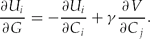
If transfers are purely altruistic, then following Cox et al. (Reference Cox, Eser and Jimenez1998), we expect  , that is the less earnings household j has the more gifts it receives from household i. Since in this case we deal with a large covariate shock due to massive flooding, current income is subject to high variability for almost every household. So the stock of income (i.e. assets) rather than current income will be a better predictor of a transfer motive. Using assets in the analysis is also helpful in taking care of transfers that include both cash and in-kind in the presence of market imperfections and liquidity constraints. So altruistic motives can also be represented by
 . However, if transfers are motivated by reciprocal exchange, then
 and
 . Thus, if inter-household transfers are driven by an altruistic motive, the less earnings or assets a household has the more transfers it receives. In contrast, if the transfers are motivated by reciprocal exchange, then the more earnings or assets a household has the more transfers it receives (see Cox et al., Reference Cox, Eser and Jimenez1998).Footnote 6
Now we can incorporate the household's level of flood exposure, where increasing exposure is a source of disutility in the household utility maximization model. We assume that Fi and Fj represent flood exposure to household i and j. So the utility functions of the households i and j can be written as Ui = U[Ci, Fi, V(Cj, Fj)] and Vj = V[Cj, Fj, U(Ci, Fi)]. Since flood exposure creates disutility to a household, we consider that  and
 . Then, an altruistic motive implies
 .Footnote 7 Thus, with an altruistic motive, the greater the level of flood exposure a household experiences the more transfers it receives. The altruistic donor household gets less utility when the recipient household is more exposed to flooding. In contrast, for a simple reciprocal motive we would not expect to see a positive correlation between the level of private transfer and flood exposure. In fact, in that case we may see the opposite
 if we assume that the more flood exposed household has less ability to reciprocate.
3.2 Inter-household transfer and household risk sharing
Recent literature on risk sharing and consumption smoothing initiated by Townsend (Reference Townsend1994) is mainly founded on Arrow's (Reference Arrow1964) theory of full insurance. If households are risk averse, markets are complete, or there are formal or informal institutions that can pool risks to achieve Pareto-optimal allocation, the marginal utility of consumption across households will be equalized (see Morduch, Reference Morduch1999). Becker (Reference Becker1974) noted that private transfers may achieve effective risk sharing between the donor and recipient households. The essence of the risk-sharing literature is that if households are risk averse and the extent of shocks is not perfectly correlated, the household can benefit from sharing resources to smooth lifetime consumption.
Altruistic motives for inter-household transfers are not necessary for risk sharing in the basic Townsend (Reference Townsend1994) model, and a number of recent papers investigated the role of private transfer in risk sharing and consumption smoothing in a non-altruistic environment (Cox et al., Reference Cox, Hansen and Jimenez2004). However, Foster and Rosenzweig (Reference Foster and Rosenzweig2001) consider an altruistic utility function for households i and j, and then characterize the risk-sharing contract allowing different levels of altruism by the households. The model is flexible in the sense that households with low levels of altruism (self-interested ones) operate in autarchy rather than sharing any resources. Following Foster and Rosenzweig (Reference Foster and Rosenzweig2001), the optimal contract for risk sharing can be written by
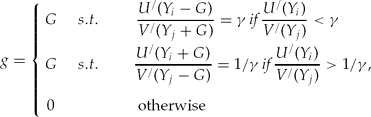
where g is the transfer function, G is the amount of transfer given or received, and γ reflects the degree of altruism. The above contract (7) is a characterization of a static Nash equilibrium where the first line implies the transfer offered by household i to household j and the second line implies the transfer received by household i from household j. The basic intuition is that when the households care about each other, the less affected household is better-off from transferring resources to the more affected household than being autarchic. Since informal contracts for helping each other are not legally binding, enforcement relies on the consequence of its violation. Foster and Rosenzweig (Reference Foster and Rosenzweig2001) argue that altruistic preferences not only increase the willingness to make a transfer when the household is relatively better-off, they also decrease the willingness to penalize in case of the violation of contract. In this way altruistic preferences lead to transfers across households, rather than being autarchic.
Thus, given that the implication of the risk-sharing hypothesis is to equalize or smooth consumption, and the 1998 flooding in Bangladesh affected the usual flow of household consumption (due to crop failure, sickness, loss of shelter and assets, etc.), we investigate whether private transfers significantly contributed to reducing the variability of household consumption in the post-flood period.
4. Data and empirical specification
The empirical analysis presented here is based on the International Food Policy Research Institute's Food Management and Research Support Project (IFPRI-FMRSP) Household Survey 1998. The survey data were collected from 757 households in rural areas in Bangladesh at three points in time between November 1998 and December 1999. The survey project was specifically implemented to examine the coping strategies adopted by households to recover from the shock caused by massive flooding. The first round of data collection took place between the third week of November to the third week of December 1998, two months after the receding of floodwater. The second round of data collection was carried out between April and May 1999. And finally the third round of data collection took place in November 1999. To obtain a geographically stratified sample of affected areas, 757 households from seven flood-affected thanas were interviewed.Footnote 8 A panel data set was then constructed based on the survey responses that included households’ incomes, expenditures, assets, inter-household transfers (gifts received and gifts given by the households), credit availability, and other household-level characteristics including the level of flood exposure. Household-level flood exposure was measured by an index based on (1) the maximum depth of water in the homestead, (2) the maximum depth of water in the house, and (3) the numbers of days the water stayed in the house. This index provides a natural reference point for examining household gift exchange behavior and consumption smoothing ability.
To analyze the gift exchange behavior after a major shock caused by massive flooding, we use this panel data set to estimate the following gift equation

where Gkh represents the level and the kinds of gifts exchanged by the household h at time t; superscript k indicates different kinds of gift exchange, e.g. gifts received, gifts given and net gifts (gifts received minus gifts given). The variable Fh represents an index of household flood exposure, Ah is the value of household assets, Xh is a vector of household or household head's characteristics, and ɛh is a household-specific stochastic error term capturing the unobservable components that affect household gift exchanges.
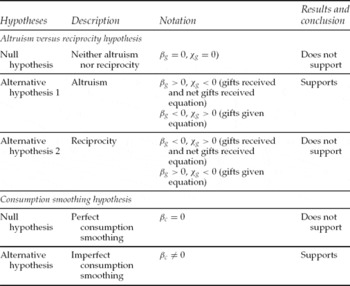
The specific hypotheses we want to test are whether gifts are transferred by the motive of altruism or reciprocity. Thus, against the null hypothesis (H0; βg = 0, χg = 0), we test two competing alternative hypotheses (altruism versus reciprocity). For both the gifts received and the net gifts received equations, βg > 0 and χg<0 support the first alternative hypothesis of altruism, whereas βg<0 and χg > 0 support the second alternative hypothesis of reciprocity. For the gifts-given equation, the signs of βg and χg are reversed for supporting the altruism and the reciprocity hypotheses.
Further, we explore whether gift exchange has any impact on the consumption smoothing process at the household level. Following Skoufias (Reference Skoufias2003), we estimate the following consumption smoothing equation

where Δln Cht denotes the change in the log of household consumption between period t and t + 1; Δln Yht is the change in the log of household income between period t and t+1. Xht is a vector of household or household head's characteristics including an index of flood exposure. Dt represents a time-specific dummy and ϵht is the stochastic error term. The coefficient βc is of particular interest in testing consumption smoothing; it measures the role of income shocks in explaining consumption variability and captures the role of any insurance mechanisms in shielding the household from income shocks. βc≠0 implies that income shocks explain the consumption variability and households are not adequately insured against the income shocks. Conversely, βc = 0 implies that households can perfectly smooth consumption against the income shocks through various insurance options (Skoufias, Reference Skoufias2003). Thus, against a null of perfect risk sharing (H0; βc = 0), we test the alternative hypothesis of inadequate or imperfect risk sharing (H1; βc≠0).
5. Results
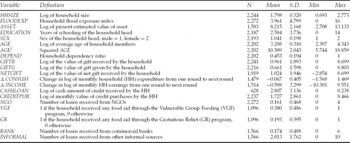
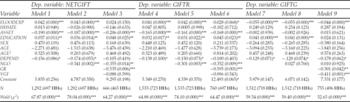
Full definitions of the variables and associated descriptive statistics are provided in table 1. In table 2 we present the regression results for the gift equation. From random-effects panel generalized least square (GLS) regression estimates, we see that the flow of gift exchanges across household is determined by a host of factors.Footnote 9 In table 2, the estimated coefficient of FLOODEXP is positive and significant in models 1 to 6 where the dependent variables are NETGIFT and GIFTR, and negative and significant in models 7, 8, and 9 where the dependent variable is GIFTG. This evidence indicates that households that are more exposed to flooding received more gifts than households less exposed to flooding. The households who are less exposed to flooding also provided more gifts. This finding implies that in the case of post-flood shock recovery, the informal insurance mechanism through gift exchanges worked similarly to any other formal insurance mechanism. That is, whoever is more exposed to flooding received more compensation. In table 2, the estimated coefficient on the ASSET variable is significant (at 1 per cent level) with a negative sign for both cases with the dependent variable GIFTR (models 1 and 2) and NETGIFT (models 3 and 4). This implies that households who own less assets received more gifts. The findings provide evidence supporting the hypothesis of an altruistic gift exchange process, rather than the reciprocal exchange hypothesis.Footnote 10
Descriptive statistics

Notes: Household flood exposure index is calculated based on three variables: (1) depth of water in the homestead, (2) depth of water in the house (feet), and (3) number of days of water in the home (see del Ninno et al., Reference del Ninno, Dorosh, Smith and Roy2001 for further detail). Household dependency ratio is the number of household members aged below 15 or above 64 divided by the number of household members aged 15 to 64. Present estimated value of asset, gift received, gift given, net gift received, monthly HH expenditure, monthly current earnings, cash loan, and credit purchases are measured in Taka, the local currency of Bangladesh. At present (i.e., in 2008) 1 USD is worth around 68 Taka. Monthly HH expenditure includes both food and non-food expenditure but does not include other major expenditures (e.g. house repairs etc.). Monthly HH earnings include wage earnings and earnings from business and agriculture. We add one in variables with zero minimum value before log transformation so that we get zero minimum value after log transformation.
Random-effects panel GLS regression results of gift equation

Notes: Random-effects specification is preferred over fixed-effects based on Hausman specification test. ***, **, * imply significance at 0.01, 0.05, and 0.10 levels respectively; numbers in parentheses are the corresponding P-values.
Table 2 also shows that more educated households received more gifts and also offered more gifts. The estimated coefficient of EDUCATION is positive and significant (at 1 to 5 per cent levels) in models 1 to 6. Educated households may be better able to construct social networks with other households, and thus utilize the gift exchange mechanism in times of need. Thus, gift exchanges are more likely in a relatively higher educated community as is found in earlier literature (Cox and Jimenez, Reference Cox and Jimenez1998). Our analysis shows that demographic factors, e.g. sex of the household head and the age structure of the household members, do not significantly affect the flow of gift exchanges across households (the estimated coefficients of SEX, AGE, and AGE2 are not significant in any of the models in table 2). However, households with more dependent members in the family both offered and received fewer gifts (the estimated coefficient of DEPEND is negative and significant at 0.10 level). This may be due to weak social networks outside the home, as working-age people are more likely to maintain an effective network with friends, neighbors, and relatives.Footnote 11
The NGO variable measures the number of loans received from Non-Government Organizations (NGOs) to represent alternative sources of shock recovery available to households. The estimated coefficient on NGO is significant and negative implying that households that have alternative sources for obtaining loans received less gifts. This finding can be interpreted in a number of ways. Households participating in NGO programs may have support mechanisms already built into their lending groups, and thus may not receive significant private transfers. Cox et al. (Reference Cox, Hansen and Jimenez2004) state that households that have access to formal insurance or other credit channels are less likely to receive private transfers. The finding is also consistent with the results of Foster and Rosenzweig (Reference Foster, Rosenzweig, Mason and Tapinos2000), which show that introduction of financial intermediation in the form of formal credit institutions, diminishes informal transfer arrangements in low-income rural areas. If gifts are flowing to households who have fewer alternative options, then this implies significant distributional gains for society. On the other hand, it may raise concerns that safety nets provided by informal social networks may be crowded out by formal interventions provided by NGOs.Footnote 12
In the context of the 1998 flood in Bangladesh, two disaster relief programs were implemented by public agencies to distribute food aid during and after flooding: Gratuitous Relief (GR) and Vulnerable Group Feeding (VGF). GR was implemented immediately after the flood and targeted the most flood-affected households. VGF was implemented much later using selection criteria such as assets, income, occupation, and demographics.Footnote 13 The crowding out of private transfers by formal intervention may be a potential concern since the estimated coefficient on GR has a significant negative correlation with gifts exchange (gifts received and net gifts received). The estimated coefficient on VGF also shows a negative sign, but it is not statistically significant (see models 3, 6, and 9 in table 2 and models 12, 15 and 18 in table 3). However, as Morduch (Reference Morduch1999) notes, distributional gains may well offset such effects.Footnote 14
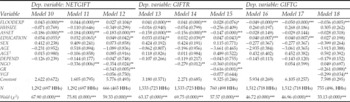
Random-effects panel GLS regression results of gift equation with AR (1) Error process

Notes: The first-order autoregressive, AR(1) error process is defined as: ϵit = ρϵit−1+zit, where |ρ|<1 and zit are iid errors. ***, **, * imply significance at 0.01, 0.05, and 0.10 levels respectively; numbers in parentheses are the corresponding P-values.
Our results also suggest that potential crowding out may be reduced by relevant targeting criteria. For instance, shock-based (i.e., exposure to flooding) targeting was used in GR program design, and poverty-based (or wealth-based) targeting was used in VGF program design. While different targeting criteria serve different purposes, the relative advantages and disadvantages need to be identified to ensure maximum social welfare. For example, shock-based criteria may be effective immediately after the event, while poverty-based criteria may perform better in serving long-term recovery (see Coady et al., Reference Coady, Grosh and Hoddinott2004 for a comprehensive review on the targeting criteria and outcomes in transfer programs in developing countries). In this case, poverty-based criteria (i.e., VGF) are less likely to be prone to potential crowding out. This makes sense since all households who are highly exposed to flooding may not necessarily be less equipped with resources to cope with flooding. In the long-term recovery process, the informal social network can be quite efficient in sorting out and rationing its resources to community members who badly need help. Poor households may still receive gifts even though they are considered for formal interventions, which are often insufficient.
To check the robustness of our analysis, we re-estimate the models of table 2 allowing an autoregressive error process and report in table 3. We assume a first-order autoregressive error process, AR(1) defined as: ϵit = ρϵit−1+zit, where |ρ| < 1 and zit are iid errors. Current gift exchanges can be influenced by previous gift exchanges. If this is the case, assuming the errors of gift equation, iid ɛit may lead to biased estimate. However, using an AR(1) error process we can control for such bias. After controlling for bias through such an error structure and using the same econometric specification (random-effects panel GLS), we produce similar results in table 3. Thus, results are robust across different specifications of the error process.
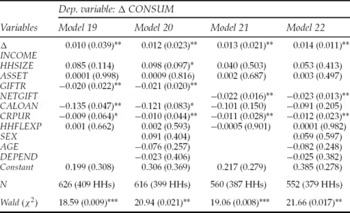
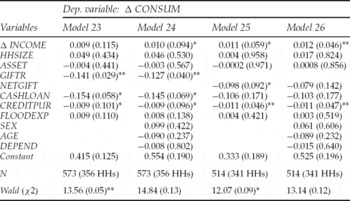
In the next step, we estimate the consumption smoothing equation. Our particular interest is how gifts contribute to the consumption smoothing process. The estimates of the consumption smoothing equation from random-effects panel GLS regressions are presented in table 4.Footnote 15 As we see in table 4 the coefficients of both GIFTR and NETGIFT are significant and appear with a negative sign. This implies that higher inflow of gifts significantly reduces the consumption variability. Thus the households that received more gifts are less vulnerable to shocks measured by consumption variability. The estimates from the consumption smoothing equation also suggest that household's consumption variability is not influenced by demographic factors, e.g. sex of the household head, age structure of household members, and the household dependency ratios (the coefficient of SEX, AGE, and DEPEND are not significant in any of the models in table 4). However, there is limited evidence that households with more members are prone to higher levels of vulnerability (HHSIZE is positive and significant at the 11 per cent level in model 13 and the 9 per cent level in model 14). Furthermore, variability in consumption is not determined by the degree of flood exposure (the coefficient of FLOODEXP variable is not significant), which is also confirmed by del Ninno et al. (Reference del Ninno, Dorosh, Smith and Roy2001). The other channels that significantly contributed to reduce consumption variability are purchases through credit (CREDITPUR is negative and significant in all models in table 4) and private cash loans received (CASHLOAN is negative and significant in models 13 and 14) by the households.Footnote 16 Another important finding is that post-flood consumption variability cannot be reduced by asset ownership, which indicates the limitation of using assets as a buffer against such covariate shocks, particularly like flooding.Footnote 17
Random-effects panel GLS results of consumption equation

Notes: ***, **, * imply significance at 0.01, 0.05, and 0.10 levels respectively; numbers in parentheses are the corresponding P-values.
In table 5 we re-estimate the consumption smoothing equation by using generalized two-stage least square (G2SLS) random-effects panel regressions to control for any potential endogeneity bias. Table 5 provides similar results to those reported in table 4 with some minor variations. Lastly, the coefficient of income variability (Δ INCOME) is significant in most cases (at 1 to 10 per cent levels) and positively contributes to consumption variability for all models in tables 4 and 5, that is households’ consumption variability can be explained by income variability. As interpreted in the consumption smoothing literature (Wong and Godoy, Reference Wong and Godoy2003), this implies that households cannot completely smooth consumption against the shock occurring through flooding, at least in the short run (note that the time length of data collection is seven to eight months after flooding). A summary of hypotheses tested and corresponding results regarding the private transfer motivation and consumption smoothing is provided in table 6.
Random-effects panel G2SLS results of consumption equation

Notes: ***, **, * imply significance at 0.01, 0.05, and 0.10 levels respectively; numbers in parentheses are the corresponding P-values. EDUCATION, BANK, NGO, INFORMAL are the variables used as additional instruments in estimating G2SLS regression.
Summary of hypotheses tested

6. Discussion and conclusions
Alessi (Reference Alessi1975) and Douty (Reference Douty1972) discuss how disastrous events spur generosity and philanthropic actions. Likewise, Collard (Reference Collard and Collard1978) argues that disasters generate the sympathy of potential donors to a larger extent than ordinary poverty and misery. It is argued that the behavioral chemistry attached to disasters helps create a powerful social fabric that fosters altruism and cooperation. Altruism, a recognized element in our preference space, gets more weight in such situations. This may be particularly the case for a disaster-prone developing country where not enough formal insurance exists against disasters; the altruistic motive is crucial to the provision of an informal insurance mechanism through private transfers. This is a public good for the society that is voluntarily generated by unselfish behavior. Hirshleifer (Reference Hirshleifer and Hirshleifer1987) characterizes this situation as the ‘weakest link’ case of voluntary public good provision generated out of an implicit alliance within a society to support and survive after a disaster. He argues that such an alliance may elicit contributions from individuals who may normally be free-riders and selfish people, and thus provide more efficient provision of a public good.
The post-flood household survey conducted by IFPRI in Bangladesh provides a unique opportunity to investigate these propositions. Analyzing such behavior in a developing-country context can generate policy-relevant information for NGOs and public agencies trying to increase post-disaster coping ability, particularly in the case of limited relief funds and the a priori absence of any formal insurance mechanisms.
While there is a considerable literature focusing on the motives and other determinants of private transfers received by households, the role of such transfers in consumption smoothing remains relatively under-investigated (Maitra and Roy, Reference Maitra and Roy2003). The results of this study extend that scarce literature by first analyzing the motives behind private transfers, and then exploring what role private transfers play in reducing post-disaster vulnerability. In the Bangladesh context, where societies are based on a strong kinship system (Quisumbing and Maluccio, Reference Quisumbing and Maluccio2003), we find that private transfers through gift exchanges are altruistically calibrated to the severity of flood exposure a household experienced. More specifically, households more exposed to flooding received more gifts and households less exposed to flooding offered more gifts. Further, our analysis implies that the nature of gift exchange is highly altruistic in comparison to simple exchange and reciprocity since households who own less assets received more gifts. However, there is also some limited evidence that can be interpreted in support of the reciprocity motive.
We also find evidence that gifts are flowing to households who have fewer alternative options (e.g. NGO Loans), implying significant distributional gains for the society. This finding supports the argument that those families who have access to alternative options to help recover from shocks are less likely to receive private transfers (Cox et al., Reference Cox, Hansen and Jimenez2004; Foster and Rosenzweig, Reference Foster, Rosenzweig, Mason and Tapinos2000). Furthermore, based on a different household survey conducted in a non-disaster situation in Bangladesh, Park (Reference Park2001) concludes that inter-household transfers do not support altruism. Analyzing post-flooding household responses in Bangladesh, we find that the nature of inter-household private transfers is strongly altruistic, rather than simply motivated by reciprocity. Thus, our findings present a contrasting behavioral impact of massive flooding in Bangladesh.
Regarding consumption smoothing, our findings reveal that after such a major covariate shock caused by massive flooding, households cannot fully smooth their consumption, at least in the short run. The evidence of partial consumption smoothing and the role played by inter-household private transfers in consumption smoothing is consistent with a number of earlier studies (Rosenzweig, Reference Rosenzweig1988; Cox and Jimenez, Reference Cox and Jimenez1998; Foster and Rosenzweig, Reference Foster and Rosenzweig2001; Townsend and Alem, Reference Townsend and Alem2002). However, the inflow of gifts plays an instrumental role in reducing vulnerability, as measured by household consumption variability. Our findings also indicate that a household's consumption smoothing ability does not vary significantly with the degree of flood exposure.
Finally, Bangladesh is prone to large-scale natural disasters because of its geographical location and topographical features (WHO, 2004). Extreme poverty and high population density exacerbate the impact of natural disasters.Footnote 18 Some climatologists argue that due to global climate change catastrophic floods in Bangladesh will appear more frequently and with increasing severity (IPCC, 2001).Footnote 19 Thus, for a variety of important reasons, understanding of human responses to natural disaster is important for framing future mitigation measures.
Consistent with a growing literature in experimental and theoretical microeconomics (e.g., Ostrom, Reference Ostrom2000), we find evidence that households altruistically responded to the 1998 massive flooding in Bangladesh. Specifically, we find that though partial in nature, private transfers insure against shocks created by flooding. Private transfers are directed to the poor and those who are more exposed to flooding, and those who have few alternative options. Thus, through private transfers, informal social insurance plays an important role in the post-disaster coping process. However, as future policy actions are considered for providing relief and rehabilitation aid, there are concerns that formal actions may crowd out the informal safety net. While the distributional benefits may well offset the likely effect of crowding out, the challenge is to adapt institutions that complement (harness, strengthen, and sustain) both formal and informal actions. For example, Evans (Reference Evans1996) details case studies (dealing with irrigation systems, microcredit, etc.) of creative institutions that help to build social networks, and coordinate voluntary measures to create a complementary bond between formal and informal actions that increase the stock of social capital and its effectiveness. Ostrom (Reference Ostrom1996) argues that a synergy of state and society can produce a virtuous cycle of collective action to co-produce the missing public goods in a society. In similar contexts as described here, formal interventions can make use of informal targeting criteria. Programs can use community-based targeting criteria, which was somewhat used in VGF program design, to reach the most disadvantaged households who desperately need help. As an example, Sharp et al. (Reference Sharp, Brown and Teshome2006) provides an Ethiopian case study that uses a mix of community-based targeting with other conventionally used formal targeting criteria.
In closing, through continued research an improved understanding of human behavior can be used to adapt institutions to ensure that they encourage altruism and social capital formation, rather than undermining efforts to mitigate the impacts of natural disasters. Such efforts may be especially critical in developing countries where funding for formal interventions is extremely limited. In addition to coordination with informal activities, public actions can prioritize efforts and focus on those most in need (e.g., less likely to be covered by informal insurance). For example, our analysis provides evidence that households with less education and more dependents may be especially important to target. Finally, even with the emerging concerns of increasing frequency and intensity, natural disasters remain a relatively under-investigated topic in economics (Yezer, Reference Yezer2000), and systematic investigations of disaster-induced behavior can provide crucial inputs to improved policy design and implementation.