Introduction
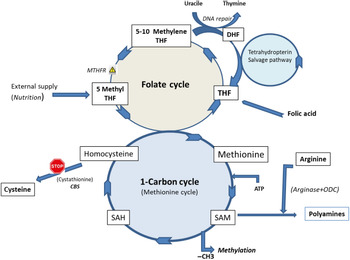
Assisted reproductive technology is now considered a safe and reliable medical intervention, applied globally, and the outcome of a healthy live birth is a reality for the majority of successful IVF and ICSI treatment cycles. Human IVF/ICSI culture conditions and manipulations generate reactive oxygen species (ROS) that can jeopardize the integrity of DNA, potentially creating abasic sites [apurinic/apyrimidinic (AP)], mutagenic DNA lesions that interfere with DNA replication and transcription (Pabon et al., Reference Pabon, Findley and Gibbons1989; Nasr-Esfahani et al., Reference Nasr-Esfahani, Aitken and Johnson1990). Human oocytes and early embryos are equipped to combat damage induced by maternal as well as sperm-borne ROS, but these defences are finite and decrease with maternal age (Hamatani et al., Reference Hamatani, Falco, Carter, Akutsu, Stagg, Sharov, Dudekula, VanBuren and Ko2004). Current scientific literature increasingly describes epigenetic/imprinting anomalies in children born as a result of IVF/ICSI procedures, and these have been attributed to methylation errors affecting the embryonic genome during in vitro culture. There is a strong correlation between oxidative stress and DNA methylation, through influence on the one-carbon cycle. Oxidative stress can induce inappropriate gene expression, i.e. methylation anomalies and oxidative stress represent two sides of the same coin (Menezo et al., Reference Menezo, Silvestris, Dale and Elder2016). The regulation of epigenesis and imprinting relies mainly on histones and DNA methylation. RNA interference also plays a role as an actor/regulator, but elucidating the mode of action is so far limited/difficult, moreover a potential mechanism for manipulating this process is therefore very inaccessible. It is possible that RNAi intervenes as a regulator of methylation as well as in the protection against oxidative stress and its significant effects on methylation/epigenetic marking. RG Edwards had previously expressed this concern about in vitro culture (Edwards and Ludwig, Reference Edwards and Ludwig2003), highlighting the fact that the in vitro zygote may lack a mechanism for methylation maintenance. Data based on methylation studies carried out on in vitro cultured human embryos has led to misleading observations (Smith et al., Reference Smith, Chan, Humm, Karnik, Mekhoubad, Regev, Eggan and Meissner2014): early stage in vitro culture leads to anomalies of methylation, with global detrimental effects that are observed only at a later time. A high incidence of four major imprinting disorders in Japanese babies born after assisted reproductive technology (ART) has recently been documented (Hattori et al., Reference Hattori, Hiura, Kitamura, Miyauchi, Kobayashi, Takahashi, Okae, Kyono, Kagami, Ogata and Arima2019). Culture conditions have been shown to affect epigenetic chromatin remodelling during preimplantation development both in human and in animal species (Lafontaine et al., Reference Lafontaine, Labrecque, Palomino, Blondin and Sirard2020), On a global scale, babies born as a result of IVF procedures show different patterns of DNA methylation compared with those conceived naturally (Katari et al., Reference Katari, Turan, Bibikova, Erinle, Chalian, Foster, Gaughan, Coutifaris and Sapienza2009; Hiura et al., Reference Hiura, Okae, Miyauchi, Sato, Sato, Van De Pette, John, Kagami, Nakai, Soejima, Ogata and Arima2012; Song et al., Reference Song, Ghosh, Mainigi, Turan, Weinerman, Truongcao, Coutifaris and Sapienza2015; Choux et al., Reference Choux, Binquet, Carmignac, Bruno, Chapusot, Barberet, Lamotte, Sagot, Bourc’his and Fauque2018). These problems are thought to arise from the technology itself rather than the aetiology of male and/or female infertility (Song et al., Reference Song, Ghosh, Mainigi, Turan, Weinerman, Truongcao, Coutifaris and Sapienza2015). If we consider the technologies used in IVF, anomalies can potentially be introduced by defects arising during two separate steps: controlled ovarian hyperstimulation (COH) and embryo culture. We will describe the influence of COH, the mechanisms through which current in vitro culture conditions during the period prior to genomic activation can create oxidative stress that may aggravate epigenetic/imprinting problems associated with methylation, and review the crucial effects of the folate and one-carbon cycles (Figure 1). Homocysteine is a cause and a consequence of oxidative stress (Hoffman, Reference Hoffman2011) and is at the epicentre of impairments to the methylation process.
Two separate but interacting pathways that are crucial to methylation processes revolve around methionine and folate, respectively. The outputs from these two cycles are important in the metabolism of nucleotides, proteins and lipids, providing substrates for methylation reactions as well as generating reducing power to maintain appropriate redox potential. Homocysteine recycling is an important feature of these pathways. The tetrahydropterin salvage pathway, involved in the regulation of the biopterins synthesis, is grafted onto the folate cycle; it is not directly involved in the regulation of methylation/epigenesis, but it interferes with the folate endogenous pool available.

Effects of controlled ovarian hyperstimulation
The effect of COH per se is difficult to estimate, as it is generally followed by in vitro culture of the oocytes retrieved after stimulation. However, animal studies in monovulatory animals such as the bovine demonstrate that transfer of the resultant embryos to recipients have a good prognosis with respect to development to term. In the bovine model, COH does not apparently impair embryo quality, but in vitro culture does affect imprinting (Lafontaine et al., Reference Lafontaine, Labrecque, Palomino, Blondin and Sirard2020), leading to large offspring syndrome (LOS) (Young et al., Reference Young, Sinclair and Wilmut1998). Epigenetic/imprinting problems observed following human ART may represent a parallel situation to LOS seen in ruminants (Chen et al., Reference Chen, Robbins, Wells and Rivera2013). Animal models generally follow superovulation with embryo culture (Huffman et al., Reference Huffman, Pak and Rivera2015), so that it is impossible to distinguish between the effects of hyperstimulation and those that may be due to embryo culture. In some models, in vitro maturation adds further uncertainty, as oocyte methylation patterns may be re-set during the final stages of in vivo maturation in the ovary. The same dilemma occurs in humans: most embryos undergo in vitro culture after ovarian hyperstimulation. A study by Sato et al. (Reference Sato, Otsu, Negishi, Utsunomiya and Arima2007) describes methylation anomalies following COH, but the GV and MI oocytes collected for study were matured in vitro.
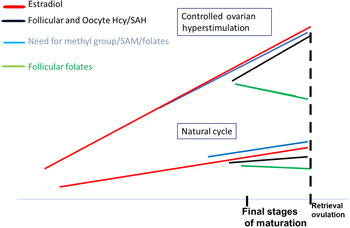
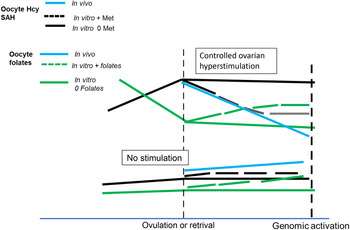
Any direct contribution by superovulation to perturbations in embryonic imprinting/DNA methylation is probably only marginal (Denomme et al., Reference Denomme, Zhang and Mann2011), at least in mono-ovulatory animals. However, the influence of estradiol is an important parameter that has significant consequences for the embryo. Estradiol triggers DNA/histone methylation (Kovács et al., Reference Kovács, Szabó-Meleg and Ábrahám2020), initiating methylation of CpG islands as well as the histone 3 lysine 4 (H3K4) methylation process that triggers gene transcription (Greer and Shi, Reference Greer and Shi2012). Oestrogen receptors are important partners in remodelling chromatin structure by methylation. In human oocytes, oestrogen receptor beta is expressed at 13× the basic signal level, and oestrogen receptor binding protein is expressed at a level of >200×. Ovarian hyperstimulation significantly raises both circulating and follicular estradiol. During oocyte maturation, there is an initial requirement for methyl groups at several oocyte targets, and oocytes express DNA methyltransferases 3A and 3B at levels that are 100× the background signal. The process of methylation generates homocysteine (Hcy), which accumulates in follicular fluid, but not in serum (Boxmeer et al., Reference Boxmeer, Steegers-Theunissen, Lindemans, Wildhagen, Martini, Steegers and Macklon2008, Reference Boxmeer, Macklon, Lindemans, Beckers, Eijkemans, Laven, Steegers and Steegers-Theunissen2009; Berker et al., Reference Berker, Kaya, Aytac and Satiroglu2009; Ocal et al., Reference Ocal, Ersoylu, Cepni, Guralp, Atakul, Irez and Idil2012). Homocysteine and methionine share and compete for the same transporter (Menezo et al., Reference Menezo, Khatchadourian, Gharib, Hamidi, Greenland and Sarda1989). An environment that is rich in Hcy restricts methionine transport and uptake, and this will modify the intracellular Hcy/Met balance, creating a transitory elevation of Hcy and a decreased endogenous pool of methionine within the oocyte (see Figures 2 and 3). Folates are required to support regeneration of methionine from Hcy. There is a clear association between low follicular fluid (FF) Hcy concentrations and oocyte maturation/embryo quality (Szymański and Kazdepka-Ziemińska, Reference Szymański and Kazdepka-Ziemińska2003; Ocal et al., Reference Ocal, Ersoylu, Cepni, Guralp, Atakul, Irez and Idil2012) and lower FF Hcy concentrations are observed in younger women. It is also of note that Hcy accumulation will have a negative effect on the fertility of women who carry methylene tetrahydrofolate reductase single nucleotide polymorphisms (MTHFR SNPs) (Altmäe et al., 2010; Servy et al., Reference Servy, Jacquesson-Fournols, Cohen and Menezo2018). This mutation interferes with the folate cycle by limiting the conversion of folic acid to active 5-methyl tetrahydrofolate (see Figure 1); suboptimal methylation in these patients leads to DNA instability, and this is associated with anomalies in the chromosomal status of the embryo (Enciso et al., Reference Enciso, Sarasa, Xanthopoulou, Bristow, Bowles, Fragouli, Delhanty and Wells2016).
Evolution of ovarian and oocyte parameters that affect the generation of methyl groups during follicular growth in stimulated and unstimulated cycles.

Trajectory of compounds related to methylation in oocytes/early embryos in controlled ovarian hyperstimulation (COH) or unstimulated cycles, cultured in media with or without in vitro folate support.

The observation that FF Hcy concentrations remain low in natural (unstimulated) cycles/ovaries (Szymański and Kazdepka-Ziemińska, Reference Szymański and Kazdepka-Ziemińska2003) provides further confirmation of the biochemistry outlined above. In vivo, the tubal environment provides adequate levels of methionine and folates, whereas Hcy levels are low. This allows a dynamic decrease in the ratio of Hcy to Met, so that the appropriate intracellular Met pool is maintained. Active transport of folates also facilitates Hcy recycling. In a natural cycle, oocyte Hcy levels remain low through recycling, and methionine can enter the embryo either from tubal fluids in vivo (Menezo and Laviolette, Reference Menezo and Laviolette1972; Aguilar and Reyley, Reference Aguilar and Reyley2005), or from culture medium if this essential amino acid is present. This biochemical feature is of major importance for further embryo culture: a medium that contains methionine and folate can mimic the in vivo mechanism for Hcy recycling. In the absence of methionine, an intracellular excess of Hcy can inhibit methylation during early embryonic stages prior to maternal to zygotic transition/zygotic genomic activation (MZT/ZGA), and a lack of folate prevents Hcy recycling. In the bovine, the quality of embryos obtained by superovulation followed by in vivo insemination can be explained by the capacity for Hcy/Met exchange in tubal fluid, which has an estimated 50 micromolar concentration of methionine (Menezo and Laviolette, Reference Menezo and Laviolette1972; Aguilar and Reyley, Reference Aguilar and Reyley2005). Similarly, the high incidence of multiple gestations sometimes seen after COH combined with artificial insemination in humans may reflect biochemical in vivo compensation, with exchange and recovery from elevated Hcy levels by the milieu of the tubal environment.
Preventing oxidative stress in the embryo
The negative influence of oxidative stress (OS) on embryo quality, and the mechanisms of defence have been previously described (El-Mouatassim et al., Reference El-Mouatassim, Guérin and Ménézo1999; Guérin et al., Reference Guérin, El Mouatassim and Ménézo2001) and should be emphasized when examining mechanisms for biochemical protection against OS during IVF/ICSI.
The oocyte and early embryo contain a group of enzymes that are involved in the destruction of ROS, and there is a good correlation between specific mRNA expression and the activity of enzymes that cannot be synthesized before maternal to zygotic transition, such as superoxide dismutases (Cu, Zn and Mn SODs) and glutathione peroxidase (El-Mouatassim et al., Reference El-Mouatassim, Guérin and Ménézo1999). Upregulation of the pentose phosphate pathway (PPP) immediately post fertilization allows the production of NADPH, necessary for synthesis of reducing compounds such as glutathione (GSH). GSH has a certain capacity for crossing any type of membrane, in many cells. However, in most cases, the nature of these transporters remains unclear. GSH has never been detected in tubal fluid; adding glutathione to culture medium can potentially offer only a questionable protection of embryonic membranes. Cysteine sulfinate decarboxylase (CSD), which decarboxylates cysteine sulfinic acid (CSA) to form hypotaurine, another reducing compound, is absent; hypotaurine cannot be synthesized by oocytes or embryos and is acquired from tubal fluid in vivo (Guérin and Ménézo, Reference Guérin and Ménézo1995). Tubal fluid is rich in transferrin and ceruloplasmin (Menezo and Laviolette, Reference Menezo and Laviolette1972); these proteins reduce/remove free copper and iron divalent cations to minimize the risk of a Fenton reaction that will generate free radicals in the embryonic environment. Free radicals as an entity were first recognized by Fenton in Reference Fenton1894. Fe2+ and Cu2+ gave similar results:
 $${\rm{F}}{{\rm{e}}^{{\rm{2}} + }} + {{\rm{H}}_{\rm{2}}}{{\rm{O}}_{\rm{2}}} \to {\rm{F}}{{\rm{e}}^{{\rm{3}} + }} + {\rm{O}}{{\rm{H}}^ - } + \bullet {\rm{OH}}$$
The chain reaction known as the Haber–Weiss reaction was described by Haber and Willstätter (Reference Haber and Willstätter1931), then by Haber and Weiss (Reference Haber and Weiss1932) and then adopted by Weiss and Humphrey (Reference Weiss and Humphrey1949):
 $$ \bullet \!{{\rm{O}}_{\rm{2}}}^ - + {\rm{ }}{{\rm{H}}_{\rm{2}}}{{\rm{O}}_{\rm{2}}} \to \bullet {\rm{OH}} + {\rm{O}}{{\rm{H}}^ - } + {{\rm{O}}_{\rm{2}}}.$$
Glutathione (GSH), γ-l-glutamyl-l-cysteinyl glycine and GSH/cysteine balance
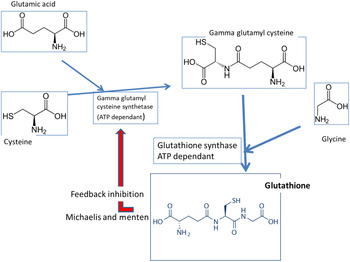
GSH deserves special attention as the universal antioxidant molecule. First of all, reduced glutathione is necessary for sperm head swelling, and must be present at a significant concentration during fertilization. It is also used in the reduction of ribonucleotides to produce deoxyribonucleotides by ribonucleotide reductase (expressed in the oocyte at 120× background signal). As mentioned previously, the oocyte/early embryo is equipped with key enzymes necessary for glutathione synthesis. GSH is synthesized from cysteine in the cytosol, by glutamate cysteine ligase (GCL), which has two subunits, catalytic and modifier; both are expressed in the oocyte/early embryo. Glutathione synthetase (GS), the enzyme that catalyzes condensation of gamma-glutamylcysteine and glycine to form glutathione is also highly expressed. These enzymes are ATP dependent.
Glutamic acid and glycine are easily synthesized by the embryo, but uptake is also possible as these two amino acids are present at high levels in tubal fluid (glycine: 2–3 mM, glutamic acid + glutamine: 0.5 mM). Glutathione-disulfide reductase (GSR) reduces oxidized glutathione to reduced glutathione, and GSR is expressed in the early embryo at 25× the background signal. This reaction requires NADPH, which is provided by upregulation of PPP (Comizzoli et al., Reference Comizzoli, Urner, Sakkas and Renard2003); a transaldolase enzyme that allows some PPP metabolites to enter glycolysis is expressed at 1400× the background signal.
Cysteine is a true rate-limiting compound; cysteine/cystine is incorporated into the embryo by alanine/serine/cysteine transporter 2 solute carrier family 1 member 5 (SLC1A5), which is highly expressed both in the oocyte (30× the background signal) and in the preimplantation embryo up to the time of genomic activation. However, availability of the enzyme is dependent on the endogenous store accumulated during oocyte maturation. DNA/histone methylation releases homocysteine, and this cannot be recycled to form cystathionine, then cysteine, via the cystathionine β-synthase (CBS) pathway, which is not expressed in the human oocyte (Benkhalifa et al., Reference Benkhalifa, Montjean, Cohen-Bacrie and Ménézo2010; Ménézo et al., Reference Ménézo, Lichtblau and Elder2013), another factor in the potentially toxic accumulation of Hcy. In these conditions, cysteine becomes an essential amino acid and the embryo is completely dependent on cysteine from the external compartment. In vivo, cysteine is provided by tubal fluid; its transport is activated by solute carrier family 3 member 1 (SLC3A1; transports cystine and dibasic and neutral amino acids), which is also highly expressed in the oocyte (35–40× background signal). Elevated SLC3A1 expression accelerates cysteine uptake, with regulated accumulation of reduced glutathione (GSH) (Ménézo and Elder, Reference Ménézo and Elder2020).
GSH is the ‘control tower’ of embryonic redox status and homeostasis, and therefore activity of the enzymes involved in GSH metabolism is highly regulated at the levels of transcription, translation and post translation. Negative feedback control mechanism of gamma-glutamylcysteine synthetase by glutathione (Michaelis–Menten effect) is an important regulatory mechanism: both a deficit and an excess of GSH are deleterious. GSH is synthesized only in the cytosol and is transported into intracellular organelles.
Glutaredoxins are thiol-disulfide oxidoreductase enzymes, ‘light proteins’ that use glutathione as a cofactor; they are highly expressed in oocytes at levels between 25× and 50× background signal. Glutaredoxins are oxidized by oxidized substrates and are non-enzymatically reduced by reduced glutathione that is then regenerated to its reduced form by glutathione reductase (GSR), in the presence of NADPH obtained from the PPP. Glutaredoxins protect methylation processes by converting oxidized methionine sulfone to methionine. Based on intrinsic embryonic biochemical machinery alone, methionine inter-conversion is impossible. Methionine can be recycled from Hcy by methionine synthase activity, but this pathway cannot lead to the formation of cysteine. In a recent paper (Truong and Gardner, Reference Truong and Gardner2017), an improvement in embryo development was observed after adding acetyl cysteine and acetyl carnitine to the culture medium, even in the presence of 20% O2. The authors attributed the benefit to the ‘antioxidant’ effect of these compounds. However, acetyl cysteine is a stable precursor of glutathione and does not have intrinsic antioxidant properties. Acetyl carnitine is not an antioxidant, it is a ‘catalyzer’ of lipid beta oxidation, and FF provides a source of acetyl carnitine in vivo (Montjean et al., Reference Montjean, Entezami, Lichtblau, Belloc, Gurgan and Menezo2012).
Under conditions of cysteine restriction, the resulting imbalance may lead to autophagy by activation of glucose uptake, mediated by mitogen activated protein kinase, with PPP upregulation to generate NADPH to counteract ROS (Aquilano et al., Reference Aquilano, Baldelli and Ciriolo2014). Thioredoxins (Trxs) are also important low-molecular-weight oxido-reductases whose active sites contain cysteine; Trx mutations rapidly lead to cell death. Cytoplasmic Trx1 and mitochondrial Trx2, as well as their reductases, are highly expressed in the human oocyte/early embryo, both present at 100× background signal. Trx reductases again require NADPH to reactivate their reducing activity. APEX/Ref-1 (strongly expressed), a multifunctional protein that is a major effector of DNA repair in human embryos (El-Mouatassim et al., Reference El-Mouatassim, Bilotto, Russo, Tosti and Menezo2007) is associated with thioredoxin (Trx) in upregulation of redox potential (Hedley et al., Reference Hedley, Pintilie, Woo, Nicklee, Morrison, Birle, Fyles, Milosevic and Hill2004). Elevated levels of both APEX/Ref-1 and Trx increase cell growth and resistance to programmed cell death (Powis et al., Reference Powis, Mustacich and Coon2000). APEX/Ref-1 controls the redox status of transcription factors such as Fos and Jun (both expressed in the oocyte), keeping them in an active reduced state (Kelley and Parsons, Reference Kelley and Parsons2001).
A lack of reduced thiols and thiol redox imbalance upregulates glucose uptake and the PPP, which has already been activated during fertilization to increase the supply of NADPH. A risk of NADPH shortage is significant. For this reason, the supply of glucose for preimplantation embryos must not be severely reduced on the grounds of potential toxicity (Chatot et al., Reference Chatot, Ziomek, Bavister, Lewis and Torres1989; Quinn, Reference Quinn1995; Quinn et al., Reference Quinn1995) reviewed by Summers and Biggers (Reference Summers and Biggers2003) by metabolic generation of ROS (Aquilano et al., Reference Aquilano, Baldelli and Ciriolo2014).
Methionine (Met) and S-adenosyl methionine (SAM)
If we consider glutathione to be the control tower of embryo redox homeostasis, methionine is the mastermind behind methylation, imprinting and epigenesis. SAM is the universal cofactor of all methylation processes. Methionine uptake is very active in oocytes and preimplantation embryos; uptake is higher in humans than in the mouse, even after consideration of the difference in size (Menezo et al., Reference Menezo, Khatchadourian, Gharib, Hamidi, Greenland and Sarda1989). Methionine that is present in follicular and tubal fluids is sensitive to oxidation, generating methionine sulfone and methionine sulfoxide; this oxidation can be reversed, mainly by glutaredoxins; methionine sulfoxide reductases A and B are expressed, but are less active. All of the enzymatic steps necessary for SAM synthesis and for the one-carbon cycle are present in mouse, bovine and human embryos (Ménézo et al., Reference Ménézo, Lichtblau and Elder2013) expressed at high levels (Benkhalifa et al., Reference Benkhalifa, Montjean, Cohen-Bacrie and Ménézo2010). Conversion to SAM is marginally higher in human than in mouse embryos and is regulated, rapidly reaching a plateau in the presence of increasing external Met concentrations. S-Adenosylmethionine acts as a switch between remethylation and transsulfuration through allosteric inhibition of methylenetetrahydrofolate reductase and activation of cystathionine β-synthase (Fowler, Reference Fowler2005), but the CBS pathway is inactive before genomic activation. Methionine transporters are multiple and redundant (Table 1).
Transport of methionine into the oocyte/early embryo. Expression of the transporters in the early embryo (microarrays; Menezo et al., Reference Menezo, Russo, Tosti, El Mouatassim and Benkhalifa2007; Benkhalifa et al., Reference Benkhalifa, Montjean, Cohen-Bacrie and Ménézo2010)

System A: Alanine-preferring amino acid transporters, important in regulation of cell growth. These transporters are sodium-dependent active transporters that are able to transport amino acids against their concentration gradients.
System L: A major nutrient amino acid transport system that is responsible for Na+-independent transport of neutral amino acids, including several essential amino acids.
System γ: Gamma transporter, a process that binds the AA with glutamic acid to form a gamma-glutamyl peptide for transport: usually a slow process.
Abbreviations: A, subfamily; ASC, alanine/serine/cysteine transporters subfamily (Na+-dependent exchange of small neutral amino acids); L: corresponds to the amino acid form (d- or l-); SLC: SoLute Carrier.
Methylation processes in gametes and embryos
Methylation of DNA/histone targets results in release of homocysteine (Hcy); this must be recycled to methionine by methionine synthase (MS), a system that is supported by the folate cycle. 5-Methyltetrahydrofolate-homocysteine transferase (MTR) and methyltetrahydrofolate-homocysteine methyltransferase reductase (MTRR) are highly expressed and active in early embryos. As the CBS pathway leading to the formation of cysteine and homoserine is not expressed, there is an absolute requirement for the MS system, and ‘active folate’, 5MTHF, must be available (see Figure 1). DNA methylation stabilizes the genome and for this reason carriers of MTHFR SNPs are susceptible to anomalies in DNA methylation that can lead to embryos with high rates of chromosomal aberrations (Enciso et al., Reference Enciso, Sarasa, Xanthopoulou, Bristow, Bowles, Fragouli, Delhanty and Wells2016; Servy et al., Reference Servy, Jacquesson-Fournols, Cohen and Menezo2018) leading to implantation failures and repeat miscarriages (Tara et al., Reference Tara, Ghaemimanesh, Zarei, Reihani-Sabet, Pahlevanzadeh, Modarresi and Jeddi-Tehrani2015). Methylation also participates in DNA repair by synthesis of thymine; DNA repair is partially processed at the expense of methylation. Thymidylate synthase is highly expressed in the early embryo (200× background signal) during the period when mRNA synthesis is weak or absent, prior to ZGA. Thymine synthesis also requires serine hydroxymethyl transferase and dihydrofolate reductase (DHFR), both also highly expressed before genomic activation. Folates are clearly at the epicentre of numerous biochemical pathways during this period before maternal to zygotic transition; oocytes express high levels of folate receptor 1 and folate transporter 1 solute carrier family 19 member 1 (SLC19A1), as well as all of the enzymes involved in the folate and one-carbon cycles (Ménézo et al., Reference Ménézo, Lichtblau and Elder2013). Global rapid demethylation has been postulated to occur immediately post fertilization in human IVF embryos (Smith et al., Reference Smith, Chan, Humm, Karnik, Mekhoubad, Regev, Eggan and Meissner2014), however there are increasingly further indications that the situation is far more complex. The paternal genome is rapidly demethylated first, followed by passive demethylation of maternal genes during the subsequent cell cycle. Paternal demethylated DNA appears to be immediately re-methylated (Park et al., Reference Park, Jeong, Shin, Lee and Kang2007). Methylation anomalies at these early stages will affect placental development (Georgiades et al., Reference Georgiades, Watkins, Burton and Ferguson-Smith2001). Experiments in the mouse suggest that levels of methylation are stable up to and immediately after genomic activation (Croteau and Menezo, Reference Croteau and Menezo1994; Fulka et al., Reference Fulka, Mrazek, Tepla and Fulka2004; Okamoto et al., Reference Okamoto, Yoshida, Suzuki, Shimozawa, Asami, Matsuda, Kojima, Perry and Takada2016); embryonic DNA methyl cytosine content remains stable during this period. In human oocytes, DNA methyltransferase 1 (DNMT1), the enzyme that is responsible for maintenance of DNA methylation, is highly expressed. Its polyA mRNA is one of the most abundant transcripts found. DNMT3, responsible for de novo DNA methylation is also expressed, but at a much lower level. Active de novo methylation has been observed in ruminants (Park et al., Reference Park, Jeong, Shin, Lee and Kang2007) and in mouse (Croteau and Menezo, Reference Croteau and Menezo1994) and may also occur in humans. Methylation maintenance and, to a lesser extent, de novo methylation persist in human embryos until, and immediately after, MZT and attenuating the exclusion of imprinted genes during the global demethylation that takes place during preimplantation embryo development. This means that methionine, the ‘basic fuel’ necessary for methylation, is a crucial requirement at this time. In addition, methionine restriction increases mitochondrial OS (Lu et al., Reference Lu, Hoestje, Choo and Epner2003) and methionine must also be protected from oxidation. Preimplantation embryos must maintain a balance between active and passive demethylation, with co-existing demethylation and maintenance of DNA methylation (Inoue and Zhang, Reference Inoue and Zhang2011; Wang et al., Reference Wang, Zhang, Duan, Gao, Zhu, Lu, Yang, Zhang, Li, Ci, Li, Zhou, Aluru, Tang, He, Huang and Liu2014). Methylation processes must be efficiently protected against OS that jeopardizes correct acquisition of methylation marks, as well as subsequent methylation maintenance. In vivo, this regulatory protection against OS is provided by endogenous glutathione and by hypotaurine in tubal cells (Guérin and Ménézo, Reference Guérin and Ménézo1995; Guérin et al., Reference Guérin, El Mouatassim and Ménézo2001).
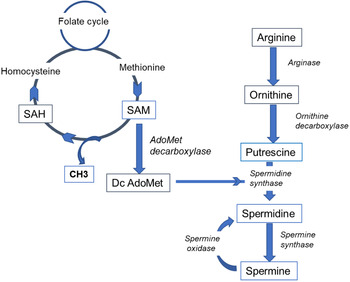
Polyamines and the one-carbon cycle (Figure 5 and Table 2)
SAM is a precursor for polyamine synthesis. These molecules are recognized as a major influence throughout the reproductive process (Lefèvre et al., Reference Lefèvre, Palin and Murphy2011), particularly in spermatogenesis. Their role in early embryogenesis is less clear, but has been demonstrated in the mouse (Pendeville et al., Reference Pendeville, Carpino, Marine, Takahashi, Muller, Martial and Cleveland2001; Nishimura et al., Reference Nishimura, Nakatsu, Kashiwagi, Ohno, Saito and Igarashi2002). The two main enzymes involved in polyamine biosynthesis are highly expressed in human oocytes: ornithine decarboxylase (ODC) (1000× background signal), and arginase (100× background, see Figure 4). Members of the solute carrier (SLC)7 γ+ family of cationic amino acid transporters that are responsible for polyamine transport are expressed in oocytes and early embryos. Polyamines, and spermidine in particular, are regulators of early embryo methylation and decreased polyamine concentrations in general have been associated with aberrant methylation of the entire genome (Soda, Reference Soda2018). Spermine protects against decreased DNMT activity and aberrant DNA methylation (Soda, Reference Soda2018), and spermine synthase is expressed at >100× background signal (BS); spermidine synthase has lower expression at >10× BS. Ornithine is also present in tubal fluid (Menezo and Laviolette, Reference Menezo and Laviolette1972); one of its transporters, solute carrier family 25 member 15 (SLC25A15) is not expressed in the embryo, but a second transporter, solute carrier family 25 member 29 (SLC25A29), is expressed at 30× basic signal. This means that during preimplantation stages the active synthesis of polyamines in the embryo is mainly dependent upon endogenous arginine. This is established in the oocyte during follicular growth and then depends on uptake from the tubal fluid environment after fertilization, in which it is present at ±200 μM during the embryonic free-floating stages (Aguilar and Reyley, Reference Aguilar and Reyley2005). The arginine transporter solute carrier family 7 member 7 (SLC7A7) is expressed at 220× BS in embryos (Closs et al., Reference Closs, Simon, Vékony and Rotmann2004).
Expression of the enzymes involved in polyamine synthetic pathways (× times the background signal) in human oocytes/early embryos (microarrays; Menezo et al., Reference Menezo, Russo, Tosti, El Mouatassim and Benkhalifa2007; Benkhalifa et al., Reference Benkhalifa, Montjean, Cohen-Bacrie and Ménézo2010)

Glutathione synthesis from glycine and glutamine; ‘retro-control’ by Michaelis–Menten negative feedback by glutathione on gamma-glutamylcysteine synthetase.

Polyamine synthesis and its connection with SAM and the folates and one-carbon cycles.

If ornithine decarboxylase (ODC) initiates the polyamine biosynthetic pathway and is ‘the control tower’, (Pegg, Reference Pegg2006) this does not seem to be the case in the early embryo where the expression of ODC is very high. Ornithine decarboxylase antizyme 1 and the antizyme inhibitor 1 are very strongly expressed at 600× and 30× BS respectively, confirming a strong trafficking activity around these molecules.
Methylation and oxidative stress in vitro
The processes involved in imprinting/epigenetic marking are crucial to normal development; conditions to allow their correct establishment in vitro must be provided and protected from OS.
Acquisition of methyl marks
Methylation requires SAM, the universal methylation cofactor. Demethylation immediately after fertilization has been described in human IVF embryos (Smith et al., Reference Smith, Chan, Humm, Karnik, Mekhoubad, Regev, Eggan and Meissner2014), and methylation anomalies in babies conceived by ART have been described, associated with imprinting defects in some cases (Song et al., Reference Song, Ghosh, Mainigi, Turan, Weinerman, Truongcao, Coutifaris and Sapienza2015; Hattori et al., Reference Hattori, Hiura, Kitamura, Miyauchi, Kobayashi, Takahashi, Okae, Kyono, Kagami, Ogata and Arima2019). Methylation processes cannot be correctly maintained without the appropriate substrates, and yet, with one exception, most IVF culture media that are commercially available do not contain methyl donors such as folates. Moreover, methionine is absent in three out of six first phase culture media; another contains 4 µM, which is insufficient to allow active uptake (Morbeck et al., Reference Morbeck, Krisher, Herrick, Baumann, Matern and Moyer2014). This omission apparently arose from a suggestion, based on mouse embryo culture, that some essential amino acids are toxic to early preimplantation embryos in sequential media (Lane and Gardner, Reference Lane and Gardner1997a, Reference Lane and Gardner1997b; Lane et al., Reference Lane, Hooper and Gardner2001). This concept was challenged by several authors, for several species (Ho et al., Reference Ho, Doherty and Schultz1994, Reference Ho, Wigglesworth, Eppig and Schultz1995; Leese, Reference Leese1998; Biggers and Summers, Reference Biggers and Summers2008; Herrick et al., Reference Herrick, Lyons, Greene-Ermisch, Broeckling, Schoolcraft and Krisher2018). According to Leese (Reference Leese1998):
‘This requirement (high turnover of some amino acids including methionine) would obviously not be fulfilled by culture media which included only nonessential amino acids during the early preimplantation phase. Our data led us to favour including all 20 amino acids in human embryo culture’, cited by Biggers and Summers (Reference Biggers and Summers2008).
Studies by Market-Velker et al. (Reference Market-Velker, Fernandes and Mann2010, Reference Market-Velker, Denomme and Mann2012) unambiguously confirm that current IVF culture media do not allow correct embryonic methylation status to be established, even in mouse embryos, the model that is used to evaluate media for human IVF culture (MEA, mouse embryo assay). Therefore, IVF embryos cultured in currently available culture media are an inappropriate model for evaluating the regulation of methylation in early stage embryos. Moreover, a suggestion that essential amino acids decrease the rate of first cleavage divisions in the mouse (Lane and Gardner, Reference Lane and Gardner1997a) was used as a further basis for removing essential amino acids from IVF culture media. This observation should be interpreted in the context of methylation studies by Market-Velker et al. (Reference Market-Velker, Fernandes and Mann2010, Reference Market-Velker, Denomme and Mann2012): epigenetic marking requires a certain amount of time, which decreases the speed of development so that rapid cleavage results in loss of imprinting. Developmental speed in vitro should be treated with caution, and with respect for the timing of essential processes that are crucial to normal development.
COH results in accumulation of Hcy, and its release from the oocyte after COH is an important feature for consideration. If methionine is absent from culture medium used prior to MZT, Hcy cannot be exchanged for Met (Menezo et al., Reference Menezo, Khatchadourian, Gharib, Hamidi, Greenland and Sarda1989), creating an abnormally high Hcy/Met in the embryonic environment. This imbalance inhibits methylation by at least two mechanisms: lack of methionine for synthesis of SAM, and inhibition due to the accumulation of SAH and Hcy in the embryo. SAH binds to the catalytic region of most SAM-dependent methyltransferases with high affinity (Hoffman et al., Reference Hoffman, Marion, Cornatzer and Duerre1980) and is a potent inhibitor of DNMT(s) (Cohen et al., Reference Cohen, Griffiths, Tawfik and Loakes2005).
Protecting methylation against OS
A clear correlation has been described between OS and methylation anomalies (Ménézo et al., Reference Ménézo, Lichtblau and Elder2013). This is a significant issue in vitro, as IVF culture media spontaneously generate free radicals during incubation (Martín-Romero et al., Reference Martín-Romero, Miguel-Lasobras, Domínguez-Arroyo, González-Carrera and Alvarez2008) and there is no antioxidant protection: embryos have limited protection against oxidative insults and are not able to synthesize glutathione, if the precursor cysteine is lacking. Most of the endogenous oocyte glutathione has been used for sperm swelling. An excess of oxygenated free radicals can lead to the formation of hydroxymethyl cytosine, which may precipitate undue and abnormal demethylation processes. Oxidation of methylcytosine (MeC) can cause active demethylation of some CpG sites, which are known to be crucially related to imprinting mechanisms (Menezo et al., Reference Menezo, Clément and Dale2019a). Decreased oxygen tension can partially compensate for lack of some types of antioxidant protection, with the exception of hypotaurine, which is present in the natural embryonic environment. In vivo, the embryo can generate glutathione from cysteine by GCL or GS as endogenous protection against OS. However, as the CBS pathway is not active, Hcy cannot be converted to cystine, and cysteine/cystine must be provided by the culture medium. Most (three out of six) of ‘first phase’ sequential culture media did not contain cystine, and one contained 2 µM. Fertilization media (when information is available) do not contain cystine.
Arginine and regulation of methylation
Arginine, which is also considered to be an essential amino acid, is essential for polyamine synthesis: this feature should be taken into consideration in the composition of in vitro culture media, as the embryo has appropriate arginine transport capacity. A lack of arginine removes another level of the regulatory processes involved in methylation, again contributing to genomic instability as a result of altered methylation status (Soda, Reference Soda2018).
Conclusion
Recent observations have highlighted a risk of aberrant epigenetic/imprinting events associated with ART, and IVF/ICSI in particular. There is a consensus opinion that these risks originate during the period of in vitro culture, and may be due specifically to the composition of culture media (Edwards and Ludwig, Reference Edwards and Ludwig2003; Menezo et al., Reference Menezo, Dale and Elder2019b; Ménézo and Elder, Reference Ménézo and Elder2020). Sunde et al. (Reference Sunde, Brison, Dumoulin, Harper, Lundin, Magli, Van den Abbeel and Veiga2016) have correctly observed that it is ‘Time to take human embryo culture seriously’. The literature surrounding human IVF culture media is replete with confounding and unclear statements, many without real scientific foundation. In relation to biochemical aspects of methylation and its association with OS, the suggestion that essential amino acids are toxic during early stages of development (Lane and Gardner, Reference Lane and Gardner1997a, Reference Lane and Gardner1997b; Lane et al., Reference Lane, Hooper and Gardner2001) must be questioned. Early embryos in culture need methionine, cystine/cysteine, arginine and a certain amount of glucose to generate NADPH and ribose-5-phosphate required for nucleotide synthesis. NADPH is a key effector/regulator of the majority of the anabolic processes. Methionine is also required to re-establish the correct oocyte/embryo Met/Hcy ratio after COH. Under appropriate conditions, the embryo uses methionine to produce SAM, arginine to produce polyamines and cystine/cysteine for glutathione synthesis. Glutathione provides protection against ROS and preserves methylation markers from inappropriate demethylation due to oxidized methyl cytosine and demethylation by the TET system. Addition of folates merits attention, not only for their role in embryo metabolism, but also with respect to the genomic instability observed in embryos originating from women carrying the two MTHFR SNPs C677T and A1298C (Enciso et al., Reference Enciso, Sarasa, Xanthopoulou, Bristow, Bowles, Fragouli, Delhanty and Wells2016).
Interestingly, it was recently demonstrated that addition of N-acetyl cysteine to culture media alleviates the need for reduced oxygen tension (Truong and Gardner, Reference Truong and Gardner2017): this strongly suggests that embryos might best be protected against OS by allowing them to manufacture their own protection, by glutathione and the associated light proteins, thioredoxins and glutaredoxins. This fits with the ‘back to nature’ concept (Tervit et al., Reference Tervit, Whittingham and Rowson1972; Leese, Reference Leese1998; Houghton et al., Reference Houghton, Hawkhead, Humpherson, Hogg, Balen, Rutherford and Leese2002), which should also involve closer inspection of the biochemistry associated with major metabolic processes of the embryo. Addition of external antioxidants is a complicated issue as some antioxidants, such as vitamins E and C, can rapidly switch to pro-oxidant action in the absence of antioxidant enzymes such as superoxide dismutases.
Large numbers of sequential media formulations do not contain essential amino acids, and therefore major effectors/regulators/protectors of crucial methylation processes are missing. Similarly, a certain amount of glucose is required to activate the pentose pathway, which generates the NADPH necessary for glutathione synthesis and anabolic processes in general. This role of glucose should not be overlooked in the design of culture media.
Sophisticated developments in analytic technologies over the past decade have provided elegant and precise tools for studying the molecular biology of human gametes and embryos at the single-cell level, allowing metabolic pathways and general metabolism to be probed in detail. This has particular significance with respect to epigenetic regulation by DNA and histone methylation, as well as the hazardous influence of OS. Aspects of modern lifestyles now add a further level of concern, with environmental pollution by endocrine disruptor compounds that generate high levels of OS and strongly affect methylation processes (Skinner et al., Reference Skinner, Manikkam and Guerrero-Bosagna2010; Manikkam et al., Reference Manikkam, Tracey, Guerrero-Bosagna and Skinner2013; Nahar et al., Reference Nahar, Liao, Kannan, Harris and Dolinoy2015; Montrose et al., Reference Montrose, Padmanabhan, Goodrich, Domino, Treadwell, Meeker, Watkins and Dolinoy2018; Menezo et al., Reference Menezo, Dale and Elder2019b). Technological advancement in microscopy and culture systems have also accumulated vast amounts of data surrounding morphologic and morphometric parameters of embryo development. Revisiting these types of data, such as speed of development/methylation process/embryo quality (Bos-Mikich et al., Reference Bos-Mikich, Mattos and Ferrari2001) in the perspective of biochemical/molecular biology observations reviewed here (Market-Velker et al., Reference Market-Velker, Denomme and Mann2012) can lead to a deeper understanding of the fundamental processes involved in the early stages of life. There needs to be understanding based upon a scientific approach of the basic principles involved in providing safe and appropriate culture conditions for in vitro culture of human gametes and embryos. It is time to leave the ‘mouse model’ behind as part of history.
Financial support
This research received no specific grant from any funding agency, commercial or not-for-profit sectors.
Conflicts of interest
None.
Ethical approval
Not applicable.