1. Introduction
This paper addresses a central issue in the literature on language contact and heritage language, namely, the vulnerability of grammatical categories in situations of language contact. We approach this issue from the perspective of gender agreement in Argentine Danish, a heritage language spoken by descendants of Danish immigrants in Argentina. A heritage language may be defined as an immigrant or a minority language spoken in the family; a bilingual individual grows up hearing and possibly speaking such a minority language but uses the majority language of the wider community as their dominant language since early childhood. As such, a heritage language provides an illuminating insight into (the nature of) language contact outcomes and the different factors affecting language in situations of minority language bilingualism. These factors include early acquisition of the minority language in a naturalistic setting, switching to the majority language as the dominant language well before puberty, the continuous influence of the majority language, as well as socio-psychological and societal factors that may be language-stabilizing (such as the presence of minority language schools) or destabilizing (such as a low degree of identification with the minority group; Brown & Bousquette 2018).
Morphology, and in particular the inflectional realization of grammatical gender, has attracted the attention of a number of researchers, including those who study heritage languages. An often-made claim in these studies is that gender is particularly vulnerable in language contact (Romaine Reference Romaine1988:27–33, Thomason Reference Thomason2001:75). From the perspective of heritage language research, Montrul (Reference Montrul, Tej and William2013:174) adds:
[U]ndoubtedly, the linguistic area most noticeably affected in heritage language grammars is inflectional morphology. Heritage speakers of languages with rich verbal agreement and overt gender, number, and case marking produce a significant number of errors as compared to native speakers or even their own parents.
However, other heritage language studies suggest that gender does not seem to be particularly susceptible to change. For example, Boas (Reference Boas2009:234–236) finds that gender in Heritage Texas German is unaffected, and Johannessen & Larsson (2015) do not see major changes in gender agreement in American Norwegian and American Swedish. Anticipating our main result, we can say that our study corroborates these findings as grammatical gender in Argentine Danish exhibits an overwhelming degree of stability; it is consistent with the rules of Standard Denmark Danish (StDkDan), although we do observe some clear patterns of variation. In this paper, we document the small extent of variation and change in Argentine Danish grammatical gender, and we attempt to identify the nature of the change and the reasons for it. Although small in extent, the observed variation still shows some systematicity, thus providing a basis for a discussion of general tendencies in morphological change in situations of language contact.
The structure of this article is as follows: Section 2 contains a brief presentation of the history of Argentine Danes and the data used in this study. Section 3 provides a basic overview of the gender system in Danish. Section 4 introduces some recent studies of gender agreement in other Scandinavian heritage languages. Section 5 describes how gender is realized in Argentine Danish, while sections 6 and 7 contain the descriptive and inferential statistics used in the analyses of the data. The analyses are followed by a discussion of the results in section 8, and the paper finishes with concluding remarks in section 9.
2. Speakers and Data
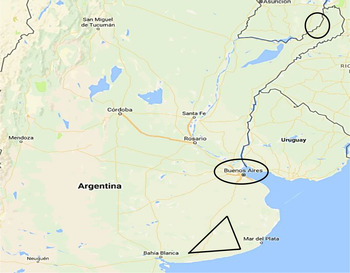
The history of Danish in Argentina goes back to around 1840 when Danish immigration to Argentina began.Footnote 1 The Danish emigration to Argentina continued to around 1930, peaking around 1890–1910. By 1930, the influx of Danish people ceased. The Danish immigrants settled in the capital Buenos Aires and, from the early 1920s, in Eldorado in the province of Misiones in the north of Argentina. However, it was on the pampa southwest of Buenos Aires where most of the Danish immigrants and their descendants formed dense and self-sufficient networks, maintaining the Danish language and many Danish cultural customs due to a high degree of ethnic awareness (Bjerg Reference Bjerg and Svanberg1991, Reference Bjerg2001). The shift in the group’s dominant language from Danish to Argentine Spanish occurred around 1970 as a result of a growing openness toward the majority society, which in turn led to a reduction in domains where Danish was spoken. Accordingly, reduced activation of the language has led to both attrition and a lesser degree of acquisition than beforehand.Footnote 2
The Argentine Danish communities in Eldorado (Misiones) in the north, in Buenos Aires, and on the pampa, to the south.

Our consultants (see table 2) represent two types of speakers: Those who are older than 60 and grew up before the Argentine Danes shifted to Spanish as their dominant language in the 1970s, and younger speakers, who grew up during or after the language shift. The speakers of the first group were mostly raised with Danish as the dominant home language. They acquired Spanish either simultaneously or in Argentinian schools, where Spanish was the only medium of instruction. Some of the older speakers were homeschooled (in Danish) or/and went to the Argentine Danish boarding school in Cascallares, where both Danish and Spanish were the medium of instruction. The older speaker group represents fluent speakers of Danish, and those who were taught the Danish language also mastered Danish literacy (though most speakers state that they rarely use it).Footnote 3 Still, by now Spanish has become their dominant and most frequently used language in everyday life. The second group, that is, speakers younger than 60, who grew up during or after the language shift, is much less fluent in Danish due to reduced input and fewer opportunities for the use of Danish. The size of the Danish-speaking community is unknown even to the Argentine Danes themselves, as they now mostly speak Spanish with each other. Due to this intergenerational shift, Argentine Danish is by now on the verge of dying out (Kühl et al. Reference Kühl, Jan and Gert2019).
The data for the present study were extracted from the Corpus of South American Danish (CoSAmDa; Kühl et al. Reference Kühl, Jan and Gert2019). The CoSAmDa consists of semi-structured sociolinguistic interviews with approximately 100 speakers of Argentine Danish, recorded in 2014 and 2015 by researchers on the project Danish Voices in the Americas, including the authors of this study.Footnote 4 The consultants were recruited following the friend-of-a-friend method (Milroy Reference Milroy1980). While we believe the speakers to be reasonably representative of the Argentine Danish communities as regards age, gender distribution, and language competence, we cannot say how the number of recorded speakers (ca. 100) relates to the size of the Argentine Danish communities altogether.
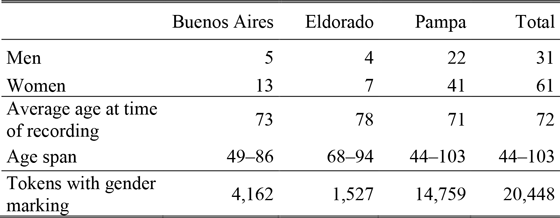
The present study includes 92 speakers from Buenos Aires, Eldorado, and the Pampa settlement (the speakers whose speech had been transcribed at the time of the study). Table 1 provides an overview of the speakers and total word tokens.
The speaker set (n=92).

In total, the 92 speakers produced 20,448 tokens of gender marking, which constitute the data set of this study.
3. Grammatical Gender in Standard Denmark Danish
We follow Hansen & Heltoft (2011:452–464) in considering gender in Danish as an inflectional category connected with nouns, distinguishing between common gender and neuter gender.Footnote 5 Nouns themselves do not have expressions of gender but govern the manifestation of gender (common or neuter) in morphemes that can express this category and that are in a syntactic or morphological relation with a noun.Footnote 6 Following Corbett (Reference Corbett1991:105ff.), StDkDan gender is a case of gender agreement (see also Cornips & Gregersen 2017:103).
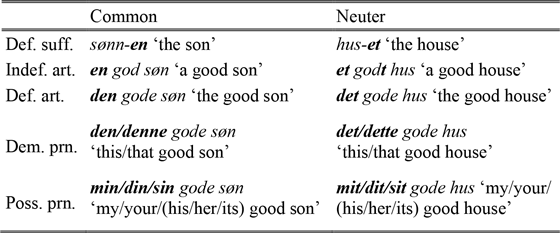
For countable nouns, gender is expressed only in the singular in i) the definite suffix, ii) prenominal determiners, iii) attributive adjectives in indefinite NPs, iv) anaphorical singular pronouns, and v) predicative adjectives (Hansen & Heltoft 2011:452–453).Footnote 7 Gender on attributive adjectives is only marked in the indefinite singular of a neuter noun. Table 2 provides an overview of gender marking of countable nouns on the definite suffix and on the prenominal determiners (exponents of gender are in bold).Footnote 8
The basic principles of gender marking in StDkDan: the definite suffix and prenominal determiners.

Today’s two gender system is the result of historical change where Old Danish masculine and feminine gender converged into common gender. As a result, approximately 75% of all countable nouns in Danish have common gender. It is possible to establish rules for the assignment of common or neuter gender to a noun, but almost all rules have numerous exceptions (Hansen & Heltoft 2011:453–455).
For mass nouns, the morphological exponents of gender serve to distinguish between an individualized and a substance use of the mass noun. Hansen & Heltoft (2011:454–460) refer to this system as a “semantic gender” system: Common gender marking on a determiner indicates that the mass noun refers to an individualized entity, while neuter gender marking indicates that it refers to substance, for example, en (c) lim ‘a glue (of a certain kind)’ versus noget(n) lim ‘some glue’. In order not to analyze two systems at the same time, that is, the traditional gender system (for countable nouns) and semantic gender (for noncountable nouns), mass nouns have been excluded from the present study (such as lim ‘glue’, vand ‘water’, etc.).
With the exception of a few lexical items and some recent loanwords, the Danish gender agreement system is stable (Hansen & Heltoft 2011:453ff., Braüner Kappelgaard & Bruun Hjorth 2017).Footnote 9 Thus, there is no reason to believe that the variation observed in Argentine Danish is the result of an inherent instability of Danish gender.
4. Gender in Scandinavian Languages Spoken by Bilinguals
The analysis in this paper is inspired by and related to three recent studies of gender in the Scandinavian languages spoken by bilinguals: two studies of heritage speakers in North America and one study of bilingual speakers in Denmark. The latter and more recent study by Cornips & Gregersen (2017) compares the use of grammatical gender (assignment) in Danish (and Dutch) by monolingual and bilingual teenagers. Their main results are that i) nonstandard-like forms are almost always produced by the bilingual speakers, ii) the variation exists only in the free forms (prenominal articles), iii) the variation is mostly found with indefinite forms, and iv) common gender is overused at the expense of the neuter.
Johannessen & Larsson 2015, a study of Heritage American Norwegian (with a 3-gender system, masculine, feminine and neuter) and Heritage American Swedish (with a two-gender system, common and neuter), and Lohndal & Westergaard 2016, a study of Heritage American Norwegian, show very similar results: In both heritage languages, variation in gender marking is observed mainly in prenominal determiners, that is, free morphemes such as the indefinite article, the definite article, and the possessive pronoun. Hardly any variation is observed in the definite suffix. However, these two studies disagree regarding the explanation of the differences in stability of gender marking in bound versus free morphemes. Johannessen & Larsson (2015) consider the stability of the gender form of the definite suffix to indicate that gender is, in general, not a vulnerable category. Lohndal & Westergaard (2016), in contrast, analyze the definite suffix as an exponent of declension class (not of gender), and consequently, they do not include the morpheme in their calculation of (non)target-like gender. They mention acquisition and processing patterns as potential explanations for the difference between free and bound morphemes, emphasizing that “highly frequent nouns […] may be stored in memory as units together with the suffix” (with which they form a certain prosodic pattern). These nouns are “easily retrieved, while the indefinite forms must be computed as part of a productive process” (2016:11).
Both studies observe that one gender is overgeneralized at the expense of the others, namely, masculine gender in Heritage American Norwegian and common gender in American Swedish. Johannessen & Larsson (2015:4) suggest that the preference for masculine/common gender over the other genders (feminine and neuter in Norwegian and neuter in Swedish) may be due to exposure, that is, the high frequency of the overgeneralized gender. Further, they speculate that morphological markedness may play an important role, referring to the fact that the Norwegian masculine and the Swedish common gender are not expressed by a separate morpheme on adjectives (Ø-expression), while the neuter is, which renders the masculine/common gender “morpho-phonologically less marked than neuter” (Johannessen & Larsson 2015:4), and consequently an overall more stable gender.
Both studies also raise the notion of complexity as a factor underlying variation in gender marking: Johannessen & Larsson (2015:13) note that nonstandard gender marking on determiners is more frequent in complex NPs, such as Det +Adj + N. They state that this may be the result of processing difficulties due to the distance between agreeing forms and the noun (Johannessen & Larsson 2015:13, 17–18). Lohndal & Westergaard (2016:11) acknowledge these findings but point out that rote-learning of the construction Det + N may have an influence on the probability of target-like gender marking:
Given that the number of noun types in the corpus [Corpus of American Scandinavian, CANS] is quite low and mainly consists of high-frequency nouns, we could argue that the simple noun phrases are more likely be rote-learned and memorized as chunks than the more complex ones, which require a productive system of gender agreement.
Both studies note considerable interspeaker variation: Some speakers show only standard-like realizations of gender, while others exhibit a considerable number of mixed forms. In Johannessen & Larsson’s American Swedish corpus, five speakers produce nonstandard-like gender forms 0%–9% of the time, while three speakers produce such forms 19%–28% of the time. In their American Norwegian data, 60% of the American Norwegian speakers “show no deviant forms while a few speakers show a considerable number” (Johannessen & Larsson 2015:18). Lohndal & Westergaard identify several speaker groups in their data set that are characterized by particular patterns of gender marking: speakers who “may possibly have an intact three-gender system”, speakers who “produce masculine forms only,” and speakers who “produce a mixture of forms” (Lohndal & Westergaard 2016:10).
Based on the findings of Johannessen & Larsson 2015, Lohndal & Westergaard 2016, and Cornips & Gregersen 2017, we hypothesize that Argentine Danish exhibits the following properties with respect to gender marking:
(i) Gender marking on the definite suffix is stable, that is, the same as in StDkDan;
(ii) there is a considerable degree of interspeaker variation;
(iii) there is an overgeneralization of the high-frequency common gender to neuter nouns;
(iv) the gender marking on prenominal determiners shows more variation as compared to StDkDan, and
(v) complex NPs show more variation in gender marking on determiners than simple NPs.
In what follows, we test these hypotheses and show that our predictions are borne out.
5. Grammatical Gender in Argentine Danish
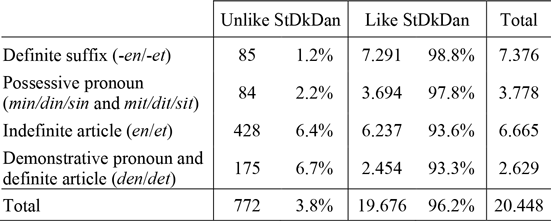
This section provides a general overview and discussion of our results. Table 3 outlines the use of grammatical gender in Argentine Danish as compared to StDkDan. It clearly shows that the Argentine Danish gender system to a very large extent is in accordance with StDkDan: Only 3.8% of the gender marking shows a different realization. This is the main finding of our study.
Grammatical gender in Argentine Danish: The definite suffix and prenominal determiners (free morphemes).Footnote 10

Despite the many instances of standard-like gender marking, we can occasionally observe nonstandard-like gender agreement in Argentine Danish. Some examples appear in 1.
(1)


Within the small number of instances of nonstandard-like gender marking, a hierarchy of stability emerges: The definite suffix (a bound morpheme) shows standard-like behavior in most cases (98.8% consistency with StDkDan), followed by the possessive pronouns (97.8% consistency with StDkDan), the prenominal indefinite article, and, finally, the definite articles and demonstrative pronouns (93.6–93.3% consistency with StDkDan). Thus, the hierarchy of standard-like realizations of grammatical gender in Argentine Danish is as follows: suffix > possessive pronoun > other free morphemes.
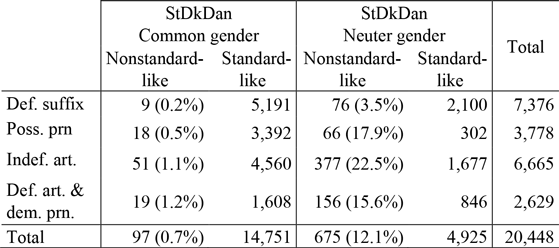
In table 4, we take a closer look at the differences between StDkDan and Argentine Danish gender agreement, examining its distribution in the four grammatical categories crossed with the two genders, common and neuter.
Distribution of gender marking of common and neuter gender in Argentine Danish across gender marking morphemes.

The table shows very different figures for common and neuter gender. Nouns that in StDkDan require common gender marking show neuter gender in 0.7% of all occurrences in the Argentine Danish data set. In contrast, nouns that require neuter gender marking in StDkDan show common gender marking in 12% of all occurrences in Argentine Danish. We conclude from this that common gender is stable, that neuter gender is somewhat more unstable, and, accordingly, that common gender is overgeneralized in this particular language contact situation.
With regard to the use of common gender for neuter nouns, the hierarchy of stability across morpheme types is more fine-grained: suffix > definite article or demonstrative pronoun > possessive pronoun > indefinite article. Still, the suffix is by far the most stable gender agreement category with a mere 3.5% of all cases deviating from StDkDan, whereas in the other grammatical categories, deviation ranges between 15.6% and 22.5%.
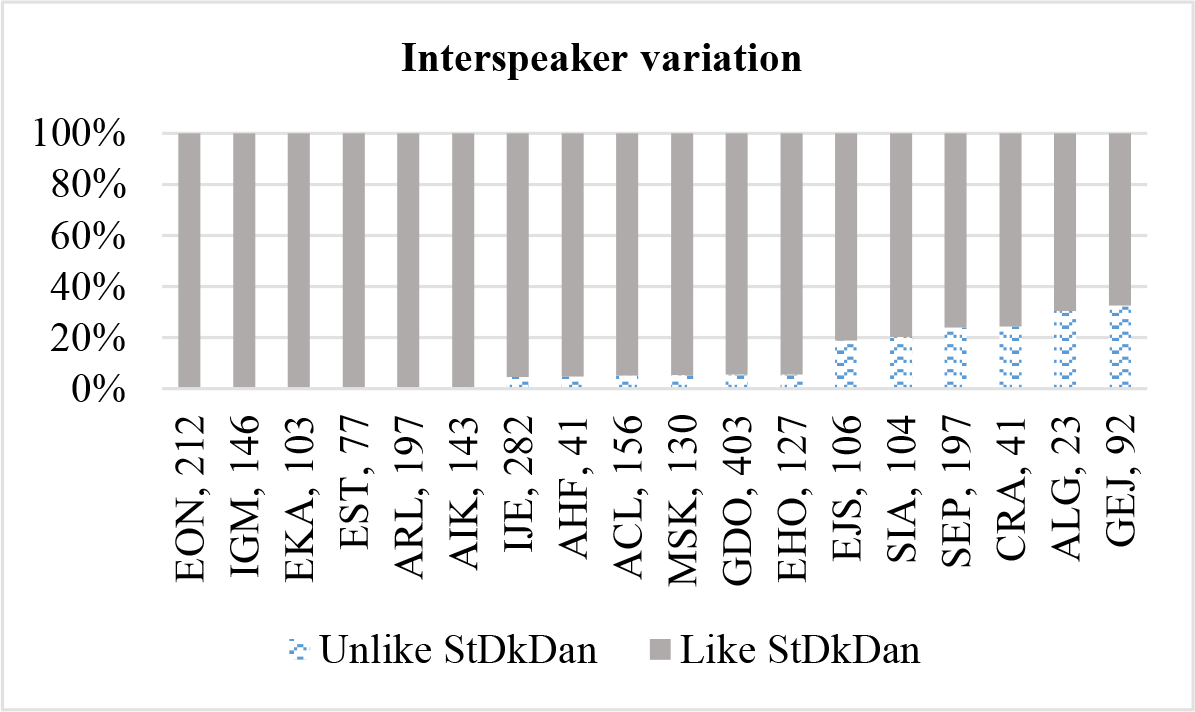
The interspeaker variation regarding standard-like gender marking is considerable, as expected. We have calculated the variation for all 92 speakers, but for reasons of space figure 2 exemplifies the variation for only 18 speakers: the six speakers, whose gender marking differs most significantly from StDkDan (from right to left: GEJ, ALG, CRA, SEP, SIA, and EJS) and the six speakers, whose gender marking either does not differ at all or differs the least from StDkDan (from left to right: EON, IGM, EKA, EST, ARL, and AIK). Further, there are six speakers, whose gender marking is closest to the mean level of different gender marking (as calculated on the basis of all 92 speakers in the data set), including the three speakers just below the average (moving from the middle to the left: ACL, AHF, and IJE) and the three speakers just above the average (moving from the middle to the right: MSK, GDO, and EHO).
Degree of variation in gender marking on prenominal determiners for 18 speakers, with number of tokens.

Figure 2 shows that while some speakers only produce standard-like gender marking (the first four speakers on the left: EON, IGM, EKA, and EST), others produce nonstandard-like gender marking in 20% of the cases or even higher (the last five speakers on the right: SIA, SEP, CRA, ALG, and GEJ). The remaining speakers (n=83) fall in between (note that figure 2 shows only six of these in-between speakers).
To sum up, Argentine Danish grammatical gender in general conforms to the StDkDan rules. The suffix is by far the most stable of all gender-marking morphemes. If there is variation in gender agreement in Argentine Danish, it is in the direction of an overgeneralized use of common gender, which is the most frequently occurring gender in spoken Danish. Furthermore, the interspeaker variation is considerable, ranging between consistent standard-like gender marking to nonstandard-like gender marking occurring 31% of the time. These results confirm hypotheses i and ii listed in section 4, which are based on previous studies of similar populations. In section 6, we test the remaining three hypotheses.
6. Mixed-Model Regression Analysis
In this section, we take a closer look at the factors that may cause or influence particular gender marking. We apply a statistical approach to establish whether or not gender marking in Argentine Danish is the same as in StDkDan. The independent linguistic and extralinguistic factors that are used to test hypotheses iii–v in section 4, appear in 2.
(2)

To these linguistic factors we add the sociolinguistic factors in 3.
(3)

The significance of the factors in 2 and 3 was established using a mixed-model regression analysis. This kind of analysis allows us to test a variety of factors at the same time and in competition with each other, and it also allows us to control for the effect on variation of so-called random factors—that is, factors that are random in relation to the entire population and that will not be identical in a replication of the test (Baayen Reference Baayen2008:241–242). In our case, the individual speaker and the lexeme, that is, the modified head noun of the NP, are random factors.
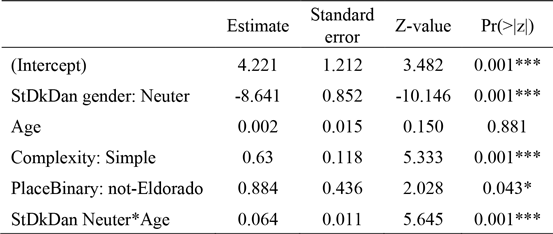
The set of influential factors presented above has been established through a step-up procedure. First, all independent factors were tested individually (with modified noun and speaker as random factors) and ranked according to their degree of significance. Then the model was built by first including the most significant factor, then the second most significant factor, and so on. If an independent factor was not significant together with or in an interaction with another fixed factor, it was excluded from the model. Only those factors that, either individually or in interaction with another factor, had a significant influence on the outcome of the independent variable were kept in the model. This procedure excluded the linguistic factor determiner type and the speakers’ gender. The remaining factors that had an influence on gender marking are shown in the model presented in table 5.
Mixed-effect linear regression analysis; observations n=13,072. Random factors: speaker (n=90), modified noun (n=1,532).Footnote 11

Two values are particularly important for the interpretation of the model: the estimate and the P-value. The estimate tells one how influential a factor is and in which direction it operates; the P-value informs one whether the influence is statistically significant.
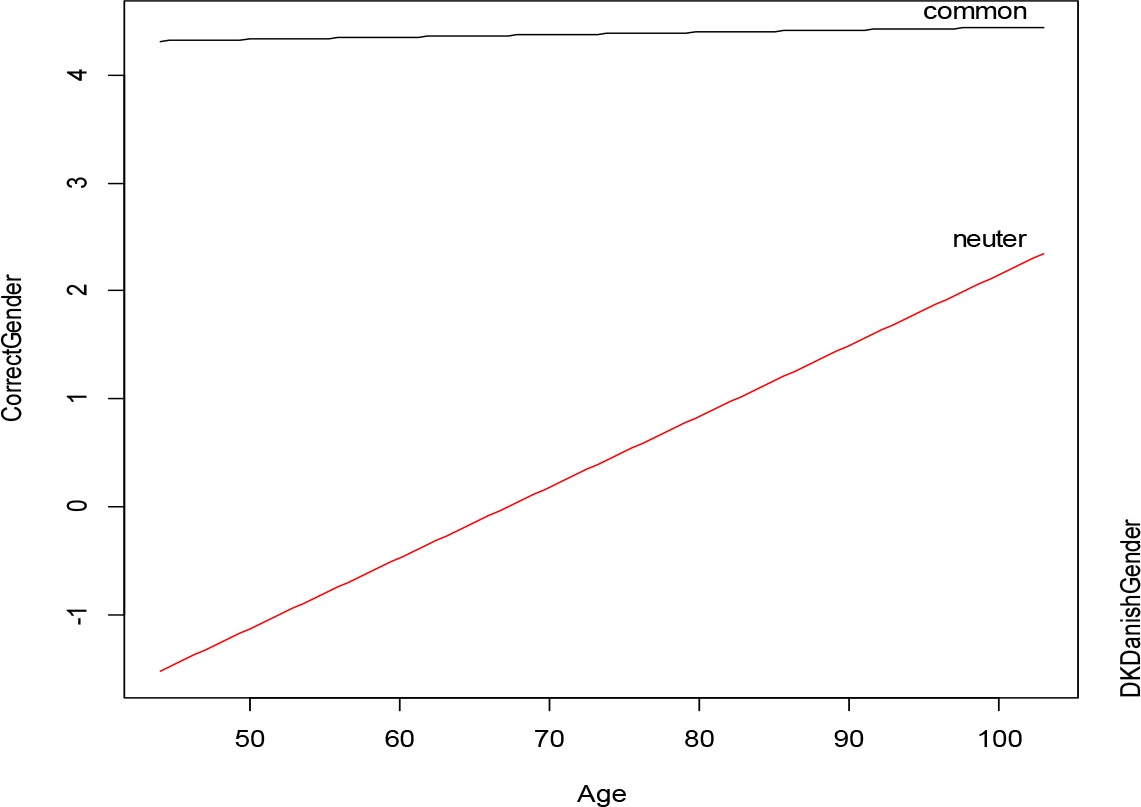
As expected, the model in table 6 shows that the gender of a noun in StDkDan is important for the dependent factor. The relatively high negative value shows that nouns that are neuter in StDkDan are particularly inclined to receive nonstandard-like gender marking; the P-value shows that this is highly significant. Furthermore, the model tells one that complexity matters: Simple NPs more often show StDkDan-like gender marking than complex NPs containing one or more attributive adjectives. This result is also statistically highly significant. Moreover, the model shows that the Eldorado speakers produce more nonstandard-like gender markings than the speakers from other places. However, this result is only marginally significant (p<0.043). Finally, the model tells one that age as a single factor is not a relevant factor, only in conjunction with StDkDan gender. The interaction between factors age and StDkDan gender is shown in figure 3.
Interaction between factors age and StDkDan gender in production of gender marking.

The plot in figure 3 shows that for nouns that have common gender in StDkDan, there is almost no difference between the speakers of different age groups (see almost horizontal line at the top), that is, younger and older speakers both produce standard-like gender forms. There is, however, an age effect when it comes to StDkDan neuter nouns: The younger the speakers are, the less likely they are to produce standard-like forms. In other words, age does not play a role with regard to gender marking on StDkDan common nouns, but it does with respect to StDkDan neuter nouns.
7. Complexity and Gender Agreement
The analysis in section 6 showed that complex NPs are more inclined to show nonstandard-like gender marking. However, the number of instances of nonstandard gender marking does not grow exponentially with the number of attributive adjectives. A comparison of NPs with only one attributive adjective (less complexity) with NPs with two or more adjectives (more complexity) showed no significant difference in the number of instances of nonstandard-like gender agreement on the prenominal determiner (less complexity versus more complexity, z=-0.712, p=0.476; observations, n=2,937; random factors: modified noun, n=659, speaker, n=90). Thus, we agree with Johannessen & Larsson (2015) that complexity matters, but more complexity does not matter more.
According to Cornips & Gregersen (2017:115, 117), overall, definite NPs are most likely to receive standard gender marking. However, among complex NPs, definite NPs are less likely to receive standard gender marking than indefinite ones. However, their results were not computed statistically and therefore cannot be compared directly to our data.
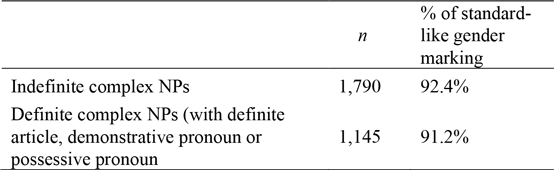
The difference regarding definiteness and complexity is not supported by our data set, though, as table 6 shows.
Comparison of indefinite and definite complex NPs regarding standard-like gender marking.

The difference between indefinite complex NPs and definite complex NPs in terms of (non)standard-like gender marking is not statistically significant (chi-square test, p=0.24). These results imply that it is indeed complexity as a single factor that is relevant here, not definiteness (as expressed through the prenominal determiners).
Gender marking in complex NPs seems to be the only possibility of disambiguating “accidental” standard-like choices of gender marking in Argentine Danish. If the prenominal determiner matches the gender marked on attributive adjectives but not that of the noun in the standard language, then the agreement indicates that the speakers have indeed assigned this particular gender to this particular noun. If such nonstandard-like gender marking occurs consistently throughout the Argentine Danish speaker group in significant numbers, then this would indicate a gender shift of the noun, that is, reassignment of gender. Such a process has been discussed by Lohndal & Westergaard (2016:9–10). In that study, they identified groups of American Norwegian speakers who reanalyzed the Standard Norwegian gender system as a system with only one, masculine, gender.
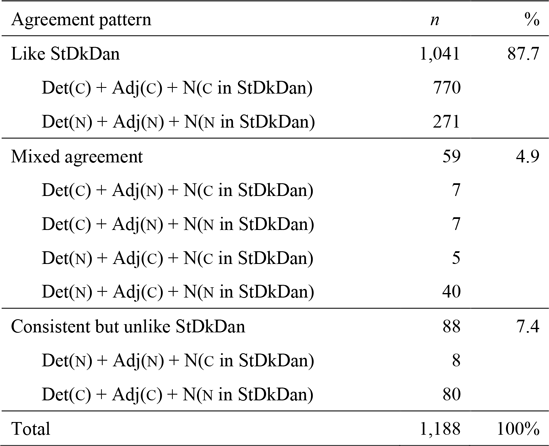
Table 7 outlines the gender marking of complex NPs in Argentine Danish (note that Det stands for both definite and indefinite determiner).Footnote 12
Gender agreement in complex NPs in Argentine Danish.

Table 7 shows a comparatively high degree of conformity between StDkDan and Argentine Danish gender marking, even when speakers need to process complex NPs, where gender marking is required not only on the noun, but also on at least one adjective. Not surprisingly, the data show a preference for common gender for nouns that are assigned neuter gender in StDkDan. There is little evidence, though, for a community-wide change of Argentine Danish toward a rearranged gender system. In only 7.4% of all cases does the gender agreement of attributive adjectives with the head noun show a consistent assignment of the nonstandard/standard StDKDan gender (visible in the “Consistent but unlike StDkDan” row).Footnote 13
There are not many tokens of mixed agreement (4.9%, or 59 out of 1,188 tokens)—that is, cases where the gender marking on the determiner does not match the gender marking on the attributive adjective or the gender assigned to the head noun in StDkDan. Among those few tokens one pattern stands out quantitatively, namely, Det(n) + Adj(c) + N(n in StDkDan). These constructions constitute by far the largest portion of all mixed agreement cases: 40 tokens. Gender agreement of attributive adjectives modifying nouns that have common gender in StDkDan is unmarked morphophonologically; in other words, adjectives agreeing with a noun assigned common gender in StDkDan do not show any inflection. It may well be that this unmarkedness plays a role in the acceptability of complex NPs that show mixed agreement.
8. Discussion
The results of the present study may be summed up as follows: On the basis of a large data set of 20,488 tokens of overt gender markings, we have shown that grammatical gender in Argentine Danish largely conforms to the StDkDan norms (96.2% of the data set). Within the number of tokens where gender marking does not comply with the StDkDan rules, we have observed some patterns that are discussed below.
The low occurrence of nonstandard gender marking in Argentine Danish means that the gender agreement system is in general preserved. The preservation reflects the high degree of linguistic competence of the (older) speakers of Argentine Danish and it suggests that the Argentine Danish speakers are fluent in Danish (Heegård Petersen & Kühl 2017, Heegård Petersen et al. 2018). This result is also in accordance with Johannessen & Larsson’s (2015) study of gender in American Norwegian and American Swedish as well as with Boas’ (Reference Boas2009:234–236) study of Texas German.
However, the observation that morphological gender is a stable category in heritage languages contrasts with Lohndal & Westergaard’s (2016:10) conclusion that “gender is in fact vulnerable in American Norwegian.” It is likely that Lohndal & Westergaard (2016) on the one hand and the authors of the present study (as well as Johannessen & Larsson 2015, who examine the same data) on the other hand arrive at different conclusions because of their different treatment of the definite suffix. Following Enger (Reference Enger2004), Lohndal & Westergaard (2016) consider the definite suffix in Norwegian a marker of inflectional class, not a manifestation of gender. In contrast, the authors of the present study, as well as Johannessen & Larsson (2015), who study Norwegian and Swedish, follow StDkDan grammars and consider the definite suffix as a marker of gender agreement. However, even if the definite suffix is excluded from the analysis, one still observes an overall stability of gender in Argentine Danish, with only 5.3% of nonstandard gender agreement (687 tokens out of 13,072). This is still higher than, for example, the 0.004% observed by Heegård Petersen et al. (2019:20) in dialectal Denmark Danish; yet this does not provide a solid indication that gender as a morphological category is more vulnerable than other grammatical categories, as claimed by researchers in bilingualism, language contact, and heritage language (see, among others, Romaine Reference Romaine1988, Thomason Reference Thomason2001, and Montrul Reference Montrul, Tej and William2013). In order to establish whether or not Argentine Danish gender agreement is vulnerable, one needs to compare the results of the present study with the results of future studies of incipient change in other morphological (and syntactic) categories.
Despite being small in extent, the change in the gender marking system in Argentine Danish exhibits some features that are also found in other heritage languages, as well as in StDKDan (see Cornips & Gregersen’s 2017 study of bilingual Danish teenagers). One of these features is that gender marking on free morphemes (articles and pronouns) is much less stable than gender marking on the definite suffix, a bound morpheme. This implies that Argentine Danish noun morphology is stable, while long-distance gender marking is (relatively) unstable. This difference in vulnerability between gender marking on the definite suffix and gender marking on prenominal morphologically free determiners and pronouns suggests that different cognitive mechanisms are involved in processing free versus bound morphemes, regardless of whether they are defined as gender markers (Larsson & Johannessen 2015) or as realizations of declension class (Lohndal & Westergaard 2016). Whichever way the suffix is defined, it is an exponent of a morphological process (Matthews 1974; Booij Reference Booij2012) and is noticeably unaffected in Scandinavian heritage languages. This observation runs counter to Montrul’s prediction that the morphology in heritage languages is “most noticeably affected” (2012:174).
The overuse of the most frequently occurring gender at the expense of other gender(s) (in our case, the overuse of common gender at the expense of the neuter) is also in keeping with the findings of other studies (see Johannessen & Larsson 2015 for American Swedish and American Norwegian, Lohndal & Westergaard 2016 for American Norwegian, and Cornips & Gregersen 2017 for StDkDan). We assume this overgeneralization to be an effect of frequency: Common gender in Danish (and in Swedish) is the most frequent gender, which means that it will occur most frequently. Also, most of the high-frequency nouns have common gender (in StDKDan). It may well be the case that the high frequency of common gender has an effect on the choice of linguistically insecure speakers, who choose common gender when in doubt. Owing to its high frequency, common gender may be the first that comes to mind. It is the default gender in StDKDan, and therefore a safe choice in cases of uncertainty. The default gender status is supported by the fact that all Spanish loanwords in Argentine Danish are assigned common gender (as in estancia-en ‘the estate’, camp-en ‘the field’, from campo, etc.; see Heegård Petersen & Kühl 2017). This, in turn, implies that the nonstandard-like gender assignment observed in simple NPs may only be the tip of the iceberg. We were unable to identify any cases where the speakers accidentally used standard-like gender marking.
Another observation that is in line with the other studies we have cited is that complex NPs as opposed to simple NPs tend to show more unexpected gender marking on preadjectival determiners. We can therefore conclude, in line with Johannessen & Larsson (2015), that complexity matters. However, complexity seems to be an “either/or” factor in Argentine Danish, as we did not find that more complex NPs, such as Det + Adj + Adj + N, show nonstandard gender agreement more often than less complex NPs, such as Det + Adj + N. Thus, it seems to be the interruption of the close syntactic connection between the determiner and the noun per se that matters, not how many elements occur in between. This result is in line with Johannessen & Larsson 2015, and it suggests that the close syntactic connection between the determiner and the noun is a stabilizing factor, a hypothesis that should be explored further in a future study of gender marking on (long-distance) anaphoric pronouns.
It is possible that frequency also plays a role in gender agreement in complex versus simple NPs. While the determiner has a fixed form in any variety of Danish (en or et for the indefinite article), adjectives vary considerably. The simple combination of en ‘a’ and vej ‘road’ is more frequent than en lang vej ‘a long road’, en smuk vej ‘a beautiful road’, en besværlig vej ‘a difficult road’, etc. Accordingly, the simple NPs have a greater chance of being rote-learned (see Lohndal & Westergaard 2016 for the same argumentation). Future studies may reveal whether the combination Det+N for a specific noun occurs more frequently than Det + Adj + N for the same noun.
In Argentine Danish, we found only very little indication of gender shift: No neuter nouns are consistently treated as common nouns in the data set, and it was shown that only 7% of complex NPs (88 out of 1,118 tokens) contained a neuter noun (in StDkDan) with a common determiner and the common agreement on the adjective (or vice versa; see table 8). Thus, Argentine Danish is hardly undergoing a shift from a two-gender system to a nongender system, the preferred agreement pattern in complex NPs being very much in accordance with StDkDan (88% of complex NPs follow the StDkDan agreement pattern).
Turning to sociolinguistic observations, we found that younger speakers produce more nonstandard-like gender agreement forms than older speakers, and that speakers from Eldorado produce more nonstandard-like gender agreement forms than speakers from other places in Argentina. The difference between the two age groups may be explained by the language shift in the 1970s when Danish ceased to be used at home and among the then young people during, for example, social meetings and sports activities (see section 2). Consequently, the younger speakers in the data set are less accustomed to speaking Danish (and to a much lesser degree literate in Danish). Thus, there is a price to pay for the lack of language maintenance, so to speak, at least as regards gender agreement.
Given the characteristics of the Argentine Danish communities (see section 2), it is not surprising that the Eldorado speakers produce more nonstandard-like gender agreement. Eldorado is by far the smallest Danish settlement of the three Danish networks. The settlement is characterized by exogamy and interaction with people of other heritage groups, implying more exposure to, and use of, Spanish (the common language for all ethnicities), hence less exposure to, and use of, Danish. These results are in accordance with other studies, which show greater Spanish influence in the phonology, grammar, and lexicon among the Eldorado speakers and the younger speakers (Heegård Petersen & Kühl 2017).
9. Conclusion
We conclude that Argentine Danish grammatical gender conforms to the StDkDan norms to a very large extent, despite the fact that this variety of Danish is dying due to interrupted intergenerational transmission. The conclusion that the Argentine Danish gender marking is stable overall is substantiated by the rather large number of occurrences of gender marking (20,448) that this study is based on. Thus, we may state, using Dorian’s memorable metaphor, that Argentine Danish “is dying with its morphological boots on” (Dorian Reference Dorian1978:608). As concerns the small amount of variation, we found patterns similar to those identified in other studies of bilingual speakers of Danish. Free morphemes showed a greater degree of variation with respect to gender marking than bound morphemes, and the most frequently occurring gender was overused at the expense of the less frequently occurring gender(s). The fact that our results are in strong agreement with the results of other studies of Mainland Scandinavian and Germanic heritage languages (3rd–5th generation speakers of the heritage language), as well as with the results of the study of Danish bilingual teenagers living in Denmark, means that this pattern is not peculiar to the Argentine Danish language contact situation. Rather, this seems to indicate that the overall stability of grammatical gender in language contact is a more general phenomenon that only partly relates to social or societal factors. Some of the micro variation in our data can be due to factors linked to the situation of Argentine Danish (the generational difference and the difference between Eldorado and other places with regard to standard-like gender agreement); yet the overall stability of grammatical gender in situations of language contact or bilingualism does not seem to be found in particular communities.