Introduction
Coriander (Coriandrum sativum L.) is an annual herb that belongs to the umbelliferous plant family, the Apiaceae. Coriander's origin is from a large region extending from North Africa to south-western Asia (Nejad Ebrahimi et al., Reference Nejad Ebrahimi, Hadian and Ranjbar2010). It displays a wide environmental adaptation as a crop around the world where it grows under different types of soils and climatic conditions (Khodadadi et al., Reference Khodadadi, Dehghani, Jalali-Javaran, Rashidi-Monfared and Christopher2016a). In particular, the rapid life cycle of some coriander genotypes allow them to be cultivated throughout the world (Lopez et al., Reference Lopez, Widrlechner, Simon, Rai, Boylston, Isbell, Bailey, Gardner and Wilson2008). Coriander fresh and dried leaves and seeds are used as food ingredients (Nejad Ebrahimi et al., Reference Nejad Ebrahimi, Hadian and Ranjbar2010); it is mainly cultivated for its fruits. Because of the fruit characteristics, it is used for flavouring of sauces, meat products, bakery and confectionery products. Coriander fruit are rich in essential oils and fatty acids (Msaada et al., Reference Msaada, Hosni, Taarit, Hammami and Marzouk2009).
Drought tolerance is defined as the ability of a plant to live, grow and produce seed yield under drought-stressed conditions (Abou-Elwafa, Reference Abou-Elwafa2016). Physiological traits that are correlated with yield and drought stress can be used as secondary traits for screening drought-tolerant genotypes in coriander breeding programmes. Physiological traits such as chlorophyll a (Chla), chlorophyll b (Chlb), total chlorophyll (Tchl) content, electrolyte leakage (EL) and relative water content (RWC) are involved in drought stress injury and can be used as drought tolerance indicators (Geravandi et al., Reference Geravandi, Farshadfar and Kahrizi2011; Pirnajmedin et al., Reference Pirnajmedin, Majidi, Saeidi, Gheysari, Nourbakhsh and Radan2017). Drought stress damages the photosynthetic apparatus and decreases chlorophyll content (Mathobo et al., Reference Mathobo, Marais and Steyn2017). Dapanage and Bhat (Reference Dapanage and Bhat2017) reported that chlorophyll content can be used as a suitable indicator for screening genotypes for drought tolerance. It was found that EL is one of the indicators of drought stress tolerance and the degree of EL has been used to evaluate drought tolerance in olive (Dias et al., Reference Dias, Correia, Serôdio, Silva, Freitas and Santos2018). A number of studies reported that a higher RWC is closely related with drought tolerance (Ebrahimiyan et al., Reference Ebrahimiyan, Majidi, Mirlohi and Noroozi2013; Dias et al., Reference Dias, Correia, Serôdio, Silva, Freitas and Santos2018).
Knowledge of the extent and nature of the genetic architecture and the heritability of major traits associated with drought tolerance and of the correlations between traits is necessary to improve the efficiency of breeding programmes (Khodadadi et al., Reference Khodadadi, Dehghani and Jalali Javaran2017). The diallel cross-mating design has been used to estimate the genetic parameters and to quantify the general combining ability (GCA) and specific combining ability (SCA) of parents and crosses (Durai et al., Reference Durai, Kozak, Verma, Gupta and Pattanayak2009; Ketthaisong et al., Reference Ketthaisong, Suriharn, Tangwongchai and Lertrat2014; Kumari et al., Reference Kumari, Dikshit, Singh and Singh2015; Khodadadi et al., Reference Khodadadi, Dehghani, Javaran and Christopher2016b; Ishaq et al., Reference Ishaq, Khan and Razi2017). Information on the genetics of physiological traits in response to drought stress and their association with essential oil yield (EOY) is insufficient in coriander. The aims of this study were (1) to quantify the heritability and mode of gene action controlling physiological traits involved in drought tolerance and (2) to evaluate the possibility of improving drought tolerance in coriander through indirect selection based on physiological traits.
Materials and methods
Plant material and growth conditions
The coriander genotypes used in diallel crosses had been evaluated in a preliminary experiment for drought tolerance by Khodadadi et al. (Reference Khodadadi, Dehghani, Jalali-Javaran, Rashidi-Monfared and Christopher2016a). Parental lines included the commercial (P1; drought susceptible), TN-59-353 (P2; relatively drought tolerant), TN-59-80 (P3; relatively drought susceptible), TN-59-160 (P4; drought tolerant and relatively high yielding), TN-59-158 (P5; highly drought susceptible) and TN-59-230 (P6; highly drought tolerant but low yielding). All six parents were used in half diallel mating, without reciprocals, to produce 15 F1 hybrids in 2014. F1 hybrids were used to produce 15 F2 populations through self-pollination in isolated conditions. All the six parents, the 15 F1 hybrids and the 15 F2 populations were assessed under different irrigation regimes. Irrigation regimes were applied in three separate experiments. A randomized complete block design with three replications was used for each experiment. Evaluations were carried out at Tarbiat Modares University (51°09′E longitude and 35°44′N altitude, at an elevation of 1265 m above sea level), Iran, during the growing season of 2016. In experiment 1, genotypes were kept well-watered overall (WW). In experiment 2, genotypes were well-watered until the start of stem elongation, at which time watering was withdrawn until the end of the flowering stage at which time one recovery watering was applied (mild water deficit stress; MWDS). In experiment 3, plants were well-watered until the start of the flowering stage, after which watering was cut off completely (severe water deficit stress; SWDS) (Khodadadi et al., Reference Khodadadi, Dehghani, Javaran and Christopher2016b). Individual plot size was 1.5 × 2 m for parents and F1 hybrids and 2 × 2 m for F2 populations. The spacing between rows was 40 cm and spacing between plants 25 cm. The field soil physical and chemical properties are presented in online Supplementary Table S1 and the weather conditions in online Supplementary Fig. S1.
Trait measurements
Traits including relative chlorophyll content (RCC), RWC, EL, Chla, Chlb, TChl, carotenoids (Car), essential oil content (EOC) and EOY were measured. Sample size in each plot was 10 individual plants for parents and F1 hybrids and 30 individual plants for F2 populations. Chla, Chlb, TChl and Car were measured using the spectrophotometry according to the method proposed by Arnon (Reference Arnon1949). RCC was determined using the SPAD-502 instrument (Minolta Co., Ltd., Osaka, Japan) in the fruit filling stage when the drought stress progressed. RWC was measured as described by Lafitte (Reference Lafitte2002). Leaf samples were taken according to Khodadadi et al. (Reference Khodadadi, Dehghani and Jalali Javaran2017), then placed in a pre-weighed plastic centrifuge vial. The vials were placed on ice, taken to a laboratory and weighted immediately. The vials were then filled with distilled water, recapped and stored in dark room at 4°C for 24 h. The next morning, leaves were blotted dry with paper towels for about 30 s per sample, and were weighed immediately to record fully turgid weight. Then samples were dried at 70°C to obtain the dry weight. Leaf sampling was done in the morning after the dew had dried, during the fruit filling stage when drought stress was in progress. RWC was calculated according to Equation (1).
 $${\rm RWC}(\% ) = \left[ {\displaystyle{{\rm FW-DW} \over {\rm TW-DW}}} \right] \times 100,$$
where FW, DW and TW are the fresh weight, dry weight and turgid weight, respectively. For measuring EL, samples were washed with deionized water to remove the surface contamination and carefully blotted dry. Twenty 0.5 cm2 leaf discs were made from the bulked sample and submerged in 10 ml of deionized water in 20 ml screw-cap vials and kept at room temperature in the dark overnight. Then, electrical conductance of the sample solutions was measured with a conductivity meter (Model, CR-30, Colorado, Denver instrument). Afterwards, the samples were autoclaved and total electrical conductance was measured after vigorously shaking of vials (Khodadadi et al., Reference Khodadadi, Dehghani and Jalali Javaran2017). All measurements were recorded at 25°C. EL was estimated according to the formula used by Sedaghat et al. (Reference Sedaghat, Tahmasebi-Sarvestani, Emam and Mokhtassi-Bidgoli2017) (Equation 2).
 $${\rm EL}(\% ) = \left[ {\displaystyle{{{\rm C}_1} \over {{\rm C}_2}}} \right] \times 100,$$
where C1 and C2 are the electrical conductivity of the sample solutions before autoclaving and after autoclaving, respectively. Leaf sampling to measure Chla, Chlb, TChl, Car, RWC and EL was performed in the fruit filling stage when drought stress progressed.
Extracting the essential oil from coriander fruits, using samples of 30 g of dry-matter was established by hydrodistillation for 120 min using a Clevenger-type system. The EOC (%w/w) was obtained as the weight (g) of essential oil per 100 g of fruit (Khodadadi et al., Reference Khodadadi, Dehghani, Javaran and Christopher2016b). Also, EOY was estimated by multiplying EOC with fruit yield per plant (g).
Statistical analysis
The datasets were tested for normality by the Anderson and Darling normality test using the Statistical Analysis System (SAS) (SAS, 2003). The analysis of variance for GCA and SCA effects was carried out according to the Griffing's (Reference Griffing1956) method 2, model 1 using a SAS program developed by Zhang et al. (Reference Zhang, Kang and Lamkey2005). Estimates of GCA variance σ g2 and SCA variance σ s2 and their variances were computed based on the random-effects model. The σ g2 and σ s2 were used to calculate additive variance σ A2, dominance variance σ D2 and heritability (H 2) (Zhang et al., Reference Zhang, Kang and Lamkey2005). The relative importance of variances due to GCA and SCA (GCA/SCA ratio) was computed using a formula proposed by Baker (Reference Baker1978) (Equation 3).
 $${\rm GCA/SCA}_{\rm ratio} = \displaystyle{{2\sigma _{\rm g}^2} \over {2\sigma _{\rm g}^2 + \sigma _{\rm s}^2}}. $$
The GCA/SCA ratio reflects the degree of trait transmission from the parents to the progeny. When the GCA/SCA ratio is closer to one, it indicates that additive gene action is largely involved in the inheritance of trait and that the trait will be well transmitted to the progenies. Whereas, a GCA/SCA ratio closer to zero indicates that non-additive gene action is predominant in the inheritance of the trait. Broad-sense heritability (H B2) and narrow-sense heritability (H N2) were computed according to the Equations (4 and 5) (Kalb and Davis, Reference Kalb and Davis1984).
 $$H_{\rm B}^2 = \displaystyle{{\sigma _{\rm A}^2 + \sigma _{\rm D}^2} \over {\sigma _{\rm A}^2 + \sigma _{\rm D}^2 + ((\sigma _{\rm E}^2 )/r)}},$$
 $$H_{\rm N}^2 = \displaystyle{{\sigma _{\rm A}^2} \over {\sigma _{\rm A}^2 + \sigma _{\rm D}^2 + ((\sigma _{\rm E}^2 )/r)}},$$
where  $\sigma _{\rm E}^2 $ is an error variance and r is the number of replications. The genotypic correlation coefficients between traits were calculated according to a SAS program developed by Holland (Reference Holland2006).
Results
Combined analysis for traits under irrigation regimes
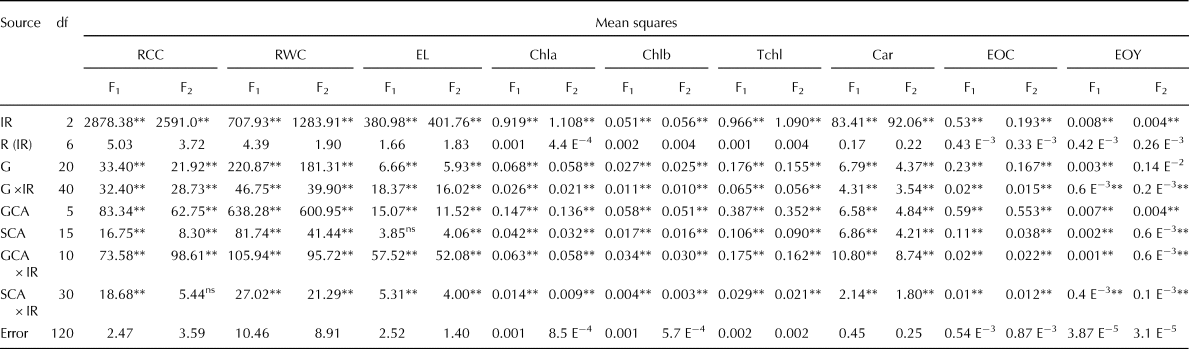
Combined analysis of variance revealed that there were significant differences between irrigation regimes for all the traits in F1 and F2 generations (Table 1). Genetic differences between F1 hybrids and between F2 populations were highly significant for all the traits. These results indicate that parent selection for diallel crosses had been properly done. Also, genotype × irrigation regime interaction effect was significant for all the traits in F1 and F2 generations (Table 1). The GCA and SCA effects were significant for all the traits except for EL in F1 generation. GCA × irrigation regime and SCA × irrigation regime interaction effects were significant for all the traits in F1 and F2 generations except for RCC in F2 generation (Table 1).
Combined analysis of variance for traits in the F1 and F2 progenies and their parents under different irrigation regimes

** is significant at 1% level of probability. Irrigation regime (IR), replication (R), genotype (G), general combining ability (GCA), specific combining ability (SCA), relative chlorophyll content (RCC), relative water content (RWC), electrolyte leakage (EL), chlorophyll a content (Chla), chlorophyll b content (Chlb), total chlorophyll (Tchl), carotenoids contents (Car), essential oil content (EOC), essential oil yield (EOY).
Nature of gene action
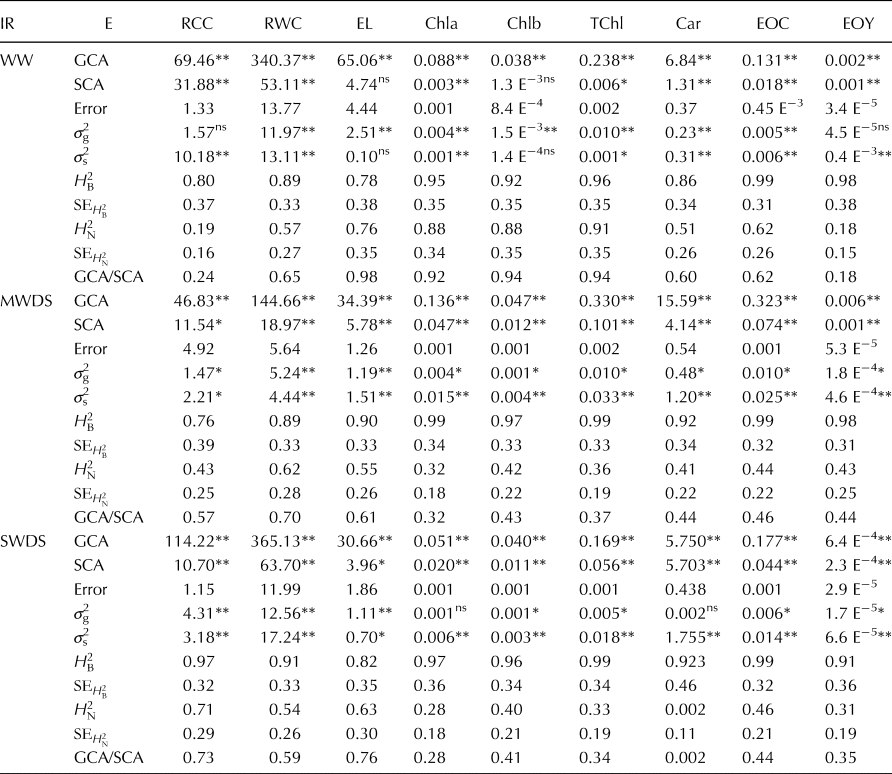
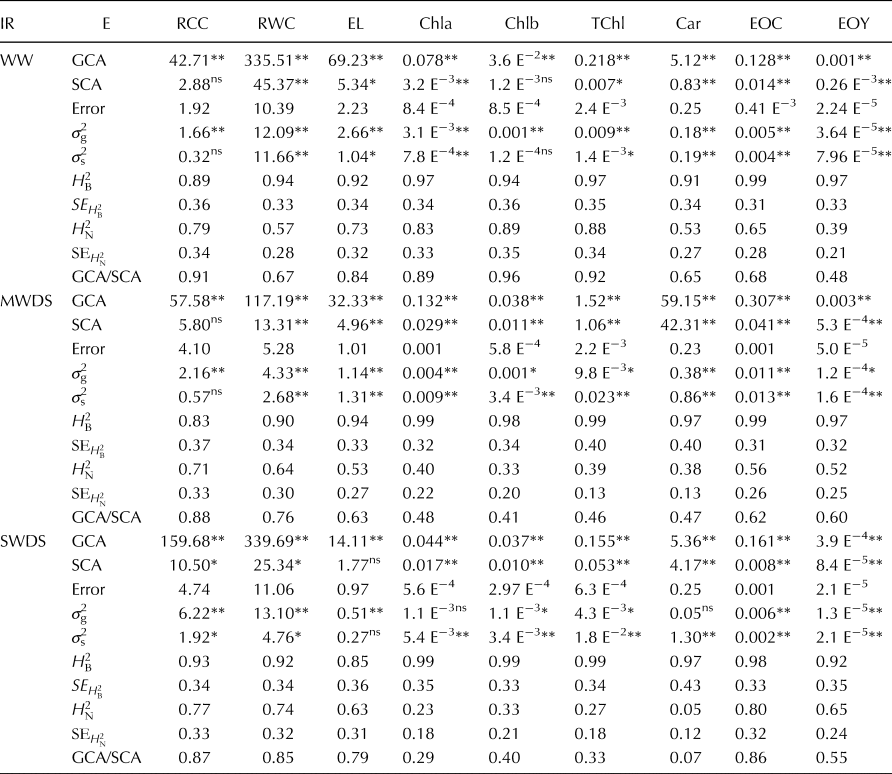
The GCA and SCA variances were significant for all the traits in F1 and F2 generations (Tables 2 and 3). In well-watered conditions, additive gene action was predominant for Chla, Chlb, TChl, Car, EL and RWC in F1 and F2 generations (Tables 2 and 3). Non-additive gene action was predominant for RCC in F1, while additive gene action was more important for RCC in the F2. Also, additive gene action was predominantly involved in controlling EOC in F1 and F2 generations. However, EOY was mostly controlled by non-additive gene action in F1 and F2 generations (Tables 2 and 3).
Analysis of variance for combining ability, variance components, heritability and GCA/SCA ratio estimates in F 1 generation under irrigation regimes

**,* and ns are significant at 1 and 5% level of probability and not significant, respectively. General combining ability (GCA), specific combining ability (SCA), variance of general  $(\sigma _{\rm g}^2 )$ and specific
 $(\sigma _{\rm s}^2 )$ combining ability, broad sense heritability
 $(H_{\rm B}^2 )$, narrow sense heritability
 $(H_{\rm N}^2 )$, standard error of broad sense heritability
 $({\rm SE}_{H_{\rm B}^2} )$, standard error of narrow sense heritability
 $({\rm SE}_{H_{\rm N}^2} )$, GCA/SCA ratio, irrigation regime (IR), estimates (E), well-watered (WW), mild water deficit stress (MWDS), severe water deficit stress (SWDS), relative chlorophyll content (RCC), relative water content (RWC), electrolyte leakage (EL), chlorophyll a content (Chla), chlorophyll b content (Chlb), total chlorophyll (Tchl), carotenoids contents (Car), essential oil content (EOC) and essential oil yield (EOY).
Analysis of variance for combining ability, variance components, heritability and GCA/SCA ratio estimates in F 2 generation under irrigation regimes

**, * and ns are significant at 1 and 5% level of probability and not significant, respectively. General combining ability (GCA), specific combining ability (SCA), variance of general  $(\sigma _{\rm g}^2 )$ and specific
 $(\sigma _{\rm s}^2 )$ combining ability, broad sense heritability
 $(H_{\rm B}^2 )$, narrow sense heritability
 $(H_{\rm N}^2 )$, standard error of broad sense heritability
 $(SE_{H_{\rm B}^2} )$, standard error of narrow sense heritability
 $({\rm SE}_{H_{\rm N}^2} )$, GCA/SCA ratio, irrigation regime (IR), estimates (E), well-watered (WW), mild water deficit stress (MWDS), severe water deficit stress (SWDS), relative chlorophyll content (RCC), relative water content (RWC), electrolyte leakage (EL), chlorophyll a content (Chla), chlorophyll b content (Chlb), total chlorophyll (Tchl), carotenoids contents (Car), essential oil content (EOC) and essential oil yield (EOY).
In mild and severe water deficit stress conditions, non-additive gene action was predominant for Chla, Chlb, TChl and Car in F1 and F2 generations (Tables 2 and 3). For EL, RWC and RCC, additive gene action was predominant in F1 and F2 generations. Also, EOC and EOY were mostly controlled by non-additive gene action in F1 generation, while additive gene action in F2 generation (Tables 2 and 3).
Narrow-sense heritability
Heritability estimates for all the traits are presented in Tables 2 and 3. In well-watered conditions, narrow-sense heritability estimates ranged from 0.18 for EOY to 0.91 for TChl in F1 generation and from 0.39 for EOY to 0.89 for Chlb in F2 generation. Under MWDS, the heritability values ranged from 0.32 for Chla to 0.62 for RWC in F1 generation and ranged from 0.33 for Chlb to 0.64 for RWC in F2 generation. Under severe water deficit stress conditions, the heritability values ranged from 0.002 for Car to 0.71 for RCC in F1 generation and ranged from 0.05 for Car to 0.80 for EOC in F2 generation. The heritability values for Chla, Chlb, TChl and Car decreased under mild and severe water deficit stress compared with well-watered condition (Tables 2 and 3).
Genetic combining ability of parents
The GCA values of parents in F1 and F2 generations showed that P1 and P5 in well-watered, P4 under MWDS conditions and P4 and P6 under severe water deficit stress conditions were the best general combiners for RCC (online Supplementary Table S2). In well-watered conditions, the H1 × 3, H1 × 4, H1 × 4 and H2 × 5 crosses had positive significant SCA values for RCC in F1 generation, while in F2 generation, the H4 × 6 population exhibited a positive significant SCA value for this trait (online Supplementary Tables S3 and S4). Under MWDS conditions, in F1 generation the H2 × 6 and H3 × 6 crosses and in F2 generation the H2 × 6 population had positive significant SCA values for RCC (online Supplementary Tables S3 and S4). Under severe water deficit stress, in F1 generation H2 × 4, H2 × 6, H4 × 5 and H5 × 6 crosses and in F2 generation the H3 × 4 and H5 × 6 populations had the positive significant SCA values for RCC (online Supplementary Tables S3 and S4).
P4 and P6 showed the largest GCA values for RWC in F1 and F2 generations under all irrigation regimes (online Supplementary Table S2). The H2 × 4 and H2 × 6 crosses in F1 generation and the H1 × 6, H2 × 4, H2 × 6 and H4 × 5 populations in F2 generation had the positive significant SCA values for RWC (online Supplementary Tables S3 and S4). Under MWDS conditions, the H2 × 5, H3 × 4 and H3 × 6 crosses had positive significant SCA values for RWC in F1 and F2 generations (online Supplementary Tables S3 and S4). Under severe water deficit stress, the H1 × 6, H2 × 4, H3 × 6 and H5 × 6 crosses in F1 generation and the H2 × 5, H3 × 4 and H3 × 6 populations in F2 generation had the positive significant SCA values for RWC (online Supplementary Tables S3 and S4).
In well-watered conditions, the P1 followed by P2 were the best general combiners for EL in F1 and F2 generations (online Supplementary Table S2). Under MWDS conditions, P4 and P6 had the largest negative GCA values for EL (online Supplementary Table S2). Also, under severe water deficit stress conditions, P4 had the largest negative GCA value for EL (online Supplementary Table S2). In well-watered conditions, the H1 × 6 cross exhibited the largest negative significant SCA value for EL in F1 and F2 generations (online Supplementary Tables S3 and S4). Under MWDS conditions, the progenies of the P4 and P6 parents (H1 × 4, H1 × 6, H2 × 4, H2 × 6 and H3 × 4) had significant negative SCA values in F1 and F2 generations (online Supplementary Tables S3 and S4). Under contrast, under severe water deficit stress conditions, there was no negative significant SCA (online Supplementary Tables S3 and S4).
For Chla, Chlb, TChl and Car traits, P1 was the best general combiner in F1 and F2 generations in well-watered conditions. While, under mild and severe water deficit stress conditions, P4 and P6 were identified as the best general combiners in F1 and F2 generations (online Supplementary Table S2). In well-watered conditions, in F1 generation, the H1 × 3, H1 × 4, H1 × 4 and H1 × 3 crosses had positive significant SCA values for Chla, Chlb, TChl and Car. While, in F2 generation, the H4 × 5 population for Chla and TChl and H1 × 4 population for Car exhibited the highest SCA values (online Supplementary Tables S3 and S4). Under MWDS conditions, the H4 × 5 and H5 × 6 crosses had the highest positive SCA values for Chla and Car in F1 and F2 generations (online Supplementary Tables S3 and S4). Also, the H3 × 6 and H4 × 5 crosses had the highest positive SCA values for Chlb and TChl, in F1 generation, whereas in F2 generation, the H3 × 4 and H5 × 6 populations had the highest positive SCA values for Chlb and total TChl (online Supplementary Tables S3 and S4). Under severe water deficit stress conditions, the H3 × 6 and H1 × 6 crosses had the highest positive SCA values for Chla and Car in F1 and F2 generations. The H2 × 6 and H4 × 5 crosses exhibited the highest positive SCA values for Chlb and TChl, in F1 generation, whereas in F2 generation, the H5 × 6 population had the highest positive SCA values for Chlb and TChl (online Supplementary Tables S3 and S4).
For EOC and EOY, P4 was the best general combiner under well-watered and MWDS conditions in F1 and F2 generations (online Supplementary Table S2). Under severe water deficit stress conditions, P4 and P6 were the best general combiners for EOC and EOY in F1 and F2 generations (online Supplementary Table S2).
In well-watered conditions, the H1 × 3, H1 × 4, H2 × 4, H2 × 6 and H5 × 6 crosses had positive significant SCA values for EOC and EOY in F1 and F2 generations (online Supplementary Tables S3 and S4). Under MWDS conditions, in F1 generation the H1 × 4, H2 × 4 and H3 × 6 crosses and in F2 generation the H1 × 4 population had the positive significant SCA values for EOC and EOY (online Supplementary Table S3 and S4). Under severe water deficit stress conditions, in F1 generation the H2 × 4, H4 × 5 and H5 × 6 crosses and in F2 generation the H5 × 6 population had positive significant SCA values for EOC and EOY (online Supplementary Tables S3 and S4). These crosses could be used to develop coriander genotypes with high EOC and EOY in advanced segregation generations.
Overall, the GCA values (online Supplementary Table S2) revealed that P4 and P6 had the high positive significant GCA values for many of the physiological traits, EOC and EOY and the negative significant GCA values for EL in F1 and F2 generations under mild and severe water deficit stress conditions.
Genetic correlation between EOY and physiological traits
Genetic correlation analysis showed that RWC was positively correlated with EOY in well-watered condition (online Supplementary Table S5). In mild and severe water deficit stress, EOY was significantly and positively correlated with RCC, Chla, Chlb, TChl, Car and RWC. EOY had a negative significant correlation with EL in both the mild and severe water deficit stress conditions (online Supplementary Table S5), as might be expected, since EL is an indicator of tissue damage.
Discussion
Identification of important traits that are significantly associated with drought tolerance and that are highly heritable is an essential prerequisite for selection and screening of drought-tolerant genotypes. Plants respond to drought stress through changes in different morphological and physiological processes. Plants physiological responses to drought stress appear to be plastic and adjust physiologically to maintain high level of leaf water content (Shimizu et al., Reference Shimizu, Maruoka, Ichikawa, Baruah, Uwatoko, Sano and Onishi2010). In our study, genetic variability was observed for phytochemical and physiological traits between the parents, F1 hybrids and F2 populations suggesting a high potential for genetic improvement in coriander.
Mild and severe water deficit stresses decreased Chla, Chlb, TChl, RCC, Car, RWC and EOY values. Bayat et al. (Reference Bayat, Mirlohi and Khodambashi2009) similarly reported that drought stress leads to reduced chlorophyll content. Chlorophyll content is a major character determining photosynthetic capacity in live plants and a higher chlorophyll content is associated with drought tolerance (Ebrahimiyan et al., Reference Ebrahimiyan, Majidi, Mirlohi and Noroozi2013; Pirnajmedin et al., Reference Pirnajmedin, Majidi, Saeidi, Gheysari, Nourbakhsh and Radan2017). Therefore, screening genotypes for a high value of chlorophyll content may lead to increased drought tolerance (Rong Hua et al., Reference Rong Hua, Guo, Michel, Stefania and Salvatore2006). Car can act as a non-enzyme antioxidant and higher Car values indicate more an efficient photoprotective system (Simkin et al., Reference Simkin, Moreau, Kuntz, Pagny, Lin, Tanksley and McCarthy2008). Car play fundamental roles in drought tolerance through light harvesting and protection from oxidative damages (Simkin et al., Reference Simkin, Moreau, Kuntz, Pagny, Lin, Tanksley and McCarthy2008). RWC is an important indicator for the water status in plant tissue in drought-stressed conditions (El-Tayeb, Reference El-Tayeb2006; Gunes et al., Reference Gunes, Inal, Adak, Bagci, Cicek and Eraslan2008) and screening genotypes for a higher RWC may lead to the identification of higher yielding genotypes under water deficit stress (Keles and Oncel, Reference Keles and Öncel2004).
The EL value increased in mild and severe water deficit stresses compared with the well-watered condition in F1 and F2 generations. A higher EL corresponds to the greater membrane injury. Kocheva and Georgiev (Reference Kocheva and Georgiev2003) reported lower levels of EL in drought-tolerant barley genotypes than sensitive genotypes. Similar to present results, other researchers reported that EL in drought-stressed plants was higher than in well-watered plants (Kocheva et al., Reference Kocheva, Lambrev, Georgiev, Goltsev and Karabaliev2004; Geravandi et al., Reference Geravandi, Farshadfar and Kahrizi2011).
Drought stress is considered to be a major factor affecting many aspects of plant biochemistry and physiology (Baghalian et al., Reference Baghalian, Abdoshah, Khalighi-Sigaroodi and Paknejad2011; Yadav et al., Reference Yadav, Sangwan, Sabir, Srivastava and Sangwan2014) and secondary metabolites such as EOC. Results revealed that drought stress has a positive effect on the EOC in coriander. Increasing EOC by drought stress has been documented by Petropoulos et al. (Reference Petropoulos, Daferera, Polissiou and Passam2008) in parsley, Bettaieb et al. (Reference Bettaieb, Zakhama, Wannes, Kchouk and Marzouk2009) in Salvia officinalis and Alinian et al. (Reference Alinian, Razmjoo and Zeinali2016) in cumin. EOY is comprised of two components including EOC and fruit yield. The reduction in fruit yield was greater than the increased EOC under water deficit stress. This leads to decreased EOY under water deficit stress condition. Similar results were reported by Farahani et al. (Reference Farahani, Valadabadi, Daneshian, Shiranirad and Khalvati2009) and Alinian and Razmjoo (Reference Alinian and Razmjoo2014).
Narrow-sense heritability and GCA/SCA ratio values suggest that additive gene action was predominant in controlling Chla, Chlb, TChl and Car in well-watered, while non-additive gene action was predominant in mild and severe water deficit stresses in F1 and F2 generations. The different patterns of inheritance for Chla, Chlb, TChl and Car in different irrigation regimes may be due to the expression of water deficit stress-responsive genes, with different levels of expression of genes involved in stress tolerance under different irrigation regimes, as well as the interaction among genes (Mathews et al., Reference Mathews, Malosetti, Chapman, Mcintyre, Reynolds, Shorter and Van Eeuwijk2008).
Under mild and severe water deficit stress conditions, high narrow-sense heritability and GCA/SCA ratio for RCC, RWC and EL indicate the high magnitude of additive gene variance contributed in genetic variance. Therefore, recurrent selection may be effective to achieve genetic progress for drought tolerance. Similar to present results, Ebrahimiyan et al. (Reference Ebrahimiyan, Majidi, Mirlohi and Noroozi2013) and Pirnajmedin et al. (Reference Pirnajmedin, Majidi, Saeidi, Gheysari, Nourbakhsh and Radan2017) in the study of tall fescue and Irani et al. (Reference Irani, Majidi, Mirlohi, Zargar and Karami2015) in sainfoin (Onobrychis viciifolia Scop) reported high heritability estimates for RWC and chlorophyll content under water deficit stress. Blum (Reference Blum2011) reported that an indirect selection through yield components and other traits which have high heritability and are correlated with yield would likely increase yield through direct selection. In the present study, RCC, RWC and EL had higher heritability estimates than EOY. Also, these traits had a significant positive genetic correlation with EOY. Therefore, indirect selection for EOY through selection for RCC, RWC and EL may be more effective than direct selection for EOY, especially under water deficit-stressed conditions.
The significant GCA × irrigation regime and SCA ×irrigation regime interaction effects indicate that there was a potential of physiological plasticity in coriander and both the additive and dominance gene actions are involved in controlling the plasticity (Kadam et al., Reference Kadam, Tamilselvan, Lawas, Quinones, Bahuguna, Thomson, Dingkuhn, Muthurajan, Struik, Yin and Jagadish2017). Physiological plasticity can lead to adaptive drought tolerance and has a positive effect on plant fitness. With the consideration of the involvement of the additive gene effects in coriander in response to drought stress, it can be expected that selection for desired physiological traits may result in drought-adaptive genotypes.
Achievements in plant breeding programmes depend on the accuracy of parent selection. Parent selection for the hybridization programmes should be based on their genetic worth. A high GCA value for a parent is mainly due to additive genetic effects (Griffing, Reference Griffing1956) that can be successfully inherited into the next segregating generations following hybridization between two parents. Therefore, parent selection for hybridization should be made on the basis of their GCA values to increase gaining the superior segregates in F2 and later generations. Based on GCA, parents P4 and P6 had high GCA value for RCC, RWC, Chla, Chlb, TChl, Car, EOC and EOY and a negative GCA value for EL in F1 and F2 generations under mild and severe water deficit stresses. Also, progenies of the crosses and populations to which P4 and P6 contributed as a parent displayed high SCA values for EOY and other physiological traits in F1 and F2 generations. The P6 (TN-59-230) is native to Bushehr which has a Koppen's climate classification as a hot desert (BWh). Therefore, this genotype has evolved in a water-limited environment and is a carrier of the drought tolerance alleles. Results herein confirmed that P6 successfully combined its alleles with other coriander genotypes and their hybrids appeared with an appropriate level of drought tolerance.
Consideration of the GCA effects of the parents involved in the superior specific cross-combinations identified for all the target traits indicated that the combining ability status of the crosses was dependent on the GCA effect status of the parents involved (Khodadadi et al., Reference Khodadadi, Dehghani and Jalali Javaran2017). For many crosses which showed the positive significant SCA effects involved relevant parents that had high positive GCA effects. This indicates that parents with high positive GCA effects are necessary for the production of crosses with the positive significant SCA effects for phytochemical and physiological traits (Banerjee and Kole, Reference Banerjee and Kole2009) should also be noted that diversity in parental GCA effects is necessary for the development of the high value-specific combinations in coriander.
Supplementary material
The supplementary material for this article can be found at https://doi.org/10.1017/S1479262118000539.
Acknowledgements
The authors thank the Gene bank of the Seed and Plant Improvement Institute of Karaj, Iran for making the plant materials available.