In the development of modern dance, Mary Wigman and her student Hanya Holm are among those most instrumental in establishing this new art form during the first decades of the twentieth century. Their most outstanding achievements took very different approaches from each other in both style and content. In Germany, Wigman was one of the leading voices for Ausdruckstanz, championing absoluter Tanz, dance alone as a form of expression.Footnote 1 She enjoyed international renown from her first solo concerts in 1919 until 1933, when her alignment with National Socialism made her a controversial figure. Holm emigrated to the United States in 1931, prior to this shift in Wigman's work in which she maintained many of the choreographic processes and conventions she learned working under Wigman.
Holm's work developed differently than it had under the direction of her longtime mentor, but it was a natural result of experiences she had gained both with Wigman and with the American modern dance movement. By examining Wigman's Totenmal: Dramatisch-chorische Vision für Wort Tanz Licht (Dramatic Choric Vision for Word Dance Light) Footnote 2 (1930) and Holm's Trend (1937), this article considers how Holm incorporated elements from Wigman's work into the dances she was creating in the context of the Bennington School of the Dance.Footnote 3 In doing so, I demonstrate which aspects of Holm's works, including strong group choreography, lighting design, and thematic elements, all effectively synthesized, are in part a result of what she learned under Wigman. I also show why Trend succeeded as a production, whereas by all accounts, Totenmal failed. Finally, I explain how the different environments in which they were created contributed to the very different interpretations of these works.
The connections between German and American modern dance has been laid out by, among others, Susan Manning (Reference Manning2006), Isa Partsch-Bergsohn (Reference Partsch-Bergsohn1994), Mary Anne Santos Newhall (Reference Newhall2009), and Claudia Gitelman (Reference Gitelman1996, Reference Gitelman2003). Wigman wrote about Totenmal both at the time of the production (Reference Wigman1930) as well as later (Reference Wigman and Sorell1966, 89–106). It was well recorded by critics in both Germany and the United States, the vast majority of whom viewed it, as a synthesis of word, dance, and light, to be a failure (Muckermann Reference Muckermann S.J.1930; Richter Reference Richter1930; Martin Reference Martin1930). Wigman's notation of the dance, along with her notes, was published in 1987, and a short film clip (Das Totenmal 1930) is also extant, as are dozens of photos of the production, which are part of the Mary Wigman collection at the Academy of Arts Berlin. Historical studies on Totenmal focus both on production and ideological aspects, and Manning (Reference Manning2006) and Partsch-Bergsohn (Reference Partsch-Bergsohn1994) recount details of the dance.
Research on the ideological and political implications of Totenmal has been conducted by Hedwig Müller (Reference Müller1986a, Reference Müller1986b), who states that Wigman “took little notice of the political events in Germany” when she created Totenmal (Reference Müller1986b, 157). Manning (Reference Manning2006) contextualizes the dance into Wigman's work both before and after she began aligning it with Nazi ideology in 1933, and Ramsay Burt (Reference Burt1998) explains how mass spectacle and modern dance were used by the Nazis for ideological purposes. Marion Kant (Reference Kant and Kolb2011) casts Wigman in the role of appealing to the right-leaning middle class, placing her work in a nationalistic light. In Hitler's Dancers: German Modern Dance and the Third Reich, Kant and Lillian Karina challenge the biographies of the great figures of German dance, including Wigman, for omitting details of their ready collaboration with the Nazis (Reference Karina, Kant and Steinberg2003, 85). More recently, Kate Elswit (Reference Elswit2014) examines Totenmal from the perspective of the contemporary spectator, demonstrating that, at the time of its initial performance, while audiences were confused by the superficial anti-war theme, neither they nor the creators realized the political implications of the work described in retrospect by historians. Manning (Reference Manning2006), for example, lays out a clear and convincing argument of how Totenmal served as a kind of prototype fascist theater, explaining how the method of presentation of the themes contributed to the destructive political forces that dominated German culture at that time and led to a stark change in Wigman's work after 1933.
At the time of the creation of Totenmal, both Wigman and Holm considered themselves apolitical; however, after 1933, their paths diverged sharply in this respect. Wigman and her former teacher Rudolf von Laban, according to Karina and Kant, submitted themselves “with total dedication to the Nazi cause,” ready “to adjust their ideas and practices to the new framework” (Reference Karina, Kant and Steinberg2003, 131). Wigman made this sharp change almost immediately after the Nazis came to power, voluntarily dismissing both instructors and students of Jewish decent (92). In New York, Holm distanced herself from the political situation in Germany as well as from Wigman's politics, never, however, disavowing her mentor. While many of the production aspects of Totenmal were absorbed into fascist works, some of these also found their way into Trend, albeit with very different results. This article attempts to explain how strikingly different messages could be produced using similar tools, given the social and political environments of Germany and the United States in the 1930s. In doing so, I compare these two dances, and attempt to show what aspects Holm brought from Totenmal to Trend. At the same time, I explore how Trend remained thematically far from the works that Wigman was creating by that time.
Trend, like Totenmal, was well recorded by critics, both at its Bennington premiere on August 13, 1937, and the New York premiere on December 28, 1937, at the Mecca Auditorium (Bloomer Reference Bloomer1937; Butler Reference Butler1938; Martin Reference Martin1937, Reference Martin1938). It was also documented photographically; many of these images are housed at the Jerome Robbins Dance Division of the New York Public Library for the Performing Arts. This collection also contains oral histories (Holm Reference Holm1974–1975) and film records (Jerome Robbins Dance Division 1981), with first-hand accounts of Trend. Upon Holm's death in 1992, several dance journals contained collections by various scholars documenting her early work, including Ballett International (1993), Choreography and Dance: An International Journal (Cristofori 1992), and The Journal for Stage Directors and Choreographers (1993). Tresa Randall (Reference Randall, Manning and Ruprecht2012) contributes valuable information regarding the concepts that Holm learned from Wigman and then adjusted to make them accessible to American dancers and audiences. She also addresses the complexity that Holm encountered in navigating her relationship with Wigman and her American students. In addition to these sources, The Borzoi Book of Modern Dance (Reference Lloyd1949) by Margaret Lloyd, Modern Dance in America, The Bennington Years (Reference Kriegsman1981) by Sali Ann Kriegsman, and The Bennington School of the Dance (Reference McPherson2013) with accounts complied by Elizabeth McPherson, provide important context to Trend and allow us to examine its development. Finally, Stepping Left: Dance and Politics in New York City, 1928–1942 (Reference Graff1999) by Ellen Graff discusses modern dance in context of the leftist political leaning of American modern dance during this time period.
Little work has been done directly comparing Wigman's work to Holm's choreographically and theatrically. One notable exception is Newhall (Reference Newhall2002), who traces the lineage of modern dance from Wigman's Totenmal, to Holm's Trend, and finally to Eve Gentry's Tenant of the Street (Reference Gentry1992). This comparison details elements of group choreography common to both Totenmal and Trend. I build on this work, looking at stagecraft and thematic elements in addition to group and solo dances, further examining connections between the two works. I contextualize these connections with developments in theatricality in American modern dance, of which Holm was an important player in the 1930s.
Dance and the Theater: The Dancers’ Congresses
German dancers were working toward theatricality in modern dance earlier than their American counterparts, and this subject became a point of contention among the most prominent dance artists of the time. In an attempt to determine a unified direction for dance in Germany, in particular regarding the institutionalization of Ausdruckstanz into established theaters, three Dancers’ Congresses were organized in Magdeburg (1927), Essen (1928), and Munich (1930) (Toepfer Reference Toepfer1997, 312). Wigman was not present at the First Congress, but Müller explains that at the Second Congress in Essen “the central theme was the dispute between Mary Wigman and her followers, representing ‘absolute’ individualistic dance, and Rudolf von Laban, who with his followers emphasized the importance of communal and theater dance” (Müller Reference Müller1986b, 7). It was at this conference that Swiss poet Albert Talhoff approached Wigman with his concept for Totenmal. This project signifies a strong departure from Wigman's previous work, and the discussions and lectures regarding the role of dance within institutional theaters in Germany, along with group pieces at this Congress, provided an important impetus for her decision, with Totenmal becoming her first large group work.
Wigman's participation in Totenmal, a synthesis of works, is surprising given that she had spent years struggling to present her art as independent. She began her career far removed from the ballet associated with opera houses and the chorus lines of revues.Footnote 4 She first studied eurhythmics, but found the need for more expression through movement and became the student of, and later the assistant to, Laban in Switzerland and Munich from 1913 to 1919. She recalled that Laban had an “extraordinary quality of getting you free artistically … to discover your own potentialities, to develop your own technic [sic], and your individual style of dancing” (Wigman Reference Wigman1956, 28). Laban was devoted to amateur dance, developing methods for large movement choirs, while Wigman launched a solo career. Within a decade, she was being lauded by critics for having shown dance to be viable in itself, standing on equal ground with other arts. Her approach to dance was the opposite of ballet; it was based on inner impulse, not codified, outwardly trained dance vocabulary (Müller and Stöckemann Reference Müller and Stöckemann1994, 22). Rather than pantomime, script, or song, it required only movement as a means of expression, stressing individuality and self-actualization (26).
Holm also trained first in eurhythmics and was a certified instructor before she became a student of Wigman after seeing her perform in 1921. In Wigman's dance, she said she saw “something fulfilled” that she “was searching for. There was some very highly dynamic force” (Siegel Reference Siegel1981, 6). Holm recalled that they started from nothing in Germany, and she considered herself fortunate to have joined Wigman's group at a time when they were in the process of discovering what dance meant (Jerome Robbins Dance Division 1981). Of this group, Wigman said that “we rather were a small experimental club in which everything was tried out which the imagination would yield and which the bodily abilities would permit” (Sorell Reference Sorell1969, 17). Wigman and her students worked together for hours, discovering the perfect movements to express an idea (Odem Reference Odem1980, 87). Holm also recalls, “There was no preconceived method in existence, no preconceived patterns, the pattern changing with the demand and with the invention expressing the new idea” (Sorell Reference Sorell1969, 18).
This atmosphere of discovery, as well as Wigman's concept of the individuality of the dancer, enabled Holm to develop a style strikingly different from her mentor as she worked in America. In Germany, Wigman remained the undisputed leader of the group, even though movement discoveries were made in her absence. Her dynamic personality overshadowed her dancers; Holm, as with many of Wigman's students, seems to have developed her own choreographic voice only after she no longer worked directly under Wigman.Footnote 5 After moving to New York to found the only Wigman school outside of Germany, Holm's creative process and teaching methods remained closely tied to Wigman's work, even after she began to establish herself as a choreographer in the 1930s and developed a very different style and vocabulary from Wigman's. Holm's student, Alwin Nikolais, explains that in the United States, “Hanya's dance creations showed little evidence of the metaphysical preferences of Wigman. … Technically and pedagogically … there is a strong portion, and for the simple reason that these existed on the basis of physio-psychological common sense searched out by von Laban and Wigman and continued by Hanya” (Nikolais Reference Nikolais1992, 55).
Holm passed on this independence of discovery to her American students. Gentry recalls a rehearsal of Trend in which the dancers were making repeated mistakes and Holm left the room: “Then several of us in the company plowed into the dismayed group, each of us taking one or two dancers. Suddenly everyone was busy—solving the problems. … The lights went on! Hearts were pumping—our breathing accelerated with the intensity of premeditated achievement” (Gentry Reference Gentry1992, 25). This method was similar to Wigman's, but according to Randall, it tapped into the “native rhythms and a transcendental American essence” (Reference Randall, Manning and Ruprecht2012, 93), which Holm had observed during her first years in New York. As Wigman had in Germany, Holm created an American Tanzgemeinschaft, a community of dancers that worked and created together (80). Wigman's method, according to Randall, was “antirational, even irrational, guided by sensation, emotion, instinct and physical exploration rather than rational thought” (87). In the German Tanzgemeinschaft, a type of religious mysticism played a focal role in the community and therefore the dances they produced. In New York, Holm worked with American dancers who she saw as being energetic and full of vitality, yet lacking the ability to cross from rational thought to irrationality or mysticism. With this fundamental difference between German and American dancers, similar approaches to creating dances necessarily produced vastly different works.
Having fought for modern dance to gain equal status with other arts, Wigman's approach was at odds with theatrical dance, which was often subject to other aspects, including music, lighting, and costuming. However, by the late 1920s, many German modern dancers had begun to take positions in theaters and opera houses, requiring them to work within established institutions.Footnote 6 Kurt Jooss, who was exploring the compatibility of ballet and modern dance as well as the role of modern dance within the theaters, acknowledged the intrinsic conflict in his Congress lecture:
On the one side the ‘absolute dance,’ dance for itself, depending purely on dance composition, usually plotless (and if there is one, it is a completely unimportant side note). … The other extreme to this species is ‘theater dance,’ which views dance as a servant of other stage arts: sung, spoken or silent drama, dance in the opera, in theater, and above all, pantomime. (Jooss Reference Jooss1993, 76–77)
The main weakness of theater dance is revealed, as Jooss calls it, as a servant to the other arts. A servant gives way to the more dominant elements; choreography must often submit to the other arts, whether plot, music, or costume design.
Part of Wigman's position was based on the idea that working within theaters presented a different institutional structure than modern dancers were accustomed to. In her Congress lecture in Essen, Wigman is pragmatic; she acknowledges that they will begin working in theaters, but she warns that many lacked the proper training for that setting (Reference Wigman1993, 80). Her position is consistent with her advice to Holm to forgo an offer to direct the opera house in Hannover. She told Holm she was not ready and did not want her to be exposed too soon to that kind of “rough and tumble” environment (Sorell Reference Sorell1969, 24). However, Wigman did note that the “possibilities for the scenic development of the dance theatre [sic] fascinated” her (Wigman Reference Wigman and Sorell1966, 89).Footnote 7
Talhoff introduced the idea of Totenmal to Wigman in the midst of these discussions. He intended to create a Gesamtkunstwerk, a work of total art, portraying his message through both speaking and movement choirs and an elaborate lighting plan. After much deliberation, Wigman agreed to the collaboration, to be presented at the Third Congress in 1930. The massive production included dozens of performers: speakers, dancers, and instrumentalists. As Wigman approached the collaboration, she did so with the understanding that she was creating a work that was a synthesis of various art forms, but that dance would remain separate enough to maintain its integrity as an independent art form. She saw it as an opportunity to create a true merger of theater and dance, in which dance, rather than being subjugated to other forms, would be part of a fully equal synthesis (Wigman Reference Wigman1930, 16).
From the beginning, Wigman sought to present dance as independent and equal to the other arts, not as a vehicle to present the work of composers, poets, or visual artists. This approach makes Wigman's collaboration with Talhoff's vision extraordinary. The second part of the title itself demonstrates the collaborative nature of the work: Dramatic Choral Vision for Word Dance Light. As a work of literature, it was not written to be read on paper or even to be read aloud alone; he intended his works to be part of the greater performance, one in which dance and lighting design played a role equal to the spoken word in the final performance. Officially, dance was not subjugated to the other art forms, but Talhoff maintained the direction over the entire production, including the dance. According to Hanns Johst of the Hannoverscher Kurier , Talhoff “created the scenery himself, he forced his imagination on the dance steps; he wrote the text, he composed the music. Every robe is his instruction, every word, every movement his will … everything serves and thanks its existence to this unique Talhoffian vision” (Johst Reference Johst1930).
Although Holm became the codirector of Totenmal and was responsible for directing the choruses as well as helping with the lighting cues, there is no indication that she was part of the initial discussions between Talhoff and Wigman. However, she was Wigman's closest coworker and the main instructor of the Wigman School in Dresden. In 1928, when Wigman disbanded her company for financial reasons, Holm was responsible for the work in Dresden while Wigman pursued a solo-touring schedule (Müller Reference Müller1986b, 8). It was during this time period, in 1929, that Holm had her first important choreographic job, creating and dancing the role of the princess in Stravinsky's L'Histoire du Soldat.Footnote 8
Discussions at the Dancers’ Congresses along with the role modern dancers were playing in institutional theaters and opera houses enabled German dance artists to transition to theatricality during the 1920s. The Bennington School of the Dance (1934–1942) provided American dancers a place where the top players in modern dance, labeled as the “Big Four”—Martha Graham, Doris Humphrey, Charles Weidman, and Holm—worked with students from all over the country to develop their technique and choreography. Similar to the Congresses, discussions were held and new works were presented; however, Bennington's primary focus was to offer several weeks of study in dance and related fields like music and theater (McPherson Reference McPherson2013, 13). Each year, one choreographer was in charge of the workshop portion of the school at which the dancers worked “as a large concert group under professional standards of discipline and performance” (Bloomer Reference Bloomer1937, 74). The composition of dancers that Wigman and Holm worked with in Totenmal was similar to the groups who participated in the Bennington workshops; the choreographers worked with their own company of dancers, along with students from other regions.
Among the Bennington cohort, Humphrey was working most successfully toward theatricality in her work. In the years 1935–1936, she presented her New Dance Trilogy, a series of three dances, titled New Dance, Theatre Piece, and With My Red Fires, which were all performed together in 1936. In these two years previous to Holm's successful workshop in 1937, Humphrey created what Martin considered the first work of modern dance to make the transition from a recital format, a “succession of unrelated little compositions without theatre dimensions” (Martin quoted in Kriegsman Reference Kriegsman1981, 130), to a theatrical one which dramatized the “conflict between the individual and his universe” (30). The final section included forty-five dancers along with three soloists. A narrative love story between a couple danced by Weidman and Katherine Litz was portrayed, with Humphrey, in the role of the Matriarch, trying to come between the couple. Reviews note Humphrey's outstanding performance—a “masterpiece,” according to Martin (146).
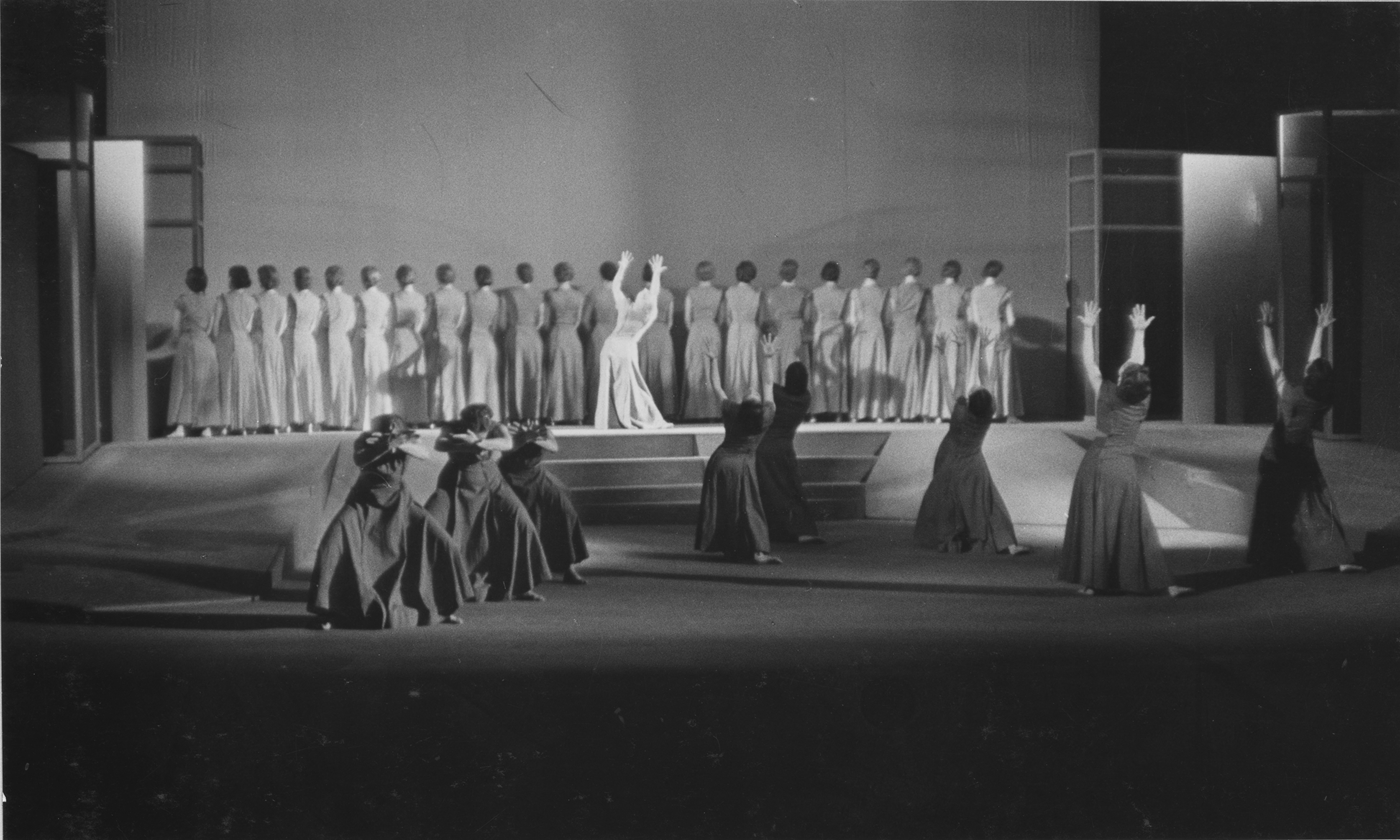
Humphrey used a large group of dancers to create dramatic effect, placing them on two stage levels with steps between the upper and lower stages. Black screens formed wings, and architectural boxes, which were moved to represent a house or a tower, framed and supplemented the action. Extant photos show the dancers amply using both parts of the stage and the steps. Critics lauded the innovative group choreography. Joseph Arnold Kaye of Dance claimed it to be the “finest choral composition that the modern dance has produced” and that there was a pattern of “processional dancing marvelously integrated” (Kaye quoted in Kriegsman Reference Kriegsman1981, 144). Margaret Lloyd noted that “large use was made of the large space and large groups available, giving the effect of humanity speaking—through movement” (Lloyd quoted in Kriegsman Reference Kriegsman1981, 143). However, it is notable that many reviews focus on Humphrey's performance,Footnote 9 with the group dances supporting the work of the three soloists. Like Wigman, Humphrey was creating strong group works, with her own dynamic performances remaining a focal point.
Although Holm did dance a solo role in Trend, her performance did not outshine that of her dancers, and several others performed solos in the piece. Much of her own energy was placed in the ensemble work and non-choreographic production aspects, which, I suggest, she was able to execute skillfully because of her codirection of Totenmal. Humphrey's work did lay a foundation for theatricality in American modern dance, but Holm had previously worked directly with a very large cast in a setting that required complex production elements, moving toward a Gesamtkunstwerk. Trend represented a synthesis of elements; in contrast, Humphrey's own performance in Trilogy still seems to have dominated other aspects of the production. Of Trend, Martin wrote, “Though, to be sure, this is not the first work to attack the theatre [sic] problems. … It brings distinctive new forces to bear on the subject which makes it memorable and in a way revolutionary” (Martin Reference Martin1938).Footnote 10 Holm later explained, “The lyric theatre [sic] … in which I am interested, fuses music, drama and dance into an entity” (Sorell Reference Sorell1957, 84). It is apparent from the many descriptions as well as photographs of Trend that this dance represented a movement toward theater dance, for which Jooss had advocated at the Second Congress. By showing that dance was capable of working with the production tools of theater, while at the same time being innovative, Partsch-Bergsohn sees Holm as being closer to Jooss than the other American dancers at that time (Reference Partsch-Bergsohn1994, 88). In Trend, she overcame the chief weakness of theatrical dance as described by Jooss, that dance can become a servant of the other arts. In Totenmal, dance was considered to be the strongest part of the work; however, it was greatly limited by the weaknesses of the other elements. Trend demonstrated that modern dance can be an equal player in a Gesamtkunstwerk without compromising choreographic innovation.
Totenmal and Trend: The Interplay of Group and Solo Choreography
There are similarities between Trend and Totenmal, but also striking differences; Totenmal failed in almost every aspect, but in many of the ways it failed, Trend succeeded. From the perspective of process, however, Totenmal was an experiment that bore fruit far beyond its failed performances. I suggest that the success of the Trend is partially a result of the experience Holm gained from Totenmal, which served as a vital stepping-stone in the development of theatricality in Holm's work. In the seven years between the dances, Holm added to her abilities, gleaning new technique and innovations from the American modern dance movement.
Both dances are notable for their use of large groups of dancers. Prior to the Dancers’ Congresses in Magdeburg in 1927 and Essen in 1928, Wigman did not share Laban's enthusiasm for amateur movement choirs, focusing instead on professional dancers (Newhall Reference Newhall2002, 30). However, in Totenmal, she saw the opportunity to create a bridge between the two approaches to choreography. She worked with her own dancers from Dresden, as well as dancers from the Günther School Munich and the Wigman School Munich (Totenmal Advertisement 1930). Like her willingness to participate in a Gesamtkunstwerk, working with a movement choir shows a departure from the concepts with which she had been successful up to this point and a willingness to experiment. She acknowledged the potential of the project, seeing it as an opportunity to create her most “mature and inventive” group work to date (Wigman Reference Wigman and Sorell1966, 90).
With the exception of the choreography and Wigman's performance, Totenmal is best remembered as a failed work. Wigman herself later recalled that it was an “experiment of its day which very soon was buried in oblivion” (89). Critics lay its failure squarely in the hands of Talhoff, who, despite his lack of experience in directing this kind of production, maintained control over all the details. Wigman recalled, “Too many forces, unbalanced among one another, were put into play to be able to fulfill Talhoff's wishdream [sic] of a Gesamtkunstwerk” (96). Many critics found Wigman's dance to be the only redeeming quality of the production. Friedrich Muckermann S.J., disappointed in the work as a whole, still found that “Mary Wigman produced a masterpiece, and revealed the art of the expression of dance in its last, purest beauty” (Reference Talhoff1930). Another anonymous critic believed that the entire production failed as a “synthesis of word, sound, movement and light,” and wondered why Wigman tolerated the disastrous lighting (Chorische Vision 1930). Even the New York Times reported that Wigman was the only redeeming factor in the performance:
The great lack which is evident in the production … is that nobody with a director's instinct and a technical knowledge of the theatre [sic] was in charge to bring all the diffuse elements into a wholeness of form. Here was no synthesis of movement, light and the spoken word—here was rather a disconnected series of episodes in different mediums, now in recited verse, now in percussion, now in miming and dance. The result is a moving tragedy, to be sure, but one weeps not over the horrors of war but that Mary Wigman's genius should have been so pitifully betrayed. (Martin Reference Martin1930)
None of the critics mentioned Holm's role in the production, nor is she credited as being codirector of the dance.Footnote 11 However, later accounts by both her and Wigman discuss her important role.
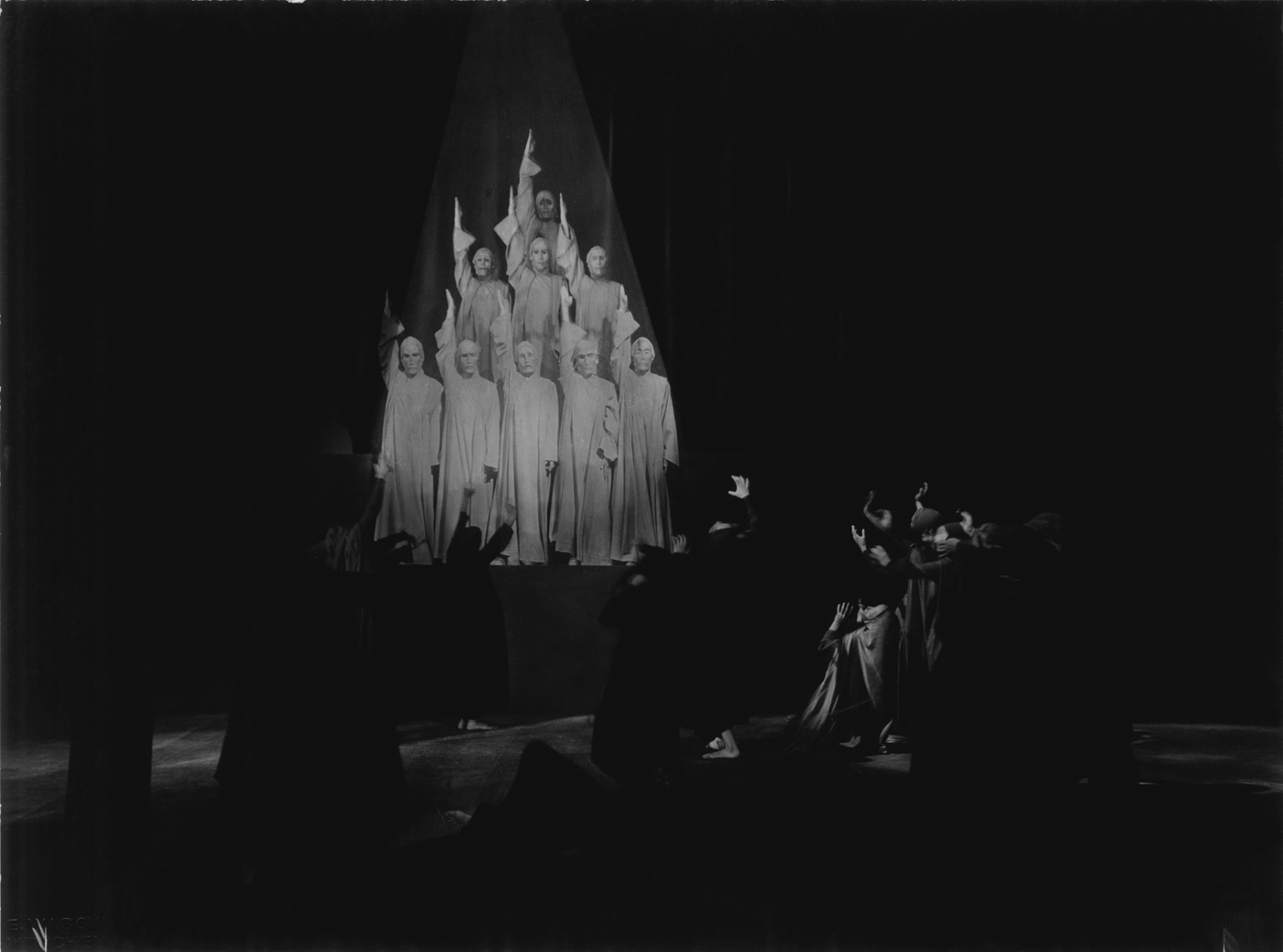
Totenmal was not finished in time for the 1930 Congress in Munich, but it was contractually obligated to be shown (Martin Reference Martin1930). The final version was presented a total of thirty times at a specially designed space in Munich, a massive venue for an audience of 1,600, with sets specially designed for this production. On stage were more than sixty performers and an orchestra. A men's chorus located on two sides of the stage chanted Talhoff's script in a style somewhere between speech and song, their voices eerily recalling the war dead. Letters from the fallen read by speakers located throughout the auditorium provided much of the emotional effect. A women's chorus danced; all of them except Wigman wore masks created by Bruno Goldschmitt. In a final dramatic scene, Wigman confronted Death in a duet, her role serving as a connection between the living and the dead (Hales Reference Hales2013, 68). Wigman describes her memory of these choruses:
Two choruses opposed each other: loving women who in the torment of their loneliness advanced to the threshold of death, obsessed by the mad notion they could obliterate the finality of separation and recall the beloved in his former shape. And opposed to them the phantomlike male chorus symbolizing the dead of the war, appearing bigger than life—in staring silence, in painful, passive defense, and finally in rebellion against the women's invasion into the shadowy, twilight abode which it was no longer in their power to leave. (Reference Wigman and Sorell1966, 93)
Totenmal: Dramatisch-chorische Vision für Wort Tanz Licht (1930). Photo by E. Waswo. Courtesy of Mary-Wigman-Archive, Akademie der Künste, Berlin.

Manning describes how the choruses demonstrate “opposition between femininity and masculinity [that] corresponds to the opposition between life and death … mobility and immobility” (Reference Manning2006, 154). Throughout the dance, the female chorus flees after interacting with the spirits of the fallen, but Wigman remains steadfast, up to the point that she faces Death in a final struggle. Manning explains that the “subsequent sections repeat and intensify the fundamental actions of the first section: again and again the women encounter the spirits, and all except Wigman flee” (154). Wigman saw her role as soloist vital to the idea of the chorus, saying that the “choric creation demands its antagonist. … In many cases it also asks for a leader chosen by the chorus, for the one who conveys the message powerfully, who, supported and carried by the entire chorus, advances the thematic idea and brings it to its final execution” (Wigman Reference Wigman and Sorell1966, 93).Footnote 12
For Totenmal, Wigman laid out the choreography in dozens of color-coded sketches and notations (Wigman and Steinbeck Reference Wigman and Steinbeck1987), which gave details regarding spacing and the movements of the choruses. Wigman's role was taxing, and Holm, in addition to dancing, directed the choruses. Without her guidance of the fifty dancers, the production would have become a disaster (Müller Reference Müller1986a, 184). Holm recalled the many tasks she was responsible for in Totenmal:
Mary entrusted me with assignments which, although I had to solve them according to her designs and wishes, gave me great responsibility. First of all I was responsible for the whole chorus. But I had to observe everything that was going on onstage, the entire technical and artistic apparatus, which included the dancers as well as the speakers. (Holm quoted in Sorell Reference Sorell1969, 27)
In production aspects, Holm's role as codirector was vastly different from recital type performances given by most American modern dancers during the 1920s and early 1930s. American dance artists were advancing choreographic invention, something that Holm had only begun to do in L'Histoire du Soldat (1929) in Germany. After coming to the United States, she carefully studied the culture and people, trying to make Wigman's concepts applicable to her new situation (Randall Reference Randall, Manning and Ruprecht2012, 86). In the dances she created in the 1930s, she developed her own style, one that had a “lighter, more lyric, air” than Wigman or Laban (Sorell Reference Sorell1957, 27). Trend was a huge undertaking with a cast of thirty-three, eleven company members and twenty-two workshop dancers (Gentry Reference Gentry1992, 24). Solo roles were spread generously among her company dancers, allowing the focus of the work to be on the interaction between the soloists and groups, rather than on one performer. In this respect, she successfully worked with a large group, as she had in Totenmal, minus the dominant solo role that Wigman had performed. Similarly, in New Dance Trilogy (1935–1936), Newhall notes that “the choric element of mass movement … appear secondary to the narrative content of the work and to Humphrey's dramatic role” (Reference Newhall2002, 35). Holm used choric elements as both Humphrey and Wigman did; however, her choreographic approach was diverging from theirs in that it was not centered on her own skills as a soloist.
Holm did not completely reject the notion of the soloist who was, as Wigman described, advancing the theme while at the same time being supported by the chorus. Holm described how she used the soloists in each of the seven sections of Trend in the Magazine of Art:
Each episode was mainly carried by a soloist. … In one, Lest We Remember, the soloist was self-sufficient. No group movement … was necessary. In another, The Effete, the group movement was restrained, forming a sustained counterweight without action. In From Heaven, Limited the group was a supporting factor, and the soloist was the climactic point of the group action. In Lucre Lunacy, the group was drawn into the soloist's activity. In the last of the episodes, He, the Great, the group was most prominent in reacting to the soloist. In the part I took over myself, the soloist formed the sustaining transition from a dramatic climax (Cataclysm), through solitude, to a new development (The Gates Are Desolate). (Reference Holm1938, 136)Footnote 13
The differences in Holm's use of the soloists in relation to the groups is evident. In Totenmal, as the only soloist, Wigman repeatedly appears as a leader who does not flee when encountered by the spirits of the fallen. Holm's interplay between the soloists and the group is more complex. At times, the soloist stands alone or supports the group; at other times, the group supports the soloist. There are several soloists, not one. The narrative of social destruction and rebirth is carried by the entire cast, rather than held together by one performer. According to Holm, “A large number of dancers was needed to carry out the weight of the action. … The theme calls for various uses of the large group, of smaller groups and even individuals” (Reference Holm1938, 136). In Totenmal, Wigman's strength seems to highlight the weakness of all the other women, presenting a narrative in which the majority of the women are not fulfilling their patriotic duty to properly remember and honor the fallen; she alone stands firm. Manning notes how both Talhoff and Wigman promoted the “cult of the fallen soldier” while at the same time having a pacifistic theme (Reference Wigman2006, 149). Trend contains no political subtext in the interplay between the soloists and the groups.
Trend diverges materially from Totenmal in that Holm did not attempt to use the spoken word in her synthesis. Her role, however, in directing the monotonous movements of the fifty-person speaking chorus in Totenmal does make it relevant to her future work, in that it created a cast double the size, almost one hundred performers. She carried this experience over to Trend, showing herself to be “superb at moving masses of people on the two stages” (Kegan Reference Kegan1993, 16).
Trend (1937). Photo by Barbara Morgan. Courtesy of Barbara and Willard Morgan photographs and papers, Library Special Collections, Charles E. Young Research Library, UCLA and New York Public Library of the Performing Arts.
Set Design and Lighting
Of the factors that contributed to the failure of one dance and the success of the other, set and lighting design played pivotal roles. Holm was present at the 1928 Dancers’ Congress in Essen at which the discussions on dance in the theater took place, and her participation as codirector of Totenmal at the Congress in Munich gave her a practical role in the issue. An extensive lighting design was meant to be a fundamental part of Totenmal, the third aspect in the synthesis of word, dance, and light, and its failure was a major factor in the overall lack of success of the production. Talhoff had hired the top lighting designer from the Bavarian State Theater, Professor Adolf Linnebach, who built a special machine to create the cathedral-like lighting effects Talhoff had envisioned.Footnote 14 His machine, however, did not work and he dropped out entirely before the scheduled premiere at the Third Congress. The lack of direction in the lighting, along with the last-minute changes necessitated by Linnebach's absence, may explain why Holm became responsible for many of the lighting cues.
The lighting design had to be greatly reduced, and Holm, in addition to dancing and directing the chorus, worked with the lighting calls, including running the switchboard. She recalled,
I had to give light cues, and there were moments in this production when I had to be at the switchboard. … At that time I was already very familiar with all the theater arts. I had acquired my stage experiences not from books but from being on stage. My beginnings with Reinhardt in Frankfort, my working in the theater in Dresden, being backstage and seeing what was going on, all this was practical experience which came in handy for the many tasks I had to fulfill in the Totenmal. (Holm quoted in Sorell Reference Sorell1969, 27–28)
In this respect, Holm was ahead of her contemporaries, who in the early 1930s were focusing on choreographic development rather than on theatricality. This experience prepared Holm to work closely with designer Arch Lauterer on Trend. Up to this point, not much had been done in dance design (Lauterer Reference Lauterer1938, 136). Lauterer stood at the forefront of these techniques, first with Humphrey on her New Dance Trilogy, then with Holm the following year. Their successful collaboration was a large part of the success of Trend. Of the design, Gervaise Butler writes,
Another important part of Trend is the admirable setting devised for it by Arch Lauterer, not to mention what must have been a most elaborate light score … which focuses its action on the ramp at stage right and for the first time brings the set to life and integrates its great possibilities, hitherto potential into the movement. (Reference Butler1938, 24)
Lauterer was clear in his concept for set and lighting design for dance: “In design for the dance one … seeks to show the voice of the poet, now serving as choreographer rather than playwright. In this case, however, the action is expressed through movement alone, so in the final analysis the purpose is to show the movement” (Lauterer Reference Lauterer1938, 142; italics in original). Lauterer and Holm had a truly equal collaboration; as a lighting designer, Lauterer understood dance; as a dance artist, Holm understood lights. Gentry described, “The set was not there just for effect. It was designed for choreographic action. And Hanya used it to its full potential” (Gentry Reference Gentry1992, 25). The success of the collaboration between Holm and Lauterer allows Trend to stand in sharp contrast to the lighting failures of Totenmal. Because light was to be one of three components to the synthesis of word, dance, and light, the inability of Linnebach to create a machine that realized Talhoff's vision left a huge dearth in the fulfillment of a true synthesis. However, being in charge of important lighting elements of the production introduced Holm to large-scale lighting design, preparing her for future work and collaboration with artists of other media.
Themes: Man and His Universe
Both Totenmal and Trend dealt with the idea of the greater human condition. Talhoff's idea was meant for an international European audience; translations of his poem were available to the audience in German, English, and French, and letters written by the fallen of various nationalities were read. Similarly, Holm's theme was an “anti-militaristic, anti-conformist wide angle version of social destruction and rebirth” (Gitelman Reference Gitelman1996, 35). Holm wanted to show the ills of mechanized society and its tendency toward destruction. According to her, it was distinctly meant to represent American society, not to address the political turmoil in Germany in the 1930s (Holm Reference Holm1974–1975).Footnote 15 Holm's theme reflected Wigman's philosophy: “The entire orientation of the dance of Mary Wigman is toward the establishment of a relation of man and his universe” (Holm Reference Holm1956, 24). In exploring her concept for Trend, Sorell believes that Holm wanted to address contemporary ideas and themes, becoming a “spokesman for [her] time” (Reference Sorell1969, 62). She showed herself to be a genuine disciple of Wigman in her ability to demonstrate the “universal expression of a social awareness” (68).
In an article for the program titled “My Stand on Albert Talhoff's Totenmal,”Footnote 16 Wigman explains why she, as a strongly independent artist, one whose success was based on her dynamic performances, would be willing to participate in a collaboration in which she placed herself under the direction of Talhoff. She explained,
In Totenmal the dance remains in the realm of the dance and the word in the realm of the word. Both forms of expression complement one another, without mixing … the clear separation of the dancing expression against the verbal composition. Last but not least, the content of the poem itself, which I felt obligated to both as a human and as an artist. (Wigman Reference Wigman1930, 15)
First and foremost, Wigman maintains that the dance remained separate enough from the rest of the production. However, she gives another reason for her participation: the content of the poem compelled her to be part of this work. Müller says that Wigman was referring to it as the “song of life and death” (Reference Müller1986a, 169). In the program book, it is noted that Talhoff “was deeply disturbed by the War. He experienced it in Germany together with other things, the stories told by the wounded soldiers and those on leave” (Totenmal Programmheft 1930, 3). By Talhoff's own account, Totenmal was intended as an international anti-war statement, featuring the dead and the survivors from both sides of the Great War. While later interpretations of Totenmal question its pacifistic intentions, the majority of critics at the time described it as anti-war, and it is reasonable to accept that Wigman's intentions were sincere. Even the Völkischer Beobachter, the official publication of the Nazi party, interpreted the work as pacifistic, claiming it blasphemed the fallen (Elswit Reference Elswit2014, 104).
As has been noted, most scholars examine Totenmal in the context of the pattern it laid for future fascist theater. In the following section, I will present for consideration the idea that Wigman's strong collaboration with the Nazis was a result of the context in which she worked in the 1930s, and her participationFootnote 17 in the “mass opportunism [that] swept the dance studios” (Karina and Kant Reference Karina, Kant and Steinberg2003, 85) reflected her desire to promote her own art more so than ideology. The topic is fraught with complexity, and this consideration is in no way intended to absolve Wigman or lessen any of her subsequent actions or role in encouraging other dance artists in Germany to follow her lead. Rather, it is an attempt to understand how it is possible that Wigman, with Holm codirecting, could have sincerely created Totenmal as an international anti-war statement, then diverged so strongly just a few year later. I present this argument in an attempt to supplement the work of Manning (Reference Manning2006), Kant (Reference Kant and Kolb2011), Karina and Kant (Reference Karina, Kant and Steinberg2003), and Elswit (Reference Elswit2014), and to present a possible reason that Totenmal came to be interpreted so differently by current scholars than it was by audiences and artists in 1930. I also hope to show why the theatrical devices Holm used in Trend could be a natural result of her work on Totenmal, yet still be without the political implications of its forerunner.
In retrospect, the failed lighting plan for Totenmal bears similarities in concept to the lights that created the religious tone at some of the Nuremburg Rallies, massive propaganda events of the Nazi party in the 1930s. Linnebach had hoped to create a cathedral-like atmosphere for Totenmal with his lighting design, which would have become the space for the spiritual and physical realms represented by the men's and women's choruses to engage. German mysticism, as described by Sorell (Reference Sorell1969), was a pivotal part of Wigman's work, and providing a religious-type atmosphere in Totenmal was in line with her artistic concepts. It is also notable that this was Wigman's first large group work, and in some ways can be seen as a precedent for her later works. Heldenkampf und Totenklage (Hero's Struggle and Lament for the Fallen), in which Wigman appeared with eighty female dancers as part of the festival dance Olympic Youth at the opening ceremonies of the 1936 Olympic games in Berlin, is perhaps the best-known piece she created under the Nazis (Partsch-Bergsohn Reference Partsch-Bergsohn1994, 93).
As was noted in a previous section, in Totenmal, Wigman's use of the interplay between group and solo choreography allowed for a political subtext. She presented the fallen soldier and the living who fail to properly honor them juxtaposed with one person standing firm in her duty. Thematically, Heldenkampf und Totenklage harkens back to Totenmal. Similarly, Olympic Youth concluded with a Lichtdom (cathedral of light), created by searchlights with beams converging at the top (Guttmann Reference Guttmann2002, 66). Here they succeeded in creating a cathedral-like atmosphere with the lighting that Talhoff had envisioned, but Linnebach had not been able to create.
Like Wigman in Totenmal, in Trend, Holm also worked with a large group of dancers and a complex lighting design and addressed a theme that dealt with man's relation to his environment. She had first worked with a large group in Totenmal; however, her own dance contained no nationalistic subtext. Rather, Holm showed her own perception of modern society, one that is engaged in progressive decadence, culminating in destruction. The theme was certainly due to Holm's own vision but was also rooted in her creating the dance on American dancers, a necessary result of Wigman's methods which brought out the inner essence of those dancers. Lauterer's lighting design also did not attempt to create a mystical or religious atmosphere. It was intended to show the dance. However, as I have mentioned before, Holm's experience in working with a large group as well as complex lighting design prepared her for Trend. This dance represents an important step forward in dance as part of artistic collaboration and in the development of theatricality in modern dance.
We cannot know what direction either of these artists would have taken in a different context; we can only study what actually did happen. Wigman readily joined the Nazi cause, immediately dismissing Jewish students and encouraging others to do the same. In contrast, Holm did not do this in New York. In fact, because many of her students objected to her connection to Wigman, she chose to distance herself from her mentor by removing her name from the school. Wigman supported this choice, since it would ensure that Holm's work continue in the United States, a move that seems to indicate that Wigman's primary concern was propagating her art. Had she been a true ideologue, it is likely that she would have wanted Holm to follow her lead in dismissing Jewish students and company members. As Manning (Reference Manning1989) describes, Totenmal set a precedent for Nazi dramaturgy, and her interpretation that the dance was, on the surface, an international anti-war statement, while at the same time sowing the seeds of Nazi theater above politics, “cannot be understood simply as a matter of Wigman and Talhoff's intentionality, but rather as an illustration of how theatrical production models cultural transformation, in this case, the transformation from Weimar to the Third Reich” (212).
Recent interpretations of Totenmal as protofascist are primarily a product of retrospect. Contemporary audiences viewed it as an anti-war work, addressing European loss of life in the Great War. Scholars do not see ambiguity in Trend and take Holm's explanation that it represented American culture of the 1930s at face value. Sorell explains why Trend is thematically more straightforward than Totenmal; he believed that Holm had moved beyond the German mysticism that can “hopelessly … get bogged down in obscurity” (Reference Sorell1969, 68).Footnote 18 Holm herself realized that this mysticism did not resonate with American dancers or audiences (Randall Reference Randall, Manning and Ruprecht2012, 87) and Totenmal was rife with mysticism. Wigman brought mythical and mystical elements into the theater and the modern dance; however, this was not a new idea. Gabrielle Brandstetter describes these elements as fundamental to the theater reforms in the early twentieth century, noting that some American dance artists such as Isadora Duncan and Ruth St. Denis were also immersed in these concepts (Reference Brandstetter, Polzner and Franco2015, 210). The cathedral-like atmosphere of Totenmal added to the spiritual theme connecting the living and the dead, adding to the mysticism and the obscurity of the work. While still dealing with subjects that represent the human condition, Trend remained in the land of the living and did not touch on this mysticism, allowing for a straight forward interpretation.
Conclusion: A Synthesis of Dance and Light
Both Trend and Totenmal were experiments that incorporated theatrical production tools into modern dance. Both dances planned to place large groups of dancers in a non-traditional space and to use elaborate lighting designs. They embraced concepts that had been discussed at the Second Dancers’ Congress in Essen (1928), at which the merits of theatrical dance were debated. Both sought to create a true collaboration, in which dance did not become the servant of the other arts. Totenmal was not successful; it failed not just as a synthesis, but also as a work of art in general. The elements present did not synthesize as Talhoff had hoped, and the failure of the lighting plans meant that one of the most important elements was not realized. In addition, the mysticism of Totenmal allowed for ambiguity in its interpretation and seems to have added to the lack of clarity in the entire work.
Talhoff attempted to bring together what was a rather disjointed vision of three art forms with collaborators who had not worked together previously. In contrast, Trend was created in the context of a multiyear dance festival, with the main collaborators having long-term working relationships. Like Totenmal, Trend had stage, sets, and lighting designs created specifically for it. However, Trend was able to achieve a synthesis of genres among the collaborators: choreography by Holm, set and lighting design by Lauterer, musical composition by Wallingford Riegger with sections by Edgar Varese, and musical direction by Normal Lloyd. The highpoint of the festival that year, Trend was the largest undertaking by any of the choreographers at the Bennington Festival up to that point.Footnote 19
Beyond the actual production failures and its political ambiguities, however, Totenmal moved the art of modern dance forward. Holm served as Wigman's codirector and learned valuable lessons that enabled her to choreograph and stage Trend. Working in a truly equal artistic collaboration with Lauterer, Trend was successful in ways that Totenmal was not. Dancer Louise Kloepper later said, “Holm was not only a fine choreographer, but her imagination worked simultaneously with the elements of theatre, music, stage design and lighting to produce a unified statement through movement” (Kloepper quoted in Partsch-Bergsohn Reference Partsch-Bergsohn1993, 15). These skills were only shown for the first time in Trend; she continued to expand them particularly in her Broadway successes like Kiss Me Kate and My Fair Lady.
In one aspect, both Holm and Wigman had similar success. Wigman considered Totenmal to be her first great choral work; it was the first time she had been able to work with such a large group of dancers. Directing the chorus in Totenmal gave Holm the valuable experience she needed to work with as many dancers as she did in Trend, creating up to that point the most cohesive, large group work that had been done in American modern dance. John Martin praised it for its success in emerging “not as a collection of dances, but as a unified dramatic entity” (1937).
The above analysis shows how a dance that was a failure as a production, was in no way a failure in the experimentation that led to the development of the art form. Totenmal enabled Holm to develop the skills she needed to create Trend, making a vital contribution to theatricality in American modern dance. In the development of art, what may appear to be a failure and a long-forgotten experiment can hold the key to future progress, as Totenmal did for Trend.