


Introduction
Mindfulness is an integrative, mind–body-based approach that helps people change the way they think and feel about their experiences. It involves paying attention to thoughts and feelings in the present moment, so one becomes more aware of them, but less enmeshed in them, and better able to manage them. There is growing evidence that mindfulness can be helpful for a wide range of mental health difficulties and improve psychological functioning (for a review, see Baer, Reference Baer2003).
The feasibility of mindfulness-based interventions in the management of psychotic disorders has been questioned, with some arguing that deep states of absorption may be linked to the onset of hallucinations in people who are prone to psychosis (Yorston, Reference Yorston2001). Nevertheless, these concerns, mostly referring to lengthy transcendental meditation practices, are based on single cases and lack experimental rigour. Modern therapeutic mindfulness approaches have been adapted according to the needs of people with psychosis (Chadwick, Reference Chadwick2006), and there is increasing evidence demonstrating that these techniques can be used safely and effectively in the management and treatment of psychosis of ≥2 years’ duration (Chadwick et al. Reference Chadwick, Newman-Taylor and Abba2005). There is a need to explore whether mindfulness is an appropriate intervention for people experiencing their first episode of psychosis.
Early intervention (EI) services work with a range of psychotic disorders including schizophrenia during the first few years of onset. There is evidence to suggest that the early stages of the illness, known as the ‘critical period’, provides a window of opportunity to deliver effective treatments, which may reduce the likelihood of long-term deficits in functioning (McGlashan, Reference McGlashan2005; Birchwood et al. Reference Birchwood, Todd and Jackson1998).
Psychological approaches play a vital role in the treatment of psychosis. NICE guidelines recommend that cognitive behavioural therapy (CBT) should be offered to people diagnosed with schizophrenia. The evidence for the effectiveness of CBT for early psychosis is currently limited although developments are being made (Haddock & Lewis, Reference Haddock and Lewis2005), and to improve outcomes there are calls for interventions to be further refined to better meet the needs of this client group. The effectiveness of CBT for psychosis may be enhanced by including ‘third-wave’ mindfulness-based approaches. While traditional CBT for psychosis focuses primarily on critically challenging and modifying negative thoughts and beliefs about psychotic experiences, mindfulness approaches help individuals to relate differently to these experiences, observing them as they come and go, in a non-judgemental, accepting way.
To date, most studies evaluating the effectiveness of mindfulness for psychosis have been conducted with people with a long history of psychotic symptoms (Chadwick et al. Reference Chadwick, Newman-Taylor and Abba2005, Reference Chadwick, Russell, Russell, Russell and Dagnan2009; Dannahy et al. Reference Dannahy, Hayward, Strauss, Turton, Harding and Chadwick2011). Little is known about the feasibility and usefulness of mindfulness group therapy as a stand-alone intervention in EI settings, although there are some encouraging preliminary findings (Ashcroft et al. Reference Ashcroft, Barrow, Lee and MacKinnon2012; Van Der Valk et al. Reference Van Der Valk, Van De Waerdt, Meijer, Van Den Hout and De Haan2013). The aim of this study is to examine whether recent developments in mindfulness interventions can be effective for people in the early stages of psychosis, and whether delivering mindfulness as a stand-alone intervention is a feasible treatment option for this client group.
Methodology
The group
Participants were invited to attend one of two mindfulness groups, offered as one of the standard available treatment options within the EI service. Participants were experiencing a range of symptoms including paranoia, hallucinations and delusional beliefs. Referrals were invited from care coordinators within the EI team, and a leaflet was given to explain the purpose of the group, what it involved, and how it could help people learn a new way of relating to distressing experiences. Care coordinators were encouraged to refer people who were help-seeking, who were not acutely unwell, with no risk issues that would prevent them from safely participating in a therapeutic group.
Eighteen referrals were assessed, which included completion of baseline measures, a discussion of current difficulties, and a short mindfulness of the breath practice session. The assessment allowed the authors to develop a formulation of distress, explore current coping strategies, and identify any risk factors that might prevent clients from safely participating in a group. The formulations indicated that distress arose from attempts to avoid difficult experiences, and from making negative judgements about themselves and the meaning of their symptoms. Sixteen people were assessed as suitable and ten people decided to attend the groups (62.5%). The authors ran two mindfulness groups which were weekly programmes, consisting of eight 90-minute sessions. Both authors have experience of delivering mindfulness-based interventions in other services. The first author (2 years of mindfulness practice) has experience of co-running mindfulness groups and of working psychologically with people experiencing psychosis. The second author (14 years of mindfulness practice) is a clinical psychologist with experience of delivering cognitive-behavioural and mindfulness-based interventions to individuals with various mental health difficulties, including psychosis.
The group aimed to teach individuals how to relate to their experiences in a less distressing way. Themes included learning to observe thoughts, feelings and sensations; being in the moment; letting-go of judgements; increasing positive emotions; dealing with difficult emotions; and acceptance. An existing mindfulness manual used previously in the Trust was adapted to include the descriptions from Chadwick (Reference Chadwick2006), such as shorter mindfulness practice led by the facilitators, avoiding prolonged silences, and reduced emphasis on practice between sessions. Participants were carefully monitored during the groups and invited to discuss any changes in symptoms at a post-group assessment, which included completion of the measures and the opportunity to give verbal feedback, as well as completing an anonymous questionnaire about their experience of the group.
Advice was sought from the Trust's Research and Development office, who advised that ethical approval was not required as the project involved an informal evaluation of psychological service provision, using information collected as part of routine clinical practice.
Measures
The primary outcome measure was the Clinical Outcomes in Routine Evaluation – Outcome Measure (CORE-OM; Evans et al. Reference Evans, Mellor-Clark, Margison, Barkham, Audin, Connell and McGrath2000), which is a 34-item self-report measure of global distress. This measure comprises four domains: wellbeing, problems/symptoms, life functioning, and risk to self and others. A low score on this scale indicates a low level of distress.
Two secondary outcome measures were used. The Southampton Mindfulness Questionnaire (SMQ; Chadwick et al. Reference Chadwick, Hember, Symes, Peters, Kuipers and Dagnan2008) is a 16-item self-report measure of the degree to which individuals respond mindfully to distressing thoughts and images. It is designed to capture four aspects of mindfulness: mindful observation, letting-go of reacting, opening awareness to difficult experiences, and acceptance. A low score on this scale signifies a low level of mindfulness.
The Depression Anxiety Stress Scale – Short form (DASS-21; Lovibond & Lovibond, Reference Lovibond and Lovibond1995) is a 21-item self-report measure of the negative emotional states of depression, anxiety and stress. A low score on this scale indicates low levels of these states.
Results
Seven males and three females attended one of two groups. Of these, eight people chose to complete pre- and post-group measures. Three were White British, four were British Indian, and one was White-other. The mean age of participants was 29 years. One person received supportive counselling from outside the EI service alongside attending the group. The average number of sessions attended was 6 (range 2–8). In total there were 37 attendances out of a possible 64 (57.81%). The mean length of time between the final session and completion of post-group measures was 19 days, and one participant chose to return their questionnaire via mail. The duration of untreated psychosis was available for six participants, the average of which was 329.5 days. The mean length of time participants had been receiving support from the EI service before attending the first mindfulness session was 8.8 months.
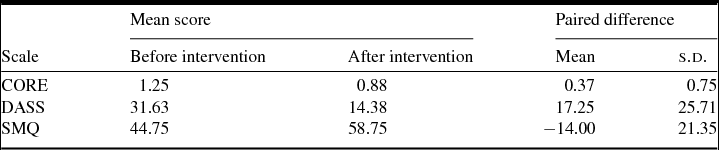
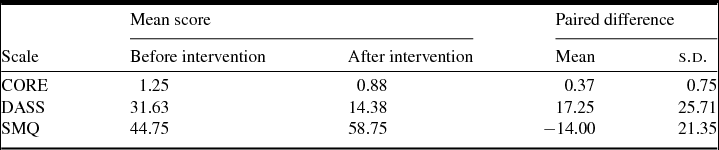
Mean scores on the CORE, SMQ and DASS pre- and post-intervention, as well as paired differences, are displayed in Table 1. Data were checked for normal distribution. Paired samples t tests were used to compare the means. A comparison of CORE-OM scores revealed a reduction in pre-group (mean = 1.25, s.d. = 0.59) and post-group (mean = 0.88, s.d. = 0.72, t 7 = 1.41, p = 0.20) scores, indicating a reduction in distress, but this difference was not statistically significant. The η 2 statistic (0.22) indicated a large effect size. An increase was found between pre-group (mean = 44.75, s.d. = 15.55) and post-group (mean = 58.75, s.d. = 16.70, t 7 = -1.86, p = 0.11) scores on the SMQ, suggesting an improvement in the ability to relate to distressing experiences mindfully, although this difference did not reach statistical significance. The η 2 statistic (0.33) indicated a large effect size. There was a reduction in pre-group (mean = 31.63, s.d. = 25.74) and post-group (mean = 14.38, s.d. = 13.67, t 7 = 1.9, p = 0.10) DASS scores, but this was not statistically significant. The η 2 statistic (0.34) indicated a large effect size.
Pre- and post-mindfulness group measures (n = 8)
Although post-intervention measures and feedback questionnaires were not completed by two individuals, information was sought from their notes and their care coordinators 1 month after the final group session to identify any potential negative effects of the group. One client had sadly passed away due to a medical condition. A discussion with the other client's care coordinator indicated that their mental health remained stable and there were no reported negative effects following their participation in the group.
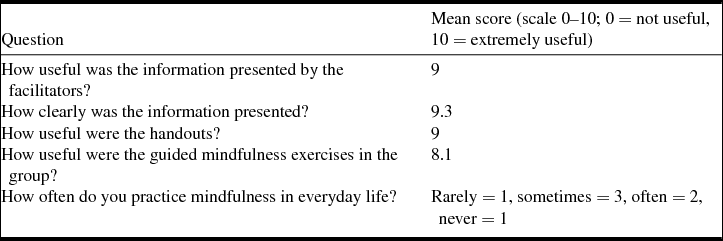
Seven people completed a feedback questionnaire, which was anonymous (70% response rate, see Appendix). A summary of the results is presented in Table 2. Two participants commented that they preferred the mindfulness exercises read by the facilitators, instead of listening to recordings in the group. One participant said they would have liked to spend more time learning how to deal with traumatic events and one person said they would have preferred more group work and interaction with other participants. A further suggestion was to run the group at a more central location with good transport links, to make it easier for participants to attend.
Feedback questionnaire results (n = 7)

Participants highlighted the following themes when asked what they had learnt during the group that was helpful: how focusing on breathing can help with facing a difficult experience, feeling more in control of thoughts and feelings, reducing self-critical and judgemental thoughts, accepting unwanted feelings and ‘going with the flow’, how stepping back, breathing, thinking, observing and working out how to accept a situation can help, and finally to be more at peace. In terms of how much participants had been using mindfulness in everyday life indicated on a scale, one person rated ‘rarely’, three ‘sometimes’, two ‘often’ and one ‘always’. In response to the question ‘What is it like using Mindfulness?/How would you describe Mindfulness for you?’, the following themes emerged: feeling calm and relaxed, being content with ones feelings and emotions, helping one to switch off from autopilot, and feeling more in control.
Discussion
The aim of this study was to determine the effectiveness and feasibility of running a mindfulness group for people receiving support from an early intervention in psychosis service, and to investigate whether attending a mindfulness group might help people establish a mindful relationship with unpleasant experiences, and reduce distress associated with these symptoms.
This study is encouraging considering the concerns that have been raised about teaching meditation techniques to people with psychosis (Yorston, Reference Yorston2001). The feedback received at post-group assessment was very positive, and no clients reported any negative effects of the intervention. It would be beneficial to explore this further, especially seeking more feedback from those who do not attend a post-group assessment.
Attendance rates were lower than those reported elsewhere for therapeutic groups delivered to people experiencing their first episode of psychosis. For example, Fanning et al. (Reference Fanning, Foley, Lawlor, McWilliams, Jackson, Renwick, Sutton, Turner, Kinsella, Trimble and O’Callaghan2012) reported an average attendance rate of 10.5 out of 12 and median rate of 9 out of 12 for group CBT interventions, with lower levels of education, more negative symptoms and less insight highlighted as potential barriers to engagement. Given the feedback provided in this study and large geographical area covered by the service, it is possible that the distance some individuals with motivational or physical difficulties had to travel may have affected attendance rates. The balance between psycho-educational and experiential practice within this study group was similar to other mindfulness programs. The content and structure of the group was discussed at the pre-group assessment, as well as a short mindfulness practice exercise. It is therefore unclear whether either the mindfulness exercises or the psycho-education component affected the group drop-out rate. While the general feedback for both aspects was positive, it would be beneficial to have further investigation into the optimal balance, and to particularly consider individuals with concentration difficulties and/or lower levels of education, when planning future mindfulness groups for people experiencing psychosis.
These results support earlier findings that mindfulness groups may be an acceptable and effective treatment approach for psychotic experiences (Chadwick et al. Reference Chadwick, Newman-Taylor and Abba2005, Reference Chadwick, Russell, Russell, Russell and Dagnan2009; Dannahy et al. Reference Dannahy, Hayward, Strauss, Turton, Harding and Chadwick2011). The lack of statistically significant findings may be because this study was underpowered. The improvements that were found are particularly promising, as there is evidence to show that delivering effective interventions in the critical period during the first few years of onset of psychosis may lead to improved functioning in the long term. Further studies including a follow up assessment are required to investigate whether the benefits are maintained, and it would be useful to collect information on mindfulness practice between sessions, as there is evidence to suggest that frequent practice may enhance benefits obtained from attending a mindfulness group (Perich et al. Reference Perich, Manicavasgar, Mitchell and Ball2013).
The formulations developed during the assessments for the groups indicated that clients’ reactions to distressing experiences were characterized by confrontation, avoidance and negative judgements. Romme & Escher (Reference Romme and Escher1989) found that these types of reactions are associated with increased distress in relation to psychotic symptoms. Although the specific mechanism for change was not investigated in this study, Abba et al. (Reference Abba, Chadwick and Stevenson2008) used grounded theory to look at the psychological processes involved in a developing a more mindful response to distressing psychotic experiences. They theorized that distress might arise from feeling controlled and overpowered by psychotic symptoms, leading to struggles against them or trying to alter them, as well as judging the self as bad or abnormal for having these experiences. It was found that clients can learn to relate to distressing experiences in a more mindful way through a three stage process: centering in awareness of psychosis, allowing experiences to come and go without reacting to them, and reclaiming power by accepting the self and the psychotic symptoms. A qualitative study by Ashcroft et al. (Reference Ashcroft, Barrow, Lee and MacKinnon2012) further examined the psychological processes involved in learning to use mindfulness skills, in a group of clients receiving support from an EI service. They highlighted the importance of promoting self-acceptance for people in the early stages of psychosis, as they are still adjusting to loss and distress associated with their symptoms. These theories offer an explanation of the change that clients may go through when learning how to respond to distressing experiences in a more mindful way. It may be helpful to include an interview with participants following mindfulness interventions to explore their experiences in more depth.
These findings are limited as there was no comparison to a control group, and the small sample size means it is difficult to generalize these findings to other people recovering from early psychotic experiences. It is possible that the benefits accrued following the mindfulness group may have been influenced by other factors such as the effects of medication, support from care coordinators and, in one case, receiving supportive counselling. In the absence of a control group, a multiple baseline design may have been a better approach to use in order to determine with greater confidence whether the intervention is influencing the outcomes. Including a control period between baseline and completion of pre-group measures may control for the fact that all clients were actively receiving support from the EI service.
Summary
Psychological interventions play a vital role in the treatment of psychosis. Although preliminary, these findings offer promising evidence that mindfulness interventions are a feasible and beneficial treatment option for people experiencing distressing psychotic symptoms, and warrant further large-scale investigations.
Appendix. Feedback for Mindfulness Group
We are interested in finding out about your experiences of the mindfulness group.
1. How useful was the information presented by the facilitators? (Please circle)
012345678910
(not useful) (extremely useful)
Any comments:
2. How clearly was the information presented by the facilitators?
012345678910
(not useful) (extremely useful)
Any comments:
3. How useful were the handouts?
012345678910
(not useful) (extremely useful)
Any comments:
4. How useful was listening to tapes/doing mindfulness in the group?
012345678910
(not useful) (extremely useful)
Any comments:
5. Was there anything that was not helpful or you would have liked to spend less time on?
6. Is there anything that was not covered which might have been helpful?
7. What have you learnt that has been helpful during the group?
8. How much have you been using mindfulness in your daily life? (please circle)
NeverRarelySometimesOftenAlways
9. What is it like using Mindfulness/How would you describe Mindfulness for you?
Any other comments
Thank you
Acknowledgements
Sincere thanks to all participants, Urmilla Pillay for support with running the groups, and Paul Chadwick for his helpful comments on an earlier version of this paper.
Declaration of Interest
None.
(1) To enhance practitioners’ awareness of the practical and clinical issues in using mindfulness interventions with people experiencing psychosis.
(2) To understand how mindfulness practice can be adapted for people experiencing psychosis.
(3) To understand how to improve user engagement in a mindfulness group intervention, based on the needs of people experiencing their first episode of psychosis.



Comments
No Comments have been published for this article.