Introduction
Active engagement with life, defined as the ability to maintain interpersonal relations and productive activities, is foundational to successful ageing (Baltes and Baltes, Reference Baltes and Baltes1993; Rowe and Kahn, Reference Rowe and Kahn1997). Generally, participating in social activities (e.g. church-related activities, shopping, and games) and more productive activities (e.g. gardening and non-paid community work) has been found to increase one's overall quality of life (Silverstein and Parker, Reference Silverstein and Parker2002; Menec, Reference Menec2003; Matz-Costa et al., Reference Matz-Costa, Besen, Boone James and Pitt-Catsouphes2012), and even reduce one's risk of mortality (for review of social engagement effects on health, see Bath and Deeg, Reference Bath and Deeg2005). However, many of these enriching activities are associated with independent living and are not as easily engaged in for the oldest-old living in assisted living facilities (ALFs). The oldest-old, also known as the fourth age of adulthood, include individuals who have outlived 50 per cent of their birth cohort, which in the United States of America (USA) begins around 80 years of age (Baltes, Reference Baltes1997). Realising the shortcomings of the successful ageing model, Kahn (Reference Kahn2002) suggested it is best paired with complementary models. Due to the expected illnesses of ALF residents and the structural constraints of ALFs, models of developmental adaption are apt for understanding active engagement for the oldest-old (Cho et al., Reference Cho, Martin and Poon2015). ALFs, at their best, provide older adults with personalised care that helps them cope with increased physical and psychological impairment to continue to pursue meaningful activities (Ball et al., Reference Ball, Perkins, Whittington, Connell, Hollingsworth, King, Elrod and Combs2004). In order for ALFs to achieve this goal, more research is needed to elucidate what is seen as enriching to the oldest-old living in ALFs and their methods of adapting to age-related loss to continue to engage with life. Such research would provide ALFs with the necessary information to provide meaningful activities to residents and the resources to help them overcome perceived barriers to participation.
ALFs have become the fastest growing type of senior housing, especially amongst the oldest-old, in the USA (Stevenson and Grabowski, Reference Stevenson and Grabowski2010). Currently, there are nearly 40,000 ALFs, housing over 1 million older adults (National Center for Health Statistics, 2019). ALFs are a preferred housing option for those who want to remain independent and receive limited health care within a home-like environment. However, ALFs are also home to many with more advanced cognitive disabilities like dementia, as 40–67 per cent of assisted living residents have dementia-related diseases (Hyde et al., Reference Hyde, Perez and Forester2007). Older adults in ALFs have a range of physical health too, with some residents not needing any help with activities of daily living, and 50 per cent requiring assistance with three or more activities of daily living (Horowitz and Vanner, Reference Horowitz and Vanner2010). With ALFs becoming a more popular housing option for the oldest-old, it is important to understand how these social structures can provide adequate opportunities for engagement with life in the face of physical and mental decline.
Life in an ALF can be difficult as health declines pair with difficult life transitions such as identity loss from changes in social roles and status, social isolation due to transportation constraints, and loss of social support due to the death and decline of close others (Perkins et al., Reference Perkins, Ball, Whittington and Hollingsworth2012). With the majority of studies looking at the effects of meaningful activity engagement on health and wellbeing among community-dwelling older adults, an investigation of the types of activities ALF residents are pursuing or want to pursue is needed. Understanding ALF residents’ motivations to pursue various activities can illuminate what meaningful engagement looks like for this population. Moreover, investigating what activities residents want to pursue will uncover barriers to meaningful engagement, which can inform ALFs on how to provide the person-centred care that is the cornerstone of optimal service (Ball et al., Reference Ball, Perkins, Whittington, Connell, Hollingsworth, King, Elrod and Combs2004).
Although engagement with life is a foundational aspect of successful ageing (Rowe and Kahn, Reference Rowe and Kahn1997), it can be elusive for many experiencing health declines. The inability for many older adults who feel they are successfully ageing but are not labelled as such since they do not meet the standards of each of the three aspects within Rowe and Kahn's (Reference Rowe and Kahn1997) model (e.g. freedom from disease and disability, high cognitive and physical functioning, and social and productive engagement) has left the adequacy of the model in question (Jeste et al., Reference Jeste, Depp and Vahia2010). Moreover, when older adults are asked to define successful ageing subjectively, they emphasise the role of adaption to physical illness and engagement with life (Jeste et al., Reference Jeste, Depp and Vahia2010), both of which fit earlier definitions of successful ageing that have maintained their traction to date through the perpetuation of the SOC framework (i.e. selection, optimisation, and compensation to regulate loss; Baltes and Baltes, Reference Baltes and Baltes1993). Thus, the current study adopts this more person-centred approach when discussing successful ageing.
Acknowledging the importance of adaption for successful ageing, it is essential to understand how individuals maintain, recover, and regulate loss to fully support development and engagement in the last stage of life (Baltes, Reference Baltes1997). As many older adults in ALFs are subject to physical, psycho-social, and cognitive decline beyond repair, it is important to explore different modes of adaption that allow one to thrive in the face of such loss in order to develop methods of supporting them. For many older adults in ALFs, physical disabilities lead to losses in mental functioning and overall quality of life (Jang et al., Reference Jang, Bergman, Schonfeld and Molinari2006). Amongst the older residents, the comorbidity of physical and cognitive decline is associated with depressive symptoms (Cummings, Reference Cummings2002; Watson et al., Reference Watson, Garrett, Sloane, Gruber-Baldini and Zimmerman2003). Although not directly studied in ALFs, community-dwelling adults who experience health declines are more likely to experience social isolation and perceived loneliness (Shankar et al., Reference Shankar, McMunn, Demakakos, Hamer and Steptoe2017).
In the face of age-related loss, adaption is key for successful ageing (Baltes, Reference Baltes1997). For the oldest-old, both distal and proximal influences shape one's capacity for development (Cho et al., Reference Cho, Martin and Poon2015). Distal influences represent developmental factors that impact one's entire ageing experience, such as education and early life experiences. Proximal influences, on the other hand, encapsulate resources that facilitate successful ageing – physical functioning, cognitive functioning, social resources, and economic status (Cho et al., Reference Cho, Martin and Poon2015). The perceived barriers that hinder engaging with life and the resources that allow for developmental adaption need to be elucidated to properly support successful ageing amongst the oldest-old living in ALFs. Elucidating methods of adapting to health declines in ALFs is crucial as engagement in meaningful activities is unlikely if self-efficacy diminishes (Jang et al., Reference Jang, Bergman, Schonfeld and Molinari2006; Perkins et al., Reference Perkins, Ball, Whittington and Hollingsworth2012). Research is also needed to discern what the most effective strategies are for dealing with various types of loss and for whom they work – all of which can aid the creation and deployment of practical therapeutic interventions within the ALF (Petriwskyj et al., Reference Petriwskyj, Gibson and Webby2018).
The current study
To understand better the adaption to developmental losses and meaningful engagement amongst the oldest-old in assisted living, this study examines:
(1) What types of activities do the oldest-old residing in ALFs want to pursue?
(2) What are the perceived barriers to engaging in meaningful activities that residents are motivated to pursue?
(3) How do residents adapt to overcome perceived barriers and engage in activities they deem meaningful?
Method
Recruitment and sampling
This study recruited participants from two continuing care retirement communities (CCRCs) located in the suburbs of Los Angeles County, California. CCRCs are a combination of independent living, assisted living, and skilled-nursing facilities. CCRCs allow an individual to age in place by progressing through the three levels of care as their physical and mental functioning declines. Theoretically, one can stay a part of the community regardless of which living situation they choose.
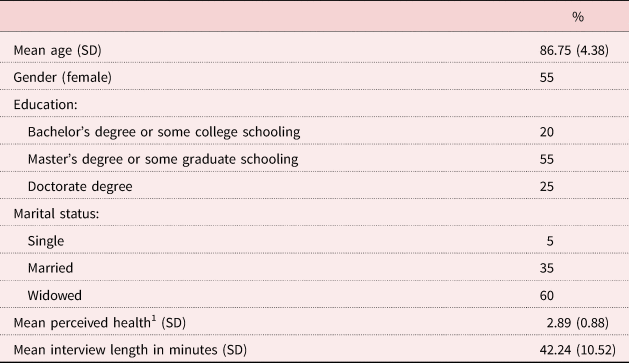
All participants in the current study resided in the assisted living sector of their care community at the time of the interview. Advertisements for the study were placed in the residents’ mailboxes, and the activity co-ordinator at both facilities made oral announcements. The current study used a criterion sampling approach. All participants had to be residing in an ALF, be near or within the oldest-old age group (minimum 80 years old to represent the fourth age of adulthood more broadly; Baltes and Smith, Reference Baltes and Smith2003), and have not been diagnosed with mild cognitive impairment, Alzheimer's or dementia-related diseases. Since a large portion of the interview protocol called for the ability to reconstruct a typical day and week, the study excluded participants diagnosed with cognitive impairment. The study's minimum age requirement of 80 years of age did not exclude any participants as all individuals who agreed to participate met this criterion. Based on interview memos, data saturation across key emerging themes was reached after a total of 21 interviews were conducted. One individual appeared to display several symptoms of dementia during the interview process and was later excluded from the study, resulting in a total of 20 valid interviews for data analysis. On average, participants were 86 years of age (standard deviation = 4.38). The majority of participants were female (55%), widowed (60%) and received a Master's degree or some graduate schooling (55%). Information on race was not collected since the majority of participants were homogenously Caucasian. However, two participants noted their mixed-race identity during the interview, one of which was Caucasian and Native American, while the other was Caucasian and Chinese. Full participant demographics can be seen in Table 1.
Participant demographics
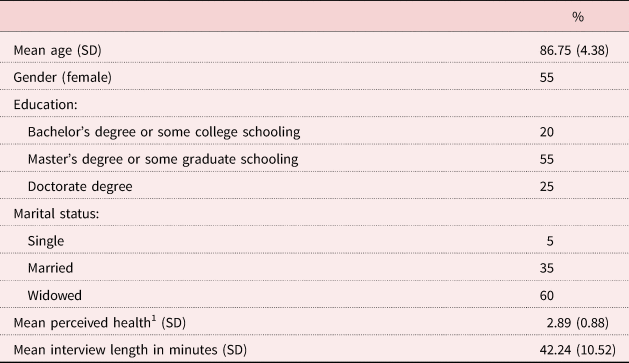
Notes: N = 20. SD: standard deviation. 1. Measured on a scale from 1 (poor) to 5 (excellent).
Procedure
The lead researcher conducted interviews over the course of three months. The interviews were semi-structured and lasted between 22 and 62 minutes, with an average length of 42 minutes. Each interview started with a set of basic demographic questions, including age, marital status, number of children, educational status, main occupation and subjective health (‘poor’, ‘decent’, ‘good’, ‘very good’, and ‘excellent’). Next, participants were asked to take a moment to think about their typical day and week, followed by what time they typically wake up. As the participant and researcher reconstructed a typical day, using a range of activities that may be participated in throughout a week, the interviewer probed reoccurring themes, including motivation to participate in activities, perceived barriers to activity participation, loss of activities, and general experiences associated with residing in an AL community. As these themes began to emerge, the interviewer created more questions to investigate those themes further in subsequent interviews. Moreover, member checks were used to provide interviewees with a chance to comment on their experience with an emerging theme directly. All interviews took place within the AL community in either a common area or within the participants’ home. Each interview was audio-recorded and transcribed verbatim for data analysis.
Data analysis
An inductive approach to data analysis was utilised to identify emergent themes and weave new information into theories, in lieu of directly testing hypotheses that come from pre-existing theories (Bengtsson, Reference Bengtsson2016). Thematic analysis was employed as the research questions can be more fully answered by connecting and interpreting emergent themes rather than addressing the frequency of a particular set of statements (Krippendorff, Reference Krippendorff2004). Themes were identified at the semantic level, meaning interpretations beyond what was explicitly said by the participants were not made to create themes (Braun and Clarke, Reference Braun and Clarke2006). Data analysis was carried out by three researchers: the first author who conducted the interviews, the second author who specifically worked on the data analysis phase to limit coding biases, and the third author who served as an auditor to review the final codes and themes.
In line with the thematic analysis process, the data were first analysed using an open-coding approach (Boyatzis, Reference Boyatzis1998). All excerpts related to the study's broad research questions were coded during this time. These codes were then compiled into emergent themes, and connections between such themes were made. Throughout this process, the constant comparison method was used to maintain a close connection between the data, codes, and themes (Strauss and Corbin, Reference Strauss and Corbin1990). The constant comparative method was also used to find evidence against certain themes to test the validity of emerging themes and/or to find sub-samples for whom the themes apply. These beginning phases of data analysis were carried out independently by the two coders to ensure the reliability of emerging themes. Next, the two coders met regularly to discuss the emerging themes across the 20 transcripts. These discussions were used to come to a consensus on the codes and connections between the themes and sub-themes. Observed coding discrepancies led to redefining certain codes and broadening possible selective attention biases from either of the researchers. Finally, the transcripts, codes, and themes were reviewed by an auditor to examine the validity of emerging patterns and preliminary findings. The final coding categorisations incorporated the auditor's feedback. The two coders used the qualitative software Dedoose to organise the final codes and themes.
Findings
Several themes emerged from analysing the interview data. First, all residents stated that they wanted to participate in activities that were enriching. Enriching is used as an umbrella term to describe activities that respondents subjectively self-define as providing a sense of fulfilment and enhancing the quality of their life when engaged. Enrichment was often connected to activities that provided a sense of purpose or community. Accordingly, residents were frustrated when they could not access enriching activities. Residents who had severe physical limitations but high cognitive functioning were most at risk for not feeling enriched, as well as socially isolated due to not being able to access meaningful activities outside the AL. However, these individuals were found to adapt to activity loss through emotion regulation techniques and adapting old activities to fit their current capabilities. In contrast, those with less-severe physical limitations and high cognitive functioning were found to maintain a sense of purpose by engaging in a select number of activities outside the ALF.
A desire for enrichment: the pursuit of purpose and community
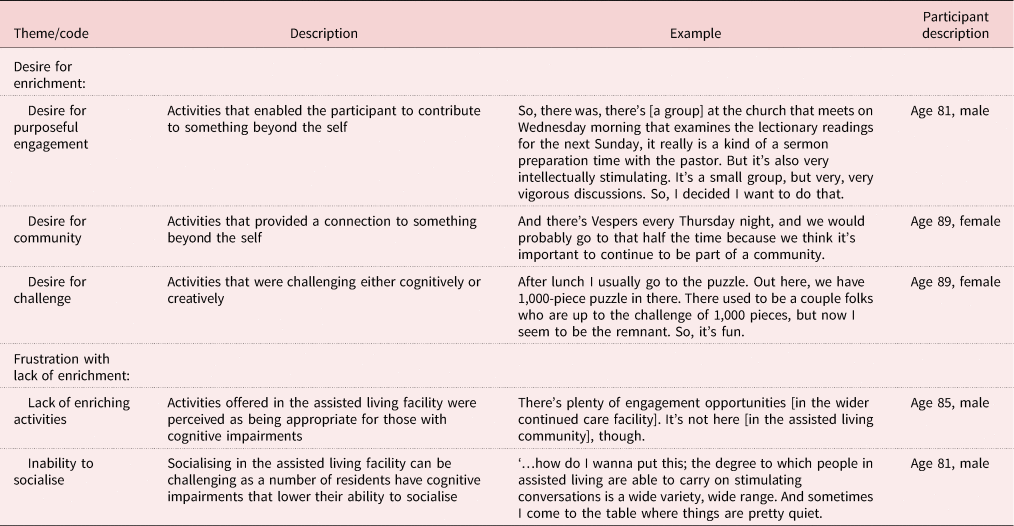
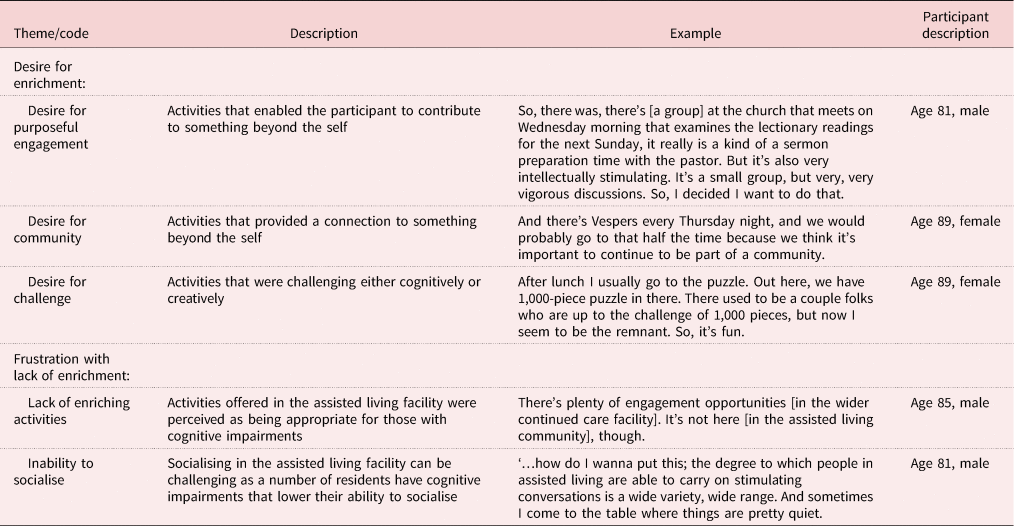
Every participant mentioned having a desire to participate in enriching activities, whether it be a reason for participating in their current activities or the cause of current frustrations (see Table 2). Roughly half of the participants stated that they participate in activities for purposeful engagement or avoid activities that cannot provide it. Purposeful engagement as a theme was defined as an activity that enabled the participant to contribute to something beyond the self:
So, we have, you know, various meetings with different segments of the community, meet to discuss things if some topic or some problem comes out, we're down to [the community room] and discuss that or have smaller meetings. And then there's, like, a theological group that I'm a member of, I always go. And there's some exercises that I go out for. And you know, none of them are just social meetings, there's always a purpose. (Age 93, male)
Description and examples of themes and codes regarding enrichment
Fulfilling one's need for enrichment was satisfied in a number of other ways as well. For instance, some individuals expressed their creativity through various art forms. Others mentioned that they pursued activities that allowed them to continue to learn and satisfy their wide-ranging curiosities. Also some participants stated that they simply enjoy activities that challenge them:
I think the best part of the day for me, is when I'm working in stained glass or lapidary. I love it. And I lose track of the time. You know, like, today, you know, I looked up at the clock, and I said, ‘Oh, my God, it's quarter 12. Where did it go?’ And I just get very absorbed in what I'm doing. (Age 80, female)
Besides the need for enrichment, almost all participants desired a sense of community. Community, in this sense, was any connection to something beyond the self. Most people wanted to be a part of the assisted living community, the broader continued care community or the surrounding city. Others stated that they wanted to continue to feel a part of the world as a whole and the current cultural tides:
I'm interested in, in politics, and interested in international things. As well as what's going on here. And there are lots of people who are quite involved in political issues and social justice issues. And these things I'm interested in. So that particular website [Google Discussion site] is where we can discuss things. I don't put a lot on, but I like reading it. See, seeing what other people are thinking. (Age 85, female)
The need for community was often realised in pro-social work, as many participants stated feeling a sense of community by providing for their continued care facility or by partaking in social justice campaigns. Feeling a sense of relatedness also came from participating in a variety of social activities:
Well, most of [my activities] provide me a sense of community. I'm somebody's sense of purpose and fulfilment. (Age 85, male)
I think there's a rhythm. Rhythm of rest, work, introspection, community, all those things are part of the chemistry of the day. (Age 85, male)
Frustration with lack of enrichment
Unfortunately, many of the residents felt frustrated by the lack of enrichment in their lives (see Table 2). Just as having enriching activities provided participants with a sense of purpose and relatedness, those without them felt unproductive and isolated from others. Most often, frustrations were linked to the programming of the ALF. Residents felt that the activities were geared towards those with impaired cognitive functioning like mild cognitive impairment, Alzheimer's, dementia and dementia-related diseases:
And when I realised that she was trying to stimulate them, and I was the only one awake practically, then I just quietly stepped away when the time came because it was not doing anything for me to just be there, sitting. So that was funny. But they do things like that here, which is wonderful … But I think they could work a little more on activities for people that are a little more awake. (Age 86, female)
Another common source of frustration came from unfruitful attempts at socialising. With the participants in this study being cognitively healthy, many found themselves frustrated when trying to hold a conversation with the more cognitively impaired residents. Most often, frustrations arose during mealtimes where seating arrangements are randomly assigned, meaning a cognitively healthy individual could be sitting with several residents who have limited communication skills. Since having a sense of community was mentioned as a motivator for activity engagement, the inability to socialise at times made participants feel unsatisfied:
I mean, they just, they're very quiet and don't speak. Or they're suffering from dementia, so they don't remember to make good conversation. So once in a while you like if you're a table for four and my wife and myself and the other two are both quiet, you know, non-communicative type of people. It's kind of dull. (Age 93, male)
High cognitive functioning and low physical functioning is a recipe for disaster
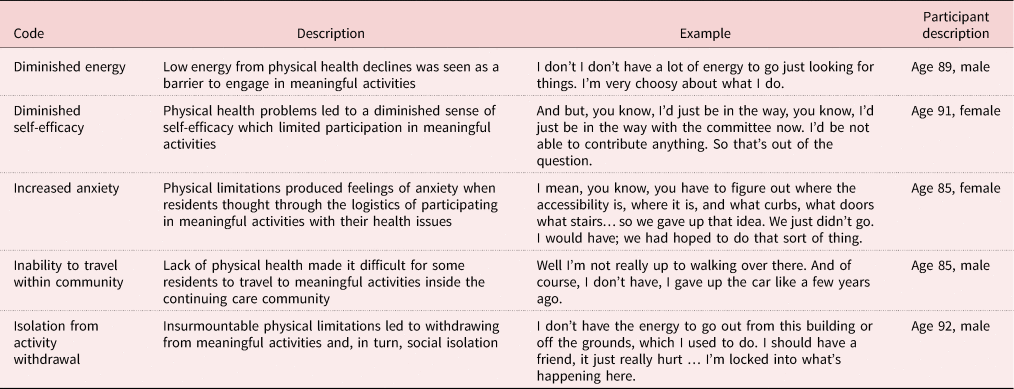
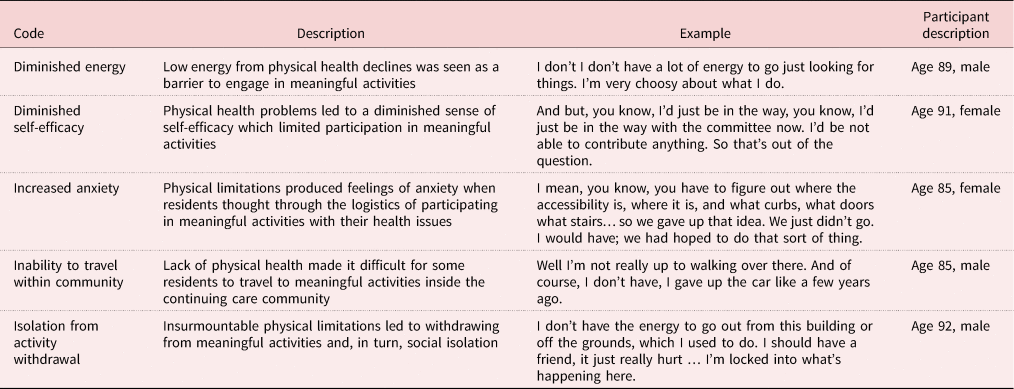
The most commonly expressed reason for withdrawing from meaningful and engaging activities was health issues (see Table 3). Moreover, health issues were also perceived as the most significant barrier for engaging in new activities that residents felt would be meaningful. Specifically, having low energy and mobility issues were the most common ailments that prompted activity loss and prevented future activity participation. Often, participants felt like they did not have the energy to motivate themselves to participate in desirable activities:
Interviewer: What do you think is the main cause of [you feeling isolated]?
Participant: One main part is not eating at [the temporarily closed dining hall]. The other part is just not having the energy and the ability anymore. To do the things you used to. (Age 91, female)
Description and examples of codes within the barriers to meaningful engagement from physical health limitations theme
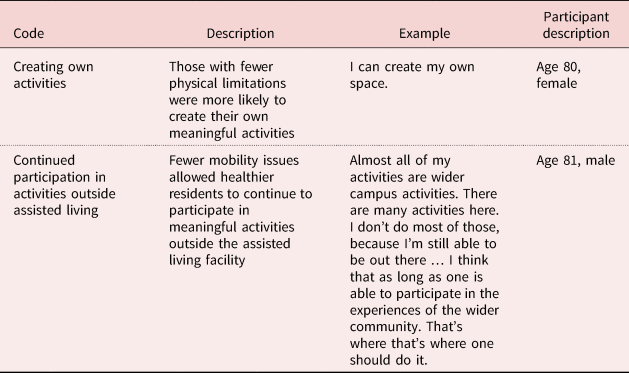
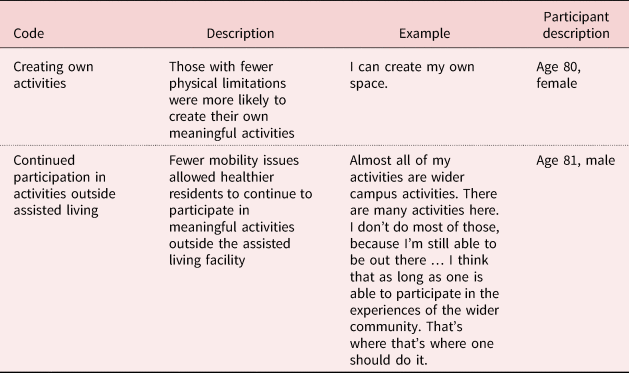
Description and examples of codes within the advantages of good physical health theme
Not only did physical ailments directly limit one's ability to participate in activities, but disabilities also limited one's sense of self-efficacy to feel capable of being a contributing member to an activity:
Interviewer: So when you think about activities, do those kind of things go through your head, like the energy it would take to participate?
Participant: It probably does. I probably, I probably rule out things before I really really entertain them seriously. (Age 81, female)
Moreover, physical disabilities produced feelings of anxiety as residents were worried about feeling physically uncomfortable during activities:
Participant: Once I'm sitting down, I'm fine. Okay, once I'm sitting down I'm fine. But it's the getting there and getting into the room and getting a chair without, you know, there's always a large group, you've got to be careful, you don't bump into anyone, or that they don't bump into you, or you know, it's, you've got to learn new manoeuvring skills.
Interviewer: It sounds like there's some anxiety associated with getting places.
Participant: Yeah, yeah yeah. (Age 91, female)
With residents believing the ALF activities were geared towards the less cognitively functional, individuals with high cognitive functioning but low physical functioning were more likely to state that they had a lack of purpose and felt isolated from others. Those with high mental and physical functioning were more often found creating their own activities and even actively avoiding the ones offered by the ALF (see Table 4):
Well, I you know, to tell the truth. I just don't pay that much attention to [assisted living activities] because I don't need them and I'm not gonna do it just for play. (Age 93, male)
Moreover, their mobility, and for some, their ability to drive, allowed them to continue to participate in activities that they were engaged in while still living independently. Such activities were a part of the greater continued care facility and, often, the city-wide community:
And we just don't seem to need to [participate in assisted living activities]. And I know I've looked at the calendar, and there's so much that goes on here. A person could live their whole life in [the assisted living building]. We don't. We don't want it. We don't have to now. But we may someday. (Age 89, female)
In contrast, residents with physical disabilities and mobility issues, in particular, felt trapped in the ALF. Still having high cognitive functioning, the inability to travel within the continuing care facility limited their ability to nurture their need for competence. The programmes created by and for the independent residents were believed to be much more engaging and purposeful. However, the energy and assistance needed to go to the buildings that host such activities were found to be an insurmountable barrier for the most physically disabled:
I'm, I'm really disappointed in sort of being tied down to my room because of the way my health's been going and so I'm a little disappointed. (Age 86, female)
Feelings of isolation emerged for several reasons. Being ‘out of sight, out of mind’ weakened connections with long-time friends. Not being able to travel limited opportunities to see geographically distant friends. Lastly, having smaller living quarters limited the possibility of hosting personal social gatherings. Dealing with the frustrations of being limited to socialising with the more cognitively impaired caused some to withdraw and self-isolate. Reducing the number of activities due to physical ailments naturally reduced the number of opportunities to engage in meaningful social events:
A couple of my friends keep kept saying ‘Well, what do you like to do? You were going to the movies, do you want to go to the theatre?’ I said no. Again, it takes more physical energy for me to have to go out. (Age 85, female)
Adapting activity participation
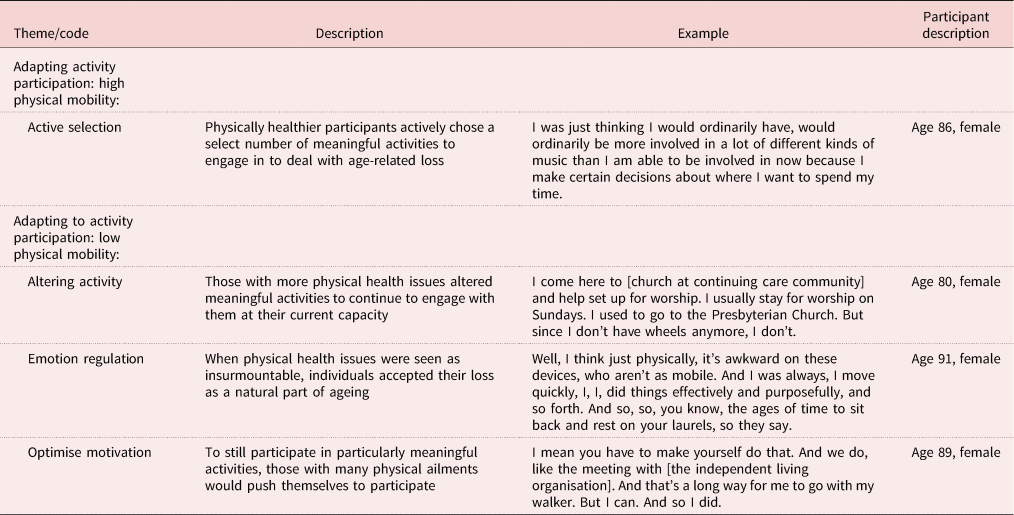
Amongst those who have maintained their cognitive functioning, individuals with severe physical limitations experienced the most drastic changes in their activity participation, often having to withdraw from meaningful activities. However, all participants had some physical ailments that called for a need to adapt the way they engaged in their various activities (see Table 5). Again, there were notable differences between those with minor and more severe physical disabilities. Those who still felt relatively physically healthy were more likely to reduce their total number of activities purposefully to maximise their energy and engagement with the most meaningful ones. Moreover, those with less-severe health conditions autonomously chose to cut activities for reasons other than health limitations, such as growing bored of an activity they had participated in throughout their life, no longer wanting to be a leader of an activity, and to maintain a more flexible schedule to try new activities as they arise:
Keep telling myself all the time. Hey, you're 93 you're 93, you don't need to do that. You know, I'll be asked to do something. They asked me to serve on a committee right now. And it's just so hard to say no, but I'm forcing myself to say no. (Age 93, male)
Description and examples of themes and codes regarding adapting activity participation
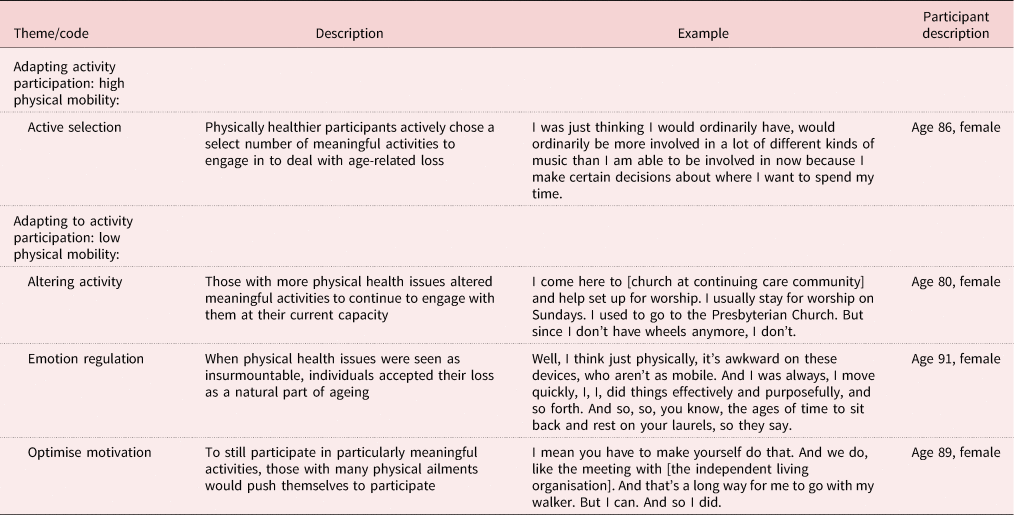
Those with more physical ailments were not as likely to actively disengage from meaningful activities as their disabilities forced them out of so many. Instead, the unhealthier participants were found to change the way they engaged in an activity to fit their new capabilities:
And I've had to change over. This is why there's this thing. I'm allergic to the fumes of oil paint now. Okay. So I'm having to get all acrylics, which is, you know [is way different?] Yeah, but I'm gonna do it ’cause it's what I have to do, so. (Age 82, female)
I feel [communicating on the computer], it's a mode of communication and involvement, that otherwise I wouldn't have I, I don't feel it's effective as getting out. But it's sort of where I'm at, at the moment. (Age 91, female)
These residents were also found to change their emotional reaction to activity loss by fully accepting it as a natural part of ageing and turn to introspection as a form of coping:
Well like I used to arrange flowers at the health centre, I can't do that anymore. And I was always on admissions. So I was on nominating committee and, you know, all those things I gradually stopped doing. But it was okay. I don't feel bad about any of it, what was, was. (Age 89, female)
Lastly, the more physically limited participants stated that they could, at times, build up their energy to engage in an activity if it is particularly enriching:
And when something comes up, that I really like, like if a certain author comes to speak, or there are certain persons coming to entertain, and we all can go over there [building on opposite side of campus]. And I do. If it's, you know, something really that I'm interested in. Almost always like, I know, say, New Years’ eve, I'll be over there. Just because there's more people that I know it's a little more stimulating. Because I'm slowing down, it's easier on me to be in this building. (Age 82, female)
Discussion
The current study had three guiding research questions. First, the types of activities that the oldest-old living in ALFs are motivated to pursue were explored. Generally, residents stated that they wanted to pursue purpose- and community-based activities that were enriching. Next, perceived barriers to these meaningful activities that residents wanted to pursue were investigated. The most influential barrier was functional health, as having limited mobility was found to limit access to enriching activities outside the ALF and restrict one to less cognitively challenging activities offered within the ALF. Lastly, the current study explored how residents adapt to perceived barriers to engage in meaningful activities to age successfully. Modes of adaption were predicated on health, such that residents with better physical functioning maintained participation in a select number of activities outside the ALF. In contrast, residents with more severe physical limitations adapted meaningful activities to fit their capabilities, accepted their limitations as a natural part of ageing, or actively pushed themselves to engage in highly enriching activities in an attempt to continue to age successfully.
The need for purposeful engagement was evident across participants, as each interviewee either currently participated in activities to fulfil this desire or lamented that it felt out of reach at times. Participants often used the word ‘purpose’ when describing reasons why they engaged in activities and stated a lack of purpose as a reason to avoid particular activities. For many, the desire for purpose did not solely mean pursuing a meaningful long-term goal but also included a yearning for challenge. Essentially, the residents were describing a need for vital engagement, a simultaneously absorbing (i.e. flow, the balance between challenge and skill) and meaningful (i.e. subjective significance) activity (Nakamura, Reference Nakamura2001). Vital engagement can occur through participating in interests, engaging with people, causes, concerns, or any other object or aspect of the world (Nakamura, Reference Nakamura2001).
For the oldest-old residing in ALFs, connecting to the world was often found through activities that offered a sense of productiveness. Effectance motivation research (White, Reference White1959) and self-determination theory (Ryan and Deci, Reference Ryan and Deci2000) both view the need to express competence as an innate human need that does not dwindle with increasing age. The intrinsic need to manipulate one's environment successfully through learned skills provides individuals with a sense of self-efficacy (White, Reference White1959), a powerful belief that influences the extent to which one feels in control of their lives (Bandura, Reference Bandura1997). Competence was often exercised through enriching activities that allowed for creative expression or a chance to learn something new. Other individuals were vitally engaged by continuing their vocation in some capacity, such as writing books or being a guiding member on a committee board. The desire to express competence aligns with other research which found older adults enact values to adapt to physical loss (Sugarhood et al., Reference Sugarhood, Eakin and Summerfield-Mann2017). Almost all of the commonly enacted values align with the desire to express competence: maintaining autonomy, affirming abilities, doing the best you can, being useful, maintaining self-identity, and pursuing interests (Sugarhood et al., Reference Sugarhood, Eakin and Summerfield-Mann2017). According to continuity theory, trying to preserve hobbies and occupational work is an adaptive strategy to maintain a sense of coherence throughout transitions across adulthood (Atchley, Reference Atchley1989). Therefore, it is not enough for ALFs to provide activities that help fill the hours of the day; rather, activities need to be able to fulfil one's sense of competence to maintain self-efficacy and, in turn, wellbeing. Opportunities for creativity and learning should be prioritised in ALFs over more simple activities like watching television or non-challenging card games.
The desire for vital engagement was also related to social activities, such that participants stated that they wanted meaningful and enriching connections with specific groups of people and social causes to foster a sense of community. In terms of activity selection, previous research has found that leisure activities are often chosen because they offer opportunities to feel connected to a community and create social networks (e.g. Lyons and Dionigi, Reference Lyons and Dionigi2007; Kerstetter et al., Reference Kerstetter, Yarnal, Son, Yen and Baker2008; Dattilo et al., Reference Dattilo, Lorek, Mogle, Sliwinski, Freed, Frysinger and Schuckers2015). Older adults are also found to choose ALFs located within their former communities to maintain community-based leisure activities (Perkins et al., Reference Perkins, Ball, Whittington and Hollingsworth2012). However, research indicates that ALF residents are prone to loneliness and such feelings are dependent on time (e.g. time of day and day of week), as well as place (e.g. being forced to stay in their rooms; Jansson et al., Reference Jansson, Karisto and Pitkälä2021). Our study adds to these finding by introducing the factor of residents’ health in the loneliness equation. For instance, physical health largely determined whether a resident was able to participate in social activities outside the AL. For the less mobile, social interactions were limited to what was provided by the AL, creating a structural barrier that excluded them from community and city-wide events that they wanted to attend. Additionally, mismatches in cognitive health led to feelings of isolation as those in good health felt isolated when surrounded by those with lower communication abilities. The issues of random meal seating and lack of transportation leading to feelings of social exclusion align with previous research which found the structure of ALFs can moderate feelings of isolation (Herron et al., Reference Herron, Funk, Spencer and Wrathall2020). The current study highlights how both resident health and the structure of ALFs can interact in ways that propagate feelings of loneliness. Based on the findings, residents can benefit from structural changes within the ALF and from helping them extend their social circle beyond the confines of the ALF.
Interestingly, residents in the current study often stated that they did not just want to converse with others, but rather connect with them on a topic they felt was meaningful and other-focused, such as social justice concerns or politics in general. Acts of service to one's ALF community or the greater CCRC often fostered a sense of social engagement. The desire to participate in pro-social activities has been found amongst those transitioning into retirement as a means of maintaining meaning and connections (Van den Bogaard et al., Reference Van den Bogaard, Henkens and Kalmijn2014), however, such acts of generativity have gone mostly unexplored amongst ALF residents. The specific desire for social interactions that are personally meaningful and other orientated are in line with the definition of purpose of Damon et al. (Reference Damon, Menon and Cotton-Bronk2003). Having an outwardly directed purpose is linked to greater life satisfaction in later life while searching for it is negatively related to life satisfaction (Cotton-Bronk et al., Reference Cotton-Bronk, Hill, Lapsley, Talib and Finch2009). Although many activities in ALFs are designed to promote social interaction, many may lack the purposeful aspect that is desired and, in turn, do not directly bolster wellbeing. To help residents fulfil their need for purpose-based social interactions, ALFs should offer activities that bring residents together to address a social cause, such as sending letters of support to children in hospitals (directly aiding others) or political discussion groups (connecting to current social issues).
Although all participants stated that they desired enrichment, either in the form of productive or social activities, not all residents were able to satisfy this need. ALF residents have a variety of physical (Horowitz and Vanner, Reference Horowitz and Vanner2010) and cognitive functioning (Hyde et al., Reference Hyde, Perez and Forester2007), which impact their ability to engage in activities. Like previous research, the current findings show that functional health is one of the most common barriers to activity participation (e.g. Crews and Campbell, Reference Crews and Campbell2001; Lees et al., Reference Lees, Clark, Nigg and Newman2005; Freelove-Charton et al., Reference Freelove-Charton, Bowles and Hooker2007). Lack of energy and mobility issues were particularly salient concerns in the current study, often being the cause of losing important activities and representing a barrier to participating in new enriching activities that residents want to pursue. Many of the more severely impaired participants were lacking the feelings of competence and relatedness experienced by healthier residents. Mobility, in particular, often prevented residents from attending activities as participating would be overly taxing on the body or planning to overcome obstacles to participate in an activity produced anxiety. Moreover, low functional ability was found to affect some residents’ self-efficacy adversely and prevent them from feeling able to navigate new activities that they wanted to pursue. Loss of health has been linked to declines in one's sense of autonomy amongst ALF residents (Perkins et al., Reference Perkins, Ball, Whittington and Hollingsworth2012). Previous studies have found a bidirectional relationship between health and social isolation in community adults, as lower health leads to more social isolation, just as social isolation can reduce overall health (e.g. Cornwell and Waite, Reference Cornwell and Waite2009; Luo et al., Reference Luo, Hawkley, Waite and Cacioppo2012). Although ALFs are smaller communities that require less mobility, similar issues still arose as low functional health reduced the perceived availability of the entire community.
The perceived lack of enriching activities offered by the ALFs intensified issues related to functional health limiting access to the entire CCRC. Many residents believed that the activities offered by the ALF only served those with severe cognitive limitations. In other words, residents felt the activities within the ALF could not fulfil their desire for enrichment. ALF-based activities did not offer opportunities for competence or meaningful socialising. Higher-functioning residents often had trouble communicating and engaging with the lower-functioning residents. For ALF residents without mobility issues, the lack of engaging opportunities in the ALF was not an issue as they were able to access more enriching activities in the wider CCRC, and the broader community setting. Thus, those with high cognitive functioning but low physical functioning may be most at risk for not being able to fulfil their basic needs of autonomy, competence, and relatedness. Other studies have stressed the importance of mobile transportation, allowing community-dwelling older adults to continue to engage with life and, in turn, maintain a sense of wellbeing (e.g. Banister and Bowling, Reference Banister and Bowling2004; Michael et al., Reference Michael, Green and Farquhar2006). The current study supports these findings in ALFs and calls for more transportation within the ALF/CCRC and into the broader community to provide all residents with access to the same resources in an attempt to preserve an adequate quality of life in the face of disability. As suggested by one of this article's reviewers, one solution to several identified issues would be to educate residents with higher cognitive functioning on how they can assist their fellow residents who suffer from mild cognitive impairment or some dementia-related disease. Such educational experiences may alleviate some of the tensions between residents with high and low cognitive functioning, while also increasing a sense of community and purposeful engagement.
Although those with more severe functional impairment are believed to be most at risk for losing meaningful activities and perceiving barriers to new activities, all participants experienced health declines that changed the nature of their activity involvement. The ability to adapt and regulate loss is a key aspect of development in later life and successful ageing (Baltes, Reference Baltes1997; Cho et al., Reference Cho, Martin and Poon2015). The ALF residents were found to use adaption methods that mapped on to aspects of the SOC meta-theory of developmental regulation to continue to engage with life. The process of selection refers to committing to select personal goals as internal and external resources are limited (Baltes, Reference Baltes1997). The SOC framework details two forms of selection: elective selection and loss-based selection (Freund and Baltes, Reference Freund and Baltes1998). Elective selection refers to choosing a limited number of goals that match one's available resources to achieve higher levels of functioning. In contrast, loss-based selection occurs from a reduction of choice due to losses in available resources and typically leads to a restructuring of one's goal in the form of focusing on the most important goals, adapting one's standards, or selecting new goals if previous ones are no longer attainable (Freund and Baltes, 1998). Optimisation is the acquisition, application, and refinement of one's internal and external resources to achieve personal goals (e.g. altering practice hours to develop or maintain musical skills). Compensation is employed in the face of resource loss (e.g. health-related decline; conflicting goals; limited time and energy) and involves acquiring new resources or activating unused resources to alter one's approach to goal attainment (e.g. relying on experience and less on fluid intelligence to compete in board games).
Differences in the use of SOC were observed between physically able residents and those with more severe limitations. Due to uncontrollable health declines, less healthy participants were more likely to use loss-based selection compared to healthier participants who primarily used elective selection to focus on their most meaningful activities. Residents with more physical handicaps were more likely to use compensation by changing the way they participated in an old activity to fit their new capabilities. The more physically impaired residents were also found to optimise their resources by building their energy to participate in activities they felt were especially meaningful. These activities tended to be more novel, meaning this form of regulation was utilised for particularly meaningful events. Moreover, the most physically impaired participants used emotion-regulation strategies to adapt to loss. Several of these residents decided to accept their disabilities and their current place in life instead of spending their motivational resources on unachievable goals. The cognitive reappraisal of loss being a part of their lifelong journey is in line with socio-emotional selectivity theory's positivity effect such that older adults favour cognitive processing of positive stimuli over negative (Reed and Carstensen, Reference Reed and Carstensen2012). Such acceptance may also be a sign of ego-integrity, where residents have a sense of completeness with their life, void of regret (Erikson, Reference Erikson1982). The various uses of SOC are particularly noteworthy as they highlight how the amount of physical loss incurred changes the type of regulation method used. These different methods of adaption can inform therapeutic techniques to assist in the regulation process for older adults experiencing loss in ALFs. With more severely impaired residents experiencing declines in self-efficacy, it would be beneficial to create and deploy interventions to assist such residents to help maintain current functioning and regulate further loss. The use of such interventions could be a useful tool to help ALFs commit to their person-centred care philosophy.
Limitations
In light of the findings described in this study, several limitations are worth mentioning. In general, a selection bias may exist in our sample, which could limit the generalisability of results. Some research indicates that ALF residents within CCRCs may be different from typical ALF residents in terms of socio-economic status (SES) and educational attainment. According to the 2009 Overview of Assisted Living (Independent Living Report, 2009), independent residents entering CCRCs were twice as likely to have a college degree compared to the typical US citizen over the age of 65. In a similar vein, independent residents entering CCRCs mostly belong to middle- and upper-income brackets (Independent Living Report, 2009). Since most ALF residents in CCRCs begin in independent living, these demographics should largely represent the ALF residents in such communities. As was found in the current study, the participants were much more educated than typical members of their cohort. Due to both higher SES and educational attainment, findings from this study may be more generalisable to ALF residents who specifically reside in CCRCs. Moreover, with the majority of participants having an advanced degree, some of the findings may be skewed and specifically represent older adults with high educational attainment. Specifically, desiring enriching activities in later life may be uniquely connected to those who sought out enrichment in their younger years through advanced educational attainment. Nevertheless, with education being more widely accessible and more citizens earning advanced degrees (National Center for Education Statistics, 2018), future generations that reach the oldest-old status may be more similar to those sampled in the study than a typical ALF resident today.
Another limitation could come from excluding those who have been diagnosed with mild and severe cognitive impairment. With roughly half of ALF residents having dementia-related diseases, the findings from this study may be more representative of particularly healthy older adults in ALFs. However, findings from the current study indicate that residents felt that most activities were geared towards the more cognitively impaired, so understanding the experience of higher-functioning residents may better inform necessary changes to ALFs to support the maintenance and regulation of loss.
Conclusions
The present study highlights the range of motivations to pursue activities, perceived barriers to activity engagement, and modes of adapting to loss within activities amongst the oldest-old living in ALF. All participants desired enrichment in some form or another, showing that the need for competence and vital engagement exists in the final stage of development. Although all residents desired meaningful and challenging activities, there was a disparity in who was able to fulfil such needs. Structural lag (Riley and Riley, Reference Riley and Riley1986) is evident here as ageist stereotypes of diminished brain functioning (Hummert, Reference Hummert, Schaie and Willis2011) has stalled the creation of engaging opportunities for the oldest-old even in contexts that are designed to care for them. Those with more physical impairments were less likely to be engaged in productive and social activities that provided enrichment. Physically healthy participants were able to access more resources and activities available outside the ALF to fulfil their competence and relatedness needs. With residents perceiving the activities provided by the ALF being primarily fit for those with cognitive impairment, the cognitively fit but physically limited residents often felt unfulfilled.
This study highlights how the interaction between cognitive and physical health can alter an ALF resident's ability to stay engaged in life and age successfully. Residents with high mental functioning and low physical mobility appear to be most at risk for further health decrements as the ALFs seem to provide many diverse activities for residents with low cognitive functioning, and residents with overall good health can maintain activity participation in a variety of communities. Thus, ALFs should consider providing activities that can serve a range of cognitive abilities and provide adequate transportation to increase opportunities for engagement. Lastly, many with physical loss were found to engage in various methods of adaption to maintain and regulate their quality of life. In particular, the residents we believe are most at risk were found to engage in SOC. These residents accepted their limitations as a normal part of ageing, altered the way they engage in meaningful activities to fit their new capabilities, and optimised motivational resources to attend the most meaningful and enriching activities. With cognitive and physical loss experienced by all residents in varying degrees, ALFs should adopt individualised therapeutic approaches to help residents adapt to their unique losses to maintain personally meaningful engagement with life and, in turn, their wellbeing.
Acknowledgements
The authors would like to thank the continued care communities and the residents within the assisted living facilities that participated in this study.
Financial support
This work was supported by the National Institutes of Health, National Institute of General Medical Sciences (TC, grant numbers BUILD UL1GM118976, RL5GM118975; SH, grant number BUILD TL4GM118977).
Conflict of interest
The authors declare no conflicts of interest.
Ethical standards
This study was deemed exempt by the Institutional Review Board (IRB) at Claremont Graduate University. All ethical guidelines set forth by the IRB were followed throughout the course of this study. Documentation for ethical approval can be found through Claremont Graduate University (IRB number 3479).