1. INTRODUCTION
Talking about something is probably one of the most basic linguistic activities. Hence, marking the topic of conversation is an essential part of the linguistic system in the sense that most of what is said is usually said ‘in relation to, concerning or regarding’ a certain subject. This is what Halliday (Reference Halliday1967:212) calls theme, i.e. ‘theme is what is being talked about, the point of departure for the clause as a message’. In a similar sense, Langacker (Reference Langacker2008:513) builds his characterization of topic, defined as ‘what the sentence is about’, on what he calls the ‘notion of “aboutness”’.
The focus of this paper is precisely the notion of ‘aboutness’, but on a more specific, clause-internal level. What we call a (prepositional) topic-marking relation is the one established between, typically, certain verbs, nouns and adjectives denoting communication or mental processes and their ‘topic’, or ‘subject matter’ in the terminology of Quirk et al. (Reference Quirk, Greenbaum, Leech and Svartvik1985:709–710).Footnote 1 In a sentence such as I enjoy talking/thinking about the future, the future is the topic of discussion or thought, about is the topic-marking preposition (TMP), and talk/think are the head elements of the TMP, i.e. the words triggering the topic-marking relation.Footnote 2
Languages typically have various means of expressing the topic-marking relation depending on context and communicative necessity. In English about is the default topic-marking preposition (Lindstromberg Reference Lindstromberg2010:141), om being its Swedish equivalent, as in tala om framtiden ‘to talk about the future’. Beside unmarked om, Swedish has four originally participial expressions, angående, beträffande, gällande and rörande that can be considered marked topic-marking prepositions in much the same way as English on, concerning and regarding are marked in comparison with default about.Footnote 3 Furthermore, there are several other expressions that can be used to establish a topic-marking relation in Swedish. Alongside om and the four TMPs angående, beträffande, rörande and gällande, the spatial preposition kring ‘around’ is frequently used, and there are also more complex expressions such as vad X angår/beträffar/gäller or, alternatively, vad angår/beträffar/gäller X (roughly equivalent to ‘when it comes to X’ or ‘with regard to X’), where X stands for the topic.
In this paper, we shall focus only on angående, beträffande, rörande and gällande, which share a number of characteristics making them a good case for investigating the issue of adpositional synonymy. Apart from belonging to the conceptual domain of topic-marking expressions, angående, beträffande, gällande and rörande are all originally present participle forms on the verge of becoming lexicalized as prepositions (SAG:Particip §42; Prepositioner §28, §38). Furthermore, they bear connotations of a formal, bureaucratic and legal register, and their use is widely discouraged as ‘rigid and formal’ among language planning professionals (Ssb:s.v. beträffande; SLAF:83, 127, 135). As example (1) shows, the interchangeability of these four expressions is uncontroversial in a context such as this one, where even om is possible without a significant change in meaning:
(1) Till följd av statens avtal med Landstingsförbundet beträffande[/angående/gällande/rörande/om] finansieringen av länsmusiken är det rimligt att (med tanke på uppsägningstid m.m.) tillämpa det nuvarande systemet under 1997.
‘As a consequence of the agreement with Landstingsförbundet regarding the financing of regional music it is reasonable to follow the present legislation during 1997 (when it comes to let-off times, etc.).’
What is the difference between using one of the four participle prepositions in the topic relation as compared default om? And, related to this question, what are the differences between the four?
The first question can be answered, initially and in a simplified manner, by referring to stylistic reasons, since the four participle TMPs that concern us here belong to the formal register and are often thought of as an indication of complicated legal language, on the one hand, and as a symbol of education and high style, on the other. Another difference is that angående, beträffande, gällande and rörande are numerically quite rare – with a total of 929 prepositional cases in the PAROLE corpus, compared to 108,427 cases of prepositional om. Furthermore, whereas om can stand alone, i.e. as a so-called stranded preposition, angående, beträffande, gällande and rörande cannot (SAG:Prep. §35).
For the reasons presented above we will not address the first question in this study, but instead concentrate on the more delicate issue of what differences there are between the four participle-based prepositions. Specifically, are the expressions synonymous or not? If they are, to what degree? What differences in meaning and usage can be identified?
Underlying these questions is the assumption that there are differences in the usage of the four TMPs. This assumption rests on the idea that changing the expression also implies a change in meaning, i.e. the principle of ‘one form, one meaning’. As Gilquin (Reference Gilquin2010:97) states,
this ‘one form, one meaning’ principle has been adopted in several theoretical frameworks, most notably in functional grammar and cognitive linguistics [where] it has been expressed among others by Goldberg (Reference Goldberg1995:67) and her ‘Principle of No Synonymy’.
According to this principle ‘[i]f two constructions are syntactically distinct, they must be semantically or pragmatically distinct’ (Goldberg Reference Goldberg1995:67).
Langacker (Reference Langacker1987:110–113, 138–141; Reference Langacker2008:43) builds his notions of imagery and construal on this principle of ‘one form, one meaning’, i.e. ‘[t]he term construal refers to our manifest ability to conceive and portray the same situation in alternate ways’. At the lexical level, the ‘one form, one meaning’ principle has led to the introduction of the term near-synonymy (see Taylor Reference Taylor2002; Vanhatalo Reference Vanhatalo2002, Reference Vanhatalo2003; Arppe & Järvikivi Reference Arppe and Järvikivi2007:8; Desagulier Reference Desagulier2014). From Langacker's construal perspective,
synonymous expressions have identical conceptual content and impose the same construal upon that conceptual content, while near-synonyms share the same conceptual content but differ in terms of construal. (Desagulier Reference Desagulier2014:145–146).
As Taylor (Reference Taylor2002:265–266) states, in summarizing the opinions of earlier theoretical considerations regarding synonymy,
[i]f, depending on one's viewpoint, perfect synonymy is vanishingly rare, methodologically proscribed, or a logical impossibility, what we frequently do encounter are pairs of words that are ‘near’ synonyms. A characteristic of near synonyms, as opposed to words which are merely similar in meaning, is that near synonyms exhibit ‘a low degree of implicit contrastiveness’. (Cruse Reference Cruse1986:266)
From the perspective of the TMPs under focus in this study, the question of synonymy is, in principle, a lexical one. Four near-synonymous prepositions are contrasted. However, due to the fact that angående, beträffande, gällande and rörande are used as prepositions, their syntactic behaviour is far more constrained than that of nouns, verbs or adjectives, which have been the subject of most previous studies on lexical synonymy (see Taylor Reference Taylor2002; Vanhatalo Reference Vanhatalo2002, Reference Vanhatalo2003; Divjak & Gries Reference Divjak and Gries2006; Arppe & Järvikivi Reference Arppe and Järvikivi2007; Arppe Reference Arppe2008; Janda & Solovyev Reference Janda, Solovyev and Janda2013; Glynn Reference Glynn2010, Reference Glynn2014; Gries & Otani Reference Gries and Otani2010; Liu Reference Liu2010, Reference Liu2013; Desagulier Reference Desagulier2014). Hence, it is not easy to see how the following consideration made by Divjak & Gries (Reference Divjak and Gries2006:24) applies to the TMPs in question: ‘no two words ever are exact synonyms, but instead always differ from a syntactic, semantic and/or pragmatic point of view’. Langacker's notion of construal, does not improve the situation significantly, because the inherently abstract notion of ‘aboutness’ is not evidently ‘construed’ differently in terms of angående as opposed to beträffande, and so on.Footnote 4
As the title of this paper indicates, we have to deal with what we refer to as adpositional synonymy.Footnote 5 This notion seems closely related to Klavan's (Reference Klavan2012) work on grammatical synonymy. However, in comparing two Estonian locative constructions, the adessive case and adpositional peal ‘on’, Klavan's grammatical synonymy bears reminiscence of the extensive work on syntactic and grammatical alternations, as exemplified by Goldberg's (Reference Goldberg1995) work on the English so-called ‘dative alternation’ from a Construction Grammar perspective (see Gries & Stefanowitsch Reference Gries and Stefanowitsch2004). Our prepositional topic-markers, as exemplified in (1), however, do not instantiate distinct (grammatical) constructions, but can rather be seen as belonging to a single schematic topic-marking construction, in which both the topic-marking preposition and the topic-instantiating head elements can vary.
Under these conditions, then, we have adopted a broad working definition of the notion of synonymy, such as the one presented by Glynn (Reference Glynn2014:10), who considers that synonymy is, quite simply, the ‘formal variation of a concept-function’. This means that we view (near)synonymy not only as a ‘low degree of contrastiveness’ in terms of meaning, but also in terms of differences in ‘formal variation’, as might be evidenced in distinct collocation patterns for the four TMPs.
Having said this, we can introduce a couple more technical objectives for the study. First, what can a corpus-based analysis of mainly one linguistic register (namely the formal, written language; see Section 2) actually tell us about adpositional synonymy? Second, we will also discuss other information needed in order to reach a ‘full’ account of this question, envisaging directions for future research.
In the next section, we present the main points of interest for the realization of the study, introducing the corpus and the methods used for analysing the data. Section 3 focuses on the data, including an analysis of the four synonyms first from a collocation perspective (Section 3.1) and then from a statistical modelling perspective (Section 3.2). The main focus of Section 3 lies on the comparative analysis, i.e. we comment on the differences and similarities across the four TMPs as they are highlighted by the different analyses. Section 4 provides a discussion of the main findings of the study as well as a critical evaluation of the methodology used. In Section 5 we wrap it all up by offering some concluding remarks and discussing the issue of adpositional synonymy from the perspective of this study.
2. CORPUS AND METHODS
Given that the centre of attention of this paper are four prepositions which are known to belong in a formal, high-style register, focusing on a written corpus seems motivated. By excluding the potentially differentiating factor of genre and limiting the analysis to the use of angående, beträffande, gällande and rörande within a single genre, our main interest lies on specific lexicogrammatical differences between them.
With this in mind, we extracted all prepositional uses of angående (N = 187), beträffande (N = 466), gällande (N = 77) and rörande (N = 199) in the Swedish PAROLE corpus. This is a corpus of written contemporary Swedish, consisting of 24,331,936 tokens constituting 1,646,688 sentences. The material was collected within the PAROLE project during the 1990s, and it includes novels, newspapers, magazines and web texts. The PAROLE corpus is freely available on the internet at the Språkbanken web page, where it is included in the Korp corpus search interface (http://spraakbanken.gu.se/korp/). The corpus is tagged for syntactic features and the word class information was used in calculating overall frequencies for the words with which angående, beträffande, gällande and rörande co-occur.
The searches were made using the full lemma form of each TMP. A total of 1,719 cases were found, 929 of which are topic-marking prepositions (TMP) as defined above. This means that almost half the retrieved cases had to be discarded. In the case of angående and beträffande, which function exclusively as prepositions, only a dozen or so examples that are repeated in the corpus had to be removed. For angående the original search provides 196 cases, but the actual total is 187 distinct examples, and for beträffande the corresponding numbers are 472 and 466. The search word gällande yields a total of 692 hits, a number that is reduced to 686 by eliminating the doublets. However, only 77 of these cases are prepositional uses. The most frequent use of gällande is as an adjective, as in gällande regler ‘current rules’ (N = 335), but the form also occurs frequently as a verb particle (N = 267), mainly in the expression göra (sig) gällande ‘to show/enforce (one/itself)’. Finally, seven cases of gällande correspond to verbal uses of the present participle. Rörande also presents other than prepositional uses. Out of a total of 365 hits, 199 are prepositional uses, while the rest are adjectival, as in en rörande vers ‘a touching (i.e. “emotional”) verse’.
Since we were interested in finding out to what extent context has an impact on the choice of one synonym over another, the data set was annotated using a number of factors. Prepositions typically occur as a nexus between two lexemes, so one of the fundamental differentiations that have to be made is to determine the word class of the head (prepositional trajector) and the governed (prepositional landmark) element. After making this initial distinction, the examples were annotated according to ten mainly syntactic characteristics of the usage context. When the head and governed elements were nouns, they were annotated for number, definiteness (two classes), modification (two classes) and complexity. When the syntactic head of the TMP was a verb, the formal attributes transitivity, tense, voice, and subject complexity were used.
The head element was also annotated using four semantic criteria, including semantic word class, agent animacy, abstract/figurative use, and uniqueness (see Thuilier & Danlos Reference Thuilier and Danlos2012).Footnote 6 The semantic word class annotation was performed by both authors in order to minimize the influence of subjective judgements on the results. A total of five classes were included, representing communication, cognitive processes, actions, information source and general words (see examples (11) to (15) in Section 3.1 below). Beside the residual class of general words, the information source class is worth a comment, since it comprises words, typically nouns, which are conceptually quite close to the communication words. However, nouns such as uppgifter ‘data, information’, avtal ‘agreement’, and rapport ‘report’, do not really communicate, but rather contain some sort of information, hence the label. The agent animacy classes, on the other hand, are more straightforward, including human, collective, objects (i.e. inanimate) and unspecified subjects/agents. The uniqueness factor makes reference to the presence or absence of other topic-marking prepositions in the clause.
Figure 1 includes an excerpt of the annotated material including one line per TMP, the specifics of which are exemplified and explained in Appendix A. The data lines in Figure 1 correspond to the corpus sentences (2)–(5):
(2) Det står nu utom allt tvivel att Autonova systematiskt har lämnat falska uppgifter inför koncessionsnämnden och regeringen angående innehållet av lösningsmedel i de vattenbaserade lacker man ska använda, skriver Björn Gillberg till miljödepartementet.
‘It is beyond doubt that Autonova has systematically been giving false information to the concession board and the government regarding the solvents included in the water based lacquers that are to be used, writes Björn Gillberg to the Ministry of Environment.’
(3) Det hedrar konstitutionsutskottets ledamöter att de inte gick på finansminister Göran Perssons linje att köra över lagrådets synpunkterbeträffande förslaget till nytt inkomst- och kostnadsutjämningssystem för kommunerna.
‘It does the deputies of the constitutional committee credit that they did not follow Finance Minister Göran Persson in overriding the considerations of the Council of Legislation regarding the proposed new municipal income and cost levelling system.’
(4) Senare modifierade Winberg sina uttalanden till att det inte spelade någon roll om förslagrörande sysselsättningen kom under våren eller först till hösten.
‘Later on, Winberg modified his/her comments saying that it did not matter whether suggestionsregarding employment were presented during the spring or only by autumn.’
(5) Hur långt skall vi acceptera fackföreningarnas stridsåtgärder för att tvinga en oorganiserad arbetsgivare att skriva under ett avtal med facket gällande icke fackansluten personal mot deras vilja?
‘To what extent shall we accept the combat measures of the labour unions forcing an unorganized employer to sign an agreement with the union regarding non-unionist personnel against their will?’
Excerpt from the annotated corpus data.

The rationale behind the detailed annotation of our data is the Firthian idea that a word gets its meaning by the company it keeps (Firth Reference Firth and Palmer1968:179). That is, by assuming that the immediate syntactic context can predict the choice of synonym, we are interested in finding out which of a range of possible contextual factors are important for determining which TMP is used. An effective method that can be used to test the relative contribution of a range of factors is logistic regression analysis (see Glynn Reference Glynn2010, Klavan Reference Klavan2012). As the dependent variable in this case is categorical and has four members (i.e. angående, beträffande, gällande and rörande), a multinomial version of the logistic regression analysis was used. What the multinomial logistic regression analysis (MLRA) does is to create a model that describes which of the included factors can be used to distinguish between the four TMPs. The advantage of the MLRA is that it simultaneously takes into account the impact of all the factors included in the data, determining their relative contribution to the model as a whole. It also reveals which factors are significant for a particular TMP and builds up a general classification model based on the data. The prediction capacity of the model provides an insight into how well the annotated factors predict the usage of the different TMPs.
In addition to the considerable detail the MLRA goes into by taking into account all the annotated factors, we also decided to look at context on a purely superficial level, i.e. the lexical co-occurrence of the TMPs with different head elements. The main objective was to find out whether there are frequent collocates or collexemes for any of the four TMPs, following the idea that word combinations actually constitute meaningful patterns of their own (Croft Reference Croft2001:14–29; Croft & Cruse Reference Croft and Cruse2008:323). With this in mind, we turned to the collostructional and distinctive collexeme analyses (see Stefanowitsch & Gries Reference Stefanowitsch and Gries2003, Gries & Stefanowitsch Reference Gries and Stefanowitsch2004, Schmid Reference Schmid2010, Schmid & Küchenhoff Reference Schmid and Küchenhoff2013). This means considering each combination of a head element + TMP as a (sub-)construction of its own. The four sub-constructions thus analysed can then be compared to reveal possible differences and similarities.Footnote 7
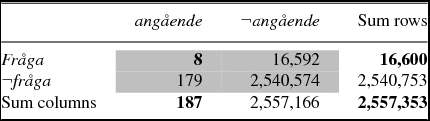
Following Schmid & Küchenhoff (Reference Schmid and Küchenhoff2013:555), we decided to rank the collexemes of angående, beträffande, gällande and rörande according to their relative Odds Ratio (OR) ratings (see Table 4 in Section 3.1 below). In order to compute the Odds Ratio value for a given collocation, four values are needed, which can be expressed in a conventional contingency table, as shown in Table 1 for angående combined with its most frequent collexeme, the noun fråga ‘question’. As the table shows, the values of interest are the frequencies of the angående sub-construction, and the frequencies of one of its collexemes, fråga. The figures marked by boldface stem directly from the PAROLE corpus, while the others are calculated.
Contingency table for the collocation fråga angående ‘question regarding’ in the PAROLE corpus.
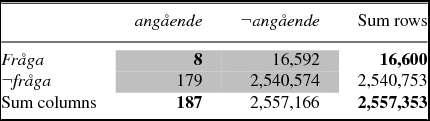
Note: The negation sign in this table indicates, very simply, other elements than fråga (¬fråga) and other prepositions than angående (¬angående). The sum total of this table stands for all prepositions in the corpus, whereas 16,600 is the token frequency of the noun fråga and 187 the token frequency of angående. Since the relationship between the head element and the TMP is semantically and syntactically constrained, the collocation of the two elements is of course not limited to their linear combination.
The OR value is achieved by making three calculations, using the values in the shaded area in Table 1. First, the relative frequency of the collexeme in question, fråga, is divided by the frequency of other words in the same construction, i.e. combined with angående, giving a score of 8/179 = 4,5% (0.0447).Footnote 8 The second relative frequency is obtained by dividing the remaining frequency of fråga, i.e. its use outside the angående construction (16,592 cases), with the frequency of all other prepositional constructions with any head other than fråga (2,540,574 cases). Finally, the first frequency is divided by the second frequency, giving the OR value, which for fråga and angående is 6.8.Footnote 9 A positive side of the OR score is that it is directly interpretable. Thus, a score of 6.8 indicates that finding the word fråga in a Swedish text implies that it is almost seven times more likely for it to appear in combination with angående compared to any other Swedish word (Schmid & Küchenhoff Reference Schmid and Küchenhoff2013:554).
3. ANALYSIS
In this section the main results of the two analyses are presented. In Section 3.1 we go through the outcome of the collostructional analysis, focusing on the different prepositions in order to set the basis for their comparison. In Section 3.2 we look into the results that emerge from the multinomial logistic regression analysis.
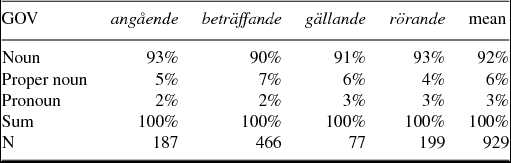
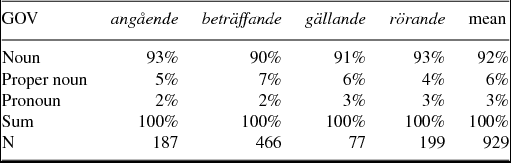
Before proceeding with the analyses it is worth taking a look at some general characteristics of the data. Tables 2 and 3 present the main distributional data regarding the syntactic word class of the head and governed elements combined with the four TMPs. As Table 2 shows, the governed elements (GOV) are very similar for all the four TMPs; angående, beträffande, gällande and rörande all combine preferably with nouns (N) (over 90% of the governed elements), and to a much lesser extent with proper nouns and pronouns.
Characteristics of governed element (GOV) (p = .77, χ2 = 3.299, df = 6).
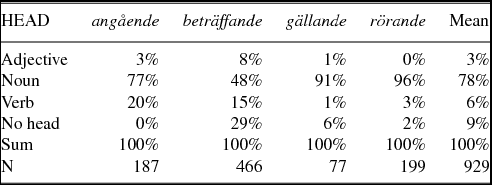
Characteristics of head element (HEAD) (p < .001, χ2 = 228.95, df = 9).

The numbers in Table 3, on the other hand, show significant differences among the four TMPs with regard to the syntactic category of the head element (HEAD). Angående, for example, is never used without a head, while up to 29% of the uses of beträffande lack a clear syntactic head. Rörande is never combined with adjectives, and together with gällande is almost exclusively used with nominal heads (96% and 91%, respectively). And, although beträffande exhibits the greatest variety of usage contexts and is the most frequent of all the TMPs, angående shows a higher relative frequency of combination with verbal heads.
These initial data seem to indicate a greater contribution to the overall differences and similarities in usage in the characteristics of the head elements (the prepositional trajector) than in the governed elements (landmark), which are highly uniform. This makes perfect sense, as it is natural to assume that what influences the choice of topic marker is not the topic itself, i.e. the governed element that indicates what is talked about, but rather the specific word or expression triggering the topic-marking relation, i.e. the head element. As we shall see, this initial hypothesis is largely confirmed in the logistic regression analysis, where no factor concerning the governed element was found to be significant in the regression model.
Before continuing a further observation needs to be made. Based on the data presented in Tables 2 and 3, the rest of our analyses will focus mainly on the different head elements of the topic-marking construction. This has an important consequence which might not be immediately apparent, and which affects the number of cases analysed. Since a total of 140 of the identified topic-marking prepositions in our data are analysed as lacking an explicit head element (133 cases of beträffande, five of gällande and two of rörande), these cannot be included in the analyses because they carry no information. Thus, eliminating the no-head cases from the following analyses means that our focus lies on ever more specific contextual factors. This is especially relevant to beträffande, whose use without a head (with 95% of the 140 cases) already clearly distinguishes it from the other TMPs.
3.1 Collostructional analysis
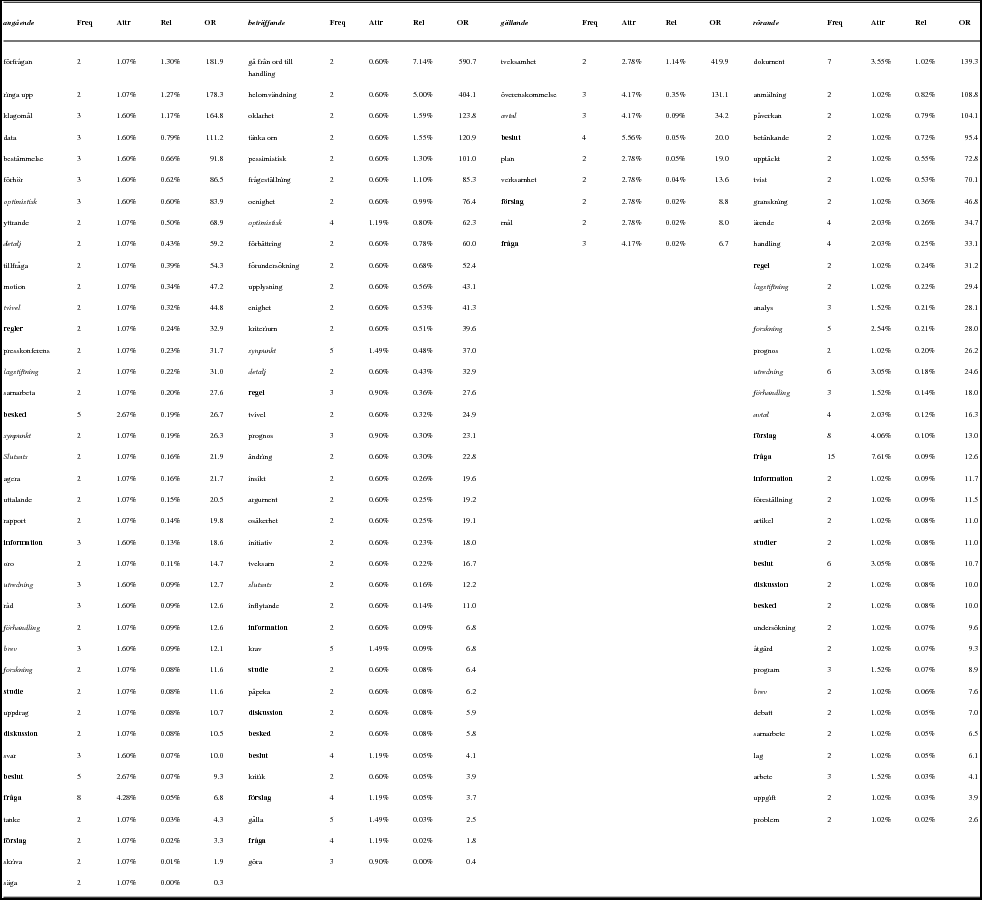
The main idea in carrying out a collostructional analysis is to find out which words are most salient for a given construction. For reasons presented above, the following collostructional analysis concentrates on the combination of different head elements with the four TMPs. In order to keep the presentation at a manageable size, Table 4 only includes the heads occurring at least twice with angående, beträffande, gällande and rörande. The collexemes are ranked according to their OR-score, which correlates very strongly with the Reliance (Rel) score.Footnote 10 The Attraction score, on the other hand, correlates with absolute frequency, but neither has been taken into account in Table 4.Footnote 11
OR-ranking of head collexemes for angående, beträffande, gällande and rörande.
Note: The values used for calculating the different values are angående 187, beträffande 335, gällande 72, rörande 197. The numerical differences compared to Tables 2 and 3 are due to the lack of syntactic heads for some of the TMPs. The total number of constructions used is 2,557,353, which corresponds to all prepositions in the PAROLE-corpus (see Table 1). Nouns co-occurring with three or four of the TMPs are marked with boldface, italics indicate nouns co-occurring with two of the TMPs. The abreviations used are the following: Freq = frequency, Attr = Attraction value, Rel = Reliance value, OR = Odds Ratio value.
As the data show, most of the top ranked lexemes (those with an OR score of over 100, for example) are unique for each TMP. This might lead one to consider that they form some sort of formulaic sequence together with the TMP in questions. However, this is hardly the case since the total number of co-occurrences is very small, as the very low Attraction and Reliance scores indicate. Also, judging by examples (6)–(10) the contexts in which these high scoring collocations occur are not so specific as to lead one to think that there is a particular attraction between any two of them.
(6) Redan förra året fick det svenska justitiedepartementet en förfrågan från EU-kommissionen, angående vilka regler som gällde för flaggföring och fartygsregistrering. (förfrågan, N = 154, two occurrences with angående)
‘Already last year the Swedish Department of Justice received an enquiry from the EU Commission regarding the rules that apply to flagging and ship registration.’
(7) Vart en sådan attityd till sist leder har vi dock under den senaste veckan kunnat bevittna: först helomvändningenbeträffande den höjda fastighetsskatten, sedan anpassningen till folkpartiets riktlinjer för den kommunala skatteutjämningen. (helomvändning, N = 126, two occurrences with beträffande)
‘Where such an attitude leads is something we have been able to witness in the past week: first the full-turnregarding the raise in property tax, then the adaptation to the guidelines of the People's Party for municipal tax equilibration.’
(8) Vidare slöts en andra överenskommelse, gällande EU-importen av ris och vete. (överenskommelse, N = 851, three occurrences with gällande)
‘There was a further agreementregarding the EU import of rice and wheat.’
(9) Per-Erik Nilsson säger att det fanns flera tveksamhetergällande ansvarsfördelningen efter mordet. (tveksamhet, N = 179, two occurrences with gällande)
‘Per-Erik Nilsson says that there were many doubtsregarding the division of responsabilites after the murder.’
(10) Hittills har Skolverkets tillsynsinsatser huvudsakligen gällt anmälningarrörande enskilda elevers situation. (anmälning, N = 243, two occurrences with rörande)
‘Up until now the supervision efforts of the Swedish National Agency for Education have primarily concerned reportsregarding the situation of particular students.’
In addition to the top-scoring collexemes in Table 4 the collostructional analysis brings up a couple of further issues. First, it needs to be pointed out that the head elements in Table 4 that are marked with boldface co-occur with at least three of the four TMPs. There are eight of them in total, all nouns, and only three of them co-occur with all four TMPs: beslut ‘decision’, fråga ‘question’ and förslag ‘proposal’. The remaining five, which are not found with gällande, are besked ‘notification’, diskussion ‘discussion’, information ‘information’, regel ‘rule’, and studie ‘study’. The words marked with italics co-occur with two of the TMPs: avtal ’agreement’, brev ‘letter’, detalj ‘detail’, forskning ‘research’, förhandling ‘negotiation’, lagstiftning ‘law making’, optimistisk ‘optimistic’, prognos ‘prognosis’, slutsats ‘conclusion’, synpunkt ‘opinion’, tvivel ‘doubt’, and utredning ‘investigation’. This total of 19 nouns and one adjective co-occurring with two or more of the four TMPs make up 51 collexemes out of a total 791 cases, which amounts to only six percent of all collexemes. This can be interpreted as an indication that that there seem to be no specific collocations for any of the TMPs, or even for the more schematic topic-marking construction.Footnote 12
Second, most of the shared head elements are situated in the lower half of Table 4, meaning that they are ranked low in terms of occurring in the topic relation with any one of the TMPs in question. Only the adjective optimistisk ‘optimistic’ scores relatively high on the OR scale for angående and beträffande, and, interestingly, for beträffande its antonym, pessimistisk ‘pessimistic’ also scores quite high. Optimistisk seems to be of some importance also from an Attraction perspective, since for both TMPs it ranks among the top five in terms of Attr score (see Appendix B), but its overall frequency of seven occurrences in the four topic-marking sub-constructions is hardly enough for it to constitute a formulaic expression.
Third, the shared collexemes are fairly evenly distributed over the TMPs. For all four, they account for roughly 40% of the total amount of collexemes: out of a total of 39 collexemes for angående, 17 co-occur with other TMPs as well, amounting to 44%. For gällande the relationship is 4 to 9 (i.e. 44%), for rörande 15 to 36 (i.e. 42%); only beträffande shows a slightly lower dependence on shared collexemes, with 13 out of 38 (34%) being shared. This might be interpreted as indicating that beträffande, as the most frequent of the four TMPs, is the default alternative of them all, since it does not pattern up with any particular head.
In addition to the above, we wish to highlight one further aspect of the annotation of the corpus that is closely related to the head elements, namely their semantic class. As Table 4 shows, many of the collexemes represent words of communication or mental processes, which is of course to be expected. However, upon a more careful analysis, five different semantic classes can be distinguished, namely words that refer to Communication, Cognitive processes, Actions, Information sources, and General words, as exemplified in (11) to (15):
(11) Communication
Det gäller att välja sina slagfält, skriver Dala-Demokraten (s) angående den kommande partikongressen.
‘It is a question of choosing one's battlefields, writes Dala-Demokraten (social democrat) regarding the upcoming party congress.’
(12) Cognitive processes
Inte ens Banque de France, annars hyperkänsligbeträffande inflationssiffrorna, väntas knorra över det resultatet.
‘Not even Banque de France, otherwise overly sensitiveregarding inflation figures, is expected to frown at this result.’
(13) Actions
Det rättsliga efterspeletgällande två andra ex-ministrar, Mona Sahlin (s) och Reidunn Laurén (opol) har kommit så långt att det i dag är dags för de första förhören.
‘The judicial aftermathconcerning two other ex-ministers, Mona Sahlin (social democrat) och Reidunn Laurén (unpolitical) has reached the point that the first hearings will take place today.’
(14) Information source
Det konstaterar Finansinspektionen i en rapport till regeringen “rörande värdepappersfondernas avgifter och informationsgivning”.
‘This is what Finansinspektionen agency states in a report to the government “regarding the fees and information of investment funds”.’
(15) General
Datoranvändningen i svenska skolor varierarbeträffande omfattning och innehåll såväl mellan som inom skolor.
‘The use of computers in Swedish schools varies with regard to the extent to and the way in which they are used across schools as well as within schools.’
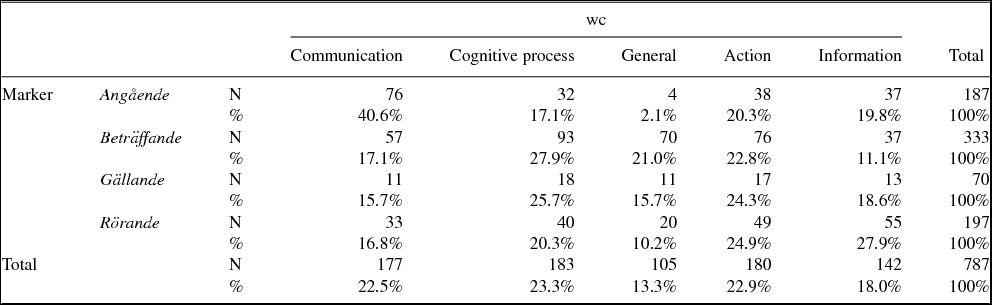
Tables 5 and 6 show the distribution of these five semantic classes across the four TMPs. As the tables show, on the level of semantic classes there are some differences between the four TMPs. Following the figures in Table 5, angående most frequently co-occurs with heads belonging to the communication domain. Beträffande and gällande are quite evenly divided between Cognitive processes and Actions, while rörande is biased towards Actions and Information sources. From the TMP (Marker) perspective, the most important semantic classes seem to be Communication, Cognitive processes and Action.
Crosstabulation of topic-marking prepositions (Marker) and semantic classes (wc) with percentages calculated ‘within Marker’ (χ2 = 95.3, p < .001).
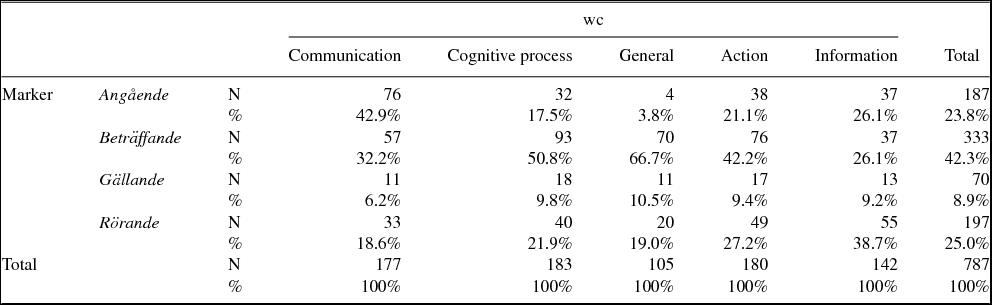
Crosstabulation of topic-marking prepositions (Marker) and semantic classes (wc) with percentaged calculated ‘within wc’ (χ2 = 95.3, p < .001).
The figures in Table 6 corroborate the preference of angående for words of communication, followed by beträffande. This TMP dominates in the domains of Cognitive processes, General and Action words, while the preference of rörande for Information heads is also confirmed. What is interesting to observe in Table 6 is that beträffande is the most frequent or second most frequent TMP for all five semantic classes, a fact due to its numerical dominance (42.2% of all TMPs). Conversely, the few cases of gällande are also enhanced in the figures in Table 6.
To sum up, the discussion of the lexical co-occurrence of the four TMPs with their head elements, most of which are nouns of communication and cognitive processes or verbs or nouns of action, has shown that there is great variation in collocation patterns. The most frequent of all the heads, fråga ‘question’ (with 8, 4, 3, 15 = 30 cases in total) ranks highest for angående and rörande in terms of Frequency and Attraction. Fråga actually seems to be a significant collexeme of rörande, differentiating it from the other TMPs. However, despite this relative importance of fråga with regard to rörande, with a Reliance score of only 0.09 percent (15 out of 16,600 uses of fråga combine with rörande), rörande can hardly be considered a highly salient sub-construction for fråga.
Except for fråga rörande ‘question regarding’, though, the collostructional analysis shows little evidence for any formulaic sequences including the TMPs. This conclusion is enhanced by the fact that only six percent of all analysed topic-marking constructions include collexemes that co-occur with two or more TMPs. Instead, since all the TMPs are used with a large number of different head elements, they clearly behave distinctly; on the other hand, the absence of clear collocation patterns also indicates that they are used very freely and in highly similar contexts.
Introducing the semantic classes of the head elements into the discussion reveals some more detailed preferences: angående lines up with Communication words and rörande prefers Action and Information words. On the other hand, the most frequent of the four TMPs, beträffande, is used with all five semantic classes, and the same goes for gällande, although with lower overall frequency.
3.2 Multinomial logistic regression analysis
Compared with the collostructional analysis presented in the previous subsection, the multinomial logistic regression analysis (MLRA) is a natural following step to take, since what it does is, in a sense, to take the idea of co-occurrence to another level and consider not only one element, e.g. the specific head element, but rather the whole set of co-occurring factors (syntactic and semantic) and see to what degree they map together with one or several of the focus expressions, i.e. the TMPs. Simply put, the MLRA performed on the annotated corpus data is actually a mathematically sound comparison of 30 simultaneous collostructional analyses. The difference is not only that 11 factors with 30 different values are taken into account in parallel, but also that their importance is calculated relative to one another. The degree to which a particular factor is significant is thus calculated by taking all the other factors into account simultaneously (ceteris paribus).
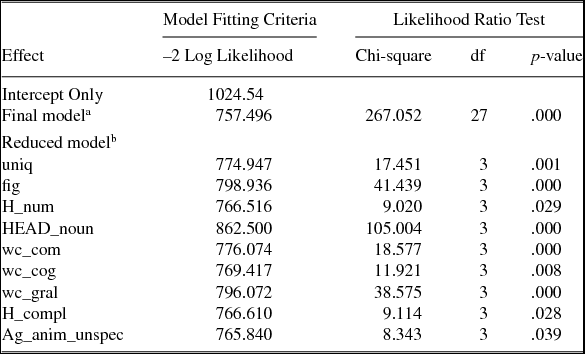
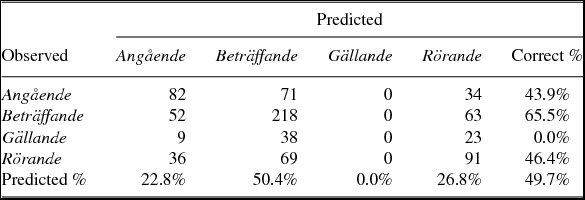
Tables 7 and 8 show the main results of the MLRA that was carried out on the annotated data set. As can be seen in the Classification table in Table 8, the overall prediction capacity of the model is only 49.7%. That this value even approaches the 50% mark, however, depends almost entirely on beträffande, which attains a reasonable accuracy (at 65.5%) while also being the most frequent TMP. Angående and rörande are also classified correctly to a certain extent on this scale with an accuracy of 44 and 46%, while gällande eludes the model completely and is mostly classified as either beträffande (38/70) or rörande (23/70). The figures in the Classification table also tell us that the model often (wrongly) classifies angående as either beträffande or rörande, while more than half of the instances of rörande are also classified as either beträffande or angående. This initial data thus corroborates the finding from the collostructional analysis that beträffande is the leading TMP; however, it also calls into question to what extent the other TMPs can be neatly distinguished with respect to each other and to beträffande.
Model fitting information and Likelihood Ratio Test of the multinomial logistic regression model on Swedish topic expressions angående, beträffande, gällande and rörande.
a The final model includes nine significant variables. The chi-square statistic is the difference in –2 log-likelihood between the final model and a ‘blind’ model (intercept only).
b The reduced model is formed by omitting an effect from the final model. The chi-square statistic is the difference in –2 log-likelihoods between the final model and a reduced model.
Classification accuracy of the multinomial logistic regression model on Swedish topic expressions angående, beträffande, gällande and rörande.

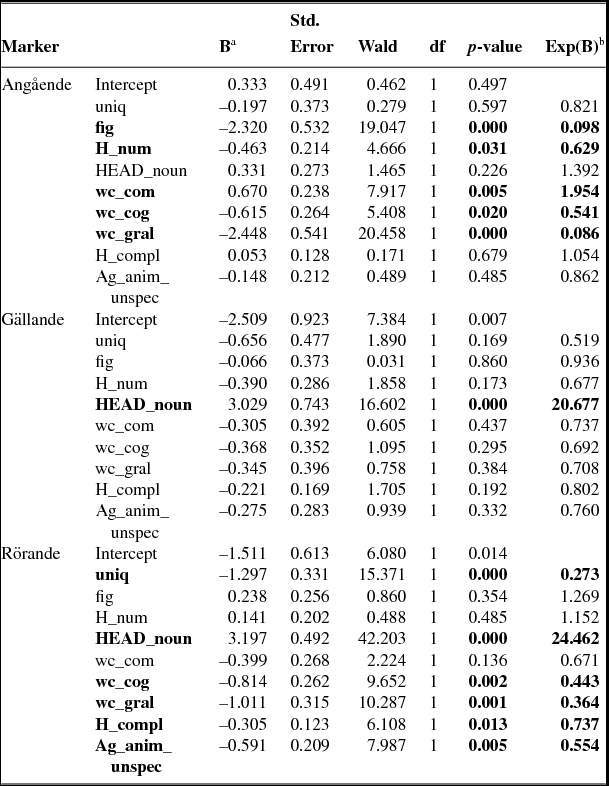
The Likelihood Ratio Tests in Table 7 list the factors that contribute significantly to the model.Footnote 13 Of these nine factors, which were arrived at by a step-wise approach, six are semantic (uniq, fig, wc_com, wc_cog, wc_gral and Ag_anim_unspec) and three formal (H_num, HEAD_noun, and H_compl).Footnote 14 No factors concerning the governed element were found to be significant. The relative contribution of the significant factors to the different TMPs is presented in more detail in Table 9. As Table 9 indicates, the factors contribute differently to the different TMPs. One should also bear in mind that in a multinomial regression analysis, one of the four TMPs is taken as point of comparison. In this case, we decided to use beträffande as reference point, a choice motivated by it being the most frequent and versatile of the four. This means that the measures in the p-value column indicate significance of the factor in question for the relevant TMP in contrast to beträffande. A value above 1 in the Exp(B) column indicates that the odds for using the TMP in question with this factor are higher than for using beträffande (e.g. when the head element is a noun, as happens with gällande and rörande). Conversely, values below 1 indicate that the odds for using beträffande are higher.
Parameter estimates for relative significance and contributions of the nine significant factors in the MLRA (multinomial logistic regression analysis). The significance for each topic-marking preposition is measured in relation to beträffande, and significant values (p ≤ .05) are bolded. See Appendix A for an explanation of the abbreviations in the first column.
a Coefficient estimates in the MLR model.
b Odds ratio estimates.
As a first example, take the figurativeness factor (fig), which makes reference to the figurativeness or abstractness of the head element. This factor is only significant for angående and the value of 0.098 for Exp(B) indicates that the odds for using angående is 1:10 compared to beträffande when the head element is used metaphorically. Conversely, the odds for using beträffande over angående are tenfold when the governed element is used in a figurative sense, as in tryckte på ‘pushed on’ in (16):
(16) William Perry (förre försvarsministern) tryckte påbeträffande Bosnienuppdraget, vilket han betraktade som en möjlighet att gjuta nytt liv i Nato och förändra USA:s relationer till Ryssland efter det att Moskva skickat en brigad som lyder under amerikanskt kommando.
‘William Perry (the former prime minister) put pressure on [regarding] the Mission in Bosnia, which he considered an opportunity to bring NATO to a new life and to change US relations to Russia after Moscow had sent a brigade operating under US command.’
In the following paragraphs, we will comment on the remaining eight significant factors and their contribution to marking a difference between TMPs.
The uniqueness factor (uniq) makes reference to the presence or absence of another TMP in the immediate textual context. In this case, a positive value implies the presence of another TMP, e.g. om, kring, angående, beträffande, gällande or rörande, in addition to the one explicitly analysed. As Figure 2 indicates, the co-occurrence of two or more TMPs in the same sentence is much less frequent than its counterpart, with less than 10% of the cases included in the count.
Two perspectives on the relative distribution of the uniqueness factor over the four topic-marking prepositions (χ2 = 19.1, p < .001).
As shown in Table 9 above, the uniqueness factor is significant for rörande. The Exp(B) value is 0.27, which means that the odds for using beträffande are almost four times higher than for rörande when the TMP is unique. That is, rörande is almost four times more likely to occur when another TMP is present in the same sentence, as in (17):
(17) I anslutning till valet 1994 uppstod frågaom lokal folkomröstning i Stockholm rörande Dennispaketet.
‘At the 1994 elections there was [a] questionabout a local referendum in Stockholm regarding the Dennis package.’
This can be interpreted as indicating that rörande functions as some sort of stylistic alternative rather than an apparent first-choice, where beträffande might be more suitable. This tendency is clearly visible in the pie chart and the crosstabulation table in Figure 2, where rörande accounts for almost 40% of the 79 not unique cases.
Another factor that is only significant with regard to one TMP is the class designating an unspecified agent (Ag_anim_unspec) of the head element. Of the agent types, this was the only one that proved significant in the MLRA. As its Exp(B) value of 0.5 indicates, the odds for using beträffande are two to one compared to rörande when the agent is unspecified, as is the case in (18):
(18) Men ett är säkertbeträffande den kurdiska frågan: De omgivande länderna har alla sina intressen och investeringar i olika kurdiska organisationer, och använder dem gärna mot varandra.
‘One thing is certainregarding the Kurds: the surrounding countries all have their interests and investments in different Kurdish organizations and they are not afraid to use them against one another.’
As Figure 3 reveals, the relative frequency of rörande with unspecified agents is lower (22.7%) than with other kinds of agents (26.6%), whereas the other TMPs are more evenly distributed over different kinds of agents. Note, though, that the data in the crosstabulation table in Figure 3 are not statistically significant. Despite this lack of statistical significance, unspecified agents is still the only one of the five different agent types included as significant in the MLR model.
Two perspectives on the relative distribution of the unspecified agent factor over the four topic-marking prepositions (χ2 = 1.83, p = .6).
The first of the three significant semantic classes of the head nouns, the words belonging to the domain of communication is a significant factor only for angående. With an Exp(B) value of 1.954, the communication domain positively distinguishes angående from the other TMPs, indicating that the odds for using angående over beträffande are almost two to one when the head element refers to some form of communication, such as, talking, writing, commenting, saying, etc. As the pie chart and the crosstabulation table in Figure 4 below show, with over 40% of the communication cases, angående clearly favors this domain, a detail that was already hinted upon in the collocation analysis (see Tables 5 and 6).
Two perspectives on the relative distribution of the communication words factor over the four topic-marking prepositions (χ2 = 45.6, p < .001).
The semantic class of cognitive processes is a significant factor for both angående and rörande. In both cases, however, the Exp(B) value is below 1.0, lying at 0.54 and 0.44, respectively. This means that the odds for using beträffande are the double as compared to angående and rörande when the head element is a word indicating a cognitive process, such as tänka ‘to think’, insikt ‘comprehension’, enighet ‘consensus’, optimistisk ‘optimistic’, and befara ‘to suspect’ as in (19):
(19) Därefter ägnade han sig mest och med stor framgång åt vattenpolo, en utveckling som knappast kan befarasbeträffande Anna.
‘After that he mostly dedicated himself to water polo with great success, a development that can hardly be suspectedwith regard to Anna.’
The higher percentage corresponding to beträffande with words of cognitive processes is evident in Figure 5, where it is seen to stand for as much as 52.7% of all the topic-marking relations belonging to this semantic domain.
Two perspectives on the relative distribution of the words of cognitive process factor over the four topic-marking prepositions (χ2 = 10.2, p = .017).
The last semantic class that contributes significantly to the model is a residual one called general words, which includes cases such as alternativ ‘alternative’, aspekt ‘aspect’, använda ‘to use’. This factor is also significant for angående and rörande, for which its Exp(B) value is lower than 1.0, lying at 0.086 and 0.36, respectively. This, of course, means that the odds for using beträffande greatly exceed the odds for using either angående or rörande when the head element is classified as ‘general’.
This seems to underline, once more, the relatively unmarked character of beträffande compared to the other TMPs, as beträffande stands for as many as two thirds of all cases. As the data in Figure 6 show, angående seems particularly repelled by heads classified as general words (with an Exp(B) value of 0.086). Although statistically unimportant for the model as a whole, the relative frequency of gällande, on the other hand, actually goes up with general words as head elements compared to other heads.
Two perspectives on the relative distribution of the general words factor over the four topic-marking prepositions (χ2 = 39.4, p < .001).
Moving on to the syntactic factors, it seems natural to start off with the category of nominal heads. This is the only factor that is significant for gällande, but it is also highly significant for rörande (p < .001 for both). The Exp(B) values are also very high (20 and 24, respectively), meaning that the odds for using gällande or rörande compared to beträffande are more than twentyfold when the head element is a noun. As the leftmost pie chart in Figure 7 shows, when the head element is not a noun beträffande is used in over 80% of the cases, while gällande and rörande are very seldom used with other than nominal heads.
Two perspectives on the relative distribution of the nominal head factor over the four topic-marking prepositions (χ2 = 185.2, p < .001).
However, as the figures in the crosstabulation table in Figure 7 indicate, due to its sheer numerical frequency beträffande is still the most frequent TMP even with nominal heads with 35.5% of the 633 cases. This table also clearly shows how much gällande and rörande prefer nominal heads: 70/77 and 192/199 cases. On a broader level, this result seems to indicate that beträffande is the most flexible of the TMPs and most readily used in varying contexts, i.e. with different head elements.
The following syntactic factor with a significant contribution to the model is the number of the head, i.e. whether it appears in singular or plural form. This factor is important only for angående. The Exp(B) value of 0.63 indicates that the odds for using beträffande are almost the double when the head is plural. As above, this result seems to underline the fact that beträffande is more flexible and readily used in different syntactic contexts. However, as can be seen in Figure 8, the relative frequency of angående is significantly higher with singular than with plural heads. Although this factor is not significant for rörande, the tendency for this TMP stands out as the opposite to angående in Figure 8, i.e. rörande is relatively more frequent with plural heads.
Two perspectives on the relative distribution of the head number factor over the four topic-marking prepositions (χ2 = 11.9, p = .008).
The final significant factor of the MLRA is head complexity, which refers to the formal complexity of the head element. A bare noun without syntactic arguments is classified as being low in complexity (gaining a score of 0), whereas nouns with one or several modifiers or verbs with adverbs and complex subjects are annotated as more complex with scores ranging from 1 to 3. Head complexity is only significant for rörande compared to beträffande. The p-value for rörande is .013, and its corresponding Exp(B) value is 0.74 (see Table 9), indicating that the odds for using beträffande are somewhat higher when the head element is a bare noun, as in (20), while rörande is more frequently used with more complex heads, as in (21):
(20) Regeringen avser därför att senare återkomma med förslagbeträffande återstående regler.
‘The government intends to return later with proposalsregarding remaining rules.’
(21) Det var inte förrän han hade fått det tredje brevet från advokaten rörande hustruns storståtliga legat som hon lyckades övertala honom att göra resan till Newcastle. . .
‘It was not until he had received the third letter from his lawyer concerning his wife's grand legacy that she was able to convince him into making the trip to Newcastle.’
This is also clear in the data included in Figure 9, where rörande shows its lowest relative frequency with bare nouns (17.6%), whereas beträffande is most dominant with bare nouns (63.6%).Footnote 15 If one considers that the bare noun pattern is typical of legal language, where cases such as example (20) are relatively common, beträffande stands out as the most salient formal TMP.
Two perspectives on the relative distribution of the head complexity factor over the four topic-marking prepositions (χ2 = 54.8, p < .001).
4. DISCUSSION
Looking back at the data analysis, what can be said about the four TMPs studied? The first and foremost finding regarding the specifics of the TMPs is that one of them rises above the rest, namely beträffande. It is the most frequent of the four, it is used with all four kinds of head elements, and with all five semantic classes. Furthermore, one must keep in mind that 29% of the cases of beträffande occur with no explicit head element, a fact that by itself distinguishes beträffande from its three companions, and, probably, also from default om.
In the MLRA, beträffande stands out as the first-choice alternative with a classification accuracy of over 65%. One of the factors in the MLRA model pointing to the special status of beträffande is the uniqueness factor, which reveals that beträffande is used more often than angående and rörande when no other TMP is present. The odds for using beträffande are very high compared to the other TMPs when the governed element is a bare noun (i.e. no modifier). Finally, one must not forget the significant impact of overall frequency on all corpus-driven analyses, which is also a salient feature of beträffande.
Gällande is used very similarly to beträffande, with the important difference of being very unsalient in most aspects. It can be used with heads belonging to any of the five semantic classes, but its overall frequency is a fifth of beträffande. Thus it is not surprising that gällande eludes a statistical modelling, yielding a prediction accuracy of zero percent in the MLRA. The only distinguishing factor for gällande is its strong preference for nominal heads in contrast to beträffande.Footnote 16 One reason for this lack of salience might be that gällande is the TMP that presents the most other uses, appearing as an adjective, a verb particle and verbally as a present participle. The prepositional use actually stands for only 11% of all cases of gällande, signaling its marginal status as a preposition.
What about angående and rörande? On the basis of the above analyses these two TMPs fall somewhere in between beträffande and gällande. In terms of frequency they combine for 40% of all the analysed expressions, and they have a classification accuracy of 44 and 46%. The main distinguishing factor for angående is that it strongly favours the communication domain and disfavours figurative heads and heads belonging to the domain of general words. Rörande strongly favours nominal heads, and it is repelled by many other factors, most importantly uniqueness. Rörande thus stands out as the TMP that is most frequently used when the context includes another TMP.
It is another matter, though, to determine to what degree angående and rörande differ from each other. A clear difference is that angående is used solely as a TMP, whereas rörande also functions as an adjective to a considerable extent (44%). In the analysis angående shows a bias towards Communication words, while rörande prefers words of Action and Information source.Footnote 17
Having recalled these specifics, which help distinguish the TMPs from one another, there are two important things that must be kept in mind. Firstly, the overall predictive accuracy of the MLRA model is quite poor, not reaching even the 50% line. Only the most frequent TMP, beträffande, which stands for almost half the TMPs included in the data set, is described with reasonable success. The other TMPs are classified by the model as another TMP, mostly as beträffande: 38% of angående, 54% of gällande and 35% of rörande (see Table 8 above).
Secondly, the results of the collostructional analysis are also unconvincing in terms of underlining differences between the TMPs, since no lexically specific collocations stand out. Although the OR, Attraction and Reliance values permit the ranking of head elements so that the order reflects a significant relationship between the TMP and the head element, the collocation frequencies are so low that they seem to impede any significant interpretation of the rankings. Instead, we found a considerable number of nouns, verbs and adjectives that occur repeatedly with many of the TMPs. Among these, the most salient are the nouns beslut ‘decision’, fråga ‘question’and förslag ‘suggestion’, which co-occur with all four TMPs. This finding, though, is not significant from the perspective of distinguishing between the different topic-marking prepositions, but rather points at the importance of the topic-marking relation, in general, to these particular nouns.
Having constructed a sophisticated mathematical model (MLRA) and a detailed measure for lexicogrammatical attraction that are unable to bring forth clear differences between the four prepositions studied, it seems reasonable to address where these apparent shortcomings might arise from.
The most obvious explanation to inconclusive results in a quantitative study would be that there was not enough data or that the data was too heterogeneous in some ways. This might well be true especially with regard to the different frequencies of the TMPs. For gällande only 77 cases were identified, compared to 466 cases of beträffande. This surely has an impact on the statistics, especially for the MLRA that uses group sizes as prior probabilities and thus favours the largest group. Another plausible explanation is that the annotated factors were insufficient or did not include the correct ones in order to single out the differences. What strikes us, though, when looking at the results of the two analyses is not, really, the lack of data to interpret, but rather its richness and the lack of salient patterns.
Another factor that is often thought to bring forth usage differences between elements is the presence of different genres. This factor is of course absent in the PAROLE corpus, which consists mainly of formal, written language. However, since it is well known that the TMPs are typically associated precisely with formal language, in this study we explicitly decided to overlook this factor and concentrate on possible differences within a loosely defined genre. This does not mean, of course, that taking genre into account is not of interest for future studies, quite the contrary.
In a sense, then, the fact that the two analyses we have performed have not produced the desired results does not seem be due to inherent faults either in them or in the data sets. Instead, we find that the most serious impediment to finding factors differentiating angående and beträffande from one another lies in the language usage itself, where the data indicates not that they are clearly distinct in one way or another, but that they are very similar (see Glynn & Krawczak forthcoming). The differences that do show up tend to be very slight and highly detailed. Another factor influencing the interpretation of the results from the regression analysis is that in comparing four different expressions, the multinomial approach always uses one as reference point. This means that comparison with the reference point is straight-forward, but cross-wise comparison outside the reference-point expression is harder.
On the positive side, combining two complementary analyses aiming at revealing underlying differences between four near-synonyms has provided some converging evidence that there may not be that many factors that distinguish angående from beträffande, gällande and rörande. Seeing two methods produce similarly inconclusive results is in a sense less disappointing than seeing it happen with only one. In fact, having observed two approaches that are expected to mark a difference between a set of synonyms fail to do so is probably the single most important factor allowing us to emphasize the (near-)synonymous status of the TMPs studied, as will be evident in the final section.
5. CONCLUDING REMARKS
It is not easy to determine what specific differences there are among angående, beträffande, gällande and rörande. Although we have repeatedly pointed out that beträffande seems to be the most salient of the four, dominating when no head element is present, and gällande is a marginal alternative, their level of mutual contrastiveness is certainly very low. Rather, the major finding of our analyses points to subtle preferences for certain features such as angående preferring words of communication and rörande being the best option when another TMP is already present.
Considering further developments of the question under study here, a natural step would be to take the influence of genre into consideration. Bringing in the genre, though, would also automatically imply addressing the difference between default om and the four participle base TMPs, as well as, perhaps, kring ‘around’, which in present-day Swedish has become quite a popular alternative to the unwanted participles. The genre dimension could also focus on more subtle genre distinctions, such as contrasting legal, government and institutional texts with journalistic and academic texts, for example. Another possible way of identifying differences would be to take regional varieties into account, for example, the difference between the Swedish spoken in Sweden and Finland.
Another way of advancing the study would be to turn to other forms of data besides written corpora, such as the questionnaire approach advocated by Vanhatalo (Reference Vanhatalo2002, Reference Vanhatalo2003) and Arppe (Reference Arppe2006, Reference Arppe2008) or the experiments ran by Klavan (Reference Klavan2012).Footnote 18 One must keep in mind, though, that adpositional semantics is a very different matter compared to lexical semantics, in the sense that speakers’ intuitions tend to be much less reliable with function words than content words (see Granvik Reference Granvik2012). It would be interesting, however, to specifically test the interchangeability of the four TMPs using the most highly preferred contexts for all TMPs as control.
Furthermore, it does not seem intuitively plausible that angående and rörande, for instance, due to their lexical-semantic specifics, impose different construals on the topic-marking relation, as Taylor (Reference Taylor2002) finds for the adjectives high and tall and Klavan (Reference Klavan2012) for the adessive case and peal ‘on’.Footnote 19 Most importantly, even though Klavan's (Reference Klavan2012) study addresses the abstract issue of grammatical synonymy, a locative relation such as the support relation is fairly concrete in comparison with the inherently figurative topic-marking relation, where an experiment such as an image rating task is difficult to imagine. On the other hand, the existence of lexically specific syntactic alternatives to the TMPs angående, beträffande and gällande (but not with regard to rörande), i.e. vad X angår/beträffar ‘in what concerns/regard X’, and vad gäller Y ‘with regard to Y’, is certainly something that could be explored further in an experimental approach such as sentence similarity or acceptability judgment tasks or the like.
Having said this, what do we make of the relationship between angående, beträffande, gällande and rörande? Quite obviously, the corpus-based statistical models do not tell us the story we wanted to hear. In fact, this was one of the motives for running the fine-grained collostructional analysis. And still the picture does not seem as neat and clear-cut as one would desire. Could there be something with the whole setup, as hinted at before? Perhaps the denial of perfect synonymy and the introduction of its psychologically more valid substitute, near-synonymy, based as it is on the ideal of one meaning, one form, is what leads one partly astray. This is indeed how we set out addressing the differences between angående, beträffande, gällande and rörande; we expected that there were differences to be found. And we have gone to some detail trying to point out what these differences are.
Indeed, the detailed analysis of the specific patterning of angående, beträffande, gällande and rörande in formal written texts reveals certain idiosyncrasies. However, the classification model that emerges from the statistically sound MLRA is far from satisfactory. The same goes for the collocation analysis where few differences stand out beyond the level of individual collexemes. All of this seems to indicate that the four topic-marking prepositions indeed constitute a fairly good case of near-synonymy. There simply seem to be more similarities than differences between them: there are few unambiguously distinguishing contextual factors, the four TMPs are not semantically contrastive, their distribution is both highly similar and highly variable, and they are almost always interchangeable in the registers studied. Thus, despite being different words, we feel that angående, beträffande, gällande and rörande bear essentially the same meaning and behave syntactically in very similar ways.
In a case such as this one, then, it might not be so fruitful to dig increasingly deeper into the intricacies of particular lexemes in order to find subtle differences that are supposed to be there but do not seem to emerge. From a cognitive linguistic perspective, where redundancy in linguistic expression is accepted and even defended as the rules of parsimony and economy are frequently broken in the richness of actual language use, perhaps true synonymy is not to be ruled out after all, especially on an abstract level such as the prepositional topic-marking relation. The existence of a number of words for expressing the same meaning is but an example of the wide repertoire of our means of communication, which allows us to play around with words and meanings, using a variety of forms to express the same meanings that our thoughts swirl around as they keep us mentally occupied.
ACKNOWLEDGEMENTS
We thank the two anonymous reviewers for the Nordic Journal of Linguistics for their valuable comments on the original draft of this paper. All remaining inconsistencies and possible shortcomings are, of course, solely our responsibility.
APPENDIX A
Annotated factors, abbreviations, variables and annotation coding
APPENDIX B
Ranking of head collexemes for angående, beträffande, gällande and rörande according to their Attraction score
The relevant figures are identical to those presented in Table 4, i.e. angående 187, beträffande 335, gällande 72, rörande 197. The total number of constructions used is 2,557,353, which corresponds to all prepositions in the PAROLE corpus. As in Table 4, nouns co-occurring with three or four of the TMPs are marked with boldface, while italics indicate nouns co-occurring with two of the TMPs. The abbreviations used are the following: Freq = frequency, Attr = Attraction value, Rel = Reliance value, OR = Odds Ratio value.