



Childhood maltreatment is associated with a broad range of psychiatric outcomes in later life (Murphy et al., Reference Murphy, McElroy, Elklit, Shevlin and Christoffersen2020; Vachon et al., Reference Vachon, Krueger, Rogosch and Cicchetti2015). Among the most of common of those psychiatric outcomes is major depression (Gilbert et al., Reference Gilbert, Widom, Browne, Fergusson, Webb and Janson2009; Humphreys et al., Reference Humphreys, LeMoult, Wear, Piersiak, Lee and Gotlib2020; Li et al., Reference Li, D’Arcy and Meng2016; Vallati et al., Reference Vallati, Cunningham, Mazurka, Stewart, Larocque, Milev, Bagby, Kennedy and Harkness2020), a seriously debilitating mood disorder that is the leading cause of disability worldwide, according to the World Health Organization (WHO; Friedrich, Reference Friedrich2017). In fact, in a cross-sectional mental health survey conducted across 21 countries and comprised of over 51,000 individuals completing self-reports, approximately 25% of the population attributable risk for developing a mood disorder by early adulthood was attributable to childhood maltreatment (Kessler et al., Reference Kessler, McLaughlin, Green, Gruber, Sampson, Zaslavsky, Aguilar-Gaxiola, Obaid Alhamzawi, Alonso, Angermeyer, Benjet, Bromet, Chatterji, de Girolamo, Demyttenaere, Fayyad, Florescu, Gal, Gureje and Williams2010).
Despite the pernicious and harmful effects of childhood maltreatment, it is notable that most youths with maltreatment histories do not go on to develop depression. For instance, a study of 237 adolescents involved in child welfare systems found that while 29% of them met criteria for major depressive disorder (MDD), the majority did not develop MDD (Greger et al., Reference Greger, Myhre, Lydersen and Jozefiak2015). Similarly, Rehan et al. (Reference Rehan, Antfolk, Johansson, Jern and Santtila2017) found that 28% of 184 youths with severe maltreatment histories reported clinically significant levels of depression in adulthood (thus, 72% of youths did not develop adult depression). Additionally, an epidemiological study of youths with maltreatment histories (n = 676) found that only 25% of abused or neglected children met criteria for lifetime MDD (Widom et al., Reference Widom, DuMont and Czaja2007). These studies indicate that most youths with maltreatment histories are “resilient,” at least as it pertains to the development of one of the most common negative psychiatric outcomes in depression. Yet, it is unclear whether seemingly resilient youths (i.e., with maltreatment histories, but without depression) also function adaptively in other domains in their lives, particularly as they age into adulthood. Addressing this question may have critical intervention and public policy implications for youths who experience maltreatment.
Issues in studying resilience and depression
We define resilience from an encompassing developmental psychopathology framework (Cicchetti, Reference Cicchetti2013; Rutter & Sroufe, Reference Rutter and Sroufe2000), in which it is a multidimensional and dynamic process where an individual is able to positively adapt to adversity or risk. Notably, nearly all conceptualizations of resilience converge on the notion that it reflects some form of a “positive adaptation in the context of adversity or risk” (Cicchetti, Reference Cicchetti2013; Masten & Obradović, Reference Masten and Obradović2006; McGloin & Widom, Reference McGloin and Widom2001; Menge et al., Reference Meng, Fleury, Xiang, Li and D’Arcy2018; Rind et al., Reference Rind, Tromovitch and Bauserman1998). For instance, positive adaptation can either reflect a lack of psychopathology and other negative outcomes, or even better than expected functioning on social, emotional, and behavioral outcomes after the experience of adversity or risk (Yoon et al., Reference Yoon, Howell, Dillard, McCarthy, Napier and Pei2021). However, not all conceptualizations of resilience consider that it is not static nor time-limited, but a process that unfolds over the development (Infurna & Luthar, Reference Infurna and Luthar2016; Kim-Cohen & Turkewitz, Reference Kim-Cohen and Turkewitz2012; Southwick et al., Reference Southwick, Bonanno, Masten, Panter-Brick and Yehuda2014). Some individuals might show resilience at a later point in their development than others, for instance. Furthermore, resilience is not an “all or nothing” phenomena but rather, encompasses the individual’s positive adaptations to adversity or risk in multiple domains of functioning, including social, emotional, and behavioral (Infurna & Luthar, Reference Infurna and Luthar2017; Jaffee & Gallop, Reference Jaffee and Gallop2007; Luthar et al., Reference Luthar, Cicchetti and Becker2000, Reference Luthar, Doernberger and Zigler1993; Masten et al., Reference Masten, Hubbard, Gest, Tellegen, Garmezy and Ramirez1999). Thus, from a developmental psychopathology perspective, labelling individuals as resilient simply because they lack a single psychopathology at a particular point in time may be misleading and possibly even harmful to their development, as it is possible that impairment may be still present in other domains (e.g., social, emotional, and behavioral) and/or a later point in their lives (e.g., during adulthood) where earlier intervention would have been warranted (Infurna & Luthar, Reference Infurna and Luthar2016).
For instance, in an early study on resilience, Luthar et al. (Reference Luthar, Doernberger and Zigler1993) found that nearly 85% of high schoolers who reported stressful life experiences were positively adapted in the domain of social competence, but struggled in at least one other domain (e.g., behavioral, emotional including depression and internalizing/externalizing) at a 6 month follow up assessment. Similarly, another study by the same researchers found that among a sample of Australian adults who experienced spousal loss followed longitudinally, as many as 66% showed a positive trajectory in a single domain of resilience (i.e., in life satisfaction), but only 8% showed resilience when all other domains were considered simultaneously (“multidimensional resilience”; i.e., life satisfaction, negative affect, positive affect, general health, and physical functioning) (Infurna & Luthar, Reference Infurna and Luthar2017). These findings highlight the importance of examining resilience as a multidimensional and dynamic process, rather than as a unidimensional and static construct (Cicchetti, Reference Cicchetti2013; Infurna & Luthar, Reference Infurna and Luthar2016; Kim-Cohen & Turkewitz, Reference Kim-Cohen and Turkewitz2012). In fact, there are studies from across the developmental spectrum – including child/adolescent and adult studies – that have come to this conclusion (Infurna & Luthar, Reference Infurna and Luthar2017; Luthar et al., Reference Luthar, Doernberger and Zigler1993; Mersky & Topitzes, Reference Mersky and Topitzes2010).
Yet, most studies of maltreatment have not operationalized resilience from a developmental and multifactorial perspective. Yoon et al.’s (Reference Yoon, Howell, Dillard, McCarthy, Napier and Pei2021) recent meta-analysis of 67 studies conducted since 2010 on resilience following child maltreatment revealed that more studies assessed resilience by measuring either a lack of psychopathology or other negative outcome (14 studies) than by assessing multiple domains simultaneously (11 studies). In fact, several studies identified in Yoon et al.’s (Reference Yoon, Howell, Dillard, McCarthy, Napier and Pei2021) meta-analysis focused on depression specifically, as either an independent and/or singular marker of resilience or lack thereof (e.g., Cisler et al., Reference Cisler, James, Tripathi, Mletzko, Heim, Hu, Mayberg, Nemeroff and Kilts2013; Dennison et al., Reference Dennison, Sheridan, Busso, Jenness, Peverill, Rosen and McLaughlin2016; Kassis et al., Reference Kassis, Artz, Scambor, Scambor and Moldenhauer2013; Lumley & McArthur, Reference Lumley and McArthur2016). Additionally, almost all the studies included were cross-sectional. This could be problematic, as cross-section studies of resilience that focus exclusively on the presence or absence of depression at a single time point may have crucially mischaracterized certain individuals as being resilient when the onset of their depression may not yet have manifested.
Our study used a developmental psychopathology framework to address two important yet largely unanswered questions in the resilience literature: (1) are there differences in the long-term (over approximately 20 years) trajectories of depression symptoms between youths with and without maltreatment histories? (2) How are youths with maltreatment histories who do not develop a severe or chronic course of depression doing in other important functional domains in adulthood (e.g., social/interpersonal functioning, violence/victimization incidents, substance use, physical health, socioeconomic status)? To inform our hypotheses to these questions, we provide a summary of the literature as it pertains to these issues.
Developmental trajectories of depression in individuals with versus without maltreatment histories
In general, MDD emerges and then rapidly increases (in terms of symptomatology) during adolescence and young adulthood, before “tapering off” during and throughout early adulthood (Hankin et al., Reference Hankin, Abramson, Moffitt, Silva, McGee and Angell1998; Pettit et al., Reference Pettit, Lewinsohn, Seeley, Roberts and Yaroslavsky2010). However, not every individual with MDD follows this developmental progression. A growing body of literature has shown that both the initial onset and progression of depression symptoms can vary substantially from individual to individual over the course of time (Barboza, Reference Barboza2020; Li et al., Reference Li, Zhang, Wang and Lu2022; Mazza et al., Reference Mazza, Fleming, Abbott, Haggerty and Catalano2010; McLaughlin & King, Reference McLaughlin and King2015; Musliner et al., Reference Musliner, Munk-Olsen, Eaton and Zandi2016; Yarslavsky et al., Reference Yaroslavsky, Pettit, Lewinsohn, Seeley and Roberts2013). For instance, a recent study using the data from the National Longitudinal Study of Adolescent to Adult Health (Add Health) identified four distinct trajectories of depression symptoms in individuals followed from early adolescence into adulthood (Li et al., Reference Li, Zhang, Wang and Lu2022). The researchers identified a “low” depressive trajectory (which exhibited consistently low depressive symptoms over time), an “increasing” trajectory (in which depressive symptoms steadily increased over time), a “declining” trajectory (in which depressive symptoms steadily decreased over time), and an “early adult peak” depressive trajectory where youths exhibited low depressive symptoms at baseline and a steadily increased in their depression until age 23, followed by a steady decline afterwards. These trajectories appear to be robust across samples, as the same (or very similar) pattern of 3 to 4 distinct developmental trajectories of depression have been consistently observed in other longitudinal studies as well (see meta-analysis by Musliner et al., Reference Musliner, Munk-Olsen, Eaton and Zandi2016).
However, given that individuals with maltreatment histories are at particular risk for developing depression, and it is possible their patterns of depression onset and progression might differ from those without maltreatment histories. In a meta-analysis of nearly 200 (mostly retrospective, cross-sectional) studies that examined the association between childhood maltreatment and adult depression, Nelson et al. (Reference Nelson, Klumparendt, Doebler and Ehring2017) found that mean depression onset occurred 4 years earlier in individuals with childhood maltreatment histories compared to individuals without. Furthermore, individuals with maltreatment histories were twice as likely to exhibit chronic forms of depression during their adult years relative to individuals without such histories (Nelson et al., Reference Nelson, Klumparendt, Doebler and Ehring2017). Thus, there might be unique developmental trajectories of depression (e.g., earlier onset, more chronic progressions) among individuals with maltreatment histories. Identifying unique trajectories of depression among youths with maltreatment histories can better identify those at greatest risk for chronic depression and other problems, as these individuals may stand to benefit from earlier or more specialized interventions (McLaughlin & King, Reference McLaughlin and King2015).
There have been fewer comparable (in terms of study sample size) prospective longitudinal studies of depression within populations that have maltreatment histories relative to studies that do not delineate maltreatment status in their samples. The few studies of depression among youths with maltreatment histories have found similar depression trajectories as identified in general population-based samples. For example, Carlson and Oshri (Reference Carlson and Oshri2018) studied 444 youths who experienced sexual abuse recruited from National Survey of Child and Adolescent Wellbeing and identified “flat,” “rising,” and “falling” depressive trajectories from childhood into adolescence, which was similar to what was found in the two studies using the full Add Health sample (Barboza, Reference Barboza2020; Li et al., Reference Li, Zhang, Wang and Lu2022). Similarly, Lauterbach and Armour (Reference Lauterbach and Armour2016) followed 1,354 youths with maltreatment histories from childhood into adolescence and identified four trajectories, including “low-stable,” “moderate-increasing,” “high-decreasing,” and “moderate-stable.” These studies provide emerging evidence that there may be similar trajectories of depression between youths with and without maltreatment histories. However, we are not aware of any studies that have directly compared depression trajectories between youths with and without maltreatment histories from the same sample.
Social/interpersonal, substance use, physical health, and socioeconomic functioning in individuals with maltreatment histories
In addition to being a risk factor for depression, childhood maltreatment is also known to negatively affect other domains of functioning as well, including social/interpersonal, substance use, physical health, and socioeconomic. Masten and Obradović (Reference Masten and Obradović2006) refer to these domains as part of a fundamental adaptive system (FAS), which collectively shape the course of our development and are critical to our understanding of resilience from a multidimensional perspective. FAS are not inherently valenced and other examples include the attachment system (close relationships with caregivers, romantic partners), peer system (friendships), stress response system (alarm and recovery systems), school system (standards and expectations), and the cultural and societal system (values, standards, laws) among others (Masten & Obradović, Reference Masten and Obradović2006). Youths with maltreatment histories report poorer peer relations (Anthonysamy & Zimmer-Gembeck, Reference Anthonysamy and Zimmer-Gembeck2007; Bolger & Patterson, Reference Bolger and Patterson2001), more trauma and victimization experiences (Widom et al., Reference Widom, Czaja and Dutton2008), poorer physical health (Herrenkohl et al., Reference Herrenkohl, Hong, Klika, Herrenkohl and Russo2013), greater rates of alcohol and substance use (Gilbert et al., Reference Gilbert, Widom, Browne, Fergusson, Webb and Janson2009), poorer physical health (Widom et al., Reference Widom, Czaja, Bentley and Johnson2012), and lower educational attainment (Currie & Widom, Reference Currie and Widom2010) relative to youths without maltreatment histories.
Much like what has been observed in the childhood maltreatment and depression literature, there is variability in the extent to which individuals with maltreatment histories exhibit negative FAS outcomes in later life. For instance, 50%–64% of 107 youths experiencing substantiated (via a government registry) chronic maltreatment reported no peer rejection (Bolger & Patterson, Reference Bolger and Patterson2001), while 55.7% of individuals reporting childhood abuse (n = 44) reported no peer relationship issues in adolescence (Collishaw et al., Reference Collishaw, Pickles, Messer, Rutter, Shearer and Maughan2007). On the other hand, in a study of 497 individuals with documented histories of abuse/neglected assessed again in adulthood, 84.5% of them reported intimate partner violence victimization over the past 12 months and 74.3% of them reported intimate partner violence perpetration over the past 12 months (Widom et al., Reference Widom, Czaja and Dutton2014). Additionally, Barnes et al. (Reference Barnes, Noll, Putnam and Trickett2009) found that 40.4% of female individuals with severe documented child sexual abuse histories (n = 89) reported subsequent sexual violence (SV) re-victimization. Rates of substance abuse/dependency range from 15.8%–17.5% in individuals with maltreatment histories, suggesting that the majority of these individuals do not develop substance abuse/dependency issues (Collishaw et al., Reference Collishaw, Pickles, Messer, Rutter, Shearer and Maughan2007; Mersky & Topitzes, Reference Mersky and Topitzes2010). 73.4% of individuals with abuse/neglect experiences (n = 908) reported excellent or very good general physical health, 30.8% reported high blood pressure, and 42.6% were categorized as obese, again suggesting that the majority of individuals with maltreatment histories do not experience disrupted physical health (Widom et al., Reference Widom, Czaja, Bentley and Johnson2012). Finally, 63.2% of 908 individuals with abuse/neglect histories reported being employed in 2003–2004 (Currie & Widom, Reference Currie and Widom2010).
Interestingly, Collishaw et al. (Reference Collishaw, Pickles, Messer, Rutter, Shearer and Maughan2007) found that among individuals with severe abuse histories who exhibit no psychiatric problems (n = 14), they exhibit significantly better psychosocial functioning (i.e., personality, criminality, health, and relationship stability) in comparison to individuals with no abuse histories and no psychiatric problems. Yet, other studies have found that many individuals previously classified as resilient were no longer classified as such upon examining functioning across multiple domains (Mersky & Topitzes, Reference Mersky and Topitzes2010) or over time (Klika & Herrenkohl, Reference Klika and Herrenkohl2013). Inconsistent findings in the literature indicate a clear need for additional investigation into how, whether and which FAS domains are impacted in adulthood among individuals with maltreatment histories, specifically while accounting for concurrent psychopathology.
Study objectives and hypotheses
This study used data from a prospective longitudinal sample in Add Health (n = 12,058) to address two objectives as it pertains to resilience and depression in adolescent youths followed into adulthood. First, we characterized separate latent growth curve trajectories of depression symptoms, from adolescence to adulthood, in a stratified sample of individuals in the Add Health study who either self-reported maltreatment (n = 3,809) or no maltreatment (n = 8,249) during their childhood years. Informed by prior studies, we hypothesized that both groups would exhibit similar depressive trajectories, but that individuals with maltreatment histories would exhibit greater depressive symptoms at both baseline (i.e., higher intercepts) and over time (i.e., slope) compared to individuals without maltreatment histories in the same or similar trajectories. More specifically, and in line with epidemiological findings (Greger et al., Reference Greger, Myhre, Lydersen and Jozefiak2015; Rehan et al., Reference Rehan, Antfolk, Johansson, Jern and Santtila2017; Widom et al., Reference Widom, DuMont and Czaja2007), we expected that most individuals (including those with and without maltreatment histories) would belong to a class characterized by low depressive symptoms over time.
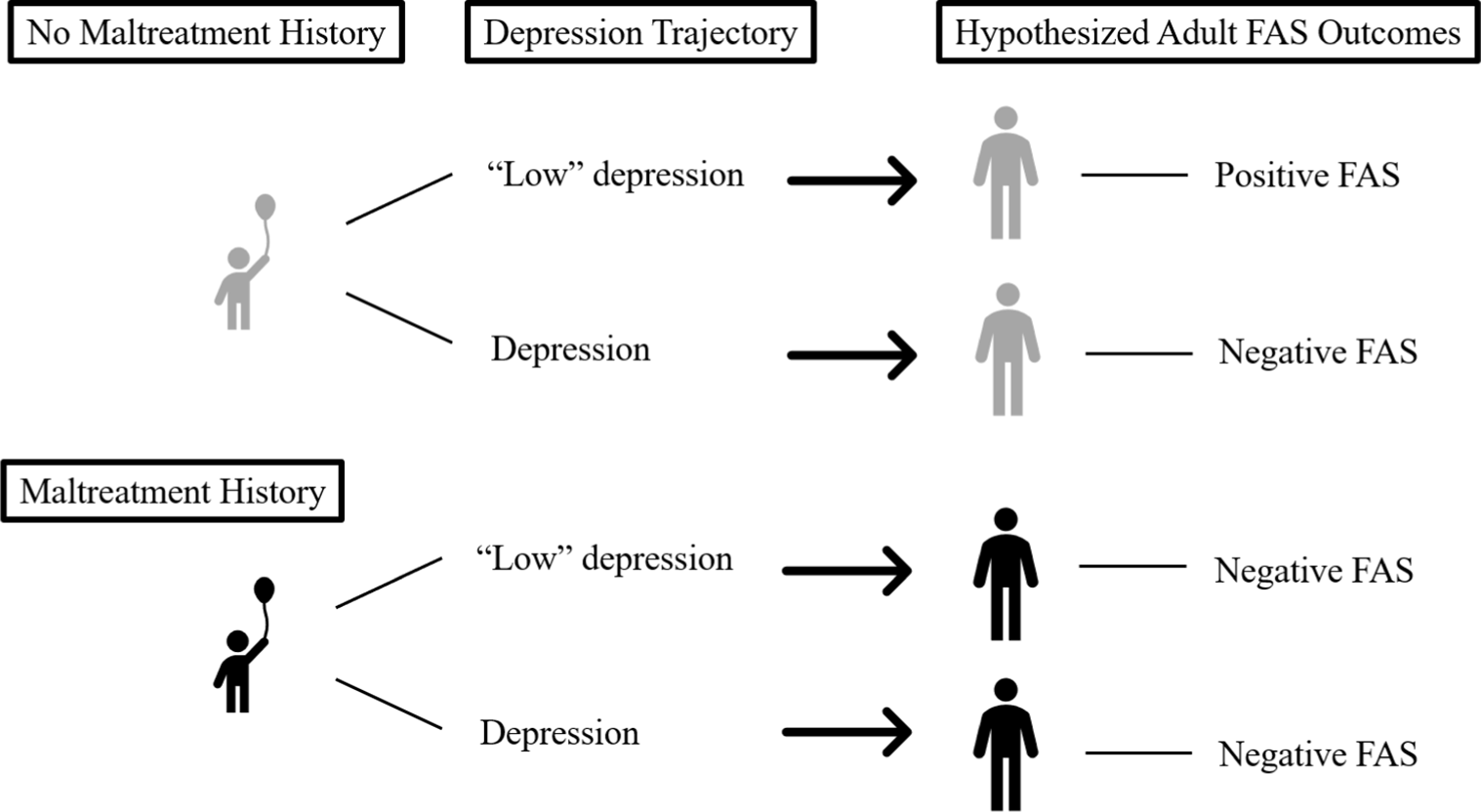
Our second objective was to examine how individuals with maltreatment histories belonging to a “low” trajectory of depression would fare relative to their counterparts without maltreatment histories in the same or similar “low” trajectory of depression on adult-measured FAS domains, including interpersonal, violence/victimization, alcohol and substance abuse/dependency, physical health, and socioeconomic domains. Due to the negative effects of maltreatment in general, we predicted that individuals with maltreatment histories in the “low” depression trajectory would exhibit worse functioning across multiple FAS domains compared to individuals without maltreatment histories in the same or similar “low” depression trajectory (see Figure 1 for an illustration).
Hypothesized adult fundamental adaptive systems (FAS) outcomes based on childhood maltreatment history and depression trajectory
Method
Participants
This current study used data from Add Health, which was initially designed to study adolescent health and behavioral outcomes but eventually expanded to study developmental and health trajectories into the adult years (Harris et al., Reference Harris, Halpern, Whitsel, Hussey, Tabor, Entzel and Urdy2009). Add Health followed a school-based nationally representative sample of adolescents recruited from 132 schools (80 high schools and 52 middle schools) across the United States. Schools were selected with unequal probability of selection, incorporating systematic sampling methods and implicit stratification to ensure the sample was representative with respect to region, urbanicity, school size, school type, and ethnicity. In 1994–1995, Wave I data were collected from 90,118 seventh- to twelfth-grade students and a subsample of these students (and their caregivers) participated in an additional in-home interview (n = 20,745; ages 11–19). This subsample completed a follow-up in-home interview again in 1996 for Wave II (n = 14,738; grades 8–12; ages 13–20) and again in 2001–2002 for Wave III (n = 15,197; ages 18–26). Finally, in 2008–2009, these individuals participated in a fourth in-home interview for Wave IV (n = 15,701; ages 24–32). The current study included participants with data available for the variables of interest and the appropriate sampling weights (n = 12,058). Individuals at Wave I who were ages 11 (n = 1) and 12 (n = 17) were exceedingly rare in the sample and excluded from our analysis. The analyzed sample was 45% male. The racial-ethnic composition at Wave I was 16% Hispanic/Latino and 63% White, 21% Black, 2% Native American, 7% Asian, and 8% “Other.” Other demographic information for the sample, including income and educational attainment of the parents, are included in Table S1.
Measures
Depression symptoms
Depression symptoms “over the past week” were assessed at all four waves using the Center for Epidemiological Studies Depression Scale (CES-D; Radloff, Reference Radloff1977). At Wave III, 9 items were used to assess depression symptoms. Therefore, we included only those 9 items that were consistently measured at every wave. Participants responded on a 4-point scale, ranging from 0 = “never or rarely” to 3 = “most of the time or all of the time,” to items across four depression domains: somatic complaints (“bothered by things” or “too tired to do things”), depressed affect (“felt sad” or “could not shake the blues”), positive affect (“enjoyed life” or “felt as good as others”), and interpersonal problems (“felt that people disliked you”). Items with positive valence were reverse coded to aid in the interpretation of the scale. We constructed a composite score for depression across each wave (range of scores = 0–27), with higher scores indicating more severe depressive symptomology. Internal consistency for the composite score was very good at each wave (Wave I α = 0.84, Wave II α = 0.82, Wave III α = 0.81, Wave IV α = 0.81).
Maltreatment
Maltreatment items were assessed retrospectively at Waves III and IV, with items pertaining to how often respondents had been exposed to maltreatment from parents or other primary caregivers. Supervisory neglect (i.e., “By the time you started 6th grade, how often had your parents or other adult caregivers left you home alone when an adult should have been with you?”) and physical neglect (i.e., “How often had your parents or other adult caregivers not taken care of your basic needs, such as keeping you clean or providing food or clothing?”) were only measured at Wave III. Physical abuse (i.e., “How often had your parents or other adult caregivers slapped, hit, or kicked you?”) and sexual abuse (i.e., “How often had one of your parents or other adult caregivers touched you in a sexual way, forced you to touch him or her in a sexual way, or forced you to have sexual relations?”) were measured at both Waves III and IV. For these items, we used Wave III data based on empirical precedent (Brumley et al., Reference Brumley, Brumley and Jaffee2019), and also because use of earlier Wave III data establishes a greater degree of temporal separation between the predictor (i.e., childhood maltreatment history, as retrospectively reported at an earlier time point) and the adult outcome variables in our study (all measured at Wave IV)Footnote 1 . Emotional abuse (i.e., “Before your 18th birthday, how often did a parent or other adult caregiver say things that really hurt your feelings or made you feel like you were not wanted or loved?”) was only measured at Wave IV. All measures of maltreatment were rated on a 6-point scale, ranging from 0 = “never happened” to 5 = “more than 10 times.”
We identified participants as having a maltreatment history if they experienced: (1) physical abuse at least three times; (2) sexual abuse at least once; (3) emotional abuse at least 10 times; (4) supervisory neglect at least 10 times; or (5) physical neglect at least twice. We omitted measures of social services investigations due to concerns about reliability and validity (see Camasso & Jagannathan, Reference Camasso and Jagannathan2000; Runyan et al., Reference Runyan, Cox, Dubowitz, Newton, Upadhyaya, Kotch, Leeb, Everson and Knight2005). These thresholds were selected based on two factors: (1) consideration of how the threshold would align with maltreatment prevalence rates reported in epidemiological surveys and studies (Afifi & MacMillan, Reference Afifi and MacMillan2011; Finkelhor et al., Reference Finkelhor, Turner, Ormrod and Hamby2009; McLaughlin et al., Reference McLaughlin, Zeanah, Fox and Nelson2012); and (2) prior factor analytic research on the same Add Health maltreatment data (Brumley et al., Reference Brumley, Brumley and Jaffee2019), which established convergent validity for using these thresholds (albeit to inform a latent variable model of maltreatment). Using these thresholds, we constructed a variable to indicate the presence (1 = met the threshold for any type of maltreatment) or absence (0 = did not meet the threshold for any type of maltreatment) of a history of maltreatment.
Interpersonal outcomes at wave IV Footnote 2
We assessed number of close friends through the question “How many close friends do you have?” and the scale ranged from 1 = “none” to 5 = “10 or more.” Romantic relationship satisfaction regarding participants’ current/most recent relationship over the last year was measured through their responses on seven Likert scale statements: (1) “We enjoy doing even ordinary, day-to-day things together”; (2) “I am satisfied with the way we handle our problems and disagreements”; (3) “I am satisfied with the way we handle family finances”; (4) “My partner listens to me when I need someone to talk to”; (5) “My partner expresses love and affection to me”; (6) “I am satisfied with our sex life”; and (7) “I trust my partner to be faithful to me.” Responses were rated on a 5-point scale (1 = “strongly agree” to 5 = “strongly disagree”), then reverse-coded. A composite score was created (range of 7–35), where higher scores indicate higher relationship satisfaction. Participants were excluded from analyses that examined this variable if they did not report having ever been in a romantic relationship (n = 370); chi-square tests indicated there was no significant difference in maltreatment status for included versus excluded participants, χ2 (1, n = 12058) = 2.14, p = .143. Internal consistency was very good (α = 0.89).
Violence/victimization at wave IV Footnote 3
Participants were asked the following items regarding their current/most recent relationship over the last year to assess for intimate partner violence (IPV) victimization: (1) “How often has [your partner] insisted on or made you have sexual relations with him/her when you didn’t want to?” (2) “How often has [your partner] slapped, hit, or kicked you?” (3) “How often has [your partner] threatened you with violence, pushed, or shoved you, or thrown something at you that could hurt?” and (4) “How often have you had an injury, such as a sprain, bruise, or cut because of a fight with [your partner]?” The scale ranged from 0 = “never” to 6 = “more than 20 times.” We constructed a dummy binary variable for each of the four items, with 0 = “never” and 1 = any other response. Then we created a composite score (range 0–4) of these four items, where higher scores indicated more incidents of IPV victimization. Again, participants were excluded if they did not report having ever been in a romantic relationship (n = 382); chi-square tests indicated no significant difference in maltreatment status between included and excluded participants, χ2 (1, n = 12058) = .94, p = .332. Internal consistency was acceptable (α = 0.76).
Similarly, participants were asked the following items to assess for IPV perpetration: (1) “How often have you threatened [your partner] with violence, pushed or shoved him/her, or thrown something at him/her that could hurt?” (2) “How often have you slapped, hit, or kicked [your partner]?” (3) “How often has [your partner] had an injury, such as a sprain, bruise, or cut because of a fight with you?” and (4) “How often have you insisted on or made [your partner] have sexual relations with you when he/she didn’t want to?” The scale ranged from 0 = “never” to 6 = “more than 20 times.” We constructed a dummy binary variable for each of the four items, with 0 = “never” and 1 = any other response. Then we created a composite score (range 0-4) of these four items, where higher scores indicated more incidents of IPV perpetration. Participants were excluded if they did not report having ever been in a romantic relationship (n = 382); chi-square tests indicated no significant difference in maltreatment status between included and excluded participants, χ2 (1, n = 12058) = .56, p = .456. Internal consistency was acceptable (α = 0.70).
SV victimization was measured by participants’ responses to the following items: (1) “Have you ever been forced, in a non-physical way, to have any type of sexual activity against your will?” or (2) “Have you ever been physically forced to have any type of sexual activity against your will?” Participants were instructed to exclude any experiences with a parent or caregiver. Both items were rated on a binary scale (0 = “no” and 1 = “yes”), and we constructed a dummy binary variable for the presence (1 = participant answered “yes” to either question) or absence (0 = participant answered “no” to both items) of SV victimization.
Alcohol and substance abuse/dependency at wave IV
We used lifetime DSM-IV criteria to assess for alcohol abuse or dependency, marijuana abuse or dependency, and illicit drug abuse or dependency. Abuse or dependency was defined as the presence of at least 1 of the 4 items pertaining to abuse and/or at least 3 of the 7 items pertaining to dependency (Li, Reference Li2019).
Physical health at wave IV
BMI and blood pressure were measured through biomarker data collected in Wave IV. BMI (range 14.40–97.40) was calculated from the height, weight, and sex of the participant. Participants were grouped into the following classes based on blood pressure: normal (systolic <120, diastolic <80), prehypertension (systolic 120–139 or diastolic 80–89), hypertension I (systolic 140–159 or diastolic 90–99), or hypertension II (systolic 160+ or diastolic 100+). General physical health was assessed by the question “In general, how is your health?” The scale ranged from 1 = “excellent” to 5 = “poor.”
Socioeconomic outcomes at wave IV
Current employment status was measured as whether participants responded affirmatively to “Are you currently working for pay at least 10 hr a week?” Personal annual earnings were assessed by the question “In 2006/2007/2008, how much income did you receive from personal earnings before taxes?” We assessed for personal annual earnings (as opposed to gross household income) to capture individual-level socioeconomic status. Educational attainment was defined by asking participants “What is the highest level of education that you have achieved to date?” Responses ranged from 1 = “8th grade or less” to 13 = “completed post-baccalaureate professional education.”
Data analysis
Step 1: Depression symptom trajectories in youths with maltreatment histories and without
We used growth mixture modeling (GMM) to estimate mean growth curves of depression symptoms from age 13-32 using Mplus 7.4. GMM is a person-centered analytic approach that combines traditional growth modeling (a single growth curve estimate) and latent class growth analysis (multiple latent growth curve estimates; Muthén & Muthén, Reference Muthén and Muthén2000). This approach allows for the identification of homogenous subgroups within a heterogenous sample, based on latent class trajectories. GMM allows for these trajectories to be freely estimated, thereby capturing variance even within subgroups (Jung & Wickrama, Reference Jung and Wickrama2008). Following several prior Add Health studies (Barboza, Reference Barboza2020; Carlson & Oshri, Reference Carlson and Oshri2018; Lauterbach & Armour, Reference Lauterbach and Armour2016; Li et al., Reference Li, Zhang, Wang and Lu2022), we opted to use GMM in order to capture individual variation in depression trajectories within subgroups (i.e., youths with maltreatment histories vs. youths without).
An accelerated longitudinal (i.e., cohort-sequential) design was employed to reconstruct the Add Health dataset so that age (instead of Wave) represented the time variable. An accelerated longitudinal design features data that are “missing by design” (Muthén & Muthén, Reference Muthén and Muthén2007), because data are not missing in relation to the actual variable assessed. This design was employed because Add Health data feature relatively high degrees of age heterogeneity at each Wave (i.e., ages 11–17 at Wave I, ages 13–20 at Wave II, ages 18–26 at Wave III, etc.), such that examining depression symptoms measured at each Wave (instead of by age) would have led to serious interpretation problems. For instance, some individuals in the Add Health study were young adolescents at Wave II (age 13 or 14 and likely still in high school), whereas others at Wave II were young adults (age 19 or 20 and likely in college or working). A Wave-based growth mixture model of depression symptoms would not be able to account for the age heterogeneity at each Wave. Notably, participants will have at most only four points of data in (because they were only assessed at the four Waves), meaning that most participants will have large amount of missing data. Mplus handles this pattern of missingness through the expectation maximization (EM) algorithm (see Duncan et al., Reference Duncan, Duncan, Strycker and Chaumeton2007 for more details).
To determine the optimal form factor in the GMM, we modeled growth trajectories separately in individuals with and without maltreatment histories and compared model fit statistics across the following parameters: intercept only; intercept and slope; intercept, slope, and quadratic. We report the Akaike Information Criterion (AIC) and Bayesian Information Criterion (BIC) values (lower AIC and BIC values indicate better fit), entropy (higher entropy values, approaching 1.0, indicate clear differentiation of classes), and the Lo-Mendell-Rubin likelihood ratio test (LMR-LRT) p-value (low p-value rejects the k-1 class model in favor of the k class model). Optimal models were identified based on fit statistics, theoretical and substantive interpretability, and proportion of sample within each class (Jung & Wickrama, Reference Jung and Wickrama2008; Nylund et al., Reference Nylund, Asparouhov and Muthén2007).
Step 2: Comparing the parameters (i.e., intercepts and slopes) between depression trajectories of individuals with versus without maltreatment histories
Following the selection of the optimal GMM model for depression in individuals with and without maltreatment histories, we then examined between-group differences of the parameters to determine whether there were significant differences between the depression trajectories. We tested the equality of parameters (e.g., slope and intercept factors) using Wald chi-square tests.
Step 3: Between-group differences in FAS
Finally, between-group (maltreatment vs. no-maltreatment) comparisons of FAS were examined. First, class membership data was saved from the best fitting GMM Mplus models, then group/mean differences on FAS were tested between class memberships in R. Specifically, general linear models for continuous outcomes and generalized linear models for non-continuous outcomes were tested to examine differences between individuals with and without maltreatment histories, matched by trajectory (i.e., “low” vs. “low,” “increasing” vs. “increasing,” etc.). All models accounted for multiple testing (and Type I error) by Bonferroni correction, with the alphas set to .003. Cohen’s d statistics (where d = .2 indicates a small effect size, d = .5 a medium effect size, and d = .8 a large effect size; Cohen, Reference Cohen1988) were also reported.
Covariates
Sex, race/ethnicity, parental income, and parental education are all known to covary with the primary variables in our study (Banyard et al., Reference Banyard, Williams and Siegel2004; Farah, Reference Farah2017; Gibb et al., Reference Gibb, Chelminski and Zimmerman2007; Hargrove et al., Reference Hargrove, Halpern, Gaydosh, Hussey, Whitsel, Dole, Hummer and Harris2020). Therefore, we included these variables in our analyses of group differences in FAS These variables were coded as follows: age (continuous), sex (1 = male, 2 = female), race/ethnicity (1 = White, 2 = Black, 3 = other), parental income (continuous), and parental education (1 = 8th grade or less, 2 = some high school, 3 = high school diploma/GED, 4 = some college, 5 = college/university degree, 6 = professional training beyond college). Additionally, we controlled for depression symptoms at Wave IV to further ensure that any between-group differences in FAS were not due to concurrent depression symptoms.
Results
Descriptive statistics
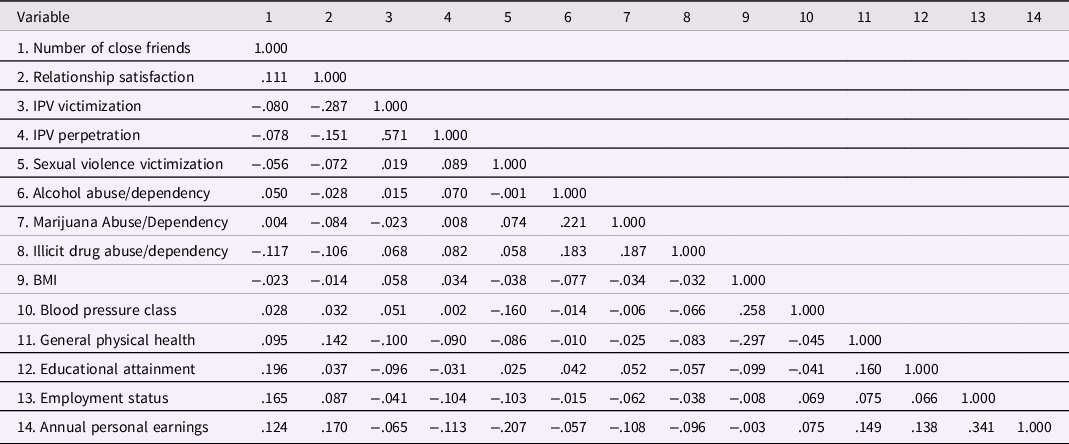
Table S1 displays the mean comparisons between individuals with and without maltreatment histories on all study variables. Table 1 shows FAS correlations. As expected, youths with maltreatment histories exhibited higher levels of depression compared to individuals without maltreatment histories at Wave I, t (6640.17) = −13.36, p < .001, Cohen’s d = .27; Wave II, t (5160.92) = −12.14, p < .001, Cohen’s d = .28; Wave III, t (6497.28) = −16.00, p<.001, Cohen’s d = .33; and Wave IV, t (6609.22) = −15.67, p < .001, Cohen’s d = .31. At Wave IV, individuals with maltreatment histories reported lower romantic relationship satisfaction, t (6913.75) = 9.80, p < .001, Cohen’s d = .20. They also reported more IPV victimization, t (6112.16) = −9.47, p < .001, Cohen’s d = .20; more IPV perpetration, t (6120.89) = −8.13, p < .001, Cohen’s d = .16; and more SV victimization, t (6013.38) = −12.50, p < .001, Cohen’s d = .25, relative to individuals without maltreatment histories. They also reported more alcohol abuse/dependency, t (3380.99) = −5.52, p < .001, Cohen’s d = .17, and more marijuana abuse/dependency, t (2600.04) = −5.24, p < .001, Cohen’s d = .18. Finally, individuals with and without maltreatment histories significantly differed on general physical health, χ2 (4, n = 12058) = 104.52, p < .001, and educational attainment, χ2 (12, n = 12054) = 82.48, p < .001. Individuals with and without maltreatment histories did not significantly differ on number of close friends, χ2 (4, n = 11875) = 13.41, p = .009; illicit drug abuse/dependency, t (1224) = −.54, p = .589, Cohen’s d = .02; BMI, t (7048.09) = −2.73, p = .006, Cohen’s d = .05; blood pressure class, χ2 (3, n = 11697) = 2.31, p = .510; employment status, χ2 (1, n = 10016) = 1.60, p = .207; or average annual personal earnings, t (11508) = 1.24, p = .214, Cohen’s d = .02, at Wave IV.
Correlations between FAS variables
Step 1: Depression symptom trajectories in youths with maltreatment histories versus without
We tested GMMs from two to six classes to determine the best fitting form factor of depression for individuals with and without maltreatment histories. Table S2 provides fit statistics for each GMM. For both groups, a three-class linear GMM emerged as the best fitting form factor (see Figure 2). Based on AIC and BIC values, LMR-LRT hypothesis tests, and theoretical and substantive interpretability, the three-class linear model for individuals without maltreatment histories (AIC = 167,389.64; BIC = 167,607.20; LMR-LRT p-value = .001) fit the data better than the two-class linear model (AIC = 168,232.38; BIC = 168,428.88; LMR-LRT p-value < .001) and the four-class linear model (AIC = 166,993.70; BIC = 167,232.30; LMR-LRT p-value = .133). The entropy (.84) for the three-class model indicated clear differentiation of classes across the sample. Similarly, the three-class linear model for individuals with maltreatment histories (AIC = 80,845.85; BIC = 81,039.45; LMR-LRT p-value = .010) fit the data better than the two-class linear model (AIC = 81,126.478; BIC = 81,301.34; LMR-LRT p-value < .001) and the four-class linear model (AIC = 80,711.82; BIC = 80,924.16; LMR-LRT p-value = .071). The entropy (.77) for the three-class model indicated clear differentiation of classes across the sample.
Estimated means of the trajectories of depressive symptoms. Trajectories for those with maltreatment histories shown in black solid lines. Trajectories for those without maltreatment histories shown in gray dotted lines.
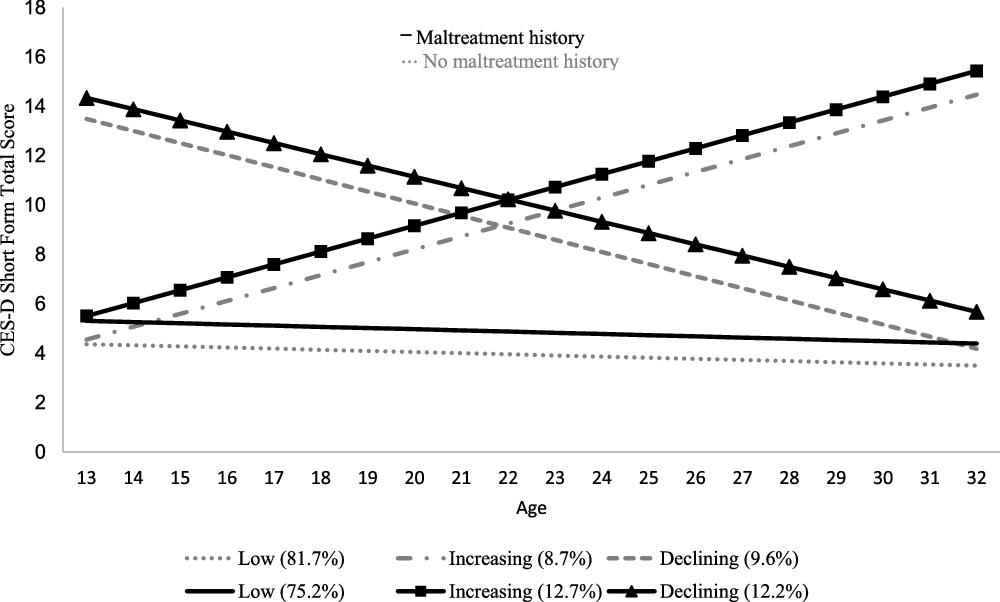
In the three-class model, we observed “low” (81.7%), “increasing” (8.7%), and “declining” (9.6%) growth trajectories among individuals without maltreatment histories. Among individuals with maltreatment histories, we similarly observed “low” (75.2%), “increasing” (12.7%), and “declining” (12.2%) growth trajectories. Individuals in the “low” classes in both groups exhibited chronically low levels of depression from early adolescence into adulthood. Individuals in the “increasing” class reported similarly low levels of depression at baseline (age 13) but then exhibited a steady increase in depressive symptoms over time. Finally, “declining” class individuals exhibited high initial depression in early adolescence then a steady decline, resulting in virtually indistinguishable levels of depression relative to “low” class individuals by their mid-30s.
Step 2: Comparing the parameters (i.e., intercepts and slopes) between depression trajectories of individuals with versus without maltreatment histories
We conducted Wald chi-square tests to determine whether there were significant group differences in the parameters (i.e., intercepts and slopes) for each of the depression trajectories between individuals with and without maltreatment histories. Individuals with maltreatment histories in the “low” trajectory were 22% more depressed at baseline (i.e., intercept; χ2 (1) = 70.08, p < .001) than individuals without maltreatment histories in the “low” trajectory, but their slopes did not significantly differ, χ2 (1) = .37, p = .551. Individuals with maltreatment histories in the “declining” class exhibited 6% more depression at baseline relative to individuals without maltreatment histories, χ2 (1) = 11.37, p < .001, but did not exhibit significantly different slopes, χ2 (1) = .07, p = .791. For individuals in the “increasing” classes, we did not find a significant difference between individuals with and without maltreatment histories either at baseline, χ2 (1) = 3.80, p = .051, or in slopes, χ2 (1) = .48, p = .487. Overall, individuals with maltreatment histories in the “low” and “declining” class were consistently more depressed relative to their counterparts without maltreatment histories at baseline, while individuals with maltreatment histories in the “increasing” class did not differ in their baseline levels of depression compared to their counterparts without maltreatment histories.
Step 3: Between-group differences in FAS
We then examined between-group (maltreatment histories vs. without) differences in the following FAS domains measured at Wave IV: interpersonal, violence/victimization, alcohol and substance abuse/dependency, physical health, and socioeconomic domains across “low,” “increasing,” and “declining” trajectories (see Table S3).
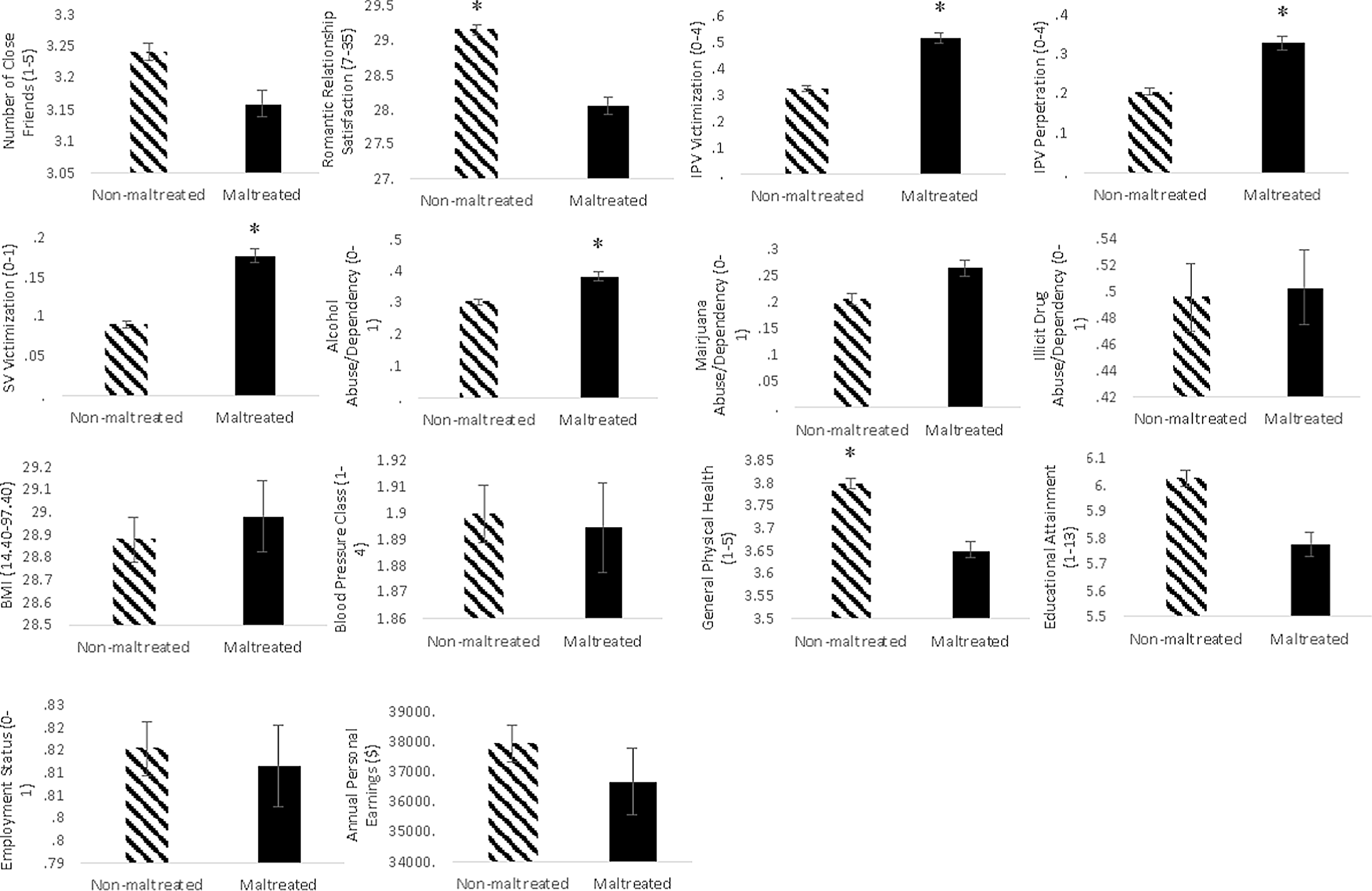
First, we compared individuals with maltreatment histories in the “low” trajectory with individuals without maltreatment histories in the “low” trajectory on FAS domains (Figure 3). For this trajectory, individuals with maltreatment histories reported 4% lower romantic relationship satisfaction, χ2 (1) = 25.54, p < .001, Cohen’s d = .20; 63% more IPV victimization, χ2 (1) = 46.72, p < .001, Cohen’s d = −.22; 65% more IPV perpetration, χ2 (1) = 93.08, p < .001, Cohen’s d = −.18; 100% more SV victimization, χ2 (1) = 114.48, p < .001, Cohen’s d = −.26; 27% more alcohol abuse/dependency, χ2 (1) = 15.13, p < .001, Cohen’s d = −.17; and 4% lower general physical health ratings, χ2 (1) = 13.72, p<.001, Cohen’s d = −.17.
Between-group differences of individuals with and without maltreatment histories in the low depression trajectory across FAS domains.
Next, we compared the “increasing” trajectories between individuals with and without maltreatment histories. In these comparisons, no significant differences on FAS emerged between these groups. Finally, when we compared the “declining” trajectories between individuals with and without maltreatment histories, we found that individuals with maltreatment histories had 72% more IPV victimization, χ2 (1) = 12.34, p < .001, Cohen’s d = −.29, and 65% more SV victimization; χ2 (1) = 17.43, p < 0.001, Cohen’s d = −.29. No other differences in FAS domains emerged.
Discussion
The present study used a developmental psychopathology framework to examine whether youths with and without maltreatment histories differ in their trajectories of depression as well as FAS domains in adulthood. First, we identified three distinct developmental trajectories of depression in individuals with and without maltreatment histories, including “low,” “increasing,” and “declining” trajectories. Consistent with our first hypothesis, we found that the majority of individuals in the Add Health study – and specifically, 75.2% of individuals with maltreatment histories – would be classically labelled as “resilient” with respect to depression. Additionally, across trajectories, although individuals with maltreatment histories were more depressed at baseline than individuals without maltreatment histories, the rates of change in depression symptoms by maltreatment history did not differ. In support of our second hypothesis, we found that individuals with maltreatment histories in the “low” depression trajectory had significantly worse outcomes across the FAS domains of romantic relationship satisfaction, violence/victimization, alcohol and marijuana abuse/dependency, and educational attainment when compared to individuals without maltreatment histories in the same depression trajectory. Thus, although most youths with maltreatment histories had low levels of depression throughout their adolescent and early adult years as expected, these individuals still experienced more difficulties in many other areas of their adult lives relative to individuals without maltreatment histories with low levels of depression. This finding importantly reinforces the pitfall of referring to large swathes of individuals as being “resilient” to maltreatment on the basis of a single (albeit, common) domain of functioning (Infurna & Luthar, Reference Infurna and Luthar2016).
Developmental trajectories of depression in individuals with versus individuals without maltreatment histories
We found that individuals with and without maltreatment histories exhibited essentially the same form factors of depression trajectories over time. In both groups, we found that the majority (>75%) of individuals belonged to a depression trajectory that was characterized by consistently low levels of depression from adolescence into adulthood. This is consistent with prior (albeit, cross-sectional) findings of depression rates within youths with maltreatment histories, which has shown that around 70%–75% of youths with maltreatment histories have low or no depression (i.e., Greger et al., Reference Greger, Myhre, Lydersen and Jozefiak2015; Rehan et al., Reference Rehan, Antfolk, Johansson, Jern and Santtila2017; Widom et al., Reference Widom, DuMont and Czaja2007). As suggested by others (Infurna & Luthar, Reference Infurna and Luthar2016), our findings similarly show that depression rates alone may be a misleading proxy for resilience given that individuals with maltreatment histories still fared significantly worse compared to their counterparts across other domains (i.e., FAS), even after controlling for adult depression symptoms. Interestingly, we did not find a significant difference in depression symptoms at baseline or in the slopes between individuals with and without maltreatment histories for the most worrisome depression trajectory – “increasing.” This might be explained by the more prominent role of genetics underlying severe and/or chronic forms of depression (Kwong et al., Reference Kwong, López-López, Hammerton, Manley, Timpson, Leckie and Pearson2019; Rice et al., Reference Rice, Riglin, Thapar, Heron, Anney, O’Donovan and Thapar2019). For instance, using data from the Avon Longitudinal Study of Parents and Children, Kwong et al. (Reference Kwong, López-López, Hammerton, Manley, Timpson, Leckie and Pearson2019) found that both genetic (i.e., polygenic scores for depression) and environmental risk factors (e.g., partner cruelty to the mother, maternal postnatal depression, being bullied) were associated with the least favorable trajectories of depression symptoms (childhood persistent and early-adult onset) but not the less severe, time-limited trajectories as measured from ages 10 to 24 years. Their study provides some evidence for the larger role of genetic risk underlying the more severe forms of depression over time, although interactive effects between genetic risk and known environmental risk factors were not tested and may also be possible (Kwong et al., Reference Kwong, López-López, Hammerton, Manley, Timpson, Leckie and Pearson2019; Rice et al., Reference Rice, Riglin, Thapar, Heron, Anney, O’Donovan and Thapar2019). Alternatively, it is also possible that individuals belonging to the “increasing” trajectory may have experienced other adversities that were not measured in Add Health. For instance, Widom et al. (Reference Widom, Czaja and Dutton2008) found that 98.9% of individuals (496 abused/neglected and 396 matched controls) experienced at least one other type of trauma or victimization experience (other than maltreatment) by age 40. Therefore, individuals in the “increasing” depression trajectory may be more likely to experience additional forms of trauma or victimization (perhaps during their adult years) in addition to childhood maltreatment. Future studies should examine whether there may be unique etiological origins underlying more severe or chronic forms of depression (over other forms), including the possibility of genetic and more complex multi-environmental interactions.
Comparing FAS in individuals with maltreatment histories versus individuals without
Individuals with maltreatment histories in the “low” depression trajectory (∼75% of individuals with maltreatment histories) exhibited worse functioning in nearly every (but not all) FAS domain, including romantic relationship satisfaction, experiences of violence/victimization, alcohol abuse/dependency, and general physical health compared to individuals without maltreatment histories who were also in the “low” depression trajectory (∼81% of individuals without maltreatment histories). These differences were even observed after we controlled for adult depression symptoms at Wave IV in our models. We discuss our interpretations for each the FAS that differed between individuals with and without maltreatment histories below (see Figure 3).
We found that individuals with maltreatment histories had worse interpersonal functioning, including more romantic relationship dissatisfaction, IPV, and SV relative to their low depression counterparts without maltreatment histories. We did not find a significant difference between individuals with and without maltreatment histories on number of close friends, though this may be due to having assessed for quantity rather than the quality of those close friendships. We surmise that worse interpersonal functioning among individuals with maltreatment histories (but no depression) may be a consequence of the generally impaired social functioning that stems from maltreatment exposure. Social learning theory posits that individuals with maltreatment histories may mirror the problematic social scripts and behavior modeled for them in childhood, thus disrupting their social interaction patterns and ability to form and maintain positive interpersonal relationships (Belsky et al., Reference Belsky, Steinberg and Draper1991). In turn, studies have shown that maltreatment is a significant predictor of intimacy disturbance (e.g., fear of showing vulnerability, distrust, ambivalence toward interpersonal relationships; Davis et al., Reference Davis, Petretic-Jackson and Ting2001). Attachment theory also may be relevant to understanding linkages between maltreatment and later violence perpetration and victimization. For example, Godbout et al. (Reference Godbout, Daspe, Lussier, Sabourin, Dutton and Hébert2017) found that childhood experiences of family violence predicted relationship violence perpetration through attachment anxiety (of abandonment) while attachment avoidance (of intimacy) and relationship violence predicted relationship dissatisfaction. Thus, it is possible that individuals with maltreatment histories may experience intimacy difficulties and resort to violence to a greater degree than individuals without maltreatment histories due to early exposure to violence and lack of opportunities to model pro-social relationship interactions. Again, our findings show that these associations are observed over and above the effects of depression symptoms measured over time.
Among those in the low trajectory of depression, we also found that individuals with maltreatment histories reported more alcohol abuse/dependency compared to individuals without maltreatment histories in the same trajectory. We did not detect a significant difference in marijuana abuse/dependency and illicit drug abuse/dependency however, although we surmise that this might have been due to the very low prevalence of marijuana and illicit drug use in our sample. It is possible that, even in the absence of depression, individuals with maltreatment histories may turn to alcohol especially as a means to cope with or reduce distress caused, either directly or indirectly, by maltreatment (Shin et al., Reference Shin, Jiskrova, Yoon and Kobulsky2020b). For example, one study found that all types of maltreatment were associated with lifetime alcohol use disorder in a nationally representative sample of US adults aged 20 and older, even after controlling for socioeconomic factors and lifetime mood, anxiety, or personality disorders (Afifi et al., Reference Afifi, Henriksen, Asmundson and Sareen2012). While some studies have suggested that depression explains the relationship between childhood maltreatment and later adult substance use (Lo & Cheng, Reference Lo and Cheng2007; Shin et al., Reference Shin, Jiskrova, Yoon and Kobulsky2020a), other studies, including ours, indicate otherwise – that the link between childhood maltreatment and problematic adult alcohol use may not be fully explained by concurrent depression and that there may be other indirect pathways between maltreatment and alcohol use that account for this association (Shin et al., Reference Shin, Miller and Teicher2013). For example, in a sample of 10,123 adolescents ages 13–18, alcohol and substance use disorders were observed in 17%–20% of youth with anxiety disorders compared to 13%–19% of youth with mood disorders (Conway et al., Reference Conway, Swendsen, Husky, He and Merikangas2016). Crucially, this study did not account for maltreatment, and to our knowledge, there has not yet been a study to examine these variables simultaneously. Finally, substance use disorders are moderately heritable (Hicks et al., Reference Hicks, Iacono and McGue2012) and parental substance use is also known to increase maltreatment perpetration (Famularo et al., Reference Famularo, Kinscherff and Fenton1992; Walsh et al., Reference Walsh, MacMillan and Jamieson2003). Collectively, these results support the importance of examining substance abuse/dependency differentially by substance, rather than grouping them together, while simultaneously accounting for multiple types of concurrent psychopathology.
Additionally, among those in the “low” depression trajectory, we found that individuals with maltreatment histories reported having worse general physical health than youths without maltreatment histories. This may be due to the impact of childhood maltreatment on physical health via allostatic load (McEwen, Reference McEwen1998). A 30-year prospective longitudinal study found that childhood abuse and neglect contributed higher allostatic load and overload by middle adulthood (Widom et al., Reference Widom, Horan and Brzustowicz2015); subsequently, there is a strong association of higher allostatic load and poorer physical health outcomes as described in a recent systematic review (Guidi et al., Reference Guidi, Lucente, Sonino and Fava2021). Some researchers have suggested for certain groups, resilience may only really be “skin-deep” wherein these youths exhibit low levels of adjustment problems (e.g., depression, externalizing problems, high school dropout) but high levels of allostatic load and other physical health problems (Brody et al., Reference Brody, Yu, Chen and Miller2020; Brody et al., Reference Brody, Yu, Chen, Miller, Kogan and Beach2013). However, there were no significant differences observed between these two groups on BMI and blood pressure, however, suggesting that depression itself may play a bigger role in the development of these outcomes as a function of maltreatment status. For instance, in a meta-analysis of 41 studies (190,285 participants), associations between childhood maltreatment and obesity became non-significant after adjusting for current depression (Danese & Tan, Reference Danese and Tan2014).
Finally, there were no significant differences between individuals with and without maltreatment histories in the “low” depression trajectory for socioeconomic outcomes, including educational attainment, employment status, and annual personal earnings. This finding was surprising because prior studies had established that there are robust associations between maltreatment exposure and later socioeconomic outcomes (Currie & Widom, Reference Currie and Widom2010; Zielinski, Reference Zielinski2009). Our findings suggest accounting for one’s depression may help to explain these associations, Footnote 4 or that having low depression symptoms may blunt the negative effects of maltreatment on one’s economic outcomes. Depression itself is a key risk factor for socioeconomic adversity in later life. Early onset (before age 22) depression has been shown to adversely affect one’s future personal earnings by up to 18% according to one large study of chronically depressed patients in a randomized controlled trial that compared the efficacy of antidepressants (Berndt et al., Reference Berndt, Russell, Miceli, Colucci, Xu and Grudzinski2000). Future studies should test whether other forms of psychopathology, including but not limited to depression, may mediate or moderate the relationship between childhood maltreatment and future economic outcomes.
Limitations
Several study limitations are noteworthy. First, despite focusing on multiple domains of functioning as adult outcomes (i.e., FAS), we only examined a single domain of psychopathology (i.e., depression symptoms) over time. Depression co-occurs with other psychopathologies, including anxiety disorders (Kotov et al., Reference Kotov, Krueger, Watson, Achenbach, Althoff, Bagby, Brown, Carpenter, Caspi, Clark, Eaton, Forbes, Forbush, Goldberg, Hasin, Hyman, Ivanova, Lynam, Markon and Zimmerman2017) and PTSD (Jaffee, Reference Jaffee2017). Unfortunately, the Add Health dataset is limited in its assessment of psychopathology over time. Symptoms of anxiety and other internalizing symptoms were only assessed at Wave IV, such that modeling a broader spectrum of internalizing (or general) psychopathology over time was not feasible. Ongoing prospective longitudinal studies, such as the Adolescent Brain Cognitive Development (ABCD) study, may be better positioned to assess for a wider spectrum of psychopathologies over time as a function of maltreatment exposure.
Second, maltreatment was retrospectively reported in Add Health, which may underestimate the prevalence of “true” maltreatment in our sample (Hardt & Rutter, Reference Hardt and Rutter2004). Some studies have shown that retrospective reports of maltreatment, while limited, are comparable to prospective reports (e.g., Reuben et al., Reference Reuben, Moffitt, Caspi, Belsky, Harrington, Schroeder, Hogan, Ramrakha, Poulton and Danese2016), whereas other studies showed that prospective and retrospective measures of childhood maltreatment may elucidate different risk pathways to mental illness (Balwin et al., Reference Balwin, Reuben, Newbury and Danese2019). Multi-modal methods are needed to better assess for maltreatment in future survey-based research studies, such as Add Health. We also acknowledge that our employment of different thresholds for each of the maltreatment items may have an impact on our results, such that applying a less conservative threshold for certain maltreatment items would likely incorporate more individuals into the maltreatment history category. Future studies could consider running models using different maltreatment thresholds to validate whether study findings are robust to these measurement differences.
Third, although gender was included in all of our models as a covariate, we did not examine gender differences in depression trajectories or FAS. We acknowledge that there are notable gender differences in maltreatment, depression, and FAS (Gilbert et al., Reference Gilbert, Widom, Browne, Fergusson, Webb and Janson2009; Hargrove et al., Reference Hargrove, Halpern, Gaydosh, Hussey, Whitsel, Dole, Hummer and Harris2020), but a stratification by gender in the current study would have drastically limited our statistical power and ability to identify homogenous latent classes in our depression growth mixture models, which were already stratified by maltreatment status. Additionally, the focus on gender differences was outside of the scope of our current investigation, as examining demographic group differences (e.g., gender, socioeconomic status, race-ethnicity) would have warranted a separate investigation to ensure that those findings are interpreted with the proper context in mind.
Fourth, FAS were only examined at one time point – at adulthood when participants were in their early 30 s. Bolger and Patterson (Reference Bolger, Patterson and Luthar2003) noted that the salience of certain domains of functioning shift over time. For example, academic performance is salient during adolescence but not in adulthood, while annual income is salient in adulthood but less so during adolescence. Furthermore, the collection of Wave IV data occurred in 2008–2009, which was more than a decade ago. Wave V data were not available at the time that the study was conceptualized but we plan to incorporate more recent Waves in follow up studies to capture later adult functioning in the Add Health sample.
Finally, it is important for future research to replicate our GMM findings under different model specifications, as well as in different populations to ensure that the trajectories are generalizable. Strict model assumptions can lead to an overestimation of the most common classes in GMM (typically, the “resilient” class; Infurna & Luthar, Reference Infurna and Luthar2016). While the number (and form factor) of the depression growth trajectories we identified in our study was consistent with prior GMM studies on depression (see meta-analysis by Musliner et al., Reference Musliner, Munk-Olsen, Eaton and Zandi2016), we could not rule out the possibility that individuals belonging in the “low” depression group were overestimated given that we applied the same stringent assumptions as conventional in the field to date.
Clinical and policy implications
While it is true that most individuals with maltreatment histories did not exhibit worrisome trajectories of depression from adolescence into adulthood, these same individuals still exhibited significantly more difficulties in other domains, including in their romantic relationships, violence/victimization, alcohol use, and general physical health, compared to individuals without maltreatment histories. Accordant to the findings by Infurna and Luthar (Reference Infurna and Luthar2016), our findings similarly call into question the true prevalence of resilience in maltreatment studies, given that individuals with maltreatment histories are still negatively impacted as adults across a multitude of domains that may not be considered in studies focusing strictly on a single domain of resilience, such as depression. For instance, being labeled as resilient during sensitive periods of development (e.g., adolescence) may carry harmful and lasting stigmatizing effects for some individuals, where these individuals may not feel as comfortable in seeking mental or occupational health services that they may still benefit from. From a public policy perspective, mislabeling individuals who experience maltreatment as resilient may have the harmful consequence of leading policymakers to withhold much needed resources to individuals who may be suffering from the effects of adversity (Infurna & Luthar, Reference Infurna and Luthar2016).
More sweeping efforts are needed to address the consequences of childhood maltreatment, starting perhaps with the need to move away from looking for the presence or absence of a psychiatric diagnosis before services are rendered to vulnerable youths with maltreatment histories. For example, early intervention programs may be geared toward reducing emotion dysregulation instead of treating mental disorders through the development of positive coping skills for youths with maltreatment histories (e.g., self-compassion, problem-solving, seeking support). Emotion dysregulation has been shown to play a significant role in the relationship between maltreatment and romantic relationship satisfaction (Bradbury & Shaffer, Reference Bradbury and Shaffer2012), revictimization (Messman-Moore et al., Reference Messman-Moore, Walsh and DiLillo2010), violence perpetration (Bliton et al., Reference Bliton, Wolford-Clevenger, Zapor, Elmquist, Brem, Shorey and Stuart2016), as well as alcohol and substance abuse/dependency (Mandavia et al., Reference Mandavia, Robinson, Bradley, Ressler and Powers2016). Additionally, our findings that maltreatment is associated with poor relationship outcomes, including violence perpetration and victimization, is consistent with prior work (e.g., McMahon et al., Reference McMahon, Hoertel, Wall, Okuda, Limosin and Blanco2015) and highlights the importance of population-level violence prevention programming. Although school-based dating violence prevention programs generally show limited effects on perpetration and victimization (De La Rue et al., Reference De La Rue, Polanin, Espelage and Pigott2017; Fellmeth et al., Reference Fellmeth, Heffernan, Nurse, Habibula and Sethi2013), programs designed to reduce violence among adolescents with maltreatment histories specifically have shown promising reductions in partner violence perpetration and victimization (Foshee et al., Reference Foshee, Benefield, Dixon, Chang, Senkomago, Ennett, Moracco and Bowling2015; Lundgren & Amin, Reference Lundgren and Amin2015; Mennicke et al., Reference Mennicke, Bush, Brancato and Coker2021; Wolfe et al., Reference Wolfe, Wekerle, Scott, Straatman, Grasley and Reitzel-Jaffe2003).
From a social policy perspective, there have been increasing calls by scholars to shift some of the focus away from dedicating resources strictly towards individual-based interventions towards preventing maltreatment from happening in the first place (Branco et al., Reference Branco, Altafim and Linhares2021; Luthar & Eisenberg, Reference Luthar and Eisenberg2017). For instance, early parental education programs geared towards developing positive parenting strategies and strengthening parental emotion regulation have been shown to reduce risk for childhood maltreatment (Branco et al., Reference Branco, Altafim and Linhares2021). Yet, these programs have not been thoroughly implemented in communities (Jones Harden et al., Reference Jones Harden, Simons, Johnson-Motoyama and Barth2020). Policymakers may want to consider allocating more resources towards the implementation of childhood maltreatment prevention programs, as prevention is a far more effective way to reduce the harmful and pernicious effects of childhood maltreatment from taking hold in the first place.
Supplementary material
The supplementary material for this article can be found at https://doi.org/10.1017/S0954579423000032
Acknowledgments
This research uses data from Add Health, a program project directed by Kathleen Mullan Harris and designed by J. Richard Udry, Peter S. Bearman, and Kathleen Mullan Harris at the University of North Carolina at Chapel Hill and funded by grant P01-HD31921 from the Eunice Kennedy Shriver National Institute of Child Health and Human Development, with cooperative funding from 23 other federal agencies and foundations. Special acknowledgment is due Ronald R. Rindfuss and Barbara Entwisle for assistance in the original design. Information on how to obtain the Add Health data files is available on the Add Health website (http://www.cpc.unc.edu/addhealth). No direct support was received from grant P01-HD31921 for this analysis.
Author contributions
SSW conducted the data analysis and drafted the manuscript. KW assisted in the interpretation of the data and provided edits to the manuscript. JJL conceived the design of the study, assisted in the interpretation of the data, and provided substantial edits to the manuscript. All authors reviewed the final manuscript.
Funding statement
This work was supported in part by a core grant to the Waisman Center from the Eunice Kennedy Shriver National Institute of Child Health and Human Development (P50HD105353) as well as from a seed grant from the University of Wisconsin-Madison Center for Human Genomics and Precision Medicine awarded to JJL.
Conflicts of interest
None.
Ethical standards
The University of Wisconsin-Madison Education and Social Sciences Institutional Review Board has approved of all aspects of the study (IRB #2015-1189).



