INTRODUCTION
Leishmaniasis is a disease caused by infection with the protozoan Leishmania which is transmitted by the bite of a phlebotomine sand fly infected with the parasite. The clinical forms of the disease in man are cutaneous, mucocutaneous or visceral. Cutaneous leishmaniasis is the most frequent clinical form and is most commonly caused in Europe, Africa and Asia by L. major whereas, in the American Continent, cutaneous leishmaniasis is most often caused by L. mexicana, L. braziliensis or L. amazonensis. This last species can, albeit rarely, cause diffuse cutaneous leishmaniasis in man and therefore dissemination is an important aspect of L. amazonensis infection.
Leishmania is a dimorphic parasite. Flagellated promastigotes multiply in the gut of the phlebotomine and intracellular amastigotes infect and divide inside mammalian macrophages. The infective forms that are transmitted to the mammalian host are called metacyclics and the non-infecting forms are procyclics (da Silva and Sacks, Reference Da Silva and Sacks1987). These two forms are found in cell-free cultures in which the procyclics proliferate and differentiate into metacyclics that are more abundant at the stationary phase of the culture (Sacks et al. Reference Sacks, Hieny and Sher1985).
Infections with L. major have been extensively studied in the mouse and disease severity depends on the genetic background. C57BL/6, C3H and CBA mice are resistant and develop self-curing small lesions at the inoculation site, while BALB/c, DBA/2 and SWR/J mice are susceptible and develop progressively larger lesions (Sacks and Noben-Trauth, Reference Sacks and Noben-Trauth2002). In contrast, most mouse inbred strains, including C57BL/6 mice, do not self-cure L. amazonensis lesions, show variable degrees of susceptibility to this infection and develop chronic non-healing lesions (McMahon-Pratt and Alexander, Reference Mcmahon-Pratt and Alexander2004).
Laboratory infections done in order to study the course of L. major (and to a much lesser extent L. amazonensis) infection in mice, traditionally used as inocula large numbers (105−107) of promastigotes obtained from stationary phase-cultures (SP-promastigotes). However, the estimate is that only 10–1000 metacyclics are left by the phlebotomine in the inoculation site at the moment of the bloodmeal (Warburg and Schlein, Reference Warburg and Schlein1986). Recently, these data were also confirmed for L. mexicana-infected sand flies whose bites deliver about 1000 promastigotes per bite of which more than 80% are metacyclics (Rogers et al. Reference Rogers, Ilg, Nikolaev, Ferguson and Bates2004).
In order to have an experimental model more closely related to the natural infection, researchers started to use as inocula metacyclic forms in numbers closer to those inoculated by the insect. Low-dose L. major metacyclic inocula were injected in the footpad (Lira et al. Reference Lira, Doherty, Modi and Sacks2000) or in the dermis of the ear of C57BL/6 mice (Belkaid et al. Reference Belkaid, Mendez, Lira, Kadambi, Milon and Sacks2000). The infection coursed with a longer lag-phase during which the local parasite numbers steadily augmented preceding a visible lesion; thereafter parasitism sharply declined. In both L. major low-dose metacyclic inoculation models, C57BL/6 mice maintained the resistant phenotype observed after traditional high-dose SP-promastigotes inoculation. On the other hand, the inoculation of highly susceptible BALB/c mice in the footpad with low doses of L. major SP-promastigotes (102–103) (which possibly had a much smaller number of infective metacyclics) did not result in progressive disease (Doherty and Coffman, Reference Doherty and Coffman1996; Menon and Bretscher, Reference Menon and Bretscher1996). Still in the footpad infection model, most BALB/c injected with 37 or 110 SP-promastigotes did not develop a visible cutaneous lesion. Among these mice, a group developed enlarged draining popliteal lymph node (LN) with detectable parasites, and ultimately cleared the infection suggesting that, confronted with a small enough number of infective forms, a host considered as susceptible can control parasitism (Uzonna et al. Reference Uzonna, Wei, Yurkowski and Bretscher2001). Courret et al. (Reference Courret, Lang, Milon and Antoine2003) compared the course of infection with different numbers of L. major or L. amazonensis metacyclics injected in the ear dermis of BALB/c mice. Inoculation of 10 L. major or L. amazonensis purified metacyclics failed to induce lesions, detectable parasitism or protective immunity in the majority of mice. A clear difference was observed in the ability of BALB/c mice to control the parasite load after inoculation of 1000 L. major or L. amazonensis metacyclics. By the 5th month of infection L. major parasitism decreased sharply and the mice became resistant to a secondary homologous challenge while L. amazonensis-infected mice maintained a high parasite load and remained susceptible to homologous challenge (Courret et al. Reference Courret, Lang, Milon and Antoine2003).
L. major metacyclics can be easily purified from axenic cultures by agglutination of procyclic forms with peanut agglutinin (Sacks et al. Reference Sacks, Hieny and Sher1985). More recently, the development and characterization of a monoclonal antibody specific for L. amazonensis procyclics made metacyclic purification easier for this species (Courret et al. Reference Courret, Prina, Mougneau, Saraiva, Sacks, Glaichenhaus and Antoine1999; Chaves et al. Reference Chaves, Soares, Da Silva and Saraiva2003; Pinto-da-Silva et al. Reference Pinto-Da-Silva, Fampa, Soares, Oliveira, Souto-Padron and Saraiva2005).
Most pre-existing studies on mouse models of L. amazonensis infection used as infection site the footpad inoculated with high numbers of SP-promastigotes. We undertook to verify, in BALB/c and C57BL/6 mice, the course of infection and dissemination after inoculation of low numbers of purified metacyclic forms in comparison with the traditionally used infection protocols that used as inocula high numbers of SP-promastigotes.
MATERIALS AND METHODS
Animals
BALB/c and C57BL/6 female mice, 6–8 weeks old were obtained from the breeding facilities of the Department of Immunology, Institute of Biomedical Sciences, University of São Paulo. All the animal handling and procedures were approved by the Institute's Committee on the ethical handling of research animals.
Parasite culture
Leishmania (Leishmania) amazonensis (WHOM/BR/75/Josefa) was provided by Dr Elvira M. Saraiva, Rio de Janeiro/Brazil). The parasites were maintained by periodic infection and re-isolation from BALB/c mice. Culture-derived parasites were injected in BALB/c mice before completing 6 passages in order to maintain the virulence. Promastigotes were grown at 25°C in Grace's Insect Cell Culture Medium (GIBCO-BRL Life Technologies, Grand Island, NY, USA) containing 20% heat-inactivated fetal bovine serum (GIBCO), penicillin (100 U/ml) and streptomycin (100 μg/ml) (antibiotics bought from SIGMA Chemical Co, St Louis, MO, USA). Cultures from the 2nd to 5th passages were used for the experimental infections of BALB/c and C57BL/6 mice.
Infection
L. amazonensis metacyclics promastigotes were obtained from stationary phase promastigote cultures (6 days) treated with the 3A1 monoclonal antibody (mAb) (hybridoma and protocol kindly given by Dr Elvira M. Saraiva) and separated by negative selection. Briefly, SP-parasites were washed twice in 0·01 m, pH 7·2, phosphate-buffered saline (PBS) by centrifugation (1000 g, 15°C, 8 min) and adjusted to 1×10⁸/ml. The parasite suspension was dispensed into the wells of a 24-well plastic tissue-culture plate (200 μl/well) and incubated for 20 min at room temperature (RT) with purified mAb 3A1 diluted 1:50 (vol/vol). The mAb was obtained from hybridoma culture supernatants and previously titrated as to its agglutinating titre for log-phase promastigotes. At the end of the incubation period 800 μl of PBS were added to each well and the plate was centrifuged at 300 g. The metacyclic enriched-supernatants were collected from the wells, pooled, washed once in PBS at 1000 g, inspected for morphology and counted. Quickly moving and slender forms with long flagella were identified as metacyclics whereas slower moving forms that were thicker and had a shorter flagellum were identified as procyclics (Pinto-da-Silva et al. Reference Pinto-Da-Silva, Fampa, Soares, Oliveira, Souto-Padron and Saraiva2005). The percentage of metacyclics in the original SP-cultures varied between 18 and 25%; after the treatment with mAb 3A1 the concentration rose to 85–95%.
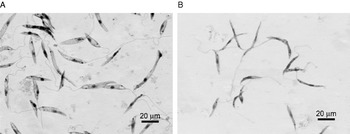
In order to obtain preparations suitable for photomicrography, drops of the parasite suspensions were deposited on clean glass-slides; immediately after drying at RT they were fixed in cold methanol for 1 min and stained with a modified Giemsa stain INSTANT-PROV (New Prov, Pinhais, Paraná, Brazil). The preparations were examined and photographed with a Nikon Microphot-Fx microscope using a 60 X oil immersion objective. The enrichment in metacyclics is shown in Fig. 1B: long and slender forms having a long flagellum predominate in the preparation after removal of procyclics with mAb 3A1. Fig 1A is of the same culture before mAb 3A1 treatment: shorter and thicker forms (procyclics) predominate while slender and intermediary forms are few.
Leishmania amazonensis promastigotes obtained from stationary-phase cultures and after treatment with the mAb 3A1 for enrichment of metacyclic forms. The SP-promastigote suspension was incubated with the monoclonal antibody 3A1 that agglutinates procyclic promastigotes, and then centrifuged. The metacyclic-rich supernatant was counted and suspensions were deposited on microscope slides, fixed and stained with Giemsa. The preparations were photographed using a 60 X immersion objective. (A) SP-promastigote suspension untreated; (B) enriched in metacyclic forms; most forms are very slender forms with a long flagellum.

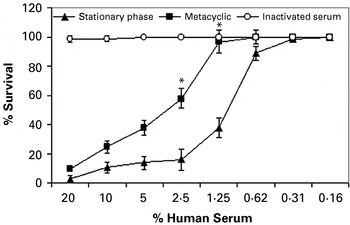
In order to obtain additional confirmation that treatment with mAb 3A1 indeed resulted in a metacyclic-enriched parasite suspension, the original SP-promastigote and the mAb3A1 treated (metacyclic-enriched) suspensions were incubated with fresh or heat-inactivated normal human serum to test for complement susceptibility as follows. A pool (120 individuals) of fresh normal human sera maintained at −70°C was used as a source of complement and was kindly given to us by Dr Lourdes Isaac (Department of Immunology, ICB, USP). The vials were thawed and diluted in ice-cold PBS containing 0·15 mm CaCl2 and 1 mm MgCl2 (Ca-Mg-PBS). Part of the serum was inactivated by incubating at 56°C for 40 min in a water bath. Heat-inactivated and fresh sera did not agglutinate the parasites at 20% dilution. The parasite suspensions (5×10⁵/50 μl) in triplicates were incubated with equal volumes of the serially diluted fresh or heat-inactivated serum or just Ca-Mg-PBS in a 96-well tissue-culture plate for 1 h at 37°C in a humid 5% CO2 incubator. After incubation the motile parasites were counted using a Neubauer haemocytometer chamber. The percentage survival was calculated as the number of motile parasites present in the suspensions treated with fresh or inactivated sera, divided by the number of motile parasites counted in the suspensions in Ca-Mg-PBS without serum additions, and the quotient was multiplied by 100. As shown in Fig. 2, after incubation in 1·25% fresh serum nearly 100% of parasites of the metacyclic-enriched suspension survived, in comparison to 33% of parasites from the original SP-promastigote suspension. Incubation in 2·5% fresh serum resulted in survival rates of 59% and 16% respectively. Survival of parasites in either suspension incubated with heat-inactivated serum was 100%. The data indicate that the mAb 3 A1 agglutination method resulted in a metacyclic-enriched parasite suspension.
Mice were inoculated with 102, 103 or 104 purified metacyclics or with 107 stationary phase promastigotes. Inoculation of 30 μl of the parasite suspension was subcutaneous into the left hind footpad. Footpad lesion development was assessed weekly by measuring paw thickness with a dial caliper. The difference between the thickness of the infected and uninfected paws corresponds to paw swelling.
Complement lysis of Leishmania amazonensis promastigotes obtained from stationary-phase cultures and after treatment with the mAb 3A1 for enrichment in metacyclic forms. Promastigote forms were harvested from 6-day-old cultures, treated or not with monoclonal antibody 3A1 that agglutinates procyclic promastigotes, and then centrifuged. Stationary-phase promastigotes (pre-mAb 3A1 treatment) and metacyclic-enriched suspensions (post-mAb 3A1 treatment) were incubated with fresh or heat-inactivated pooled normal human serum. The control survival curves of metacyclic-enriched and of stationary-phase suspensions incubated with inactivated serum are identical and superimposed; only the latter is shown. Data points represent means±s.d. of the percentages of viable parasites from triplicates relative to parasites incubated in Ca/Mg-PBS. * P<0·05.

Quantification of parasites in tissues
The parasite burden in LN and paws of infected mice was determined by limiting dilution analysis (Lima et al. Reference Lima, Bleyenberg and Titus1997) with few modifications. The following LN were examined: popliteal of the same side (ipsilateral) directly draining the infected paw and the contralateral which denotes distant spreading by the haematogenic route; iliac nodes which are further up in the draining chain of both paws and are located near the emergence of the iliac arteries; superficial inguinal located just beneath the abdominal skin on either side in the direction of the hips which drain the skin of the lower back and the upper part of each of the hind legs (the ipsilateral drains directly the skin of the infected paw; contralateral indicates distant spread (Hedrich, Reference Hedrich, Bullock and Petrusz2004). The tissues were homogenized and the cell suspensions were serially diluted and dispensed into 96-well plates with supplemented Grace's Medium. The plates were incubated at 25°C for 14 days when the final scoring was done. The positive wells containing motile parasites were identified using an inverted microscope. Data were analysed using the computer program ELIDA (Taswell, Reference Taswell, Pretlow and Pretlow1986). The data are shown as means accompanied by the 95% confidence interval. Differences between 2 groups were considered statistically significant (P<0·05) when the means and respective 95% confidence intervals did not overlap.
Detection of cytokines in lymph node cell culture supernatants
Lymph node cell suspensions were prepared from popliteal LN from normal and Leishmania-infected mice. The cells were cultured in 24-well culture plates at a density of 5×10⁶/ml, in RPMI-1640 (GIBCO) containing 5% fetal calf serum (FCS) (GIBCO), 2 mm L-glutamine, 0·05 mm 2-mercaptoethanol (2-ME), and penicillin and streptomycin (100 U/ml and 100 μg/ml, respectively) (supplements and antibiotics bought from SIGMA). The cell cultures were stimulated with live-L. amazonensis promastigotes (1×10⁶/ml). Cultures were incubated at 37°C in air with 5% CO2 for periods of 24 h (IL-4) or 48 h (IFN-γ and IL-10) before harvesting the supernatants. Cytokine production in the supernatants was measured by 2-site sandwich ELISA according to previously published protocols (Lima et al. Reference Lima, Puel, Decreusefond, Bouthillier, Mevel, Abrahamsohn and Mouton1998). Standard curves were determined with recombinant cytokines (BD Pharmingen) for each assay. The minimum sensitivity of the test was: IFN-γ – 0·313 ng/ml; IL-4 – 31 pg/ml and IL-10 – 63 pg/ml. The levels of these cytokines in control cultures from uninfected mice were below the respective minimum sensitivity values.
Statistical analysis
All data other than parasite burden determinations were analysed by Student's t-test. Comparisons of multiple groups were done by analysis of variance (ANOVA) and Bonferroni's test. Differences were considered significant when P<0·05. The GraphPad Instat software was used to perform the analysis.
RESULTS
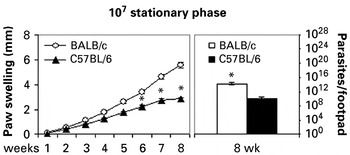
Initially, the courses of infection and dissemination were compared between BALB/c and C57BL/6 mice inoculated into the footpad with 107 stationary phase L. amazonensis promastigotes. Although considered as a relatively resistant strain, C57BL/6 mice developed footpad swelling and parasitic loads of the order of 1010 parasites in the paw by the 8th week of infection (Fig. 3). Yet, the size of the infected paws and their parasite loads were significantly smaller than those observed in the susceptible BALB/c mice. By the 8th week of infection, in spite of the fact that C57BL/6 mice had significantly less parasites in all analysed organs, the infection had spread to the directly draining lymph nodes (LNs) and also to distant lymphoid organs (LNs and spleen) in both BALB/c and C57BL/6 mice (Table 1).
Course of infection and parasite load of BALB/c and C57BL/6 mice inoculated into the footpad with Leishmania amazonensis stationary-phase promastigotes. The mice were infected with 107 promastigotes and the paw swelling data are expressed as the means+s.e.m. of 5 mice per group. The numbers of parasites were determined by LDA on the 8th week after infection and expressed as the means from 5 mice and 95% confidence intervals. Significant differences between BALB/c and C57BL/6 are indicated with *.

Dissemination of parasites to draining and distant lymphoid organs after footpad infection of BALB/c and C57BL/6 mice with Leishmania amazonensis stationary-phase promastigotes
(Pop (popliteal lymph node), il (ipsilateral), Ing (inguinal lymph node), cl (contralateral), Iliac (iliac lymph nodes). The mice were infected with 107 SP-promastigotes of 3rd to 5th in vitro culture passage and the numbers of parasites were determined by LDA on the 8th week after infection. The values shown are the means from 5 individual mice; the 95% confidence intervals are shown in parentheses. Significant differences between BALB/c and C57BL/6 mice are indicated with *.)

The traditional infection models used inocula of 106 or 107 stationary phase promastigotes and therefore led to the inoculation of a very large number of metacyclics (in the order of 105 or 106). In our SP-cultures, that have 18–25% metacyclics, this corresponds to around 2×10⁶ metacyclics. In contrast, the models of infection with metacyclic forms have most commonly used 102 or 103 purified metacyclic promastigotes (Courret et al. Reference Courret, Lang, Milon and Antoine2003; Lang et al. Reference Lang, Courret, Colle, Milon and Antoine2003).
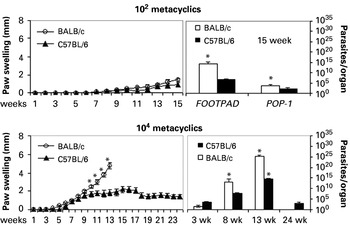
We observed that infection of 102 metacyclic-enriched promastigotes resulted, in comparison with the traditional protocol of SP-promastigotes, in a longer pre-patent period of about 9–13 weeks before definite lesions could be observed at the inoculation site in the animals that became infected (Fig. 4). However, the inoculation dose of 102 or 103 metacyclic forms resulted in heterogeneity of infection among mice of the same group. In general, 10–20% of the mice did not become infected at all and, in those infected, the ensuing lesion became visible variably between 9 and 13 weeks (data not shown). Still, by the 15th week of infection, the parasite loads in the infected paw and also in the draining lymph node were significantly larger for BALB/c mice than for C57BL/6 mice (Fig. 4). In contrast with the heterogeneity of infection obtained with inoculation doses of 102 or 103L. amazonensis metacyclic forms, the use of 104 purified metacyclic promastigotes yielded a more homogeneous and reproducible pattern of infection in BALB/c and in C57BL/6 mice (Fig. 4). The pre-patent period lasted 6–7 weeks and all mice in the injected groups became infected and there was not much individual variation. By the 13th week of infection, infected BALB/c mice were euthanized because of the very large size of the paw mainly due to swelling. The groups of C57BL/6 mice were followed until 6 months (24 weeks) after infection. From the 11th week of infection onwards, C57BL/6 mouse paw lesions were indurate and much smaller than those of BALB/c mice, and did not change in size or aspect throughout the observation period. Paw lesions did not ulcerate in either BALB/c or C57BL/6 mice. Quantification of parasites in the paw yielded much larger parasite numbers (of the order of 106 more parasites) in BALB/c than in C57BL/6 mice on the 8th and 13th week of L. amazonensis infection. There was no significant difference in the paw parasite burdens between these two strains on the 3rd week after infection (Fig. 4). However, the parasite load in the paws of C57BL/6 mice was still quite high (1014) by the 13th week; between the 13th and 24th weeks there was a marked reduction of the paw parasitic load to 103 parasites whereas the paw size remained unchanged.
Course of infection and parasite load of BALB/c and C57BL/6 mice inoculated into the footpad with Leishmania amazonensis metacyclic forms. The mice were infected with 102 or 104 metacyclic promastigotes and the paw swelling data are expressed as the means+s.e.m. of 6 mice per group. The numbers of parasites were determined by LDA and expressed as the means from 6 mice and 95% confidence intervals. Significant differences between BALB/c and C57BL/6 are indicated with *.

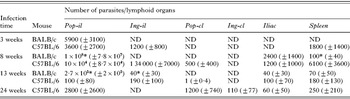
When parasite burden and dissemination to lymphoid organs were compared between BALB/c and C57BL/6 mice infected with 104 metacyclic forms (Table 2) no significant differences were observed on the 3rd week of infection in the parasite loads of the directly paw-draining lymph nodes (ipsilateral popliteal). However, dissemination of the parasites by the haematogenic route had already occurred to the spleen in C57BL/6 mice while in BALB/c mice the lymphoid organs other than the ipsilateral popliteal nodes were free of parasites. On the 8th week of infection the parasite load in the popliteal LNs was already much larger in BALB/c than in C57BL/6 mice and so persisted on the 13th week. However, infection had spread further to other LNs in C57BL/6 mice, whereas in BALB/c mice it reached the spleen and iliac nodes. By the 13th week of infection most lymphoid organs of both mouse strains had significantly decreased parasite loads in comparison to the 8th week, except the spleen of BALB/c mice in which the splenic parasite load was maintained, and the spreading to the ipsilateral inguinal LN.
Dissemination of parasites to draining and distant lymphoid organs of BALB/c and C57BL/6 mice after footpad infection with Leishmania amazonensis purified metacyclic promastigotes
(Pop (popliteal lymph node), il (ipsilateral), Ing (inguinal lymph node), cl (contralateral), Iliac (iliac lymph nodes). ND (not detected). The mice were infected with 104 metacyclic-rich (85-90% metacyclics) promastigotes purified from SP-cultures of 3rd to 5th in vitro passage. The numbers of parasites were determined by LDA and the values shown are the means from 5 individual mice; the 95% confidence intervals are shown in parentheses. Significant differences between BALB/c and C57BL/6 mice are indicated with *.)

Between the 13th and 24th week of infection the parasite load of C57BL/6 mice increased in the ipsilateral and contralateral popliteal LNs and was maintained in the iliac LN and spleen. By the 24th week, parasites could no longer be detected in the inguinal ipsilateral node, but the inguinal contralateral LN became positive for parasites. Therefore, at 6 months after infection, L. amazonensis still persisted in C57BL/6 mice at the infection site and in the directly draining and distant LN and in the spleen (Fig. 4 and Table 2).
The comparison of parasitic load between BALB/c mice that were inoculated with 107 SP-promastigotes or with 104 metacyclic forms of L. amazonensis, did not yield significant differences in the parasitic load of the paws and draining LN; however, the latter group had smaller parasite loads in the spleen and distant LNs (Fig. 3vs Fig. 4, Table 1vs Table 2). In contrast, C57BL/6 mice infected with 107 promastigotes had significantly more parasites (1000-fold more) in the paw than mice of the same strain infected with 104 metacyclics. However, in the LNs and spleen there were no significant differences in the parasitic load (Fig. 3vs Fig. 4, Table 1vs Table 2).
We also compared cytokine production by LN cells in culture in BALB/c and C57BL/6 mice that had been inoculated with 107 SP-promastigotes or with 104 metacyclics. As shown in Table 3, the cytokine levels were similar for the groups inoculated with SP-promastigotes or metacyclics. Significant differences in cytokine production were found between BALB/c and C57BL/6 mice. The levels of IFN-γ measured were higher for C57BL/6 than for BALB/c mice independently of the inocula used for infection. In contrast, IL-4 and IL-10 levels were higher in LN cultures from infected BALB/c mice.
Cytokine production by draining lymph node cells obtained from mice infected with Leishmaniasis amazonensis metacyclic or stationary-phase promastigotes
(The lymph nodes were obtained in the 8th week after infection and the cell cultures (5×10⁶/ml) were stimulated with live Leishmania amazonensis (1×10⁶/ml); the supernatants were harvested after 24 h (IL-4) and 72 h (IFN-γ and IL-10) incubation at 37°C. The detection limit was 31 pg/ml for IL-4, 0·063 ng/ml for IL-10 and 0·313 ng/ml for IFN-γ. The results are expressed as means and s.e.m. of 3 independent experiments. Significant differences between BALB/c and C57BL/6 mice are indicated with *.)

DISCUSSION
Leishmania amazonensis infection of mice inoculated with 104 purified metacyclic forms had a longer lag-phase before the appearance of paw lesions than that observed for mice infected with 107 SP-promastigotes. The comparison between the two types of L. amazonensis inocula showed that the general course of infection and the overall pattern of mouse strain susceptibility did not greatly differ whether infection was performed with metacyclics or SP-promastigotes. BALB/c mice were highly susceptible whereas C57BL/6 mice had a phenotype of relative resistance to either type of infection. Nonetheless, L. amazonensis infection presented aspects that are characteristic of this Leishmania species and that differ from those described for L. major infection.
The longer lag-phase before lesion development in C57BL/6 mice infected with low inocula of metacyclics was observed for L. major infection and was termed the silent-phase (Lira et al. Reference Lira, Doherty, Modi and Sacks2000). These same authors associated the swelling of the paw to the cellular immune response and to the onset of parasite destruction. In our experiments, the appearance of macroscopic and/ or measurable lesions also occurred after a period of increasingly heavier parasite load in the paws of BALB/c or C57BL/6 mice. Lesion formation was found to be associated with the local parasite load in BALB/c mice infected in the ear dermis with L. amazonensis or L. major metacyclic forms (Courret et al. Reference Courret, Lang, Milon and Antoine2003). Our results for BALB/c mice infected in the footpad did not generally differ from those of Courret et al. (Reference Courret, Lang, Milon and Antoine2003) as footpad swelling correlated with the local load of L. amazonensis parasites. As we used a 10-fold higher inoculum, dissemination to the spleen occurred earlier and draining LN parasite loads were higher. Characteristically we found that, for C57BL/6 mice once the lesion became apparent (7–8 weeks) it maintained the same size with no relation to a higher (13 weeks) or to a much lower (24 weeks) local parasite load. Although C57BL/6 mice eventually controlled L. amazonensis infection, there was quick dissemination to local and distant LN and to the spleen. The paws of C57BL/6 mice had parasite loads that reached 1014 parasites by the 13th week. Even after the 13th week, when parasitism was being controlled at all sites, parasites still persisted in all examined organs of the resistant mouse strain. The findings that parasites disseminate and persist also in a resistant host confirm previous observations on C57BL/6 mice and other resistant mouse strains infected with L. major (Aebischer et al. Reference Aebischer, Moody and Handman1993; Laskay et al. Reference Laskay, Diefenbach, Rollinghoff and Solbach1995). However, for mice infected by L. mexicana, a species belonging to the same Leishmania complex as L. amazonensis, it was shown that C57BL/6 mice have parasites restricted to the inoculation site and major draining LN, whereas systemic dissemination and spleen parasitism occurred only in BALB/c mice (Aguilar-Torrentera et al. Reference Aguilar Torrentera, Lambot, Laman, Van Meurs, Kiss, Noel and Carlier2002).
The reasons why C57BL/6 mice are less efficient at controlling L. amazonensis infection in comparison to L. major or L. mexicana are not clear. Mice of the related strain C57BL/10 are susceptible to L. amazonensis and have a deficient Th1 response to this species of Leishmania but are resistant to L. major (Afonso and Scott, Reference Afonso and Scott1993). Our results show that C57BL/6 mice were clearly much more resistant than BALB/c mice to L. amazonensis Josefa strain infection and capable of controlling but not eradicating parasitism. Recently, in vitro studies indicate that IFN-γ favours L. amazonensis amastigote multiplication in macrophages although it activates macrophages to kill promastigotes (Qi et al. Reference Qi, Ji, Wanasen and Soong2004). We found for C57BL/6 mice a pattern of high IFN-γ associated with very low IL-4 and IL-10 levels produced by LN cells that correlates with the classically Th1 cytokine profile associated with resistance to infection. Susceptible BALB/c mice had much reduced IFN-γ accompanied by higher IL-4 and IL-10 levels in LN cultures in comparison to C57BL/6 mice. Moreover, the general pattern of cytokine response in the 8th week of infection to in vitro parasite stimulation was maintained in each mouse strain whether inoculated with 104 metacyclics or with a large inoculum of SP-promastigotes (containing about 2×10⁶ metacyclics) as used in the traditional model of mouse infection. However, the presence of log-phase promastigotes in infective inocula of L. major led, in BALB/c mice, to a peak of IFN-γ production by draining LN cells that was not seen when the inoculum was of metacyclic forms (Lang et al. Reference Lang, Courret, Colle, Milon and Antoine2003).
It must be considered that L. amazonensis is a species that may cause diffuse cutaneous leishmaniasis in man and that parasite factors most probably influence visceralization. Factors such as the origin of parasite isolates must be taken into account. L. amazonensis isolated from patients with localized skin or mucosal lesions induced severe lesions and early dissemination to the spleen, when injected into BALB/c mice, whereas isolates from patients that had the visceral form resulted in small lesions with spleen involvement occurring much later in the course of infection (Almeida et al. Reference Almeida, Barral-Netto, De Jesus, De Freitas, Carvalho and Barral1996). However, the L. amazonensis strain (WHOM/BR/75/Josefa) used in our experiments has been re-isolated many times in our lab from the paw or popliteal nodes of infected mice and still maintains the infectivity and the ability to quickly visceralize in both susceptible and resistant mice. Also critical to L. major infectivity and survival in the macrophage is the presence in the inoculum of apoptotic parasites that stimulate TGF-beta production and a state of macrophage inactivation (van Zandbergen et al. Reference Van Zandbergen, Bollinger, Wenzel, Kamhawi, Voll, Klinger, Muller, Holscher, Herrmann, Sacks, Solbach and Laskay2006).
The realization that Leishmania parasites can visceralize in resistant hosts and that parasites may persist in the seemingly normal skin and in other organs after antimonial treatment of cutaneous localized leishmaniasis (Schubach et al. Reference Schubach, Haddad, Oliveira-Neto, Degrave, Pirmez, Grimaldi and Fernandes1998; Mendonça et al. Reference Mendonca, De Brito, Rodrigues, Bandeira, Jardim and Abath2004; Vergel et al. Reference Vergel, Palacios, Cadena, Posso, Valderrama, Perez, Walker, Travi and Saravia2006) is important for the understanding of late lesion recurrences and aspects of the disease transmissibility. Complete sterile cure of Leishmania cutaneous infections requires new treatment strategies.
This work was supported by Fundação de Amparo à Pesquisa do Estado de São Paulo (FAPESP). Dr Felizardo received a training grant from FAPESP and the work presented herein is part of her Ph.D. thesis. Mr Toma received undergraduate training grants from FAPESP and CNPq and an M.Sc. training grant from CAPES. Ms Borges received an undergraduate training grant from CNPq. The authors thank Ms Inez S. Fernandes de Souza for help with the micrographs, Dr M. Julia M. Alves (Department of Biochemistry, USP) for the use of the photomicroscope and Dr Sílvia Reni B. Uliana (Department of Parasitology, USP) for helpful suggestions.