


Information is a tool that has the potential to affect opinion and mobilize citizens to action (Foos and de Rooij Reference Foos and de Rooij2017a). We test whether local elected officials can change the political agendas and issue priorities of the people with whom they regularly communicate.
We study the ability of government officials to influence citizens’ issue priorities because governments have limited resources. Governments cannot deal with all issues at the same time; they must identify which issues will receive the highest priority. The ability to affect citizens’ priorities can thus have significant implications for the allocation of political power. As Schattschneider (Reference Schattschneider1960) noted, the ability to define political priorities and the alternatives changes the nature of political conflict and is the “prime instrument of power” (73).Footnote 1 Changing citizen priorities and the agenda changes the political lines of division within society and can reallocate power among political actors.
Citizens’ priorities and political agendas are especially important to understanding local politics (Oliver and Ha Reference Oliver and Ha2007; Rugh and Trounstine Reference Rugh and Trounstine2011; Tausanovitch and Warshaw Reference Tausanovitch and Warshaw2014). At the local level, many of the political questions are not whether an action should be taken, but whether certain issues should be prioritized (Erie, Kogan, and MacKenzie Reference Erie, Kogan and MacKenzie2011; Franklin and Ebdon Reference Franklin and Ebdon2004; Guo and Neshkova Reference Guo and Neshkova2013). For example, given a list of infrastructure projects, many constituents would support action on all the necessary improvements provided there were sufficient resources. However, given a limited budget, and limited time resources, constituents might prioritize certain action items over others.
Studies of agenda setting in other contexts have found that political elites can drive the political agenda and priorities of the general public. However, these studies have almost exclusively focused on the ability of nonelected political elites to change citizens’ priorities and the effect that these changes have on politics (e.g., Iyengar and Kinder Reference Iyengar and Kinder1987; King, Schneer, and White Reference King, Schneer and White2017; McComb and Shaw Reference McComb and Shaw1972). Scholars have not studied elected officials’ ability to shape their constituents’ priorities.
There are both arguments that public officials can shape the political agenda through their communications with constituents and reasons to believe that they cannot. On one hand, there are reasons that communication by elected officials might shape citizens’ priorities. Previous studies have found that other political elites such as the media and interest groups shape the general public's priorities (Iyengar and Kinder Reference Iyengar and Kinder1987; King, Schneer, and White Reference King, Schneer and White2017; McComb and Shaw Reference McComb and Shaw1972). What these actors talk about and highlight often become the general public’ priorities and set the agenda for political debate. Likewise, communication by other political elites, particularly the media or interest groups, has a strong effect on citizens’ priorities and can propel citizens to action (Gerber, Karlan, and Bergan Reference Gerber, Karlan and Bergan2009). There is also some evidence that elite communication can sometimes shape public opinion (e.g., Broockman and Butler Reference Broockman and Butler2016).Footnote 2
On the other hand, there are also reasons to believe that public officials’ communication with constituents may not change their priorities. Agenda setting by elected officials may work differently than agenda setting by other elites who are not necessarily in a position to directly affect policy and whose messages reach a different audience. One reason elite communication may not affect constituent priorities and action is that public officials communicate most often with constituents who likely already hold well formulated opinions. The citizens that public officials can most easily reach often have intentionally opted to receive updates and information from their representatives. They are likely to already be well-informed. People who have well formulated opinions and who traditionally follow politics are less likely to be affected by the messages they receive (Arceneaux and Johnson Reference Arceneaux and Johnson2013; Krosnick Reference Krosnick1990; Zaller Reference Zaller1992).Footnote 3 These individuals are also likely to be strong policy demanders whose principles and priorities are harder to change (Bawn et al. Reference Bawn, Cohen, Karol, Masket, Noel and Zaller2012; Fenno Reference Fenno1978; Krosnick Reference Krosnick1990; Masket Reference Masket2009). In short, previous research showing that politicians can change constituents’ opinions may not extend to the influence of public officials on the coalitions to which they have the most direct access.
In addition, even if public officials can change the political agendas of those they communicate with, we have reason to doubt that these changes have any meaningful influence on political actions.Footnote 4 Holding public opinions and using those public opinions in the ballot booth are not the only way that citizens influence political outcomes (Bergan Reference Bergan2009; Kam and Zechmeister Reference Kam and Zechmeister2013). Politicians must often rely on the willingness of individuals or groups to become involved on a particular issue to achieve their policy goals (Schlozman Reference Schlozman1984). Given the reliance of political elites on the involvement of other groups, can public officials’ efforts to change priorities affect constituents’ actions in support of a policy priority?
In some cases, public officials’ communication about their priorities may actually decrease the willingness of individuals to participate through self-undermining rhetoric (Levine Reference Levine2015; Levine and Kline Reference Levine and Kline2017). In general, actions motivated by purposive goals may actually be depressed by information about the actions that others have taken (Hassell and Wyler Reference Hassell and Wyler2018; Mutz Reference Mutz1995). Information about officials’ actions and priorities might be particularly impactful because officials are able to do something about the issue. If individuals recognize that a public official with political influence is interested in the agenda item, an individual may rationalize that his or her action is not necessary because the issue will be handled by the government. Thus, communication from public officials about their issue priorities may contain self-undermining components that reduce the participation that public officials want from constituents (Levine Reference Levine2015).
We study how elected officials’ messages influence constituents’ priorities and actions by collaborating with elected officials in four different municipalities to conduct a field experiment. In the experiment, the partnering officials sent out email messages to constituents on their distribution lists. We had the partnering officials send messages to individuals who already supported the issue but who had indicated that the issue was lower on the political agenda. We surveyed these individuals one to two months before the message went out and again the week after the official sent the message to test how these citizens responded to the message from their city official.
The key aspect of the experiment is that half of the residents received messages where the official advocated that a given issue should be placed higher on the political agenda, while the other half received a placebo email (i.e., an email that did not advocate for the importance of an issue but was otherwise similar). We included the placebo email (as opposed to a control group that received nothing) to carry out a placebo design (Nickerson Reference Nickerson2005). We could carry out a placebo design because we tracked who opened the emails that the official sent. This allows us to compare the people who were actually treated (because they opened up the email) to the individuals in the placebo control group who also opened up their email. To be clear, our sample is not representative of voters. We intentionally study the effect of officials’ communication on those with whom they most frequently communicate.
Our experiment finds that public officials’ messages did not, on average, change the political agenda and priorities of the citizens they contacted. If anything, the public officials’ messaging decreased the likelihood that individuals thought the issue should be a priority and caused citizens to be less likely to act when invited to sign a petition on the issue.Footnote 5
THE EFFECTS OF ELECTED OFFICIAL COMMUNICATION ON POLITICAL AGENDAS
There are competing expectations about elected officials’ ability to change their constituents’ priorities. On one hand, many individuals’ opinions appear to be malleable. Rather than citizens using their policy opinions to influence representatives, many analyses conclude that politicians, especially those who share a party identity, shape voters’ opinions (Broockman and Butler Reference Broockman and Butler2016; Bullock Reference Bullock2011). Previous research on politicians’ ability to shape opinion has largely focused on the constituent's positions, yet the quality of representation also depends on how well constituents’ priorities are reflected in governments’ priorities (Druckman and Jacobs Reference Druckman and Jacobs2015).
In addition, numerous studies have shown that nonelected political actors, specifically the media and interest groups, can affect citizens’ priorities and increase the salience of issues on the public agenda (Iyengar and Kinder Reference Iyengar and Kinder1987; King, Schneer, and White Reference King, Schneer and White2017; Kiousis and McCombs Reference Kiousis and McCombs2004; McComb and Shaw Reference McComb and Shaw1972)
On the other hand, prior studies have focused on political elites’ ability to change the opinions of the general public, rather than the politically active constituents that officials reach with their messaging. Although the general public is largely inattentive to political affairs, and thus susceptible to persuasion, politically involved constituents are more likely to be knowledgeable about politics and to have priorities that are harder to move (Arceneaux and Johnson Reference Arceneaux and Johnson2013; Krosnick Reference Krosnick1990; Zaller Reference Zaller1992). While previous studies have shown that even the most informed voters are still influenced by elite communication on single issues, the effect “is swamped by the average absolute effect of exposing subjects to details about. . .policy” (Bullock Reference Bullock2011, 500). The effect may be even further reduced when trying to change priorities (rather than opinions) that are often already informed by a wealth of knowledge. Thus, while there is evidence that political elites can change voters’ opinions, these previous studies have not examined constituents’ priorities and have not focused on those individuals that politicians typically reach with their messaging.
Moreover, there is evidence that attempts to persuade knowledgeable individuals with well-formed opinions may prompt a negative backlash (Brehm Reference Brehm1966; Brehm and Brehm Reference Brehm and Brehm1981).Footnote 6 This theory of psychological reactance holds that individuals react negatively to persuasive information when individuals perceive their self-determination about what priorities to hold and what actions to take being threatened. This perception of threat to self-determination is likely to be stronger among those with well-formulated opinions and priorities. When others try to persuade these individuals, this theory holds that they often embrace the attitude threatened by the attempt at persuasion (Brehm Reference Brehm1966). As such, attempts by public officials to encourage constituents with higher levels of knowledge to place more priority on certain issues may cause effects on opinion and behavior that are opposite to what was intended (Dillard and Shen Reference Dillard and Shen2005; Ringold Reference Ringold2002).
CHANGING PRIORITIES AND ENCOURAGING POLITICAL ACTION
Changing the political agenda alone does not remove many of the barriers to policy outcomes. Achieving policy success often relies on individuals’ willingness to take political action in support of the cause. Political leadership requires successfully encouraging others to act on a specific agenda. For these reasons, we also look at the effect of officials’ communication on constituents’ actions.
A stated priority is not the same as a public action, and opinions often do not conform with actions taken either privately (Berinsky Reference Berinsky2004) or publicly (LaPiere Reference LaPiere1934). Studies have shown that individuals are willing to lie or decline to respond when they know their views are not perceived as socially acceptable (Berinsky Reference Berinsky1999, Reference Berinsky2004; Schuman and Presser Reference Schuman and Presser1980; Vogel and Ardoin Reference Vogel and Ardoin2008). It is possible that pressure from politicians may change publicly stated priorities without changing underlying motivations to participate and engage on an issue.
Furthermore, communication from public officials might be self-undermining by encouraging complacency as constituents perceive that the issue is already being handled (Levine Reference Levine2015). There is some evidence that descriptions of others taking action or past success reduces participation relative to information that communicates a lack of action on the issue (Hassell and Wyler Reference Hassell and Wyler2018; Levine and Kam Reference Levine and Kam2017).Footnote 7
RESEARCH DESIGN
We test local officials’ ability to affect issue salience and to encourage participation on an issue by conducting embedded field experiments (Foos and John Reference Foos and John2018; Foos and de Rooij Reference Foos and de Rooij2017b) in collaboration with city officials from four cities across the United States.Footnote 8 The officials who worked with us on the study had earlier expressed interest in helping with a research project after they had taken a survey administered by one of the authors.Footnote 9 Table 1 provides information about the officials and the cities they serve in. Two of the officials came from relatively small towns (with populations under 20,000), another from a mid-sized suburb with a population of about 30,000, and the last a city of over 100,000 that is a key part of a metropolitan area in the Midwest. The officials also were diverse in other ways (see Table 1). For example, two of the officials were women, while two were men. One official was the mayor, while the other three were city councilors.
Partnering Officials

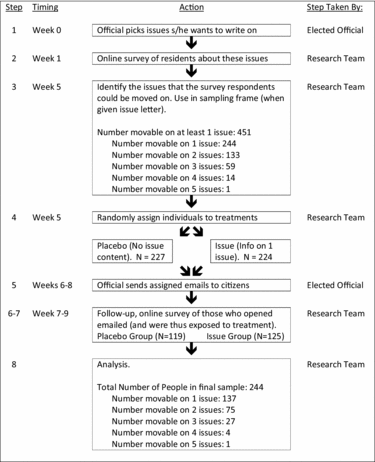
The collaborative experiments were carried out during the spring and summer of 2016. We designed and implemented these experiments to maximize external validity. For example, we had the officials decide what issues they would write about and we had them draft the text of the emails. We also had them contact the constituents using email because that is how they normally contacted the constituents in the study. We carried out the study by taking the following steps (which are summarized in Figure 1):
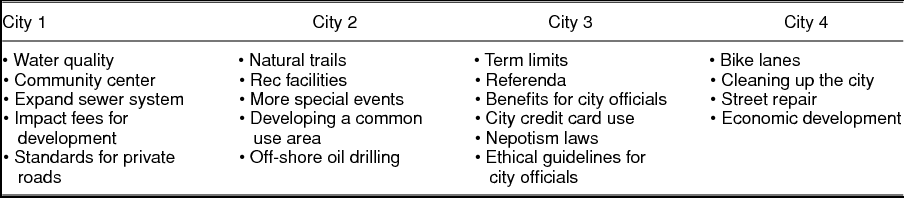
1. Identify the issues. We asked each partnering official to identify four to six issues for which they were interested in building support. We asked them to pick concrete goals that were relevant for their city and for which they were willing to write about in communications with citizens. Table 2 gives an overview of the issues that the officials chose for this study. The officials also drafted the text of the issue used in the email messages they sent. We had the officials choose the topics and draft the letter to increase the external validity of the study. Our study looks at the effect of the types of messages that elected officials would send.
2. Baseline Surveys. We conducted online surveys of residents in each city that asked them about their positions on the issues that the official had identified. For each issue, citizens chose one of four responses:
• I do not support doing this and it should not be a priority for [name of city/town].
• I believe the city should consider this but it should not be a priority for [name of city/town].
• I believe the city should consider this and it should be a medium priority for [name of city/town].
• I believe the city should consider this and it should be a high priority for [name of city/town].
The text of the surveys is provided in Section SI.2 of the Supplementary Material. Because we are interested in the ability of officials to affect their supporters’ priorities, we recruited citizens for the study from the participating officials’ email distribution lists. The survey recruitment email came from us as researchers and explained that we were studying local policy priorities. The full text of the invitation to take the survey is provided in SI.1 of the Supplementary Material.
3. Identifying the Sampling Frame. We used two criteria to determine which individuals would be included in the study. First, at the end of the survey we asked participants if they would be willing to take a follow-up survey. Our study only includes the participants who answered that they would be willing to take a follow-up survey. Second, we limited the sampling frame to those individuals who agreed with the official on an issue but did not think that the issue in question should be a high priority for the city.Footnote 10 For purposes of exposition, we will say that a citizen is movable on an issue if in their response during the baseline survey they said that they “believe the city should consider” the issue but that it “should not be a priority the city” or said that the issue “should be a medium priority for the city.” Thus, our sample only included people who were movable on at least one issue.Footnote 11
For part of our analysis, the unit of observation is the individual issue. This allows us to get more leverage because, in some cases, citizens were movable on multiple issues. When creating the sampling frame, we took steps to privilege working with people who thought the issue was not a priority. We wanted to focus on people who agreed with the legislator but thought it was “not a priority” because we felt that this was the population of greatest interest to officials trying to set the political agenda. Thus, when a citizen thought that at least one issue was not a priority for the city (but agreed the city should consider the issue), we only included the issues that they thought were not a priority in the sampling frame. If someone did not have any issues that they thought were “not a priority for the city,” then the sampling frame included all the issues for which they thought “should be a medium priority for the city.”
4. Treatments and Randomization. In our study, all citizens received an email message from his or her city official that highlighted the internet sources where individuals could find out what the city was doing. All email messages included the same subject line (i.e., this did not vary with treatment condition). We used R to randomly assign individual citizens to receive either a treatment or placebo condition. Each citizen was randomly assigned with a 50% probability of being in either condition. The placebo condition did not include any additional information. However, in the treatment condition, the email included an additional paragraph where the official advocated for an issue that was important to them. Section SI.3 of the Supplementary Material provides the text of these emails. If a citizen assigned to the treatment condition was only movable on one issue (see step 3), then they received the information about that issue. If they were movable on more than one issue, then we used R to randomly choose which of those issues was provided in the treatment email message.Footnote 12 Finally, as a reminder, we had the officials draft the letter to increase the external validity of the study. Our study looks at the effect of the types of messages that elected officials would send.
5. Message Delivery. About six to eight weeks after individuals took the baseline survey, the city official emailed them the message they were assigned to receive in step 4. Those who did not open the first email within 48 hours were sent their assigned email a second time (to increase the probability that they opened their email prior to taking the follow-up survey).Footnote 13
6. Tracking Who Opened the Email. The emails all used the same subject line: “Improving [Name of City].” The emails were sent out using MailChimp, which tracks who opens emails by embedding a small image in the email. We use this information to carry out a placebo analysis (Nickerson Reference Nickerson2005) by limiting our sample to those who opened their emails. We take this step because the treatment can only affect those who opened their emails (just like a door-to-door treatment in a Get-out-the-vote campaign is only delivered to those who open their doors). We can do this without introducing bias because we tracked who in the placebo condition opened their emails (and thus represent the types of people who would have been exposed to the treatment had they been assigned to that condition). For the analysis, we restrict the sample to those who opened the email from the city official before taking the survey.
7. Follow-up Survey. Three days after the city official sent the email message, we emailed citizens for the follow-up survey to measure the impact of the treatment. Only citizens who took the baseline survey and agreed to the follow-up survey were contacted. In addition to the initial invitation, we sent two reminder emails for those who had not taken the survey yet. The initial invitation and the reminder invitations were spaced two to three days apart. Most people who took the follow-up survey did so within a week of receiving the email from their city official. For our placebo design, we restrict the sample to those who opened the email from the official and who did so before taking the follow-up survey (Nickerson Reference Nickerson2005).
Issues

Research Design Steps

INFORMATION ABOUT THE SAMPLE
We achieved a high follow-up rate on the post-treatment survey (especially given that no incentives were provided), with 68% of respondents (310 out of 455) from the first round also taking the follow-up survey. For the analysis, we use the 80% of respondents from this subset (244 out of 310) who also opened the email sent from the official (as tracked by MailChimp) before taking our survey. We use this subsample in our analysis because they are the ones who were exposed to the intended message (either the treatment or placebo message). When we analyze the individual-level data, we have 244 observations. When we look at individuals issue priorities, we have 415 observations (408 of whom answered all the pre-treatment demographic questions).Footnote 14
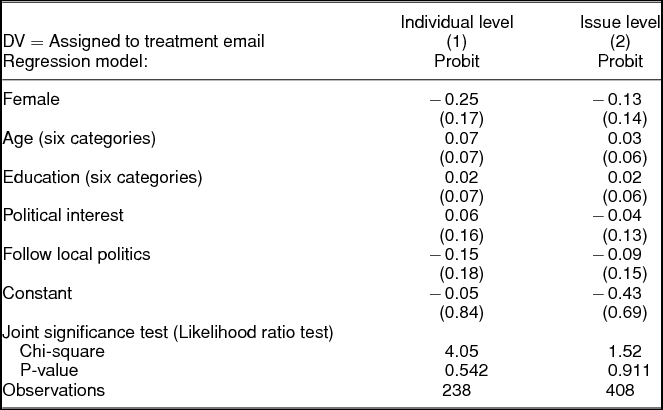
Attrition can be a problem if it leads to imbalance between the treatment and placebo groups. We test for balance by regressing the randomly assigned treatment (1 = treatment, 0 = placebo) on the demographics that were gathered in the first wave of the survey (and thus measured pre-treatment). The independent variables include gender, education (six-point scale), age (six-point scale), level of political interest (four-point scale), and how much they follow local politics (three-point scale). The wording for these questions is provided in the Section SI.2 of the Supplementary Material. Because we analyze the results at both the individual level and at the issue level, Table 3 presents the balance tests for both levels of the data (column 1 for the individual level and column 2 for the issue level). These probit regressions test the significance of each variable individually and all the variables jointly (see the bottom of the table for the results of the joint significance tests). The variables fail to achieve statistical significance both individually and jointly. We have balance on these pre-treatment characteristics.
Balance Tests

Note: Standard errors in parentheses.
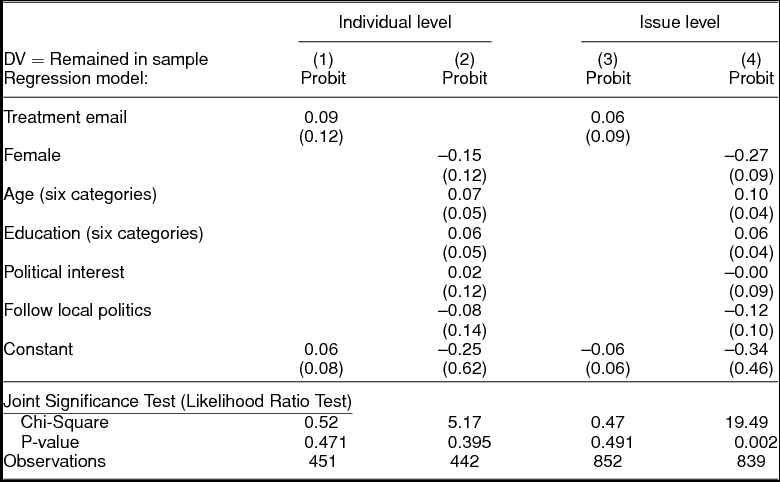
Attrition can also be a concern if it is related to treatment assignment. In other words, if a given treatment is causing people to systematically drop out of the survey, this can introduce bias. Columns 1 and 3 of Table 4 test for whether treatment assignment is related to dropping out of the survey. We again look at the results both at the individual level (column 1) and the issue level (column 3). These probit regressions look at all the observations that were in the sampling frame when we randomized (i.e., because they completed the pretreatment survey and were eligible for treatment). The dependent variable is simply whether the observation is in the final sample (i.e., because the respondent answered the question in the post-treatment survey). The results show that the missing observations (missing because of attrition) are missing independent of treatment assignment. In other words, individuals (or the issues we asked about) that were assigned to the treatment group were not more or less likely to attrite from the study.
Attrition Tests

Note: Standard errors in parentheses.
Finally, attrition can affect the population we learn about in the study. Columns 2 and 4 of Table 4 analyze whether certain types of people were more likely to drop out of the study. As Column 2 shows, there was no systematic attrition at the individual level. There was some attrition at the issue level, with older individuals and men being more likely to be in the final sample.
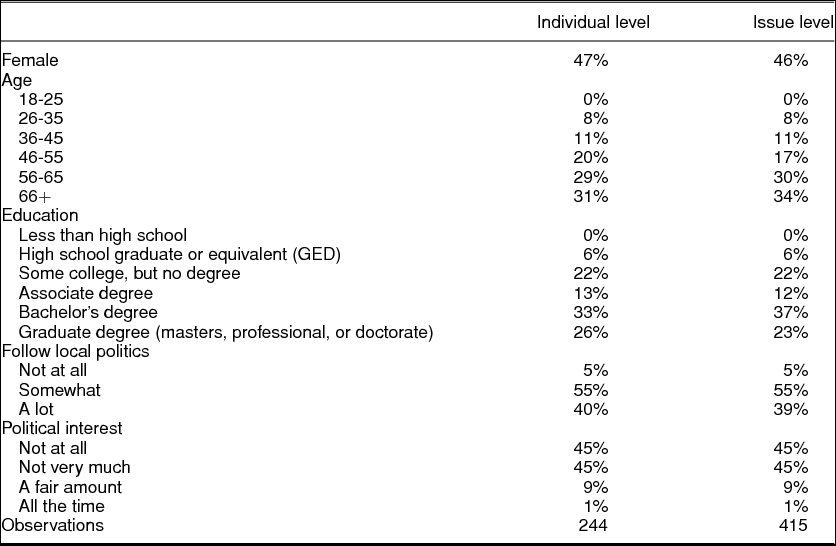
Table 5 provides a more general overview of our sample. Our study investigates the reactions of individuals who are reached by public officials. These individuals differ from the general population in systematic ways and this is reflected in our sample. Our sample is older, politically interested, and highly likely to follow local politics. These individuals may respond differently than the general public to messages from politicians. These differences, however, are intentional; we are interested in politicians’ ability to influence the audience to whom they are regularly communicating.
Descriptive Statistics of the Sample

RESULTS
Because we are interested in the ability of politicians to change their constituents’ priorities and to encourage their constituents to take political action, we estimate the effect of the issue priority email treatment on two outcomes. First, we test whether the elected official's message increases the priority of the issue for the respondent. In the pre-treatment survey, we asked individuals about their attitudes on the issue, using a four-point scale (that included the degree to which the issue is a priority). We include the same question on the posttreatment survey (for all the issues in that city) to analyze the impact of the official's message. The question wording is provided in Section SI.2 of the Supplementary Material. Because these questions included four categories, we use an ordered probit model to analyze this outcome.
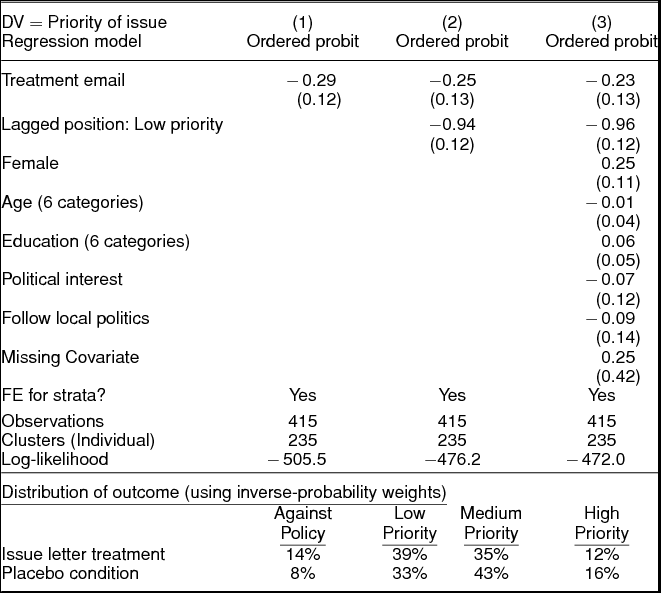
As noted in the procedures above, when constituents were moveable on more than one issue, we randomized which issue the official would write about in his or her email message. For the analysis, we maximize our power by using the individual issue as the unit of observation and including all of the individual-issue observations that were part of the sampling frame. Correspondingly, we cluster our standard errors at the respondent level. We also follow Angrist's (Reference Angrist1998) advice for studying situations where there are different strata at which the randomization is carried out by including fixed effects for these strata. In our case, the strata are represented by the number of issues on which the individual was moveable.Footnote 15 Angrist (Reference Angrist1998) shows that, under some modest conditions, including fixed effects for these randomization strata, recovers the causal effect. Finally, at the bottom of Table 6, we also present the results when using inverse-probability weights to adjust for differences in the probability of treatment assignment (Aronow and Middleton Reference Aronow and Middleton2013).
The Effect of Messaging on Issue Priorities

Notes: Standard errors in parentheses.
We estimate the treatment effect with three models and present the results in Table 6. First, we estimate the effect when not including any controls (column 1). Second, we estimate the treatment effect when controlling for the respondent's lagged position on the issue (column 2). We present this model because our design closely follows Broockman and Butler (Reference Broockman and Butler2016). Because those authors present the treatment effects when controlling for the lagged dependent variable, we provide the same model for the sake of comparability. Third, we estimate the relationship while also controlling for the full range of pretreatment covariates we have from the pretreatment survey (column 3). Missing variables are imputed and an additional dummy variable is included in the model to indicate that the observation included missing covariates to avoid the introduction of bias.
We find that public officials are not able to change these citizens’ priorities. In fact, the treatment effect is negative. When the public officials wrote that an issue was important, the constituents who saw those messages were less likely to move toward saying that the issue should be a priority. The bottom of Table 6 compares distribution of treatment and placebo groups across the different categories. The individuals in the treatment condition were 12 percentage points less likely to say that the issue was either a high or medium priority compared with the placebo condition (47% in the treatment condition versus 59% in the placebo condition). This suggests that the messages from the public officials may even cause a backlash among those to whom they are most easily able to communicate.
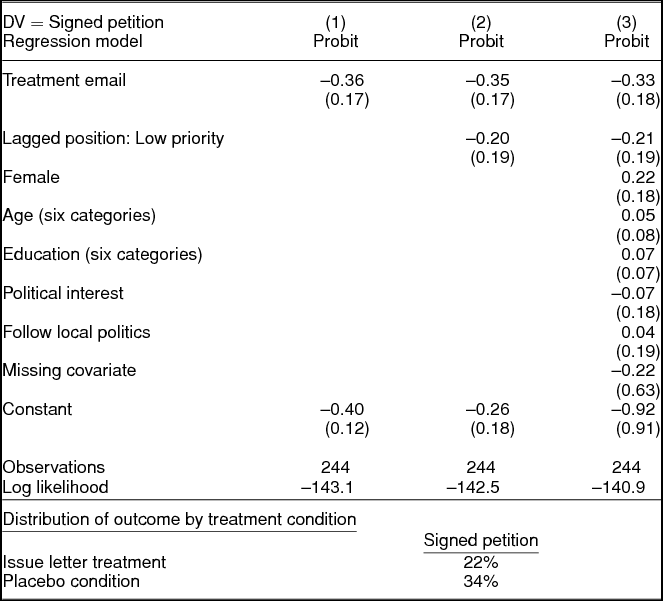
Second, we test the message's effect on the likelihood that the citizens would respond to an invitation to visit a page to sign a petition to take action on the issue. We included this item to measure whether respondents would take action (and not simply change their stated opinions). We measured citizens’ willingness to sign a petition by including an item on the follow-up survey that asked if they wanted to be directed toward a page where they could sign a petition on the issue: “We wanted to make you aware about a petition that is circulating to encourage [Name of City]’s Town/City Council to. . . [issue specific language]. . . Would you want to sign this petition? If you want to sign this petition, click yes below and you will be provided a link to the petition.” All citizens were only asked about one issue (the issue that had been randomly chosen prior to the official sending out messages). For those in the treatment group, they were thus asked about the issue that the official wrote about. For those in the placebo group, it was the issue that they would have received a message about had they been in the treatment group. The full texts the various questions are provided in Section SI.2 of the Supplementary Material. In Table 7, we use a probit model to analyze this binary outcome in the analysis.Footnote 16 Finally, we again estimate the treatment effect in three ways: (1) with no control variables (column 1), when controlling only for the respondent's lagged position on the issue (column 2), and when controlling for the full range of pre-treatment covariates (column 3).
The Effect of Messaging on Signing a Petition

Note: Standard errors in parentheses.
The treated individuals were also less likely to be interested in signing the petition. Overall the individuals were highly interested in signing the petition, likely reflecting the fact that this was a group of individuals who were very interested in local politics and these were all issues that individuals agreed with (see Table 4). However, among this group of attentive citizens, the treatment effect was negative and statistically significant. The individuals sent the treatment email were 12 percentage points less likely to visit the webpage with the petition when offered the chance.
THE SELF-UNDERMINING RHETORIC OF COMMUNICATION ON PRIORITIES
There are at least two possible explanations for why these treated individuals are less likely to be willing to consider signing the petition on the issue. The first is that the treatment has an indirect effect on the action by lowering the priority of the issue in the mind of the constituent. The second is that the message from the elected official has a direct effect on the likelihood of acting because the nature of the communication may be a form of self-undermining rhetoric. In this latter case, the message communicated by local public officials already in a position to work on the issue might discourage participation because recipients of the message might believe that the local official is already working on the issue and thus does not necessitate their participation. While we believe that both factors are likely at work here, it is the latter that we believe warrants further exploration as it is not as well understood.
Recent work on political communication has found that some forms of communication are self-undermining (Levine Reference Levine2015). These communications may have a reduced effect, or even the opposite effect desired, because the rhetoric that seeks to mobilize individuals also provides them with information that makes them less likely to engage. Being contacted by an official in government may lead constituents to believe that local government is already likely to address the issue.
To better understand the potential for self-undermining rhetoric in public official communication, we recruited 2,012 subjects from Amazon Mechanical Turk (Berinsky, Huber, and Lenz Reference Berinsky, Huber and Lenz2012; Krupnikov and Levine Reference Krupnikov and Levine2014; Mullinix et al. Reference Mullinix, Leeper, Druckman and Freese2016) to test whether communication from a local public official about a local issue causes individuals to believe that the government will act on the issue. Additional details on Mechanical Turk and the sample are available in Section SI.5 of the Supplementary Material.
In this study, we choose to focus on the same issues that were covered in the field experiment. The MTurk respondents were thus asked their positions on four issues (with responses ranging from “I do not support doing this and it should not be a priority for the city/town” to “I believe the city should consider this and it should be a high priority for the city/town.”). The issues were drawn from the issues used by the officials in the original experiment (see Table 2), with one issue randomly selected from each city. Because we were interested in the perceptions of individuals who supported at least one issue but did not view that issue as a high priority, individuals who did not indicate that any issues were a medium or low priority were dropped from the sample.
Individuals were then shown the text of the message sent by the local official on an issue that the respondent had identified as a medium- or low-priority issue.Footnote 17 Respondents were randomly assigned to one of two groups. Half of the respondents were told that the persuasive message came from a local government official; the other half was told that the message came from a local community organization. Thus, our treatment is the source of the message (a local official or a local community organization) and not the message itself.
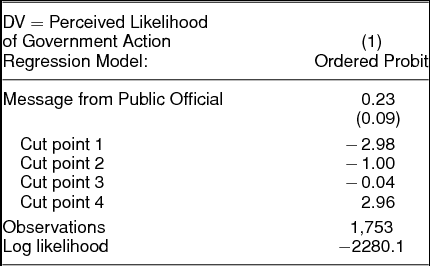
After reading the persuasive message, respondents were asked to indicate how likely it was “that this local government will take action on this issue.” As shown in Table 8, individuals who were told that the persuasive message came from a local official were significantly more likely to indicate that local government action was likely to occur. The source of the message has a significant influence on the beliefs of respondents about the actions of government. Knowing that an issue is a high priority to a local official makes the respondent more likely to believe that government will act on that the issue, perhaps thus negating the need for their own involvement and action.
The Effect of Message Source on Beliefs about Local Government Action

Note: Standard errors in parentheses.
DISCUSSION
There are three important scope conditions of our study. First, while previous studies have focused on political elites’ ability to change constituents’ issue positions, we focus on politicians’ ability to change individuals’ issue priorities. Our results may differ from previous studies because of our new focus.
Second, we intentionally focus on the sample of citizens that local officials are most likely to contact about the issues they care about: those on their email distribution list. The individuals who self-select to receive these communications are highly politically engaged with local issues. In our study, 95% of the citizens said they follow local politics at least somewhat (see Table 5). Our study does not indicate what effect politicians can have on the general public's priorities; they may (or may not) have the power to change the general public's priorities. However, our results are important because they show the effect that politicians can have on the priorities of the people they can typically reach (Zaller Reference Zaller1992).
Third, we only looked at how citizens in four cities responded to messages from their officials. This meant that our study was based on a relatively small sample and so was slightly underpowered.Footnote 18 For example, our study on changing constituents’ priorities included 415 observations.
Even with these caveats, we can still draw some important conclusions. Most importantly, we show that politicians are not able to mold and change the policy priorities of the people they reach with their messages. We find that when the public officials wrote to a constituent communicating that an issue was important, the constituents who saw those messages were less likely to move toward saying that the issue should be a priority than were those who did not receive a message about the importance of that issue. In other words, the treatment effect was statistically significant in the negative direction. Even with the smaller sample size, this is clear evidence that politicians are not having a positive effect. Perhaps because of their place in government and because of the type of individual with whom they are most likely to communicate, local officials do not have the ability to shape the political agenda among those with whom they communicate. While other political elites appear to have a strong effect on the political agenda (McComb and Shaw Reference McComb and Shaw1972; King, Schneer, and White Reference King, Schneer and White2017), elected public officials’ direct influence is limited.
The officials were also not able to motivate citizens to act. We find that the citizens who received an email from their public official about an issue's importance were less likely to be willing to sign a petition in support of that issue. This finding highlights how politicians’ communication about their priorities can be self-defeating. Communication about policy priorities may actually be self-undermining and decrease individuals’ participation in support of an issue because it conveys the message that the public official is already working on that issue and, as such, the citizen's action is unnecessary (Levine Reference Levine2015; Levine and Kam Reference Levine and Kam2017). We find that communication from public officials about issue priorities is self-undermining and reduces the participation that public officials want to encourage from their constituents. Part of this effect may be the result of the perception that local government is already likely to act. As we have shown, when constituents view a message about the importance of an issue from a local official, they are more likely to believe that government will act to address that issue than they will if a similar message is sent from an interest group. In short, public officials’ ability to mold constituents’ behavior and to change constituents’ issue priorities may be more limited than previously acknowledged (Druckman and Jacobs Reference Druckman and Jacobs2015; Broockman and Butler Reference Broockman and Butler2016).
Further, our results show that, at least to a subset of voters, local politics is important (Oliver and Ha Reference Oliver and Ha2007; Rugh and Trounstine Reference Rugh and Trounstine2011; Tausanovitch and Warshaw Reference Tausanovitch and Warshaw2014). These citizens had real opinions and their priorities were not swayed by communication from officials.
Finally, our results provide insights into politicians’ homestyles. Fenno (Reference Fenno1978) describes a variety of different homestyles and highlighted two types: an issue-based homestyle focused on articulating issues and a service-oriented homestyle. Butler, Karpowitz, and Pope (Reference Butler, Karpowitz and Pope2012) find that politicians are more likely to emphasize a service homestyle on average and Grimmer (Reference Grimmer2013) finds that variation in the tradeoff between these homestyles is correlated with the ideological congruence between politician and district. Politicians in district that are ideologically consistent with their own positions are more likely to adopt an issue-based approach than those in less ideologically congruent districts.
Our results suggest three reasons for why we might see these patterns in politicians’ homestyle. First, if politicians are not able to move the citizens they can easily reach, then focusing on service overall (Butler, Karpowitz, and Pope Reference Butler, Karpowitz and Pope2012) is a more effective use of resources for reelection-motivated officials. It is also the case that, if they cannot change constituents’ opinions, then politicians should only speak about issues if they are speaking to constituents who they already agree with (Grimmer Reference Grimmer2013).
Second, and related to the first point, politicians’ own experiences with communication may cause them to underestimate their ability to shape citizens’ opinions and priorities. Politicians may be able to shape some constituents’ opinions. However, because politicians are typically communicating with the people they are not able to move, they are likely to conclude that they cannot shape any constituents’ opinions and priorities. In other words, the feedback that politicians receive is likely to cause them to update toward the belief that politicians cannot shape opinions and so they should only focus on talking about issues if the district already shares their views.
Third, politicians also have incentives to only use a more service-oriented homestyle because emphasizing their priorities has the potential to demobilize citizens. If focusing on issues causes supporters to relax under the belief that the issue is already taken care of, then politicians simply have incentives to direct their resources to service and other activities that are not self-undermining.
SUPPLEMENTARY MATERIAL
To view supplementary material for this article, please visit https://doi.org/10.1017/S0003055418000473.
Replication material can be found on Dataverse at: https://doi.org/10.7910/DVN/KTCXTE.





Comments
No Comments have been published for this article.