Smallpox Inoculation and the Significance of Numbers
Smallpox inoculation saw a new wave of popularity in Europe during the 1750s and 60s. The method had been introduced at the beginning of the century, but was heatedly disputed for both religious and medical reasons (Miller Reference Miller1957; Glynn and Glynn Reference Glynn and Glynn2004; Lindemann Reference Lindemann2010; Seth Reference Seth2008; Williams Reference Williams2010). Moreover, the treatment was both complicated and time-consuming. By mid-century important changes started to occur that made inoculation simpler, safer, and more generally accessible. Lengthy and elaborate preparations of the patient through diet and purging were now reduced or even omitted completely, and the variolous matter was introduced in ways that provoked less violent illness. Inoculation grew in popularity during this period, and the public debate over it was re-ignited. The well-rehearsed ethical and religious arguments from the earlier period were revived, but the texts that defended and advocated inoculation after 1750 also presented new points of view. An increased use of numbers and quantitative reasoning went hand in hand with improved methodology during this period. References to probability and relative risk became frequent, and arguments were also taken from works that applied computation tools to issues of mortality and more specifically to smallpox inoculation.
This article will discuss the epistemological implications of these arguments, as well as their conditions of possibility. Arguments about quantities and numbers will never stand alone. Even when the numbers are identical, different ways of itemizing and contextualizing the thing that is being counted will create different images and represent different totalities. Moreover, during this period such new approaches had to be paired with new methods of representation. How were numbers, figures, and calculations actually presented in print in eighteenth-century pro-inoculation texts, how did they influence the design of the pages? And what kind of rhetoric did they invite, how was quantitative information to be turned into linguistic argument? This is the backdrop for asking what kinds of argument did the numbers concerning smallpox inoculation actually produce and what kind of rhetorical resources did the use of numbers and calculations represent? It will be the contention of this article that numerical argument remained deeply entangled with what can be called argument from exemplarity, and that these two ways of reasoning, though quite different, still complemented each other in pro-inoculation debate well after the mid-eighteenth century.
Arguments based on numbers and calculations that occur in influential pro-inoculation texts from the 1750s onwards are easily seen as expressions of the “quantifying spirit” typical of the eighteenth century, and particularly of the more distinct instrumentalism that emerged during the 1760s (Heilbron Reference Heilbron1990, 3). In research literature the use of numbers, statistics, mathematical probability, and quantitative argument has made smallpox a major example of new ways of conceptualizing health as a social issue, relating to the population at large and initiating the modern fields of public health and mass treatment (see for instance Dorothy Porter Reference Porter1999; Rusnock Reference Rusnock2002, 11; Seth Reference Seth2008, 207ff). Michel Foucault has claimed that inoculation “benefitted from two supports that made possible their insertion in the real practices of population and government in Western Europe” (Foucault Reference Foucault2009, 58). The first came from the new statistical instruments that were available, “the certain and generally applicable character of vaccination and variolisation made it possible to think of the phenomena in terms of the calculus of probabilities.” The second support factor was the integration of this type of medical reasoning with other governmental techniques developed in the same period (ibid., 58f). For these reasons, Foucault makes smallpox inoculation (variolization in his text) one of his main examples of the new “mechanisms of security” that he sees emerging during the late eighteenth century, and thus as constitutive to the notion of populations. Andrea Rusnock presents smallpox inoculation as one of the three most important controversies concerning health and population in eighteenth-century England and France (Rusnock Reference Rusnock2002, 10). The earliest of these three issues to arise in the public debate (the other two were environmental medicine and depopulation), smallpox inoculation also represents the first case of mathematical methods applied to matters of health. Rusnock contends: “Some advocates of inoculation constructed numerical accounts showing the risks of dying from inoculation to be far smaller than the risks of dying from natural smallpox. This is arguably the first use of numbers to evaluate a medical procedure” (ibid., 11).
This article builds on similar arguments, but will seek to expand on the complexity and implications of the story. The argument will be that use of numbers and proportions in eighteenth-century texts on inoculation had been too easily identified with “modern” quantitative approaches. To be fully understood, the numbers, figures, and calculations that occur in these texts should also be related to other types of argument with which they were deeply entangled and which reflect other ways of thinking about the disease and its treatment. Smallpox and inoculation were not magically transformed into issues of pure quantification by the stroke of a wand, just as individuals were not immediately turned into a population just by being counted. Rusnock has argued that the concept of population and its measurement were mutually constitutive (ibid., 4). In the process, the relations between public debate, the calculus of probability, quantitative reasoning, and the notion of a population were complex, involving a wide range of ideas and understandings (ibid., 2). This article will likewise argue that quantitative approaches not only changed the conceptualization of smallpox inoculation, but also – and mutually – that new understandings of disease also made such approaches possible and relevant. Quantitative thinking may have turned inoculation into a mass treatment, but a new understanding of smallpox cases as fundamentally identical was what made it relevant to count them. Arithmetic changed the ways of thinking about epidemics and those stricken by it, but new ways of conceptualizing the disease were vital to making it a matter of arithmetic at all.
With Charles E. Rosenberg's term, this quantification can be seen as a new way of framing the disease (Rosenberg Reference Rosenberg1989, 2). It should however be noted that what happened was not a simple transference from one understanding to another. The frames and framing, as described by Rosenberg, refer rather to shifting cultural, social – and in the present case, rhetorical – resources to draw on and to give meaning to diseases and actual illnesses. In the case of smallpox, the increasingly important quantitative reasoning did not stand alone during this period of change. It was complemented and at times challenged by arguments from exemplarity. This meant partly that individual cases – as striking examples – were ascribed evidential value and persuasive power equal or even superior to numerical calculations and quantities. Furthermore, it also implied that numbers, figures, and quantities at times were turned from calculations to metaphors, and thus transferred from their mathematical context to that of exemplarity. Even if numbers and figures are easily found in late eighteenth century pro-inoculation texts, they do not always represent a quantitative argument, at least not in a strict mathematical or statistical sense. A closer examination of texts will show that even in the period when conceptualization of smallpox made it relevant to count and calculate, the argument was sometimes only apparently quantitative. Numbers and figures could easily be incorporated into exemplary narrative.
Source Material: European Debates on Smallpox Inoculation
Smallpox inoculation met with varying degrees of acceptance across Europe. Thanks to the initiative of Lady Mary Wortley Montague, wife of the English ambassador in Constantinople, the method had reached Europe in the 1720s. Inoculation was already known through the writings of the physicians Timoni (Reference Timoni1714) and Pylarini (Reference Pylarini1715), but by allowing her two young children to be treated, Lady Mary introduced the method in practice. She also persuaded the Princess of Wales to have her children inoculated. The operation was carried out in 1722 after the method had been tested for safety on seven prisoners at Newgate prison. Even if it met with considerable resistance and religiously based objections, inoculation gained a foothold in Britain. Throughout the century it gained in significance and was quite widely practiced (Razzell Reference Razzell1977; Brunton Reference Brunton1992; Williams Reference Williams2010). The English debate over the new remedy, inspired by the work of James Jurin, largely came to concern the mortality of natural smallpox compared with that of the inoculated disease (Rusnock Reference Rusnock and Porter1995, 305 and below). Moreover, some of the important improvements that were developed in mid-century, mainly in Britain, were practiced rather than published. In France on the other hand, the inoculation debate very explicitly became inscribed into a wider context of Enlightenment ideas. Voltaire's praise of the English acceptance of the new method in his Letters Concerning the English Nation from 1734 established the defense of inoculation as part of what can be called the Enlightenment discourse. The implication was that people who were in favor of new and radical ideas also tended to defend inoculation, and that at the same time the new medical technology rapidly became related to other Enlightenment issues (Miller Reference Miller1957, 208; Seth Reference Seth2008, 53–59; Rusnock Reference Rusnock2002, 70–71). It is in this debate rather than in purely medical literature that the connections between medical innovation and issues of public health or political arithmetic are most explicitly expressed. While the most radical of these texts were produced in French and originated from French-speaking contexts, the empirical material and specific examples that they built on and cited were frequently British.
A number of the texts originating in this public debate came to circulate widely in Europe. They were translated into various national languages, were paraphrased and rewritten in new national contexts and inspired new debates. Translations and reworkings often appeared very shortly after the original publication, demonstrating the urgency of the matter as well as the effective networks of communication and distribution. These texts, often in the form of short pamphlets, did not demand specialized medical knowledge from their readers, but did, on the other hand, require a certain insight into the debate as well as more general concerns. The discussions in this article will build on texts that circulated in this international, though French-biased, context when the debate peaked after mid-century. The national context that will supply a more specific site of investigation is the twin kingdom of Denmark-Norway.
The article is comprised of three main sections. The first will examine some aspects of the work of James Jurin, the English physician and mathematician who introduced calculation and numerical argument into the inoculation debate in the early 1720s. His work came to be a basic reference in pro-inoculation texts throughout the century. Andrea Rusnock has investigated how Jurin collected and processed his material to make calculations possible (Rusnock Reference Rusnock and Porter1995; see also Rusnock Reference Rusnock1996). The aim of the present examination of Jurin's published text, on the other hand, is to see just how Jurin presented his calculations in print. What did a quantitatively based pro-inoculation argument actually look like on the pages of a journal? Into what kind of argumentative strategies did Jurin insert his figures, and what kind of rhetorical resources did they represent?
Against this background of early eighteenth-century mathematical work, the subsequent sections of the article will investigate how Jurin's work, or references to it, were incorporated and transformed in texts produced during the new wave of inoculation debate between 1754 and 1766. The first set of texts represents the very core of the internationally circulating pro-inoculation literature of this period. It consists of the entry on Inoculation, published in the French Encyclopédie in 1765, and signed by the physician Théodore Tronchin. This text is built on two other published texts, viz. Charles-Marie de la Condamine's Mémoires pour servir à l'histoire de l'inoculation de la petite vérole and Samuel August David Tissot's L'inoculation justifiée, both from 1754.
The following section will delve into Afhandling om Smaae-Kopperne [A treatise on small-pox] written by the medical professor Christen Friis Rottböll, and published in Copenhagen in 1766. It springs from the specific conditions of Denmark-Norway, but is also heavily influenced by the international debate. The aim of a study of these two sets of texts is to examine the relationship between inoculation practice and the conceptualization of smallpox disease of the period, and at the same time to explore how arguments based on quantification and mathematical probability were employed and how they interacted with those of exemplarity.
Numbers and Proportions
Despite the vitality of the “quantifying spirit,” defined by J. L. Heilbron as “the passion to order and systematise as well as to measure and calculate,” comparatively few inoculation studies that employed mathematical calculations on any larger scale were actually undertaken during the eighteenth century (Heilbron Reference Heilbron1990, 1). A major exception is the work of James Jurin. A staunch defender of Newton and a Secretary of the Royal Society from 1721 to 1727, Jurin was known in his own time as a physician as well as a mathematician, scientist, and proponent of the new empirical methods that were advocated by the Society (Jesseph Reference Jesseph1993, 233; Rusnock Reference Rusnock1996). In a series of texts published in Philosophical Transactions in the early 1720s, he systematically compared “the Danger of the Natural Small Pox, and of that given by Inoculation.” Based on reports from a number of English inoculators, Jurin provided an overview showing that out of 182 inoculated persons, only two had died. The proportional number thus was one out of 91 (Jurin Reference Jurin1722–23, 215). This number was compared with information taken from the annual Bills of Mortality, going back to 1667. Based on the tables produced from this source, Jurin demonstrated that “upwards of seven per Cent, or somewhat more than a fourteenth part of Mankind, die of the Small Pox; and consequently the hazard of dying of that Distemper, to every individual born into the World, is at least that of one in fourteen” (ibid., 219; emphasis in the original). It must, however, be taken into consideration that a large number of newborns and infants die without ever having had smallpox:
Allowing therefore, that out of every 100 Children that are born, 386 die under one or two Years of Age, without having the Small Pox, and 72 do some time or other die of that Distemper; it follows, that the Hazard of dying of it, to the remainder of Mankind, above one or two years of Age, who are supposed to undergo that Disease sooner or later, is that of 72 out of 614, or nearly 2 out of 17: so that no more than between 7 and 8 can recover from that Distemper, for one that dies of it. (Ibid., 220f)
The result of the computations was “that of all the Children that are born, there will, some time or other, die of the Small Pox, one in fourteen. That of Persons of all Ages taken ill of the natural Small Pox, there will die of that distemper, one in five or six, or two in eleven” (ibid., 224; emphasis in the original). Methodologically, the separation of general mortality from smallpox mortality was important, as was also the point about infant mortality.
Jurin's argument was made possible by his network of informants who supplied him with information about inoculation and carried out local investigations concerning smallpox mortality. Andrea Rusnock has discussed the efforts that were required to transform the individual cases into numbers and quantities and pointed out that Jurin was very much aware of the problems this represented, as well as the advantages of social anonymity that it offered (Rusnock Reference Rusnock and Porter1995, 295f). Her argument is underscored by the fact that inoculation during this early period was still practiced in a highly individualized way. The treatment was adapted and adjusted according to the constitution or temperament of each patient. It was not obvious that cases represented items to be counted, or even less to be made the objects of computation.
The Bills of Mortality supplied Jurin with tables covering a long period of time, thus making systematic comparisons possible. Equally important, they also represented a specific methodological tradition. As early as the 1660s John Graunt and William Petty had analyzed mortality and demographic changes in England according to tables of quantitative material taken from the Bills of Mortality. Political or medical arithmetic soon became the established terms for this kind of investigation (Rusnock Reference Rusnock2002, 2). By contrast, “statistics” or Staatenkunde was established in German-speaking countries only at the turn of the eighteenth century, with the aim of assessing the political strength of different states by means of comparative descriptions of their respective resources. Despite the term “statistics,” which today connotes numbers and graphs, these descriptions originally were purely verbal. When the use of tables, columns, and figures was introduced late in the century, the traditional proponents of the field protested heavily (Johannisson Reference Johannison1990, 344ff).
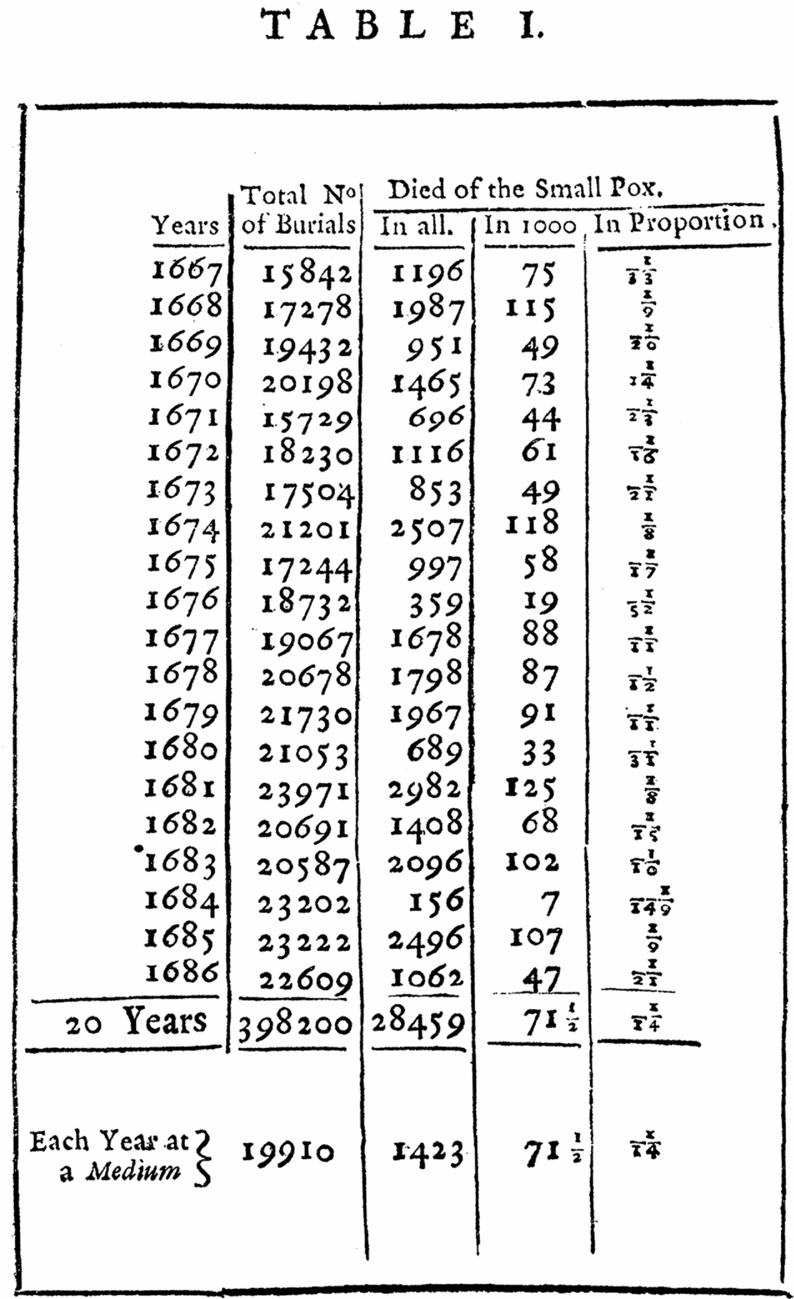
An examination of Jurin's text in Philosophical Transactions Reference Jurin1722–23 (vol. 32) shows that he followed the lead from Petty and Graunt, but also that his own presentation of the material was of a composite and complex nature. The comparison between general mortality and smallpox mortality, based on the Bills of Mortality, is given as a table (see fig. 1). Its two main parts are columns that present general mortality and smallpox mortality respectively, arranged by year. The latter column is subdivided into three, presenting first the total, then “in 1000” and finally the proportion of smallpox mortality when compared to the norm, expressed as a fraction. Below the sums at the bottom of the columns follow the annual average and then the average for the entire period (Jurin Reference Jurin1722–23, 217f). Corresponding material taken from reports that Jurin had received from colleagues is presented partly in a table and partly as a running prose text. The numbers of inoculated persons, also collected by Jurin himself through reports from colleagues, are given as a list arranged according to the names of the inoculators, sometimes including even their title and place of residence. The total number of 182 is presented as a sum below. Two fatal cases are mentioned in the following text, together with a comment saying these deaths probably are “occasioned by other causes.” They are nonetheless included in the subsequent calculations, giving the proportional number of two fatal cases out of 182 inoculated persons, or one out of 91 (ibid., 214f).
Table 1 from (Jurin Reference Jurin1722–23, 217).

The final comparisons between the general smallpox mortality and those caused by inoculation are presented in prose text only. This comparison is the very core of Jurin's argument. As Rusnock has pointed out, it was also the means by which the British debate was turned away from the more general controversy over inoculation and into a more specific argument over relative survival rates (Rusnock Reference Rusnock and Porter1995, 292). Jurin's approach to the issue is unquestionably quantitative, with numbers and calculations as vital elements in both analysis and argument. Nonetheless, the major and most important parts of his presentation are given as prose. Moreover, the textual parts present far more than mere explanations or commentaries on the tables and lists. Interspersed with numbers, written in figures as well as in letters, they contain much of the quantitative information as well as important parts of the calculations. The numerical lists, on the other hand, are not fully cleansed from additional information concerning location and social circumstance. As a whole, the presentation as it appears on the printed pages, can be seen as a result of Jurin's struggle to make numbers and quantities work as convincing argumentative resources.
Jurin's material was diverse and in some cases rather meagre. Only the Bills of Mortality represented larger amounts of systematically collected quantitative information covering a longer period of time. Most of the other information stemmed from letters, reports, and testimonies. Most of these sources referred only to a small number of cases each, and they also came without much guarantee that the figures had been systematically collected or processed (ibid., 293). It can be argued, nonetheless, that the jumbled nature of the material was not the only reason why Jurin did not turn it completely into tables and diagrams. In that period of time, it was simply not obvious that tables were the best way of conveying quantitative information, or that they most convincingly communicated arguments that were based on numbers. Even if Jurin was much admired for his work and frequently cited, he did not have many direct followers. As pointed out above, this concerns his work on large-scale systematic comparison, but it also applies to his way of presenting numerical information and quantitatively-based arguments.
More subtle issues of probability computation were discussed by the French mathematician Jean le Rond D'Alembert, originally in a paper submitted to the Parisian Académie des Sciences in 1760 and published in Opuscules Mathématiques the subsequent year. D'Alembert went straight to the methodological challenges raised by the common pro-inoculation argument based on comparing the risk of dying from inoculation with that of dying from natural smallpox. Based largely on Jurin, it had become generally acknowledged that one of seven persons struck by natural smallpox would die from it, and only one of 300 from inoculation. D'Alembert pointed out that the comparison was flawed: The individual's risk of dying from inoculated smallpox is concentrated in the period immediately after the operation, approximately one month. Even if natural smallpox as a general rule kills about one-third of the human race, this will, however, not happen in the course of one month. “Thus, during one month the risk of dying from the natural smallpox that one awaits is far smaller than dying from the smallpox one has been given. And why can one not, will the adversaries of inoculation say, make a similar argument for every month?”Footnote 1 D'Alembert refuted Daniel Bernoulli's solution to this problem of probability and presented his own. For both mathematicians, however, the question of life expectancy was at the core of the problem.Footnote 2
D'Alembert's discussion of the problem does not seem to have had a strong impact on the inoculation debate of the period. His work nonetheless holds a position in the history of probability thinking. It also demonstrates very clearly how smallpox inoculation became one of the earliest practical applications of probability calculus. Other such early fields of application were games of hazard, insurance, and life annuities (Hacking Reference Hacking1975; Daston Reference Daston1988, 82ff). In the present context, it should, however, be noted that D'Alembert's work differed from Jurin's in significant ways. D'Alembert's aim was to solve a problem of probability related to calculations of expectation and risk. Inoculation was his example. The inherent temporal dimension was the main challenge: How did time, more particularly a lifetime, influence the respective probability of specific outcomes? Jurin, on the other hand, had made smallpox a case of political arithmetic. His method was one of comparison between the different causes of mortality and their frequency. It involved the use of proportional numbers, but his computations had no temporal dimension and did not rely on the probability calculus developed by mathematicians. The main aim was to work out reliable sets of proportional numbers that could be compared, not to calculate probability in a strict mathematical sense.
References to Jurin, on the other hand, abound in pro-inoculation literature all over Europe throughout the century, and his work proved decisive to the acceptance of inoculation (Kirkpatrick Reference Kirckpatrick1754; Miller Reference Miller1957, 114–123; Skiöld Reference Sköld1996; Chamayou Reference Chamayou2008). Jurin's calculations of general mortality and the mortality of natural smallpox (excluding infants) were little contested nor further developed during the period investigated here. Contributors to the debate suggested other mortality rates, but did not present more extensive computational work comparable to Jurin's (see for instance Miller Reference Miller1957; Seth Reference Seth2008, 207; Eriksen Reference Eriksen2010a). Equally important, Jurin's source material and his own methodological concerns were hardly mentioned, and the proportional numbers that resulted from his calculations were cited as something of a natural law. It rapidly became a basic part of pro-inoculation argument.
Enthused by the potentialities of a quantitative approach without questioning the ratios presented by Jurin, even less discussing his methodological principles, European inoculators set about to collect numerical information (Seth Reference Seth2008, 208; Skiöld Reference Sköld1996). The texts they produced indicate that the counting and production of numerical material was no easy matter. Much work was necessary to make the numbers pure. Reports had to be cleansed of circumstantial information such as the social and medical condition of the patients, and also the reservations and explications of the physicians. Rusnock has discussed the challenges that Jurin had encountered (Rusnock Reference Rusnock and Porter1995). Furthermore, in most countries no material existed of the same quality as the Bills of Mortality that Jurin could draw on. Inoculators counted their own cases and collected reports from their colleagues. There were social, medical, and practical obstacles to making smallpox countable. And most important of all: In some cases the difficulties stemmed from the fact that other ways of arguing were both competing and entangled with that of numbers and quantities.
Encyclopedic Multivocality
The entry on inoculation in the Encyclopédie situates the method in its Enlightenment context. So far, it has been little acknowledged that the entry, published in 1765, largely is a compilation of two other, highly influential pro-inoculation texts. It was signed by the Swiss physician Théodore Tronchin, who was a fashionable and well-known inoculator in Paris and a friend of Diderot (Miller Reference Miller1957, 199; Seth Reference Seth2008, 290f). Tronchin earned his fame as a highly competent inoculator, but had published nothing on inoculation. What he mainly lent the entry on inoculation was thus his experience and his authority as a well-known and admired practitioner. The actual content of the article from the Encyclopédie is taken from two sources: Charles-Marie de la Condamine's Mémoires pour servir à l'histoire de l'inoculation de la petite vérole (Reference de la Condamine1754), which was first delivered as an address at the Académie des Sciences in Paris on April 24th the same year, and Samuel August David Tissot's work L'inoculation justifiée, which was published in Lausanne (1754). Even though these two sources represented somewhat different genres, a pamphlet and a popular medicine manual respectively, both texts presented strong pro-inoculation arguments, and were written with the aim of convincing. They were also both directed at readers without any medical training. First appearing in 1754, both texts were soon translated into several other European languages, and represented the very core of what has here been called the second wave of the European inoculation debate. The aim of discussing Tronchin's compilation of these two source texts is to investigate how inoculation was transferred into the explicit Enlightenment context offered by the Encyclopédie as well as to see the use that was made of the numerical argument established by Jurin.
As an explorer, geographer, and mathematician, la Condamine was a celebrity at the time (Seth Reference Seth2008). His work on inoculation was fundamental to re-igniting interest in the method in France and Europe after the middle of the century, and seems to have been the most frequently translated and widely circulated inoculation text in Europe. A Swedish translation was published as early as 1754, and the earliest English, Danish, and Italian editions followed in 1755. The text was written as a pamphlet with the aim of convincing its readers about the effect and utility of the new medical practice, arguing for its superiority. The language is strong and colorful, the arguments persistent. Tissot, for his part, was a Montpellier-trained physician and practicing inoculator. In addition to the six editions of his work that appeared in French, four German editions and five Italian ones have been identified (Emch-Dériaz Reference Emch-Dériaz1992). Some years later he became internationally known for his best-selling Avis au Peuple sur sa Santé (1761). This work of popular and accessible medical advice for “ordinary people” was also translated into many languages and had numerous editions. Tissot had the same aim of propagating inoculation and arguing for its efficacy and safety as had la Condamine, but he wrote largely from the position of a practicing physician. The language in his text was more subdued, and far more attention was given to the actual practice of the method, which made this book a veritable inoculation manual, making the method available even for persons without medical training. It also contained a section on the theory of smallpox and inoculation. The two texts that Tronchin based his work on thus differed in genre and style, and the article that he produced came to present more than one voice.
Both source texts start with the history of inoculation presented largely in chronological order, and Tronchin follows this pattern. He builds largely on la Condamine in this section but has excluded la Condamine's highly colorful introductory presentation of smallpox as “a terrible and cruel disease, whose germ we carry in our blood, [it] destroys, mutilates or disfigures one fourth of the human race.”Footnote 3 La Condamine's description builds on the “germ theory,” indicating that smallpox was due to some inherent impurity in humans. The theory became contested as early as the 1720s, but did nonetheless prevail for decades (Miller Reference Miller1957, 263ff). There are very few references to the number of people inoculated in this part of Tronchin's text. The social quality of the patients rather than the quantity of patients is emphasized, and a logic of exemplarity seems to prevail: Their social position makes them examples to be admired and followed. The uniqueness of the agents is pointed out, indirectly by reference to their titles, as for instance the Queen of Denmark or Princess of Wales, or more explicitly as the only son (or daughter) of some prominent family. References to inoculation at the orphanage in London (1746) and Paris (from 1755) imply a more quantitative approach, but the number of children that have been treated is not made the issue. Instead, both institutions are spoken of as exemplary cases of poor relief. Quantity and scale refer to the value of charity work rather than to the number of patients. The most explicitly quantitative considerations refer to Jurin's work, which is presented in the following words:
It consists of a large collection of facts that have been assembled in different places, authenticated by the known witnesses and carefully discussed in long lists of inoculated persons as well as of deaths and cases of natural smallpox, and in well considered comparisons between them.Footnote 4
The presentation of the inoculation method that follows this historical introduction is mainly based on the detailed presentation given by Tissot. Here, however, Tronchin also had his own experience to draw on, and he is emphatic that the method “now” used by physicians has been perfected through experience. Inoculation has become safer than when it was introduced in the beginning of the century:
The scratches that already Timoni replaced for incisions, now dominate. Experience has also taught that it does not matter much if the infected matter is taken from benign or malign smallpox, and that one scratch is sufficient, even if two usually are made, either on the arms or on the legs, as much to be more sure that the operation will produce the desired effect as to open a double canal for the excretion of the variolous matter, and to make sure that abscesses that are produced will be less numerous, less sharp and corrosive.Footnote 5
However, in the very period that Tronchin was producing his text, other improvements in the method also appeared, perhaps even more important than those that he chose to mention. They made inoculation a less complicated and less elaborate procedure. More fundamentally, they also had the effect of changing the conceptualization of the epidemic disease.
As early as 1757, the English surgeon Robert Sutton and his sons had started exploring methods that made inoculation less dangerous and less costly. Commercializing their method through the establishment of a number of well-run private inoculation clinics, they turned this medical success into considerable economic advantage (Williams Reference Williams2010, 137f). For the same reason, however, they kept their method a secret, and the Suttonian inoculation practice was not published until 1796 (Boylston Reference Boylston2012, 85). By then, Thomas Dimsdale, successful inoculator to the Empress Catherine of Russia and her son, the Grand Duke Paul, had already published his use of similar methods and had also been lauded as their inventor (Williams Reference Williams2010, 143). His book, The Present Method of Inoculating for the Small-Pox, was originally published in 1767 and in the next five years, five new editions were published (Eriksen Reference Eriksen2010b). The new methods, largely developed in Britain, had thus been little published at the time when Tronchin compiled his entry. It is nonetheless probable that they were known to him, due to the work of the Italian physician Angelo Gatti. Like Tronchin, Gatti was at this time a popular inoculator in Paris, frequenting the same social circles and enjoying the same kind of fashionable reputation (Miller Reference Miller1957, 230). He discussed the innovations in his book Réflexion sur les prejugés qui s'oposent au progrès et à la perfection de l'inoculation (Gatti Reference Gatti1764). To a certain extent the two men were competitors in the same social and medical “market,” though – as it seems – they used different methods of inoculation.
Tronchin appears to have employed the same method that was described by la Condamine and Tissot. This practice was in current use when their respective texts appeared in 1754, and when Tronchin arrived in Paris in 1756 to inoculate the children of the Duke of Orleans as well as a number of French aristocrats. He then reached the height of his fame (Seth Reference Seth2008, 271–277). Ten years after, however, at the time of Tronchin's article for the Encyclopédie, the situation had changed. The method that he described was now becoming old-fashioned and was on its way out. The same applies to the underlying presumptions that the method was built upon. Comparing the text from the Encyclopédie with the innovations will make this clear.
The new methods developed by the Suttons, Dimsdale, Gatti and others, mainly in the decade between the mid-1750s to the mid-1760s, shared a number of more or less identical elements. Among the important innovations were a shortening of the preparatory period before the operation and a simplification of the regimen of diets and purgings that formerly had been individually adapted to the constitution of each patient. Moreover, variolous matter was now transferred directly from one patient to the next, instead of by means of a saturated thread kept in place with a dressing. This reduced the risk of infected sores. Finally, the patient was now allowed cold drinks and fresh air during the period of illness following the operation, while the older method had been to keep him or her as warm as possible at this stage. This so-called “cold treatment” of fever had been introduced by Thomas Sydenham in the 1680s, but was now incorporated into the treatment of smallpox (Dimsdale 1767; Eriksen Reference Eriksen2010b).
Among these innovations, the simplification of the preparatory period stands out as the most important to the issues discussed here. In addition to shortening the period of preparation and simplifying the regime, the radically new idea was that the same regime could be applied to all patients. Dimsdale, for instance, gave a prescription of one regime that, according to him, could be used by anyone who was at all fit for inoculation. Adjusting it to the constitution or specific temperament of each individual patient was not required (Dimsdale [1767] Reference Dimsdale1772, 20). Gatti presented similar ideas. These changes turned inoculation into a far less individualized treatment, and suggested a fundamental – and countable – identity between all cases of smallpox (Eriksen Reference Eriksen2010b). This practice contrasted largely with the method presented by Tronchin and his two sources. Tissot had employed close to thirty pages for the presentation of preparations and all the precautions that were necessary. Several of them concerned the importance of choosing the best season and climate for inoculation, as well as considering the age and general state of health of the patient. For women, their menstruation periods also had to be taken into consideration. Only when all these circumstances had been carefully dealt with, and the best time for the operation chosen, could the preparation of the patient start. Bleedings might be required, depending on the patient's constitution. Tissot discussed this in detail before continuing to the issue of the number and type of purgings that would be necessary. Following this came the dietary prescriptions: Food must be light and easily digested. Milk, well-cooked vegetables, and white meat were recommended. Baths, particularly footbaths were highly important. Tissot also underscored that these were only the general preparations. The task of the competent physician was to adjust them to the particularities of each case and each patient. Particularly difficult cases might need more or other preparatory measures as well (Tissot 1754, 63). However, he also pointed out that if all careful precautions and adjustments were made, persons of all ages and all constitutions could be inoculated (ibid., 40).
Why were these cumbersome, complicated, and resource-demanding preparations necessary? What was their aim? Tronchin was explicit on this point:
as it is a matter of preparing the body for an inflammatory disease, the more the subject is healthy and vigorous, the more his forces generally speaking need to be weakened by bleedings, diet and the use of cooling remedies. Some purgings and in some cases baths may be added. It is reasonable to consult an experienced physician, who knows the temperament of the person who is to be inoculated, and who can prescribe the most suitable regime.Footnote 6
The success of inoculation was held to depend on the patient's constitution and on the physician's competence in modifying it. The English physician James Kirkpatrick adamantly stressed that it was in the preparations that the competence, experience, and art of the physician really were important. Preparations called “for all the Caution as well as Knowledge, of the Physician” (Kirkpatrick Reference Kirckpatrick1754, 238). Knowing his art well,
every ingenious and experienced Physician, who has considered this Matter well, may have sufficient reason to infer, that on availing his Patients of all good Circumstances, Persons of naturally unpromising Temperaments, and less convenient Ages for the accidental Disease, may have a reasonable Expectation of passing very tolerably through that by Inoculation. (Ibid., 239)
It was the physician's learning that made it possible for him to “alter the specific Constitution and Stamina” of the patient, and to lead him or her safely through the dangers of the illness introduced by the operation.
Charles E. Rosenberg has pointed out that until the nineteenth century, the “physician's most potent weapon was his ability to ‘regulate the secretions’ – to extract blood, to promote the perspiration, urination, or defecation which attested to his having helped the body to regain its customary equilibrium” (Rosenberg Reference Rosenberg1977, 488). The terminology and argument of inoculation connected this new remedy to the traditional teachings of humoural pathology, with its focus on constitutions and temperaments, bodily fluids or humours. Successful inoculators knew how the humours interacted inside the body and how they constituted the temperament of each individual. The task of the physician was to come to terms with the constitution of the individual patient and use his skills to temper it. Healing a sick person meant repairing the disturbed balance and harmony of his or her specific constitution. Correspondingly, preparing a person for inoculation meant to adapt him or her to the onslaught of the coming disease (Eriksen Reference Eriksen2013). Humoural pathology in general implied a focus on the patient rather than on the disease (Rosenberg Reference Rosenberg1977, 287). Historian of medicine Anne Kveim Lie has pointed out that eighteenth-century medicine saw the state of illness in a body as individual in principle. She has argued that this also lay behind the opposition against panaceas offered by quacks: It was not so much due to a disbelief that all diseases could be cured by one and the same remedy as to a fundamental reluctance to accept the possibility that all patients could be cured by the same treatment (Lie Reference Lie2008, 172f). Even if inoculation was introduced as a radically new technology in Europe, the great weight that was put on preparations and the rhetoric surrounding it clearly shows that it was fully incorporated into the traditional understandings of disease, illness, and treatment (Eriksen Reference Eriksen2013). What counted were the individual variations, brought on by the constitution of the patient as well as by external elements such as the season, the weather, and the phases of the moon.
This fundamentally individual understanding of illness and its treatment had important implications for the relevance of quantitative approaches to disease in general and to inoculation in particular. Physicians and surgeons knew well enough that smallpox was an epidemic disease, striking large numbers of people when it attacked. During the eighteenth century, miasmatic theories were the most prominent causal explanation of epidemics. Miasmas or bad air were thought to produce disease, but only in individuals who were in some ways predisposed for it. When it came to smallpox, this predisposition was conceived of as some kind of “germ in our blood” as la Condamine writes (la Condamine Reference de la Condamine1754, 1). He understood this as a kind of impurity transmitted from the mother to every child at birth, and hence as generally human. Others, leaning on the fact that smallpox was not a universally known disease, subscribed to the theory that only some individuals – for unknown reasons – carried this predisposition. As the argument over preparations clearly shows, individual circumstances – or more precisely the humoural constitution of each patient – were also thought to determine the illness that would be produced by inoculation. Moreover, the individual disposition was referred to as an explanation for why some persons would die from the smallpox (natural or inoculated), while others only developed mild cases (Rottböll Reference Rottböll1766, 44). As long as these ideas prevailed one case of smallpox could be understood as profoundly different from another. The particularities of each case defined the disease just as much as the miasmas or “germs.” From this point of view, counting the cases would not be directly irrelevant, but on the other hand only gave limited information about the disease, its development and the general prospects of the case.
This is an important reason why the new methods of inoculation that appeared in the 1760s represented more than technical improvements and a higher survival rate. The idea that preparations might be reduced and that all patients could be treated more or less in the same way implied an understanding that all cases of smallpox shared a basic identity, and that this – not the humours of each patient – was what defined the disease. The technical improvements of the 1760s were accompanied by discussions on the causes of smallpox: Were internal factors (humours) or external ones (contagion) the more important triggers? With theories of contagion gradually taking the lead over those of inherited impurity, the defining aspect of each case was transferred from the individual patient to the disease itself. Only then did the counting of cases become a really relevant operation, and only then did calculation of proportions and probabilities fully make sense.
Numbers as Metaphors
Even if Tronchin's text for the Encyclopédie stuck to the older practice of inoculation, with its inherent tendency to treat each case in an individual way, it also contains several references to numerical approaches. Neither Tronchin's text nor his two sources had tables, diagrams, or even lists of numbers and names. All of them did, however, refer to Jurin's work, as well as to a variety of other inoculators who more or less systematically had specified their ratios of fatal cases among their total number of patients.
Of the three, Tissot gave the least attention to numbers, but cited Jurin's work in his text on the advantages and successes of inoculation. Tissot spelled out all the numbers and incorporated them in his running text. There were no lists or tables. Combined with his strong emphasis on preparation, constitutions, and the particularities of single cases, this gives the impression that even if the low number of deaths following from inoculated versus natural smallpox had become a staple element in pro-inoculation rhetoric, the quantitative argument was not what Tissot reckoned as most important or most convincing. This also fits well with Tissot's theory that smallpox was not in itself a very dangerous disease. He argued emphatically that what created the fatal cases were unlucky circumstances, partly found in the patient's constitution, age, or general state of health, and partly in the weather and climate, in the food and diet, and so on. Correspondingly, he did not envisage inoculation as a means of preventing smallpox, but as a way of controlling it and ensuring that the patient only developed a mild and benign case (Tissot 1754, 10ff). Tissot's comparatively weak interest in citing numbers, then, does not signal a disbelief in the available figures, but indicates an understanding of disease where numbers did not represent the most relevant approach.
In Tronchin's article, the quantitative information is presented under the heading “advantages of inoculation.” Even to Tronchin inoculation was not a prophylactic means, but rather a way of controlling smallpox (Eriksen Reference Eriksen2013). He thus spoke of the two ways of having this disease, the natural versus the artificial. Following Jurin's methods, and also building largely on his figures, Tronchin presented a compact argument in favor of inoculation. It was based on comparisons between the relative risk of dying from the two forms of the disease, and on knowledge gained from experience: “Expériences et dénombremens” appears as two sides of the same coin (Tronchin Reference Tronchin1765, 759), which implies that experience in this case does not refer to a general variety of cases, but is used to denote knowledge that is quantifiable and can be used for calculations.
Tronchin presented two general principles for smallpox mortality, both, according to him, based on “experience”: Of the entire human race, one fourteenth will die from the disease, and of seven who are attacked, one normally will perish (Tronchin Reference Tronchin1765, 759). He then compared the two principles with the far smaller risk implied in inoculation:
Firstly, of seven persons less than one will die. Secondly, from 200 at least 199 will be saved and from this number, regular smallpox, that takes one seventh, would have chosen more than twenty. Let us suppose that inoculation takes one, he who is ill from natural smallpox thus runs a risk of losing his life that is at least twenty-four times greater than he who is inoculated, without mentioning the other advantages that we have explained, among which that of being protected against ugliness is as great a price as saving the life among one half of the human population.Footnote 7
After this conclusion, Tronchin discussed whether the risk of being attacked by smallpox is universal among humans. This was a frequent topic in inoculation literature, related to the issue of how smallpox partly stemmed from “internal” causes in the disposition of the patient (Eriksen Reference Eriksen2010a). After once again supporting his argument with numbers and calculations, Tronchin concluded by presenting the same answer as did Jurin: Those who ended their lives without having had the disease were mostly infants. The risk of being struck by the disease was practically universal (Tronchin Reference Tronchin1765, 761).
There can be no doubt that to Tronchin the use of numbers and calculations represented a strong and powerful line of argument as well as a rational way of organizing knowledge. His calculations followed the pattern set by Jurin, centered on comparisons of ratios and proportional numbers. He also referred briefly to calculations of probability “which is one of the branches of geometry” (Tronchin Reference Tronchin1765, 767). The issues that were dealt with here are the most important of all, and fundamental to all other questions of inoculation, according to Tronchin. However, due to their great complexity they cannot be answered by physicians or theologians, but must be left to the mathematicians. Despite this expressed belief that the key to the matter lay in calculations of probability, Tronchin left the issue after this short reference (Tronchin Reference Tronchin1765, 767).
Far more elaborate was the use of numbers in the parts where Tronchin built directly on la Condamine. Even la Condamine, who himself was a mathematician, referred to Jurin and to other English practitioners, but he had also developed another and far more flourishing rhetoric of numbers that dominated his pamphlet. A typical example can be found in his discussion of the mortality rate of natural smallpox, this terrible disease that “kills the seventh, the fifth, the quarter, at times even the third, of those that it attacks.”Footnote 8 This somewhat imprecise enumeration may be read as a result of the lack of precise information or the difference between epidemics, but it also reflects a more general use of numbers in the text. Discussing whether a loving father really should choose to have his only son inoculated, la Condamine asked rhetorically:
However small the risk is, that he [the father] will expose him to inoculation, if it be not more than one out of hundred, out of two hundreds, out of three hundreds, as it is supposed to be, to whom the operation is fatal, ought he to intentionally expose his son to it?Footnote 9
The answer was – of course – yes: A father whose paternal love was “enlightened” would have his son inoculated when the risk was so small compared to that of his being killed by natural smallpox. The argument was obviously quantitative. It also relied on calculations that were reckoned to be valid and trustworthy. Nonetheless, this litany is not so much a matter of calculations as of a rhetorical comparison of pluralities, going from the risk being “quite small” to “very small indeed.” La Condamine simply made use of one of the common tools of classical rhetoric, that of amplificatio, or magnification, enlargement.
La Condamine summed up his main argument by using two parables. Both were frequently cited and adapted in later pro-inoculation literature. They were also directly copied into Tronchin's text for the Encyclopédie. The first compared smallpox to a dangerous river that every human is compelled to cross. Swimming represents an evident danger of drowning. Then, a boat is offered. Remaining on the shore is not an option, and the question is whether one prefers to cross in the dangerous way, or make use of the new and safer remedy (la Condamine Reference de la Condamine1754, 57). The second parable made use of numbers and expectations in a way that must have been highly familiar to eighteenth-century readers:
This is the fate of humanity. One third of all who are born are destined to die during their first two years from incurable or at least unknown distempers. Having escaped this first danger, dying from smallpox becomes an inevitable risk for the entire rest of one's life. It is a forced lottery in which we find that we take part despite ourselves, each and every one has his ticket, and each year a certain numbers are drawn. Death is the lot. What does inoculation imply? The conditions of this lottery are changed, the number of unlucky tickets is reduced. One out of seven, & in more favourable climates one out of ten, that was fatal; there remains no more than one out of three hundreds, one out of five hundreds, and soon it will not be more than one out of a thousand. All future centuries will envy us this discovery: nature decimated us, art takes one in a thousand.Footnote 10
The imagery of fateful lots drew strongly on the general passion for lotteries and games of chance that ruled most European countries in this period. Games of chance were also one of the first practical applications of the calculus of probability, as well as one of the preferred examples of its theoreticians (Hacking Reference Hacking1975; Daston Reference Daston1988). La Condamine did not refer to the calculus of probability in his parable, but simply drew on the probable well-known experience of his readers of having a lottery ticket and waiting for it to be drawn. The result very concretely meant loss or gain of immense implications – as it also could do for compulsive players in the real games of chance. What distinguished the lottery that was described by la Condamine was, nonetheless, its forced character. It is not possible not to take part. To an even higher degree than his enumerations of ratios, the role of numbers in this parable was metaphorical rather than mathematical. What made it effective was not the exact number of lottery tickets or the precise chances for loss or gain, and even less the exactness of calculations like those of Jurin, but the text's ability to create a vivid image and make the readers identify with the situation and its dramatic implications.
Exemplarity and Quantity
The treatise published in 1766 by the Danish Christen Friis Rottböll elucidates the entangled rationalities of the pro-inoculation argument. Inoculation had been introduced in Denmark-Norway in the early 1750s, most notably through the inoculation of the young Baroness Bernsdorff in 1754. Her husband, at the time de facto ruler of the kingdom due to the insanity of King Christian VII, had learned about the inoculation method during a stay in Paris in the 1750s, and had an English doctor treat his young wife. In Paris, the Baron also had befriended la Condamine and had become well informed about the medical novelties of the time as well as the debates over them. Due to his initiative, the pamphlet on inoculation published in Paris by the Montpellier physician Jean-Antoine Butini in 1752 was translated into Danish as early as 1753, and that of la Condamine's in 1755 (Eriksen Reference Eriksen2010a). Both these works were thus known to Rottböll. As a professor in medicine, anatomy and botany, he had also practical experience with inoculation. From its opening in 1755 until it was closed in 1760, he had been the Head Physician of the Royal Inoculation House in Copenhagen.
Rottböll's book, which came to function as a practical handbook of inoculation, contained a final section on the history of inoculation in Denmark-Norway (Rottböll Reference Rottböll1766). In writing this, Rottböll relied on a number of documents and reports that were reproduced as appendices to his book. Comparing these reports with Rottböll's own text, it becomes clear that several ways of reasoning are present and that the numbers of successfully inoculated patients could be cited in different types of argument (Eriksen Reference Eriksen2010a). His work to collect and “cleanse” information for a large network of practitioners appears as a downscaled version of the method employed by Jurin, as discussed by Rusnock (Rusnock Reference Rusnock and Porter1995). Contrary to Jurin, however, Rottböll chose to publish even the reports, thus presenting a chorus of voices, arguments and agendas in addition to his own.
Rottböll asked his informants about the number of persons they had treated and the number of fatal cases that had developed. The questions obviously were difficult to answer. One reason was that inoculation was most often done during epidemics, with a considerable rush of patients to be treated rather than counted. Moreover, during an epidemic it was not always obvious whether patients died from natural smallpox that they already had contracted, or from inoculation that went wrong. Social and other concerns also made purely numerical information hard to come by. A report written at Rottböll's request by the physician Jensenius illustrates the problem. Its main aim was to present a list of the persons who had been treated in Jensenius' private clinic in Copenhagen, a major site of inoculation in the capital. It started, however, with a description of the inoculation of the Crown Prince, which had taken place at court. This example was so important to the history of inoculation, Jensenius wrote, that it must be recorded. He expressed his gratitude for having received the grace and luck to be present on the occasion (Rottböll Reference Rottböll1766, 112). Only following this are Jensenius's own cases presented. From among the approximately 140 persons that he had inoculated, he had chosen to list the names of those who belonged “either to the most high and noble or most well-known families in Copenhagen” (ibid.). Starting with the noble family Moltke, he lists a number of other noble families before working his way down the social ladder. Among the last ones mentioned by name was the Royal Inspector of the Icelandic trade. The nameless rest were “partly from the provinces, partly from bourgeois families, and some come from the orphanage” (ibid., 114–15). Even they had been counted, to make up the total of 140, but Jensenius's way of organizing his information also demonstrates that for him they counted far less.
This interest in noble names and influential families should not be seen as a mere expression of snobbery. It represents what can be called the logic of exemplarity. Examples create “connections between a general statement or maxim and local or specific realisation of that maxim,” according to the literary scholar John D. Lyons. By doing so, they make the general understandable while at the same time they give authority to the specific case. For this reason, the example can work as a model, specifying how a general value or principle can be made relevant, local, and concrete (Lyons Reference Lyons1989, 5). Medievalist Larry Scanlon has also pointed out that examples are not random cases, but can be defined as “enactments of cultural authority” (Scanlon Reference Scanlon1994, 37). The statement to be enacted or performed in the present case is that inoculation works, and that it saves lives. The authority in question is of a medical kind, represented by the physicians or surgeons. As demonstrated in the reports from Jensenius and other inoculators, however, the authority of the social position of the persons involved also played an important role. The exemplarity of the cases on Jensenius' list thus stemmed from their medical success, but equally as much from the names and titles of the patients and their positions in society. Rottböll tried to calculate the exact numbers of inoculations and fatal cases from the answers he received. This work was not easy. The question of figures was answered with names, meaning that quantity was transformed into a matter of social position. To other respondents, numbers were subordinated to the question of building patronage networks, supporting the inoculator's own career or of referring to local disputes (Eriksen Reference Eriksen2010a). Extracting numbers and summing up the rather composite information that he had collected, Rottböll was nonetheless able to conclude that by 1766 altogether 170 persons had been inoculated in the capital alone, while the Danish national record was held by studiosus medicus Barfoëd, who alone had inoculated approximately 200 persons in Funen during an epidemic in the mid-1750s.
Rottböll's efforts to present precise information were further complicated by the fact that he himself also oscillated between a quantitative and an exemplary line of argument. According to him, the history of inoculation in Denmark-Norway started with the treatment of the baroness Bernsdorff in 1754. Rottböll nonetheless knew that half a year before this event a vicar Thun in the remote province of Ribe had inoculated his own children, while the physician Fabricius in Holstein had inoculated his own children and close to 60 others. But the reason why he decides to start the historical account with the baroness rather than with the earliest cases, is her exemplarity. This quality stems not only from the moral fact that she offers herself as a patient, but just as much from her “Highness” and the “numerous excellent qualities” that distinguish her, i.e. from her and her husband's position in society. This is what confers authority on her sacrifice and makes her example such an outstanding one, according to Rottböll (Rottböll Reference Rottböll1766, 101f). The baroness, who was a young lady of 18, was stricken by a severe attack of confluent smallpox after her inoculation. She survived, but was left with a badly pockmarked face. A modern reader might thus wonder somewhat about the exemplarity of the event. Rottböll would have had a stronger case had the inoculation been a success, but to him the authority of the example is derived just as much from the social as from the medical context. A flock of anonymous children successfully inoculated by a provincial vicar or surgeon did not have this authority. Their case could not mark the beginning of the history of inoculation in Denmark-Norway. To Rottböll, this history starts with the authority of exemplarity, not with random first occurrences.
In Rottböll's text, exemplarity and quantities appear as competing lines of argument, drawing on somewhat different sets of rhetorical resources. The same case (or cases) may be ascribed significance due to its (their) exemplary qualities, as a paradigmatic model, or as part of a series, as one of many. To informants like Jensenius, the former seems to have offered the more powerful argument, solidly grounded in a traditional understanding of social hierarchy. However, the entanglement should not be seen simply as the tension between a traditional and a more modern way of thinking, but rather as inherent in the logic of exemplarity itself (Gelley Reference Gelley and Alexander Gelley1995). Most examples gain their rhetorical efficacy from the fact that they are outstanding models and parts of a series at the same time. The dimension of seriality, intrinsic to examples, enabled their link to the new interest in numbers, but at the same time obfuscated the reason why numerical information needed to be cleansed from social circumstance and other particularities to produce new types of knowledge.
Entangled Arguments
There can be no doubt that numbers, quantifications, and calculations were important in the eighteenth-century inoculation argument. This article has attempted to demonstrate that numbers and quantifications were used in different ways and that numerical approaches both competed and concurred with other lines of argument. These ways of reasoning in part made numbers irrelevant, and in part included them in other types of discourse. Their message was transformed from the quantitative to the qualitative. The most powerful of these competing types of argument was that of exemplarity, which made the issue of who the patients were far more important than their numbers. Social position often counted more than quantity when it came to arguing for the relevance and benefit of inoculation.
Several of Europe's royal families had been severely ravaged by smallpox for centuries. When inoculation was introduced, they were usually among the first to make use of the innovation (Seth Reference Seth2008, 207ff). Scholars have pointed out that the sacral state of the absolute king's body also conveyed special importance to inoculation. Introducing a potentially mortal disease to this body implied a very high degree of risk. Saving it from a painful and untimely death, on the other hand, was of vital importance to the entire nation (Darmon Reference Darmon1989). As the discussion above has shown, the logic of exemplarity embraced more than royalty alone, and concerned more than the special state of the king's body. The idea that one inoculated person of high social standing counted more than a large number of commoners or their children reflects a society where social position had implications other than an uneven distribution of wealth, power and connections alone. It signaled that people in high positions were of a different kind from others, but also that there were bonds between them and the rest of society. They “shine of high qualities” as Rottböll says about the unfortunate Baroness Bernsdorff (Rottböll Reference Rottböll1766, 101f), and in their uniqueness resided their exemplarity that made them models for others.
The belief in exemplarity as a considerable social force is also evident in Tronchin and la Condamine. Copying the argument of the latter, Tronchin ended his article in the Encyclopédie by asking what can be done to make inoculation general practice in France. Should a law be established that obliged fathers to have their children inoculated? Instead of a direct answer, Tronchin – or rather la Condamine – referred to the old Lacedaemonian society, where children were the responsibility of the state. However, “our” society is different, and “a law will not be required in France; encouragement and example will suffice – and perhaps have greater force than a law.”Footnote 11 According to this way of reasoning, prevalent even among leading proponents of Enlightenment ideas, the mass measure of a law could not compete with the efficacy of the example to produce general change.
Moreover, the understanding of disease as fundamentally individual also reduced or changed the significance of counting cases and making tables or calculations. Whilst ideas of exemplarity made the social circumstance of the single patient a relevant issue, the emphasis on the individual constitution and humoural balance did the same for individual medical circumstance: The important thing was who precisely you were. The method of inoculation itself long supported this view. Not only did the elaborate preparation make inoculation so resource-demanding that its practical availability was restricted; it also more theoretically precluded the relevance of quantification and mass treatment.
The significance of the individual case shines through in most pro-inoculation literature. This applies not only to the exemplarity cases that hardly any text is without, but also is apparent in tables and computations. The cases were almost always referred to by using exact numbers rather than percentages. We meet one out of seven cases, or 72 out of 614. Even if the ratios may be simplified to one out of “n,” this way of presenting numbers makes the actual patients appear far more present and real than percentages would do. Moreover, when it came to the fatal cases, those who died from the treatment, the texts frequently broke away from numerical reports and dissolved into prose. The exact circumstances of the fateful cases had to be recounted – the mere counting of deaths was not sufficient.
Finally, even the calculations and use of numbers in themselves did not unequivocally encourage what today would be understood as quantitative thinking about health and disease. Lorraine Daston has argued that until the nineteenth century, probability was about the intuition of rational men in cases of uncertainty (Daston Reference Daston1988, 49ff). The aim of the mathematical calculations was to describe as well as prescribe individuals’ rational choices rather than merely to investigate or control truly random phenomena. The argument presented by la Condamine, as well as more generally the arguments in pro-inoculation literature, strongly reflect this way of thinking about the use of numbers and computations: They are tools to help individuals – like the loving father above – make the best and most rational choice in situations of stress and uncertainty. This understanding of what probability and quantifications were about did not necessarily enhance the idea of a population or of mass treatment. Even if the quantifications and comparisons between the ratios of inoculation and natural smallpox mortality involved large numbers, they were addressed to the individual, and concerned his or her chance of survival. Neither did the efforts of making inoculation a “general” measure exclude this fundamentally individual perspective. For the proponents of inoculation, the aim was to save as many lives as possible. This was also the expressed goal of inoculators who reported the number of people they had treated. Nonetheless, even inoculators who could proudly claim to have treated a great number of persons seem to have conceptualized this solely as a matter of individual lives for a long time, not as a mass population or group. Catriona Seth has also pointed out that even if it was argued that inoculation served “the common good,” for a long time this was conceptualized in terms of individuals, not institutions, and even less in terms of nations or states (Seth Reference Seth2008, 229f). Tronchin, building on la Condamine, regretted deeply that inoculation had not become a general practice in France from the moment it was introduced in England. Had this happened, “one would already have saved the lives of nearly one million men, without including their descendants!”Footnote 12 This way of thinking about large numbers of people should not be ascribed to merely a lack in the understanding of herd immunity. It reflected fundamental ideas of society as an organic unity, composed of individuals who were connected to each other by the bonds of family, kin, and descent.