1. Introduction: entrepreneurial opportunities, judgment and market making
Diagnosis: definition – The identification of the nature of an illness or other problem by examination of the symptoms. Oxford English Dictionary.
Doctor-patient jokes are the single most popular genre among all jokes in the English language; they can trace their lineage to the ancient Romans, and are present in all language and cultural groups around the world (Davies, Reference Davies2002). This universal appeal lies in the combination of information asymmetries between patient and doctor, and the doctor's potential to offer correct or incorrect diagnoses of the problem. Overwhelmingly the humor lies not in whether the doctor is competent, but whether the patient can accurately describe their symptoms.
We contend that entrepreneurs often face similar uncertainties while marketing some types of novel products to consumers. Entrepreneurs seek to introduce such novel products to solve consumers’ problems, but consumers know very little about either the products or, indeed, their own problems. It is difficult for them to describe their symptoms and articulate their problems accurately. In order to overcome the information asymmetries and exploit the market opportunities, we suggest that entrepreneurs must invest in market-making innovations as distinct from product innovations. Analogous to the doctor-patient relationship, successful market-making requires the skill of entrepreneurial diagnosis. This, we suggest, is a key feature of entrepreneurial judgment not yet emphasized in the literature.
The article proceeds with a brief literature review, outlining the gap in the literature, before going on to develop the theory of entrepreneurial diagnosis. We then model entrepreneurial market-making, showing how under certain conditions entrepreneurs have to offer diagnoses of consumer problems. This leads to the identification of key market-making strategies adopted by diagnostic entrepreneurs.
2. Literature review: opportunities, judgment and markets versus entrepreneurial diagnosis and market making
Since Shane and Venkataraman's (Reference Shane and Venkataraman2000) call for researchers to locate the source of entrepreneurial opportunities, much conceptual development has focused on the creation, discovery and development of entrepreneurial opportunities (Choi et al., Reference Choi, Levesque and Shepherd2008; Gielnika et al., Reference Gielnika, Freseb, Grafc and Kampschulte2012; Sarasan et al., Reference Sarasan, Dean and Dillard2006; Short et al., Reference Short, Ketchen, Shook and Ireland2010; Wood and McKinley, Reference Wood and McKinley2010). Such focus on developing the separate conceptual elements of entrepreneurial opportunities is understandable as the concept has matured, but has begun to attract increasing criticism (Dimov, Reference Dimov2011; Foss and Klein, Reference Foss and Klein2012).
Foss and Klein have recently argued that under conditions of uncertainty, opportunities are really metaphorical (or ‘imagined’), not real. As a result, they can only be defined ex post, and so ‘actions, not opportunities, should be the unit of analysis in entrepreneurship studies. . . . Opportunities. . . do not exist, but are inferred (ex post) from market behavior,’ (Foss and Klein, Reference Foss and Klein2012, pp. 75 and 35). This poses immense operational difficulties for placing entrepreneurial opportunities at the center of any research agenda, because the only evidence of opportunity creation, discovery and development emerges in its profitable exploitation. It follows that if the ‘only reliable confirmation that a previously unseen or unknown valuable opportunity in fact exists occurs when a market has been created for the new item’ (Eckhardt and Shane, Reference Eckhardt and Shane2003, p. 339), then the observable activity of market creation is central to any assessment of entrepreneurial opportunities.
Foss and Klein by contrast suggest that the unit of analysis should be entrepreneurial actions, ‘the assembly of resources in the present in anticipation of (uncertain) receipts in the future, in other words, investments’ (Foss and Klein, Reference Foss and Klein2012, p. 102). Such actions are entrepreneurial because they are based on entrepreneurial judgment: ‘decision making under uncertainty over the use of scarce resources to satisfy future consumer wants’ (Foss and Klein, Reference Foss and Klein2012, p. 100).
By definition, entrepreneurial judgments and actions represent decision making in complex, highly idiosyncratic situations. This necessarily makes it difficult to evaluate entrepreneurial success and failure without detailed knowledge of the specific contexts in which the judgment and action occur. It has also led to criticism of judgment as simply a black box construct, that, like entrepreneurial opportunities, represents a poor unit of analysis for understanding entrepreneurship (Dew et al., Reference Dew, Sarasathy, Read and Wiltbank2009). But some contexts share common features (Zahra and Wright, Reference Zahra and Wright2011). Our purpose here is to elucidate how the entrepreneurial response to certain complex markets is to develop the skills of entrepreneurial diagnosis, without which markets will remain incomplete and transactions fail. This exercise reveals systematic factors which underlie the diversity of actions undertaken by entrepreneurs in pursuit of profit.
Despite one or two earlier indicators of its importance (Casson, Reference Casson1982 [2003], ch. 7), the recent literature in entrepreneurship has largely ignored market-making. This gap in the literature is doubly curious because, while so much of the empirical literature has focused on complex products offered by high technology entrants, the primary concern of many entrepreneurs is not new technology creation, but the uncertainty surrounding market reception of the product. Good innovations often fail, and inferior technologies not infrequently succeed (Christensen, Reference Christensen1997; Moore, Reference Moore1998). But in the entrepreneurship literature there is currently little attempt to better understand how superior novel technologies might get better matched to relevant consumers. Market-making is assumed to occur spontaneously, with consumers being fully informed of the relative merits of competing technologies. If this were true, then market-making would be a process of little interest to entrepreneurship scholars. But, as already noted, markets for complex, high technology novel products frequently fail to function satisfactorily.
There is, moreover, another reason why markets for novel complex and sophisticated products do not clear spontaneously. It is not only difficult to explain to a customer how the novel product may help them, but it is also possible to persuade a customer without a problem that they do in fact need a novel product. Persuading a customer to purchase a product that they do not need can be achieved through misrepresenting the quality of the product (Akerlof, Reference Akerlof1970). But for our purposes, what is more interesting is that entrepreneurs may mis-diagnose the customer's problem. The customer is persuaded that they have some problem that in fact they do not have, and they are then sold the product to cure the problem. The product may be completely useless and would not solve any problem. Or the product may solve the problem concerned, but the customer does not have the problem. Footnote 1 So far as the customer is concerned the issue is the same; in either case they are worse off than they were before because they have paid for a product that is no use to them. Mis-diagnosis does not have to be intentional, however. With complex problems it is often difficult to determine whether there is a solution. Where there are several possible solutions, it may be difficult to determine which is best. As explained below, three factors govern successful diagnosis: the complexity of the problem; the competence of the diagnostician; and the integrity of the diagnostician.
3. The concept of entrepreneurial diagnosis
The basis for a theory of diagnostic entrepreneurship is the view that entrepreneurs develop solutions to common problems and embody these solutions in products. An entrepreneur may develop a solution to a problem of their own before realising that it will be useful to others. Alternatively they may set out to discover some common problem that has not yet been identified in order to exploit the solution as a profit opportunity. In both cases the solution is embodied in a product or service sold by the entrepreneur. For example, some best-selling chilled children's meals have been based on recipes invented by working mothers for their own use.
Selling a product as a solution to a problem can be difficult, however, if customers do not understand the problem or do not believe that it applies to them. Sometimes customers may be aware that they have a problem, and be actively seeking a solution themselves, so that they will be alert to any news that a solution has been found and can be purchased (e.g. a cough or a cold). In other cases, however, they may not be aware that they have a problem (e.g. they are ignorant of some key information), or they may believe that they have a problem but be unsure exactly what the problem is (e.g. lack of social success due to poor dress sense). In the first case they do not realise that they should be seeking a product that will solve their problem, and in the second case they do not know the specification of the product they require.
When customers do not realise that they have a problem, or do not know the product specification they require, an entrepreneur who has developed a solution cannot simply announce their product and expect customers to purchase it. The entrepreneur needs to explain both the nature of the problem, and the relevance of the product to it, and help customers to assess whether they have the problem or not.
Conventional economic analysis tends to overlook this issue. It is normally assumed that the customer is concerned solely with issues of quality and price. Furthermore, quality is usually identified with some intrinsic characteristic of the product, such as its durability or reliability, or the consistency of the different units supplied. The nature of the problem, and the connection between the problem and the product, is assumed to be obvious, so that such information is freely available to everyone. In addition, customers are assumed to be experts on their own circumstances, and therefore to know for certain whether they have a problem or not.
In marketing studies there is greater recognition of the fact that not everyone understands the nature of a problem, or the connection between a problem and a product. Consumers, for example, may not realise that they have hidden desires, and that certain products will prove valuable because they can help to satisfy them. Motor cars are a trite example: ostensibly a motor car solves the problem of restricted mobility and freedom, but certain types of car may also enhance status and attract the opposite sex. Advertising can address this issue by portraying cases in which the product successfully solves the hidden problem. Similar effects apply to services: people may go shopping for visual stimulus and social contact, so that purchasing a product is simply a pretext for fulfilling other needs.
These ‘hidden desires’, however, are often assumed to apply to everyone; the issue becomes more complicated when some people have certain desires and others do not. It is then necessary for the entrepreneur to identify the people who are most likely to have a particular hidden desire. Neither economics nor marketing studies fully addresses this problem.
Many products are marketed on the premise that they are good for everyone, and that consumers can be left to decide for themselves whether they are useful to them or not. This provides an opportunity for dishonest entrepreneurs to promote products to people who do not need them. It is possible, for example, to take some harmless everyday symptoms that most people experience from time to time, and suggest that these symptoms reflect a particular problem to which a specific product is the cure. A classic example is the proposition that social isolation is caused by body odor and can be cured by shower gel.
While dishonest entrepreneurs can profit in the short run from selling unnecessary products, in the long run this strategy tends to undermine the market. Many people find through bitter experience that the diagnoses of their problems offered by entrepreneurs tend to be untrue, and so all claims are greeted with cynicism. This means that honest entrepreneurs, who have genuine solutions suitable for specific types of problem, cannot get their messages across. In the motor trade, for example, customers are often concerned about paying for unnecessary repair work. It is widely believed that most tyre and exhaust centres advise customers that they have problems they do not have, e.g. faulty shock-absorbers. The issue is not the quality of the shock-absorber but the fact that the customer never needed a new one in the first place. Local firms have survived remarkably well in the motor trade, not just because their prices are relatively low, but because their regular customers trust them to do only the repairs that are really necessary.
There are several ways in which an honest entrepreneur can address this problem, but each of them applies only in special cases.
Give away samples of the product. Where products are cheap to produce, or can be scaled down to sample quantities, they may be given away to potential customers (or offered at a discounted introductory price). This allows the customer to determine whether they have a relevant problem by consuming the sample and assessing whether they feel better as a result – sufficiently better, that is, to warrant paying the regular purchase price. This approach does not work well for costly products which are one-off purchases, however, since the sample will be costly to supply and could be sufficient to satiate the customer's demand. There is also a risk that giving away a sample to inappropriate people might actually cause them harm. In any case, customers may not bother to try the product unless they can visualize some specific problem of their own that it might solve.
Sell the product as a novelty, and make the discovery process an intrinsic part of the customer experience. Few people fully understand the role of some of the computer software that they can purchase, for example, but are happy to buy and install it simply for the fun of finding out whether it is of any use. This approach only works for modestly priced items, however, and where inexperienced users face limited down-side risks.
Money-back guarantees are useful when the entrepreneur is confident that the product is appropriate for the customer, the product is not affected by trial use, and the inconvenience to the customer of returning the product is low. Even so, a guarantee only mitigates the problem of an inappropriate sale; it cannot avoid it. Furthermore, it actually encourages inappropriate casual purchase.
The most direct way for an honest entrepreneur to ensure that customers really need their product is to empower the customer with the appropriate information before they decide whether to purchase. Typically some of the relevant information is held by the entrepreneur and some by the customer. This information needs to be synthesised, and a diagnostic entrepreneur can take the initiative in proposing how this can be done.
• The entrepreneur can interrogate the customer and make a recommendation on purchasing. This could take the form of consultation, or a fact-finding visit to the customer's home.
• The entrepreneur can invite prospective customers to an advisory centre where they discuss their needs and see the product presented to them. This may take the form of an interview with a sales person at a specialist retail outlet.
• The entrepreneur can provide the customer with a check-list of questions that they need to ask themselves, and provide them with a decision rule that to convert their responses into a purchasing decision.
The problem of customer uncertainty over whether they need the product is aggravated if there are different variants of the problem condition and a different variety of product is required to solve each of them. Not only is there a range of different variants to evaluate, but there is a need to determine which variant is most appropriate. Simple criteria such as picking the cheapest variety will not do. The situation becomes even more problematic if using the wrong variety of product will aggravate the problem and make it worse than it would have been had no product been used at all.
Understanding the differences between varieties of product may be challenging for the customer: the information costs of assimilating all the relevant details on each variety may be high. Similarly, understanding the different variants of the problem they may face can also be challenging, and may require customers to possess specialist knowledge beyond their grasp. Finally, matching particular product variants to particular problem variants requires a synthesis of all this information.
The fundamental point is that the interaction between the range of products and the range of problems makes customer decision-making very complex. The entrepreneur is often in a better position than the customer to address the complexity issue. An entrepreneur who has developed a range of products will normally have investigated the various types of problem and may have designed each product variant to address a specific variant of the problem. In this case the easiest solution may be for the entrepreneur to consult with individual customers to determine the nature of their problems, and then to prescribe the appropriate product remedy. This is a classic example of diagnostic entrepreneurship.
In some cases different variants may have been developed by different entrepreneurs. Customers may recognise that this creates an incentive for each entrepreneur to argue that a customer suffers from the variant of the problem that their particular product is designed to cure. It also creates an incentive for entrepreneurs to claim that the products treat a wider variety of situations than is in fact the case. Under these circumstances products may be distributed through independent retailers or brokers.
In the UK, for example, the consumer electricals retailer Currys PC World offers in-store ‘knowledge centres’ which advise customers on the best product specification to meet their specific needs. John Lewis stores have been successful in marketing household durables because their employee partnership system makes their sales staff trusted intermediaries; it is believed that they would not recommend an unsuitable high-price item if there were a more suitable cheaper item available. The incentive for dishonesty is only mitigated, however, and not eliminated, because it is still possible for entrepreneurs to offer hidden inducements to retailers who recommend their products.
Some retailers, e.g. Argos, are attempting to automate the diagnostic process by building customer questionnaires into their web-sites. If such experiments prove successful then the application of diagnostic entrepreneurship to consumer choices between different variants of mass-market products may become a major factor in global marketing.
4. Information asymmetries and variations in credible commitments
Classic expositions of information asymmetry focus on quality uncertainty. The supplier knows the quality of a product but the buyer does not. The supplier knows that they know it and that the customer does not. The supplier may attempt to exploit the knowledge to their own advantage, but the customer may take action to mitigate the detrimental effect (perhaps through monitoring production of the product, or demanding a price reduction in accordance with the risk, or refusing to buy it altogether). If this mitigating action damages the seller's interests, then they may credibly commit not to exploit their knowledge in this way, e.g. the supplier may post a bond which pays out if subsequent experience shows that quality was poor. If the commitment cannot be priced, however, then the transaction may fail.
The seriousness of the information asymmetry problem varies according to the type of product. Asymmetric information over quality tends to be higher for ‘experience’ goods than for ‘inspection’ goods (Godley, Reference Godley2013; Nelson, Reference Nelson1974), while asymmetric information over price tends to be greatest for goods which are not traded in organised markets, where price comparisons are easy.
This paper focuses on the far-less-studied case of asymmetry of knowledge of buyer needs. Asymmetry of buyer needs arises when the seller of a product has a better knowledge than the buyer of whether the buyer really needs a product or not. While the buyer may know whether they need a product of some general type, they may not know the precise specification of the product that they require. Under these conditions the buyer may believe that they must depend upon the seller's advice, but if they feel that they cannot trust this advice then they may not buy the product at all. The problem of how any single producer can communicate a credible commitment is at its most acute, and so the probability of consumer withdrawal is greatest.
There are certain types of product where such problems are endemic.
Knowledge-based services. Medicine (including pharmaceuticals, over-the-counter drugs and surgery) is a classic example - hence the title of this paper. But there are many others services, including law, accountancy, and management consultancy, where customers are often unclear about their real needs. These are services where the supplier is an expert and the customer is usually a generalist, lacking in specialised knowledge. This makes it difficult for the customer to understand the options available, and the criteria that they should apply to choose between them. These sectors are widely recognised to raise issues regarding diagnosis, and for this reason marketing tends to be heavily regulated, either by professional practitioner associations or statutory regulators, or both.
Customised products. Medical practitioners and other professionals often supply customised services, although for certain problems they may recommend an off-the-shelf solution. There are other contexts, e.g. tailoring, however, in which a customised solution may also be required, or where the customer needs advice on whether to select an expensive custom-made product or a cheaper off-the-shelf product instead.
Complex products. Many consumer durables are versatile; they have a range of built-in capabilities that are activated by switching the product from one mode of operation to another (e.g. motor vehicles with fold-away seats, computers used for word-processing, business accounting and playing videos). Most consumers use only a small number of product capabilities, often because they do not realise they exist, or do not understand how to exploit them. On the other hand, customers may purchase a specific model only to discover later that it lacks some useful feature. When complex products are combined into modular systems, e.g. digital cameras, computers and sound systems, then a further degree of complexity is created, and another set of issues concerned with inter-operability must be addressed by the customer.
Products where provenance is important. Ethical or health-conscious consumers may be concerned with the methods and working practices by which the product was produced. They may be aware, for example, that different methods of food production are associated with different levels of animal welfare, but unsure about how to act upon their concerns. A diagnostic entrepreneur will recognise the importance to the consumer of accurate labelling, and of explaining the criteria used to determine which label is applied. Much of the history of regulation of foods and medicines in the United States can be explained as a response to successive crises of consumer confidence in the credibility of producer advice, beginning with the dramatic muck-raking journalists exposés of snake-oil promotions (Strasser, Reference Strasser2012).
Products designed to impress other people. Although consumers are often concerned to make a good impression, they often lack the self-knowledge to understand the impression they make, and the way that this impression differs when meeting different groups of people. Social networks, comprising trusted family and friends, can help, but diagnostic entrepreneurs may also be able to advise, e.g. in the selection of jewellery, clothing and cosmetics.
Innovative products. When a radical innovation occurs customers are faced with a choice between established products and a new one, and it be may be difficult to understand how the new product differs from the old ones. It is therefore difficult for the customer to know whether it is worthwhile for them to pay a premium for the new product. This is a general problem, which can apply in any industry, even if at any given time it is characteristic of specific innovative industries.
When a radical innovation occurs, rival producers may produce alternative variants. These may involve different designs based on the same technology, or different technological solutions to the same problem. Furthermore, each innovator may produce a range of variants to the same basic design in an attempt to saturate the market and reduce the risk of further competitive entry. This may lead to a bewildering proliferation of products, all of an unconventional nature. Under these circumstances, independent retailers may emerge to provide diagnostic services, enabling customers to make informed choices between different product ranges and between product variants within the chosen range, as noted above.
It is often assumed that a successful new product will entirely supersede established products, but in practice some consumers may switch to the new product and others will not. Customers may be worried about whether they really need to switch. This suggests that the success of an innovation may depend not only on the quality of its design and technology, but on the innovator's ability to explain the strengths and weaknesses of the product in terms of the problems that it solves particularly well. It is not just research and development, but also diagnostic entrepreneurship, that is key to successful innovation. Radical innovation can affect any sector – not just the professional service sectors noted above. This implies that diagnostic entrepreneurship is a general phenomenon that applies in principle to all sectors and not just a specific issue that applies to just a few.
Some types of customer have a particular need for diagnostic entrepreneurs. Customers making occasional one-off purchases are less likely to understand the options available to them than are those who purchase regularly. Where luxury products are concerned, poorer customer are likely to purchase more occasionally than richer ones (e.g. they may own fewer consumer durables and replace them less frequently); as a result, they will need more advice on which model to purchase. While advice can be obtained through social networks as well as from diagnostic entrepreneurs, some customers (e.g. young people) may have limited networks or networks confined to other relatively inexperienced buyers.
Personal customers will on average face greater problems than business customers, who are likely to possess some relevant specialist knowledge, or have access to advice through business networks. When purchasing customised products, business-to-business markets often rely on a tendering system, in which the supplier addresses in writing many of the issues on which the customer requires information.
Finally, it should be noted that diagnostic entrepreneurship can facilitate the process of innovation by allowing entrepreneurs to feed back information gathered from consumers through the diagnostic process. In the absence of diagnosis, producers must engage in guesswork in order to better identify more exactly what it is that consumers desire but are unable to articulate. In recent years innovative firms have emphasized the improvement to their innovative processes through incorporating the views of lead-users, for example, but the problem remains, even in these markets, that what may be acceptable to early-adopters often fails with the mass-market (Christensen, Reference Christensen1997; Moore, Reference Moore1998). In the end entrepreneurs have to opt for a particular product or design with less than perfect information about consumer preferences (Orme, Reference Orme2006, Ch. 2). Having made their decision producers then have to communicate their diagnosis to their target audience about the problem and how their novel product is a solution. But given that the real underlying consumer demand factors remain inarticulate, producers engage in communicating tacit as well as non-tacit information with consumers, through advertising, sponsorship, PR and so on, with the aim that such investments in intangible information will lead consumers to recognize congruence between their own inarticulate desires and problems and the diagnoses and solutions on offer from the firm. The need for diagnostic market-making therefore arises not only from information asymmetries about product quality, but also the need to design a product that meets inarticulate requirements.
5. Modeling the market making process
The remainder of this paper is concerned with a market with information asymmetry relating to the buyers’ needs. It analyses the incentives for the supplier to offer a misleading diagnosis, and considers the role of reputation in overcoming customer suspicion that the seller's diagnostic role will be abused.
Three factors govern successful diagnosis: the complexity of the problem; the competence of the diagnostician; and the integrity of the diagnostician. Competence is often difficult to determine. A track record of performance is only available in mid-career; for this reason many diagnosticians are apprenticed in their early career, so that their master can correct any obvious mistakes that they make. Competence can also be endorsed by university qualifications, professional associations, and government regulators.
A dishonest diagnostician is, in principle, easy to recognise, although in practice it may be difficult. An honest diagnostician is likely to make many negative diagnoses, and in the case of a positive diagnosis to offer the customer a range of solutions. They will attempt to avoid financial conflicts of interest, and will disclose them when they arise. By contrast, a dishonest diagnostician is likely to make a large number of positive diagnoses, to recommend their own proprietary solutions and to fail to disclose alternatives. Dishonest diagnostician can, however, offer spurious justifications for such behavior that are sufficiently plausible to sound convincing to many people.
Given the problems of honesty and competence in diagnosis, it might seem remarkable that so many people seek external advice. There are, however, many different problems that can afflict an individual and some are sudden and unpredictable. For the individual customer, the key to successful problem-solving is to ‘know the right person to ask’. But why turn to a supplier who is known to have a financial interest in a specific solution? The answer is that such a supplier may be well-known already, and have earned a good reputation. The product itself may be well-established; if it is new it may be sold through reputable retailers or carry a brand name that has earned a reputation through the success of related products. These key points can be illustrated in a series of formal models.
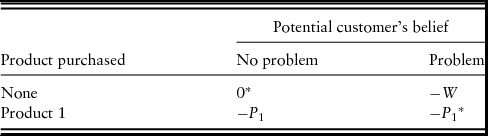
Model 1: Preliminary view of customer decisions (Table 1)
Customer expected net reward.
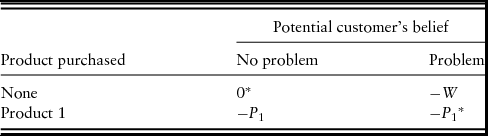
Assumption: Product 1's price (P 1) is given. The price level is such that it is rational for the customer to buy the product if they believe that they have a problem (W):
 \begin{equation*}
0 < P_1 < W
\end{equation*}
Solution: Comparing the elements in the first column shows that if there is no problem then it pays not to purchase the product. Comparing the elements in the second column shows that if there is a problem then the consumer's welfare is increased by buying the product. The solutions are indicated by the asterisked values.
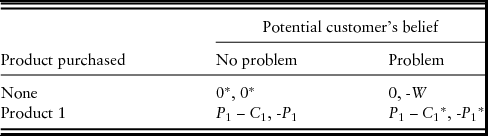
Model 2: Introducing the entrepreneur and their profit (Table 2)
Net rewards of entrepreneur and customer
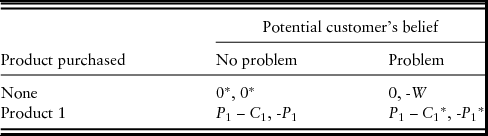
Note: In each cell the entrepreneur's reward is shown first.
Assumption: Because revenue (P 1) is greater than cost of production, supply is always profitable, P 1 > C 1.
Solution: Since transactions are voluntary, trade will occur only if the customer believes that they have a problem. The entrepreneur can therefore make a profit only if the customer believes that they have a problem.
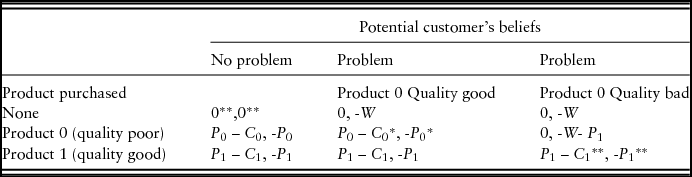
Model 3: Illustration of a quality uncertainty problem
There is an additional column in Table 3. This is because the columns now indicate, not only whether the customer believes that they have a problem but whether, given that they have a problem, they believe that product 0 is of good quality and can therefore solve their problem. Customers believe correctly that, as before, product 1 will solve their problem.
Variant of Akerlof ‘lemons’ problem
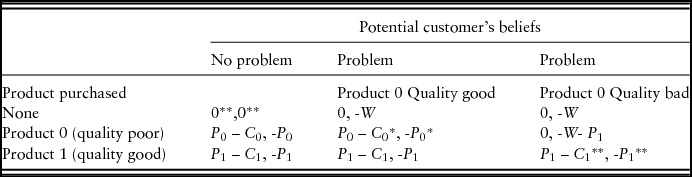
Assumptions. One entrepreneur produces product 1 and another (an independent rival) produces product 0. Both products are profitable: P 0 > C 0; P 1 > C 1. Product 0 is cheaper to produce and sells at a lower price, C 1 > C 0, P 1 > P 0.
Solutions: Reading down column 1 shows that with no problem there is no demand, no product is produced and no profit made. Reading down column 2 shows that when customers wrongly believe the product 0 is of good quality they will purchase product 0 because they believe that it will solve their problem and it is cheaper than product 1. Column 3 shows that if customers correctly believe that product 0 is of bad quality then they will purchase product 1 to solve their problem.
The supplier of product 0 therefore profits from investing in some market-making to persuade customers that product 0 is of better quality than it really is. The supplier also benefits from persuading customers who believe that they do not have a problem that they do have a problem. The supplier of product 1 benefits from persuading customers that product 0 is of inferior quality (which is true), but also benefits, like the supplier of product 0, from persuading customers that they have a problem, even when they do not.
In the table, outcomes that result from customer's beliefs are indicated by asterisks, as before. Outcomes that also optimise consumer returns are given two asterisks. One asterisk indicates an outcome that does not give the customer the best deal. This outcome arises when the customer wrongly believes that the quality of product 0 is good.
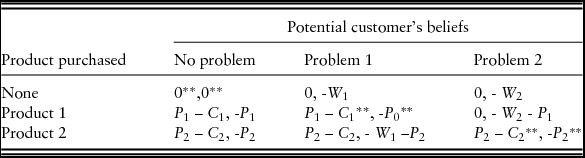
Model 4: Introducing complexity into the customer's decision problem (Table 4)
In the previous model it was the quality of a product that was variable. Now suppose that it is the nature of the problem that is variable. The customer may not only be unsure of whether or not they have a problem, but, if they believe that they have a problem, be unsure of exactly what kind of problem it is. Problem 1 is addressed by product 1 and problem 2 by product 2. For simplicity, both products are assumed to be of good quality – they solve the particular problem that they are meant to address.
Matching the type of product to the type of problem
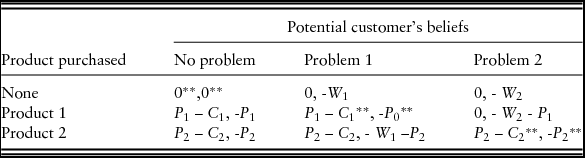
Assumptions: W 1 > P 1 > C 1, W 2 > P 2 > C 2.
Solution: Reading down column 2 and then column 3 shows that product 1 can only be sold if the customer believes that they suffer from problem 1, and product 2 can only be sold if the customer believes that they suffer from problem 2 instead.
If the two products are supplied by different entrepreneurs that it pays the supplier of product 1 to claim that the customer suffers from problem 1, and the supplier of product the claim that the difficulty lies in problem 2 instead. This may be confusing for the customer. Although evaluation of the rival claims may lead the consumer to a better understanding of the true problem, and therefore to a better decision, there is no guarantee that this will be the outcome.
If the two products are supplied by the same entrepreneur then it will pay the entrepreneur to promote the most profitable product by claiming that the corresponding type of problem exists, both when there is no problem, and when the problem is of the other type. This does not create confusion, but may well produce a bad outcome from the customer's point of view.
Model 5: Over-specifying products
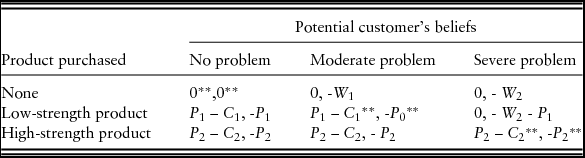
Table 5 shows a variant of this last situation which is of particular interest. It arises when a given problem can be either moderate or severe. A low-price low-strength product (product 1) is sufficient to solve a moderate problem, but only a high-price high-strength product (product 2) will solve the severe problem. This is not strictly a special case of the previous problem, since the high-strength product will also solve the moderate problem, but it will also waste the customer's income because of the premium price.
A problem with varying degrees of severity
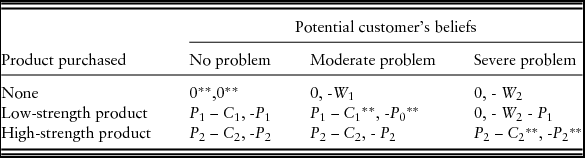
Assumptions: The severe problem is more costly: W 2 > W1. The high-strength product is more profitable than the low-strength product: P 2 – C 2 > P 1 – C 1 > 0. Both products are supplied by the same entrepreneur.
Solution: The high-strength product is sold only when the problem is believed to be severe. The low-strength product is sold when the problem is believed to be moderate. Profit is highest when the customer believes that their problem is severe. It therefore pays the supplier to claim that this is the case.
Models 3, 4, and 5 all introduce different aspects of uncertainty into the transaction. All show that producers need to invest in some sort of market-making mechanism to persuade consumers of the merits of their particular products, but that in one-off transactions the outcomes may be unsatisfactory for consumers. Because producers always have an incentive to make exaggerated claims, the likelihood of consumer dissatisfaction increases. These are all markets with a high probability of consumer withdrawal. But should the environment change and the structure of the industry provide the possibility of entrepreneurs making an indefinite credible commitment to the market (technological or regulatory change dramatically increasing entry costs, for example), so future transactions will depend on how well entrepreneurs develop the skill of correctly diagnosing the consumer problems. This is best expressed as the penalties entrepreneurs now face for making incorrect diagnoses.
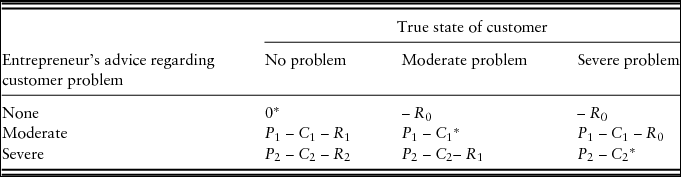
Model 6: A typology of misdiagnosis (Table 6)
Suppose now that the entrepreneur intends to remain serving the market indefinitely, offers to diagnose the customer's problems, and that they are competent to do so. As a result, their reputation is liable to suffer if they mis-diagnose a problem. Suppose that they receive a penalty R 1 ≥ 0 if they overstate a problem by one degree (from none to moderate, or from moderate to severe) and R 2 ≥ 0 if they overstate it by two degrees (from none to severe).
Diagnostic possibilities
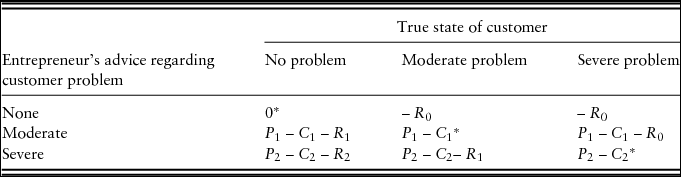
Note: An asterisk indicates a truthful diagnosis by an honest and competent entrepreneur. The truthful cells lie along the diagonal. The off-diagonal elements correspond to mis-diagnosis.
Comment: There are several incentives to overstate problems. There is no incentive to deny the existence of a problem, but there may be an incentive to report as moderate a problem that is severe if a moderate-strength product affords a higher profit margin than a high-strength one.
If the entrepreneur is competent to make a diagnosis, then for each customer they can respond according to the customer's true state, and in this way control exactly the reputational costs that they are liable to incur. In order for the entrepreneur to behave with complete integrity, therefore, each incentive must be addressed by a reputation cost of requisite magnitude.
There are four incentive problems that need to be addressed. The relevant levels of reputation costs are:
1. Over-specification from no problem to moderate problem:
 \begin{equation*}
R_1 > P_1 - C_1
\end{equation*}
2. Over-specification from no problem to severe problem:
\begin{equation*}
R_2 > P_2 - C_2
\end{equation*}3. Over-specification from moderate problem to severe problem:
\begin{equation*}
R_1 > (P_2 - C_2 ) - (P_1 - C_1 )
\end{equation*}4. Under-specification from severe problem to moderate problem:
\begin{equation*}
R_1 > (P_2 - C_2 ) - (P_1 - C_1 )
\end{equation*}




(Cases 3 and 4 are alternatives: they cannot both occur at the same time.)
If these costs are not sufficiently high in any particular case then the entrepreneur will be dishonest with the customer.
6. Discussion
In markets where consumers are unsure about the problem they face, one-off transactions will always be shrouded with great uncertainty and consumer withdrawal is always a likely outcome. For entrepreneurs wanting to enter these markets, making a credible commitment to solve these consumers’ problems is the only way to make the market. This is because the commitment to the market tells consumers that the producer is willing to invest in the complementary asset of a reputation, and then suffer a reputational penalty if they make a mistake. Consumers therefore are more likely to trust the diagnoses of their problems offered by committed entrepreneurs. This is a variation of the Klein-Leffler model, where entrepreneurial rents from the initial innovation are eventually bid away by the need to invest in ever greater reputational capital to deter competitive entry (Klein and Leffler, Reference Klein and Leffler1981).
It is worth exploring some of the properties of this model. If an entrepreneur lacks diagnostic competence, and only pretends to possess it, then the only strategies that can possibly generate a profit are to recommend the low-strength product all the time, to recommend the high-strength product all the time, or make each recommendation a certain proportion of the time. Mixing the recommendations is inferior, however, to recommending one or other product all the time. Thus an entrepreneur who lacks diagnostic skills will either recommend one or other variant of the product all the time, or decide not to operate at all. An incompetent entrepreneur that offers diagnosis is effectively a dishonest entrepreneur because they are bound to make mistakes (unless all customers happen to suffer from exactly the same problem, and this problem happens to be the most profitable problem for the entrepreneur to address).
In any case, an incompetent and dishonest entrepreneur cannot normally match the performance of a competent entrepreneur because they are likely to incur some reputation costs that the competent entrepreneur can avoid. However, an incompetent and dishonest entrepreneur may be able to compete with an honest and competent entrepreneur if they can avoid the reputation costs that the honest and competent entrepreneur incurs. They can, in principle, achieve this by quitting the industry every time they cheat and re-entering with a different identity with a new and blameless record. The major threat to a long-standing entrepreneur with a good warranted reputation is therefore a dishonest entrepreneur who adopts hit-and-run tactics, by continuing quitting and re-entering the industry to cover his tracks.
Markets where consumer uncertainty over needs is overcome mainly by competent producers with successful diagnoses investing in reputation will therefore tend towards monopolistic competition based around brand and reputation. Subsequent entrepreneurial rents will arise mostly from brand extension into related areas because the initial rents are bid away by the need to commit to the market through continual investment in the reputational asset (Ireland et al., Reference Ireland, Hitt and Sirmon2003; Klein and Leffler, Reference Klein and Leffler1981; Woolley, Reference Woolley2010). This is the outcome of the Klein and Leffler model. It assumes that entrepreneurs share essentially similar characteristics, that any single entrepreneur is unable to develop a markedly better solution to a problem than competitors. But the vast swathe of entrepreneurship literature assumes that entrepreneurs are different; different from the general population, and different from each other. They possess different prior knowledge (Foss and Klein, Reference Foss and Klein2012; Larrañeta et al., Reference Larrañeta, Zahra and Galán González2012); good and bad judgment (Casson, Reference Casson1982, Reference Casson2005; Casson and Godley, Reference Casson, Godley, Cassis and Pepelasis Minoglou2005); differences in their entrepreneurial orientation (Wicklund and Shepherd, Reference Wicklund and Shepherd2005); and in their rationalization of the world (Dew et al., Reference Dew, Sarasathy, Read and Wiltbank2009; Sarasvathy et al., Reference Sarasvathy, Dew, Read and Wiltbank2011). Once we allow for the possibility that entrepreneurs differ, then the long term outcomes to Model 6 vary.
First, to continue with the doctor-patient metaphor, as some doctors are better than others, so some entrepreneurs may possess superior diagnostic skills in understanding consumer problems. Here the long term outcome is for such an entrepreneur to continue to enjoy rents because their results are persistently superior to industry average.
Second, an entrepreneur may possess superior abilities in innovative market making as opposed to product innovation. If market making depends on reputation, then this entrepreneur is able to establish a reputation at a lower cost than competitors. Once again the outcome is for one entrepreneur to continue to enjoy competitive rents.
Finally, a variant of the case above, and of particular interest here, is where an entrepreneur with a particular skill in market-making is able to continue to persuade customers to buy inferior products. The long run outcome here would see a trade off between the rents gained from superior reputation building skills and the losses from inferior technology compared with competitors. If the market-making skill is more significant than the additional problem solving capacity of the superior technology, then the inferior technology continues to be successful in the market. This helps to explain the persistent conundrum in the literature about why good technologies fail. And it also helps to explain why so many ‘doctor, doctor’ jokes are so funny!
7. Conclusion
Entrepreneurs have to engage with customers who are ignorant, not only about the attributes of a novel product, but also about the nature of problem the novel product aims to solve. If such markets were to resolve themselves spontaneously then, in addition to researching the various products available, customers would need to diagnose their problems carefully, in order to ensure that they purchased the variety of product that solved the problem. But customers often lack the expertise to do this. This introduces a different kind of information asymmetry to that normally considered in the literature, one where the customer may be unable to diagnose their problem. The entrepreneur may have the appropriate expertise and the customer may wish the entrepreneur to make their diagnosis for them, but only if they can trust the entrepreneur. They need to trust in both the competence and integrity of the entrepreneur. Integrity is important because the entrepreneur may have a financial incentive to over-specify the product.
An entrepreneur that commits to serve the market for a long time will incur reputational penalties from dishonesty, unlike an entrepreneur who is prepared to exit as soon as mis-diagnosis is discovered. Diagnostic competence backed by demonstrable long-term commitment to the product market therefore sustains a situation in which a reputable and competent diagnostic entrepreneur can remain viable in the face of competition from dishonest and incompetent entrepreneurs. Without such reputable diagnostic entrepreneurs making indefinite credible commitments, many markets could not function at all, and many innovations would not be viable. Markets such as these where entrepreneurs have been able to find successful solutions are likely to be characterised by large sunk costs or other significant entry barriers, not because of the underlying technological or regulatory imperative, but rather because of the entrepreneur's need to invest further in reputation in order to avoid their rents being eroded by speculative, dishonest and incompetent entrants.
Markets with information asymmetries, such as those focused on here, are by definition markets where ethical dilemmas are likely to be more acute, or where state intervention is likely to be seen as a credible solution. We acknowledge that there are a plurality of valid approaches to analysing complex markets. But given the focus of this special issue on entrepreneurial judgment, it is appropriate to focus on the entrepreneurial response. The diagnostic entrepreneur described in this paper therefore represents a creative response to these difficult diagnostic problems, analagous to a doctor diagnosing a patient's problems.Footnote 2
Diagnostic entrepreneurship is therefore a subset of entrepreneurial judgment. Entrepreneurial judgment is the ‘residual, controlling decision-making about resources to be deployed’, in the ‘service of satisfying future imagined customer preferences’ (Foss and Klein, Reference Foss and Klein2012, pp. 78 and 224). Much of the recent literature has focused on the identification of profitable opportunities for entrepreneurs, notably in new product creation arising from technological innovation. But many new firms and products are not particularly innovative but are highly successful; indeed the widespread evidence of consumer resistance to new technology is poorly incorporated into the current entrepreneurship literature (Christensen, Reference Christensen1997). Diagnostic entrepreneurship therefore adds to this literature by emphasizing the importance of deploying resources to signal to ill-informed consumers that the entrepreneur's specific new product will solve the consumer's problem. Successful diagnostic entrepreneurs are trusted not only for their truthfulness about the quality of their product, but for their honesty, confidentiality and understanding in helping customers identify the most appropriate product to their needs.