Mountainous societies have their own rules and knowledge to pass on. There's so much to learn…. Looking back upon my former experiences … living with nature, and coming and going around the forests and mountains, life was indeed exciting (gou weidao夠味道).
—Zhang dadieThe concept of “borderland” has by and large been associated with periphery, wasteland, backwardness, and lawlessness. It is in sharp contrast to the ideas of center, civilization, progress, and law and order. Such dualistic thinking results from the political ideology underlying state building—designating the borderland as something to be tamed and controlled by the central state (Baud and Van Schendel Reference Baud and van Schendel1997; Walker Reference Walker1999, 7). This top-down ideology stresses absolute national sovereignty and rules out the ideas of flexible or negotiable boundaries (Donnan and Wilson Reference Donnan, Wilson, Donnan and Wilson1994, 1). In other words, while founded on the fixation of national boundaries, it subjugates borderlands; the subjectivity of borderlands and transborderlands is purposefully ignored. Likewise, those belonging to the categories of social borderlands, such as women, ethnic minorities, the green party, and the labor class, are often subconsciously or consciously considered inferior, with a need to be governed by their “central” counterparts. The demarcation is underlined by unequal power relations and by a strict line of inclusion and exclusion (Donnan and Wilson Reference Donnan and Wilson1999; Johnson and Michaelsen Reference Johnson, Michaelsen, Michaelsen and Johnson1997, 20; Lugo Reference Lugo, Michaelsen and Johnson1997). This sociopolitical mainstream of governance was not challenged until the early 1970s, when more and more “peripheral” groups raised alternative voices and drew wider social recognition of their agency. Since then, some subaltern communities have successfully challenged the orthodox hegemony and compelled the latter to release some resources to them; but others have failed in their appeals. Whatever the result, their struggles have inspired new directions for academic research—rethinking the traditional demarcation between the center and the periphery and their complex power relations.
Consequently, a burgeoning literature on liminal borderlands relating to gender, culture, migration, environment, and underground trade has illuminated the dynamism of the peripheral and pointed out the fact of unidentified interstitiality in individual subjectivities and social categorizations (e.g., Anzaldúa Reference Anzaldúa1987; Butler Reference Butler1990; Hall and Du Gay Reference Hall and du Gay1996; Sturgeon Reference Sturgeon2005; Tagliacozzo Reference Tagliacozzo2005). It makes us look into the forces of borderlands embedded in or coming across in our lives or marginal communities. Former political discourses focusing solely on state-centeredness or mainstream social ideologies are being debated or subjected to criticism. It is from this angle that Renato Rosaldo probes the complexities of the lifeworld and suggests that instead of living in our “supposedly transparent cultural selves,” our everyday practices are intertwined with “structure” and “agency” (1993, 104). Behind the façade of ascribed political or sociocultural identities, everyone embodies a part of the unidentified borderland that interacts with the ascribed identity frameworks and facilitates everyday life. This standpoint reminds us of the classic ethnography by E. R. Leach—Political Systems of Highland Burma (Reference Leach1954)—which set an eminent example in the field of social organization half a century ago. Leach's work illustrates the oscillating reality of the tribal identity and sociopolitical structures of the Kachin societies while interacting with the Shans in the face of changes resulting from ecological, political, economic, kinship, and religious factors. “Every real society is a process in time,” Leach says (Reference Leach1954, 4), and so is every human being, embracing an inevitably changing nature that opens itself to transformation. The ongoing process is often full of fragmentation and inconsistency, and it is in contrast to a superficial belief in structural coherence. Borderlands, be they metaphorical or geographic, should therefore “be regarded not as analytically empty transitional zones but as sites of creative cultural production that require investigation” (Rosaldo Reference Rosaldo1993, 207–8), and the field of everyday practices should be the focus of inspection instead of the structures from above.
With regard to the region covering southwestern China and Southeast Asia, many recent works have discarded conventional structural thinking or the unified state-oriented approach to shed light on issues of borderlands. For example, Thongchai Winichakul's Siam Mapped (Reference Winichakul1994) is a masterpiece on the nation building of modern Thailand. He deconstructs the creation of the modern Thai “geo-body” and demonstrates its fixation of national boundaries by means of absorbing map-making technologies. Also in the field of history, C. Patterson Giersch's Asian Borderlands looks into the political, economic, and social interactions between the indigenous and Chinese official agents and immigrants in Yunnan during the Qing period and redefines the frontier as a “‘middle ground’ [a meeting place] in which social boundaries and cultural practices were in flux” (2006, 7). Andrew Walker's The Legend of the Golden Boat examines the recent Economic Quadrangle cooperation of the Upper Mekong area. His ethnographic findings lead to the conclusions that the transnational movements of the Quadrangle region are the latest stage in a series of regimes of Upper Mekong regulation, and that “state (and non-state) regulation is intrinsically involved in the creation of the contexts in which markets flourish” (1999, 14). From an ecological approach, Janet C. Sturgeon's Border Landscapes explores the landscape plasticity of two border Akha communities located in southwestern China and northern Thailand. She illustrates the appropriation processes by showing how these two communities turn their border landscapes from topography and land cover into “sites for maneuvering and struggle” (2005, 9) by resorting to their sociopolitical tradition.
Among others, these quoted works are geographically and theoretically related to the present study of the cross-border trade among the migrant Yunnanese between Thailand and Burma. Even though the transborder analyses differ in approach and deal with different issues, the common thread uniting them is a consensus on the interlinking of interacting forces that operate along constantly changing borders across time and space. They dismiss a simplified center–periphery model and look into borderlands in process. While recognizing the modern political trend in the formation of nation-states, their analyses are not confined to the borders of a specific country. The other side of the border, in imagination or in practice, is also under investigation. Their works, in effect, articulate subjectivities of borderlands in different aspects and offer new frames of analysis that go beyond the constraints of national boundaries.
Based on the aforesaid insights, this essay adopts a transborder perspective for the examination of the livelihood of a major part of the migrant Yunnanese Chinese (simply referred to as migrant Yunnanese) who moved from southwestern China and are settled today in northern Thailand and in Shan and Kachin States and Mandalay Division in Burma. Throughout history, the Yunnanese have been very mobile in the region of northern mainland Southeast Asia, seeking economic pursuit in ordinary times and political refuge in times of unrest. Their mobility has resulted in the establishment of diasporic Yunnanese communities and transnational networks in this large stretch of land. The period of concern of the present study falls largely in the era of the Burmese socialist regime, when the state implemented a nationalized economic system and strictly forbade free movement and private trade. Taking a transborder perspective, the essay looks beyond government institutions and probes the mercantile agency of the migrant Yunnanese traders, which has contributed to the formation of their socioeconomic mechanisms—consisting of widespread nexuses and integrating different regional communities and state apparatuses of Burma and Thailand.
The research focus is on the migrant Yunnanese themselves, and not the state policies or reports on them; the methodology is allowing the people to tell their own stories while conducting participant observation in different places beyond border limits and officially permitted areas. The goal of the research corresponds to Thongchai's call for “writing history at the interstices,” with the intention to “[traverse] the margins of national identity and national history, looking for the ‘in-between’ locations of encounters” (Reference Winichakul, Ahmad and Ee2003, 23). He says, “Thinking of national history with a spatial perspective, we should explore all the extremities where the domain of national history ends and another history begins, be it the super- or the subnational, especially the ones suppressed by national history” (11). Burma, a country founded in 1948 after the British colonization, is made up of diverse ethnic groups. Far from being a united nation, the country has been torn apart politically, socially, and culturally under the rule of a shaky parliamentary government in the beginning, followed by the ruthless Ne Win regime, and now a military junta. By retelling stories of the minorities, we not only make the voice of the margin heard, but also decenter Burmese national history and challenge the central state's political power in claiming the fortuitous line of inclusion and exclusion in social, economic, and political policy making.
The movement of the Yunnanese, a transnational migrant group, was primarily involuntary, a result of the Communist takeover of China in 1949. The factors of their unrecognized refugee status, their movement from a frontier province to another frontier region, and their participation in the underground cross-border trade compounded their marginal position. In relation to indigenous residents, we may say that their borderland status is doubled or even tripled, which reduces them to a “sub-subaltern community.” However, their livelihood as borderland movers, which has had the effect of connecting them to an expansive outside world and sustaining an essential part of the Burmese economy (though not officially recognized), compels us to rethink their marginality, their interstitiality, and other peripheral attributes ascribed to them. While reviewing their experiences, which are constrained by national policies and regulations, we also witness their dynamism, their power, as well as their struggles to survive and to apprehend what Tsing has tried to do by illuminating the “margins.” She says, “I use the term [margins] to indicate an analytic placement that makes evident both the constraining, oppressive quality of cultural exclusion, and the creative potential of rearticulating, enlivening, and rearranging the very social categories that peripherize a group's existence” (Reference Tsing1994, 279). In the end, the objective of “writing history at the interstices” is to negate the essentialized understanding of center versus periphery, legality versus illegality, superiority versus inferiority, and the absolute legitimacy attached to the nation-state.
Taking the perspective from below at the “interstices of transnational and transcultural processes” (Thongchai Reference Winichakul, Ahmad and Ee2003, 23), the findings of the present study suggest that the cross-border economic practices of the migrant Yunnanese in effect constituted a transnational popular realm that formed an informal oppositional power against the Thai and Burmese national bureaucracies on the one hand, and incorporated varied state agencies on the other hand. This is in contrast to the conventional viewpoint in international circles that holds the nation-state as the most widely accepted political entity. The idea of “popular realm” (minjian, 民間) is derived from Mayfair Mei-Hui Yang's work (Reference Yang1994), in which she applies the concept to the analysis of the production of guanxi (關係, social connections) in everyday activities in China. She points out the emergence of an unofficial order, known in Chinese as minjian, that is generated through infinite weaving and spreading of personal connections and group formations, and its social force vis-à-vis the Chinese central government. By dealing with a diasporic community, I expand Yang's usage of the concept from national to transnational. The criterion of minjian here falls on the people's movement and their interconnection, instead of being truncated by the national boundary. While the large stretch of the Yunnanese activity space in question was seen as an untamed frontier by the central states of both Thailand and Burma, it was in practice an economic core for the Yunnanese merchants, and also the heart of the black market for Burmese society—in fact, the primary living engine of Burma. In sum, by probing the informants' stories, this essay will illustrate the force of this transnational popular realm, which turned its sociopolitical marginality into an economic center. Therefore, the borderland is not essentialized with negative characteristics in a conventional sense, but reveals its embodiment of paradoxical features of periphery and center, separation, and connection.
In order to reveal a concrete and structural social history of the traders' livelihood, the main discussion is drawn from the narrative accounts of three key informants, in both oral and written forms (collected time and again over the past thirteen years). The first was born in Burma and migrated to Thailand and then to Taiwan for further education and career prospects; the other two were from Yunnan and are now settled in Thailand and Burma. These three informants belong to different age groups and have had different migration experiences. Their stories, complemented by other informants' accounts and relevant literature, illustrate a lively picture of the flow of people, goods, capital, and information between northern Thailand and upper Burma, the latter being a very underresearched region.
With respect to the force of narratives, Elinor Ochs and Lisa Capps (Reference Ochs and Capps1996) have argued that by narrating one's lived experiences, one relates one's involvement with the outside world in a meaningful sequence of time that connects past, present, and imagined worlds. Likewise, Nigel Rapport and Andrew Dawson observe, “Narrative mediates one's sense of movement through time,” and “through narrative, human beings, individual men and women with agency, tell the world, and tell it anew, continuously reorganizing their ‘habitation in reality’” (Reference Rapport, Dawson, Rapport and Dawson1998, 28, 29). The genre of narrative, therefore, interacts with a temporal consciousness and embraces a subjective truthfulness voiced by the narrator. Being narrated, stories not only convey valuable data; they also shed light on the informants' reflections on their experiences and on the cultural meanings inherent in their commentaries (Marcus and Fisher Reference Marcus and Fischer1986, 54, 58). Founded on the informants' narratives, I reconstruct the trajectories of their transnational economic movement, look into their mercantile agency as they interact with different political entities. and reexamine the knowledge of borderlands in this region. The issues of local knowledge, uncertainty of power relations, and economic and political appropriation and transgression, which have been dealt with by the scholars referred to in one way or another, will recur in the discussion. Before going into the main discussion, I will give a brief historical background of Yunnanese migration in relation to the Thai and Burmese political economy.
Historical Background
For the Yunnanese, economic undertakings across the border have been a significant part of their lives. The existence of long-distance caravan trade between Yunnan and its neighboring countries may be traced back more than 2,000 years. Its growth was especially enhanced by massive waves of Han Chinese migration to Yunnan since the Ming period (1368–1644) on account of the state policy of colonizing this frontier province (Chen Reference Chen1992; Chiranan Reference Chiranan1990; FitzGerald Reference FitzGerald1972; Giersch Reference Giersch2006; Hill Reference Hill1998; Lu Reference Lu2001; Sun Reference Sun2000; Yang Reference Yang2008). Its development was connected to the region's mountainous environment, which obstructed fluid communication and contributed to arduous living conditions. Able to endure hard work, mules took up the main role in caravan trade for the transportation of consumer goods to different corners of the region. One of the prerequisites of this especial economic enterprise was long-distance travel, which became a vital part of what Yunnanese call the “culture of caravan trade” (mabang wenhua, 馬幫文化) (Wang and Zhang Reference Wang and Zhang1993). Continuity in this engagement was seen especially in Yunnanese border towns. This economic tradition characterized by travel is highlighted by a common Yunnanese saying, qiong zou yifang ji zou chang (窮走夷方急走厰)—when one was short of money, one took to the caravan trade and ventured into areas occupied by “barbarians” (as other ethnic groups were referred to) or hoped to get lucky in the jade and other mineral mines in Burma. Thus, it was not uncommon for people to venture into “barbarous” regions (zouyifang, 走夷方) to search for a means of livelihood. People who did not have the stomach for such ventures were labeled timid and mocked by other Yunnanese (Fang Reference Fang2003; Yin Reference Yin1984).
Drawing on the interpretation of migration culture given by Massey et al., it would appear that movement across borders is deeply entrenched in the behavior of the people in the border areas of Yunnan and has become a “rite of passage” for adult men (Reference Massey, Arango, Hugo, Kouaouci, Pellegrino and Taylor1993, 453). Among Yunnanese traders, the Han Chinese constitute the primary group. Other major groups include Muslims as well as the Yi, Bai, Naxi, Shan, and Pumi (Chiranan Reference Chiranan1990; FitzGerald Reference FitzGerald1972; Hill Reference Hill1998; Lu Reference Lu2001; Wang and Zhang Reference Wang and Zhang1993).Footnote 1 From a historical point of view, the Yunnanese involvement in long-distance trade has formed a vital part of the Yunnanese overland movement.
Among its neighbors, Burma in particular has been the major country for Yunnanese economic adventurism and for seeking political asylum because of its physical contiguity with Yunnan. Some Yunnanese even set up parallel homes there. The Communist takeover of China in 1949 saw the flight of Yunnanese into Burma on an unprecedented scale. The inflows went on well into the 1970s as a result of a number of political movements in China. As the Yunnanese refugees did not have permission from the Burmese government to reside in that country, they moved on to the mountain areas of Shan and Kachin States in the initial stages.
Among these refugees, a group of stragglers from the Nationalist army (Kuomintang, or KMT) and local self-defense guards from Yunnan organized themselves into guerrilla forces in 1950. Numerous civilian refugees gathered around the bases set up by the KMT to protect themselves from harassment by the Burmese army and other ethnic militias. However, these forces were disbanded in 1961 under international pressure. The sole survivors of the disbandment were the Third and Fifth armies. They later entered northern Thailand with the tacit approval of the Thai government (see Chang Reference Chang1999; Republic of China 1964; Union of Burma 1953; Young Reference Young1970).Footnote 2
In a military coup in 1962, General Ne Win grabbed the reins of power in Burma. In his bid to guide the country under the ideology of the “Burmese Way to Socialism,” he implemented the nationalization of trade and industry. However, gross mismanagement, infrastructural weaknesses, and policy errors led to disastrous consequences—economic recession and scarcity of essential goods. Moreover, the problems of an impoverished economy were aggravated by deep ethnic rifts. The socioeconomic instability compelled many of the civilian Yunnanese refugees to follow the two remnant KMT armies into northern Thailand (though a large number stayed behind). The troops helped their fellow refugees rehabilitate themselves in villages along the border of Chiang Rai, Chiang Mai, and Mae Hongson provinces. These villages emerged as havens for later Yunnanese migrants throughout the 1970s and 1980s (see Chang Reference Chang2002, Reference Chang2006a).
In the meantime, the black market, with its links to the underground border trade, satisfied the Burmese demand for consumer goods. It is estimated that smuggled merchandise may have constituted more than 80 percent of Burma's total consumption (Lintner Reference Lintner1988, 23; Mya Than Reference Than1996, 3). Market-dominated Thailand was the major partner in this illegal trade. According to informants, about 70 percent of the smuggled Thai goods entered the country through Shan State before the 1980s, mostly by means of mule-driven caravans. This particular mode of conveyance persisted into the 1980s, and was gradually replaced by car transportation beginning the mid-1980s. The expenses of the ethnic militias were met through taxes that were levied on these products (Chen Reference Chen1996, 4; Smith Reference Smith1993, 25).Footnote 3
Informants remarked that before fleeing Yunnan, many of the KMT soldiers and fellow civilians made annual trips to upper Burma as part of the caravan trade. During the period of insurgency, many of the troops were engaged in drug trafficking. “The troops were caravan traders and the caravan traders were troops. Both were combined as a unit,” a former KMT official wrote (Hu Reference Hu1974, 195). After establishing themselves firmly along the border of northern Thailand, the KMT armies continued to strengthen their positions by carrying on transborder trade between Thailand and Burma. They dominated the trade through the 1960s and 1970s as a result of their business acumen, acquaintance with Shan State, and the requirements of the black-market economy in Burma (Chang Reference Chang2002; Chao Tzang Yawnghwe Reference Yawnghwe1990; Lintner Reference Lintner1994). The armies were not disbanded until the end of the 1980s. The period of their existence by and large coincided with that of the Ne Win regime.
According to informants, Yunnanese traders accounted for 70 percent to 80 percent of the Thai–Burmese cross-border traders; the rest were Shans, Karens, and traders of other ethnic minorities. Among the Yunnanese merchants, 90 percent were Han Chinese and about 10 percent were Muslims. Accordingly, the Yunnanese played a significant role in sustaining the Burmese hmaung-kho (black-market) economy during the socialist period. This fact has not yet been recognized by academics.
In 1988, the Burmese socialist junta had to make an exit as a result of a series of nationwide revolts. Though prominent measures, such as embarking upon a market economy, have been undertaken since 1989, whimsical policies and weak socioeconomic infrastructure continue to pose serious obstacles. From an academic perspective, this opening has given researchers the chance to study this hitherto insulated country. Over the last fifteen years, many publications have come out. But most of these works, especially those related to politicoeconomic issues, take a state-oriented perspective, as Kyaw Yin Hlaning points out (2001). Analyses refer to official policies and macroeconomic performance based on statistics and on data produced by government or international organizations. The macro image of the state apparatus and the social structure, however, fails to provide an insight into the daily lives of the people, their interconnections with official and nonofficial agencies, and links with the outside world that transcend the state. The life of the people under the Ne Win regime has not received much attention, as most studies focus on the postsocialist era. There is a lacuna in our understanding of the struggle of different communities through various stages up to the present. A lack of information about the past gives a hazy picture of the present. It is these factors that prompted me to study the transnational trade between Burma and Thailand during the socialist period. My objective is to set a foundation for further building.
In sum, the participation of migrant Yunnanese in transborder trade during the period in question can be attributed to several factors: the long history of their predecessors' engagement in overland commerce; their illegal status, which restricted movement to borderlands; the diasporic nexuses resulting from their mobility; the military support of the KMT forces; and the demands of the black-market economy in Burma. However, contribution of the Yunnanese was overshadowed by their involvement in drug trafficking and by their activities being labeled as criminal by some publications (e.g., Lamour and Lamberti Reference Lamour, Lamberti, Ross and Ross1974; Lintner Reference Lintner1994; McCoy Reference McCoy1991). Through discussion of the informants' detailed trading accounts in the following section, I look into the parallel civil mechanisms in ordinary people's lives, in addition to the government institutions, with a transnational perspective.
Long-Distance Caravan Trade as a Means of Livelihood
Zhang Dage's Story
I met Zhang dage Footnote 4 for the first time during the Chinese New Year in 1996 at his parents' home in Ban Mai Nongbua (also known as Reshuitang Xincun, 熱水塘新村). It is a primarily Yunnanese Han village located in Chaiprakan District, Chiang Mai Province, in northern Thailand. Like many migrant Yunnanese, his life has been marked by a series of migrations. He was born in a mountain village in Shan State, Burma, in 1962. His family moved several times within the state. In 1978, an uncle took him to northern Thailand for further studies. They followed a Yunnanese caravan escorted by a troop of the KMT Third Army during the journey. Zhang dage's father was a KMT troop leader and had been dispatched to Thailand four years earlier. There, Zhang dage was reunited with his father. (The other family members arrived in Thailand a few years later.) He completed his Chinese education at the junior high school organized by the KMT Third Army in Ban Mai Nongbua. In 1980, he went to Taiwan for further education. Afterward, he graduated from medical college and became a physician in southern Taiwan.
Because of his interest in my research, Zhang dage was very willing to share his migration experiences with me. We maintained contact through meetings, telephone conversations, letters, and e-mail messages. Zhang dage often told me stories of his childhood in Burma. Memories of caravan trade are an essential part of his recollections. The following story is a translated extract from a short essay he wrote in 2002. His written narrative provides precious information on caravan trade that embodies an inner voice of the sociocultural meaning of this distinctive economic practice.
Bianliang (便良) was a small village located in the lower range of a mountain…. There were about 50 families. It was a Chinese village; most villagers were dependents of KMT troops which were stationed nearby. Villagers practiced Chinese customs and spoke [Yunnanese]. The village was distinguished from neighboring villages of other ethnic minorities…. The highest building in the village was a two-story wooden house—the residence of Commander Luo. Bianliang was a vital point along a caravan trading route in [northern Shan State] providing connections to northern Thailand. All caravan traders passing by had to pay tolls….
Though located in the mountain, the guerrillas [stationed in Bianliang] had a system of wireless communication…. Waiting [for the arrival of caravans] became the [most exciting] event [for the village kids]. When the first mule appeared in sight, the mood of the kids reached the highest point.
We children loved watching the adults unloading the packs off the mules with the help of division of labor. They did this task in an empty space and arranged the unloaded packs in an orderly manner. Some muleteers arranged the unloaded pack-saddles in rows on the ground … and covered them with pieces of waterproof cloth. These then became warm caves for muleteers to sleep in. Some muleteers went up to the forest to cut bamboo poles for constructing fences and setting up tents. Some people busied themselves by making fire for cooking. Usually a large group of caravans consisted [many small teams] of seven to ten people with a leader…. The team members shared the work and looked after each other. The whole group was like a community.
As regards food, the caravans usually carried dried meat and pickled vegetables. These types of food were easy to carry and remained unspoilt for a long time. When caravans reached a village, they also purchased fresh vegetables and eggs [as supplementary food]. The transaction also brought income to the villagers. Apart from food for human beings, the mules needed feed too. Some muleteers would go and cut grass; others would cook yellow beans; both grass and beans served as feed for the mules. After arranging settlement and food, some muleteers and traders would visit their friends or relatives in the village. The meetings were always hospitable and animated. News about relatives living far away was exchanged.
The size of a caravan often increased with smaller mounted parties joining on the way. [Metaphorically] the journey between upper Burma and northern Thailand resembled the flow of a river with its incessantly converging tributaries. The group required military escort for its safety. Sometimes it encountered natural disasters, such as landslides or floods during the rainy season. Other times it faced attacks [from Burmese forces or other militias]. The traveling routes had to change from time to time…. Experienced groups reacted to dangers with accumulated wisdom. What could not be controlled had to be entrusted to god.
Our family also kept two mules. When caravans arrived in our village, Junior Uncle Fu would join them with the two packed mules. Father would write a note indicating the amount of goods [raw opium] and to whom these should be handed…. The trip concerned the economy of our family….
Zhang dage's story colorfully portrays the intimate relationship between this Yunnanese village life and the long-distance mule caravan trade. Since childhood, this risky economic engagement has excited the young boys. As a result of observing the arrival and departure of caravan merchants and muleteers, they were familiar with this traveling trade. It fired their imagination, and they wanted to be a part of future movements.
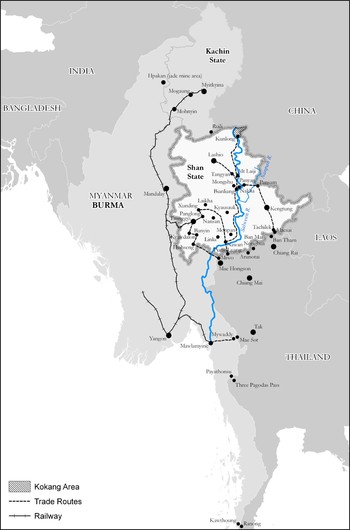
Zhang dage's family lived in Bianliang for six years (1967–73). It was a KMT post located along the Salween River, about a two- to three-hour walk from Monghsu (famous for its ruby mines) to the northwest. From 1961 to 1973, the KMT forces had several military bases along the Salween River to facilitate their caravan trade. The farthest point in the north was located in Mount Laiji, a five- to six-hour walk (about one hour by car) from Tangyan (or Tangyang) to the northwest; but their trading routes extended further to Kokang, a primarily Yunnanese Han inhabited area on the Burmese borderland adjacent to China (see figure 1). The number of troops stationed at each post ranged from a few dozen to a few hundred. Each post had a wireless communication system, and the movement of caravans from post to post was reported by means of this system.
Caravan trade routes between Thailand and Burma.

The region between Tangyan and Kokang was especially productive for opium cultivation. For the local people, growing poppies was a means of survival. Like Zhang dage's family, they traded opium for other consumption goods. Zhang dage's father, who was from this area, said, “I've done different things, all for a living. In these mountainous areas, what could you grow? The land wasn't fertile enough for growing rice. If you didn't grow opium, you couldn't make a living.” His words expressed the lamentable situation of the region, which had been observed earlier by a British commissioner in Shan State:
The real point about opium in the Wa States and Kokang is that opium is the only thing produced which will pay for transport to a market where it can be sold. To suppress opium in Kokang and the Wa States without replacing it by a crop relatively valuable to its bulk, would be to reduce the people to the level of mere subsistence on what they could produce for food and wear themselves or to force them to migrate. (John S. Calgue, 1937, quoted in Jelsma, Kramer, and Vervest Reference Jelsma, Kramer, Vervest, Jelsma, Kramer and Vervest2005, vii)
Before the early 1970s, local people either sold their opium to the KMT forces or carried their produce to Thailand for sale, as Zhang dage's family did, and then transported Thai commodities on the way back for sale on the black market.
In the foregoing story, Zhang dage vividly described the performance of different tasks by the muleteers. Each one was assigned specific chores. In interviews and casual conversations, other informants also stressed the importance of caravan organization, which required strict observance of discipline, division of labor, and compliance with taboos (see also Ma Reference Ma1985; Wang Reference Wang1993; Wang and Zhang Reference Wang and Zhang1993). These were prerequisites for the efficiency of a caravan's movement and for coping with different kinds of perils on the long journey. A group of caravans comprised many small teams belonging to different traders. According to the usual way of classifying caravans, a small team consisted of five mules (yiba, 一把), and five small teams constituted a small caravan (yidanbang/yixiaobang, 一單幫/一小幫) (Wang Reference Wang1993, 310). The number of mules may have amounted to several hundred to more than 1,000. Every two to three mules required a muleteer in the long-distance caravan trade. A group of caravans formed a united body that was characterized by leadership and hierarchy. The group had a commander, usually from the escort troops, and each small team also had a leader. The cohesion among caravan members was reflected in the use of language. Each team organized its own meals; team members ate from the same pot (guo, 鍋) of rice and referred to their team as women shi tong guokou (我們是同鍋口, we are from the same pot). The team leader was called guotou (鍋頭, pot head), and the commander of the whole caravan daguotou or maguotou (大鍋頭/馬鍋頭, big pot head/pot head of a mule-driven caravan). Traditionally, the caravan commander had absolute authority: He was in charge of maintaining internal order and external relations and meted out punishments to those who broke the rules. Whenever emergencies occurred, he had to respond quickly.
Apart from transporting commodities, each team had a mule that carried food and kitchen utensils; this included “rice bowls, plates, soup basins, chop sticks, knives, chopping boards, fire-tongs, fire-forks, bronze tea-pots, bronze cooking-pots, cooking oil, salt, soy sauce, vinegar, dried fish, dry meat, picked vegetables, noodles, and rice” (Fang Reference Fang2002, 25). This mule was referred to as kongduo (空馱, empty carrier) in Yunnanese (kongtuo in Mandarin). Usually it was an old mule that was not afraid of the noises produced by the utensils while moving (Fang Reference Fang2002, 25). Each team had to calculate as accurately as possible how much food they would need during the journey and where they could get replenishments.
Caravans measured the distance of the journey using metaphors of cooking. A half-day distance, called yi sao lu (一燒路, a journey that requires cooking one meal), was covered in about four hours. A break for cooking was termed kai sao (開燒, having an opening fire). Most parts of the caravan routes wound through mountains and were full of dangers, such as wild animals, miasma, or flooding and landslides. Maintaining a peaceful relationship with nature has thus been an essential part of Yunnanese religious beliefs. This is shown in their worship of mountain gods (shan shen, 山神) in most rituals.Footnote 5 Prior to departure on a long-distance journey and upon their return, travelers pay respects to mountain gods by sacrificing chickens or pigs. Shrines and temples that house mountain gods are common in migrant Yunnanese communities in northern Thailand and Burma. In addition, the Yunnanese interpret the overwhelming power of nature by strict adherence to taboos. A frequently cited taboo held that if rice was not well cooked during the caravan journey, serious misfortunes would occur. The caravan commander might halt the journey or even turn back. Other taboos related to the use of language, the arrangement of dishes, and the appearance of certain animals (see Ma Reference Ma1985, 154).
Apart from seeking harmony with nature, maintaining a good relationship with other communities was important, too. The KMT forces associated with Shan, Kachin, and Kokang military groups for convenience of movement. Some of these militias were Ka Kwe Ye (KKY) forces, auxiliary local defense troops officially recognized by the Burmese government between 1963 and 1973. The KMT forces disguised themselves as KKY troops when entering their territories in order to avoid attacks by the Burmese army. In exchange for this convenience, the KMT provided small amounts of weapons to these allied parties. Nevertheless, power conflicts occurred among them from time to time. The most notable example was the fighting that occurred between the KMT and Khun Sa's troops in a bid to gain control over trading routes in 1967 (see Lintner Reference Lintner1994, 245; McCoy Reference McCoy1991, 333–34). Informants pointed out that Khun Sa had received support from the KMT early on, and most of his high ranking officers were also from the KMT (see also Chen Reference Chen1996).
Many informants related that before 1985, almost every village family kept a few mules at home, as did Zhang dage's family. Villagers either engaged in cross-border trade with their own mules or rented out the mules to other traders. The caravans from Thailand carried different types of consumption goods; among these, textiles were the major commodity. The weight carried by a mule was approximately 40 zuai (equal to 60 kilograms). Tang dadie,Footnote 6 who was in charge of taxation in the KMT Third Army in Ban Mai Nongbua, said that prior to caravan departure, all commodities had to be taxed. The tax on one mule-load of textiles was 800 baht (Thai currency)—the price of armed escort. After the tax was paid, the army issued a tax certificate. One load of textiles could be exchanged for 4–8 zuai of raw opium in Burma (depending on the textile quality). Apart from consumption goods, the troops and merchants also carried gold bars for the purchase of opium in Burma. “At the beginning, the gold bars were carried by porters. One person carried 32 gold bars. Each bar weighed five liang Footnote 7…. [which could be] exchanged for five zuai of opium,” recounted Li dadie, who used to follow the caravans organized by the KMT Third Army.
In 1973, the Burmese government changed its policy and decided to wipe out the KKY forces. It launched frequent attacks in the mountain areas in Shan and Kachin states, compelling many Yunnanese migrants to move to cities. Around the same time, as international pressure against drug trafficking grew more intense,Footnote 8 the KMT forces gradually withdrew southward inside Shan State. The opium trafficking routes then fell primarily into the hands of Khun Sa's army (Cowell Reference Cowell, Jelsma, Kramer and Vervest2005, 13). Nevertheless, the KMT remained active in their military-cum-economic engagement. Jade trade became the new enterprise for the KMT and for many other Yunnanese traders. The trading routes led from northern Thailand to Taunggyi, Mandalay, and then up to Kachin State, where the jade stones are found.
Accordingly, the transnational popular realm moving back and forth between Shan and Kachin States in Burma and northern Thailand was composed of migrants, civilian traders, and local militias. Their movement was officially banned in Burma and denounced by the Thai government from time to time. The civilians were dependent upon the protection of these militias (though the forces were a source of exploitation, too), and, in turn, the latter depended on the former for tax revenue. The composition of the militias was complex: A part of them was recognized by the Burmese government, like the KKY, while another part was tacitly accepted by the Thai government, like the KMT, and still others were rebels in the borderlands. They sometimes collaborated with one another to further their economic or political interests, and at other times, they fought each other for the same reasons. The mutual alliances and the power structures of these militias were in a constant state of flux, illustrating an ongoing process of what Leach calls fragmentation and inconsistency. Nevertheless, no matter how fragmented or inconsistent the power structure was, traders and ethnic militias observed self-regulated rules (in relation to taxation, compensation, and meting out punishment in required situations) to ensure the continuity of economic movement. The best example is the underground trade of jade stones from Burma to Thailand, the organization of which I have elaborated elsewhere (see Chang Reference Chang2004, Reference Chang2006b).
With regard to the sociocultural meaning of the caravan trade to the migrant Yunnanese, Zhang dage's narration reflects several points of significance. It was a distinctive lifestyle in Yunnan and its neighboring countries for many centuries, as mentioned earlier. On the one hand, the existence of the trade satisfied the consumption demands of the people residing in a large part of the mountainous region; on the other hand, it resulted in webs of connections between different communities. An interesting point in Zhang dage's story has to do with the exchange of news about kith and kin residing far away. Because of their historical mobility, the Yunnanese have relatives and friends located in different places. Caravans conveyed not only goods but also information. In one conversation, Zhang dage told me that in the days before electronic communication, the movement of caravans provided people with connections to the outside world. Oral messages were a common form of correspondence, but in case of urgent and important matters, the message sender would prepare a written note tied with a piece of dry chili to indicate its seriousness and hand it to a muleteer for delivery. This kind of “express mail” was especially resorted to by the militias.
Moreover, as Zhang dage's story illustrates, the arrival of caravans always brought much excitement and expectation. The goods they supplied linked villagers' lives to distant places they had never been to. Lin dajie,Footnote 9 now settled in Mae Salong in northern Thailand (Mae Fa Luang District, Chiang Rai Province), lived in northern Shan State in Burma from the 1950s to 1960s. She once joyfully told me,
I love reading novels greatly. I spoiled my eyesight by reading novels. I especially love the works written by Qiong Yao [瓊瑤] and Jin Yong [金庸] [popular novelists from Taiwan and Hong Kong]. When I [and mother and brothers] still lived in Burma and father [a KMT officer] in Thailand, our caravans used to bring novels of Taiwan and Hong Kong from Thailand to Burma. And also those movie magazines, such as Jia-he Magazine (jiahe dianying huabao, 嘉合電影畫報). I was familiar with Mei Dai (美黛), Qing Shan (青山) and other stars.
Zhou dajie, who taught dress making in Taunggyi from 1975 to 1980, said that she used the Japanese fashion magazine Lady Boutique (貴夫人時裝) as a textbook for teaching. Moreover, Zhang dage mentioned in our conversations other interesting items transported by caravans to his village. These included Chinese dictionaries, copybooks for practicing Chinese calligraphy (zitie, 字帖), Chinese painting books, Chinese almanacs, and so on. It is amazing to see how the migrant Yunnanese, while maintaining a Chinese lifestyle in these remote areas, had knowledge of these famous movie stars and Japanese fashion through different types of cultural materials imported from abroad. Accordingly, the caravan trade played an essential role in the people's everyday lives by performing both economic and sociocultural functions.
Yue Dashu's Story
Nineteen-year-old Yue dashu Footnote 10 fled from Tengchong (騰衝), a historical border entrepôt of Yunnan, with his newlywed wife in 1968 to escape the Cultural Revolution. His parents and other siblings fled separately to Burma in the 1950s. Different waves of flight among family members were a common phenomenon during this chaotic period. To make a living, Yue dashu took up the job of a muleteer for the first three years. After saving some money, he purchased two mules and became a small caravan trader. The number of mules increased year by year. By the late 1970s, he owned twenty mules and was able to hire a few muleteers.
In 1972, his family moved to Ban Mai Nongbua in northern Thailand. Yue dashu continued his transborder commerce; his wife sewed clothes and made Yunnanese pickled food for sale in the village market. While the KMT forces were still active along the Salween River, Yue dashu used to go on trade trips to Tangyan. Sometimes the group of caravans left Thailand from Maesai (a border town in Chiang Rai Province) and entered Tachilek. In Tachilek, the caravans entrusted their commodities to a KKY group for transportation by vehicle to Kengtung. One load of goods was charged 300 kyat (Burmese currency). Traders and muleteers could join the KKY on the trip from Tachilek to Kengtung or make a separate trip. The traders reloaded their goods on mules again on the outskirts of Kengtung. On departing from there, they entered areas controlled by the ethnic rebels. “This is a region with big mountains. We had to walk up and down all the time…. There were dozens of tracks. Even though I had moved in this area for several years, I haven't been able to go through all of them. These places were very wild. The minorities lived in a very primitive way, except the Baiyi [Shans],” Yue dashu said.
One frequent direction the caravans took was to walk northward to Pansam. This took five days from Kengtung. Then the caravans passed the Nanpan River. Continuing westward, they reached Panyan, then passed the Salween River and arrived in Nakha (a military post of the KMT Third Army). They usually rested for one day in Nakha before going upward to Mount Laiji, the final stop for the caravans. This took two more days. Traders unloaded their goods in Mount Laiji and had them transported to Tangyan (see figure 1) by vehicle.Footnote 11 During the dry season, the journey took fifteen days; but during the rainy season, it could take more than a month. Sometimes the caravans left Thailand from Piang Luang (a border village supervised by both the KMT Third Army and the Shan United Revolutionary Army, situated in Wiang Haeng District, Chiang Mai Province). After entering Burma, the caravans moved northward until they reached a ferry plying the Salween River—Tamiao.Footnote 12 They crossed the river and arrived at Nawan; a KMT military base, Banbishan, lay to the west, four to five hours away on foot. They then carried on upward along the river until they arrived at Mount Laiji. The whole journey took about a month during the dry season.
Yue dashu said,
Tangyan was the center of the hmaung-kho trade in upper Burma before 1973. Most of the commodities that arrived in Tangyan were transported by cars to Lashio, and then other main cities such as Taunggyi and Mandalay. These places constituted the first ring for distribution of hmaung-kho goods. From these nodes the smuggled commodities were then conveyed to various parts of the country. Much of the transportation was undertaken by the KKY. Underground taxes were paid to different connected officials for the goods' passage. Related agencies included the customs, the police, the military intelligence, the migration department, the forest department and the military.
With meager government salaries, the extra income from the hmaung-kho economy actually became their main source of income. One informant related, “Burmese officials were very corrupt. If you gave them money, they would let you do what you wanted. Once I passed a check point without smuggled goods, an officer said to me: ‘Why didn't you bring merchandise with you this time? No need to be afraid, you only have to pay taxes to us, and we will let you go.’” Similar stories were told by other informants. In other words, state agencies also participated in this underground trade and were in effect integrated into this informal economic mechanism, despite its illegality and denouncement by the government.Footnote 13
In 1975, Yue dashu and many other Yunnanese caravan traders, following the steps of the KMT armies, shifted their trading routes. Sometimes they left Thailand from Piang Luang, following the route described earlier until they reached Nawan, then walked in the direction of Nansan to the north, then further northwest to Xunding, a Shan village that was three to four hours on foot from Panglong (Pinlong). Other times, they left Thailand from Miwo (another KMT base in Mae Hongson Province) and then crossed the border and walked northwest in the direction of Hsihseng, and then upward to the area near Banyin. (Caravans did not enter these towns; they just passed by, as these towns were under the control of the Burmese government.) From the Banyin area, they continued westward and reached Kyawdalon (a Pa-O village). These two routes took about six to eight days during the dry season. Xunding and Kyawdalon were two major meeting points for caravans to and from Thailand; the former was in use from the late 1960s to the mid-1980s, and the latter from the late 1970s to early 1980s for a period of about three to four years.Footnote 14 Thai merchandise was unloaded in these two places. Local villagers provided their places for storage (duizhan, 堆栈) and received some extra income. The merchandise was further conveyed to Taunggyi, which became the hub of the hmaung-kho trade after 1973.Footnote 15 From Taunggyi, the hmaung-kho goods were distributed to different parts of the country.
In line with other informants, Yue dashu pointed out that caravan journeys traveled primarily over mountain routes. Main roads, which they referred to as “public roads” (gonglu, 公路), were controlled by the Burmese army and had to be avoided. However, caravans needed to use public roads sometimes. Such occasions were said to be very intense. Caravans usually took up the action at night for safety reasons. The escorting army had to block the road first and let the caravans pass quickly. Sometimes they had to walk on the public roads for some time before connecting to a mountain route. If they were unfortunate and encountered the Burmese army, fighting would take place.Footnote 16
Before the early 1970s, Yue dashu joined the armed caravans organized by the KMT forces once a year. Afterward, he often led his caravan alone or joined small groups—totaling 40–50 mules—which usually were not escorted by troops. Their movement was said to be more dynamic than large-sized caravans. They could switch routes immediately upon encountering dangerous conditions. Yue dashu said that experience trained the traders to ting xiaoxi (listen to news, 聽消息). Upon arrival at a village, they would first visit the headman and inquire about the situation nearby. Within territories of ethnic insurgency, headmen were obliged to provide necessary information to traders, and the latter had to pay tolls to the ethnic militias. This was not something novel but constituted continuity in the tradition of caravan trade in this ethnically diverse region that required collaboration between merchants and local political entities. In other words, different groups learned to live together symbiotically over generations in this area, developing their own political ecology. The knowledge of coping with emergent situations was transmitted. In Merchants and Migrants, Ann Maxwell Hill (Reference Hill1998) provides insights into the interplay of trade and politics, configuring the interactions between traders and local power structures (see also Giersch Reference Giersch2006, 180, 185).
In the early stages, Yue dashu traded his Thai commodities for raw opium. Later on, he engaged in jade trade for ten years. He left Taunggyi by car for Mandalay and then went upward by train to Mohnyin, which was one of the jade trading places along the railway line. There were several Yue households in Mohnyin that provided him with trading connections. Being able to speak Shan fluently and knowing sufficient Burmese, he could travel easily with his purchased Burmese identity. (Many Yunnanese traders resorted to the same strategy.) After buying jade stones, he made arrangements for their transportation.
In 1981, Yue dashu also traded British 555 cigarettes from Thailand to Burma for a short period. It was a very lucrative business. Each time he would purchase 5,000 cartons that were then carried by 10 mules. At that time, the exchange rate was 2 Thai baht to 1 Burmese kyat. He paid 88 or 89 baht for one carton and sold it for 280 kyat in Taunggyi. The price in Mandalay was even higher—360 kyat for one carton. But after four months of engagement in this business, the profits plummeted because of competition.
Even though the economic margins were great, the caravan trade was highly risky, as mentioned earlier. Yue dashu said that he lost all of his caravan goods twice. Once the caravan was “borrowed” by Khun Sa's troops—it was intercepted on the way. The other time, all caravan goods were bombarded at Banbishan by the Burmese air force. Fortunately, Yue dashu escaped alive from that bombardment. “Having lost the goods, I felt ashamed to go back home. Most goods were purchased on credit in Thailand,” Yue dashu said. He then stayed in Burma and conducted local trade for two years. In this way, he managed to save 30,000 to 40,000 kyat. He used this money to buy jade stones and took them to Thailand for sale. Subsequently, he cleared his former debts and had enough money left over to buy a piece of land for cultivation in Ban Mai Nongbua.
Other informants in Thailand also mentioned that traders often got stuck in Burma, referred to as “overstaying,” for different reasons. Yin dajie recalled that her father had lost his goods from time to time. Once in such an instance, he felt ashamed to face his wife and failed to turn up at home. The wife remained unaware of the husband's whereabouts and presumed that he had died during the trip. When she learned about her husband's predicament four or five years later, she prevailed upon someone to bring her husband back from Burma. While men were away for trade or military duty, it was the women who sustained everyday life at home (see Chang Reference Chang2005). In contrast to the public or outer places resorted to by men, the domestic or inner spheres of women were composed of their households, the fields, and nearby market places for petty trade prior to 1980. But thereafter, more and more Yunnanese women traders in Burma also joined the transnational commerce between Burma and Thailand. In contrast to their male counterparts, who resorted to mule-driven caravans, the women traveled by car on the public roads with relatively smaller amounts of smuggled commodities. They bribed Burmese officials at checkpoints, but confiscation by state agents still occurred. (On account of different trading strategies and gendered politics, I will explore the issue of Yunnanese female traders in another essay.)
Yue dashu related his experiences of overstaying in Burma. His narration reveals important information about interaction with local communities. Because of space limitations, I will discuss only one experience here. It took place in the early 1980s, when he joined a large convoy of caravans composed of more than 900 mules, 700 to 800 traders and muleteers, and more than 200 Wa escort troops. The caravans reached a village near Laihka (about nine hours on foot from Panglong to the south). The Wa troops assigned the traders and muleteers to different village houses for accommodation. The whole village was occupied by the caravans. Fighting between different Shan militias occurred on and off nearby and prevented them from further movement. Yue dashu and his hired muleteers, totaling ten people, stayed at a local family's house for nine months. The host was a Kala (Indian), and his wife was Shan. The latter was said to be very friendly, but the former was not. (Shan hospitality was consistently referred to by other informants.) Yue dashu said the husband was very strict with them; if they forgot to take off their shoes upon entering the house, they were scolded.
This family had three daughters but no sons. They had a rice farm. That year, the father could not find enough laborers to transplant the seedlings that were already overgrown. Yue dashu had been a farmer in Yunnan. After learning about the situation, he led his people to work on the farm. The Indian master was very happy with their help and changed his attitude. Yue dashu often purchased food from the market and gave it to the mistress of the house for preparation. The family was impressed by his generosity. Yue dashu said that although caravan trade was a lucrative business, unexpected situations, such as overstaying in Burma, required much spending. He stressed that this kind of extended sojourn in effect stimulated the local village economy. Moreover, it resulted in the development of friendships based on reciprocity between traders and villagers. In his case, the Indian master sought advice from him whenever he traded his cattle in Thailand thereafter.
During his stay, Yue dashu also did some short-distance trade. He purchased local tobacco wholesale and supplied it to other places. Yue dashu said, “We were young at that time; we could endure harsh conditions…. Yunnanese often say you may die but you cannot be poor (side qongbude, 死得窮不得). If you die from trading, people will not laugh at you; but if you die from poverty, people will laugh at you.” Yue dashu's words and his story reflect Yunnanese mercantile consciousness and their exceptional risk-taking spirit in this transnational enterprise. Migrant Yunnanese compare their daring behavior to the cautious and careful nature of the Teochiu, Hakka, Hokkien, Hainanese, and Cantonese—the descendants of earlier migrants from southeastern coastal provinces of China by sea—to set themselves apart from the latter group.
Tangge's Story
Tangge Footnote 17 was fourteen years old when he fled to Burma with many members of his extended family from Tengchong in 1958. His was a family with local authority that belonged to the landowning class, which became the target of class struggle initiated by the Communists. After arriving in Burma, he picked up different jobs in two textile and two tea factories in northern Shan State until 1970. Afterward, he took up trade in rotating markets (zhuan gai/jie, 轉街).Footnote 18 He purchased goods from Panglong or Taunggyi and sold them in mountain villages of the Panglong area. He said,
A mountain region was divided into several parts. Each part had a marketplace (gai/jie, 街). The markets were held every five days. Traders went to a different market each day to sell their goods. I left around three o'clock in the morning; the market closed at noon. I returned home around three o'clock in the afternoon…. Every five days I went to Panglong to replenish my stocks [which took two days for a round trip] and every 15 days I traveled to Taunggyi to get larger stocks…. I used to go with three or five traders with 20 to 30 mules. For short-distance trade, one person could lead five to ten mules…. We left our mules in Panglong, and took a private jeep to Taunggyi, which took about five hours. Sometimes I stayed one night in Taunggyi; sometimes two nights; it depended on how the replenishment was processed. After returning to Panglong by jeep again, I would load the goods on my mules and go back home.
Tangge said that prior to 1964, most wholesale merchandise in Taunggyi consisted of Burmese products, but afterward, smuggled Thai goods predominated. In 1972, tangge began to undertake long-distance trade to Thailand. He transported animal hides, raw opium, jade stones, and coffee seeds to Thailand and carried Thai textiles back to Burma. A group of caravans hired a guide for each stage of the journey and employed escort troops depending on the situation. Tangge said,
In the beginning, it was quite safe. There were not that many rebel groups. Traders only needed to pay regulated passage fees to them. But when the number of rebels increased, conflicts among them occurred from time to time. Some rebels were not disciplined and robbed traders. Consequently, traders needed to hire escort troops for safety. The most powerful ethnic military groups were the [KMT] Third and Fifth Armies and Khun Sa's forces….
Caravans gathered in Xunding before setting off to Thailand. Xunding was a Shan village, under the control of a Shan rebel group; it had collaboration with the KMT Third Army. Sometimes there would be 100 to 200 mules in Xunding; sometimes the number was over 1,000; but most of the time it was around 400 to 500….
Caravans did not have fixed places for rest at night. It depended on the situation…. There were different mountain routes. They had to ask for information all the time wherever they went (yibian zou yibian tanlu, 一邊走一邊探路). If there were Burmese troops, they had to take detours…. Only big traders rode horses; small traders had to walk….
Caravans engaged in trade all year round. During the rainy season, the economic benefits were much higher. Many self-employed porters who joined the trade during the dry season had to stop in the rainy season; this gave the caravan traders better margins [because of reduced competition]. Moreover, in the rainy season, the Burmese army was less active…. [Nevertheless,] it was very dangerous to cross rivers during the rainy season. Rafts capsized easily. Also, it was very difficult to climb up and go down the mountain routes.
When caravans reached the border adjacent to Thailand, the Thai Border Patrol Police (BPP) would let them enter the country. It was an informal agreement between the BPP and the ethnic militias along the border. The KMT villages were entrance bases for Yunnanese caravan traders from Burma. Many traders would go to Miwo, Piang Luang, Arunotai (Chiang Dao District, Chiang Mai Province), Ban Mai Nongbua, or Ban Tham (Maesai District, Chiang Rai Province) (see figure 1) and pretend to be village inhabitants so as to apply for a permit from the BPP to go to Chiang Mai or Chiang Rai to purchase Thai merchandise. Ban Mai Nongbour was a major caravan post in the 1970s and 1980s. Old villagers described it as a bustling town where the lights were not turned off even during the night (buyecheng, 不夜城). There were always hundreds of mules coming or leaving the village. Traders and muleteers frequented gambling houses, food shops, and sundry stores during their stay. (Most Yunnanese refugees in Thailand did not obtain legal status until the mid-1980s. Prior to this date, their movement was confined to the villages.) The traders left their mules in the village and went to Chiang Mai or Chiang Rai by bus.
Tangge was a petty trader with three mules. Part of his goods from Thailand were given to his wife for sale in the Panglong hmaung-kho market; the rest were sold to other local traders. He said that he was not able to make a fortune from the trade. The goods of his wife were confiscated by the Burmese local officials twice. Moreover, he and most traders were badly hit by repeated demonetization of the kyat during the socialist era.
Following the opening of the Chinese market, migrant Yunnanese in Burma started to undertake smuggling between Burma and Yunnan in the mid-1980s. The price of Chinese commodities was cheaper than that of Thai commodities. One informant pointed out that the price of Chinese textiles was only about one-third the price of Thai textiles, but the quality of the latter was better. While Chinese goods were imported secretly to Burma, Burmese natural resources, such as teak woods and jade stones, were smuggled to Yunnan. In 1986, tangge switched his trading routes to Yunnan for jade trade. He bought jade stones and entrusted them to private car drivers for transportation to Ruili, a Yunnanese border town. He then went to Ruili to pick up the stones and sold them there or farther up in Tengchong with the help of relatives there. After being a closed economy for several decades, the Chinese welcomed the reimportation of the much-beloved jade stones from Burma, the so-called feicui (翡翠). Tangge engaged in the trade for five years and was able to make a good profit. Afterward, he retired and handed the business over to his sons. He returned to Panglong and later on devoted himself to Chinese education there.
A Transnational Popular Realm
Time and again, informants stressed their engagement in the risky transborder trade as being impelled by external conditions. Their very lives were at stake as they faced a desperate situation, devoid of alternatives, that pushed them to the edge of liminality in life. This liminality arose, on the one hand, from their marginal positioning as unrecognized refugees from abroad and, on the other hand, from the politically divided frontier in which they were situated. The only familiar way to confront the state of double liminality was to venture into this untamed region by taking up long-distance caravan trade. By doing so, they not only retrieved the traditional knowledge related to this activity but also (unconsciously) broke away from their own ethnocentric perception of viewing the borderland as “barbarous.” Their economic participation required a reciprocal relationship with the ethnic militias and local people. There were rules to learn and respect, although the process was replete with fragmentation and unpredictable inconsistency. Zhang dadie's words quoted at the beginning of the paper best characterize this reflection.
Accordingly, despite the isolation of the Burmese socialist regime from the international arena, people living inside the country found their own way to reach out to the outside world. Neither borders nor national policies could absolutely bar them, physically or mentally, from the outside world. The prevalence of illegal trade was, in practice, necessary, as it opened the window of exchange and saved the country from acute deprivation resulting from the “Burmese Way to Socialism.” By the early 1970s, illegal trade already dominated the economy of Burma (Kyaw Yin Hlaing Reference Hlaing2001, 205). It was tied to the everyday life of the nation—civilians as well as state officials. Even those in the inner circles of power who made the laws against the operation of underground trade were consumers of the smuggled goods. Moreover, local government agencies depended on the financial assistance of hmaung-kho traders (Kyaw Yin Hlaing Reference Hlaing2001, 122).
Since the opening of the Burmese economy in 1989, the government has issued new laws for international trade. However, its arbitrary policies and inefficient socioeconomic infrastructure have turned away many foreign investors, and the underground trade is probably still dominant. In order to comprehend the development of the present Burmese politicoeconomic setup and its problems and prospects, it is necessary to have a good understanding of the preceding social history, built on an investigation of the people's concrete livelihoods. In contrast to a state-oriented viewpoint that simply considers the cross-border activities in question as illegal and criminal, a transnational perspective delving into the people's everyday practices helps us perceive the true causes of their existence and the complex power relations between the state and the people. In this essay, I have tried to reconstruct the economic trajectories of the migrant Yunnanese in cross-border trade between Burma and Thailand during the Burmese socialist period by drawing on informants' narrative accounts, in both oral and written forms. On the one hand, their narrations expressed their passion for this age-old traveling enterprise, and on the other hand, they revealed their outstanding mercantile dynamism in resolving numerous obstacles posed by nature, the Burmese government, and intricate power relations among regional ethnic militias.
Geographically speaking, the migrant Yunnanese discussed here were located on the peripheral frontiers of Burma and Thailand. Yet, economically speaking, they transformed the region into a central area for transnational trade from which smuggled goods were further distributed to widespread locations. Their movements for migration and traveling commerce transgressed the national boundaries of China, Burma, and Thailand, while at the same time connected them to a wider market economy. In consequence, this resulted in what Roger Rouse calls “transnational migrant circuits,” which maintain “spatially extended relationships as actively and effectively as the ties that link them to their neighbors” (Reference Rouse1991, 14, 13). The concerned borderlands therefore embodied paradoxical features—periphery and center, separation and connection.
In the case of the migrant Yunnanese, their mobility and links with faraway relatives, the KMT forces, other militias, and the state agencies of Burma and Thailand in effect constituted a transnational popular realm that paralleled the regimes of Burma and Thailand. While this popular realm enjoyed an informal power in comparison to the power exercised by the forces of the state in Burma and Thailand, it also incorporated the different official agencies in the course of their operations. Nevertheless, it was not a united popular realm, powerful enough to challenge the central states; rather, it was crisscrossed with factions and characterized by intense competition.Footnote 19 Its strength was derived from economic force rather than political power. Alongside the government institutions of these two countries, the mercantile spirit of the migrant Yunnanese created their own civil mechanisms, composed of prevailing networks. Hence, their activity space was not defined by borders but by their transnational connectivity. Moreover, in politicoeconomic terms, it was not restricted to the fringes of the Thai–Burmese border zones, but extended to a wide stretch of borderlands covering northern Thailand and Shan and Kachin States in Burma. In consequence, the interacting force embraced different scales (local, regional, national, and transnational) of geopolitical and geosocial entities.
Seen from a long historical perspective, the long-distance caravan trade supported the demand and supply of consumer goods in upper mainland Southeast Asia for centuries. Despite the vicissitudes of regional politics, the flow of commodities persisted across “natural and social landscapes” by means of both “regulated and subversive travel,” in James Clifford's words (Reference Clifford, Crossberg, Nelson and Treichler1992, 109). This persistence highlights the economic agency of borderland traders, which originated in their urge to earn a livelihood, and affirms the argument given by Baud and Van Schendel: “[P]eople will ignore borders whenever it suits them…. Local inhabitants cross them whenever services or products are cheaper or more attractive on the other side; and traders are quick to take advantage of price and tax differentials” (1997, 211).
Because of practical constraints, I have not been able to travel as widely as I would like for field research in Burma. So far, I have only been able to visit a small part of the former caravan trading routes. Moreover, data from other ethnic communities are still lacking. This is the limitation of the present study. Nevertheless, current findings attest to the fact that borderlands are not passive geographic margins but active sites intertwined with different forces, constantly subject to tensions, struggles, and ongoing negotiations. Relying on their economic tradition and local knowledge, the Yunnanese traders successfully handled this risky military-cum-economic engagement, which played a major role in the Burmese economy during the socialist period.
Acknowledgments
I would like to thank in particular Koji Tanaka, Hue-Tam Ho Tai, Michael Herzfeld, and Michael Leaf for their critiques when I presented this topic on different occasions. The paper was revised during my visiting fellowship at the Harvard-Yenching Institute, Harvard University (2007–2008). C. Scott Walker of the Harvard Map Collection, Harvard University, helped to generate the map. I am also indebted to the anonymous reviewers for their invaluable comments and Jeffrey Wasserstrom's constructive suggestions for revision. Any remaining errors are my responsibility.