Pulmonary arterial hypertension in neonates and young children often has heterogeneous causes compared with adults and older children. However, untreated, the mortality and morbidity are as grave as pulmonary vascular disease in older patients.Reference Adatia1 Infants with bronchopulmonary dysplasia have a poor outcome if they develop pulmonary hypertension, and there is a clear need for therapy in this group of patients.Reference Khemani, McElhinney and Rhein2 Children with congenital cardiac disease may continue to suffer from pulmonary vascular disease after surgical repair. The advent of newer therapies for pulmonary hypertension that may be administered orally have obvious appeal in the management of neonatal and childhood pulmonary hypertensive vascular disease. Sildenafil is a highly selective and potent inhibitor of the cyclic guanosine monophosphate specific type 5 phosphodiesterase isoenzyme.Reference Ghofrani, Pepke-Zaba and Barbera3 Oral sildenafil improves symptoms and exercise capacity and decreases pulmonary vascular resistance in adults and older children with pulmonary arterial hypertension.Reference Humpl, Reyes, Holtby, Stephens and Adatia4–Reference Michelakis, Tymchak and Noga6 There are few reports of the effects of prolonged sildenafil therapy in neonates, infants, and children under 5 years of age.Reference Mourani, Sontag, Ivy and Abman7 Acute administration of sildenafil in neonates and children is tolerated well, reduces pulmonary artery pressures, and improves oxygenation in persistent pulmonary hypertension of the newborn.Reference Steinhorn, Kinsella and Pierce8–Reference Noori, Friedlich, Wong, Garingo and Seri11 Inhaled nitric oxide, which activates cyclic guanosine monophosphate, is an effective pulmonary vasodilator in a variety of neonatal and childhood pulmonary vascular diseases. We hypothesised that sildenafil would be beneficial in young children with pulmonary arterial hypertension. Therefore, we investigated prospectively the effects of oral sildenafil therapy in neonates, infants, and children under 5 years of age diagnosed with pulmonary hypertensive vascular disease.
Materials and methods
The study protocol was approved by the research and ethics review board of the Hospital for Sick Children, Toronto, Canada and informed signed consent was obtained from the patients’ parents.
We undertook an open-label, single-drug clinical study of sildenafil for the treatment of pulmonary hypertension in neonates, infants, and children under 5 years of age.
Eligible patients for study were under 5 years of age and diagnosed with pulmonary arterial hypertension. We defined pulmonary arterial hypertension as a mean pulmonary artery pressure greater than 25 millimetres of mercury or right ventricular systolic pressure of greater than 40 millimetres of mercury or pulmonary vascular resistance index greater than 3 Wood units metre square.Reference Galie, Torbicki and Barst12, Reference Grunig, Weissmann and Ehlken13 There were two criteria for entry into the study: either the patients received inhaled nitric oxide therapy in the critical care unit and suffered from symptomatic rebound pulmonary hypertension, or they were diagnosed with pulmonary hypertensive vascular disease by cardiac catheterisation. Patients with surgically correctable pulmonary arterial hypertension secondary to congenital cardiac disease were excluded. However, patients with congenital cardiac disease who had sustained elevation of pulmonary artery pressures despite surgical correction, or who were not candidates for surgery, were eligible for inclusion.
Patients with rebound pulmonary arterial hypertension after nitric oxide withdrawal
Patients were eligible to receive sildenafil if rebound pulmonary arterial hypertension occurred after withdrawal of inhaled nitric oxide, despite following the weaning protocol described below, and resolved with reinstitution of inhaled nitric oxide.
Inhaled nitric oxide was decreased gradually from 20 to 5 parts per million by 5 parts per million per hour and then by 1 part per million per hour. While weaning the dose of nitric oxide, the arterial pH was maintained above 7.35. If arterial oxygen saturation decreased below 95% or 5% from baseline we increased the FiO2. Rebound pulmonary arterial hypertension on withdrawal of inhaled nitric oxide was defined by a 15% increase in right ventricular to systemic systolic pressure ratio unresponsive to increasing the FiO2 with a normal pH. Right ventricular pressure was measured by echocardiography. Patients without tricuspid or pulmonary regurgitation were excluded from analysis. Rebound pulmonary arterial hypertension was treated with nitric oxide 5 parts per million and oral sildenafil administered every 6 hours. Nitric oxide withdrawal was re-attempted within 24 hours. Sildenafil was continued until pulmonary arterial hypertension resolved.
Patients with sustained pulmonary arterial hypertension
Patients with sustained symptomatic pulmonary artery hypertension as defined above were eligible for sildenafil therapy after assessment by history, physical examination, echocardiography, ECG, and chest X-ray, and if clinically indicated by high-resolution chest computed tomography scan, nuclear ventilation-perfusion scan and a cardiac catheterisation.
All patients were followed clinically and by echocardiography for the duration of treatment. Right ventricular systolic pressures were estimated by echocardiography and calculated by measuring the velocity of the tricuspid valve regurgitant jet using the modified Bernouille equation (4× squared velocity of tricuspid valve regurgitant jet) without estimation of right atrial pressure. The ratio of right ventricular systolic pressure divided by systemic blood pressure was calculated for each echocardiographic examination. Systemic blood pressure was measured by cuff, unless the patient had an indwelling arterial line. Ten patients underwent cardiac catheterisation before starting sildenafil therapy. Five patients underwent follow-up cardiac catheterisation. Cardiac catheterisation was performed under general anaesthesia with mechanical ventilation with a baseline FiO2 0.25. Anaesthesia was induced with sevoflurane, midazolam, and remifentanil. Sevoflurane was discontinued after induction. Rocuronium was used for muscle relaxation. We recorded heart rate, systemic and pulmonary arterial pressure, and left atrial pressure (or pulmonary capillary wedge pressure) and right atrial pressure in the standard manner with fluid-filled catheters. Oxygen consumption was measured. Oxygen saturations were measured by co-oximetry after sampling in the superior caval vein, pulmonary vein, pulmonary artery, and systemic artery. We estimated systemic and pulmonary blood flow from the Fick equation and calculated systemic and pulmonary vascular resistance from standard equations (mean arterial pressure minus mean atrial pressure divided by flow). Blood flow and vascular resistances were indexed to body surface area.
Preparation and dosing of sildenafil: Sildenafil was administered either by nasogastric tube or orally after crushing and dissolving the tablets. We administered 0.25 milligram per kilogram per dose and increased this to 1 milligram per kilogram per dose administered four times daily as tolerated and by observation of clinical effect.
Statistical analysis
Non-normally distributed data are presented as median with a range. We compared paired variables before and after sildenafil therapy by paired non-parametric tests.
Results
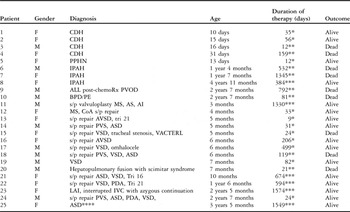
Between November 2000 and January 2005 a total of 25 patients at a median age of 180 days (10–1790 days) were recruited and received oral sildenafil therapy. The patient details are summarised in Table 1.
Patient details categorised as neonates (numbers 1–5), idiopathic pulmonary arterial hypertension (numbers 6–8), secondary pulmonary arterial hypertension not associated with congenital cardiac disease (numbers 9 and 10), pulmonary arterial hypertension associated with congenital cardiac disease (numbers 11–25).

ALL post-chemoRx = acute lymphatic leukaemia post-chemotherapy; AI = aortic incompetence; AS = aortic stenosis; ASD = atrial septal defect; AVSD = atrioventricular septal defect; BPD = bronchopulmonary dysplasia; CDH = congenital diaphragmatic hernia; CoA = aortic coarctation; IPAH = idiopathic pulmonary arterial hypertension; IVC = inferior caval vein; LAI = left atrial isomerism; MS = mitral stenosis; PDA = patent arterial duct; PE = multiple pulmonary emboli; PPHN = persistent pulmonary hypertension of the newborn; PVOD = pulmonary veno-occlusive disease; PVS = pulmonary vein stenosis; SPH = secondary pulmonary arterial hypertension; Tri = trisomy; VSD = ventricular septal defect
*Discontinued sildenafil with resolution of pulmonary arterial hypertension
**Death on therapy
***Maintained on sildenafil
****Failed attempted ASD closure with suprasystemic pulmonary artery pressures, lung biopsy Grade 111 by Heath-Edwards
Patients with sustained pulmonary arterial hypertension
We started sildenafil at a dose of 0.25 milligram per kilogram, and in the absence of unwanted side effects increased this to approximately 1.0 milligrams per kilogram. The median dose administered was 0.7 milligram per kilogram (0.5–2.25) four times daily.
The median duration of therapy for patients whose pulmonary artery pressures decreased to near-normal levels and in whom sildenafil was discontinued (n = 11) was 34 days (9–499).
Echocardiography data
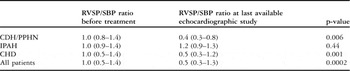
The median ratio of the right ventricular systolic pressure divided by systemic blood pressure for all patients at the initiation of sildenafil therapy was 1.0 (0.5–1.4) and decreased to 0.5 (0.3–1.3) at the last echocardiography study. This change was statistically significant (p = 0.0002; Table 2).
Echocardiographic estimation of right ventricular systolic pressure (*RVSP) in different subgroups of children with pulmonary hypertension

CDH = congenital diaphragmatic hernia; CHD = repaired congenital cardiac disease; PPHN = persistent pulmonary hypertension of the newborn; IPAH = idiopathic pulmonary arterial hypertension; SPH = non-CHD secondary pulmonary arterial hypertension; RVSP = right ventricular systolic pressure; SBP = systemic systolic blood pressure
*RVSP measured from velocity of tricuspid valve regurgitation in all patients
Cardiac catheterisation
Ten patients underwent a cardiac catheterisation before the initiation of sildenafil therapy. The median pulmonary vascular resistance index was 12.9 (7.1–23) Wood units metre square. Five patients underwent a follow-up study after a median time of 6 months (83–637 days) from the start of sildenafil. The median pulmonary vascular resistance index in these five patients at the initiation of sildenafil therapy was 10 (7.1–13.6) Wood units metre square and decreased to 5.8 (2.7–15.6) Wood units metre square (p = 0.04) at follow-up cardiac catheterisation.
Deaths
Nine patients in the cohort died after a median of 119 days (12–1345). Eight of nine patients died while still receiving sildenafil. None of the deaths were attributable to sildenafil therapy. Three patients (numbers 3, 4, and 20 in Table 1) with lung hypoplasia died. One patient (number 20) with congenital hepatopulmonary fusion (diagnosed as congenital diaphragmatic hernia before autopsy), severe right lung hypoplasia, and anomalous pulmonary venous drainage to the inferior caval vein died receiving compassionate care after a prolonged course (including tracheostomy and multiple attempts to wean the ventilator) in the critical care unit. Serial MRI scans demonstrated growth of the proximal hypoplastic pulmonary artery, and cardiac catheterisation demonstrated a decrease in pulmonary vascular resistance index during sildenafil therapy. The findings were confirmed at autopsy. Two patients (numbers 3 and 4) with congenital diaphragmatic hernia and severe pulmonary hypoplasia died after 12 and 159 days, respectively. Both patients received sildenafil to facilitate the discontinuation of nitric oxide and responded with a decrease in right ventricular pressure. We continued treatment with sildenafil because the right ventricular pressures remained elevated and we were unable to wean support from mechanical ventilation.
Three ex-premature infants died after prolonged hospital courses. One of these (number 10) had severe bronchopulmonary dysplasia and multiple pulmonary emboli with almost complete occlusion of the left pulmonary artery. The pulmonary emboli originated from a tricuspid valve vegetation secondary to a central line infection. The findings were confirmed at autopsy. The second (number 18) had congenital pulmonary vein stenosis and underwent repair of the pulmonary veins by sutureless repair. The pulmonary hypertension resolved with sildenafil therapy from suprasystemic to half-systemic levels. However, 3 months after hospital discharge the child presented to an outside hospital moribund with fever and respiratory distress. Autopsy demonstrated unobstructed pulmonary veins and grade 1 pulmonary artery changes. The cause of death was overwhelming respiratory syncytial viral infection. The other ex-preterm infant (number 15) died late after a repaired ventricular septal defect as a sequelae of multiple congenital malformations. The pulmonary hypertension had resolved on sildenafil and the drug was discontinued before death.
Patient number 6 with idiopathic pulmonary arterial hypertension deteriorated on sildenafil. Intravenous prostacyclin therapy was added to sildenafil therapy. However, the patient died with an overwhelming respiratory syncytial viral infection. Autopsy demonstrated severe pulmonary hypertensive vasculopathy.
Patient number 7 with idiopathic pulmonary artery hypertension died after more than 3 years of therapy with sildenafil. The patient had been started initially on intravenous prostacyclin therapy but experienced syncope. A static balloon dilation of the atrial septum was performed, and sildenafil and then bosentan therapy were started. No further syncopal episodes occurred. Subsequently, the intravenous prostacyclin was weaned and discontinued, at parental request, with only mild increase in pulmonary vascular resistance index. One year later the child presented with seizures and autopsy demonstrated acute encephalitis as the cause of death. Pulmonary vascular histology showed severe idiopathic pulmonary arteriopathy.
Patient number 9 developed pulmonary hypertension after chemotherapy for leukaemia. He responded to sildenafil with a decrease in mean pulmonary artery pressure by 10 millimetres of mercury during cardiac catheterisation (40–30 millimetres of mercury). He failed a challenge with calcium channel blocker therapy. He had elevated liver function tests excluding him from bosentan therapy. He was started on sildenafil therapy. Cardiac catheterisation 6 months later measured a mean pulmonary artery pressure of 52 millimetres of mercury. The family declined intravenous prostacyclin therapy. Two years after diagnosis the child was admitted with worsening respiratory function and fluid retention, leading to multi-organ failure. Autopsy demonstrated pulmonary veno-occlusive disease, secondary to chemotherapy.
Thus, three patients died with severe lung hypoplasia. Four patients died from causes unrelated to the pulmonary vascular disease. One patient died from post-chemotherapy pulmonary veno-occlusive disease. One patient with severe bronchopulmonary dysplasia and multiple pulmonary emboli died.
Biochemistry and platelet counts
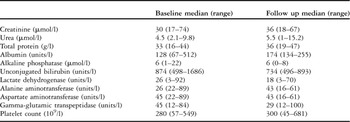
No major side effects attributable to sildenafil were reported by parents or children. There was no change in serum creatinine, urea, liver function tests, or platelet count (p > 0.08;
Table 3).

Patients with rebound pulmonary hypertension after nitric oxide withdrawal
Fifteen out of 36 patients who received inhaled nitric oxide during the study period suffered from rebound pulmonary arterial hypertension as defined above. Following reinstitution of nitric oxide these 15 patients received sildenafil to facilitate subsequent withdrawal of nitric oxide. Sildenafil was administered by nasogastric tube at a dose of 0.25 milligram per kilogram, and if tolerated the dose was increased incrementally to 1.0 milligram per kilogram and given every 6 hours. We discontinued nitric oxide after the second dose of sildenafil. Following sildenafil treatment, we discontinued nitric oxide therapy, without rebound pulmonary arterial hypertension, in all 15 patients. The median ratio of right ventricular systolic pressure to systemic systolic pressure was 1.0 (0.8–1.4) during rebound and 0.4 (0.3–0.8) following nitric oxide withdrawal after sildenafil treatment p = 0.006.
Discussion
We found that prolonged oral sildenafil was tolerated well and improved pulmonary vascular haemodynamics in children less than 5 years of age with sustained pulmonary arterial hypertension. In addition, oral sildenafil effectively prevented rebound pulmonary hypertension after withdrawal of inhaled nitric oxide therapy.
The long-term evaluation of the effects of treatment in children under 5 years of age with pulmonary hypertensive vascular disease is difficult. Most studies of adults and older children have used the results of cardiopulmonary exercise testing and the distance walked in 6 minutes as indicators of improvement or deterioration. These tests are clearly not applicable in very young children and infants. In general, we lack surrogates of exercise tolerance and capacity in very young children.Reference Adatia14 This partly accounts for the under-representation of children under 12 years of age in pulmonary hypertension drug trials. Therefore, we chose to follow the children with echocardiography and, when appropriate, cardiac catheterisation. This approach is not without precedent. Improvement in echocardiographic estimation of right ventricular pressure has been reported in children under 2 years of age with pulmonary hypertension due to chronic lung disease treated with sildenafil.Reference Mourani, Sontag, Ivy and Abman7 The present study confirms the safety and efficacy demonstrated by Mourani et alReference Mourani, Sontag, Ivy and Abman7 and broadens the diagnostic categories of responders to therapy. The clinical and echocardiographic improvements were confirmed in five patients by cardiac catheterisation, which demonstrated a 55% reduction in pulmonary vascular resistance index at follow-up.
Nine patients died during the study period, and this emphasises the vulnerability of young children with pulmonary hypertension. However, of the eight out of nine who died while receiving sildenafil therapy, four died from the direct sequelae of their pulmonary vascular disease, and this is similar to the mortality reported by Mourani et al.Reference Mourani, Sontag, Ivy and Abman7 Two of the four patients died from severe lung hypoplasia and one from a combination of severe bronchopulmonary dysplasia and additional loss of pulmonary vascular cross-sectional area from pulmonary emboli. This emphasises the high mortality of pulmonary hypertension associated with severe lung hypoplasia as reported by Mourani.Reference Mourani, Sontag, Ivy and Abman7 A further death occurred from pulmonary veno-occlusive disease, a known, albeit rare, complication of chemotherapy.Reference Adatia15 Pulmonary veno-occlusive disease is notoriously difficult to diagnose pre-mortem and in general refractory to medical therapy.Reference Adatia15
Rebound pulmonary hypertension
Rebound pulmonary hypertension may be a difficult, even life-threatening, clinical problem that delays tracheal extubation in patients with pulmonary hypertension.Reference Atz, Adatia and Wessel16, Reference Miller, Tang, Keech and Celermajer17 In our study, we found that approximately 60% of young infants treated with inhaled nitric oxide and weaned according to our protocol will have rebound pulmonary hypertension as defined above. Our definition of rebound pulmonary hypertension was deliberately inclusive, and this overestimated the number of patients that need treatment on clinical grounds. Sildenafil obviated rebound pulmonary hypertension in all 15 patients and reduced right ventricular to systemic pressure ratio below 50% in most patients. These findings are in keeping with those of Namachivayam et al.Reference Namachivayam, Theilen, Butt, Cooper, Penny and Shekerdemian18
Adverse events
Sildenafil treatment did not affect biochemical parameters of renal or hepatic function, in keeping with findings in older children.Reference Humpl, Reyes, Holtby, Stephens and Adatia4 This may be an advantage of sildenafil over endothelin receptor antagonists, which require monthly monitoring of liver function tests. Although sildenafil may affect platelet function, bleeding complications were not encountered and platelet counts remained stable. Retinal side effects of sildenafil have been reported. However, a recent comprehensive assessment of retinal function after 6 months of sildenafil and tadalafil therapy found no differences compared with placebo.Reference Cordell, Maturi and Costigan19 In a previous study in older children no changes in colour vision were detected during sildenafil therapy.Reference Humpl, Reyes, Holtby, Stephens and Adatia4 Adverse events may have been under-reported, particularly oesophageal reflux and dysmotility.Reference Keller, Moore, Teitel, Hawgood, McQuitty and Fineman20 Feeding intolerance is a common accompaniment of chronically ill children. However, in general enteral tolerance of feeds improved on sildenafil therapy in our study.
The limitations of this study are the absence of a control group. Therefore, improvements may not have been due to sildenafil therapy only. The patients were followed and managed in a dedicated childhood pulmonary hypertension clinic, which may contribute to improved outcomes.Reference Adatia14
Adverse events such as oesophageal reflux may have been under-detected as discussed above, and would require careful evaluation in a future trial.
The use of echocardiographic outcome parameters is not ideal, but the options are limited in this age group. In routine clinical practice, echocardiography is used to follow and aid decision making in young patients. Thus, our study reflects daily practice.
In conclusion, we found that in children under 5 years of age with pulmonary hypertensive vascular disease, prolonged enteral therapy with sildenafil resulted in hemodynamic improvements as assessed by echocardiography and cardiac catheterisation. There were no adverse effects on biochemical indicators of liver, haematological, or renal function. In addition, enterally administered sildenafil obviated rebound pulmonary hypertension after withdrawal of inhaled NO and facilitated weaning of ventilator support. Further evaluation of sildenafil therapy for chronic childhood pulmonary hypertensive vascular disease in prospective controlled trials may be indicated.
Acknowledgements
The authors gratefully acknowledge the support of the staff in the echocardiography laboratory, the cardiac catheterisation laboratory and the pharmacy at the Hospital for Sick Children, Toronto.